International Journal of Innovative Technology and Exploring Engineering (IJITEE) ISSN: 2278-3075, Volume-8 Issue-9, July, 2019
Abstract: Meraki Digital Indonesia wants to evaluate security management on Service Oriented Architecture that has been implemented in this company whether it is in accordance with the standards or not, using the COBIT 5 method. It is expected that the suitability of the maturity level can be carried out in accordance with the security management domain needed to ensure the fulfillment of the basic requirements of organizational information resources, namely the availability of integrity and availability of data or information. As well as using the Analytical Hierarchy Process algorithm to provide recommendations using decision-making in solving problems with explicit logical analysis, there are three principles that underlie AHP thinking, which is compiling hierarchies, the principle of setting priorities, and the principle of logical consistency. Then the evaluation results using COBIT 5, there are 6 security management criteria that are used as a basis for evaluating, among others, strategies & policies, organizations, people, processes, technology and facilities and domains that are used are Plan and Organizes (PO), Acquire and Implement (AI), Deliver and Support (DS), and Monitor and Evaluate (ME). Whereas for recommendations needed by using analytical hierarchy processes, there are three things that need to be improved according to the wishes of stakeholders, namely the need to improve the criteria of technology with a value of 0.132, facilities with a value of 0.137, and people with a value of 0.161 according to the lowest ranking on the tested criteria.
Keywords: Analytical Hierarchy Process, Cobit, Evaluation, Service Oriented Architecture, Security Management.
I. INTRODUCTION
In the era of technology that is growing rapidly has entered a new era faster than ever imagined [1] until now it requires operational supervision in business to support the business continuity of a company in accordance with company rules using system integrated. System theory is a theory that tries to explain order. The word system itself comes from Greek to system which means arrangement. The system can be defined as a whole in the sense of unity that is more than just the sum of its parts, a number of elements and also the relationships between them with each other [2]. Given the long term benefits of adopting this new phenomenon [3] currently, Meraki Digital Indonesia, one of the IT consultants in Indonesia, has implemented Service-oriented architecture to support data exchange between applications, improve reliability, participate in business processes, and standardize and consolidate applications owned by the company. Other notions of Service-oriented architecture (SOA) [4] takes an architectural approach to designing and implementing IT solutions. Currently the implementation of Service-oriented
Revised Manuscript Received on July 04, 2019.
Indra Ranggadara, Faculty of Computer Science, Mercu Buana
University, Jakarta, Indonesia.
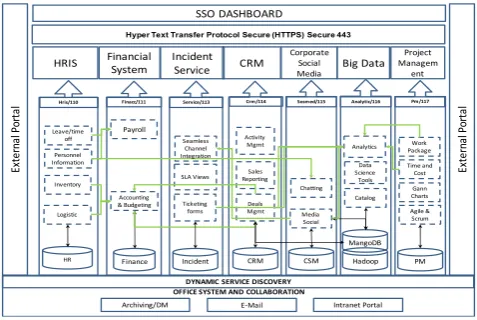
architecture (SOA) developed has 7 applications that are integrated and standardized so that the development process in the future can be easily done. Applications developed include HRIS applications, CRM, Incident Services, Payroll, Big Data, Corporate Social Media, and Project Management. To improve the security management of applications developed, evaluation is needed to compile and maintain an information security program to ensure the fulfillment of the 3 basic requirements of organizational information resources, namely the confidentiality of the integrity and availability of data or information. Along with the development of computer and communication technology, managing computer and network security programs will become increasingly complex and challenging, this is to protect data or information in the system so that it can only be accessed by those who have the right show on figure 1.
SSO DASHBOARD Ex te rn al Po rt al Ex te rn al Po rt al Financial System
HRIS CRM CorporateSocial
Media
Big Data ManagemProject ent Incident Service HR Finance Payroll Accounting & Budgeting Leave/time off Personnel Information Inventory Logistic E-Mail
DYNAMIC SERVICE DISCOVERY
Archiving/DM Intranet Portal
OFFICE SYSTEM AND COLLABORATION
CRM Media Social Deals Mgmt Hadoop Hyper Text Transfer Protocol Secure (HTTPS) Secure 443
Ticketing forms
Incident
Hris/110 Finacc/111 Service/113 Crm/114 Sosmed/115 Analytic/116 Pm/117
[image:1.595.307.546.367.527.2]CSM Chatting Agile & Scrum PM Sales Reporting Activity Mgmt Gann Charts Time and Cost Work Package MangoDB Catalog Data Science Tools Analytics SLA Views Seamless Channel Integration
Figure 1: Corporate Application Architecture
Evaluations are carried out using one of several existing frameworks, including COBIT, ISO 7799 and ITIL V3. Here the author will use the COBIT 5 framework (Control Objectives for Information and Related Technology). The COBIT-5 as new comprehensive approach [5], COBIT is a model designed to control the IT function and COBIT provides an IT Governance instrument that allows manager to bridge the gap with respect to control requirements, information systems (IS) and information technology (IT) issues and business risks, in order to communicate that level of control of stakeholder, it enables the development of clear policy and good practice for the control of IT throughout organization [6]. Framework COBIT 5 as a reference in conducting information system audits, in this context Service-oriented rchitecture (SOA).
Evaluation for Improving Security Management
of Service Oriented Architecture At Meraki
Digital Indonesia
Indonesia
The audit process is meant to detect the incompliance of the product with standards, procedures or external requirements [7] and this evaluation to assess the ‘as-is’ situation of the IT function and using the result obtained to provide recommendation to the IT function [8]. Meanwhile, in addition to evaluations carried out, recommendations are needed by stakeholder to solve a complex situation. In this study the method used to provide recommendations using decision-making methods from [9] by using the Analytical Hierarchy Process (AHP) according to him to break down a situation into its component parts and arrange this part or variable into a hierarchical arrangement. In solving problems with explicit logical analysis, there are three principles that underlie AHP thinking, namely the principle of compiling hierarchies, the principle of setting priorities, and the principle of logical consistency. So, this is very necessary to conduct evaluations while providing appropriate recommendations to support improvements security management in particular on Service-oriented architecture (SOA) that has been implemented.II. STUDYLITERATUREANDPREVIOUSSTUDY
A. Auditing Definition
An audit is the collection and evaluation of the evidence above information to determine and report the level of conformity of the information with the criteria that have been determined [10]. An audit must be carried out by someone who is competent and independent. According to Sanyoto [11], audits are divided into several types, namely; Financial audit, operational audit, compliance audit and information system audit. According to Weber [12] an information system audit is the process of collecting and evaluating evidence to determine whether a computer system has been establish and implement a control system sufficient, all assets are protected properly or not misused and guaranteed data integrity, reliability and the effectiveness and efficiency of organizing information systems. according to Agoes [13] Auditing is an examination carried out critically and systematically, by an independent party, on financial statements prepared by management, along with accounting records and supporting evidence, with the aim of being able to provide opinions regarding the fairness of the financial statements. According to Mulyadi [14] in general auditing is a systematic process to obtain and evaluate evidence objectively about statements about activities and economic events, with the aim of determining the level of conformity between the statements with the criteria that have been set, as well as the delivery of results to users concerned.
B. IT Governance
Then IT governance is the responsibility of the board of directors and top management. IT governance is part of the management of the company and consists of leaders, all members of the organizational structure and processes that have the intention to ensure that existing IT supports and assists in achieving organizational strategies and objectives [15]. According to ITGI [15] there are several mechanisms that can be used to assist in implementing IT governance, namely; IT Infrastructure Library (ITIL), Control Objectives
for Information and Related Technology (COBIT), ISO 27001, The Information Security Management Maturity model (ISM3), AS8015-2005. The purpose of IT governance according to the ITGI [15] is to get it realize the benefits of IT that are expected, use and maximize these benefits, realize the use of IT resources that are responsible, and can manage the risks associated with IT appropriately.
C. Previous Study
International Journal of Innovative Technology and Exploring Engineering (IJITEE) ISSN: 2278-3075, Volume-8 Issue-9, July, 2019
From the previous research that has been distinguished from this study by previous research is combining evaluation methods using COBIT 5 and the Analytical Hierarchy Process (AHP) to rank for recommendations needed to improve service oriented architecture (SOA) that has been carried out according to the wishes of company stakeholder.
III. METHOD
In this section, the author discusses methods, designs, data collection methods, populations and samples and the stages of research. Bodgan and Taylor [22] define that qualitative methodology is a research procedure that produces descriptive data in the form of written or oral words from people and observable behavior. This approach is directed at the background and the individual holistically (intact), so that we cannot isolate individuals or organizations into variables or hypotheses, but are seen as part of a wholeness [23]. The research method used in this study is a qualitative method, using case studies (objects), namely a systematic way of seeing an event, collecting data, analyzing information and reporting the results. In this case study, the main data collection was carried out by interviewing and analyzing company documents related to research.
A. Location Study and Data Source
The research was conducted at PT. Meraki Digital Indonesia, Centennial Tower 29 Floor. Jl. General Gatot Subroto No. 27, South Jakarta, Indonesia . Then the data sources in this research are two parts, primary data and secondary data :
1) Primary Data : Primary data is data obtained directly from the object research, in this case through interviews with Chief Finance Officer Meraki Digital Indonesia 2) Secondary Data : Secondary data is data obtained from
the object's internal data research, such as data obtained from books, journals, papers, and addresses of reference websites that are related to the research title.
B. Data Collection
The data collection methods used in writing this research are as follows:
1) Literature Study : This research was carried out by searching and collecting data, sources of information and materials obtained from books, literature, articles related to COBIT, IT Governance, System Audit Information, research methods used, and so on.
2) Field Study : This study is done by getting data directly from object of research. Secondary data taken is data in the form of Strategic Plan, Annual Financial Report, etc.
3) Interview : Conduct questions and answers with related parties to get information and data - data needed. Interviews were conducted both face to face and using e-mail, due to the busyness and high mobility of the speakers. For measurement of performance (maturity level), the author uses a closed statement, where the author limits the respondent to answer yes / no, with the source of questions based on COBIT 5.
This is done in order to focus the question so that it is more focused on performance appraisal and not too broad:
1) Observation: Make observations directly on the environment and the application of information systems to the company and the use of the system information by related users.
2) Questionnaire: Distributing questionnaires to Meraki Digital Indonesia employees for reference to the system maturity calculation there.
C. Data Sample
In this research using a method of collecting data from a number of respondents with a written list of questions, then processed to produce complete and valid information. Questionnaire was conducted to obtain data. The distribution of the questionnaire was carried out using the Purposive Sampling method. Respondents on the research questionnaire This consists of 10 respondents, including: 1 Chief Finance Officer, 1 Information Technology Manager, 1 Hardware supervisor and 1 supervisor software, and 6 IT staff. This Research using the method of taking respondents with Purposive Sampling. The purposive sampling method is the determination of the sample by selecting certain samples that are considered appropriate and focused on the objectives or problems of this research within a population [24]. Then the sample is selected to staff - staff who have an active role related to Service Oriented Architecture (SOA) services.
D. Evaluation Method
The research method for evaluation using the COBIT framework 5 and Analytical Hierarchy Process (AHP), at the first method for evaluation used COBIT 5, this framework allows the creation of IT control policies and best practice across business levels [25]. In accordance with the rules in the COBIT 4.1 framework there are stages that are used to carry out evaluations, this evaluation will answer the manager who responsible the information technology department as a reviewer. As explained [26] stages of the audit process using COBIT 5 framework consists of several stages:
Stage 1. Identify Business Goals
This stage will be carried out by SOA analysis as a description of where the application will be headed. Then the business objectives are adjusted according to their views in the domain that is in COBIT 5.
Stage 2. Identify IT Goals
This stage will identify the objectives based on the SOA application, at this stage the objectives of the IT Goals will be obtained by connecting business objectives with IT Goals based on COBIT 5..
Stage 3. Identify the IT Process
Indonesia
Stage 4. Control ObjectivesThis stage is continued from the IT process. After identifying, control objectives are used as questionnaire material to fulfill a data requirement that is needed in determining objectivity. Stage 5. Maturity Level Calculation
In the fifth stage of this research is the calculation of maturity level, according to the maturity model based on the COBIT 5 framework. Then the Stages conducted which are includes the selection IT process on the COBIT 5, as well as data collection which is consists of interviews, observations and questionnaires, processing questionnaires, data analysis include the current maturity and the expected maturity level, strategy improvements based on COBIT 5 [26]. Then In general, the maturity level assessment range is described as follows:
Level 0 (non-existent)
The company does not have management in a process, it cannot even assess what issues need to be considered. On this scale, it is important to evaluate controls and make important findings.
Level 1 (initial level)
The company has been aware of the issues that need to be considered. The company does not have a standardized process (standardized), but an informal process that tends to be applied individually in case by case and in general (still reactive or in accordance with sudden needs), the approach used is not well organized. In this scale, the probability of the risk occurring is not as large as a scale of 0 (zero).
Level 2 (repeatable level)
The company has a pattern for managing processes based on repeated experience that has been done before. However, this pattern has not been standardized and communicated, and there has been no formal training given to each employee regarding the procedure so that the ability of expert staff is limited, besides that responsibility is given entirely to individuals so that possible irregularities can occur.
Level 3 (Defined level)
Management has succeeded in creating a standard for managing related processes, and has been communicated, but has not been implemented in an integrated manner, but has been required in its implementation. The procedure is still simple and inadequate, has not received an evaluation process, so there is still a possibility of irregularities. Level 4 (Managed level)
The process has been monitored and evaluated properly regarding the extent of compliance with the established procedures, and being able to take necessary actions if the existing process does not appear to work properly. Automated tools and systems are being used even though they are still limited.
Level 5 (Optimized level)
The process has reached the level of Best Practices because the continuous improvement and comparison with other companies. Information technology is used to run workflows. Providing supporting tools for the effectiveness and quality of processes that encourage corporate adaptation to changes.
The second method for recommendation used AHP, the function of AHP is the process stresses the importance of the intuitive judgments of a decision-maker and consistency in the comparison of alternatives in the decision-making process [27]. Basically, AHP is a general theory of measurement used
to find the scale of ratio of both discrete and continuous pairwise comparisons. These comparisons can be drawn from the actual size or base scale reflecting the strength of feelings and relative preferences [28]. This method will get a value to get rank as stakeholder desire, the questionnaires will answer only stakeholder and this method have some principles in solving problems with Analytical Hierarchy Process (AHP): 1) Determining the hierarchy
2) Determining the priority of the elements by making pairwise comparisons
3) Synthesis
4) Measuring consistency 5) Calculate index consistency 6) Calculate the index ratios
IV. RESULTANDDISCUSSION
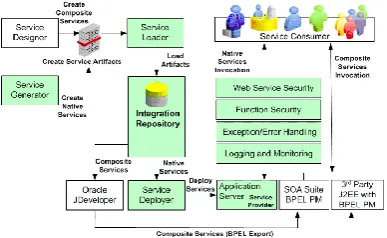
[image:4.595.307.501.318.437.2]In this research, discussing the evaluation of the SOA implementation carried out, currently SOA is implemented using Oracle E-Business Suite which is implemented in Meraki Digital Indonesia. Seen the SOA architecture used in figure 2:
Figure 2: Oracle E-Business Suite Integrated SOA Gateway Architecture[29]
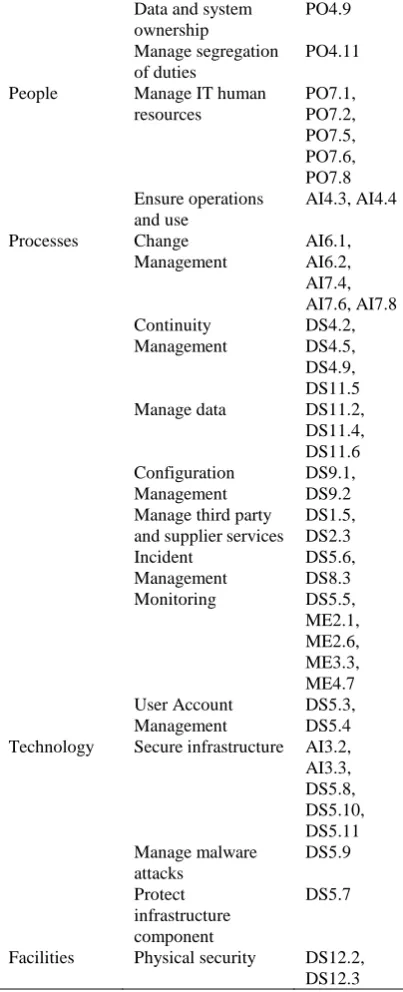
[image:4.595.322.543.595.835.2]Before getting the evaluation results, it is necessary to determine the domain and measurement of control in this research, based on COBIT 5 there are domains that play a role in conducting evaluations, namely plan and organize (PO), acquire and implement (AI), deliver and support (DS), monitoring and evaluate (ME). The domain that has been determined as the basis for the evaluation is carried out, and in this research recapitulation of questions according to the domain used can be seen in table 1.
Table 1: Domain and Control Measurement
Domain Control Measure COBIT 5
Strategy & Policies
Define an
information security plan
DS5.2, PO6.3
Define the information architecture
PO2.1, PO2.3
Determine technological direction
PO3.3, PO3.4
Assess and manage (IT) risks
PO9.1, PO9.4, PO9.6 Organization Information Security
Organization
International Journal of Innovative Technology and Exploring Engineering (IJITEE) ISSN: 2278-3075, Volume-8 Issue-9, July, 2019
Data and system ownership
PO4.9
Manage segregation of duties
PO4.11
People Manage IT human
resources
PO7.1, PO7.2, PO7.5, PO7.6, PO7.8 Ensure operations
and use
AI4.3, AI4.4
Processes Change
Management
AI6.1, AI6.2, AI7.4, AI7.6, AI7.8 Continuity
Management
DS4.2, DS4.5, DS4.9, DS11.5
Manage data DS11.2,
DS11.4, DS11.6 Configuration
Management
DS9.1, DS9.2 Manage third party
and supplier services
DS1.5, DS2.3 Incident
Management
DS5.6, DS8.3
Monitoring DS5.5,
ME2.1, ME2.6, ME3.3, ME4.7 User Account
Management
DS5.3, DS5.4
Technology Secure infrastructure AI3.2,
AI3.3, DS5.8, DS5.10, DS5.11 Manage malware
attacks
DS5.9
Protect infrastructure component
DS5.7
Facilities Physical security DS12.2,
DS12.3
[image:5.595.67.269.52.549.2]After obtaining the desired domain for evaluation, and assessment can be carried out in figure 3 the results of maturity that need to be evaluated per each domain.
Fig. 3: Legend Control Maturity Level
Fig. 4: Security Management - spread of operational maturity level
[image:5.595.321.532.111.196.2]Figure 4 show currently there are 6 domains that have been evaluated, including strategies & policies, organizations, people, processes, technology, and facilities. Details of the evaluations conducted per each domain are described below:
Fig. 5: Strategy and Policies Domain Maturity Level
[image:5.595.323.531.358.440.2]Figure 5 explains that the obtained domain strategy and policy maturity level is high, except for maintenance and monitoring of a risk action plan with second level maturity (repeatable). Due to the implementation of service-oriented that has only been done for 1 year and In the security arena, there are emerging SOA capabilities for things like authentication services and audit trail collection [30], it is necessary to be accustomed in carrying out the strategies carried out to carry out maintenance and monitoring on the side of security management.
Fig. 6: Organization Domain Maturity level
Figure 6 explains the domain organization, in this domain control of responsibility for risk, security and compliance and segregation needs to improve to optimize at maturity level four. But overall this domain has been fairly good because the management of information security and data and system ownership has been optimized.
Fig. 7: People Domain Maturity Level
Figure 7 explains the people domain in this domain, there are still many things that need to be improved, including recruitment and retention of personnel, personnel competencies, knowledge transfer to end users, and knowledge transfer to operations and support staff. Especially the expert understanding area of security management. With expert expertise, it can make it easier to protect the application that is implemented, besides that, a lot of security adjustments are needed for each service on the application. And consultants are needed for training and providing knowledge about the standard IT services to run service with security and providing
[image:5.595.326.531.523.592.2] [image:5.595.45.255.641.756.2]Indonesia
the understanding of end users is very different. This is needed to create security awareness in all elements of the company. while for clearance personnel, the procedure and job change termination has been very good and has been optimized. Because this will also have an impact on the domain of the process required by all personnel to comply with the company's operational procedure standards, especially on security and company secrets.Fig. 8: Process Domain Maturity Level
Figure 8 on the domain process, overall has been very good overall. The operational standards that have been implemented have been previously optimized. With the process running it has been consulted with the right consultant to handle the process. But even though it can be optimized as a whole, the process needs to be maintained and increase the current maturity level for the next period.
Fig. 9: Technology Domain Maturity Level
Figure 9 explains on domain technology, this domain needs to be improved, especially in infrastructure resource protection and availability and maintenance infrastructure that is still at level one. For now, the resource is not maximized in monitoring the infrastructure built so that a team that takes turns takes 8 hours to carry out this task. As well as to maintain infrastructure, it is better not to wait for vendors to do preventive or corrective maintenance, but it is necessary to regularly schedule a team that has responsibilities in carrying out maintenance on a monthly or quarterly basis. As well as cryptographic key management, network security, and exchange of sensitive data still need to be improved, and specialists are needed for the technology used.
Fig. 10: Facilities Domain Maturity Level
Figure 10 describes the domain facilities, in this domain optimization of physical security and physical access steps has been carried out. However, improvements to the physical infrastructure storage facilities need to be carried out due to a place that is sufficiently complete with data center
infrastructure, and for the next day to develop data center scalability, it will be difficult to do, not to restore data center infrastructure facilities. After obtaining a basic evaluation based on COBIT, then decision support is needed by stakeholder who are in accordance with the wishes and monitoring of security management in service-oriented that has been implemented. In accordance with AHP rules, a hierarchy is needed to achieve stakeholder desires as seen in figure 11 which explains to achieve objectives at level one and in which there are criteria at the second level which contain strategies & policies, organizations, people, processes, technology, and facilities and for the third level is an alternative that is provided and adapted to the COBIT domain, namely Plan and Organizes (PO), Acquire and Implement (AI), Deliver and Support (DS), and Monitor and Evaluate (ME). This information is then arranged in a multilevel tree.
Strategy & Policies
Goal
Organization People Processes Technology Facilities
Plan and Organize (PO)
Acquire and Implement (AI)
Deliver and Support (DS)
Monitor and Evaluate (ME)
Fig. 11: Analytical Hierarchy Process Tree
After making criteria and alternatives desired by stakeholders, the criteria are then weighted according to the rules of the analytical hierarchy process consistently, after which the values from the largest to the smallest are seen and given a priority ranking to determine which criteria need to be improved. The results obtained can be seen in table 2.
Table 2: Analytical Hierarchy Process Result Security
Management Criteria
Final Result
Rank Priority
Need Improve? (Yes/No) Strategy &
Policies 0,213 6 No
Organization 0,183 5 No
People 0,161 3 Yes
Processes 0,175 4 No
Technology 0,132 1 Yes
Facilities 0,137 2 Yes
International Journal of Innovative Technology and Exploring Engineering (IJITEE) ISSN: 2278-3075, Volume-8 Issue-9, July, 2019
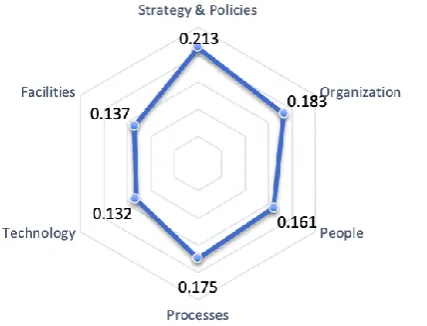
[image:7.595.69.283.99.262.2]These three criteria need improvement to improve security management on service oriented architecture based on stakeholder’s desire and to facilitate interpretation in figure 12.
Figure 12: Analytical Hierarchy Process Result Radar
V. CONCLUSION
Based on the evaluation results obtained there are several conclusions obtained, namely the evaluation results using COBIT 5, there are 6 security management criteria that are used as the basis for evaluating, among others, strategies & policies, organizations, people, processes, technology, and facilities and domains that used are Plan and Organizes (PO), Acquire and Implement (AI), Deliver and Support (DS), and Monitor and Evaluate (ME). As a result of the assessment obtained for the people and technology criteria, it is necessary to increase the maturity level described previously. Whereas for the recommendations needed by using analytical hierarchy process, there are three things that need to be improved according to the wishes of stakeholders, namely the need to improve the criteria of technology with a value of 0.132, facilities with a value of 0.137, and people with a value of 0.161 according to the lowest ranking on the criteria tested. These three criteria need improvement to improve security management on service oriented architecture and both of these methods can convince stakeholders in evaluating not just the theory that is used but to measure evaluations based on desires desired by stakeholders.
ACKNOWLEDGMENT
Special thanks to Mrs. Virna Estriana, Chief Finance Officer and Meraki Digital Indonesia IT team who cannot be mentioned one by one, they have provided information from the survey to the data needed for the completeness of this research and are expected to carry out optimization and improvement according to recommendations from the method that has been used.
REFERENCES
1. R. Yulistyo and N. R. Kurnianda, “Analysis and Design of Information System for Social Services Administrative of ‘Semut Adventure’ Natural Lover Community in Kembangan Utara Country State with Web Based Method,” International Journal of Computer Science and Mobile Computing, vol. 7, no. 7, pp. 11–19, 2018. 2. F. B. Hardiman, “Teori Sistem Niklas Luhmann,” Jurnal Filsafat
Driyarka-ra, vol. 29, no. 3, pp. 1–15, 2008.
3. R. Rai, S. Mehfuz, and G. Sahoo, “Efficient Migration of Application
to Clouds: Analysis and Comparison,” GSTF Journal on Computing (JoC), vol. 3, no. 3, p. 23, Dec. 2013.
4. M. D. S. Asyari and Y. S. Triana, “Credit Analysis Tool System Application Using Cobit 4.1 Method Approach,” International Journal of Computer Science and Mobile Computing, vol. 7, no. 4, pp. 153–165, 2018.
5. A. Efe, “COBIT-5 FRAMEWORK as a MODEL FOR THE REGIONAL DEVELOPMENT AGENCIES IN TURKEY,”
International Journal of ebusiness and egoverment Studies, vol. 5, no. 1, pp. 33–42, 2013.
6. K. Brand and H. Boonen, IT governance based on CobiT® 4.1-A management guide. Van Haren, 2007.
7. L. Cotfas, D. Palaghita, and B. Vintila, “Audit Techniques for Service Oriented Architecture Applications,” Informatica Economica, vol. 14, no. 1, pp. 128–136, 2010.
8. A. A. Latif and N. Hanifi, “Analyzing IT Function Using COBIT 4.1 – A Case Study of Malaysian Private University,” Journal of Economics, Business and Management, vol. 1, no. 4, pp. 406–408, 2013.
9. T. L. Saaty, The Analytic Network Process: Decision Making with Dependence and Feedback. Pittsburg: RWS Publications, 2001. 10. A. A. Arens and J. Loebbecke, Auditing Pendekatan Terpadu.
Jakarta: Salemba Empat, 2002.
11. G. Sanyoto, Audit Sistem Informasi + Pendekatan CobIT. Jakarta: According to Sanyoto, audits are divided into several types, namely: Financial audit, operational audit, compliance audit and information system audit., 2007.
12. R. Weber, Information System Control and Audit. London: Prentice Hall, 1999.
13. A. Sukrisno, Auditing (Petunjuk Praktis Pemeriksaan Akuntan Oleh Akuntan Publik). Jakarta: Salemba Empat, 2012.
14. Mulyadi, Auditing. Jakarta: Salemba Empat, 2013.
15. IT Governance Institute (ITGI), COBIT 5 Enabling Processes. United States of America: ISACA, 2012.
16. Harwikarya, M. Sadikin, D. Fitrianah, M. M. Sarinanto, I. Nurhaida, and A. R. Dwiyanto, “IS Strategic Plan for Higher Education Based on COBIT Assessment: A Case Study,” International Journal of Information and Education Technology, vol. 5, no. 8, pp. 629–633, 2015.
17. D. Fitrianah and Y. G. Sucahyo, “Audit sistem informasi/teknologi informasi dengan kerangka kerja COBIT untuk evaluasi manajemen teknologi informasi di Universitas XYZ,” Jurnal Sistem Informasi, vol. 4, no. 1, pp. 37–46, 2008.
18. K. Eylem and H. A. Burhan, “An Application of Analytic Hierarchy Process (AHP) in a Real World Problem of Store Location Selection,”
Advances in Management & Applied Economics, vol. 5, no. 1, pp. 41–50, 2015.
19. X. Kong, “Application of improved analytic hierarchy process in network education evaluation,” BioTechnology: An Indian Journal, vol. 10, no. 3, pp. 7130–7135, 2014.
20. S. Ahriz, A. EL Yamami, K. Mansouri, and M. Qbadou, “Cobit 5-Based Approach for IT Project Portfolio Management: Application to a Moroccan University,” International Journal of Advanced Computer Science and Applications, vol. 9, no. 4, pp. 88–95, 2018. 21. I. N. Putra, A. Hakim, S. H. Pramono, and H. Tolle, “Adopted
COBIT-5 Framework for System Design of Indonesia Navy IS/IT : An Evaluation,” International Journal of Applied Engineering Research, vol. 12, no. 17, pp. 6420–6427, 2017.
22. R. Bogdan and S. J. Taylor, Pengantar Metode Penelitian Kualitatif. Surabaya: Usaha Nasional, 1992.
23. Basrowi and Suwandi, Memahami Penelitian Kualitatif. Jakarta: PT. Rineka Cipta, 2008.
24. Sugiyono, Metode Penelitian Kuantitatif Kualitatif dan R&D. Bandung: Alfabeta, 2016.
25. R. A. Khther and M. Othman, “Cobit Framework as a Guideline of Effective it Governance in Higher Education: A Review,”
International Journal of Information Technology Convergence and Services, vol. 3, no. 1, pp. 21–29, Feb. 2013.
Indonesia
27. M. Balubaid and R. Alamoudi, “Application of the Analytical Hierarchy Process (AHP) to Multi-Criteria Analysis for Contractor Selection,” American Journal of Industrial and Business Management, vol. 5, pp. 581–589, 2015.
28. M. Sulistiyono, “Sistem Penunjang Keputusan Untuk Seleksi Calon Guru Menggunakan Analytical Hierarchy Process (AHP),” Jurnal Ilmiah DASI, vol. 17, no. 2, pp. 62–66, 2016.
29. D. Weld and M. Yang, Oracle® E-Business Suite Integrated SOA Gateway User’s Guide, Release 12. United States of America, 2018. 30. O. Karimi, “Security Model For Service-Oriented Architecture,”
Advanced Computing: An International Journal, vol. 2, no. 4, pp. 48–57, Jul. 2011.
AUTHORSPROFILE