JAVA™ SECURITY OVERVIEW
White Paper
Table of Contents
1 Introduction. . . 1
2 Java Language Security and Bytecode Verification . . . 2
3 Basic Security Architecture . . . 3
Security Providers . . . 3
File Locations . . . 4
4 Cryptography . . . 5
5 Public Key Infrastructure . . . 6
Key and Certificate Storage . . . 6
PKI Tools . . . 6
6 Authentication . . . 8
7 Secure Communication . . . 10
SSL/TLS . . . 10
SASL . . . 10
GSS-API and Kerberos . . . 11
8 Access Control . . . 12
Permissions . . . 12
Policy . . . 12
Access Control Enforcement . . . 13
9 For More Information . . . 15
Appendix A – Classes Summary . . . 16
Appendix B – Tools Summary . . . 17
Appendix C – Built-in Providers . . . 18
Chapter 1
Introduction
The Java™ platform was designed with a strong emphasis on security. At its core, the Java language itself is
type-safe and provides automatic garbage collection, enhancing the robustness of application code. A secure
class loading and verification mechanism ensures that only legitimate Java code is executed.
The initial version of the Java platform created a safe environment for running potentially untrusted code, such as
Java applets downloaded from a public network. As the platform has grown and widened its range of deployment,
the Java security architecture has correspondingly evolved to support an expanding set of services. Today the
architecture includes a large set of application programming interfaces (APIs), tools, and implementations of
commonly-used security algorithms, mechanisms, and protocols. This provides the developer a comprehensive
security framework for writing applications, and also provides the user or administrator a set of tools to securely
manage applications.
The Java security APIs span a wide range of areas. Cryptographic and public key infrastructure (PKI) interfaces
provide the underlying basis for developing secure applications. Interfaces for performing authentication and access
control enable applications to guard against unauthorized access to protected resources.
The APIs allow for multiple interoperable implementations of algorithms and other security services. Services are
implemented in providers, which are plugged into the Java platform via a standard interface that makes it easy for
applications to obtain security services without having to know anything about their implementations. This allows
developers to focus on how to integrate security into their applications, rather than on how to implement complex
security mechanisms.
The Java platform includes a number of providers that implement a core set of security services. It also allows for
additional custom providers to be installed. This enables developers to extend the platform with new security
mechanisms.
This paper gives a broad overview of security in the Java platform, from secure language features to the security
APIs, tools, and built-in provider services, highlighting key packages and classes where applicable.
Note – This paper is based on Java™ 2 Platform, Standard Edition (J2SE™), version 5.0.
Chapter 2
Java Language Security and Bytecode Verification
The Java language is designed to be type-safe and easy to use. It provides automatic memory management,
garbage collection, and range-checking on arrays. This reduces the overall programming burden placed on
developers, leading to fewer subtle programming errors and to safer, more robust code.
In addition, the Java language defines different access modifiers that can be assigned to Java classes, methods,
and fields, enabling developers to restrict access to their class implementations as appropriate. Specifically,
the language defines four distinct access levels: private, protected, public, and, if unspecified,
package. The most open access specifier is public—access is allowed to anyone. The most restrictive modifier is private—access is not allowed outside the particular class in which the private member (a method, for
example) is defined. The protected modifier allows access to any subclass, or to other classes within the same package. Package-level access only allows access to classes within the same package.
A compiler translates Java programs into a machine-independent bytecode representation. A bytecode verifier is
invoked to ensure that only legitimate bytecodes are executed in the Java runtime. It checks that the bytecodes
conform to the Java Language Specification and do not violate Java language rules or namespace restrictions. The
verifier also checks for memory management violations, stack underflows or overflows, and illegal data typecasts.
Once bytecodes have been verified, the Java runtime prepares them for execution.
Chapter 3
Basic Security Architecture
The Java platform defines a set of APIs spanning major security areas, including cryptography, public key
infrastructure, authentication, secure communication, and access control. These APIs allow developers to easily
integrate security into their application code. They were designed around the following principles:
1. Implementation independence
Applications do not need to implement security themselves. Rather, they can request security
services from the Java platform. Security services are implemented in providers (see below),
which are plugged into the Java platform via a standard interface. An application may rely on
multiple independent providers for security functionality.
2. Implementation interoperability
Providers are interoperable across applications. Specifically, an application is not bound to a
specific provider, and a provider is not bound to a specific application.
3. Algorithm extensibility
The Java platform includes a number of built-in providers that implement a basic set of security
services that are widely used today. However, some applications may rely on emerging standards
not yet implemented, or on proprietary services. The Java platform supports the installation of
custom providers that implement such services.
Security Providers
The java.security.Provider class encapsulates the notion of a security provider in the Java platform.
It specifies the provider’s name and lists the security services it implements. Multiple providers may be configured
at the same time, and are listed in order of preference. When a security service is requested, the highest priority
provider that implements that service is selected.
Applications rely on the relevant getInstance method to obtain a security service from an underlying provider.
For example, message digest creation represents one type of service available from providers. (Chapter 4 discusses
message digests and other cryptographic services.) An application invokes the getInstance method in the
java.security.MessageDigest class to obtain an implementation of a specific message digest algorithm, such as MD5.
MessageDigest md = MessageDigest.getInstance("MD5");
The program may optionally request an implementation from a specific provider, by indicating the provider name,
as in the following:
MessageDigest md =
MessageDigest.getInstance("MD5", "ProviderC");
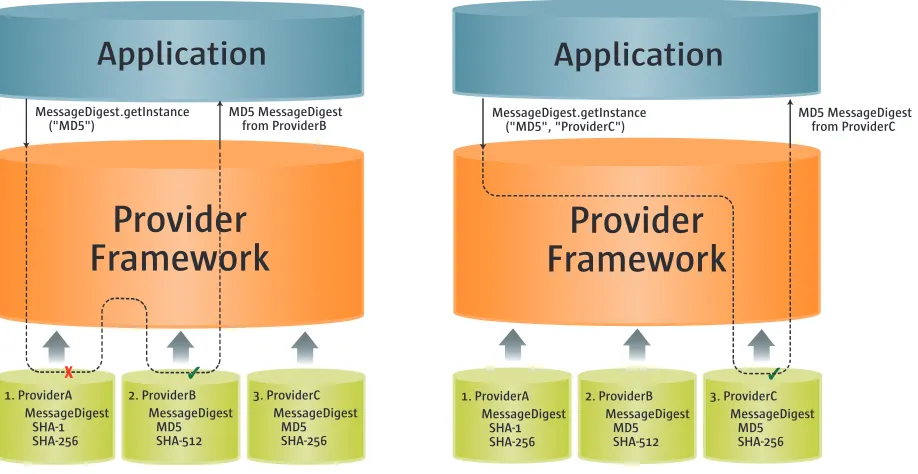
Figures 1 and 2 illustrate these options for requesting an MD5 message digest implementation. Both figures show
three providers that implement message digest algorithms. The providers are ordered by preference from left to
right (1-3). In Figure 1, an application requests an MD5 algorithm implementation without specifying a provider
name. The providers are searched in preference order and the implementation from the first provider supplying
that particular algorithm, ProviderB, is returned. In Figure 2, the application requests the MD5 algorithm
implementation from a specific provider, ProviderC. This time the implementation from that provider is returned,
[image:6.612.80.539.179.416.2]even though a provider with a higher preference order, ProviderB, also supplies an MD5 implementation.
Figure 1 – Provider searching Figure 2 – Specific provider requested
The Java platform implementation from Sun Microsystems includes a number of pre-configured default
providers that implement a basic set of security services that can be used by applications. Note that other vendor
implementations of the Java platform may include different sets of providers that encapsulate vendor-specific
sets of security services. When this paper mentions built-in default providers, it is referencing those available in
Sun’s implementation.
The sections below on the various security areas (cryptography, authentication, etc.) each include descriptions
of the relevant services supplied by the default providers. A table in Appendix C summarizes all of the default
providers.
File Locations
Certain aspects of Java security mentioned in this paper, including the configuration of providers, may be
customized by setting security properties. You may set security properties statically in the security properties file,
which by default is the java.security file in the lib/security directory of the directory where the Java™ Runtime
Environment (JRE) is installed. Security properties may also be set dynamically by calling appropriate methods of
the Security class (in the java.security package).
The tools and commands mentioned in this paper are all in the ~jre/bin directory, where ~jre stands for the
directory in which the JRE is installed. The cacerts file mentioned in Chapter 5 is in ~jre/lib/security. Sun Microsystems, Inc. P4Basic Security Architecture
Chapter 4
Cryptography
The Java cryptography architecture is a framework for accessing and developing cryptographic functionality for
the Java platform. It includes APIs for a large variety of cryptographic services, including:
• Message digest algorithms
• Digital signature algorithms
• Symmetric bulk encryption
• Symmetric stream encryption
• Asymmetric encryption
• Password-based encryption (PBE)
• Elliptic Curve Cryptography (ECC)
• Key agreement algorithms
• Key generators
• Message Authentication Codes (MACs)
• (Pseudo-)random number generators
For historical (export control) reasons, the cryptography APIs are organized into two distinct packages. The
java.security package contains classes that are not subject to export controls (like Signature and
MessageDigest). The javax.crypto package contains classes that are subject to export controls (like
Cipher and KeyAgreement).
The cryptographic interfaces are provider-based, allowing for multiple and interoperable cryptography
implementa-tions. Some providers may perform cryptographic operations in software; others may perform the operations on a
hardware token (for example, on a smartcard device or on a hardware cryptographic accelerator). Providers that
implement export-controlled services must be digitally signed.
The Java platform includes built-in providers for many of the most commonly used cryptographic algorithms,
including the RSA and DSA signature algorithms, the DES, AES, and ARCFOUR encryption algorithms, the MD5
and SHA-1 message digest algorithms, and the Diffie-Hellman key agreement algorithm. These default providers
implement cryptographic algorithms in Java code.
The Java platform also includes a built-in provider that acts as a bridge to a native PKCS#11 (v2.x) token. This
provider, named “SunPKCS11”, allows Java applications to seamlessly access cryptographic services located on
PKCS#11-compliant tokens.
Sun Microsystems, Inc. P6Public Key Infrastructure
Chapter 5
Public Key Infrastructure
Public Key Infrastructure (PKI) is a term used for a framework that enables secure exchange of information based
on public key cryptography. It allows identities (of people, organizations, etc.) to be bound to digital certificates
and provides a means of verifying the authenticity of certificates. PKI encompasses keys, certificates, public key
encryption, and trusted Certification Authorities (CAs) who generate and digitally sign certificates.
The Java platform includes API and provider support for X.509 digital certificates and certificate revocation lists
(CRLs), as well as PKIX-compliant certification path building and validation. The classes related to PKI are located
in the java.security and java.security.cert packages.
Key and Certificate Storage
The Java platform provides for long-term persistent storage of cryptographic keys and certificates via key and
certificate stores. Specifically, the java.security.KeyStore class represents a key store, a secure repository
of cryptographic keys and/or trusted certificates (to be used, for example, during certification path validation),
and the java.security.cert.CertStore class represents a certificate store, a public and potentially
vast repository of unrelated and typically untrusted certificates. A CertStore may also store CRLs.
KeyStore and CertStore implementations are distinguished by types. The Java platform includes the standard PKCS11 and PKCS12 key store types (whose implementations are compliant with the corresponding PKCS
specifications from RSA Security), as well as a proprietary file-based key store type called JKS (which stands for
“Java Key Store”).
The Java platform includes a special built-in JKS key store, cacerts, that contains a number of certificates for
well-known, trusted CAs. The keytool documentation (see the security features documentation link in Chapter 9)
lists the certificates included in cacerts.
The SunPKCS11 provider mentioned in the “Cryptography” chapter (Chapter 4) includes a PKCS11 KeyStore
implementation. This means that keys and certificates residing in secure hardware (such as a smartcard) can be
accessed and used by Java applications via the KeyStore API. Note that smartcard keys may not be permitted
to leave the device. In such cases, the java.security.Key object reference returned by the KeyStore
API may simply be a reference to the key (that is, it would not contain the actual key material). Such a Key
object can only be used to perform cryptographic operations on the device where the actual key resides.
The Java platform also includes an LDAP certificate store type (for accessing certificates stored in an LDAP
directory), as well as an in-memory Collection certificate store type (for accessing certificates managed in a
java.util.Collection object).
PKI Tools
There are two built-in tools for working with keys, certificates, and key stores:
keytoolis used to create and manage key stores. It can
• Create public/private key pairs
Sun Microsystems, Inc. Public Key Infrastructure P7
• Create self-signed certificates
• Issue certificate (PKCS#10) requests to be sent to CAs
• Import certificate replies (obtained from the CAs sent certificate requests)
• Designate public key certificates as trusted
The jarsignertool is used to sign JAR files, or to verify signatures on signed JAR files. The Java™ ARchive (JAR) file format enables the bundling of multiple files into a single file. Typically a JAR file contains the class files and
auxiliary resources associated with applets and applications. When you want to digitally sign code, you first use
keytool to generate or import appropriate keys and certificates into your key store (if they are not there already),
then use thejartool to place the code in a JAR file, and finally use the jarsigner tool to sign the JAR file. The jarsigner tool accesses a key store to find any keys and certificates needed to sign a JAR file or to verify the
signature of a signed JAR file.
Sun Microsystems, Inc. P8Authentication
Chapter 6
Authentication
Authentication is the process of determining the identity of a user. In the context of the Java™ runtime environment,
it is the process of identifying the user of an executing Java program. In certain cases, this process may rely on
the services described in the “Cryptography” chapter (Chapter 4).
The Java platform provides APIs that enable an application to perform user authentication via pluggable login
modules. Applications call into the LoginContext class (in the javax.security.auth.login package),
which in turn references a configuration. The configuration specifies which login module (an implementation of the
javax.security.auth.spi.LoginModule interface) is to be used to perform the actual authentication.
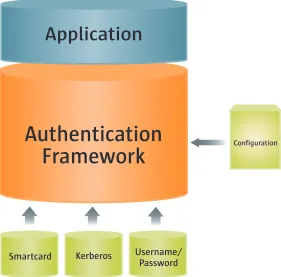
Since applications solely talk to the standard LoginContext API, they can remain independent from the underlying plug-in modules. New or updated modules can be plugged in for an application without having to
modify the application itself. Figure 3 illustrates the independence between applications and underlying login
[image:10.612.201.482.344.621.2]modules:
Figure 3 – Authentication login modules plugging into the authentication framework
It is important to note that although login modules are pluggable components that can be configured into the
Java platform, they are not plugged in via security providers. Therefore, they do not follow the provider searching
model described in Chapter 3. Instead, as is shown in the above diagram, login modules are administered by their
own unique configuration.
Application
Authentication
Framework
Smartcard Kerberos Username/ Password
The Java platform provides the following built-in LoginModules, all in the com.sun.security.auth.
module package:
• Krb5LoginModule for authentication using Kerberos protocols
• JndiLoginModule for username/password authentication using LDAP or NIS databases
• KeyStoreLoginModule for logging into any type of key store, including a PKCS#11 token
key store
Authentication can also be achieved during the process of establishing a secure communication channel between
two peers. The Java platform provides implementations of a number of standard communication protocols, which
are discussed in the following chapter.
Chapter 7
Secure Communication
The data that travels across a network can be accessed by someone who is not the intended recipient. When the
data includes private information, such as passwords and credit card numbers, steps must be taken to make the
data unintelligible to unauthorized parties. It is also important to ensure that you are sending the data to the
appropriate party, and that the data has not been modified, either intentionally or unintentionally, during
transport.
Cryptography forms the basis required for secure communication, and that is described in Chapter 4. The Java
platform also provides API support and provider implementations for a number of standard secure communication
protocols.
SSL/TLS
The Java platform provides APIs and an implementation of the SSL and TLS protocols that includes functionality for
data encryption, message integrity, server authentication, and optional client authentication. Applications can use
SSL/TLS to provide for the secure passage of data between two peers over any application protocol, such as HTTP
on top of TCP/IP.
The javax.net.ssl.SSLSocket class represents a network socket that encapsulates SSL/TLS support
on top of a normal stream socket (java.net.Socket). Some applications might want to use alternate data transport abstractions (e.g., New-I/O); the javax.net.ssl.SSLEngine class is available to produce and
consume SSL/TLS packets.
The Java platform also includes APIs that support the notion of pluggable (provider-based) key managers and trust
managers. A key manager is encapsulated by the javax.net.ssl.KeyManager class, and manages the keys used to perform authentication. A trust manager is encapsulated by the TrustManager class (in the same
package), and makes decisions about who to trust based on certificates in the key store it manages.
SASL
Simple Authentication and Security Layer (SASL) is an Internet standard that specifies a protocol for authentication
and optional establishment of a security layer between client and server applications. SASL defines how
authentica-tion data is to be exchanged, but does not itself specify the contents of that data. It is a framework into which
specific authentication mechanisms that specify the contents and semantics of the authentication data can fit.
There are a number of standard SASL mechanisms defined by the Internet community for various security levels
and deployment scenarios.
The Java SASL API defines classes and interfaces for applications that use SASL mechanisms. It is defined to be
mechanism-neutral; an application that uses the API need not be hardwired into using any particular SASL
mechanism. Applications can select the mechanism to use based on desired security features. The API supports
both client and server applications. The javax.security.sasl.Sasl class is used to create SaslClient
and SaslServer objects.
SASL mechanism implementations are supplied in provider packages. Each provider may support one or more SASL
mechanisms and is registered and invoked via the standard provider architecture.
The Java platform includes a built-in provider that implements the following SASL mechanisms:
• CRAM-MD5, DIGEST-MD5, EXTERNAL, GSSAPI, and PLAIN client mechanisms
• CRAM-MD5, DIGEST-MD5, and GSSAPI server mechanisms
GSS-API and Kerberos
The Java platform contains an API with the Java language bindings for the Generic Security Service Application
Programming Interface (GSS-API). GSS-API offers application programmers uniform access to security services atop
a variety of underlying security mechanisms. The Java GSS-API currently requires use of a Kerberos v5 mechanism,
and the Java platform includes a built-in implementation of this mechanism. At this time, it is not possible to plug
in additional mechanisms.
Note – The Krb5LoginModule mentioned in Chapter 6 can be used in conjunction with the GSS Kerberos mechanism.
Before two applications can use the Java GSS-API to securely exchange messages between them, they must
establish a joint security context. The context encapsulates shared state information that might include, for
example, cryptographic keys. Both applications create and use an org.ietf.jgss.GSSContextobject to establish and maintain the shared information that makes up the security context. Once a security context has
been established, it can be used to prepare secure messages for exchange.
The Java GSS APIs are in the org.ietf.jgss package. The Java platform also defines basic Kerberos classes,
like KerberosPrincipal and KerberosTicket, which are located in the javax.security.
auth.kerberos package.
Chapter 8
Access Control
The access control architecture in the Java platform protects access to sensitive resources (for example, local files)
or sensitive application code (for example, methods in a class). All access control decisions are mediated by a
security manager, represented by the java.lang.SecurityManager class. A SecurityManager must be installed into the Java runtime in order to activate the access control checks.
Java applets and Java™ Web Start applications are automatically run with a SecurityManager installed. However, local applications executed via the java command are by default not run with a SecurityManager
installed. In order to run local applications with a SecurityManager, either the application itself must programmatically set one via the setSecurityManager method (in the java.lang.System class), or
java must be invoked with a -Djava.security.manager argument on the command line.
Permissions
When Java code is loaded by a class loader into the Java runtime, the class loader automatically associates the
following information with that code:
• Where the code was loaded from
• Who signed the code (if anyone)
• Default permissions granted to the code
This information is associated with the code regardless of whether the code is downloaded over an untrusted
network (e.g., an applet) or loaded from the filesystem (e.g., a local application). The location from which the code
was loaded is represented by a URL, the code signer is represented by the signer’s certificate chain, and default
permissions are represented by java.security.Permission objects.
The default permissions automatically granted to downloaded code include the ability to make network
connections back to the host from which it originated. The default permissions automatically granted to code
loaded from the local filesystem include the ability to read files from the directory it came from, and also from
subdirectories of that directory.
Note that the identity of the user executing the code is not available at class loading time. It is the responsibility of
application code to authenticate the end user if necessary (for example, as described in Chapter 6). Once the user
has been authenticated, the application can dynamically associate that user with executing code by invoking the
doAs method in the javax.security.auth.Subject class.
Policy
As mentioned earlier, a limited set of default permissions are granted to code by class loaders. Administrators have
the ability to flexibly manage additional code permissions via a security policy. The Java platform encapsulates the
notion of a security policy in the java.security.Policy class. There is only one Policy object installed
into the Java runtime at any given time. The basic responsibility of the Policy object is to determine whether access to a protected resource is permitted to code (characterized by where it was loaded from, who signed it,
and who is executing it). How a Policy object makes this determination is implementation-dependent. For example, it may consult a database containing authorization data, or it may contact another service.
The Java platform includes a default Policy implementation that reads its authorization data from one or more ASCII (UTF-8) files configured in the security properties file. These policy files contain the exact sets of permissions
granted to code—specifically, the exact sets of permissions granted to code loaded from particular locations,
signed by particular entities, and executing as particular users. The policy entries in each file must conform to a
documented proprietary syntax, and may be composed via a simple text editor or the graphical policytoolutility.
Access Control Enforcement
The Java runtime keeps track of the sequence of Java calls that are made as a program executes. When access to a
protected resource is requested, the entire call stack, by default, is evaluated to determine whether the requested
access is permitted.
As mentioned earlier, resources are protected by the SecurityManager. Security-sensitive code in the Java platform and in applications protects access to resources via code like the following:
SecurityManager sm = System.getSecurityManager(); if (sm != null) {
sm.checkPermission(perm); }
where perm is the Permission object that corresponds to the requested access. For example, if an attempt is made to read the file /tmp/abc, the permission may be constructed as follows:
Permission perm =
new java.io.FilePermission("/tmp/abc", "read");
The default implementation of SecurityManager delegates its decision to the java.security.
AccessController implementation. The AccessController traverses the call stack, passing to the installed security Policy each code element in the stack, along with the requested permission (for example, the
FilePermission in the above example). The Policy determines whether the requested access is granted, based on the permissions configured by the administrator. If access is not granted, the AccessController
throws a java.lang.SecurityException.
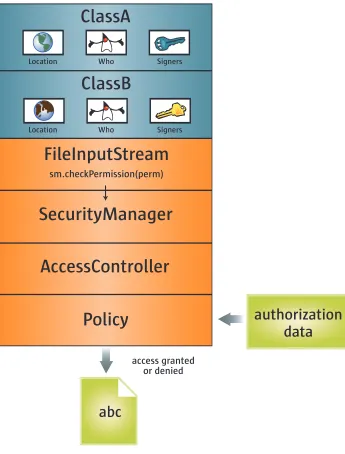
Figure 4 illustrates access control enforcement. In this particular example, there are initially two elements on
the call stack, ClassA and ClassB. ClassA invokes a method in ClassB, which then attempts to access the file
/tmp/abc by creating an instance of java.io.FileInputStream. The FileInputStream constructor
creates a FilePermission, perm, as shown above, and then passes perm to the SecurityManager’s
checkPermission method. In this particular case, only the permissions for ClassA and ClassB need to be checked, because all system code, including FileInputStream, SecurityManager, and
AccessController, automatically receives all permissions.
In this example, ClassA and ClassB have different code characteristics—they come from different locations and
have different signers. Each may have been granted a different set of permissions. The AccessController
only grants access to the requested file if the Policy indicates that both classes have been granted the required FilePermission.
Figure 4 – Controlling access to resources
Sun Microsystems, Inc. P14Access Control
ClassA
ClassB
FileInputStream
sm.checkPermission(perm)
SecurityManager
Policy
AccessController
Location Who Signers
Location Who Signers
abc
authorization
data
Sun Microsystems, Inc. For More Information P15
Chapter 9
For More Information
Detailed documentation for all the J2SE 5.0 security features mentioned in this paper can be found at
http://java.sun.com/j2se/1.5.0/docs/guide/security/index.html
Additional Java security documentation can be found online at
http://java.sun.com/security/
and in the book Inside Java 2 Platform Security, Second Edition (Addison-Wesley). See
http://java.sun.com/docs/books/security/index.html
Sun Microsystems, Inc. P16For More Information
Appendix A – Classes Summary
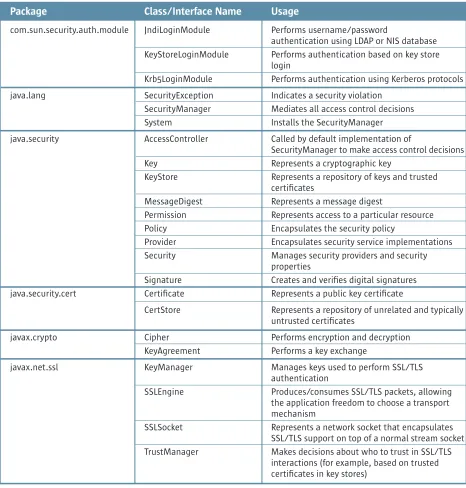
Table 1 summarizes the names, packages, and usage of the Java security classes and interfaces mentioned in
[image:18.612.73.539.188.676.2]this paper.
Table 1 – Key Java security packages and classes
Package Class/Interface Name Usage
com.sun.security.auth.module JndiLoginModule Performs username/password
authentication using LDAP or NIS database KeyStoreLoginModule Performs authentication based on key store
login
Krb5LoginModule Performs authentication using Kerberos protocols java.lang SecurityException Indicates a security violation
SecurityManager Mediates all access control decisions System Installs the SecurityManager java.security AccessController Called by default implementation of
SecurityManager to make access control decisions Key Represents a cryptographic key
KeyStore Represents a repository of keys and trusted certificates
MessageDigest Represents a message digest
Permission Represents access to a particular resource Policy Encapsulates the security policy
Provider Encapsulates security service implementations Security Manages security providers and security
properties
Signature Creates and verifies digital signatures java.security.cert Certificate Represents a public key certificate
CertStore Represents a repository of unrelated and typically untrusted certificates
javax.crypto Cipher Performs encryption and decryption KeyAgreement Performs a key exchange
javax.net.ssl KeyManager Manages keys used to perform SSL/TLS authentication
SSLEngine Produces/consumes SSL/TLS packets, allowing the application freedom to choose a transport mechanism
SSLSocket Represents a network socket that encapsulates SSL/TLS support on top of a normal stream socket TrustManager Makes decisions about who to trust in SSL/TLS
Sun Microsystems, Inc. For More Information P17
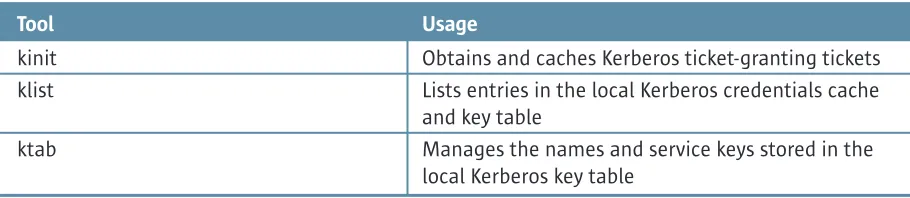
There are also three Kerberos-related tools that are shipped with the Java platform for Windows. Equivalent
functionality is provided in tools of the same name that are automatically part of the Solaris™ and Linux operating
[image:19.612.70.546.110.281.2]environments. Table 3 summarizes the Kerberos tools.
Table 3 – Kerberos-related tools
Tool Usage
kinit Obtains and caches Kerberos ticket-granting tickets
klist Lists entries in the local Kerberos credentials cache
and key table
ktab Manages the names and service keys stored in the
local Kerberos key table
Appendix B – Tools Summary
[image:19.612.70.550.410.509.2]Table 2 summarizes the tools mentioned in this paper.
Table 2 – Java security tools
Tool Usage
jar Creates Java Archive (JAR) files
jarsigner Signs and verifies signatures on JAR files
keytool Creates and manages key stores
policytool Creates and edits policy files for use with default Policy implementation
Package Class/Interface Name Usage
javax.security.auth Subject Represents a user
javax.security.auth.kerberos KerberosPrincipal Represents a Kerberos principal KerberosTicket Represents a Kerberos ticket javax.security.auth.login LoginContext Supports pluggable authentication
javax.security.auth.spi LoginModule Implements a specific authentication mechanism javax.security.sasl Sasl Creates SaslClient and SaslServer objects
SaslClient Performs SASL authentication as a client SaslServer Performs SASL authentication as a server org.ietf.jgss GSSContext Encapsulates a GSS-API security context and
[image:19.612.78.533.614.713.2]Sun Microsystems, Inc. P18
Appendix C – Built-in Providers
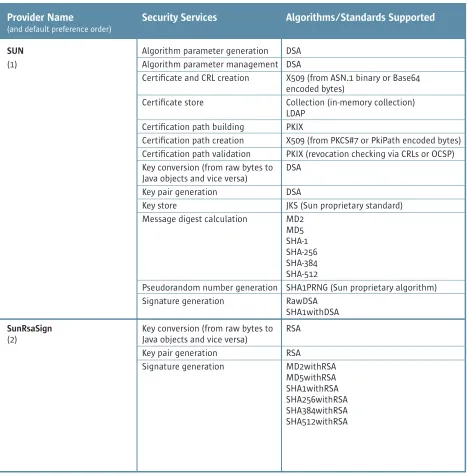
The Java platform implementation from Sun Microsystems includes a number of built-in provider
packages. Table 4 summarizes some of the most important security services supplied by these providers. For
details, see the documentation referenced in the “For More Information” chapter.
In the table, the providers are listed in default preference order, and the preference order is shown underneath
each provider name, in parentheses. The final column lists the standard names that can be passed to relevant
[image:20.612.75.542.252.728.2]getInstance calls (for example, MessageDigest.getInstance).
Table 4 – Built-in providers and the services they implement
P18For More Information
Provider Name Security Services Algorithms/Standards Supported
(and default preference order)
SUN Algorithm parameter generation DSA (1) Algorithm parameter management DSA
Certificate and CRL creation X509 (from ASN.1 binary or Base64 encoded bytes)
Certificate store Collection (in-memory collection) LDAP
Certification path building PKIX
Certification path creation X509 (from PKCS#7 or PkiPath encoded bytes) Certification path validation PKIX (revocation checking via CRLs or OCSP) Key conversion (from raw bytes to DSA
Java objects and vice versa)
Key pair generation DSA
Key store JKS (Sun proprietary standard) Message digest calculation MD2
MD5 SHA-1 SHA-256 SHA-384 SHA-512
Pseudorandom number generation SHA1PRNG (Sun proprietary algorithm) Signature generation RawDSA
SHA1withDSA
SunRsaSign Key conversion (from raw bytes to RSA (2) Java objects and vice versa)
Key pair generation RSA
Sun Microsystems, Inc. For More Information P19P19
Provider Name Security Services Algorithms/Standards Supported
(and default preference order)
SunJSSE Key manager SunX509
(3) Key store PKCS12
SSL/TLS protocols SSLv3 TLSv1
Trust manager PKIX (alias: X509)
SunJCE Algorithm parameter generation DiffieHellman
(4) Algorithm parameter management AES Blowfish DES
DESede (Triple DES) DiffieHellman OAEP PBE PBEWithMD5AndDES PBEWithMD5AndTripleDES PBEWithSHA1AndDESede PBEWithSHA1AndRC2_40 RC2
Cipher modes Modes provided for all block ciphers: CBC (Cipher Block Chaining)
CFB (Cipher Feedback) CTR (Counter)
ECB (Electronic Codebook) OFB (Output Feedback)
PCBC (Propagating Cipher Block Chaining) Cipher padding For all block ciphers:
NOPADDING or PKCS5PADDING For non-PKCS#5 block ciphers:
ISO10126PADDING (XML encryption padding) Encryption/decryption AES
ARCFOUR Blowfish DES
DESede (Triple DES) PBEWithMD5AndDES PBEWithMD5AndTripleDES PBEWithSHA1AndDESede PBEWithSHA1AndRC2_40 RC2 RSA
Key agreement DiffieHellman Key conversion (from raw bytes DES
Sun Microsystems, Inc. P20For More Information
Provider Name Security Services Algorithms/Standards Supported
(and default preference order)
Key generation AES ARCFOUR Blowfish DES
DESede (Triple DES) DiffieHellman HmacMD5 HmacSHA1 HmacSHA256 HmacSHA384 HmacSHA512 RC2
Key store JCEKS (Sun proprietary standard) Message authentication code HmacMD5
(MAC) calculation HmacPBE SHA1 HmacSHA1 HmacSHA256 HmacSHA384 HmacSHA512
SunJGSS GSS-API security mechanism (built-in Kerberos v5 provider) (5)
SunSASL Client authentication CRAM-MD5
(6) mechanisms DIGEST-MD5
EXTERNAL
GSSAPI (Kerberos v5) PLAIN
Server authentication CRAM-MD5 mechanisms DIGEST-MD5
GSSAPI (Kerberos v5)
SunPKCS11 PKCS#11 token cryptography (Enables access to native PKCS#11 tokens via standard Java cryptography APIs) Key store PKCS11
(1 on Solaris 10—other provider preferences increased by 1—otherwise not configured by default)
White PaperJava Security Overview On the Websun.com
SUN™
© 2005 Sun Microsystems, Inc. All rights reserved. Sun, Sun Microsystems, the Sun logo, Java, the Java Coffee Cup logo, Solaris, and J2SE are trademarks, registered trademarks or service marks of SunMicrosystems, Inc. in the United States and other countries.
UNIX is a registered trademark in the United States and other countries, exclusively licensed through X/Open Company, Ltd.
All SPARC trademarks are used under license and are trademarks or registered trademarks of SPARC International, Inc. in the U.S. and other countries. Products bearing SPARC trademarks are based upon an architecture developed by Sun Microsystems, Inc.
Sun Microsystems, Inc.4150 Network Circle, Santa Clara, CA 95054 USA Phone1-650-960-1300 or 1-800-555-9SUN Websun.co
© 2005 Sun Microsystems, Inc., 4150 Network Circle, Santa Clara, CA 95054 USA
All rights reserved.
This product or document is protected by copyright and distributed under licenses restricting its use, copying, distribution, and decompilation. No part of this product or document may be reproduced in any form by any means without prior written authorization of Sun and its licensors, if any. Third-party software, including font
technology, is copyrighted and licensed from Sun suppliers.
Sun, Sun Microsystems, the Sun logo, Java, the Java Coffee Cup logo, Solaris, and J2SE are trademarks, registered trademarks or service marks of Sun Microsystems, Inc. in
the United States and other countries.
UNIX is a registered trademark in the United States and other countries, exclusively licensed through X/Open Company, Ltd.
All SPARC trademarks are used under license and are trademarks or registered trademarks of SPARC International, Inc. in the U.S. and other countries. Products bearing SPARC
trademarks are based upon an architecture developed by Sun Microsystems, Inc.
RESTRICTED RIGHTS: Use, duplication, or disclosure by the U.S. Government is subject to restrictions of FAR 52.227-14(g)(2)(6/87) and FAR 52.227-19(6/87),
or DFAR 252.227-7015(b)(6/95) and DFAR 227.7202-3(a). DOCUMENTATION IS PROVIDED “AS IS” AND ALL EXPRESS OR IMPLIED CONDITIONS, REPRESENTATIONS AND WARRANTIES, INCLUDING ANY IMPLIED WARRANTY OF MERCHANTABILITY, FITNESS FOR A PARTICULAR PURPOSE OR NON-INFRINGEMENT, ARE DISCLAIMED, EXCEPT TO THE
EXTENT THAT SUCH DISCLAIMERS HELD TO BE LEGALLY INVALID.