JOURNAL OFVIROLOGY, Sept. 1995, p. 5806–5811 Vol. 69, No. 9 0022-538X/95/$04.0010
Copyrightq1995, American Society for Microbiology
The Amino Terminus of Tax Is Required for Interaction with
the Cyclic AMP Response Element Binding Protein
ITAMAR GOREN,
1† OLIVER J. SEMMES,
2KUAN-TEH JEANG,
2AND
KARIN MOELLING
3*
Max-Planck-Institut fuer Molekulare Genetik, D-14195 Berlin (Dahlem), Federal Republic of Germany
1;
Institut fuer Medizinische Virologie, Universitaet Zuerich, CH-8028 Zuerich, Switzerland
3;
and Molecular Virology Section, Laboratory of Molecular Biology, National Institute
of Allergy and Infectious Diseases, Bethesda, Maryland 20892
2Received 30 January 1995/Accepted 23 May 1995
Tax of human T-cell leukemia virus type 1 was analyzed for interaction with the cyclic AMP response element
binding protein (CREB) in vitro with and without Tax response element DNA. Mutations in the carboxy
terminus of Tax (L296G and L320G) did not affect binding to CREB and led to supershifts. In contrast,
mutants with changes in the amino-terminal cysteine-rich region lost the ability to bind to CREB. The S10A
mutant protein bound moderately. Thus, the amino terminus of Tax is essential for Tax-CREB interaction.
Human T-cell leukemia virus type 1 (HTLV-1) is the
etio-logical agent of adult T-cell leukemia (23, 41) and tropical
spastic paraparesis HTLV-1 associated myelopathy (13). It
codes for a 40-kDa Tax protein (Fig. 1A) which is a potent
transactivator of the HTLV-1 long terminal repeat (LTR), as
well as other viral and cellular genes (8, 18, 20, 26, 31, 35, 38).
Tax functions by binding indirectly to DNA, forming
multipro-tein complexes with host cell transcription factors to prompt
RNA synthesis (4, 9, 10, 14, 17, 19, 37). Three tandem 21-bp
repeats, the Tax response elements (TxREs), are located in the
U3 region of the HTLV-1 LTR (30) (Fig. 1C). A cyclic AMP
response element-like sequence, TGACG, is located in the
core of each repeat and is crucial for transcriptional activation
by the activating transcription factor (42) and the cyclic AMP
response element binding protein (CREB) shown in Fig. 1B (4,
17, 42, 43). The G- and/or C-rich sequences flanking the cyclic
AMP response element motif are required for the formation of
a stable Tax-CREB-DNA ternary complex (22) and necessary
for Tax transactivation in vivo (12).
Mutational analyses of Tax have indicated that Tax
transac-tivation of viral and cellular promoters is mediated through
distinct functional domains (28, 33). The extreme amino
ter-minus of Tax (amino acids 1 to 13) has been shown to be
important for promoter selectivity between the HTLV-1 and
HTLV-2 LTRs (6). A zinc finger-like structure located in the
amino terminus has been implicated in localization of Tax in
the nucleus (34), as well as for the overall protein folding (27).
In this study, we found that the interaction of Tax and
CREB requires the integrity of the amino terminus of Tax in
vitro.
Tax-CREB-DNA interaction analyzed in gel electrophoretic
mobility shift assays.
The human CREB CDNA (a kind gift of
K. Lee) contained in a 1.02-kb fragment with blunted 5
9
EcoRI
and staggered 3
9
BamHI sites was inserted into T7 vector
pET3CH6 (25), which contained the sequence for six histidines
upstream of the cloning site (15) through blunted NcoI and
staggered BamHI sites. Histidine-tagged CREB (Fig. 1B) was
expressed in Escherichia coli BL-21 DE3 as previously
de-scribed (36) and purified with Ni-NTA agarose (24) (Fig. 2A).
Amino-terminal mutant Tax proteins were cloned by PCR
into p5TaxH6 (graciously supplied by C.-Z. Giam) via
HindIII-MluI sites. The carboxy-terminal mutant proteins were cloned
into p5TaxH6 by using ClaI-PspAI sites. A Tax(His)
6wild-type
protein and Tax mutant proteins were expressed and purified
essentially as previously described (42) (Fig. 2A). A
glutathi-one S-transferase (GST)–Tax fusion protein was constructed by
ligating the Tax wild-type coding sequence into pGEX2TNX
via NcoI-BamHI sites and expressed and purified as previously
described (32). A 143-bp DNA fragment (
2
213 to
2
71; Fig.
1C) was amplified by PCR with plasmid pURI (35) as the
template and labelled with [
g
-
32P]ATP. The recombinant
pro-teins (500 pg) were incubated in DNA binding buffer (10 mM
Tris-HCl [pH 7.6], 50 mM NaCl, 2.5 mM MgCl, 2 mM
sper-midine, 2 mM dithiothreitol, 10
m
M Zn
2SO
4, 10% glycerol, 3
m
g of bovine serum albumin) in the presence of poly(dI-dC)
(0.8
m
g) in 20
m
l for 30 min at room temperature.
DNA-protein complexes were separated by electrophoresis through
5% polyacrylamide gels (29:1 acrylamide/bisacrylamide ratio)
in TGE buffer (25 mM Tris, 192 mM glycine, 1 mM EDTA, pH
8.5) at 4
8
C. Complexes were visualized with a Phosphorimager
(Molecular Dynamics).
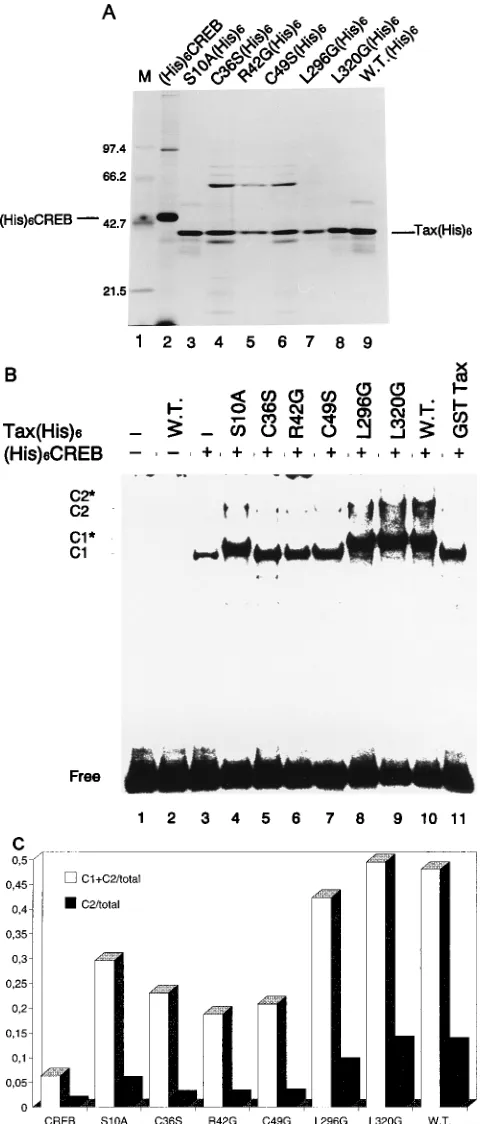
As shown in Fig. 2B, two complexes arose, C1 and C2,
consisting of one and two dimers of CREB, respectively, and
DNA. In the presence of wild-type Tax, C1 and C2 were
shifted, creating two more-slowly migrating protein-DNA
com-plexes, C1* and C2*. This indicates the presence of Tax in
stable multiprotein-DNA complexes. The three zinc finger
mu-tant proteins (C36S, R42G, and C49S) and GST-Tax increased
the amount of CREB bound to DNA in this assay, perhaps by
improving CREB dimerization, yet they failed to interact
sta-bly with the CREB-DNA complex and did not lead to the
formation of more-slowly migrating protein-DNA complexes.
Carboxy-terminal mutant proteins L296G and L320G gave rise
to results similar to those obtained with wild-type Tax,
indicat-ing that this region is not involved in complex formation.
Ami-no-terminal mutant protein S10A behaved similarly to the wild
type, except that the intensity of the complex was reduced,
especially that of C2. GST-Tax, in contrast to Tax(His)
6, did
not lead to the formation of the slowly migrating complex,
thereby resembling the three zinc finger mutants proteins.
Quantitative evaluation of DNA bound in complexes C1 and
* Corresponding author. Mailing address: Institut fuer Medizinische Virologie, Universitaet Zuerich, Gloriastrasse 30, CH-8028 Zuerich, Switzerland.
† Present address: Hadassah Medical School, Hebrew University, 91010 Jerusalem, Israel.
5806
on November 9, 2019 by guest
http://jvi.asm.org/
FIG. 1. HTLV-1 Tax and CREB proteins. (A) Schemes of Tax wild-type and mutant proteins and the deleted zinc finger domain of Tax (DZn Finger Tax), including important structural elements. Mutated amino acids are in bold letters, and the numbers indicate the amino acid residues. The acidic carboxyl region (Acidic) and the proposed region for interaction with general transcription factors (GTF) are shown as well. Some restriction sites used for cloning are indicated. (B) Histidine-tagged CREB [(His)6CREB] and GST-CREB fusion proteins. Glutamine-rich domain Q, the kinase-induced domain (KID), the DNA binding domain (DBD), and the basic
region with the leucine zipper (B-ZIP) are indicated. The histidine-tagged protein and the fusion protein contain additional amino acid residues as indicated by the one-letter symbols upstream of the CREB sequence. (C) HTLV-1 LTR promoter with the three 21-bp TxREs, a related TxRE2, and CAAT and TATA boxes. The arrow at nucleotide11 indicates the start of mRNA synthesis, R indicates the redundant region, and U5 and U3 are unique regions of the LTR. The PCR-amplified promoter fragment used in this assay is indicated below. It contains the middle TxRE (M-TxRE) and the proximal TxRE (39-TxRE) of the promoter.
5807
on November 9, 2019 by guest
C2 was achieved by Phosphorimager analysis (Fig. 2C). The
ratio of DNA bound in C1 plus C2 (white column) or C2 (black
column) versus the total DNA input was lowest for the cysteine
mutants. It was reduced five- to sevenfold in C2.
Filter binding analysis of Tax-CREB-DNA interaction.
Tax-CREB-DNA interaction was further characterized by filter
binding assays. A synthetic oligodeoxynucleotide
correspond-ing to the middle TxRE 21-bp motif, spanncorrespond-ing nucleotides
2
203 to
2
183 of the HTLV-1 LTR, was synthesized and
ex-tended by five additional oligonucleotides, end labelled with
[
g
-
32P]ATP, annealed, and treated as previously described (3).
Various amounts of recombinant (His)
6CREB protein were
incubated with 100 pg of labelled DNA in DNA binding buffer
in a final volume of 100
m
l for 30 min at room temperature
essentially as previously described (21). Where indicated,
poly(dI-dC) was added as a nonspecific competitor alone or
together with 100 ng of Tax(His)
6wild-type or mutant protein
(Fig. 3). Addition of increasing amounts of CREB gave rise to
a saturation curve well fitted to the two-step protein-DNA
binding model previously suggested for (CREB)
2-TxRE
inter-action (2). Addition of 1
m
g of poly(dI-dC) abolished this
binding activity almost completely. Addition of 100 ng of
wild-type Tax protein, however, restored the binding activity of
CREB. In addition to what was previously described (2) and
the shift assay results (Fig. 2B), Tax was found to increase the
binding activity of CREB to the 21-bp repeat in this assay,
especially at lower concentrations of CREB (50 ng). The
mo-lecular ratio of CREB to Tax was about 2.5:1. These results
support the notion that Tax increases the specific affinity of
CREB dimers for the 21-bp repeat DNA. Carboxy-terminal
mutant Tax proteins L320G and L296G were almost as
effi-cient in restoring this CREB-DNA binding as the wild-type
protein. In contrast, the C36S mutant protein had no influence
on CREB-TxRE complex formation and the binding activity of
CREB remained as low as with the addition of poly(dI-dC)
alone. Amino-terminal mutant protein S10A restored only
some of the CREB-binding activity to the TxRE DNA, making
it similar to what was obtained in the DNA shift assay.
Direct interaction between Tax and CREB.
The interaction
of wild-type and mutant Tax proteins with CREB was further
analyzed in the absence of DNA in vitro. CREB cDNA present
in a 1-kb fragment (amino acids 3 to 341) was cloned into
pETGST via NcoI-BamHI restriction sites, expressed in E. coli
B1-21 DE3 (36), and purified as previously described (32).
Wild-type and mutant Tax proteins were cloned into vector
pGNE [a pGEM3 derivative (Promega Co.) which contains
b
-globin leader sequences upstream and a (dA)
30sequence
downstream of the cloning site (15)] via NcoI-BamHI sites.
Deletion of the zinc finger domain of Tax (amino acids 18 to
54) was generated by religating previously mung bean
nucle-ase-blunted, AccI-digested, Klenow-blunted, ClaI-digested
plasmid pGTaxNE. An EcoRI-linearized plasmid (1
m
g) was
used for in vitro transcription with T7 RNA polymerase
(Pro-mega Co.), and 1/10 of the transcribed RNA was translated in
rabbit reticulocyte lysate in the presence of [
35S]methionine
and resolved by sodium dodecyl sulfate (SDS)–10%
polyacryl-amide gel electrophoresis (PAGE) (Fig. 4A). Equal amounts
of labelled protein adjusted to 10
m
l with nonprogrammed
[image:3.612.59.299.71.633.2]reticulocyte lysate were incubated with 1
m
g of bacterially
FIG. 2. Effect of Tax and Tax mutant proteins on CREB binding activity to the HTLV-1 LTR promoter fragment. (A) Proteins used in the DNA binding reaction were analyzed by SDS–10% PAGE and visualized by silver staining (5). Lanes: 1, molecular weight standards (sizes are indicated to the left in kilodal-tons); 2, (His)6CREB; 3 to 9 wild-type and mutant Tax(His)6proteins as
indi-cated above the lanes. The amount of protein was estimated by comparison with a standard by using silver staining (data not shown). (B) Electrophoretic mobility shift assay using the32
P-labelled LTR DNA fragment (Fig. 1C) and purified wild-type (W.T.) and mutant (His)6CREB (20 ng) and Tax(His)6(100 ng)
pro-teins as described in text. C1 represents one TxRE occupied by a CREB dimer. C2 represents two TxREs both occupied by CREB dimers (i.e., a fully occupied
promoter fragment). Shifted complexes are represented by asterisks (C1* and C2*). (C) DNA-protein complexes measured with a Phosphorimager and ratio of DNA bound in C1 plus C2 to total DNA (h) and ratio of two TxREs occupied by CREB dimers (C2) to total DNA (■).
5808 NOTES J. VIROL.
on November 9, 2019 by guest
http://jvi.asm.org/
expressed GST-CREB immobilized on 15
m
l of
glutathione-Sepharose beads and treated as previously described (40).
GST-CREB-bound proteins were resolved by SDS–PAGE
(Fig. 4B). Mutant proteins with changes in the cysteine- and
histidine-rich region, including a mutant protein with a deleted
zinc finger, did not bind. Carboxy-terminal mutant proteins
L296G and L320G allowed binding somewhat similar to that
allowed by the wild type. Figure 4C shows the GST-CREB
proteins used for binding and visualized by Coomassie blue
staining of the gel shown in Fig. 4B. Quantitative analysis of
the binding reaction was obtained with a Phosphorimager. The
amount of wild-type Tax bound to GST-CREB was arbitrarily
set to 1, and the other reactions were quantified accordingly.
The result shows that the mutant proteins with changes in the
zinc finger region exhibited 5- to 10-fold reduced binding
ef-ficiencies (Fig. 4D). The two carboxy-terminal mutants bound
about half as efficiently as the wild type. In a control
experi-ment, Tax was found to bind exclusively to the NH
2-deleted
GST–TATA-binding protein (TBP) (168-339) fusion protein
[GST-TBP(C); Fig. 4E, section II, lane 4], in agreement with
what was previously reported (7), and not to the
COOH-deleted GST–TBP(1-163) fusion protein [GST–TBP(N); lane
3] or GST alone (lane 2).
We found that mutant proteins with three single amino acid
substitutions located in the zinc finger domain of Tax and the
GST-Tax fusion protein were unable to interact with CREB
and HTLV-1 LTR DNA. Mobility shift assays showed,
how-ever, that the amount of protein-DNA complexes was slightly
increased over that obtained with CREB alone and no
de-crease in the mobility of the protein-DNA complex was
ob-tained. Moreover, in filter binding assays, we observed no
en-hancement of CREB binding to the 21-bp repeat DNA
mediated by the C36S cysteine substitution mutant protein,
although the binding activity of CREB was enhanced by
wild-type or mutant Tax protein. This supports the notion that the
induction of CREB binding to TxRE DNA mediated by Tax
depends, to some extent, on stable interaction of Tax with the
CREB-DNA complex.
Mutant Tax protein S10A, with a mutation adjacent to the
cysteine-rich region, was still able to interact with the
CREB-DNA complex to a moderate level and also reduced the
mo-bility of this complex in the shift assay. This suggests that the
sequence adjacent to the zinc finger domain is also important
for the interaction of Tax with CREB on the HTLV-1 LTR
promoter, as was recently demonstrated by Adya and Giam
(1).
The finding that the COOH-terminal mutant Tax proteins,
although they do not activate the HTLV-1 LTR promoter in
vivo (28), can still bind to the CREB 21-bp repeat complex and
enhance the binding of CREB to the HTLV-1 LTR DNA in a
manner comparable to that of the wild-type protein in vitro
points to the role of this domain in interaction with other
factors, such as the general transcription factors. These mutant
proteins were unable to inhibit (squelch) the activity of a
GAL4-FIG. 3. Filter binding assay results. A double-stranded DNA oligonucleotide containing the middle TxRE was radiolabelled and treated with increasing concen-trations of (His)6CREB protein. The amount of the filter-bound CREB-TxRE complex as a function of the CREB concentration was measured. Nonspecific DNA
competitor poly(dI-dC) (1mg) alone or supplemented with 100 ng of wild-type or mutant Tax(His)6protein was added to all reactions except a control reaction
containing CREB only. Poly(dI-dC) abolished the binding of CREB to DNA, which was restored by wild-type Tax and some of the mutant proteins. Symbols:■, CREB;
F, CREB plus poly(dI-dC);å, CREB plus poly(dI-dC) plus Tax S10A;{, CREB plus poly(dI-dC) plus Tax C36S;E, CREB plus poly(dI-dC) plus Tax L296G;1, CREB plus poly(dI-dC) plus Tax L320G;❇, CREB plus poly(dI-dC) plus wild-type Tax.
on November 9, 2019 by guest
http://jvi.asm.org/
Tax fusion protein in cotransfection assays and hence lack the
ability to interact with transcription cofactors (29). The
exis-tence of a transactivation domain located in the COOH
ter-minus of Tax which can be replaced by the heterologous
acti-vation domain of herpes simplex virus VP16 has been
suggested on the basis of functional activation assays with
GAL4-Tax (11, 39). Therefore, interaction of Tax with CREB,
which requires the intact NH
2-terminal domain of Tax and
induces CREB binding, is a prerequisite but is probably not
sufficient to account for activation (29).
We are grateful to K. Lee, C.-Z. Giam, and T. Kouzarides for the generous supply of CREB, Tax(His)6, and the GST-TBP expression plasmids, respectively. I.G. is indebted to H. Schuster for the use of laboratory facilities.
This work was supported by the Deutsche Forschungsgemeinschaft and the Max Planck Society.
REFERENCES
1. Adya, N., and C.-Z. Giam. 1995. Distinct regions in human T-cell lympho-tropic virus type I Tax mediate interactions with activator protein CREB and basal transcription factors. J. Virol. 69:1834–1841.
2. Anderson, M. G., and W. S. Dynan. 1994. Quantitative studies of the effect of HTLV-I Tax protein on CREB protein-DNA binding. Nucleic Acids Res.
22:3194–3201.
3. Beimling, P., and K. Moelling. 1990. Tax-independent binding of multiple cellular factors to the Tax response element DNA of HTLV-I. Oncogene
5:361–368.
4. Beimling, P., and K. Moelling. 1992. Direct interaction of CREB protein with 21 bp Tax-response elements of HTLV-I LTR. Oncogene 7:257–258. 5. Blum, H., H. Beier, and H. J. Gross. 1987. Improved silver staining of plant
proteins, RNA and DNA in polyacrylamide gels. Electrophoresis 8:93–99. 6. Cann, A. J., J. D. Rosenblatt, W. Wachsman, and I. S. Y. Chen. 1989. In vitro
mutagenesis of the human T-cell leukemia virus types I and II tax genes. J. Virol. 63:1474–1479.
7. Caron, C., R. Rousset, C. Beraud, V. Monocllin, J. M. Egly, and P. Jalinot. 1993. Functional and biochemical interaction of the HTLV-I Tax 1 transac-tivator wih TBP. EMBO J. 12:4269–4278.
8. Fujii, M., P. Sassone-Corsi, and I. M. Verma. 1988. c-fos promoter trans-activation by the tax1protein of human T-cell leukemia virus type I. Proc.
Natl. Acad. Sci. USA 85:8526–8530.
9. Fujii, M., H. Tsuchiya, T. Chuhjo, T. Akizawa, and M. Seiki. 1992. Interac-tion of HTLV-I Tax1 with p67-SRF
causes the aberrant induction of cellular immediate early genes through CArG boxes. Genes Dev. 6:2066–2076. 10. Fujii, M., H. Tsuchiya, T. Chuhjo, T. Minamino, K. Miyamoto, and M. Seiki.
1994. Serum response factor has functional roles both in indirect binding to the CArG Box and in the transcriptional activation function of human T-cell leukemia virus type I Tax. J. Virol. 68:7275–7283.
11. Fujii, M., H. Tsuchiya, and M. Seiki. 1991. HTLV-I Tax has distinct but overlapping domains for transcriptional activation and for enhancer speci-ficity. Oncogene 6:2349–2352.
12. Fujisawa, J.-I., M. Toita, and M. Yoshida. 1989. A unique enhancer element for the trans activator (p40tax
) of human T-cell leukemia virus type I that is distinct from cyclic AMP- and 12-O-tetradecanoylphorbol-13-acetate-re-sponsive elements. J. Virol. 63:3234–3239.
13. Gessain, A., F. Barin, J. C. Vernant, O. Gout, L. Maurs, A. Calender, and G.
de The.1985. Antibodies to the human T lymphotropic virus type 1 in patients with tropical spastic paraparesis. Lancet ii:407–410.
14. Giam, C.-Z., and Y.-L. Xu. 1989. HTLV-I Tax gene product activates tran-scription via pre-existing cellular factors and cAMP responsive element. J. Biol. Chem. 264:15236–15241.
15. Goren, I., and S. Volkmann. 1992. Unpublished data.
16. Hagemeier, C., S. Walker, R. Caswell, T. Kouzarides, and J. Sinclair. 1992. The human cytomegalovirus 80-kilodalton but not the 72-kilodalton imme-diate-early protein transactivates heterologous promoters in a TATA box-dependent mechanism and interacts directly with TFIID. J. Virol. 66:4452– 4456.
17. Jeang, K.-T., I. Boros, J. Brady, M. Radonovich, and G. Khoury. 1988. Characterization of cellular factors that interact with the human T-cell leu-kemia virus type I p40x-responsive 21-base-pair sequence. J. Virol. 62:4499–
4509.
18. Leung, K., and G. J. Nabel. 1988. HTLV-I transactivator induces interleu-kin-2 receptor expression through an NF-kB like factor. Nature (London)
333:776–778.
19. Mariott, S. J., I. Boros, J. F. Duvall, and J. N. Brady. 1989. Indirect binding of human T-cell leukemia virus type I tax1to a responsive element in the
viral long terminal repeat. Mol. Cell. Biol. 9:4152–4160.
20. Miyatake, S., M. Seiki, R. D. Malefijit, T. Heike, J. Fujisawa, Y. Takebe, J.
Nishida, J. Shlomai, T. Yokota, M. Yoshida, K. Arai, and N. Arai.1988. Activation of T cell-derived lymphokine in T cells and fibroblasts: effect of human T cell leukemia virus type I p40x
protein and bovine papilloma virus encoded E2 protein. Nucleic Acids Res. 16:6547–6567.
21. Mu¨ller, G., B. Strack, J. Dannull, B. S. Sproat, A. Surovoy, G. Jung, and K. Moelling.1994. Amino acid requirements of the nucleocapsid protein of HIV-1 for increasing catalytic activity of a Ki-ras ribozyme in vitro. J. Mol. Biol. 242:422–429.
22. Paca-Uccaralertkun, S., L.-J. Zhao, N. Adya, J. V. Cross, B. R. Cullen, I. M.
Boros, and C.-Z. Giam.1994. In vitro selection of DNA elements highly responsive to the human T-cell lymphotropic virus type I transcriptional activator Tax. Mol. Cell. Biol. 14:456–462.
23. Poiesz, B. F., F. W. Ruscetti, A. F. Gazdar, P. A. Bunn, J. D. Minna, and R. C.
Gallo.1980. Detection and isolation of type C retrovirus particles from fresh FIG. 4. In vitro association of wild-type (W.T.) and mutant Tax proteins with
CREB. (A) In vitro-translated, [35S]methionine-labelled wild-type and mutant
Tax proteins were subjected to SDS–10% PAGE, and radioactivity was measured with a Phosphorimager. (B) Equal amounts of in vitro-translated [35
S]methi-onine-labelled wild-type Tax and mutant Tax were incubated with GST-CREB (1
mg) immobilized on glutathione-agarose beads, washed extensively, and analyzed by SDS–10% PAGE. Radiolabelled wild-type and mutant Tax proteins bound to GST-CREB were measured with a Phosphorimager. (C) Coomassie blue stain-ing of the same gel as in panel B showstain-ing GST-CREB fusion protein in each reaction. (D) Binding of mutant Tax to GST-CREB relative to the binding of the wild-type protein (set as 1) plotted by quantitation of the results (shown in panel B) obtained with a Phosphorimager. (E) In vitro association of Tax with recom-binant GST protein (lane 2), GST-TBP(N) (amino terminus) fusion protein (lane 3), or GST-TBP(C) (carboxy terminus) fusion protein (lane 4) (a kind gift of T. Kouzarides [16]). [35S]methionine-labelled Tax was incubated with
immo-bilized GST-TBP fusion proteins and treated as described above for Tax-CREB association. Protein complexes were analyzed by SDS–10% PAGE and visualized by Coomassie blue staining (I). The gel was then dried and exposed for autora-diography (II). Lanes M contained molecular weight markers (sizes are indicated in kilodaltons at the left).
5810 NOTES J. VIROL.
on November 9, 2019 by guest
http://jvi.asm.org/
cultured lymphocytes of a patient with cutaneous T-cell lymphoma. Proc. Natl. Acad. Sci. USA 77:7415–7419.
24. Qiagen Inc. 1992. The QIAexpressionist: the high level expression & protein purification system. Qiagen Inc., Hilden, Germany.
25. Rosenberg, A. H., B. N. Lade, D. S. Chui, S. W. Lin, J. Dunn, and F. W.
Studier.1987. Vector for selective expression of cloned DNAs by T7 RNA polymerase. Gene 56:125–135.
26. Seiki, M., S. Hattori, Y. Hirayama, and M. Yoshida. 1983. Human adult T-cell leukemia virus: complete nucleotide sequence of the provirus genome integrated in leukemia cell DNA. Proc. Natl. Acad. Sci. USA 79:3618–3622. 27. Semmes, O. J., and K.-T. Jeang. 1992. HTLV-I Tax is a zinc-binding protein:
role of zinc in tax structure and function. Virology 188:754–764. 28. Semmes, O. J., and K.-T. Jeang. 1992. Mutational analysis of human T-cell
leukemia virus type I Tax: regions necessary for function determined with 47 mutant proteins. J. Virol. 66:7183–7192.
29. Semmes, O. J., and K.-T. Jeang. 1995. Definition of a minimal activation domain in human T-cell leukemia virus type I Tax. J. Virol. 69:1827–1833. 30. Shimotohno, K., M. Takano, T. Teruuchi, and M. Miwa. 1986. Requirement of multiple copies of a 21-nucleotide sequence in the U3 regions of human T-cell leukemia virus type I and type II long terminal repeats for trans-acting activation of transcription. Proc. Natl. Acad. Sci. USA 83:8112–8116. 31. Siekevitz, M., S. F. Josephs, M. Dukovitch, N. Pfeffer, F. Wong-Staal, and
W. C. Greene.1987. Activation of the HIV-1 LTR by T-cell mitogens and the trans-activator protein of HTLV-I. Science 238:1575–1578.
32. Smith, D. B., and K. S. Johnson. 1988. Single-step purification of polypep-tides expressed in Escherichia coli as fusions with glutathione S-transferase. Gene 67:31–40.
33. Smith, M. R., and W. C. Greene. 1990. Identification of HTLV-I tax trans-activator mutants exhibiting novel transcriptional phenotypes. Genes Dev.
4:1875–1885.
34. Smith, M. R., and W. C. Greene. 1992. Characterization of a novel nuclear localization signal in the HTLV-I Tax transactivator protein. Virology 187: 316–320.
35. Sodroski, J., C. Rosen, W.-C. Goh, and W. Haseltine. 1985. A transcriptional activator protein encoded by the x-lor region of the human T-cell leukemia virus. Science 228:1430–1434.
36. Studier, F. W., and B. A. Moffatt. 1986. Use of bacteriophage T7 RNA polymerase to direct selective high-level expression of clonal genes. J. Mol. Biol. 189:113–130.
37. Tanimura, A., H. Teshima, J.-I. Fujisawa, and M. Yoshida. 1993. A new regulatory element that augments the Tax-dependent enhancer of human T-cell leukemia virus type 1 and cloning of cDNAs encoding its binding proteins. J. Virol. 67:5375–5382.
38. Tsuchiya, H., M. Fujii, T. Niki, M. Tokuhara, M. Matsui, and M. Seiki. 1993. Human T-cell leukemia virus type 1 Tax activates transcription of the human
fra-1 gene through multiple cis elements responsive to transmembrane
sig-nals. J. Virol. 67:7001–7007.
39. Tsuchiya, H., M. Fujii, Y. Tanaka, H. Tozawa, and M. Seiki. 1994. Two distinct regions from a functional activation domain of the HTLV-I trans-activator Tax1. Oncogene 9:337–340.
40. Xu, X., C. Prorock, H. Ishikawa, E. Maldonado, Y. Ito, and C. Ge´linas. 1993. Functional interaction of the v-Rel and c-Rel oncoproteins with the TATA-binding protein and association with transcription factor IIB. Mol. Cell. Biol.
13:6733–6741.
41. Yoshida, M., I. Miyoshi, and Y. Hinuma. 1982. Isolation and characterization of retrovirus from cell lines of human adult T-cell leukemia and its implica-tion in the disease. Proc. Natl. Acad. Sci. USA 79:2031–2035.
42. Zhao, L.-J., and C.-Z. Giam. 1991. Interaction of the human T-cell lympho-trophic virus type I (HTLV-I) transcriptional activator Tax with cellular factors that bind specifically to the 21-base-pair repeats in the HTLV-I enhancer. Proc. Natl. Acad. Sci. USA 88:11445–11449.
43. Zhao, L.-J., and C.-Z. Giam. 1992. Human T-cell lymphotropic virus type I (HTLV-I) transcriptional activator, Tax, enhances CREB binding to HTLV-I 21-base-pair repeats by protein-protein interaction. Proc. Natl. Acad. Sci. USA 89:7070–7074.