S
TRATHCLYDE
D
ISCUSSION
P
APERS IN
E
CONOMICS
D
EPARTMENT OF
E
CONOMICS
U
NIVERSITY OF
S
TRATHCLYDE
G
LASGOW
A COMPARISON OF FORECASTING PROCEDURES FOR
MACROECONOMIC SERIES: THE CONTRIBUTION OF
STRUCTURAL BREAK MODELS
B
Y
LUC
BAUWENS,
GARY
KOOP,
DIMITRIS
KOROBILIS
AND
JEROEN
V.K.
ROMBOUTS
A COMPARISON OF FORECASTING PROCEDURES FOR
MACROECONOMIC SERIES: THE CONTRIBUTION OF
STRUCTURAL BREAK MODELS
Luc Bauwens, CORE Gary Koop, University of Strathclyde
Dimitris Korobilis, CORE, Jeroen V.K. Rombouts, HEC Montreal and CORE
January 24, 2011
Abstract: This paper compares the forecasting performance of different models which
have been proposed for forecasting in the presence of structural breaks. These models differ
in their treatment of the break process, the parameters defining the model which applies in
each regime and the out-of-sample probability of a break occurring. In an extensive
empir-ical evaluation involving many important macroeconomic time series, we demonstrate the
presence of structural breaks and their importance for forecasting in the vast majority of
cases. However, we find no single forecasting model consistently works best in the presence
of structural breaks. In many cases, the formal modeling of the break process is important
in achieving good forecast performance. However, there are also many cases where simple,
rolling OLS forecasts perform well.
Keywords: Forecasting, change-points, Markov switching, Bayesian inference.
JEL Classification: C11, C22, C53.
Acknowledgements: This research was supported by the ESRC under grant
RES-062-23-2646, and by the contract ”Projet d’Actions de Recherche Concert´ees” 07/12-002 of the
”Communaut´e francaise de Belgique”, granted by the ”Acad´emie universitaire Louvain”. This
text presents research results of the Belgian Program on Interuniversity Poles of Attraction
1
Introduction
Structural breaks are commonly found to be present in many macroeconomic and financial
time series (e.g. Stock and Watson (1996) and Ang and Bekaert (2002)) and to be one
of the major reasons of poor forecasting performance (e.g. Clements and Hendry (1998)).
This has led to several papers which work with forecasting methods which are robust to
breaks (e.g. Pesaran and Timmermann (2007), Eklund, Kapetanios, and Price (2009) or
Clark and McCracken (2009)) or formally model the break process (e.g. Pesaran, Pettenuzzo,
and Timmermann (2006), Koop and Potter (2007), Giordani and Kohn (2008), Maheu and
Gordon (2008) and D’Agostino, Gambetti, and Giannone (2009)). It is an open empirical
question as to which types of methods or models will work best when dealing with the sort
of structural change present in many macroeconomic data sets. The purpose of this paper
is to shed light on this question. We compare empirically the forecasting performance of
existing models that explicitly allow for structural breaks both in the sample period and in
the forecast period. Two such models are given in Pesaran, Pettenuzzo, and Timmermann
(2006), hereafter PPT, and Koop and Potter (2007), hereafter KP, and these form the main
focus of our forecasting evaluation.1
Conventional time-varying parameter (TVP) models such
as that used by D’Agostino, Gambetti, and Giannone (2009) also allow explicitly for structural
breaks in-sample and out-of-sample and are also included in our forecasting evaluation. In
addition, we include some benchmark forecasting procedures such as recursive and rolling
OLS.
Our study is in the spirit of Meese and Geweke (1984), Stock and Watson (1996) and
Mar-cellino, Stock, and Watson (2006) in the sense that we investigate the performance of various
forecasting approaches at different forecast horizons in a set of macroeconomic time series
using relatively simple forecasting models (i.e. extensions of autoregressive, AR, models).
We evaluate forecast performance using a variety of metrics. In addition to a conventional
measure based on point forecasts (i.e. root mean squared forecast error, RMSE), we
com-pare the approaches using average predictive likelihoods (APL) which are based on the entire
predictive density.
1The mixture innovation model of Giordani and Kohn (2008) can also be used to forecast in the presence
In this paper we focus on PPT and KP as two representative examples of models which
address the issues which arise when forecasting subject to structural breaks. Such forecasting
models can differ in three important aspects. First, they can differ in the priors they use for
the parameters which define the conditional mean (and possibly the conditional variance) of
the dependent variable. PPT uses a hierarchical prior of the sort commonly used in the panel
data literature where conditional mean coefficients are all assumed to be drawn from some
common distribution. KP uses a hierarchical prior motivated by the state space literature
where the conditional mean coefficients in the most recent regime are most relevant when a
break occurs. Second, they can differ in the hierarchical prior used for the regime durations.
For instance, PPT assume a Geometric distribution for regime duration whereas KP assume
a Poisson distribution. Third, they can differ in whether they impose the restriction that a
precise number of breaks occurs in a sample of size T or whether the number of in-sample
breaks is treated as unknown. The former approach is adopted by PPT, involves an (arguably,
see Koop and Potter (2007) and Koop and Potter (2009)) unattractive prior at the end of the
sample and requires the calculation of marginal likelihoods. The latter approach is adopted
by KP and does not involve these drawbacks.
Of course, it is an empirical matter which of these approaches works well in practice and
it is possible that each approach works well in some cases but not others. KP and PPT each
illustrate the performance of their approaches with a single time series (and with modeling
details calibrated to that particular series). The purpose of this paper is to investigate these
and related approaches for a wide variety of macroeconomic series. We select twenty-three
of the most important quarterly US macroeconomic time series and compare PPT and KP
to a variety of forecasting methods. We find that structural breaks are an important feature
of most of the time series we consider. Handling such breaks is shown to be an important
issue for forecasting. However, we find that there is no one single method which can be
recommended universally. That is, for some series PPT forecasts best, for others KP does,
for others simpler methods such as rolling OLS forecasts performs best. We argue that this is
empirically-sensible and stress the importance of tailoring forecasting models to the empirical
KP models that we use in our empirical evaluation. Technical details are provided in
ap-pendices. In Section 3, we present the estimation results of applying PPT and KP to the
series we analyze, focussing on what breaks we find in the series. In Section 4 we discuss the
implementation of our forecasting evaluation and in Section 5 we present our main results.
Section 6 contains the results of sensitivity analyses and the last section our conclusions.
2
Models with Structural Breaks
In this section, we present and compare the PPT and KP models. After providing a framework
for structural break models (sub-section 2.1), we discuss how the parameters of different
regimes are linked (sub-section 2.2), how the break process is modelled (sub-section 2.3), and
how the number of breaks is determined (sub-section 2.4).
2.1 A Framework for Structural Break Modelling
A linear regression model framework for discussing structural break models is:
yt=Ztβst +σstεt, (1)
where yt is the dependent variable,Zt (with m elements in total) contains lagged dependent
variables or lagged exogenous variables available for forecastingyt, and εtis i.i.d. N(0,1).
Equation (1) allows forβst andσst to vary over time withst∈ {1, .., K}a random variable
indicating which regime applies at time t. The vector βst determines the conditional mean
of yt and, thus, we will refer to them as conditional mean coefficients with σst being the
volatilities.
Different structural break models vary in the way they model the break process. To
simplify the exposition, we will focus here on βst and assume σst = σ. But we stress that
breaks in volatilities can be modelled in exactly the same manner as breaks in the conditional
mean coefficients and in our empirical work we allow for breaks in volatility.2
Suppose we are working with a model withK−1 breaks which occur at unknown times
2Furthermore, we could allow for breaks in volatility to occur independently of breaks in the conditional
mean. In this case, st is a bivariate discrete random variable with the first element controlling breaks in
τ1, .., τK−1. Thus, we can write:
yt=
Ztβ1+σεt ifst= 1 (i.e. t≤τ1),
Ztβ2+σεt ifst= 2 (i.e. τ1< t≤τ2),
...
ZtβK−1+σεt ifst=K−1 (i.e. τK−2< t≤τK−1),
ZtβK+σεt ifst=K (i.e. τK−1 < t≤T).
(2)
Different structural break models arise through different formulations forβst andst. From
a Bayesian point of view these can be interpreted as hierarchical priors. In the next two
sections, we discuss modelling of βst and strespectively.
2.2 Linking the Conditional Mean Coefficients in Different Regimes
It is possible to allow for βj for j = 1, .., K to be completely independent of one another
(i.e. after a break occurs, pre-break information provides absolutely no information about
what likely values for the new conditional mean coefficients are). But, in practice, it is
typically desirable to avoid such independence. Even when simply doing an in-sample analysis,
structural break models can be over-parameterized and placing more structure on the model
can help avoid this problem. That is, if βj is completely independent of all other regimes,
one must estimate it using data only from regime j. With relatively short macroeconomic
data sets, possibly high dimensional βj and possibly multiple structural breaks, it may be
hard to obtain precise estimates of βj. When forecasting subject to structural breaks, an
even more serious problem occurs. Suppose a break occurs during the forecast period, and
the conditional mean coefficient switches from βj to βj+1. Forecasting must be done using
βj+1. If we assume complete independence of conditional mean coefficients across regimes,
then immediately after the break we have no data-based information to estimate βj+1. In a
Bayesian forecasting exercise, this means the prior forβj+1 will be used to produce forecasts.
Given a common desire to use relatively noninformative priors, this could lead to extreme
and unreasonable forecasts when a break occurs. This has motivated various models which
linkβj and βj+1 in some manner.
form:
βj =β0+uj
for j= 1, .., K, whereuj is i.i.d. Nm(0, B0) or, equivalently, in Bayesian language, a
hierar-chical prior of the form:
βj ∼Nm(β0, B0), (3)
the parameters β0 andB0 are assumed unknown and can be estimated from the data. Thus,
the conditional mean coefficients in each regime are drawn from a common distribution. This
practice is commonly used in panel data models with random effects or in random coefficient
models and results from that literature can easily be adapted to show that β0 andB0 reflect
average values across all regimes. If a break occurs in a forecast period, this means that the
new value of the conditional mean coefficients will be drawn from a distribution which reflects
the values of the coefficients from all past regimes. This is an empirically sensible approach
in environments where breaks occur, but in a recurrent way. It allows, for instance, for the
1950s, 1970s, 1990s and 2000’s to be different regimes, but the regime in the 2000s is just as
likely to be similar to the 1950s as to more recent regimes.
In contrast, KP adopt a hierarchical prior motivated by the state space literature on TVP
models. They specify random walk evolution of coefficients:
βj =βj−1+uj
where uj is specified as above, or equivalently,
βj|βj−1 ∼Nm(βj−1, B0). (4)
The KP prior is similar to the PPT prior, except that, when a structural break occurs, the
conditional mean coefficients are drawn from a distribution centered at βj−1. Thus, it is the
most recent regime which has the most influence on conditional mean coefficients in a new
regime. This is a common modelling assumption in macroeconomic models such as
TVP-VARs and, indeed, the KP model is equivalent to a TVP regression model if st=tand, thus,
K =T.
It is worth noting that with either the PPT prior or the KP prior, it is possible to introduce
exogenous explanatory variables into the hierarchical prior (e.g. in the PPT prior we could
have β0 =Wtb0 for some lagged variablesWt) although we do not explore this avenue in the
2.3 Modeling the Break Process
The break process is modelled throughST = (s1, .., sT)′ wherest∈ {1,2, .., K}are the regime identifying (or state) variables defined previously. It is possible to use a noninformative prior
which does not restrict the timing of the breaks. This is an approach developed in Koop and
Potter (2009). However, unless the number of breaks is small, computation is difficult (or
infeasible) due to the large number of possible configurations ofK breakpoints. Furthermore,
when forecasting under structural breaks, it is necessary to forecast the probability that a
break occurs during the forecast period and this cannot be done using a noninformative prior
forST. This has led to an interest in informative hierarchical priors for the break process.
The most popular of these is developed in Chib (1998) and adopted by PPT. This begins by
assuming a restricted Markov process forST:
Pr (st=i|st−1=i) =pi
Pr (st=i+ 1|st−1 =i) = 1−pi.
(5)
Thus, if regimeiholds at timet−1, then at timet the process can either remain in regimei
(with probabilitypi) or a break occurs and the process moves to regimei+ 1 (with probability
1−pi).
Equation (5) can be interpreted as a hierarchical prior. Note that the durations of regimes
are defined as:
di=τi−τi−1
and it can be shown that (5) implies a Geometric prior distribution fordi. KP argue that this
may be restrictive in some situations. For instance, the geometric distribution is decreasing
and, thus, this hierarchical prior imposesp(di)> p(di+ 1). They suggest the use of the more
flexible Poisson distribution for the durations:
di−1∼P o(λi) (6)
whereP o(λi) denotes the Poisson distribution with meanλi. However, in the present paper,
in order to maintain a fair degree of computational simplicity and comparability across our
forecasting approaches, we implement the KP approach using the Geometric prior implied by
Either of these two hierarchical priors can be used for forecasting purposes. However,
when forecasting with structural breaks, we need to estimate the probability that a break
occurs during the forecasting period. In some cases, it can be desirable to include more
information on the break process or further restrict the model to ensure parsimony. Thus, we
note a few empirically useful extensions of the previous priors. First, it is possible to assume
a hierarchical prior forpi orλisuch that they are drawn from some common distribution. An
extreme limiting case of such an approach would involve settingλ1 =...=λKorp1=...=pK.
Second, it is possible to allow for either pi or λi to depend on lags of themselves (e.g. the
prior forλi can depend onλi−1) or durations of past regimes. Some of these possibilities are
investigated in KP, but are not pursued here.
2.4 Choosing the Number of Breaks
Thus far, we have said nothing about choosing K−1, the number of breaks. But this raises an important issue. Note that both the Geometric and Poisson duration distributions which
arise using (5) or (6) are unbounded distributions. Thus, it is possible that any regime endures
beyond the end of the sample. For instance, if the sample runs from t= 1, .., T and the model
has three breaks, it is possible that sT = 1 or 2 and, thus, that the third regime has not
begun beforeT. PPT and KP adopt two different ways of dealing with this issue, which we
describe in turn.
PPT, following Chib (1998), impose additional prior information beyond (5). Intuitively,
we can impose that exactly K regimes occur in sample by adding prior information of the
form:
Pr[sT =K|sT−1=K] = Pr[sT =K|sT−1=K−1] = 1. (7)
Thus, if the process reaches the final regime before the end of the sample it stays there. But
if it has not reached the final regime by period T −1, it must switch to the final regime. If K exceeds 2, additional restrictions are required. To express these restrictions in words,
consider the case K = 3. If, in period T−1, we are not already in the third regime, then it must be the case that a regime switch occurs in period T and this must be imposed on the
the end of the sample, leading to a prior which is quite informative (and, thus, potentially
influential) precisely at the time forecasting is being done.
KP simply recommend working with models which allow for breakpoints to occur
out-of-sample. Statistically, working with such models poses no difficulties for a Bayesian using a
proper prior. Consider the case where regimejoccurs entirely out-of-sample. It appears that
there is no data to directly estimate βj. However, Bayesian inference is still possible. If the
prior forβj were independent of the conditional mean coefficients in the other regimes, then
its posterior would simply equal its prior. Such an approach would allow for valid statistical
inference but could yield poor forecasting results unless strong prior information existed about
βj. However, using hierarchical priors such as (3) or (4) allows for data information from
in-sample regimes to spill over into out-of-in-sample regimes and, thus, the posterior for βj will
contain data information. More importantly, allowing for regimes to occur out-of-sample
allows the researcher to estimate the number of regimes in-sample. For instance, if the
researcher allows for two breakpoints, but one of these occurs after timeT, then (in-sample)
this is equivalent to estimating a model with one breakpoint. This means that the researcher
can simply select a value for the maximum number of breakpoints to allow for as opposed
to doing a search over all possible numbers. By contrast, with the PPT approach, marginal
likelihoods are calculated forK= 1, ..Kmax
and the value with the highest marginal likelihood
is selected. This need for calculation of marginal likelihoods increases the computational
burden.
3
Breaks in US Macroeconomic Series
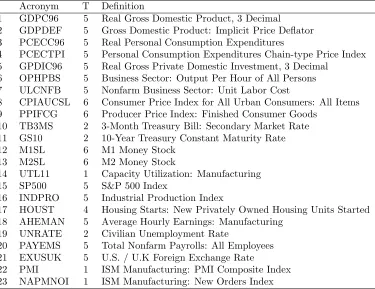
We apply the PPT and KP models to twenty-three quarterly series for the USA (listed in Table
1) which are among the most important macroeconomic variables. The sample period is 1959,
first quarter, till 2010, second quarter. As indicated in the table, we have transformed most
series to growth rates or first differences, and in this we are proceeding as in the literature,
see e.g. Stock and Watson (1996). We use AR(q) models in each regime, hence, Zt in (2)
contains an intercept and the first q lags of yt.
Details about prior densities and posterior evaluation are provided in Appendix A for PPT
models and in Appendix B for KP. Further discussion of the prior is given in Section 6.2.
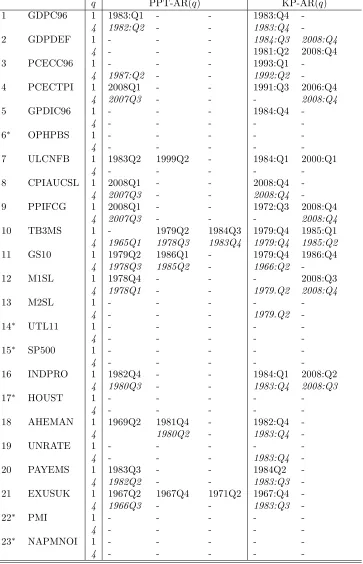
In Table 2 we report the break dates found in the PPT-AR(1) and AR(4) models (called
PPT1 and PPT4 hereafter), and similarly KP-AR(1) and AR(4) models (KP1 and KP4),
using the complete sample. In Table 3 we report the posterior means of the AR(1) equations
for each regime. The reported break dates are medians of posterior distributions and there is
some uncertainty (though not much) about these point estimates.
We do not find any break in six series (6, 14, 15, 17, 22, 23) both with PPT and KP
(irrespective of the lag order), and in four other series with PPT (series 2, 5, 13, 19), see
Table 2. No series has more than two breaks with KP, while only series 21 has three breaks
with PPT1. To a large extent, the break numbers and dates are robust with respect to the
lag order (1 or 4), keeping in mind that for dates we report posterior medians. This is much
less the case with respect to the type of model (PPT and KP). For example, even if three
series (4, 8, 9) have a break in the last three years of the sample according to both models,
KP detects more breaks of this type than PPT, see series 2, 12, and 16.
Thus there is evidence that macroeconomic series are subject to breaks since about three
quarters of our series have at least one break when modeled by structural break models. The
next obvious question is how large are the parameter changes when breaks occur and what
parameters are affected. Table 3 contains the posterior means of the parameters of the AR(1)
equations of each regime for each series, over the full sample period. Focusing on the series
with more than one regime (for PPT and KP), we observe that the most sensitive parameter
is the variance of the error term. It decreases substantially for some series in the first half
of the eighties, see the break in series 1, 7, 16, 18, and 20 with both models, and in series 5
with KP, corresponding to what has been named the great moderation (the decrease is about
seventy-five percent on average for these series). The error variance increases quite a lot in
2007 or 2008 for series 4, 8, 9 with PPT, and 2, 8, 9 and 16 with KP (see the last break).
These increases correspond to the great recession triggered by a widespread financial crisis.
Other cases are the reduction by half of the variance of series 3 in 1993, and the quadrupling
for series 7 in 2000. The interest rate series (10 and 11) witness also large changes: a tenfold
increase in 1979 corresponds to the beginning of the Volcker period at the Fed, which is
Table 1: Variables used in forecast evaluation
Acronym T Definition
1 GDPC96 5 Real Gross Domestic Product, 3 Decimal 2 GDPDEF 5 Gross Domestic Product: Implicit Price Deflator 3 PCECC96 5 Real Personal Consumption Expenditures
4 PCECTPI 5 Personal Consumption Expenditures Chain-type Price Index 5 GPDIC96 5 Real Gross Private Domestic Investment, 3 Decimal
6 OPHPBS 5 Business Sector: Output Per Hour of All Persons 7 ULCNFB 5 Nonfarm Business Sector: Unit Labor Cost
8 CPIAUCSL 6 Consumer Price Index for All Urban Consumers: All Items 9 PPIFCG 6 Producer Price Index: Finished Consumer Goods
10 TB3MS 2 3-Month Treasury Bill: Secondary Market Rate 11 GS10 2 10-Year Treasury Constant Maturity Rate
12 M1SL 6 M1 Money Stock
13 M2SL 6 M2 Money Stock
14 UTL11 1 Capacity Utilization: Manufacturing 15 SP500 5 S&P 500 Index
16 INDPRO 5 Industrial Production Index
17 HOUST 4 Housing Starts: New Privately Owned Housing Units Started 18 AHEMAN 5 Average Hourly Earnings: Manufacturing
19 UNRATE 2 Civilian Unemployment Rate
20 PAYEMS 5 Total Nonfarm Payrolls: All Employees 21 EXUSUK 5 U.S. / U.K Foreign Exchange Rate
22 PMI 1 ISM Manufacturing: PMI Composite Index
23 NAPMNOI 1 ISM Manufacturing: New Orders Index
T (transformation applied to original series): 1 = no transformation, 2 = first differ-ence, 4 = log, 5 = first difference of logged variables, 6 = second difference of logged variables. Sample period (after data transformation): 1959Q1-2010Q2 (206 observa-tions). Data source: St. Louis ALFRED database (http://alfred.stlouisfed.org).
In some series, the constant and the AR(1) coefficients change also, but less spectacularly
than the variance. This happens to the two interest rates. Keeping in mind that they are in
first differences, the changes of the coefficients (in particular the sign change of the constant)
around 1985 correspond to the start of a long period of decrease of interest rates. A change
of sign of the constant happens also in series 21 in the last quarter of 1967 (first break with
KP, second break with PPT). The British pound sterling came under pressure in the
mid-sixties since the exchange rate against the dollar was considered too high and was eventually
devalued by 14.3% to 2.40 on 18 November 1967. This suggests that the first break detected
Table 2: Break dates based on full sample
q PPT-AR(q) KP-AR(q)
1 GDPC96 1 1983:Q1 - - 1983:Q4
-4 1982:Q2 - - 1983:Q4
-2 GDPDEF 1 - - - 1984:Q3 2008:Q4
4 - - - 1981:Q2 2008:Q4
3 PCECC96 1 - - - 1993:Q1
-4 1987:Q2 - - 1992:Q2
-4 PCECTPI 1 2008Q1 - - 1991:Q3 2006:Q4
4 2007Q3 - - - 2008:Q4
5 GPDIC96 1 - - - 1984:Q4
-4 - - - -
-6∗ OPHPBS 1 - - - -
-4 - - - -
-7 ULCNFB 1 1983Q2 1999Q2 - 1984:Q1 2000:Q1
4 - - - -
-8 CPIAUCSL 1 2008Q1 - - 2008:Q4
-4 2007Q3 - - 2008:Q4
-9 PPIFCG 1 2008Q1 - - 1972:Q3 2008:Q4
4 2007Q3 - - - 2008:Q4
10 TB3MS 1 - 1979Q2 1984Q3 1979:Q4 1985:Q1
4 1965Q1 1978Q3 1983Q4 1979:Q4 1985:Q2
11 GS10 1 1979Q2 1986Q1 - 1979:Q4 1986:Q4
4 1978Q3 1985Q2 - 1966:Q2
-12 M1SL 1 1978Q4 - - - 2008:Q3
4 1978Q1 - - 1979.Q2 2008:Q4
13 M2SL 1 - - - -
-4 - - - 1979.Q2
-14∗ UTL11 1 - - - -
-4 - - - -
-15∗ SP500 1 - - - -
-4 - - - -
-16 INDPRO 1 1982Q4 - - 1984:Q1 2008:Q2
4 1980Q3 - - 1983:Q4 2008:Q3
17∗ HOUST 1 - - - -
-4 - - - -
-18 AHEMAN 1 1969Q2 1981Q4 - 1982:Q4
-4 1980Q2 - 1983:Q4
-19 UNRATE 1 - - - -
-4 - - - 1983:Q4
-20 PAYEMS 1 1983Q3 - - 1984Q2
-4 1982Q2 - - 1983:Q3
-21 EXUSUK 1 1967Q2 1967Q4 1971Q2 1967:Q4
-4 1966Q3 - - 1983:Q3
-22∗ PMI 1 - - - -
-4 - - - -
-23∗ NAPMNOI 1 - - - -
-4 - - - -
Table 3: Posterior means of AR(1) break models
S R PPT-AR(1) KP-AR(1) AR(1) full sample AR(1) last 40 data
c φ σ2 c φ σ2 c φ σ2 c φ σ2
1 1 0.55 0.30 1.12 0.62 0.28 1.10 0.52 0.32 0.69 0.19 0.49 0.36 2 0.39 0.46 0.32 0.38 0.45 0.29 - - - 0.51 0.29 0.26 2 1 0.12 0.87 0.09 0.14 0.87 0.10 0.11 0.87 0.09 0.33 0.41 0.09 2 - - - 0.24 0.35 0.04 - - - 0.29 0.58 0.03 3 - - - 0.23 -0.19 0.35 - - - -3 1 0.56 0.31 0.46 0.65 0.26 0.51 0.56 0.31 0.45 0.23 0.54 0.20
2 - - - 0.46 0.42 0.22 - - - 0.72 0.02 0.35 4 1 0.13 0.86 0.10 0.13 0.87 0.10 0.15 0.83 0.13 0.42 0.24 0.23 2 0.14 0.51 0.84 -0.09 0.01 0.64 - - - 0.40 0.49 0.08 3 - - - 0.20 0.10 0.45 - - - -5 1 0.07 0.18 0.21 0.10 0.10 0.30 0.07 0.18 0.21 -0.02 0.54 0.12
2 - - - 0.06 0.30 0.11 - - - 0.08 0.02 0.11 6∗ 1 0.56 -0.01 0.72 0.56 -0.01 0.71 0.57 -0.01 0.71 0.59 0.10 0.53
- - - 0.33 0.14 0.41 7 1 0.60 0.40 1.28 0.60 0.43 1.21 0.51 0.32 1.11 0.26 -0.14 1.01 2 0.47 0.14 0.33 0.47 0.14 0.33 - - - 0.55 0.08 0.34 3 0.39 -0.07 1.33 0.38 -0.07 1.35 - - - -8 1 0.00 -0.29 0.18 0.01 -0.30 0.18 -0.00 -0.30 0.27 -0.01 -0.35 0.76
2 -0.03 -0.30 2.69 -0.17 -0.30 3.62 - - - 0.00 -0.35 0.18 9 1 0.02 -0.38 1.08 0.03 -0.45 0.40 0.02 -0.32 1.69 0.05 -0.27 5.13 2 0.03 -0.30 19.08 0.02 -0.38 1.32 - - - 0.00 -0.37 1.65 3 - - - -0.16 -0.23 21.71 - - - -10 1 0.04 0.36 0.32 0.03 0.33 0.31 -0.01 0.23 0.57 -0.06 0.61 0.19
2 -0.01 0.25 3.80 -0.00 0.19 3.45 - - - 0.01 0.67 0.13 3 -0.03 0.55 0.14 -0.03 0.56 0.14 - - - -11 1 0.04 0.22 0.08 0.03 0.21 0.06 -0.00 0.23 0.23 -0.06 0.02 0.13
2 0.01 0.22 0,93 -0.02 0.24 0.22 - - - -0.05 0.38 0.23 3 -0.04 0.22 0.16 -0.05 0.20 0.15 - - - -12 1 0.01 -0.18 0.36 -0.00 -0.32 0.77 0.00 -0.30 0.96 0.05 -0.28 2.12
2 -0.00 -0.31 1.35 -0.04 -0.24 7.30 - - - -0.07 -0.11 0.94 13 1 -0.00 -0.15 0.48 -0.01 -0.15 0.46 -0.01 -0.15 0.47 -0.04 -0.16 0.79
- - - -0.05 -0.12 0.30
14∗ 1 0.25 0.97 0.02 0.26 0.97 0.02 0.25 0.97 0.02 0.42 0.94 0.02
- - - 0.45 0.95 0.01 15∗ 1 0.11 0.24 0.45 0.11 0.23 0.44 0.11 0.23 0.45 -0.04 0.36 0.67
- - - 0.28 -0.15 0.50
16 1 0.39 0.44 4.00 0.46 0.45 3.11 0.35 0.51 1.99 -0.00 0.70 1.23 2 0.21 0.67 0.85 0.25 0.61 0.69 - - - 0.33 0.54 0.62 3 - - - 0.05 0.76 2.90 - - - -17∗ 1 0.18 0.97 0.01 0.18 0.97 0.01 0.21 0.97 0.01 -0.27 1.03 0.01
- - - 0.63 0.91 0.01 18 1 0.83 0.14 0.40 0.72 0.52 0.40 0.38 0.65 0.26 0.63 0.04 0.07 2 1.00 0.47 0.26 0.55 0.22 0.07 - - - 0.49 0.28 0.07 3 0.58 0.19 0.08 - - - -19 1 0.01 0.64 0.07 0.01 0.64 0.07 0.01 0.65 0.07 0.03 0.74 0.07
- - - -0.02 0.70 0.03
20 1 0.14 0.76 0.17 0.15 0.76 0.17 0.08 0.83 0.10 -0.02 0.86 0.07 2 0.03 0.89 0.04 0.03 0.90 0.04 - - - 0.06 0.88 0.03 21 1 -0.00 0.20 0.00 -0.00 0.19 0.00 -0.02 0.26 0.17 0.00 0.41 0.19 2 -0.31 0.27 0.40 -0.03 0.26 0.20 - - - 0.05 0.14 0.35 3 0.01 0.12 0.00 - - - -4 -0.03 0.24 0.22 - - - -22∗ 1 0.89 0.83 0.16 0.96 0.82 0.15 1.01 0.81 0.15 0.93 0.82 0.13
- - - 0.95 0.82 0.07 23∗ 1 1.20 0.78 0.27 1.31 0.76 0.26 1.40 0.75 0.26 1.36 0.75 0.33
- - - 1.30 0.77 0.14
S = series number (see Table 2); R = regime number. Each AR(1) is written yt =
c+φyt−1+σǫt. Two estimations are reported in the block ”AR(1) last 40 data”: on the
4
Forecasting Implementation
In this section, we explain how we forecast with the PPT and KP models, and in sub-section
4.3 we review briefly the other models with which we generate alternative forecasts to be
compared with the forecasts coming from the break models.
The setup is the following: we shall carry out a recursive forecasting exercise for the final
α percent of the observations. This means that we first estimate the models with an initial
sample consisting of 1−αpercent of the data, and we forecast future observations. Then we add one data point, estimate and forecast again, until we have consumed all the data.
4.1 Forecasting with PPT
With the PPT approach, if one were to assume that no breaks occur out-of-sample, forecasting
could be done in a straightforward way based on the posterior density of the the parameters
of the regime that holds at the end of the estimation sample. Such an approach, of course,
does not address the issue of forecasting when breaks can occur out-of-sample. Appendix A
provides details about how predictive simulation is implemented for the PPT model.
To choose the number of breaks, we choose a maximum number of regimes,Kmax
, evaluate
the marginal likelihood forK= 1, .., Kmaxand select the optimal number of regimes as the one
which maximizes the marginal likelihood. However, in the context of a recursive forecasting
exercise, we wantKmaxto vary over time as the number of regimes can increase as time goes
by. Accordingly, we adopt the following strategy.
Using the initial sample of observations, we calculate the optimal number of regimes as
described in the preceding paragraph. Then we begin our recursive forecasting exercise. Let
Kt be the number of regimes in a model using data through time t. We compute marginal
likelihoods for Kt = {1, . . . , Kt∗−1 + 1} where Kt∗−1 is the optimal number of regimes at
t−1 and select K∗
t as the value that maximizes the marginal likelihood. We do this for
t = T0+ 1, . . . , T −h where T0 = αT. Marginal likelihoods are calculated as described in
Bauwens and Rombouts (2010), based on output from the posterior simulator.
We calculate two predictive densities, one which assumes no future break, and one of
which allows for a possible single break in the forecast period. The necessary details are given
4.2 Forecasting with KP
With the KP approach, dealing with out-of-sample structural breaks is straightforward.
Suppose regime j holds at the end of the estimation sample (called t) and, thus, st = j.
The posterior simulation algorithm produces Pr (st+1=j|Yt) and Pr (st+1 =j+ 1|Yt), where
Yt = (y1, .., yt)′. Furthermore, the posterior simulation algorithm provides us with draws
from p(βj, σj|Yt) and p(βj+1, σj+1|Yt). These are the components needed to do
forecast-ing with structural breaks. Appendix C provides details about how predictive simulation is
implemented for the KP model.
Defining the optimal number of regimes for each sample in our recursive forecasting
exer-cise is done in a way similar to the PPT model described previously, but without the need to
compute marginal likelihoods. Using output from the posterior simulator using data through
time t, we calculate the optimal number of breaks as K∗
t = median(Pr(st|data)), i.e. the median of the posterior of the state variable of the last observation.
In particular, we run the model for t=T0 (where T0 =αT) for a large number of breaks.
Then instead of using marginal likelihoods to estimate the optimal number of breaks at time
T0, we just use the estimate KT∗
0 =median(Pr(sT0|data)). In the next period (t=T0+ 1) we
estimate the KP model with KT0+1 breaks and forecast, where we define KT0+1 =K ∗
T0 + 1.
From the Gibbs sampler output we estimate K∗
T0+1 = median(Pr(sT0+1|data)). Then we
increase the observations by one (t=T0+ 2) and set KT0+2 =K ∗
T0+1+ 1 and so on.
In words, with number of observations t we always allow for one more break than the
optimal number of breaks estimated in the previous sample t−1. However, when we set the number of breaks using the formula Kt = Kt∗−1+ 1, this doesn’t necessarily mean that we
forecast with exactlyKt∗−1+ 1 breaks at timet. This is the maximum number of breaks. This
implies that it might be the caseK∗
t =Kt∗−1 so that the number of regimes we use to forecast
hasn’t changed. Therefore, as we progress at timet+ 1 we set Kt+1 =Kt∗+ 1 =Kt∗−1 + 1.
Nevertheless, if the optimal number of estimated regimes at time t has actually changed to
Kt∗ = Kt∗−1 + 1 (we discovered an additional break), then we ought to set at time t+ 1 a
maximum number of regimes Kt+1=Kt∗+ 1 =Kt∗−1+ 2.
4.3 Forecasting with Other Approaches
In addition to the forecasting methods of KP and PPT outlined above, we consider a variety
of other ”no-break” models.
Our first approach is a standard TVP-AR(1) model. This is a restricted special case of
the KP approach. That is, if we adopt the KP framework but set st=t for all time periods
(or equivalently,Kmax
t =tand Pr (st=t|st−1 =t−1) = 1 then we obtain the standard TVP
model which is of the form
yt = Ztβt+σtεt
βt = βt−1+ut (8)
log(σt) = log(σt−1) +vt
whereεt∼N(0,1),ut∼N(0, B0) andvt∼N(0, δ). Note that for this special case we need extra care in defining our priors, since the autoregressive coefficients evolve as random walks
for allt periods and they can easily become explosive. The priors we use for this model are
β0 ∼ Nm(0,4Im)
log(σ0) ∼ N(0,1)
B0−1 ∼ W ishart m+ 1,(0.001 2
(m+ 1)R)−1
δ−1 ∼ Gamma(1,0.1).
whereR is a diagonal matrix with elements R{1,1} = 5 for the intercept, and R{i, i}= 1/i
for lag lengthi= 1, ..., p. Forecasting in this model requires first to simulate the future paths
of the time-varying coefficients βt and log(σt) using their random walk specifications. Then
conditional on these simulated out-of-sample coefficients, we forecast yT+h as in a simple
regression model.
We also present recursive and rolling AR(q) forecasting results (with q set to one and
to four). Bayesian inference is used for these models using the same prior density as in the
PPT implementations if we allow for only a single regime. For the rolling forecasts we use
a window of ten years (forty observations). We tried a window of five years but the forecast
results are much deteriorated by this choice. A window of ten years seems reasonable since
different enough from the sample used with the recursive approach.4
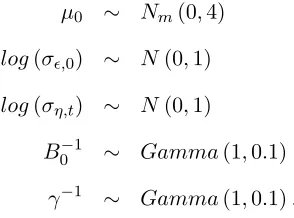
Finally we also use an unobserved component model with stochastic volatility (UC-SV).
We follow the formulation of Stock and Watson (2007), who specify a model with only a
time-varying trend (no AR dynamics), which takes the form
yt = µt+σǫ,tεt
µt = µt−1+ση,tηt (9)
log(σǫ,t) = log(σǫ,t−1) +vt
log(ση,t) = log(ση,t−1) +wt
where in this case, (εt, ηt)∼ N(0, I2), ut ∼N(0, γ1) and vt ∼N(0, γ2). For U.S. inflation,
Stock and Watson (2007) setγ1=γ2 = 0.2. We estimate these parameters and the priors we
use to forecast with this model are
µ0 ∼ Nm(0,4)
log(σǫ,0) ∼ N(0,1)
log(ση,t) ∼ N(0,1)
B0−1 ∼ Gamma(1,0.1)
γ−1 ∼ Gamma(1,0.1).
Forecasting in the above model is similar in spirit with the TVP and KP models. We first
need to simulate the future values of the time-varying parameters, and then plug in these
[image:18.595.227.374.376.485.2]simulated values in the first equation in 9.
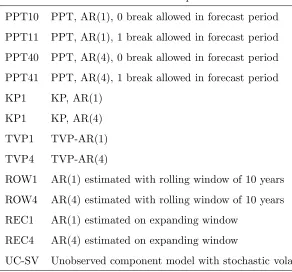
Table 4 lists the models used in the forecasting evaluations, with a short definition.
5
Results of Forecasting Evaluations
For each series listed in Table 1, we carry out a recursive forecasting exercise for the final thirty
percent of the observations: we first estimate the models with an initial sample consisting
of seventy percent of the data, and we forecast at the horizons h equal 1 and 4. Then we
Table 4: Models used in the forecasting evaluations
Name Description
PPT10 PPT, AR(1), 0 break allowed in forecast period
PPT11 PPT, AR(1), 1 break allowed in forecast period
PPT40 PPT, AR(4), 0 break allowed in forecast period
PPT41 PPT, AR(4), 1 break allowed in forecast period
KP1 KP, AR(1)
KP1 KP, AR(4)
TVP1 TVP-AR(1)
TVP4 TVP-AR(4)
ROW1 AR(1) estimated with rolling window of 10 years
ROW4 AR(4) estimated with rolling window of 10 years
REC1 AR(1) estimated on expanding window
REC4 AR(4) estimated on expanding window
UC-SV Unobserved component model with stochastic volatility
61 one-step and 58 four-step ahead forecasts on which we can base the forecast evaluations.
Forh > 1, our forecasts are all iterated (see, e.g., Marcellino, Stock, and Watson (2006) for
a motivation for use of iterated over direct forecasts).
Our forecast metrics are RMSE and the average of log predictive likelihoods (APL). RMSE
is based on point forecasts and we use the predictive median as point forecast. The predictive
likelihood is the predictive density evaluated at the observed outcome. This is estimated by
a nonparametric kernel smoother using draws from the predictive simulator.
For each series in Table 1, we provide in Appendix C the RMSE and APL values from the
recursive forecasting exercise. For one-step ahead forecasts, see Tables 13 (RMSE) and 15
(APL) and for four-step ahead forecasts see Tables 14 and 16. We report the relative values,
with the model in the last column (UC-SV) serving as reference.
The RMSE/APL values for the reference model are reported to fix their order of
mag-nitude. For example, in Table 13, we see that for the UC-SV model and the first series,
PPT11 has a RMSE 1.1 percent lower than the UC-SV model. For each series, the smallest
(for RMSE) or largest (for APL) value across all models is in bold. If this global minimum is
in the set of break models, the value in italics is the minimum across the no-break models.5
If the global minimum is in the latter group, the value in italics is the minimizer across the
break models.
We discuss the results based on the RMSE criterion in subsection 5.1, and in subsection
5.2 the results based on the APL criterion. Generally, we are interested in three questions:
Question 1: How does the forecasting performance differ between break models and
no-break models?
Question 2: How does the forecasting performance differ between PPT, KP, and TVP?
Question 3: How does the forecasting performance differ between lag orders?
5.1 RMSE Results
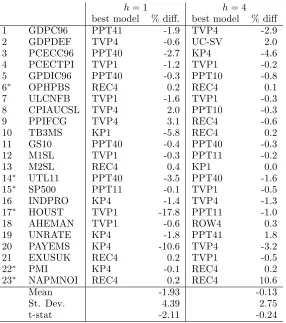
To summarize the contents of Tables 13 and 14, we provide in Table 5 the list of the best
model for each series, together with the relative performance of the best break model with
respect to the best no-break model. It appears that according to the RMSE criterion, at
horizon one, the break models are the best in 83 percent of all series (26 for PPT, 22 for
KP1, and 35 for TVP1). At horizon four, the break models forecast better in 70 percent (30
for PPT1, 10 for KP1, and 30 for TVP1). REC is best for four series at horizon one and
five at horizon four, ROW is best only for one series at horizon four, and UC-SV as well.
These scores do not take account of the magnitude of the differences of the RMSE between
the different models (for this see below). Though there are many cases where the best model
differs between horizons one and four, a switch between a break model and a no-break one
happens in seven series on a total of twenty-three.
With the results in Tables 5–13-14, we can answer to our questions about the forecasting
performance of the different models.
Question 1: To answer, we compare the best break model RMSE value to the best no-break
best break (no-break) model has its RMSE three percent smaller (larger) than the RMSE of
the best no-break (break) model. Although for a high proportion of the series the differences
are negative, they are nevertheless small, by what we mean they are less than five percent
(often much less). Exceptions are, at horizon one, series 10 (-6 for KP1), 17 (-18 for TVP1),
and 20 (-11 for KP4). At horizon four, one difference is larger than 5 (series 10, +11 for
REC4). A test for the nullity of the mean of the differences is significant at the five percent
level for horizon one, but not for horizon four. In brief, there is some weak evidence in our
[image:21.595.162.448.337.660.2]results that break models perform a little better than no-break models.
Table 5: Relative performance of best forecasting models on last thirty percent of sample
(Root mean squared error criterion)
h= 1 h= 4
best model % diff. best model % diff
1 GDPC96 PPT41 -1.9 TVP4 -2.9
2 GDPDEF TVP4 -0.6 UC-SV 2.0
3 PCECC96 PPT40 -2.7 KP4 -4.6
4 PCECTPI TVP1 -1.2 TVP1 -0.2
5 GPDIC96 PPT40 -0.3 PPT10 -0.8
6∗ OPHPBS REC4 0.2 REC4 0.1
7 ULCNFB TVP1 -1.6 TVP1 -0.3
8 CPIAUCSL TVP4 2.0 PPT10 -0.3
9 PPIFCG TVP4 3.1 REC4 -0.6
10 TB3MS KP1 -5.8 REC4 0.2
11 GS10 PPT40 -0.4 PPT40 -0.3
12 M1SL TVP1 -0.3 PPT11 -0.2
13 M2SL REC4 0.4 KP1 0.0
14∗ UTL11 PPT40 -3.5 PPT40 -1.6
15∗ SP500 PPT11 -0.1 TVP1 -0.5
16 INDPRO KP4 -1.4 TVP4 -1.3
17∗ HOUST TVP1 -17.8 PPT11 -1.0
18 AHEMAN TVP1 -0.6 ROW4 0.3
19 UNRATE KP4 -1.8 PPT41 1.8
20 PAYEMS KP4 -10.6 TVP4 -3.2
21 EXUSUK REC4 0.2 TVP1 -0.5
22∗ PMI KP4 -0.1 REC4 0.2
23∗ NAPMNOI REC4 0.2 REC4 10.6
Mean -1.93 -0.13
St. Dev. 4.39 2.75
t-stat -2.11 -0.24
Source: results in Tables 13-14. See Table 4 for definitions of mod-els. The ”%diff” are computed as [(smallest RMSE across the break models/smallest RMSE across the no-break models)-1]x100.
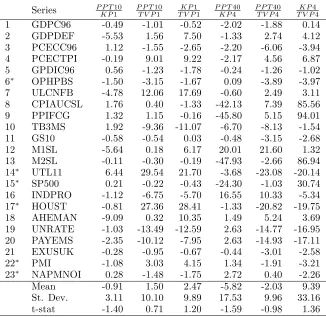
are shown in Table 6. For example, the value -0.49 of series 1 for a comparison of PPT10
and KP1 means that PPT10 is performing better than KP1 by almost half a percent. Means
and standard deviations are given at the bottom of each column. The results show that for
most series the differences are small, and there are a few cases where they are large. On
average, at horizon one, PPT performs slightly better than KP, and TVP better than the
other two models. At horizon four, PPT performs better on average than the other two
models, and TVP dominates KP. Nevertheless given the large standard deviations due to a
[image:22.595.139.465.335.652.2]few large differences, no mean is significant even at the ten percent level.
Table 6: Performance comparison of break models on last thirty percent of sample
(Root mean squared error criterion)
Series P P T10
K P1
P P T10
T V P1
K P1
T V P1
P P T40
K P4
P P T40
T V P4
K P4
T V P4
1 GDPC96 -0.49 -1.01 -0.52 -2.02 -1.88 0.14
2 GDPDEF -5.53 1.56 7.50 -1.33 2.74 4.12
3 PCECC96 1.12 -1.55 -2.65 -2.20 -6.06 -3.94
4 PCECTPI -0.19 9.01 9.22 -2.17 4.56 6.87
5 GPDIC96 0.56 -1.23 -1.78 -0.24 -1.26 -1.02
6∗ OPHPBS -1.50 -3.15 -1.67 0.09 -3.89 -3.97
7 ULCNFB -4.78 12.06 17.69 -0.60 2.49 3.11
8 CPIAUCSL 1.76 0.40 -1.33 -42.13 7.39 85.56
9 PPIFCG 1.32 1.15 -0.16 -45.80 5.15 94.01
10 TB3MS 1.92 -9.36 -11.07 -6.70 -8.13 -1.54
11 GS10 -0.58 -0.54 0.03 -0.48 -3.15 -2.68
12 M1SL -5.64 0.18 6.17 20.01 21.60 1.32
13 M2SL -0.11 -0.30 -0.19 -47.93 -2.66 86.94
14∗ UTL11 6.44 29.54 21.70 -3.68 -23.08 -20.14
15∗ SP500 0.21 -0.22 -0.43 -24.30 -1.03 30.74
16 INDPRO -1.12 -6.75 -5.70 16.55 10.33 -5.34
17∗ HOUST -0.81 27.36 28.41 -1.33 -20.82 -19.75
18 AHEMAN -9.09 0.32 10.35 1.49 5.24 3.69
19 UNRATE -1.03 -13.49 -12.59 2.63 -14.77 -16.95
20 PAYEMS -2.35 -10.12 -7.95 2.63 -14.93 -17.11
21 EXUSUK -0.28 -0.95 -0.67 -0.44 -3.01 -2.58
22∗ PMI -1.08 3.03 4.15 1.34 -1.91 -3.21
23∗ NAPMNOI 0.28 -1.48 -1.75 2.72 0.40 -2.26
Mean -0.91 1.50 2.47 -5.82 -2.03 9.39
St. Dev. 3.11 10.10 9.89 17.53 9.96 33.16
t-stat -1.40 0.71 1.20 -1.59 -0.98 1.36
Source: results in Tables 13-14. See Table 4 for definitions of models. The values for column header A
B are computed as [(RMSE of model A/RMSE of
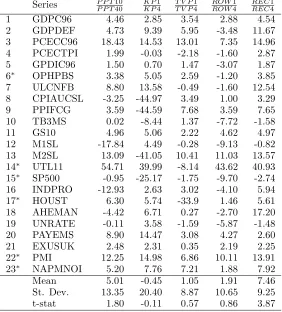
are reported in Table 7. These results indicate that the models with four lags perform a
little better than those with one lag, maybe not a surprise for quarterly data. However, the
differences are significant at the ten percent level on average only for PPT and REC.
Another question of interest is whether allowing for a possible single break (rather than no
break) in the forecast period makes a difference in the PPT approach. Pesaran, Pettenuzzo,
and Timmermann (2006) found on their example (a single series) that this decreases RMSE at
all horizons on their full sample and on several subsamples. We don’t find this to be significant
on average for our series with one lag (t-stat−0.05 at horizon 1 and 0.81 at horizon four), but with four lags there is some evidence in favor of allowing for a possible break: the performance
is improved on average by 0.49 percent at horizon 1 (t-stat 1.91) and by 2 percent at horizon
four (t-stat 1.75).
5.2 APL Results
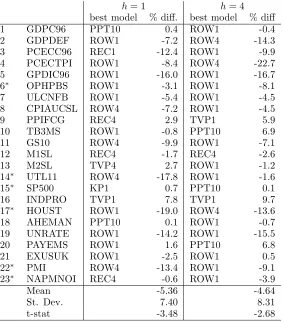
We summarize the contents of Tables 15 and 16 in Table 8 where we list the best model for
each series, together with the relative performance of the best break model with respect to
the best no-break model. It appears that according to the APL criterion, at horizon one,
the break models are the best in 22 percent of all series (9 for PPT, 4 for KP1, and 9 for
TVP1). At horizon four, the break models forecast better also in 22 percent (13 for PPT1, 0
for KP1, and 9 for TVP1). ROW is the best at horizon one for fourteen series (61 percent)
and seventeen (74 percent) at horizon four. REC is the best for four series at horizon one
and one at horizon four, and UC-SV is dominated by all other models. These scores do not
take account of the magnitude of the differences of the APL between the different models
but suggest that ROW is by far dominating the other models (for this see question 1 below).
Though there are many cases where the best model differs between horizons one and four,
a switch between a break model and a no-break model happens in six series on a total of
twenty-three.
With the results in Tables 8–15-16, we can answer to our questions about the forecasting
performance of the different models.
Question 1: To answer, we compare the best break model APL value to the best no-break
model value, see columns ”% diff.” in Table 8. For example, a value of +4 (-4) means that
no-Table 7: Performance comparison of lag orders on last thirty percent of sample
(Root mean squared error criterion)
Series P P T10
P P T40
K P1
K P4
T V P1
T V P4
ROW1
ROW4
REC1
REC4
1 GDPC96 4.46 2.85 3.54 2.88 4.54
2 GDPDEF 4.73 9.39 5.95 -3.48 11.67
3 PCECC96 18.43 14.53 13.01 7.35 14.96
4 PCECTPI 1.99 -0.03 -2.18 -1.60 2.87
5 GPDIC96 1.50 0.70 1.47 -3.07 1.87
6∗ OPHPBS 3.38 5.05 2.59 -1.20 3.85
7 ULCNFB 8.80 13.58 -0.49 -1.60 12.54
8 CPIAUCSL -3.25 -44.97 3.49 1.00 3.29
9 PPIFCG 3.59 -44.59 7.68 3.59 7.65
10 TB3MS 0.02 -8.44 1.37 -7.72 -1.58
11 GS10 4.96 5.06 2.22 4.62 4.97
12 M1SL -17.84 4.49 -0.28 -9.13 -0.82
13 M2SL 13.09 -41.05 10.41 11.03 13.57
14∗ UTL11 54.71 39.99 -8.14 43.62 40.93
15∗ SP500 -0.95 -25.17 -1.75 -9.70 -2.74
16 INDPRO -12.93 2.63 3.02 -4.10 5.94
17∗ HOUST 6.30 5.74 -33.9 1.46 5.61
18 AHEMAN -4.42 6.71 0.27 -2.70 17.20
19 UNRATE -0.11 3.58 -1.59 -5.87 -1.48
20 PAYEMS 8.90 14.47 3.08 4.27 2.60
21 EXUSUK 2.48 2.31 0.35 2.19 2.25
22∗ PMI 12.25 14.98 6.86 10.11 13.91
23∗ NAPMNOI 5.20 7.76 7.21 1.88 7.92
Mean 5.01 -0.45 1.05 1.91 7.46
St. Dev. 13.35 20.40 8.87 10.65 9.25
t-stat 1.80 -0.11 0.57 0.86 3.87
Source: results in Tables 13-14. See Table 4 for definitions of mod-els. The values for column header A
B are computed as [(RMSE of
[image:24.595.161.443.280.592.2]Table 8: Relative performance of best forecasting models on last thirty percent of sample
(Average predictive likelihood criterion)
h= 1 h= 4
best model % diff. best model % diff
1 GDPC96 PPT10 0.4 ROW1 -0.4
2 GDPDEF ROW1 -7.2 ROW4 -14.3
3 PCECC96 REC1 -12.4 ROW1 -9.9
4 PCECTPI ROW1 -8.4 ROW4 -22.7
5 GPDIC96 ROW1 -16.0 ROW1 -16.7
6∗ OPHPBS ROW1 -3.1 ROW1 -8.1
7 ULCNFB ROW1 -5.4 ROW1 -4.5
8 CPIAUCSL ROW4 -7.2 ROW1 -4.5
9 PPIFCG REC4 2.9 TVP1 5.9
10 TB3MS ROW1 -0.8 PPT10 6.9
11 GS10 ROW4 -9.9 ROW1 -7.1
12 M1SL REC4 -1.7 REC4 -2.6
13 M2SL TVP4 2.7 ROW1 -1.2
14∗ UTL11 ROW4 -17.8 ROW1 -1.6
15∗ SP500 KP1 0.7 PPT10 0.1
16 INDPRO TVP1 7.8 TVP1 9.7
17∗ HOUST ROW1 -19.0 ROW4 -13.6
18 AHEMAN PPT10 0.1 ROW1 -0.7
19 UNRATE ROW1 -14.2 ROW1 -15.5
20 PAYEMS ROW1 1.6 PPT10 6.8
21 EXUSUK ROW1 -2.5 ROW1 0.5
22∗ PMI ROW4 -13.4 ROW1 -9.1
23∗ NAPMNOI REC4 -0.6 ROW1 -3.9
Mean -5.36 -4.64
St. Dev. 7.40 8.31
t-stat -3.48 -2.68
Source: results in Tables 15-16. See Table 4 for definitions of mod-els. The ”%diff” are computed as [(largest APL across the break models/largest APL across the no-break models)-1]x100.
break (break) model. At horizon one, the differences are larger than five percent in absolute
value for twelve series, and only for one (series 16) the difference is positive. At horizon four,
nine differences are smaller than minus five percent and four are larger than five percent. A
test for the nullity of the mean of the differences is significant at the one percent level for both
horizons. In brief, there is strong evidence in our results that the no-break models (especially
ROW) perform much better than break models, though there are a few exceptions (series 16
at both horizons, series 9, 10 and 20 at horizon four).
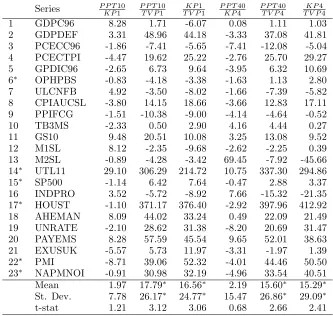
Question 2: The relative differences (in percent) between the APL of the different models
KP1 means that PPT10 is performing better than KP1 by a little more than 8 percent. The
differences vary a lot, and there are a few cases where they are very large. On average, at
both horizons, PPT performs slightly better than KP but not significantly even at the ten
[image:26.595.134.467.255.571.2]percent level, and TVP is significantly dominated by the other two models.
Table 9: Performance comparison of break models on last thirty percent of sample
(Average predictive likelihood criterion)
Series P P T10
K P1
P P T10
T V P1
K P1
T V P1
P P T40
K P4
P P T40
T V P4
K P4
T V P4
1 GDPC96 8.28 1.71 -6.07 0.08 1.11 1.03
2 GDPDEF 3.31 48.96 44.18 -3.33 37.08 41.81
3 PCECC96 -1.86 -7.41 -5.65 -7.41 -12.08 -5.04
4 PCECTPI -4.47 19.62 25.22 -2.76 25.70 29.27
5 GPDIC96 -2.65 6.73 9.64 -3.95 6.32 10.69
6∗ OPHPBS -0.83 -4.18 -3.38 -1.63 1.13 2.80
7 ULCNFB 4.92 -3.50 -8.02 -1.66 -7.39 -5.82
8 CPIAUCSL -3.80 14.15 18.66 -3.66 12.83 17.11
9 PPIFCG -1.51 -10.38 -9.00 -4.14 -4.64 -0.52
10 TB3MS -2.33 0.50 2.90 4.16 4.44 0.27
11 GS10 9.48 20.51 10.08 3.25 13.08 9.52
12 M1SL 8.12 -2.35 -9.68 -2.62 -2.25 0.39
13 M2SL -0.89 -4.28 -3.42 69.45 -7.92 -45.66
14∗ UTL11 29.10 306.29 214.72 10.75 337.30 294.86
15∗ SP500 -1.14 6.42 7.64 -0.47 2.88 3.37
16 INDPRO 3.52 -5.72 -8.92 7.66 -15.32 -21.35
17∗ HOUST -1.10 371.17 376.40 -2.92 397.96 412.92
18 AHEMAN 8.09 44.02 33.24 0.49 22.09 21.49
19 UNRATE -2.10 28.62 31.38 -8.20 20.69 31.47
20 PAYEMS 8.28 57.59 45.54 9.65 52.01 38.63
21 EXUSUK -5.57 5.73 11.97 -3.31 -1.97 1.39
22∗ PMI -8.71 39.06 52.32 -4.01 44.46 50.50
23∗ NAPMNOI -0.91 30.98 32.19 -4.96 33.54 40.51
Mean 1.97 17.79∗ 16.56∗ 2.19 15.60∗ 15.29∗
St. Dev. 7.78 26.17∗ 24.77∗ 15.47 26.86∗ 29.09∗
t-stat 1.21 3.12 3.06 0.68 2.66 2.41
Source: results in Tables 15-16. See Table 4 for definitions of models. The values for column header A
B are computed as [(APL of model A/APL of model
B)-1]x100. Means and standard deviations with a∗superscript are computed
excluding the values for series 14 and 17.
Question 3: The relative differences (in percent) between the RMSE of the different models
are reported in Table 7. On average models with four lags do not perform better than models
Allowing for one break deteriorates the performance on average: with one lag by 0.68 percent
at horizon one (t-stat −5.29) and 5.42 percent at horizon four (t-stat −6.65); with four lags by 0.93 percent at horizon one (t-stat −6.05) and 8.40 percent at horizon four (t-stat 14.4). This is is explained by the increase of the predictive variances when one break is allowed,
[image:27.595.160.443.274.594.2]while the predictive means do not change much as witnessed by the RMSE results.
Table 10: Performance comparison of lag orders on last thirty percent of sample
(Average predictive likelihood criterion)
Series P P T10
P P T40
K P1
K P4
T V P1
T V P4
ROW1
ROW4
REC1
REC4
1 GDPC96 4.36 -3.54 3.75 5.41 -1.57
2 GDPDEF 7.34 0.43 -1.22 0.80 -4.74
3 PCECC96 -4.93 -10.31 -9.73 -7.72 -4.16
4 PCECTPI -5.97 -4.29 -1.19 4.55 -6.49
5 GPDIC96 3.27 1.89 2.87 4.61 -1.80
6∗ OPHPBS -2.70 -3.48 2.69 2.74 -3.98
7 ULCNFB 2.43 -4.00 -1.70 4.75 -7.28
8 CPIAUCSL -5.73 -5.58 -6.82 -3.42 -8.66
9 PPIFCG -2.48 -5.09 3.77 -2.42 -4.42
10 TB3MS 1.73 8.49 5.71 5.43 -3.27
11 GS10 1.03 -4.73 -5.21 -2.64 -2.10
12 M1SL 6.39 -4.17 6.50 6.41 -1.69
13 M2SL -7.51 58.12 -11.03 -5.85 -8.81
14∗ UTL11 -7.43 -20.59 -0.36 -19.11 -21.82
15∗ SP500 3.99 4.69 0.54 3.33 2.86
16 INDPRO 11.49 15.95 0.14 7.18 -7.98
17∗ HOUST -1.42 -3.23 4.18 1.49 -2.75
18 AHEMAN 12.61 4.69 -4.54 1.50 -16.72
19 UNRATE 6.24 -0.39 -0.32 6.15 1.41
20 PAYEMS 9.17 10.55 5.30 3.91 -3.60
21 EXUSUK 7.73 10.31 -0.11 6.83 0.57
22∗ PMI -7.62 -2.87 -4.03 -6.47 -10.15
23∗ NAPMNOI -1.09 -5.13 0.84 3.85 -5.43
Mean 1.34 1.64 -0.43 0.92 -5.33
St. Dev. 6.26 14.52 4.74 6.25 5.54
t-stat 1.03 0.54 -0.44 0.71 -4.61
Source: results in Tables 15-16. See Table 4 for definitions of mod-els. The values for column header A
B are computed as [(APL of
model A/APL of model B)-1]x100.
5.3 Discussion of Previous Results
For the APL criterion and the last thirty percent of the sample that serves as forecast period,
break models. For the RMSE criterion, we find some weak evidence in favor of break models.
Why this difference?
The APL criterion takes into account the whole shape of the predictive density. This
is not normal despite the assumption of normality (conditional on the parameters), because
it is integrated with respect to a posterior distribution that is not symmetric. However our
predictive densities are very moderately skewed since we forecast at short horizons. Therefore,
we can summarize the shape of our predictive by their standard deviation. The RMSE results
indicate that in terms of the location of the point forecasts in the support of the predictive
densities, the two kinds of models (break/no-break) are roughly equivalent on average (of
course, individual exceptions occur). Thus logically the differences in the APL results must
be (at least partly) due to differences in the standard deviation of the predictive densities. In
the results, we find some weak evidence that supports our explanation.
Our rationale uses estimation results reported in Table 3 for the PPT- and KP-AR(1)
models and also for the no-break AR(1) models estimated with an expanding window (AR(1)
full sample header, named REC hereafter) and a rolling window of forty observations (AR(1)
last forty data, named ROW1 hereafter). For the latter, in the last three columns of the table,
we report two sets of point estimates: on the first row the estimates are computed with the
last forty observations of the full sample, on the second row (in italics), they are computed
with the last forty observations of the sample that ends just before the forecast period begins
(1995). We call the latter the pre-forecast sample. For example, for series 1, the posterior
expectation of the error variance is equal to 0.36 for the last forty observations of the full
sample, 0.26 for the pre-forecast sample, and 0.69 for the full sample.
If we compare the pre-forecast ROW1 variance estimates with those of the regime
gener-ating the PPT and KP forecasts, we find that for most series the ROW1 estimate is smaller
than the PPT, KP, or even REC estimates.6
This is nothing else but the effect of the great
moderation. Since the variance of the error determines to a large extent the predictive
vari-ance, we expect that that for the series witnessing this effect, the predictive densities are more
concentrated when based on estimates using essentially data in that period than using data
starts in the mid-eighties and our forecast period starts about ten years later). Thus for an
observation that is not far from the mean, the predictive density of ROW1 should be larger
than the predictive of PPT, if the predictive densities have similar means. For an observation
far in the tails, the reverse is true. We indeed observe this on many graphs of predictive
densities. Hence if the observations of the forecast sample are not outliers in the predictive,
and the predictive of both models have approximately the same mean at every date, the APL
of ROW1 should be larger than the APL of PPT.7
To be concrete on this, let us compare the σ2
estimate that is effective at the beginning
of the forecast period from PPT-AR(1) with the σ2 estimate from the AR(1) model on the
pre-forecast period. The error variance estimates of AR(1) models are smaller on average
by 17.45 percent (t-stat −2.42). A comparison of the APL values reveals that they increase on average by 8.91 percent (t-stat. 4.25) at horizon one, and by 8.42 percent (t-stat 3.26)
at horizon four. The correlation coefficients between the series of percentage changes of the
variances and of the APL are, as expected, negative:−0.21 (t-stat −0.98) for horizon one, and −0.29 (t-stat−1.41) for horizon four. These negative correlations support our previous explanation of why ROW1 performs better than PPT in terms of APL, though they are
not much significant statistically (the p-values of the t-statistics are 0.33 and 0.17). Similar
computations with KP-AR(1) instead of PPT10-AR(1) give similar results, with correlations
of −0.21 (t-stat−0.72) at horizon one and−0.14 (t-stat−2.01) at horizon four.
6
Sensitivity Analyses
We perform two sensitivity checks. The first is with respect to the forecast period: we focus
on the last three years of data, starting in 2007, quarter three, which corresponds more or
less to the beginning of the great recession, until the end of the sample. The second check
7A similar argument applies if we compare the APL of PPT10 and PPT11 (and also PPT40 with PPT41).
concerns the influence of the prior used in the break models.
6.1 Forecast performance since the middle of 2007
These results were obtained with the same prior as in the previous section. We focus on
ques-tion 1 since for the other quesques-tions the previous answers are unchanged, with the excepques-tion
that for question 2, using the RMSE criterion, PPT performs significantly better on average
than KP at both horizons.
For the RMSE criterion, break models perform better than no-break models in about
eighty percent of series at both horizons and on average (see the negative means in Table 11).
These differences are significant on average at the five percent level, as the t-statistics in the
table reveal. This is stronger than in the results for the last thirty percent of the sample (see
subsection 5.1).
For the APL criterion, we find that break models perform better than no-break models
in about fifty percent of series at horizon 1, and the (slightly negative) mean difference is
not significant. At horizon four, break models dominate in about eighty percent of series and
the mean difference (of almost +12 percent) is significant at the one percent level. These
conclusions are different from what we found for the last thirty percent of the sample, where
the no-break models, especially ROW, were clearly the winners (see subsection 5.2).
We can explain the improved performance of the break models with respect to ROW
for the last twelve observations by the same argument as in subsection 5.3, but reversed.
Estimated error variances (by ROW) increase at the end of the sample8
due to the impact of
the financial crisis, while break models do not capture this as much (few series have a break
around mid-2007).
6.2 Impact of the prior for break models
In Bayesian inference, it is good practice to assess the sensitivity of the results with respect
to the informative content of the prior. Thus we have computed again all the results with
different sets of prior hyperparameters, one implying a more informative prior (PRIOR M),
Table 11: Performance comparison on last twelve observations
RMSE APL
% diff. h= 1 h= 4 h= 1 h= 4 Mean -15.8 -8.51 -0.12 11.96 t-stat -2.40 -2.19 -0.07 3.58
Source: results available on request. Mean is the mean of percentage differences of the series.
of PRIOR I are given in Appendix A for the PPT model and in Appendix B for the KP
model.
All our priors (M, I, L) imply that the unconditional prior expectations are equal to
zero for the regression coefficients of the AR(1) or AR(4) equations in each regime since
E(βj) =E[E(βj|β0)] =E(β0) and the latter is set to zero. They imply non-existing second
moments for the regression coefficients because V ar(βj) =V ar[E(βj|β0)] +E[V ar(βj|β0)] =
V ar(β0) +E(B0) andE(B0) is not finite due to setting the degrees of freedom of the Wishart
prior to m+ 1, withm= 2 for AR(1) and 5 for AR(4). However V ar(β0) is set tocIm with
c = 1 in PRIOR I and by changing the value of c, we can change the tightness of the prior
on the regression coefficients.
In PRIOR L, we setc= 100, implying standard deviations equal to 10 forβ0, that is ten
times larger than the corresponding value in PRIOR I (which has c = 1). We are also less
informative on error variances of AR equations by setting ρ= 0.01 and d= 0.01 (instead of
0.1 for both in PRIOR I) in the PPT model. In the KP model, we setVω = 100 (instead of
1) andκ1=κ2 = 0.01 (instead of 0.5).
In PRIOR M, we setc= 0.01Im, implying a more precise prior (with standard deviations
of 0.1) than in PRIOR I. For the other parameters of the prior, the values are the same as in
PRIOR I.
Computed by simulation, the highest prior density interval of ninety percent level for
each regression coefficient is equal to (−17,+17) for PRIOR L, (−3.9,+3.9) for PRIOR I, and (−2.6,+2.6) for PRIOR M. Notice that if c is set to a smaller value than 0.01, the last interval does not shrink due to the E(B0) term that is not finite. Compared to the