UCD GEARY INSTITUTE
DISCUSSION PAPER SERIES
Explaining Variations in Patterns of Fiscal Consolidation
Sebastián Dellepiane-Avellaneda
School of Politics and International Relations, University College Dublin.
Niamh Hardiman
School of Politics and International Relations, University College Dublin.
This paper was presented at the 5thECPR General Conference in Potsdam, September 2009 (Section 9. Political Economy: Shifting Boundaries Between the Economic and the Political. Panel 185. The Political Economy of Macroeconomic Stabilization)
Abstract
The comparative study of debt and fiscal consolidation has acquired a new focus with
the re-emergence of debt as a major problem consequent upon the global financial
crisis. This leads us to re-evaluate the literature on fiscal consolidation that flourished
during the 1980s and 1990s. We identify two broad schools of analysis, one which
segments episodes of fiscal change into discrete observations, the other comparing
budget profiles at two points in time. We argue that both strategies miss the dynamic
features of government strategy, especially in the choices made between
expenditure-based and revenue-expenditure-based fiscal consolidation strategies. We propose a focus on
pathways rather than episodes of adjustment, to recapture what Pierson terms ‘politics
in time’. We draw on classical explanatory tools of comparative political economy,
including structures of interest intermediation, the role of ideas in shaping the set of
feasible policy choices, and the situation of national economies in the international
political economy. We support our argument with qualitative data based on paired
Introduction
Fiscal consolidation emerges as a problem for European societies in different forms
over time. The imperative of domestic stabilization in the aftermath of the crises of the
1970s meant that deficit reduction policies dominated the political agenda during the
1980s. During the 1990s, the politics of fiscal discipline was given additional impetus
by the adoption by many countries of the Maastricht convergence criteria, which placed
debt exposure centre-stage. The combination of increasing capital mobility and the
institutionalisation of macroeconomic discipline at both the national and EU levels was
supposed to enforce good governance in the management of fiscal affairs. However, the
disciplines required to qualify for EMU were not necessarily maintained once the Euro
was adopted. Country-specific targets for a one-off qualification decision were replaced
by common-pool obligations with more diffuse sanctions, and spread over iterated
budget processes. Moreover, the current economic downturn is putting immense and
unexpected pressure on governments’ fiscal balances. As a result, fiscal deficits in many
European countries are likely to reach unprecedented levels in the near future. Fiscal
adjustment is bound to become, once again, an urgent political priority for many
countries over the next decade.
One of the central issues in fiscal consolidation concerns the composition of the
adjustment, that is, whether governments seek to reduce deficits and cut debts by raising
taxes or cutting expenditure, or indeed relying on growth to lift the public finances out
of difficulty. Despite commonality in pressures and incentives, we observe a great deal
of variation not only in countries’ performance at any one moment, but in the trajectory
of change over time. Even when the combination of external and domestic factors
enforced a low-deficit equilibrium, the process can be characterized as a non-convergent
convergence. As McNamara argues, the rule-based constraint of EMU and the
market-based constraint of the global economy have induced overall convergence in
budget-deficit levels, but have produced ‘neither a race to the bottom nor a convergence in the
composition of fiscal policy’ (McNamara 2003, p.333). European countries achieved
balanced budgets in the late 1990s by following different pathways of fiscal
However, this has not been fully accounted for in the existing literature. Two main
comparative analytical strategies prevail. The dominant trend is work by economists
such as Alesina and Perotti, and political scientists such as Hallerberg and von Hagen,
among others. This breaks countries’ experiences into multiple discrete episodes of
fiscal consolidation, measured in terms of change in the fiscal situation between one
time period and the next (Alesina and Perotti 1995a; Hallerberg et al. 2007; Perotti
1998). This research strategy has generated important insights into the main
determinants of the stability and duration of fiscal consolidation strategies, and has
yielded useful hypotheses to guide further research endeavour. The recent work of
Mulas-Granados is perhaps the most thorough and sophisticated contribution to this
literature, drawing on an extensive range of economic, political, and institutional
explanatory variables (Mulas-Granados 2006). An alternative approach is that adopted
by Frank Castles and his colleagues, where the strategy is to compare observations at
two points in time (Castles 2007a). The principal emphasis here is on change in the
main components of public spending, particularly shifts in social transfer spending on
the one hand and non-transfer spending on the other; and shifts in the size of the deficit
and volume of accumulated debt. This innovative work provides an alternative set of
insights into the choices made across countries in deciding where the weight of
adjustment is to fall, across the range of spending commitments of modern
governments. Again, this analytical strategy relies upon quantitative indicators and
formal analysis to evaluate explanations.
This paper takes issue with both of these standard ways of analysing the politics of
fiscal consolidation. Firstly, we wish to renew the question of how best to capture the
dynamics of countries’ adjustment paths. Breaking down the dependent variable into
discrete episodes of fiscal adjustment yields large numbers of observations. But some
countries have many of these episodes, others have relatively few. Not only is fiscal
discipline institutionalized in different ways across countries, but the underlying
propensity to incur debt exposure appears to vary too. We need to understand
trajectories across time as well as episodes within time or comparisons of two points in
time. Situating ‘politics in time’ is a demanding but necessary research agenda (Pierson
function of the institutional design of the political system, or of the technical incentives
and constraints facing decision-makers. It is also at the heart of politics itself (Levi
1988; Skocpol 1985; Steinmo 1993). How and to what degree taxes are raised is at the
core of political life; how the fiscal bargain is struck between who pays and who
benefits is the very stuff of democracy itself. Budgets are therefore inseparable from
distributive politics, broadly conceived. How potentially conflicting interests are
organized and represented, how and to what degree they are inserted into the
decision-making process, may be vitally important for understanding the process as well as the
outcome of fiscal adjustment strategies. We accept that institutional design is central to
explaining variations in policy outcomes. But we wish to bring interests back into the
frame too. Thirdly, we find ourselves dissatisfied with standardization of some
explanatory variables, necessary though this may be for quantitative analysis. This is
especially important when we seek to explain outcomes with reference to government
composition. Aggregate indicators of government partisanship must presume that ‘left’
and ‘right’ have an invariant meaning over time. But the dominant ideas shaping party
priorities, and the set of feasible policy options perceived by governments, have
changed quite markedly over time. We think it is important to probe more deeply into
the meaning of partisanship for policy choice, not only across countries but also within
a single country over time.
The structure of this paper is as follows. Firstly, we review the literature on the
economic and political determinants of fiscal consolidation with a view to identifying
some key analytical gaps. Secondly, we outline alternative perspectives on political
strategy over time, and propose a new explanatory strategy. Thirdly, we present a
case-study analysis to illustrate some of our key arguments.
The political economy of fiscal consolidations
Three main lines of research can be identified in the literature on the economic, political
and institutional sources of fiscal adjustment in European and OECD countries. The
first generation of research opened up debt as an issue, and looked at the
politico-institutional determinants of the government budgets, seeking to explain the sources of
Building on new political economy, this literature studied the role of economic and
political institutions in shaping the incentives policy-makers face. For example, Grilli,
Masciandaro and Tabellini assessed the relationship between government attributes and
the accumulation of public debt in 18 OECD countries. They found that the
accumulation of large public debts is concentrated among countries characterized by
representative democracies as opposed to majoritarian parliamentary and presidential
democracies, and among countries with fractionalized party systems. A key mechanism
inducing suboptimal public financial policies, by this account, is the existence of
short-lived governments (Grilli et al. 1991a; Grilli et al. 1991b).
A second body of work, which we might term the ‘consolidation matters’ approach,
focuses on the macroeconomic and political effects of adopting alternative consolidation
strategies (Alesina et al. 1998a; McDermott and Wescott 1996; Perotti 1996). This
literature distinguishes between revenue-based and expenditure-based adjustments.
Some quite strong claims emanate from this literature. Alesina and colleagues, for
example, claimed that ‘fiscal corrections relying mostly on spending cuts that are
concentrated on government wages and transfers tend to be expansionary, whereas those
relying mainly on tax increases are contractionary’. They also find that the political
costs to governments arising from expenditure cuts are minimal: they argue that there
‘no evidence of a systematic electoral penalty or fall in popularity for governments that
follow restrained fiscal policies’ (Alesina et al. 1998b, p.198; Alesina and Wacziarg
1998).
These rather counterintuitive findings have significant policy implications.
Spending-based consolidations might not only produce positive economic outcomes (through
non-Keynesian effects), but may also be rewarded by voters. Not surprisingly then, the case
for expansionary fiscal adjustments (EFAs) has been quite popular in certain epistemic
communities and policy circles (Alesina et al. 1998a; European Commission 2007;
Giavazzi and Pagano 1990; Perotti 1996). The argument that revenue-increasing
approaches to reducing budget deficits were more likely to fail, and that the only
reliable budget consolidation strategy was one based on cutting expenditure, was
positively welcomed by some. Alesina et al., for example, wrote: ‘hopefully, the
Stability Pact will force serious welfare reforms’ (Alesina and Ardagna 1998, p.517).
However, the case may not be as simple as at first argued. More recent research
questions the conclusion that only a strategy based on expenditure will be durable and
effective – a strategy based on revenue-raising can also have successful outcomes over
time (Mulas-Granados 2003, pp.19-20, 34-5). Moreover, the argument that cutting
spending is a politically cost-free exercise has also been empirically challenged:
expenditure-cutting strategies appear to have more marked negative electoral
consequences than had previously been shown (Mulas-Granados 2004).
A third stream of research focuses on the economic and political determinants of the
choice of consolidation strategy. For example, Von Hagen and Strauch argue that
economic conditions such as the cyclical position of the domestic economy, the stance
of monetary policy, the sustainability of government’s financial position, and the state
of the international political economy affect the choice of consolidation strategy (von
Hagen et al. 2002). Political institutions shape government choices too. Mulas-Granados
argues that strategies of adjustment are a function of the fragmentation of
decision-making, the ideology of party in government, and the timing of elections
(Mulas-Granados 2003; 2006). Constitutional forms of government and types of electoral
system have attracted renewed attention from others too (Cheibub 2006; Fabrizio and
Mody 2006; Gali and Perotti 2003; Milesi-Ferretti et al. 2002; Persson and Tabellini
2003, chapters 6 and 8; Poterba 1994; Poterba and von Hagen 1999). Finally,
international political economy approaches have been also applied to explain patterns of
fiscal stabilization in Europe (Freitag and Sciarini 2001; McNamara 2003).
Most analysts find that the institutional fragmentation of decision-making makes
countries deficit-prone. The explanation is generally cast in terms of a common-pool
problem (Weingast et al. 1981). In the context of large, fragmented and heterogeneous
coalitions, interest groups that benefit from particular strands of public spending have
more incentives to free ride on others’ contributions, which leads to high deficits and
(Fabrizio and Mody 2006; Perotti and Kontopoulos 2002; Poterba 1994; Roubini and
Sachs 1989).
Another source of variation in fiscal policies on which there is wide-ranging agreement
is government partisanship. Partisan explanations posit that political parties adopt
distinctive economic strategies depending on their redistributive consequences, and this
persists even in the context of increasing international capital mobility (Boix 1998;
Garrett 1998). Thus Mulas-Granados argues that the ideology of parties in government
has become the most powerful predictor of fiscal policies and strategies of adjustment.
He shows that socialist or left-wing governments are inclined to use balanced budgets to
finance supply-side policies of capital formation and to maintain public expenditure,
and are reluctant to cut these expenditures even at the expense of public consumption
and transfers. In contrast, conservative or right-wing governments focus on cutting
primary spending (including both social transfers and public wages, and public
investment), using these savings to fund reductions in direct taxation for business and
individuals. Thus social-democratic governments usually implement, ceteris paribus,
revenue-based strategies of deficit reduction, while conservative governments tend to
prefer expenditure-based ones (Castles 2007b; c; Mulas-Granados 2006).
However, this literature is not without its limitations. The central problem of fiscal
consolidation tends to be conceptualized in narrowly technical terms, and the
explanatory variables are, of necessity, ones that can easily be quantified. As a
consequence, the literature tends to miss what we normally recognize as core issues in
political economy – issues about the distribution of pain in adjustment strategies, the
extent of government engagement with major social actors, government’s capacity to
choose and implement one option over another, and the electoral considerations that
underlie this. Furthermore, the slide from a positive to a normative stance is not
uncommon in the literature. Policy prescriptions have been drawn that can have
wide-ranging consequences for distributive outcomes. But these are not as well-founded as
A new approach to analysing fiscal adjustment
Political economy is about decision-making under constraints. But the nature of these
constraints, where they come from, and how they evolve over time may be
conceptualized quite differently by different schools of political economy (Caporaso
and Levine 1992). Indeed some scholars explicitly view modern political economy as
the application of economic methodology to political processes (Drazen 2000). We
would argue for a more ambitious theoretical perspective that would seek a real
integration of the substantive concerns of economics and politics (Alt and Chrystal
1983; Gourevitch 1986; Hall 1986). There is scope for a methodologically pluralistic
approach that would draw on insights from different traditions in political economy and
comparative politics, including approaches grounded in historical institutionalism, the
varieties of capitalism literature, and comparative political economy (Hall and Soskice
2001; Kahler and Lake 2003; Pierson and Skocpol 2002). With these ideas in mind, this
section identifies some of the analytical gaps of empirical studies on fiscal consolidation
and proposes a new approach for explaining patterns of fiscal adjustments.
Locating strategic political choice in time
Taking time seriously requires us to think about three aspects of political choice. Firstly,
governments must choose what to do about fiscal deficits under conditions of constraint.
But the current range of options is strongly conditioned by what has gone before:
politics is path-dependent. We need to find ways of capturing the real constraints
shaping government options, and not bundle them into a black box of lagged effects, or
country fixed effects. Secondly, the meaning of party politics may change quite
considerably, and it may be misleading to treat partisanship as time-invariant. For
example, the policy priorities of the British Labour Party in 1977 were not the same as
those of 1997 or even 2007. And thirdly, the framework of received ideas, of
assumptions about what works and what is politically necessary, is not a constant. The
horizon of meaning that decision-makers bring to bear on the set of feasible options
available to them has to be captured realistically.
The implication of taking time seriously in this way is that the conventional approach of
through quantitative formalization, loses analytical leverage and misses important
shadings of meaning. Episodes of fiscal consolidation are not experienced in real time
as independent and unrelated events. Conventional methodologies cannot deal with the
sequencing of decisions, policy learning, or the institutionalisation of policy solutions.
In order to overcome this problem, we need to go beyond the analysis of episodes and
begin to look at the politics shaping pathways of fiscal consolidation.
Bridging the gap between rational-choice and historical institutionalism
Institutions matter; but the way they affect policy outcomes needs to be explored
further. A quantitative modelling approach can report correlations between variables,
but offers little insight into how institutions shape actors’ choices. Many authors agree
that the fragmentation of fiscal decision-making weakens the prospects for fiscal
stabilization. But there is a real danger of conceptual stretching here (Sartori 1970). A
single concept may be asked to do too much work, conflating the effects of a range of
underlying political processes. Indeed, Perotti recognised that ‘fragmentation’ captures
not only formal institutional structures, but also the informal processes leading the
negotiation in government, coalition and parliaments (political fragmentation) and the
bargaining of fiscal policy between government and interest groups (social
fragmentation) (Perotti 1998).
Rational-choice institutionalism has strong affinities with the economists’ approach to
modelling interactions. Institutions are created by those with bargaining power to
establish the rules of the game (North 1990; 1994). But institutions are typically neither
rationally designed nor optimally efficient. There is scope for complementing
rational-choice institutionalism with a historical institutionalist approach, the better to be able to
analyse how cross-national variations in institutional structure may have a systematic
effect on shaping the patterns of interaction between political actors (Hall 1997; Hall
and Taylor 1996; Pierson and Skocpol 2002; Swank 2002).
Taking interests seriously
Government decisions are shaped by many factors including electoral pressures and
be constrained by the nature and intensity of the linkages between state institutions and
organized interests (Pierson 2001; Weiss 1998). The role of organized interests in
general, and of the politics of wage negotiation in particular, is neglected in many
political economy analyses. It can be difficult to assess the real influence of competing
interests in the context of collective action problems, unequal access to power and
endogenous preference formation. Quite often, the analytical power of interest group
politics is sacrificed to a kind of institutionalist imperialism. The literature tends to
focus on mechanisms of intermediation, but clearly overlooks the interest dimension.
With Pontusson, we believe that there is a case for ‘putting institutions in their place
and taking interests seriously’ (Pontusson 1995).
Interest-based explanations have been used to explain cross-national variations in
economic policies. Gourevitch, for example, shows that the balance of power among
societal actors shapes national policy responses to international economic crises
(Gourevitch 1986). Similarly, Pierson argues that the interests of employers and trade
unions must be taken into account in analysing the politics of welfare state restructuring
(Pierson 2001). Sectoral interests are also an important source of variation in monetary
and exchange rate policies (Frieden 1991; Posen 1995). The process of budget
consolidation has far-reaching distributive consequences, affecting the material interests
of powerful actors. These interests may be mobilized either to promote or to resist
consolidation strategies. The mechanisms whereby governments are able to implement
fiscal adjustment strategies may be powerfully conditioned by the profile of organized
interests in a society, and by the degree to which they are institutionally embedded in
consultative and decision-making processes. Whether or not organized interests can or
choose to act as veto players over government choices, whether they are drawn into
cost-restraining agreements or social pacts, and whether or not these entail high
additional fiscal side-payments, may make a crucial difference to the possibility of
implementing a spending-based or revenue-based adjustment strategy (Hardiman and
Partisanship and electoral politics
Political parties have the power to pursue quite distinctive economic policies, as they
seek to accommodate and represent the demands of different distributional cleavages
(Kitschelt et al. 1999; Rueda 2007). But there are problems with existing partisan
explanations of strategies of fiscal consolidation. One issue is that of measurement,
where a variable for partisanship is specified as the percentage of total cabinet posts
held by social democratic and other left parties. But this does not capture ideological
realignments within parties over time, differences of policy preferences between parties
of the same ideological family across nations, or differential influence on cabinet
decision-making. Another issue is that of turnover. If parties alternate in power
regularly, more policy continuity may be expected, but if they have longer uninterrupted
stretches in government, their capacity to shape distinctive policies may be increased;
the sequencing of governments matters.
Quantitative analysis of episodes of fiscal consolidation argues that the proximity of
elections is important in explaining the choice of adjustment policies. The dynamics of
party competition shapes politicians’ calculations when choosing alternative
consolidation strategies (Kitschelt 2001). But electoral politics is not only about parties,
it is also about voters. Variations in public preferences have been shown to affect the
formation of policy agendas and outcomes in the USA (Erikson et al. 2002; Kingdon
1997). But the relationship between public opinion and the choice of fiscal
consolidation strategies has not been systematically explored. It seems that voters do
acquiesce to tough fiscal remedies; but whether this is in a spirit of genuine acceptance
of their necessity, or faute de mieux, is unclear. There are indications such as in the
work of Mulas-Granados that voters can and do punish unpalatable policies under
certain circumstances. But as yet, we have relatively little knowledge about what those
conditions might be, and standard analyses of ‘pocket-book voting’ do not differentiate
between the consequences of revenue-based or expenditure-based consolidation
Varieties of capitalism
In mainstream analysis of fiscal consolidation, the focus is generally on domestic
political institutions, whether constitutional or electoral. But developing the insights
drawn from historical institutionalism, we suggest that it is also valuable to analyse the
constraining effects that emanate from the structure of domestic production (Hall and
Soskice 2001; Soskice 1999). The ‘varieties of capitalism’ literature is based on the
centrality of the firm to production in market economies. Variations in coordination
mechanisms and steering capacity provide the basis for differentiation between liberal
and coordinated market economies, corresponding roughly with English-speaking
versus Continental European economies, plus Japan; with scope also for a third,
‘state-led’ or ‘mixed’ market economy model, taking in France and the Mediterranean
countries (Molina and Rhodes 2007; Schmidt 2002).
Pattern of policy making and implementation are therefore deeply grounded in
economic structure, and the patterns of state-society relationships vary accordingly, with
implications for the way public policy has adjusted to successive waves or cycles of
economic activity (Hall 2007). Profiles of welfare state provision and welfare reform
can also be viewed in this light. Esping-Andersen’s work, initially grounded on analysis
of class coalitions, came to focus more on the interactions between labour markets, state
employment, and family formation (Esping-Andersen 1990; 1999). But the deep
linkages between the politics of production and distribution in the political economies
of the advanced industrial societies have come to be recognized more clearly
(Ebbinghaus and Manow 2001; Iversen and Wren 1998). Policy change normally takes
place incrementally and selectively, and there is no guarantee that pressure for change in
one policy area or another will not produce conflictual or suboptimal outcomes (Crouch
2005; Streeck and Thelen 2005). In the real world there are no pure models, and all
political economies are made up of an admixture of elements. But the incentives and
constraints facing governments as they undertake fiscal consolidation strategies are
nevertheless likely to look rather different depending on whether the patterns of
economic coordination fall more clearly into the liberal, coordinated, or mixed models.
There are many ways in which governments many intervene in a country’s underlying
shaping choice of fiscal consolidation strategy, and the consequences for employment,
growth, and equity, are likely be different across the varieties of capitalism.
Bringing ideas back into the politics of fiscal adjustment
The dominant ideas available to decision-makers may constrain the choice set of the
actors confronting a fiscal crisis. Economic ideas ‘provide agents with both a scientific
and a normative account of the existing economy and polity, and a vision that specifies
how these elements should be constructed’ (Blyth 2001, p.11). Ideas may affect policies
through different channels, including the institutionalisation of policy paradigms and the
rise of epistemic communities advocating specific policy solutions (Hall 1993; 1997;
McNamara 2002). Indeed, the causal weight of ideas is likely to be greater during
crises, particularly if a war of policy paradigms is under way about the correct diagnosis
and appropriate solutions to a given crisis (Blyth 2002; Gourevitch 1986).
Cognitive considerations may affect the dynamics of fiscal policy in general and
processes of budget consolidation in particular. The evolution of ideas has shaped the
politics of taxation in different societies; and the distribution of welfare-supporting
values changes across societies at roughly the same time (Kato 2003; Kitschelt 2001;
Steinmo 2003). It is difficult to assess empirically whose ideas matter, when and how.
Nonetheless, we can hypothesise that ideas may influence the adoption of alternative
fiscal consolidation strategies by defining the range of ‘perceived legitimate change’
(North 2005). The dominant set of policy beliefs, like the presence of social pacts,
affects the politics of legitimation of fiscal adjustments.
The international political economy context
Domestic sources of variation in fiscal adjustment strategies are only one part of the
story. International political economy considerations are often overlooked, if not
ignored altogether. Countries face external constraints which vary across space and
time. Patterns of insertion into the international economic system are systematically
different across countries. Nations are not equally exposed to global financial crises or
of external exposure can vary over time too. This presents us with a challenge to
integrate comparative and international economy analyses.
Growth in international trade and increasing capital mobility has affected the viability of
welfare states, constraining governments’ revenue-raising capacities (Scharpf and
Schmidt 2000; Swank 2002). For example, Swank and Steinmo show that
internationalization affects the development of tax policy in industrialised democracies,
though in more complex ways than suggested by the globalization thesis (Swank and
Steinmo 2002). It also influences patterns of government spending, as the ongoing
debate over globalization and the politics of compensation suggests (Adserà and Boix
2002; Rodrik 1998; Schulze and Ursprung 1999).
External commitments may be a powerful source of domestic policy constraint. Rules
governing eligibility for membership of the Euro provided incentives for fiscal
discipline in European states during the 1990s. Indeed, partisan effects appear to have
been attenuated during these years, when all governments were increasingly constrained
to ensure compliance with the qualifying conditions for Euro membership (Illera and
Mulas-Granados 2008, p.161). It is not clear whether external constraints played any
significant role in explaining the composition of adjustments. But the incentives created
by the Stability and Growth Pact appear to have been significantly weaker after 2000 in
constraining fiscal policy choices (Hallerberg and Bridwell 2008; Hassel 2009;
Johnston and Hancke 2009). All this suggests the importance of further exploring the
systematic effects of international factors on the choice of fiscal consolidation
strategies.
In summary, we take issue with the conventional ways of analysing the politics of fiscal
adjustment. Neither the approach based on analysing segmented episodes nor that based
on comparing two observation points can capture the dynamic aspects of country’s
adaptation strategies. Insofar as quantitative analyses attempt to acquire greater nuance,
they risk engaging in conceptual stretching. We suggest that the role of organized
interests in creating governance capacity, and the leading role of ideas, are more
important than conventional analysis acknowledges in explaining variations in fiscal
shaping and constraining effect on governments’ strategic decisions. We have outlined
the key elements of a political economy analysis, including domestic institutions, the
international political economy, partisan politics, organized interests, and the role of
ideas. We think it is important to draw on all of these to analyse commonalities and
variation in the trajectory and composition of fiscal adjustments, ‘taking time seriously’
in political analysis.
Profiling fiscal adjustments
By 1980, most of the advanced industrial societies were experiencing the fullest strains
of adjustment to the oil price crises of the 1970s within the then-prevailing dominant
economic management paradigm. Many countries had incurred sizeable debts trying to
sustain spending within a context of rapidly increasing unemployment and high
inflation. From the early 1980s on, divergences become apparent. Monetary-based
inflation control policies were more readily implemented by governments of the right or
centre-right, as in Britain and the Netherlands. But not even governments of the left,
such as the incoming socialist administration in France, were exempt from dealing with
the new fiscal constraints (Crouch and Streeck 1997; Gourevitch 1986).
Fiscal consolidation refers to the process by which governments attempt to put public
finances on a sustainable path by taking a discretionary decision to reduce public
deficits and debt levels. Change in the cyclically adjusted primary budget balance is a
commonly used indicator. Following Perotti and Mulas-Granados, we focus on changes
in the balance between revenue and expenditure (Mulas-Granados 2006; Perotti 1996).
Most European countries converged to a balanced-budget equilibrium in the run-up to
EMU, following up to two decades of stop-go efforts to restore sound public finances.
This process of general convergence was achieved in the context of a remarkable
variation in the composition of adjustments, as countries adopted different types of
consolidation strategies to meet the demands of fiscal austerity. Based on an analysis of
60 episodes of fiscal adjustment in Europe between 1970 and 2000, Mulas-Granados
demonstrates that while some countries, notably Ireland, show a clear preference for
revenue-based consolidations (Mulas-Granados 2006). A non-convergent convergence
was also evident in the consolidation process that preceded the introduction of the single
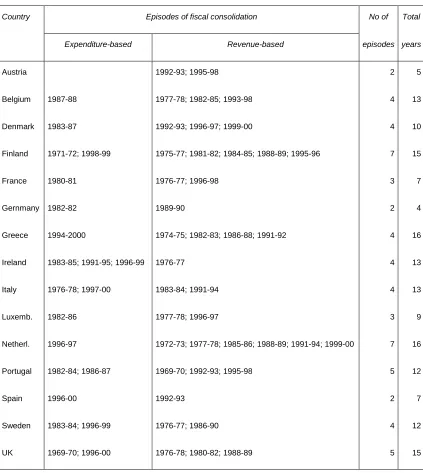
currency (European Commission 2000; von Hagen et al. 2002). Table 1 below
summarizes Mulas-Granados’s evidence of discrete episodes of consolidation, sorted by
[image:17.595.86.509.212.685.2]type.
Table 1. Episodes of fiscal adjustment in the EU, 1970-2000
Country Episodes of fiscal consolidation No of Total
Expenditure-based Revenue-based episodes years
Austria 1992-93; 1995-98 2 5
Belgium 1987-88 1977-78; 1982-85; 1993-98 4 13
Denmark 1983-87 1992-93; 1996-97; 1999-00 4 10
Finland 1971-72; 1998-99 1975-77; 1981-82; 1984-85; 1988-89; 1995-96 7 15
France 1980-81 1976-77; 1996-98 3 7
Gernmany 1982-82 1989-90 2 4
Greece 1994-2000 1974-75; 1982-83; 1986-88; 1991-92 4 16
Ireland 1983-85; 1991-95; 1996-99 1976-77 4 13
Italy 1976-78; 1997-00 1983-84; 1991-94 4 13
Luxemb. 1982-86 1977-78; 1996-97 3 9
Netherl. 1996-97 1972-73; 1977-78; 1985-86; 1988-89; 1991-94; 1999-00 7 16
Portugal 1982-84; 1986-87 1969-70; 1992-93; 1995-98 5 12
Spain 1996-00 1992-93 2 7
Sweden 1983-84; 1996-99 1976-77; 1986-90 4 12
UK 1969-70; 1996-00 1976-78; 1980-82; 1988-89 5 15
There is no clear consensus in the literature on the phasing and composition of
adjustments episodes. While Mulas-Granados suggests that countries such as Greece
and Ireland enforced significant expenditure-based consolidations during the 1990s,
Von Hagen et al. identify revenue-led adjustments. Similarly, the European
Commission suggests that Denmark implemented an expenditure-based retrenchment
during the late 1980s, while Mulas-Granados claims that the adjustment was
revenue-led (Mulas-Granados 2006; von Hagen et al. 2002). Ireland’s well-known
expenditure-based adjustment in the period 1987-89 is not captured by Mulas-Granados’s
methodology.
The diverse interpretations arise from trying to link discretionary policy choices to very
short-term fluctuations on the structural components of the budget. A more long-term
approach is needed to shed new light on this problem. Mulas-Granados defines ‘strategy
type’ as the sum of the average variation of cyclically adjusted revenues and cyclically
adjusted primary expenditures. The intuition is that the higher the value of the strategy
type, the more expansionary is the effect of the government’s strategy on the total size
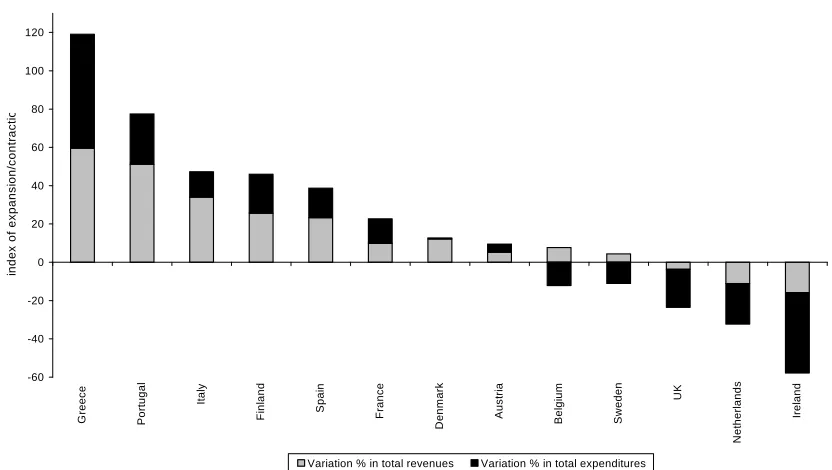
of the government budget. We can apply this thinking to assess countries’ overall fiscal
trajectories during the whole era of stabilisation. Figure 1 outlines the expansion or
contraction of the public sector across European countries between 1980 and 2000. This
confirms our intuition that Ireland is a typical case of public sector contractionary
strategy, and Greece a typical case of public sector expansionary strategy. Ireland has
relied on a expenditure-cutting fiscal stabilization strategy, while Greece has sought to
-60 -40 -20 0 20 40 60 80 100 120 G re e c e P o rt u g a l It a ly F in la n d S p a in F ra n c e D e n m a rk A u s tr ia B e lg iu m S w e d e n U K N e th e rl a n d s Ir e la n d in d e x o f e x p a n s io n /c o n tr a c ti o n
[image:19.595.90.506.75.310.2]Variation % in total revenues Variation % in total expenditures
Figure 1. Expansion/contraction of public spending and revenues, 1980-2000
Source: Own elaboration based on OECD Economic Outlook Database. The index of expansion or contraction is the sum of the average variation of structural revenues and structural expenditures between 1980 and 2000 (both revenues and expenditures are measured as percent of GDP)
Comparative case studies
Case studies are not always good for testing hypotheses. However, they are good for
revealing missing variables in existing explanations, generating arguments and ideas,
and dealing with causal complexity (George and Bennett 2005; Gerring 2007). Case
selection on the dependent variable is often held to be undesirable. But we believe that
this methodological choice is appropriate in the process of discovery, serving crucial
exploratory and heuristic purposes (Geddes 2003, p.129). We adopt a ‘diverse case’
selection strategy (Gerring 2007), choosing Ireland as an ideal type of expenditure-led
consolidation and Greece as a paradigmatic case of revenue-led adjustment. This means
that we are allowing for variation in the outcome of interest, as suggested by both King
and his colleagues and by Geddes (Geddes 2003; King et al. 1994). We also consider
the experiences of Britain and Spain to leverage our analysis of the Irish and Greek
cases respectively. Taken together, these four countries entail an interesting mix of
Ireland: expenditure-based adjustment
The fiscal trajectory of Ireland since 1980 is characterized principally by
expenditure-based adjustments. Scholars disagree on the precise phasing of adjustment periods.
During the 1980s and 1990s, Mulas-Granados identifies the periods 1983-5, 1991-5,
1996-9 (Mulas-Granados 2003, p.21; 2006, p.28), while Alesina and Ardagna argue that
during the 1980s, 1983, 1984, 1987, 1988, and 1989 were all fiscal adjustment years
(Alesina et al. 1998a, p.497). But the trend is clear: Mulas-Granados classes all three of
the fiscal adjustment periods he identifies as based on expenditure-based episodes, and
Alesina and Ardagna similarly note the reliance on expenditure-based adjustment
(Alesina et al. 1998a, p.515; Mulas-Granados 2006, p.28). Figure 2 below shows the
profile of revenues and expenditures in relation to GDP.1
15 20 25 30 35 40 45 50 55 60
1980 1981 1982 1983 1984 1985 1986 1987 1988 1989 1990 1991 1992 1993 1994 1995 1996 1997 1998 1999 2000
%
o
f
G
D
P
[image:20.595.95.500.351.582.2]Total revenues Total expenditures Deficits
Figure 2.Revenue and expenditure trends in Ireland, 1980-2000 (per cent of GDP)
Source:Own elaboration based on OECD Economic Outlook Database
1
Ireland ran double-digit deficits from 1979 to 1985, accumulating a huge government
debt (European Commission 2000). However, from 1987 on, the country embarked on a
process of consolidation that ended up changing the structure of Irish public finances.
The ratio of public spending to GDP decreased substantially from 1985 to 2000, from
53% to 32%, accompanied by a steady decline of structural revenues from 43% to 35%
of GDP. As a result, Ireland’s fiscal stance improved by around twelve points of GDP.
How can we explain this dramatic turnaround?
Institutional fragmentation cannot readily explain either the scale of the problem
incurred or the eventual turnaround. Ireland has a unitary state with centralized
governmental institutions, and notwithstanding coalition governments, multiannual
budgeting is quite recent and there is no coalition pre-commitment to performance
targets. The Minister for Finance can exercise quite strong delegated powers.
Explanations grounded in partisanship encounter some difficulty in classifying
governments in Ireland, as the Labour Party is very small, there is no clear left-right
cleavage, and the two largest parties, Fianna Fáil and Fine Gael, cluster to the
centre-right. Furthermore, the prevalence of coalition government since the late 1970s means
that the two larger parties have each governed with Labour. The presence of a small
liberal party, the Progressive Democratic Party, in coalition with Fianna Fáil between
1997 and 2007, is credited with exerting a rightward influence on budgetary policy.
Hallerberg et al. note that these latter coalition governments display rather lower
ideological distance than the Fine Gael-Labour coalitions of 1983-87 and 1994-97, or
the Fianna-Fáil-Labour coalition of 1992-4 (Hallerberg et al. 2007, p.345). This might
be expected to help explain budgetary discipline after 1997, but it should have increased
coalition tensions prior to that date. Yet expenditure-based consolidations were in fact
successfully undertaken, especially in the late 1980s, and it is in the period after 2000
(outside the scope of the current paper) that we note the most marked trends toward
fiscal loosening. The broad cross-class base of electoral support which all parties seek to
maintain gives partisan explanations less traction in the Irish case than elsewhere.
Party politics is certainly an important part of the story of fiscal consolidation in Ireland.
Gael and Labour Party government of 1983-87, as the budgetary situation worsened
during the mid-1980s. Instead, fiscal drag drew increased revenues from the existing
narrow but steeply graded tax base (Hardiman 2004). The sharp turnaround in fiscal
management strategy from 1987 was undertaken by a Fianna Fáil government. This was
a minority government: what made it possible was the commitment from the opposition
benches by the next-largest party, Fine Gael, not to oppose fiscal retrenchment
measures, as these incorporated many of the commitments Fine Gael had tried but failed
to implement. Cross-party policy agreement, rather than partisanship, explains the
adoption and implementation of spending cuts.
However, party politics is only part of the story. The legitimation of spending cuts was a
constant problem for the coalition government of 1983-87. What made it possible for
Fianna Fáil to undertake the same measures successfully after 1987 was the negotiation
of a tripartite pay pact, initially a short-term crisis management measure, but
increasingly proving its worth as a coordinating mechanism over time (Hardiman 2002).
The Irish trade union movement, like the British, is fragmented and based on a
combination of skills, professional unions, and large general unions. Its base is
narrowed by the growing economic importance of US multinationals that are resistant to
any union presence. Over the decades, governments had periodically attempted to
induce agreement to pay pacts, with little success. The social partnership agreements
negotiated after 1987 introduced a new governance mechanism into Irish political
economy that was adopted by all successive governments, in which all the major
political parties participated. The objectives of Maastricht were internalized into the
social partnership process and created the framework for wage and inflation
target-setting right through to 2000 and beyond (Roche 2009).
Conventional accounts of fiscal consolidation in Ireland cannot readily explain why and
how spending controls, underpinned by an explicit commitment to a low-tax regime,
were adopted from 1987 on. Corporate taxation had long been subject to favourable
terms and was the basis on which surges in FDI-led growth were enabled in the 1970s
and again in the 1990s (Barry et al. 1999). Reforms in tax administration, in line with
undertaken, and would not have been possible without risking inflation, in the absence
of wage moderation agreements (Barry 2009). The unions traded wage restraint for tax
cuts, in a deal that resulted in steady increases in disposable income, even as the base
from which provision of collective goods could be funded was eroded (Hardiman 2006).
Notwithstanding the marked deficiencies in the Irish welfare state, and the incapacity of
the health care system to respond adequately to demand, deep-seated suspicion of
government capacity to deliver services efficiently, combined with tax breaks for
private insurance, bolstered support for personal income-maximizing rather than
service-enhancing pay pacts. A low-tax, service-poor equilibrium became deeply
embedded in Irish political economy as the engine for growth and employment creation.
A comparison with Britain is instructive. Both countries are liberal market economies;
in both, a fragmented trade union structure made wage management during the 1970s
highly conflictual. Both countries attempted strong fiscal stabilization measures around
1980. But the profile of adjustment in Britain is rather different, as Figure 3 below
shows.
15 20 25 30 35 40 45 50 55 60
1980 1981 1982 1983 1984 1985 1986 1987 1988 1989 1990 1991 1992 1993 1994 1995 1996 1997 1998 1999 2000
%
o
f
G
D
P
Total revenues Total expenditures Deficits
[image:23.595.97.498.412.642.2]Deficits
Figure 3.Revenue and expenditure trends in the UK, 1980-2000 (per cent of GDP)
Source:Own elaboration based on OECD Economic Outlook Database
Mulas-Granados classifies Britain as resorting more frequently to revenue-based
(Mulas-Granados 2006, p.28). Alesina and Ardagna also view 1988 as a consolidation
year (Alesina et al. 1998a, p.497). But what is perhaps even more striking is the very
uneven trajectory in evidence over time. This is only in part explained by changes of
government, because the Conservative Party held power until 1997, and the Labour
Party which has been in government since then had pre-committed itself to the same
spending targets as the Conservatives in order to increase its electoral credibility and to
maintain the confidence of the financial markets. Britain has featured governments of
long duration, the absence of coalitions, and a non-fragmented decision-making process.
Yet a trend toward a stop-go policy style is apparent; so is a profile of mixed reliance on
spending reductions and revenue increases. Britain shows an unusual pattern regarding
partisanship, as Table 1 illustrates, since the Conservatives implemented two
revenue-based adjustments during the 1980s and the Labour Party introduced a spending-revenue-based
correction during the 1990s.
Three features of Britain’s political economy may be contrasted with the Irish
experience outlined above. Firstly, while Britain is also a liberal market economy, the
historical inheritance of higher levels of social protection and welfare state institutions
meant that gravitation toward a low-revenue equilibrium was not possible. Mrs.
Thatcher’s governments attempted to curtain spending on education, the NHS, and
transfer payments; but despite her electoral successes, public opinion proved resistant to
these core provisions being dismantled (Rhodes 2000). Secondly, Britain’s brief
experiment with managing the value of sterling within the European currency system
left it vulnerable to the exchange-rate crisis of 1992 and resistant to the prospect of the
Euro. It was not therefore subject to Maastricht criteria and did not need to attend to the
spending constraints this entailed. Its growing exposure to international financial
markets, with growing capital market deregulation and the diversification of
increasingly complex investment products, left it with incentives to curb deficits. The
newly independent Bank of England took over inflation targeting from 1997. But the
British government was still relatively free to mix strategies of revenue and expenditure
based consolidation. Thirdly, trade unions in Britain could exert only weak political
influence, which also left central government with a relatively free hand. The
organizational fragmentation of public sector unions, leaving virtually all sectors of the
workforce more systematically exposed than ever before to decentralized wage-setting,
responsive to local market conditions, and with much more attenuated national
reference points than previously (Bieler 2008). From a situation in the 1970s during
which Ireland and Britain had well-organized but poorly coordinated trade union
movements, Ireland moved in the late 1980s toward government-led coordination
efforts, while Britain moved in the opposite direction toward a deliberate strategy of
labour disorganization (Crouch 2000; Traxler et al. 2001). This meant that British
governments did not need to rely on effective social interlocutors, and further increased
the autonomy of government in its strategic options.
The evolution of economic ideas also plays a role in explaining change in both the Irish
and the British cases. In Ireland, the case for curbing public spending commitments
came to be increasingly widely held, grounded partly in awareness of the role of the
low-tax model in supporting its FDI-based growth potential, and partly in an acceptance
of the argument that a large public sector is inherently a drag on growth. In Britain, the
dispiriting experience of repeated electoral losses between 1979 and 1997 drove the
Labour Party to undertake not only organizational modernization, but also radical
modification of many policy commitments in a bid to reposition itself more favourably
with the electorate. From its origins as a left of centre party, New Labour came to adopt
many elements of neo-classical economic orthodoxies, which made it possible for it to
accommodate an expenditure-driven adjustment by the late 1990s (Hay 1999;
Wickham-Jones 1996).
Greece: revenue-based adjustment
In contrast to Ireland, Greece can be regarded as a paradigmatic case of revenue-based
consolidation. Indeed, three out of four of the episodes of fiscal adjustment that Greece
underwent in the post-authoritarian era were based on increasing structural revenues
(Mulas-Granados 2006, p.28). Figure 4 shows the expansionary trajectory of Greek
public finances in the period from 1980 to 2000. The size of the public sector expanded
by almost 60% during this period, funded by a revolution in the revenue-raising
Successive Greek governments faced the challenge of having to adopt measures to
enforce fiscal discipline. Indeed, as Table 1 shows, Greece is the European country
which is most likely to be involved in a fiscal adjustment process. Most of these are
based on raising revenues rather than cutting primary spending.
15 20 25 30 35 40 45 50
1980 1981 1982 1983 1984 1985 1986 1987 1988 1989 1990 1991 1992 1993 1994 1995 1996 1997 1998 1999 2000
%
o
f
G
D
P
[image:26.595.93.493.185.397.2]Total revenues Total expenditures Deficits
Figure 4.Revenue and expenditures trends in Greece, 1980-2000 (per cent of GDP)
Source:Own elaboration based on OECD Economic Outlook Database
Partisanship should explain much of the dynamics of fiscal consolidation in Greece. The
Pan-Hellenic Socialist Movement, PASOK, has been the dominant political force in
recent decades, and parties of the left tend to prefer revenue-based adjustments in order
to protect government wages, public investment, and social transfers. But the partisan
argument is not clear-cut. The revenue-based retrenchment of 1974-75 took place
during the conservative-led democratic transition, and the socialists implemented
expenditure-based adjustments in the period between 1994 and 2000. Nor can the
fragmentation of decision-making be called upon to explain these anomalies: Greece is
a unitary and highly centralized state, and governments and coalitions are not
Greece’s fiscal trajectory is embedded in the political economic of growth, starting from
a relatively low base in the 1970s. A relatively weak administrative capacity, and a
fragmented and politicized set of organized economic interests, curtailed the governance
options of parties in power. The country started out with a small tax take, poorly
developed tax instruments, a weak tax administrative system, and low levels of
compliance. The first socialist governments of Andreas Papandreou in the late 1970s
presided over political as well as economic stabilization, with strong public sector
support. During the 1980s, there was strong popular demand for more public sector
employment and welfare expansion, giving rise to the creation of new services such the
national health system in 1984. These new expenditures were met through increased
taxation and improved tax administration. But in the 1990s, the same socialist party, this
time led by Kostas Simitis, faced a radically different set of political economy
constraints, both domestic and international. There was a recognition, however
reluctantly arrived at, that the freer spending environment of the 1980s had led to
populist excesses that needed to be curbed. This paved the way for a more modernizing
and technocratic approach to policy-making, which was in turn externally enforced by
the incentives embedded in the Maastricht convergence criteria.
But expenditure-based adjustments have been the exception rather than the rule in
Greece. There is some confusion about the classification of episodes here too, and some
studies suggest that the fiscal consolidation process of the 1990s was indeed a
revenue-based retrenchment (European Commission 2000; von Hagen et al. 2002). The
significant consolidation effort of the late 1990s only occurred in the context of a
singular mix of incentives, not least the sense of urgency brought about by EMU
conditionality. Yet Greece experienced a recurrent need to resort to fresh consolidation
measures which appeared difficult to institutionalize stably. Greece is a country that
tends to generate high public deficits and accumulate unsustainable debts. The average
public deficit between 1970 and 2000 was second only to Italy’s among the EU15
(Mulas-Granados 2006, p.28).
Persistent fiscal indiscipline reflects a weak governance system arising from features of
state structures on the one hand and the profile of organized interests on the other. As
structural constraints which create une société bloquée, with ‘systemic weaknesses
deriving from the institutional capacity of the state, the regime of disjointed
corporatism, and cultural practices of clientelism and rent-seeking’ (Featherstone 2005,
p.223). The issue is not that the formal institutions are poorly structured. The problem is
one of the government’s capacity to generate coherent policies that command sufficient
consent among civil society, and the administrative system’s capacity to implement
them: it is a governance problem. The Greek government is all too often entrapped in a
stalemate bargaining game, unable to offer sufficient incentives to break deadlocks and
overcome powerful vested interests.
The politics of interest intermediation in Greece may be usefully contrasted with the
Irish experience. The scope for social dialogue in Greece is limited. Party politics is
highly confrontational both between and within parties, and clientelist electoral politics
is well established. But civil society is weakly organized, and the trade unions are
highly politicized. There is little scope for creating stable structures integrating
organized interests into administrative routines of consultation and coordination.
Structural reform initiatives are likely to encounter resistance from within the system of
‘disjointed corporatism’. Economic policy-making is constrained by ‘the reproduction
of a pattern of power relations relying on a weak and asymmetrically penetrated state
apparatus’ (Lavdas 2005, p.309). Governments are obliged to undertake fiscal
consolidation measures without the legitimating support of union and employer consent.
This leaves open the further risk of populist lobbying from potentially disadvantaged
sectors, and reinforces politically destabilizing clientelism as governments seek to shore
up their electoral support base.
Post-authoritarian stabilization policies need not take this form, as a brief comparison
between Greece and Spain reveals. These countries share common economic
development patterns, welfare state profiles, processes of modernization through
Europeanization, and a Southern European political culture. Yet despite these
similarities, these two countries have undertaken contrasting policy paths in many areas,
including the management of their respective public finances. The economic policies of
decisive efforts to converge to the new economic orthodoxy of austerity and market
liberalization, while the Greek socialists continued to practice outdated economic
expansionism and populist distributionism well into the late 1980s. As a result, public
deficits and inflation in Greece peaked during the early 1990s. Both Greece and Spain
had relatively similar public sectors, with low ratios of expenditure to GDP, in the
1970s. Yet as Figure 1 showed, Greece followed a more expansionary fiscal path during
the 1980s and 1990s. Even though we have shown that Greece relied on increasing
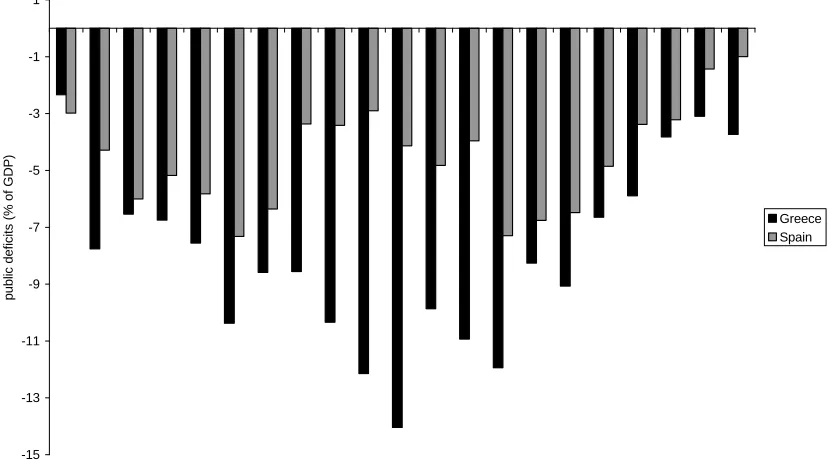
public revenues to fund its spending ambitions, Figure 5 below shows that Greece faced
more severe problems than Spain in successfully financing the growth and
modernization of its welfare state, and that deficit levels constantly outstripped Spain’s,
often by a large margin.
-15 -13 -11 -9 -7 -5 -3 -1 1
1980 1981 1982 1983 1984 1985 1986 1987 1988 1989 1990 1991 1992 1993 1994 1995 1996 1997 1998 1999 2000
p
u
b
lic
d
e
fi
c
it
s
(
%
o
f
G
D
P
)
[image:29.595.93.508.323.554.2]Greece Spain
Figure 5.Borrowing requirements in Greece and Spain, 1980-2000 (per cent of GDP)
Source:Own elaboration based on OECD Economic Outlook
The partisanship thesis is helpful in explaining the fiscal trajectories of these two
countries, as both PSOE and PASOK have preferred to implement revenue-led
consolidations, while the Spanish right-wing Partido Popular (PP) enforced a
partisan argument cannot explain why the Spanish socialists (and indeed the Spanish
conservatives) have been consistently more successful than their Greek counterparts in
enforcing fiscal discipline on a permanent basis. Nor can it account for the shifts in
PASOK’s own policy stance over time. This can only be understood by looking at the
competition for influence within the party between ideological factions – difficult to
capture with a single indicator of partisanship, but with far-reaching policy significance.
A comparison between Greece and Spain shows that the constitutional and
administrative politics of budget formation only captures part of the variation in
institutional configurations. We also need to take account of the terms on which
governments engage with powerful social actors in the process of bargaining and
implementing fiscal adjustments. Spain enjoyed certain advantages in the form of
highly-disciplined political parties and a pactista tradition that had successfully
facilitated the democratic transition (Pérez-Díaz 1993). Spain was able to manage the
transition to ‘modern’ class and interest-based civil society organization, even though
still characterized by separate partisan affiliations, facilitating a basis for
consensus-oriented bargaining. But economic interest organization in Greece continued to be
fragmented and highly conflictual, providing a weak base for social pacts (Avdagic et
al. 2005).
The role of ideas in shaping the range of feasible options was also different in Greece
and in Spain. Greece’s adherence to high-spending economic policies during the 1980s
was underpinned by a perception widely shared in government circles of a relatively
weak set of domestic and external constraints on their policy choices. A dominant
culture of national exceptionalism in Greece led to economic policies based on political
voluntarism and ideological maximalism. In contrast, the prevailing belief structures in
Spain created the conditions for a strong endorsement of the European project. This
further strengthened the commitment to administrative modernization and the
prevalence of technocratic criteria in budget formation (Pagoulatos 2004).
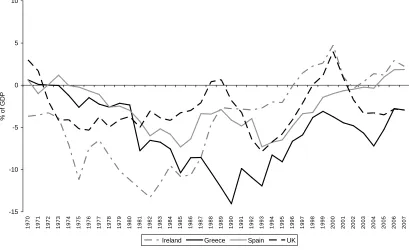
Contrasting deficit profiles
deficits. Firstly, Figure 6 below shows Britain to be more deficit-averse, on the whole,
than any of the other countries. This may at first seem paradoxical, given the prominent
place of deficit targeting in the EMU project, since Britain is the only one of our four
cases to stand outside the European exchange rate system and the Euro. A permanent
commitment to lower deficits is attributable, rather, to its situation as a hub of
international finance. Formal independence for the Bank of England after 1997
intensified but did not fundamentally alter these features. Growing political demands for
welfare-oriented spending as Labour bedded down in office proved hard to match with
revenue increases. Despite recourse to so-called stealth taxes, Britain’s
revenue-enhancing capabilities have not kept pace with spending expectations, and the current
financial crisis finds Britain exposed to a high deficit, with plummeting revenues failing
to match spending commitments that are consistently higher than any of our other three
countries. But monetary and exchange rate autonomy also permits greater autonomy in
its fiscal response to international crisis than is available to the Eurozone countries.
Gordon Brown’s Labour government undertook a classic Keynesian fiscal stimulus
programme, with tax cuts and spending increases, to boster demand and support
employment. Britain had gained a competitive advantage from the gradual depreciation
of sterling relative to the Euro during the 2000s. A large primary deficit causes it fewer
worries than would be the case for Ireland, for example, where downgrading by
international credit rating agencies limits the scope of feasible policy choice and
constrains the set of ideas deemed appropriate to respond to the crisis.
As we have already noted, among our four cases Greece displays the weakest capacity
to manage deficits due to its institutional and administrative deficiencies. Ireland
exhibits the most marked fluctuation between failures and successes, Spain the least.
Our comments about the role of social pacts in facilitating adjustments in Spain and
Ireland are reflected in the trends toward sharply reduced deficits in the periods in
which pacts are in effect. In Ireland, a particularly strong contrast is apparent between
the pre-pact and post-pact situation (assisted of course by especially strong growth
between 1994 and 2000). Spain’s especially sharp improvement after 1993 is similarly
attributable in large measure to improved governance capabilities arising from