A Study of Autonomous Docking with an AUV
Using Intelligent Controls
Pakpong Jantapremjit
1, Philip A. Wilson
2, Alan J. Murphy
3Fluid-Structure Interactions Research Group, School of Engineering Sciences University of Southampton
Highfield, Southampton, United Kingdom Tel: +44 (0)23 8059 6619, Fax: +44 (0)23 8059 5167
E-mail: 1[email protected], 2[email protected], 3[email protected]
Abstract
Autonomous docking using underwater vehicles will play an important role in long-term underwater explorations and surveys. The autonomous docking mission for an autonomous underwater vehicle at a stationary platform involves a vehicle and a platform matching both position, orientation and velocity. The docking missions therefore require intelligent control systems for precise and soft operations. A study of the sliding mode control and the fuzzy logic controller is proposed which provides stability and robustness which bounds uncertainty and external disturbances such as ocean currents. A proposed fuzz logic based sliding mode controller can improve control performances in docking operations. Furthermore, the optimisation of the controllers using genetic algorithms determines best candidate fuzzy sets to minimise docking time and energy consumption.
Keywords:
Autonomous Docking, AUV, Sliding Mode Control, Fuzzy logic, Genetic Algorithms
Introduction
Remotely Operated Vehicles (ROVs) and Unmanned Underwater Vehicles are useful for many underwater operations such as collecting biological and mineral resources, however there are some limitations for those vehicles during long-term operations and at high operational costs. Consequently an Autonomous Underwater Vehicle (AUV) which is able to make decisions and take control actions more accurately and reliably [2] without human intervention is an alternative to humans in complex operations. Examples of such operations are seabed mapping and surveying, studying underwater environment and disasters, underwater inspections and constructions, and under ice explorations [8]. Motion control for AUVs has been a subject of research since 1980s [6], [21], [23]. In the underwater environment, there are hydrodynamics affects which influences the vehicle and thruster dynamics. These are nonlinear which makes controlling the AUVs challenging. To deal with this challenging control problem, Yoerger and Slotine [21] used a robust sliding mode control, where a nonlinear control system design was applied to underwater vehicles’ trajectory control at low speed. Fossen
and Foss [5] improved the performance of a sliding mode control of a nonlinear system by using multi-input multi-output mode which is illustrated by the simulation of a polymerization reactor (in the process control). Healey and Lienard [10] used a multivariable sliding mode control for underwater vehicles and combine its equations of motion for three separate autopilot modes of speed, steering and diving control. It is shown in these articles that the sliding mode controller is robust and that it can compensate for the deficiencies caused by unmodelled dynamics and external disturbances.
In a docking missions survey, Kato and Endo [12] have presented a concept of docking guidance and control for unmanned submersibles at stationary platform by using fuzzy algorithms. This is processed as: rough guidance based on fuzzy algorithms provides prearrangement of the vehicle to the docking target and precise guidance based on sonar and transponders give a precise distance and target disposition. Position, depth and speed controllers based on fuzzy logic rules for underwater vehicles in a docking mission to a moving or stationary target submarine are used successfully by Rae et al. [13], [15]. For a moving target, an AUV may therefore be sluggish in response due to its inherent inertia caused from for example underwater currents.
There are many issues in the field of docking mission in the control aspect. The purpose of the paper is to combine a robustness of motion control for an AUV using a sliding mode control and an improvement of its control performances using an integration of fuzzy logic and genetic algorithms, giving a soft (small relative motion), minimised time and energy consumption in the application of underwater docking.
The paper is organised as follows. In Section 2, an overview of an autonomous servicing is given. Section 3 provides a dynamics model of 6-DOF AUV. The sliding mode controller is given in Section 4. Intelligent controls for docking control are discussed in Section 5. Conclusion and further works are given in the final section.
Autonomous Docking
Figure 1 - Guidance, Navigation and Control
unknown environment. Navigational information comes from inertial sensors, sonar, and on the surface global positioning system (GPS), etc. Autonomous docking for underwater vehicles at docking platform involves an estimate of the kinematic state of the vehicle and the platform, matching both position, orientation and velocity. The improvement of actuators and sensors, and the development of novel control methods are two possible recent advances to be considered by the guidance and control community. They are convinced that docking missions can be achieved with accuracy [4]. At present, docking missions are mainly controlled by a human pilot with ROVs. The presence of pilots therefore is required to accomplish the missions. To increase the scope of potential long-term application, autonomous docking missions for AUVs are required in order to reducing missions’ time (recharging battery or transferring data) and manned operational cost.
The typical framework of guidance, navigation and control system [4] for underwater vehicles allow autonomous services for docking station or other vehicles (see Figure 1). AUVs equipped with sensors measuring its own position and orientation provides the current states and determines the control actions required to achieve these desired states. The classical control theory allows the analytical model of control systems, however it is insufficient for the dynamic model of AUVs which is highly nonlinear and has a high complexity of input-output description. Underwater docking missions therefore require intelligent control systems for soft and precise operations. One of the candidate solution techniques for nonlinear controls is a fuzzy logic based guidance and navigation [3] which is to provide small relative velocities.
Three modes of fuzzy control are speed, heading and depth control. The use of sliding mode control provides the global asymptotic stability using the Lyapunov criteria which bounds uncertainty and external disturbances. A combination of fuzzy controller and sliding mode control can improve control performances in docking operations. Furthermore genetic algorithms will be studied, the methods perform the optimisation of the fuzzy controller by finding the best candidate fuzzy sets of the membership functions, to optimise docking time and energy consumption.
Model of the Dynamics of an AUV
The system dynamics of AUVs are highly nonlinear, coupled and time varying which comes from many parameters, such as hydrodynamic drag, damping and lift forces, Coriolis and
centripetal forces, gravity and buoyancy forces and forces from thrusters [4]. Attitude representation of our kinematic AUV model in the global reference frame is defined using Euler angles. The kinematic equation is thus written as,
V J J V J = = × × ) ( 0 0 ) ( ) ( 2 3 3 3 3 1 η η η
η& (1)
The vector η and ν are defined as,
, Θ = x
η
= ων
V (2)
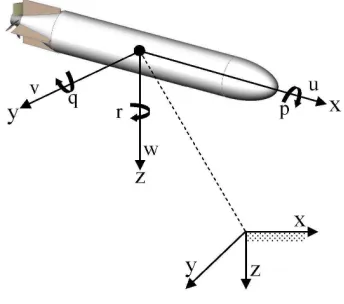
[image:2.595.347.519.389.541.2]where x = [x, y, z]T is the position vector in the x-y-z coordinates, Θ = [φ, θ, ψ]T is the vector of Euler angles parameters, ν = [u, v, w]Tand ω = [p, q, r]Tare linear and angular velocities in the x-y-z coordinates (see Figure 2).
Figure 2 - AUV Coordinates System
In the above, the transformation matrix J1(η)and J2(η)are defined as, , ) ( 1 − − + + − = φ θ φ θ θ φ ψ φ ψ θ φ ψ ψ θ φ θ ψ φ ψ θ φ φ φ ψ φ θ ψ θ ψ η c c s c s s c c s s c c s s s c s s s s c c c s s s c c c
J (3)
− = θ φ θ φ φ φ θ φ φ φ η c c c s s c t c t s J / / 0 0 1 ) (
2 (4)
where cψ = cosψand s = φ sin and φ t = θ tan , etc. θ The 6-DOF dynamic model of the AUV is derived from the Newton-Euler equation of motion of a rigid body in the fluid. The dynamic model is given by,
τ
η =
+ +
+C(V)V D(V)V g( )
V
where M is an AUV inertia matrix (including added mass), )
(V
C is the matrix of Coriolis and centripetal terms (including added mass effects), D(V)is a hydrodynamic damping and lift matrix of the AUV, g(η)is the gravitational
and buoyancy force and moment vectors, and τ is an external force and moment input.
Sliding Mode Control
Many studies have been undertaken in order to correct errors in attitude control including [1], [16]. Most stability schemes are formulated based on the Lyapunov method which provides ranges of positive stable gains for control law. Sliding mode control (SMC) which is a nonlinear controller provides excellent stability, robustness and disturbance rejection characteristics [14], [17]. It is categorised as a variable structure control system [11] which has been studied in the Soviet Union for many years. Consider the state space of a nonlinear system,
x&=Ax+Bu (6)
where x is the state vector,
[
n]
Tx
x
x
−1=
&
K
x
Let x~=x−xdbe the tracking error in the variable x, and,
~x=[x−xd] (7)
where x~is tracking error vector and x is desired d trajectory. Next, a time-varying sliding surface s is defined as the error x~,
) ( ~
d T T
x x S x S
s= = −
where S is a strictly positive constant. Then, the sliding surface converges to zero when it satisfies the Lyapunov stability as follows,
V sTs
2 1
= (9)
and its derivative must satisfy,
V&=s&Ts≤0 (10)
The condition when sliding surface s(x) = 0 and s&(x)= 0 is
reached in a finite time if,
) sgn( x
k s s& ≤−
where k is a strictly positive constant and sgn(s) is a signum function which is defined as,
> = < −
=
0 if , 1
0; if , 0
0; if , 1 ) sgn(
s s s s
From equation (6), (8) and the control is assumed to be set point control with xd =0, then the control inputs can be
obtained as,
u=−(STB)−1STAx−(STB)−1k2sgn(s) (11)
The sliding mode controller structure is generally given,
u=ueq−Ksgn(s) (12)
where ueq is an equivalent control. K is a constant,
corresponding to the maximum value of the controller output.
Reducing chattering which is caused by a sign function, a thin boundary layer of thickness around the switching surface is proposed [14],
sat( ) Φ −
=u K s
u eq (13)
where the constant Φdefines the thickness of the boundary
layer and sat( ) Φ
s
is a saturation function that is defined as,
Φ
≤ Φ Φ
=
otherwise ),
sgn(
1; if , )
( sat
s
s s
s
A hyperbolic tangent function gives a smoother version [18] so it becomes,
tanh( )
Φ −
=u K s
u eq (14)
The role of the sliding mode controller is to drive the system towards the sliding surface and keep it on the sliding surface. The sliding mode control is therefore able to improve a capability to track the desired state of the AUV modelling. In the next section, an expert control using fuzzy logic and genetic algorithm is discussed in order to improve docking performances.
Intelligent Control
Although conventional controls are successful for control of nonlinear system, the drawback of performance and stability due to unmodelled nonlinear terms has to be considered. Many methods combine the robustness of SMC [9], the intelligence of fuzzy logic based control [11], [22] and genetic algorithms based control [20].
Fuzzy logic is an intelligent controller which can deal with uncertainty and is able to construct a complex control system. Unlike classical controls, fuzzy logic controllers can be developed in a linguistic information manner without the use of analytical models. The operations in fuzzy logic (see Figure 3) can be described in three sequences called fuzzification, fuzzy inference and defuzzification. Fuzzification converts input data into linguistic variables that may be viewed as labels of fuzzy sets. The fuzzy set is defined as,
} | ) ( ,
{x x x X
A= µA ∈
where µA(x)is called the membership function of the fuzzy variables.
Figure 3 - Intelligent Control Block Diagram
A list of rules which is normally expresses in the ith IF-THEN format is given as following,
i i
n n i i
i
B y A
x A x A
x
R :IF 1is 1AND/OR 2is 2K is THEN iis
where x and i y are linguistic variables and i i n
A , B are i fuzzy sets. Inference engine evaluates IF-THEN rules expression, whilst a defuzzification converts fuzzy values into result outputs.
The vehicle control model takes control actions to the AUV’s thrusters and fins to reach a docking point with appropriate speed. There are three control modes, namely speed, heading and depth control in the docking operation using a fuzzy control logic controller described as follows:
Speed Control
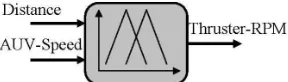
[image:4.595.364.493.475.517.2]Fuzzy logic speed control block diagram is shown in Figure 4. The input fuzzy sets for each variable are: Distance: {Very Far, Far, Near, Zero}, AUV-Speed: {Fast, Normal, Slow}, and the output sets of one variable: Thruster-RPM: {Fast, Zero, Slow}.
Figure 4 - Fuzzy Logic Speed Control
Heading Control
Fuzzy logic heading control block diagram is shown in Figure 5. The input fuzzy sets for each variable are: Yaw-Error: {Large Negative, Small Negative, Zero, Small Positive, Large Positive}, Yaw-Rate: {Negative, Normal, Positive} and the output sets of one variable: Rudder-Angle: {Large Negative, Small Negative, Zero, Small Positive, Large Positive}.
Figure 5 - Fuzzy Logic Heading Control
Depth Control
Fuzzy logic depth control block diagram is shown in Figure 6. The input fuzzy sets for each variable are: Yaw-Error Yaw-Rate Rudder-Angle Pitch-Error: {Large Negative, Small Negative, Zero, Small Positive, Large Positive}, Pitch-Rate: {Negative, Normal, Positive} and the output sets of one variable: Hydroplane-Angle: {Large Negative, Small Negative, Zero, Small Positive, Large Positive}.
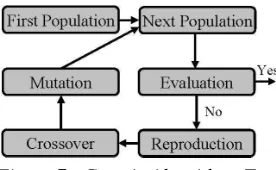
[image:4.595.92.236.503.544.2]The data base of fuzzy rules which are generated from fuzzy logic control is useful for evaluating for best solution for the soft docking by Genetic Algorithms (GAs) tool. Holland et al. [19], [7] at the University of Michigan have developed GAs which are search algorithms based on the mechanism of nature selection and genes. The genetic algorithms are used as a tool for solving optimisation problems. Figure 7 shows genetic algorithms tool.
Figure 6 - Fuzzy Logic Depth Control
[image:4.595.90.236.693.735.2]Figure 7 - Genetic Algorithms Tool
Conclusion and Further works
In this paper, the fuzzy sliding mode controller based on GAs for autonomous docking of an AUV has been studied. First, the sliding mode controller is introduced for a robustness of vehicle state tracking. Secondly, a fuzzy logic based the GAs is developed. Three modes of the fuzzy logic control based GAs are then combined with the sliding mode control to provide accurate, robust control and optimum design of the docking mission. Further studies and simulation are being conducted and are underway to extend results to hardware implementation.
References
[1]D.M. Boskovic and M. Krstic. Global attitude/position regulation for underwater vehicles. International Journal of Systems Science, 30(9):939–946, 1999.
[2]J.A. Castellanos, J. Neira, and J.D. Tardós. Multisensor fusion for simultaneous localization and map building. IEEE Transaction on Robotics and Automation, pages 908–914, 2001.
[3]J.-Y. Chen. Fuzzy sliding mode controller design: Indirect adaptive approach. An International Journal of Cybernetics and Systems, 30:9–27, 1999.
[4]T.I. Fossen. Guidance and Control of Ocean Vehicles. John Wiley and Sons Ltd., England, 1994.
[5]T.I. Fossen and B.A. Foss. Sliding control of mimo nonlinear systems. Proceedings of the European Control Conference, pages 1855–1860, 1991.
[6]T.I. Fossen and S.I. Sagatun. Adaptive control of nonlinear systems: A case study of underwater robotic systems. Journal of Robotic Systems, 8(3):393–412, 1991.
[7]D.E. Goldberg. Genetic Algorithms in Search, Optimization, and Machine Learning. Addision-Wesley, Boston, 1989.
[8] G. Griffiths. Technology and Applications of Autonomous Underwater Vehicles. Taylor and Francis, London, UK, 2003.
[9] Q.P. Ha, D.C. Rye, and H.F. Durrant-Whyte. Robust sliding mode control with application. International Journal of Control, 72(12):1087–1096, 1999.
[10] A.J. Healey and D. Lienard. Multivariable sliding mode control for autonomous diving and steering of unmanned underwater vehicles. IEEE Journal of Oceanic Engineering, 18(3):327–339, 1993.
[11] Y.C. Hsu, G. Chen, and H.X. Li. A fuzzy adaptive variable structure controller with applications to robot manipulators. IEEE Transaction on System, Man and Cybernetics - Part B: Cybernetics, 31(3):331–340, 2001.
[12] N. Kato and M. Endo. Guidance and control of unmanned, untethered submersible for rendezvous and docking with underwater station. Proceedings OCEANS ’89, 3:804–809, 1989.
[13] G.J.S. Rae and S.M. Smith. A fuzzy rule based docking procedure for autonomous underwater vehicles. Proceedings on OCEANS ’Mastering the Oceans Through Technology’, 2:539–546, 1992.
[14] J.E. Slotine and W. Li. Applied Nonlinear Control. Prentice-Hall, Inc, New Jersey, 1991.
[15] S.M. Smith, G.J.S. Rae, and D.T. Anderson. Applications of fuzzy logic to the control of an autonomous underwater vehicle. IEEE International Conference on Fuzzy Systems, 2:1099–1106, 1993.
[16] P. Tsiotras. New control laws for the attitude stabilization of rigid bodies. IFAC Symposium on Automatic Control in Aerospace, pages 12–16, 1994.
[17] V.I. Utkin. Sliding Modes and Their Application in Variable Structure Systems. MIR Publishers, Moscow 1978.
[18] C. Vuilmet. High order sliding mode control applied to a heavyweight torpedo. Proceedings of 2005 IEEE Conference on Control Applications, pages 61–66, 2005.
[19] D. Whitley. An overview of evolutionary algorithms. Journal of Information and Software Technology, (43):817–831, 2001.
[20] C.-C.Wong, B.-C. Huang, and H.-R. Lai. Genetic-based sliding mode fuzzy controller design. Tamkang Journal of Science and Engineering, 4(3):165–172, 2001.
[21] D.R. Yoerger and J. E. Slotine. Robust trajectory control of underwater vehicles. IEEE Journal of Oceanic Engineering, 10(4):462–470, 1985.
[22] X. Yu and M. Zhihong. Fuzzy sliding mode control systems with adaptive estimation. An International Journal of Cybernetics and Systems, 30:663–680, 1999.