Sparse Kernel Density Construction Using
Orthogonal Forward Regression with
Leave-One-Out Test Score and Local Regularization
S. Chen Senior Member, IEEE, X. Hong Senior Member, IEEE, and C.J. Harris
Abstract— The paper presents an efficient construction algo-rithm for obtaining sparse kernel density estimates based on a regression approach that directly optimizes model generalization capability. Computational efficiency of the density construction is ensured using an orthogonal forward regression, and the algorithm incrementally minimizes the leave-one-out test score. A local regularization method is incorporated naturally into the density construction process to further enforce sparsity. An additional advantage of the proposed algorithm is that it is fully automatic and the user is not required to specify any criterion to terminate the density construction procedure. This is in contrast to an existing state-of-art kernel density estimation method using the support vector machine (SVM), where the user is required to specify some critical algorithm parameter. Several examples are included to demonstrate the ability of the proposed algorithm to effectively construct a very sparse kernel density estimate with comparable accuracy to that of the full sample optimized Parzen window density estimate. Our experimental results also demonstrate that the proposed algorithm compares favourably with the SVM method, in terms of both test accuracy and sparsity, for constructing kernel density estimates.
Index Terms— Cross validation, leave-one-out test score, or-thogonal least squares, Parzen window estimate, probability density function, sparse kernel modeling, regularization
I. INTRODUCTION
Estimation of probability density functions is a recurrent theme in machine learning and many fields of engineering, see for example [1]–[4]. A well-known non-parametric density estimation technique is the classical Parzen window estimate [5], which is remarkably simple and accurate. The particular problem associated with the Parzen window estimate however is the computational cost for testing which scales directly with the sample size, as the Parzen window estimate employs the full data sample set in defining a density estimate for subsequent observations. In today’s data rich environment, this can be a serious problem in practical applications. Recently, the support vector machine (SVM) has been proposed as a promising tool for sparse kernel density estimation [6],[7]. The motivation of the SVM density estimation comes from the claim that the SVM can effectively perform function approximations in high dimensional spaces from finite data with sparse representations. Although this effectiveness has been demonstrated in regression and classification problems,
Manuscript received December 22, 2003; revised March 6, 2004. S. Chen and C.J. Harris are with School of Electronics and Computer Science, University of Southampton, Southampton SO17 1BJ, U.K.
X. Hong is with Department of Cybernetics, University of Reading, Reading RG6 6AY, U.K.
it is known that there are alternative methods for regression and classification [8],[9], which can provide sparser represen-tations than the SVM method. Currently, the machine learning community is actively engaged in the investigation of the SVM density estimation method.
A recent PhD thesis [10] has proposed an interesting greedy technique for kernel density estimation. This technique con-structs sparse kernel density estimates using an orthogonal forward regression (OFR) that incrementally minimizes the training mean square error (MSE) [11]. This sparse density construction algorithm is computationally simple and efficient, and the results given in [10] have demonstrated the potential of this method. One critical aspect of this method, which is less satisfactory, is in when to terminate the density construction procedure. The minimum descriptive length [12] and Akaike’s information criterion [13] were first suggested to help termi-nate the density construction process, but the empirical results showed that models obtained were still often oversized. At the end, a maximum model size was imposed in order to avoid an over-fit model. Motivated by the promising result in [10] and our previous work on sparse data modeling [14]–[16], we propose an efficient construction algorithm for sparse kernel density estimation using the OFR based on the leave-one-out (LOO) test score and local regularization. Specifically, we extend the regression model construction algorithm [16] to the construction of sparse kernel density estimates. We will refer to our proposed algorithm as the sparse density construction (SDC) algorithm.
offers considerable advantages in realizing these two critical objectives of sparse modeling over several other state-of-art methods. The current investigation shows that the proposed SDC method inherits these crucial advantages. Compared with the SVM method, our SDC algorithm is simpler to implement and has no critical algorithm parameter that needs to be specified by the user. Several examples are used to illustrate the ability of this new SDC algorithm to construct efficiently a sparse density estimate with comparable accuracy to that of the Parzen window estimate. Some examples that have been used in the existing literature to investigate the SVM method are specifically chosen in order to compare the performance of our SDC algorithm with the SVM density estimation method. Our experimental results demonstrate that the SDC algorithm offers a viable alternative to the SVM method for constructing sparse and accurate kernel density estimates.
II. KERNEL DENSITY ESTIMATION AS REGRESSION
Consider the finite sample set
drawn from a density
, where the data samples
! #"%$
are assumed to be independently identically distributed. The task is to estimate the unknown density
using the kernel density estimate of the form
&
'
(
)+* -,
/.0
(1)
with the constraints
*
21435.76879:.;<..>=
(2)
and
(
)
*
79
(3)
In this study, the kernel function is assumed to be the Gaussian function of the form
,
/.?:@
9
;BADC
FE>FG)H<IKJDLNM
L
M
;BC
O
(4)
where C
is a common kernel width. The well-known Parzen window estimate [5] is obtained by setting
*
for all
6
. Our aim is to seek a spare representation for
&
, i.e. with most of
*
being zero and yet maintaining a comparable test performance or generalization capability to that of the full sample Parzen window estimate having an optimized value for
C
.
A density
is defined as the solution of the equation
P#Q
RDS UT
<V
T
XWY
(5)
subject to the constraints
P
S
RZS [T
<V
T
\9
(6)
and
143
(7)
where W Y ^]
is the unknown cumulative distribution function corresponding to the density^]
. Given the data set , the empirical distribution functionW
/_?=N
defined by
W
/_?=N@
9
=
(
`
a
<b
a
L
a
:
(8)
with
b
'dc 9:.
%e
3
3f. %g
3 (9)
is known to be a good approximation to the true distribution function WY
[6],[7]. Thus the kernel density estimation problem can be posed as the following regression modeling problem [6],[7],[10]:
W
/_>=N@
(
)<* h
/.?:ikj
(10)
subject to the constraints (2) and (3), where the “regressor”
h
/.?:
is given by
h
/.0 l P Q
RDS
,
UT .0 fV
T
`
a
J
9
Lnm J
a
L
a
C
OoO
(11)
with
m
'
9
p
;-A
P
S
q
GH+I J Lsr
;
O
V
r (12)
andj
denotes the modeling error at
. Define t
*
*
*
!
,
W:uvW
+_?=N
and wx 6fy
hzh
0h !
with
h{|h
f.0}{~
. Then the regression model (10) for the data point
"u
can be expressed as
W
&
W ij
6f@ w
65
t
ikj
6f
(13)
where
j
6f\j
. Furthermore, the regression model (10) over the training data set can be written together in the
matrix form
X
t
ik
(14)
with the following additional notations
h{U'"K$ f
, with
9 g .>6 g =
,
j
9uj
;:Z?j
=N~!
, and
W:/W W !
. For convenience, we will denote the regression matrix
w
w
w
with w
hh '>h !
.
w
should not be confused with wx 65
(the former is the
6
th column of
, and the latter the
6
th row of
). Let an orthogonal decomposition of the regression matrix
be
(15)
where
9
3 9 . .
. ... ..
. . .. . ..
R
3 3 9
(16)
and
with columns satisfying
{
a
3
, if
. The regression model (14) can alternatively be expressed as
|ik
(18)
where the weight vector
:
associated with the orthogonal space
satisfies the triangular system
t
. The space spanned by the original model bases w
{
, 9
g
g
=
, is identical to the space spanned by the orthogonal model bases
{
,9 g@g
=
, and the model
&
W
is equivalently expressed by
&
W:
6f
(19)
where
6f'
is the 6
th row of
. In general, the “regression” matrix
in (14) may be ill-conditioned or even non-invertible, particularly for a large data set. This can cause numerical problems for some density con-struction algorithms, but not the proposed SDC algorithm. This is because the OFR automatically avoids any ill-conditioning problems and selects a subset matrix of
that is well-conditioned.
III. THE SPARSE DENSITY CONSTRUCTION
In the OFR algorithm based on the LOO test score and local regularization [16], the weight parameter vector
is the regularized least squares solution obtained by minimizing the following regularized error criterion
.'@| Fi
(
{
{
{
(20)
where
!
is the regularization parameter vector, which is optimized based on the evidence procedure [23] with the iterative updating formulas [15],[16]
{
{
=
L
-
{
.v9 g4@g
=%.
(21)
where
{
{
{
{i
{
{ and
(
{
{
(22)
Usually a few iterations (typically less than 10) are sufficient to find a local optimal
. The criterion (20) has its root in the Bayesian learning framework. For the completeness, this Bayesian interpretation of
.@
together with the deriva-tion of the updating formulas (21) and (22) are summarized in Appendix A.
An OFR procedure is used to construct a sparse density estimate by incrementally minimizing the LOO test score. Assume that an -term model is selected from the full model
(18). Then the LOO test error [17]–[20], denoted as
j! +
R
6f
, for the selected -term model can be shown to be [20],[16]
j +
R
6f@
j
6f
"
6f (23)
where
j
6f
is the -term modeling error and
"
65
is the associated LOO error weighting given by
"
65'9
L
(
{
{
{
{ i
{ (24)
The mean square LOO error for the model with a size is
defined by
s$#&%j
+
R
6f('o
9
=
(
j
6f
"
6f (25)
This LOO test score can be computed efficiently due to the fact that the -term model error
j)
65
and the associated LOO error weighting can be calculated recursively according to
j
6f@XW
L
(
{
{
{ Xj
R
6f
L
(26)
and
"
6f 9
L
(
{
{
{
{i
{
"
R
6f
L
i
(27)
respectively. For the benefits of those readers who are unfamil-iar with the LOO statistics, the idea of delete-1 cross validation and the computation of the LOO test error are explained in Appendix B.
The subset model selection procedure can be carried as follows: at the th stage of the selection procedure, a model
term is selected among the remaining to
=
candidates if the resulting -term model produces the smallest LOO test
score
. It has been shown in [20] that the LOO statistic
is convex with respect to the model size . That is, there
exists an “optimal” model size * such that for
g
+*
decreases as increases while for
1
* i 9,
increases as increases. This property is extremely useful, as it enables
the selection procedure to be automatically terminated with an
*-term model when .-/
e
.-, without the need for the user to specify a separate termination criterion. The iterative SDC procedure based on this OFR with LOO test score and local regularization can now be summarized:
Initialization. Set
{
, 9 gg
=
, to the same small positive value (e.g. 0.001). Set iteration index0
79
. Step 1. Given the current
and with the following initial conditions
j1
65'|WB
and "
1
6f'79:.9
g
6
g
=
1
32 )
W
(28)
use the procedure described in Appendix C to select a subset model with+4 terms.
Step 2. Update
using (21) and (22) with= 54 . If
remains sufficiently unchanged in two successive iterations or a pre-set maximum iteration number (e.g. 10) is reached, stop; otherwise set0
i 9
and go to Step 1.
The computational complexity of the above algorithm is dominated by the 1st iteration. After the 1st iteration, the model set contains only
76 =
terms, and the complexity of the subsequent iteration decreases dramatically. As a prob-ability density, the constraint (2) must be met. In [10], the non-negative condition (2) is guaranteed by using backward elimination. Let
be the subset matrix of
0 0.05 0.1 0.15 0.2 0.25
-10 -5 0 5
p(x)
x true pdf
Parzen
0 0.05 0.1 0.15 0.2 0.25
-10 -5 0 5
p(x)
x true pdf
SDC
[image:4.595.69.535.108.288.2](a) (b)
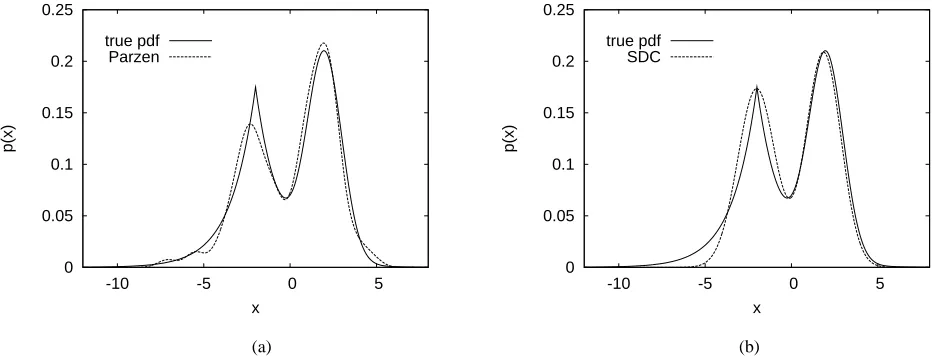
Fig. 1. (a) true density (solid) and a Parzen window estimate (dashed), and (b) true density (solid) and a sparse density construction estimate (dashed), for the one-dimensional example.
to the -term model, and andt the associated orthogonal
and original weight vectors, respectively, linked by
t
. If adding the th term causes some of the elements int
to become negative, the associated previously selected model terms are removed. This strategy requires to carry out re-orthogonalization and in particular re-calculation of the LOO test score, which are computationally expensive. We adopt a much simple method to guarantee the non-negative condition (2). In the th stage, a candidate that causes t to have
negative elements, if included, will not be considered at all. The unit length condition (3) can easily be met by normalizing the final +* -term model weights with
*
{
*
{
2
*
. 9 gk'g
+* (29)
IV. NUMERICAL EXAMPLES
Four examples were used in simulation to test the pro-posed SDC algorithm and to compare its performance with the Parzen window estimate. Comparison with SVM kernel density estimation was also given by quoting the results of [7]. In order to remove the influence of different
C
values to the quality of the resulting density estimate, the optimal value for
C
, found empirically by cross validation, was used. That is, the value of C
used was determined by testing performance. For the first three examples, in each case, a data set of=
randomly drawn samples was used to construct kernel density estimates, and a separate test data set of =
*
935.?3:33
samples was
TABLE I
PERFORMANCE OF THEPARZEN WINDOW(PW)ESTIMATE AND THE
PROPOSED SPARSE DENSITY CONSTRUCTION(SDC)ALGORITHM FOR THE
ONE-DIMENSIONAL EXAMPLE. STD:STANDARD DEVIATION.
method test error (mean STD) kernel number (mean STD)
PW
SDC ! " # $% & '()
used to calculate the *
test error for the resulting estimate according to
*
F
9
=
*
"+-,
-+
(
.
:
L
&
: .
(30)
The experiment was repeated by 100 different random runs for each example. The fourth example was a class two-dimensional classification problem taken from [24].
Example 1. This was a one-dimensional example, and the
density to be estimated was given by
l 3/
9
p
;BA GH<I JL
L
;:
;
O
ix3/ 3 10
;
GH+I
L
3 10 .
ik;
.
(31)
The number of data points for density estimation was = 933
. The optimal kernel widths were found to be C 3 /2/
and
C 9.3
empirically with cross validation for the Parzen window estimate and the SDC estimate, respectively. Table I compares the performance of the two kernel density construc-tion methods, in terms of the *
test error and the number of kernels required. Fig. 1 (a) depicts the Parzen window estimated obtained in a run while Fig. 1 (b) shows the density obtained by the SDC algorithm in a run, in comparison with the true distribution. For this one-dimensional example, it can be seen that the accuracy of the proposed SDC algorithm was comparable to that of the Parzen window estimate, and the algorithm realized very sparse estimates with an average kernel number less than 5% of the data samples.
This example was considered in [7], where a SVM Gaussian kernel density estimate of 5 terms was identified from a single set of 100 training data with an*
test error of; 934/65 93
R
over a test set of 10,000 samples. It can be seen that the result obtained by the SDC method compares favourably with that of SVM method.
two-−8 −6
−4 −2
0 2
4 6 8
−8 −6 −4 −2 0 2 4 6 8 0 0.01 0.02 0.03 0.04 0.05 0.06 0.07 0.08
x y
(a)
−8 −6 −4 −2 0 2 4 6 8
−8 −6 −4 −2 0 2 4 6 8
x
y
[image:5.595.254.539.117.497.2](b)
Fig. 2. True density (a) and contour plot (b) for the two-dimensional example.
dimensional example was defined by
.f 3 /
9
;BA GH+I%JL
L
;:
;
O G)H<IKJDL
L
;:
;
O
i 3 / 3 /
GH<I
L
3 10 .
ik;
.
5
G)H<I
L
3/ . i; .
[image:5.595.74.439.118.496.2](32)
Fig. 2 shows this density distribution and its contour plot. The estimation data set contained = /B33
samples, and the empirically found optimal kernel widths were C 3
for the Parzen window estimate and CX 9.9
for the SDC estimate, respectively. Table II lists the *
test errors and the numbers of kernels required for the two density estimation methods. A typical Parzen window estimate and a typical SDC estimate are depicted in Figs. 3 and 4, respectively. Again, for this example, the two density construction methods had comparable accuracies, but the SDC algorithm achieved very sparse estimates with an average number of required kernels less than 3% of the data samples.
This example was also taken from [7], where a SVM Gaussian kernel density estimate of 7 terms was identified from a single set of only 60 training data with an *
test
−8 −6
−4 −2 0 2
4 6 8
−8 −6 −4 −2 0 2 4 6 8
0 0.01 0.02 0.03 0.04 0.05 0.06 0.07 0.08
x y
(a)
−8 −6 −4 −2 0 2 4 6 8
−8 −6 −4 −2 0 2 4 6 8
x
y
(b)
Fig. 3. A Parzen window estimate (a) and contour plot (b) for the two-dimensional example.
TABLE II
PERFORMANCE OF THEPARZEN WINDOW(PW)ESTIMATE AND THE
PROPOSED SPARSE DENSITY CONSTRUCTION(SDC)ALGORITHM FOR THE
TWO-DIMENSIONAL EXAMPLE. STD:STANDARD DEVIATION. THE
NUMBER OF TRAINING POINTS WAS500.
method test error (mean STD) kernel number (mean STD)
PW & ) &
SDC -)")
error of / 3 :3 5\93 R
over a test set of 10,000 samples. For a comparison, we also performed the experiments over 100 random runs, each with 60 training data points, and the results are listed in Table III. Again, the accuracy of the SDC algorithm is comparable to that of the Parzen window estimate. Obviously, with such a short training data length, the standard deviation of estimate was large. Inspecting the results of the SDC algorithm, it was found that 25% of runs yielded kernel density estimates of less than 7 terms with *
test errors smaller than
/ 3:335#93 R
[image:5.595.52.299.541.613.2]−8 −6
−4 −2 0
2 4 6
8 −5
0 5 0 0.01 0.02 0.03 0.04 0.05 0.06 0.07 0.08
x y
(a)
−8 −6 −4 −2 0 2 4 6 8
−8 −6 −4 −2 0 2 4 6 8
x
y
(b)
Fig. 4. A sparse density construction estimate (a) and contour plot (b) for the two-dimensional example.
Example 3. In this six-dimensional example, the underlying
density to be estimated was given by
'
9
;-A E>
5
c
9
G .
.
G)H<I%JDL
9
;
L
R
L
O
i
9
G .' .
G)H<IKJDL
9
;
L
R
L
O
i
9
G .
.
G)H<I J L
9
;@
L
R
L
O
(33)
with
9.3 9.3 9.3 9.3 9.3 9.3-!
o
diag935.>; 35.9.3f.; 3f.9.3f.>; 3f (34)
L
9.3
L
93
L
9.3
L
9.3
L
93
L
9.
diag
; 3f.9.3f.; 3f.935.>; 35.9.3+ (35)
3 3s3 3s3 3s3 3s3 3s3 3-!
diag; 35.935.>; 3f.9.3f.; 3f.93f (36)
TABLE III
PERFORMANCE OF THEPARZEN WINDOW(PW)ESTIMATE AND THE
PROPOSED SPARSE DENSITY CONSTRUCTION(SDC)ALGORITHM FOR THE
TWO-DIMENSIONAL EXAMPLE. STD:STANDARD DEVIATION. THE
NUMBER OF TRAINING POINTS WAS60.
method test error (mean STD) kernel number (mean STD)
PW )
&
"
"
SDC & "&& ! &
TABLE IV
PERFORMANCE OF THEPARZEN WINDOW(PW)ESTIMATE AND THE
PROPOSED SPARSE DENSITY CONSTRUCTION(SDC)ALGORITHM FOR THE
SIX-DIMENSIONAL EXAMPLE. STD:STANDARD DEVIATION.
method test error (mean STD) kernel number (mean STD)
PW -"! #
SDC & & #)" &
The estimation data set contained = 3:33
samples. The optimal kernel width was found to be C 3 3
for the Parzen window estimate and C 99
for the SDC estimate, respectively, via cross validation using the test data set. The results obtained by the two density construction algorithms are summarized in Table IV. It can be seen that the SDC algorithm achieved a similar accuracy to that of the Parzen window estimate with a much sparser representation. The average number of required kernels for the SDC method was less than 3% of the data samples.
Example 4. The data was obtained from
http://www.stats.ox.ac.uk/PRNN/. This was
the synthetic data set taken from [24], which was a two-class classification problem in a two-dimensional feature space. The training set contained 250 samples with 125 points for each class, and the test set had 1000 points with 500 samples for each class. Tipping [8] reported that the optimal Bayes error rate for this example is around 8%, who also constructed a SVM Gaussian kernel classifier of 38 kernel functions with a test error rate of 10.6% and a relevance vector machine Gaussian kernel classifier of 4 kernel functions with a test error rate of 9.3%. We first estimated the two conditional density functions
&
.
C0
and
&
.
C1
from the training data, and then applied the Bayes decision rule
if
&
.
C0 1
&
.
C1).
belongs to class 0
else.
belongs to class 1
(37)
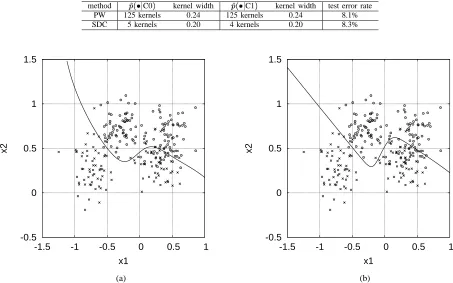
to the test data set and calculated the corresponding error rate. Table V lists the results obtained by the two kernel density construction methods, the Parzen window estimate and the SDC algorithm, where the value of C
TABLE V
PERFORMANCE OF THEPARZEN WINDOW(PW)ESTIMATE AND THE PROPOSED SPARSE DENSITY CONSTRUCTION(SDC)ALGORITHM FOR THE
TWO-CLASS CLASSIFICATION PROBLEM.
method
C0 kernel width
C1 kernel width test error rate
PW 125 kernels 0.24 125 kernels 0.24 8.1%
SDC 5 kernels 0.20 4 kernels 0.20 8.3%
-0.5 0 0.5 1 1.5
-1.5 -1 -0.5 0 0.5 1
x2
x1
-0.5 0 0.5 1 1.5
-1.5 -1 -0.5 0 0.5 1
x2
x1
[image:7.595.76.529.147.430.2](a) (b)
Fig. 5. (a) decision boundary of the Parzen window estimate, and (b) decision boundary of the sparse density construction estimate, where circles represent the class-1 training data and crosses the class-0 training data.
the classifier (37) for the Parzen window and SDC methods, respectively.
V. CONCLUSIONS
An efficient construction algorithm has been presented for obtaining kernel density estimates based on an orthogonal forward regression procedure that incrementally minimizes the leave-one-out test score, coupled with local regularization to further enforce the sparseness of density estimate represen-tations. The proposed method is simple to implement and computationally efficient, and except for the kernel width the algorithm contains no other free parameters that require tuning. The ability of the proposed algorithm to construct a very sparse kernel density estimate with a comparable accuracy to that of the full sample Parzen window estimate has been demonstrated using several examples. The results obtained have shown that the proposed method provides a viable alternative to the state-of-art support vector machine method for sparse kernel density estimation in practical applications.
APPENDIX A
According to the Bayesian learning theory (e.g. [23],[8]), the optimal
is obtained by maximizing the posterior proba-bility of
, which is given by
.
.z.
"
'
.
. '.
"
.
z.
"
.
z.
"
(38)
where
.
z.
"
is the prior with
!
denot-ing the vector of hyperparameters and"
a noise parameter (the inverse of the variance of j
6f
),
.
. '.
"
is the likelihood,
and
.
z.
"
is the evidence that does not depend on
explicitly. Under the assumption that j
6f
is white and has a Gaussian distribution, the likelihood is expressed as
.
.z.
"
'
"
;-A E>
G)H<I
L
"
;
(39)
If the Gaussian prior is chosen, namely
.
z.
"
@
`
{
p
{
p
;-A
G)H<I J L
{
{
;
O
(40)
maximizing
.
. '.
"
?
with respect to
is equivalent to minimizing the following Bayesian cost function
.z.
"
'
"
oi
(41)
where
diag
.
..
. It is easily seen that the criterion (20) is equivalent to the criterion (41) with the relationship
{
{
"
.v9 g4'g
=
(42)
The hyperparameters specify the prior distributions of
. Since initially one does not know the optimal value of
,
{
should be initialized to the same small value, and this corresponds to choose a same flat distribution for each prior of
{
speak” — it learns not only the model parameters
but also the related hyperparameters
. This can be done for example by iteratively optimizing
and
using an evidence procedure [23],[8]. Following MacKay [23], it can be shown that the log model evidence for
and "
is approximated as
. z. " ? ( { 9 ; { L = ; A i = ; " L ( { 9 ; { { L 9 ; " L 9 ; G 80 (43) where
is set to the maximum a posterior probability solution, and the “Hessian” matrix
is diagonal and is given by
i " diag /i " B. i " s .. i " (44) Setting Y 3
yields the re-calculation formula for
" " = L ( { " { { {i " { { (45) Setting Y 3
yields the re-calculation formula for
{ { " { { { {i " { {[ (46) Note { { " and define ( { { (47) with { " { { { i " { { { { { i { { (48)
Then the re-calculation formula for
{ is { { = L : { .v9 gkzg = (49)
APPENDIX B
Consider the model selection problem where a set of *
models have been identified using the training data set W .?
. Denote these models, identified using all the =
data points of , as
&
W
a
65
and the corresponding modeling errors as j a 6f'XWB L & W a 6f (50)
with index 7 9:.;<.).
+* . A commonly used cross
val-idation for model selection is the delete-1 cross valval-idation. The idea is as follows. For every model, each data point in the training set is sequentially set aside in turn, a model is estimated using the remaining
=
L
9
data points, and the prediction error is derived using only the data point that was removed from training. Specifically, let
R
be the resulting data set by removing the th data point from , and denote
the
th model estimated using
R as & W a R 6f and the related predicted model residual at as
j a R @ W L & W a R (51)
The mean square LOO test error [17],[18] for the
th model & W a 65
is obtained by averaging all these prediction errors:
# %j
a R 6f ' 9 = ( j a R 6f (52)
The mean square LOO test error is a measure of the model generalization capability. To select the best model from the
* candidate models
& W a 65 , 9 g g
* , the same modeling
procedure is applied to each of the * predictors, and the
model with the minimum LOO test error is selected.
For linear-in-the-weights models, the LOO test errors can be generated, without actually sequentially splitting the training data set and repeatedly estimating the associated models, by using the Sherman-Morrison-Woodbury theorem [17]. More-over within the OFR model selection procedure, the LOO test errors for the -term model can be computed very efficiently.
It can readily be shown [20],[16] that the computation of the LOO error j <
R
65
for the -term model is based on
the previously selected
L
9
-term model and the currently selected th model term via the efficient recursion formulas
(26) and (27).
APPENDIX C
The modified Gram-Schmidt orthogonalization procedure [21] calculates the
matrix row by row and orthogonalizes
as follows: at theth stage make the columnsw a ,
i#9 g g
=
, orthogonal to the th column and repeat the operation for
9 g g = L 9
. Specifically, denotingw
1 a w a , 9 g g = , then for 79:.>;f..?= L 9 , w R a w R a . i|9 g g = w a w R a L a . i|9 g g = ! (53)
The last stage of the procedure is simply
w R . The elements of
are computed by transforming
1" in a similar way: R i R L 9 g g = (54)
This orthogonalization scheme can be used to derive a simple and efficient algorithm for selecting subset models in a forward-regression manner [21]. First define
R $# R w R w R % (55)
If some of the columns w
R .). w R in R have been interchanged, this will still be referred to as
R
for notational convenience. Let
denote the subset matrix of
, corresponding to the -term model, and
and t the
associated orthogonal and original weight vectors, respectively, satisfying
t
be given, which specifies the zero threshold and is used to automatically avoiding any ill-conditioning or singular problem. With the initial conditions as specified in (28), the
th stage of the selection procedure is given as follows.
Step 1. For
g g =
:
Test 1–Conditioning number check. If
w
R
a
w
R
a
, the
th candidate is not considered.
Test 2–Non-negativeness check. Compute
a
w
R
a
R
J
w
R
a
w
R
a
i
a
O
Set
a
and solve
t
for t . If
t
contains negative elements, the
th candidate is not considered.
Compute, for
9
g
6
g
=
,
j
a
65'XW
R
L
R
a
6f
a
"
a
6f@
"
R
6f
L
w
w
/
!
and
a
9
=
(
j
a
6f
"
a
6f
where
W
R
and
R
a
6f
are the
6
th elements of
R
andw
R
a , respectively. Let the index set
be
\
g
g
=
and
passes both Tests 1 and 2
Step 2. Find
a
"!#.
a
.$ "
Then the
th column of
R
is interchanged with the th column of
R
, the
th column of
is interchanged with theth column of
up to the
L
9
th row, and the
th element of
is interchanged with the th element of
. This effectively selects the
th candidate as the th regressor in the subset
model.
Step 3. The selection procedure is terminated with a
L
9
-term model, if
e
R
. Otherwise, perform the orthogonalization as indicated in (53) to derive the -th row of
and to transform
R
into
; calculate
and update
R
into
in the way shown in (54); update the LOO error weightings
"
65@
"
R
6f
L
i
. 6s9.>;f.).?=
and go to Step 1.
REFERENCES
[1] C.M. Bishop, Neural Networks for Pattern Recognition. Oxford, U.K.: Oxford University Press, 1995.
[2] B.W. Silverman, Density Estimation. London: Chapman Hall, 1996. [3] H. Wang, “Robust control of the output probability density functions for
multivariable stochastic systems with guaranteed stability,” IEEE Trans. Automatic Control, Vol.44, No.11, pp.2103–2107, 1999.
[4] S. Chen, A.K. Samingan, B. Mulgrew and L. Hanzo, “Adaptive minimum-BER linear multiuser detection for DS-CDMA signals in multipath channels,” IEEE Trans. Signal Processing, Vol.49, No.6, pp.1240–1247, 2001.
[5] E. Parzen, “On estimation of a probability density function and mode,” The Annals of Mathematical Statistics, Vol.33, pp.1066–1076, 1962. [6] J. Weston, A. Gammerman. M.O. Stitson, V. Vapnik, V. Vovk and
C. Watkins, “Support vector density estimation,” in: B. Sch ¨olkopf, C. Burges and A.J. Smola, eds., Advances in Kernel Methods — Support Vector Learning, MIT Press, Cambridge MA, 1999, pp.293-306. [7] S. Mukherjee and V. Vapnik, “Support vector method for multivariate
density estimation,” Technical Report, A.I. Memo No. 1653, MIT AI Lab, 1999.
[8] M.E. Tipping, “Sparse Bayesian learning and the relevance vector machine,” J. Machine Learning Research, Vol.1, pp.211–244, 2001. [9] S.S. Chen, D.L. Donoho, and M.A. Saunders, “Atomic decomposition
by basis pursuit,” SIAM Review, Vol.43, No.1, pp.129–159, 2001. [10] A. Choudhury, Fast Machine Learning Algorithms for Large Data.
PhD Thesis, Computational Engineering and Design Center, School of Engineering Sciences, University of Southampton, 2002.
[11] P.B. Nair, A. Choudhury and A.J. Keane, “Some greedy learning algorithms for sparse regression and classification with Mercer kernels,” J. Machine Learning Research, Vol.3, pp.781–801, 2002.
[12] M.H. Hansen and B. Yu, “Model selection and the principle of minimum description length,” J. American Statistical Association, Vol.96, No.454, pp.746–774, 2001.
[13] H. Akaike, “A new look at the statistical model identification,” IEEE Trans. Automatic Control, Vol.AC-19, pp.716–723, 1974.
[14] S. Chen, “Locally regularised orthogonal least squares algorithm for the construction of sparse kernel regression models,” in Proc. 6th Int. Conf. Signal Processing (Beijing, China), Aug.26-30, 2002, pp.1229–1232. [15] S. Chen, X. Hong and C.J. Harris, “Sparse kernel regression modeling
using combined locally regularized orthogonal least squares and D-optimality experimental design,” IEEE Trans. Automatic Control, Vol.48, No.6, pp.1029–1036, 2003.
[16] S. Chen, X. Hong, C.J. Harris and P.M. Sharkey, “Sparse modeling using orthogonal forward regression with PRESS statistic and regularization,” IEEE Trans. Systems, Man and Cybernetics, Part B, to appear, 2004. [17] R.H. Myers, Classical and Modern Regression with Applications. 2nd
Edition, Boston: PWS-KENT, 1990.
[18] L.K. Hansen and J. Larsen, “Linear unlearning for cross-validation,” Advances in Computational Mathematics, Vol.5, pp.269–280, 1996. [19] G. Monari and G. Dreyfus, “Local overfitting control via leverages,”
Neural Computation, Vol.14, pp.1481–1506, 2002.
[20] X. Hong, P.M. Sharkey and K. Warwick, “Automatic nonlinear predictive model construction algorithm using forward regression and the PRESS statistic,” IEE Proc. Control Theory and Applications, Vol.150, No.3, pp.245–254, 2003.
[21] S. Chen, S.A. Billings and W. Luo, “Orthogonal least squares methods and their application to non-linear system identification,” Int. J. Control, Vol.50, No.5, pp.1873–1896, 1989.
[22] S. Chen, C.F.N. Cowan and P.M. Grant, “Orthogonal least squares learning algorithm for radial basis function networks,” IEEE Trans. Neural Networks, Vol.2, No.2, pp.302–309, 1991.
[23] D.J.C. MacKay, “Bayesian interpolation,” Neural Computation, Vol.4, No.3, pp.415–447, 1992.
PLACE PHOTO HERE
Sheng Chen (SM’97) received the B.Eng. degree in
control engineering from the East China Petroleum Institute, Dongying, China, in 1982 and the Ph.D. degree in control engineering from the City Univer-sity, London, U.K., in 1986.
He joined the Department of Electronics and Computer Science, University of Southampton, Southampton, U.K., in September 1999. He pre-viously held research and academic appointments at the University of Sheffield, Sheffield, U.K., the University of Edinburgh, Edinburgh, U.K., and Uni-versity of Portsmouth, Portsmouth, U.K. His recent research works include adaptive nonlinear signal processing, modeling and identification of nonlinear systems, neural network research, finite-precision digital controller design, evolutionary computation methods, and optimization. He has published over 200 research papers.
PLACE PHOTO HERE
Xia Hong (SM’02) received the B.Sc. and M.Sc.
degrees from National University of Defense Tech-nology, Changsha, China in 1984 and 1987, respec-tively, and the Ph.D. degree from the University of Sheffield, Sheffield, U.K., in 1998, all in automatic control.
She worked as a research assistant in the Beijing Institute of Systems Engineering, Beijing, China, from 1987-1993. She worked as a research fellow in the Department of Electronics and Computer Science, University of Southampton, Southampton, U.K., from 1997-2001. She is currently a lecturer at the Department of Cybernetics, University of Reading, Reading, U.K. She is actively engaged in research into neurofuzzy systems, data modeling and learning theory and their applications. Her research interests include system identification, estimation, neural networks, intelligent data modeling, and control. She has published over 30 research papers, and co-authored a research book.
Dr. Hong received a Donald Julius Groen Prize from IMechE, U.K., in 1999.
PLACE PHOTO HERE
Chris Harris receiving the B.Sc. degree from the
University of Leicester, Leicester, U.K., the M.A. degree from the University of Oxford, Oxford, U.K., and the Ph.D. degree from the University of Southampton, Southampton, U.K.
He previously held appointments at the University of Hull, Hull, U.K., the UMIST, Manchester, U.K., the University of Oxford, Oxford, U.K., and the University of Cranfield, Cranfield, U.K., as well as being employed by the U.K. Ministry of Defense. He returned to the University of Southampton as the Lucas Professor of Aerospace Systems Engineering in 1987 to establish the Advanced Systems Research Group and, more recently, ISIS. His research interests lie in the general area of intelligent and adaptive systems theory and its application to intelligent autonomous systems such as autonomous vehicles, management infrastructures such as command & control, intelligent control, and estimation of dynamic processes, multi-sensor data fusion, and systems integration. He has authored and co-authored 12 research books and over 300 research papers, and he is the associate editor of numerous international journals including.