This is a repository copy of ‘I’m not a natural mathematician’: Inquiry-based learning, constructive alignment and introductory quantitative social science.
White Rose Research Online URL for this paper: http://eprints.whiterose.ac.uk/115179/
Version: Accepted Version
Article:
Clark, T. and Foster, L. orcid.org/0000-0003-1471-842X (2017) ‘I’m not a natural mathematician’: Inquiry-based learning, constructive alignment and introductory quantitative social science. Teaching Public Administration, 35 (3). pp. 260-279. ISSN 0144-7394
https://doi.org/10.1177/0144739417711219
[email protected] https://eprints.whiterose.ac.uk/
Reuse
Unless indicated otherwise, fulltext items are protected by copyright with all rights reserved. The copyright exception in section 29 of the Copyright, Designs and Patents Act 1988 allows the making of a single copy solely for the purpose of non-commercial research or private study within the limits of fair dealing. The publisher or other rights-holder may allow further reproduction and re-use of this version - refer to the White Rose Research Online record for this item. Where records identify the publisher as the copyright holder, users can verify any specific terms of use on the publisher’s website.
Takedown
If you consider content in White Rose Research Online to be in breach of UK law, please notify us by
‘I’m not a natural mathematician’: Inquiry-based learning, constructive alignment and
introductory quantitative social science
Abstract
There is continuing concern at the paucity of social science graduates who have the quantitative
skills required by academia and industry. Not only do students often lack the confidence to
explore, and use, statistical techniques, the dominance of qualitative research in many
disciplines has often constrained programme-level integration of more quantitative material.
However, whilst the topic of statistical literacy is relatively well researched within the more
general educational literature, the evidence-base with respect to the effectiveness of teaching
and learning of quantitative research methods in the social science remains somewhat limited.
This paper describes the development, integration, and evaluation of a series of student-led
inquiry-based quantitative workbooks within a sociology/social policy undergraduate degree.
It outlines how the workbooks were constructively aligned within a ‘methods spine’ and offers
some insight into quantitative teaching and learning generally. The paper goes on to discusses
some of the opportunities and challenges of taking both an aligned and IBL approach to the
teaching of quantitative methods. In doing so it adds to growing evidence that ‘problem-based
pedagogies’ tend to increase educational gain over and above more didactic approaches to
learning and teaching. It highlights three key findings: programme-level approaches to
curriculum design can be crucial in improving quantitative skills, particularly where they are
tailored to student needs; a general indifference to quantitative methods is likely to be due to a
process of disenfranchisement that happens before and during their engagement with
university; and, meaningfully engaging students as partners in the process of designing,
the learning and teaching of quantitative skills.
Keywords: constructive alignment, inquiry-based learning, quantitative methods, social
sciences, student engagement
Introduction
Recent calls to establish an underlying pedagogy for the learning and teaching of quantitative
techniques in the social sciences have highlighted the paucity of the evidence-base in the area,
particularly with respect to the experiences of contemporary undergraduates themselves
(MacInnes, 2012). Whilst the challenges of teaching quantitative methods in the social sciences
are relatively well rehearsed (see Payne and Williams, 2011, for instance), evidencing effective
solutions to these difficulties have proved much more elusive.
The topic of statistical literacy is, of course, very well developed within more
mathematically-inclined arenas such as science and/or engineering. However, the entry requirements, the
expectations of students, and the epistemological frameworks that shape the social sciences,
are not necessarily the same as they are in disciplines such as physics and robotics. Simply
transferring pedagogical techniques and experiences from one to the other is not necessarily a
straight-forward task. Many students entering degree courses in the social sciences, and
sociology and social policy in particular, have little knowledge of maths and statistics beyond
the rudimentary requirements of GCSE level study (Byrne, 2012; Author). This is significant,
as Parker et al. (2008: 11) note, “the lack of sustained and widespread mathematics training
once in university creates a substantial impediment to quantitative methods training”. Indeed,
in our experience there is a general expectation amongst sociology/social policy students that
there will be an emphasis on substantive ideas and issues. Furthermore, there is a tendency for
qualitative approaches, including interviews and focus groups, to be favoured by social science
entrants (Williams et al., 2008). It is these interests that attract them to study for their social
science degree, not statistical equations.
This level of preparedness and interest can create a barrier between students and lecturers, with
many ‘stats’ modules requiring substantial mathematical skill on one hand, and knowledge of
dry technical literature on the other. This means that students are often anxious about
undertaking quantitative methods modules, have a tendency to approach them with poor
attitudes and misconceptions as to what it entails, and, fail to see their significance to the rest
of their degree programme (see Earley et al., 2014). Not only do such barriers constrain the
enthusiasm necessary to use quantitative data for sociological purpose, it can also lead to a
(life-long) lack of interest in quantitative methods generally. The challenge for dedicated
research methods lecturers is, therefore, to help to develop their students’ confidence in using
quantitative techniques in more engaging and meaningful ways.
The difficulties of teaching and learning these techniques are reflected in the apparent paucity
of social science graduates who have the quantitative skills required by academia and industry
(see, for example, Irvine et al., 1979; and Wiles et al., 2009). These concerns typically detail
the relative shortage of quantitative research within a UK context “but also a shortage of the
quantitative research skills required ... to understand, and critically review, quantitative
research” (Gorard et al., 2003: 19). If quantitative data is to be useful, not only does it need to
and interpreted with critical awareness.
Indeed, the need to promote statistical skills among social scientists is perhaps more prominent
than ever. The commencement of the five-year Nuffield-funded Q-Step Centres in 2013 - a
£19.5 million programme designed to promote a step-change in quantitative social science
training - has once again underlined the need to establish quantitative skills as a cornerstone of
the social science degree experience. Elsewhere, and as a part of their strategic plan for
2012-2016 to encourage ‘reflection and innovation’ in teaching, the challenges of teaching research
methods have also been a key concern for the Higher Education Authority (HEA), with
teaching research methods one of its three Social Science Strategic Priorities for 2013 – 14.
Within the priority there is recognition of the need share good practice in the area and focus on
“the use of open educational resources (OER) in research methods teaching” (HEA, 2014a).
It is as a result of these initiatives that greater interest is being directed toward the underlying
pedagogy of the field. However, exploring how social science students understand statistics in
practice is likely to be crucial in developing more effective pedagogies. This paper details the
development and evaluation of a project funded under the HEA’s Social Science Strategic
Priorities for 2013 – 14. It aimed to enable sociology/social policy students who have no prior
statistical knowledge to develop the confidence and skills necessary for quantitative research.
More specifically, the project involved the design implementation and evaluation of a series of
inquiry-based workbooks (see
http://www.social-policy.org.uk/uncategorized/doing-quantitative-research-workbook-resources/ to access the workbooks) to provide undergraduate
sociology and social policy students with ‘hands on’ experience of working with quantitative
data extracted from the teaching datasets held by Economic and Social Data Service (ESDS).
workbooks, before describing how they were implemented within a whole curriculum approach
that emphasised the constructive alignment of a ‘methods spine’. Offering some student-led
insight into quantitative teaching and learning generally - and the evaluation of these initiatives
specifically - the paper goes on to discuss some of the opportunities and challenges of taking
both an aligned inquiry-based learning approach to the teaching of quantitative methods.
Inquiry-Based Learning
Inquiry-based learning (IBL) - sometimes also referred to as ‘active learning methods’ - can
come in a variety of forms and under many different headings. These include: ‘collaborative
learning’, ‘problem-based learning’, ‘performance learning’ and even ‘service-based learning’.
What all these methods stress however, is a research-led and student-orientated approach to
teaching and learning. IBL “describes a cluster of strongly student-centred approaches to
learning and teaching that are driven by inquiry or research” (Levy et al., 2010). IBL promotes
theoretically-informed practice-based learning. Often this means involving “students in
discipline-based and interdisciplinary collaborative inquiries, develop[ing] students´
information literacy capabilities, and us[ing] information and communications technologies
imaginatively to enhance the learning experience” (see Levy et al., 2010, for further
discussion). Of course, didactic approaches to teaching and learning can be useful, particularly
in terms of providing background information or instructions regarding assessments. However,
there is a danger that an overreliance on such approaches can encourage a lack of engagement
from students. Indeed, Barraket (2005) has noted how, when introducing student-centred
teaching methods in a masters-level social research methods course, students emphasised the
need for integration of IBL approaches with more didactic teaching practice (see also Petress,
It is evident that utilising IBL in teaching can have many benefits, particularly in respect to
teaching and learning research methods. These include: a better understanding of the
complexities and nuances of the research process; a better retention of skills; the development
of higher levels of thinking, reasoning, critique, achievement, and motivation; developed levels
of empowerment; better engagement with, and interest in, theory; and, higher evaluation scores
and higher levels of satisfaction with their learning experience (Levy et al., 2010; Levy and
Petrulis, 2012). Elsewhere Healey and Jenkins (2009) report that inquiry-based learning not
only improved student grades, but helped students to develop a range of meta-cognitive and
academic skills. These included: the ability to transfer skills across courses; improved
engagement; changed understandings of what learning, teaching and research entails; and,
improving the transition from secondary education to higher education in terms of retention.
Of course, the relationship between inquiry-based learning and research understanding was
well recognised by the classical sociologists of the Chicago School who instructed their
students to ‘get the seat of their pants dirty in real research’ (see McKinney, 1966). Indeed, as
applied to research methods, IBL highlights the importance of both declarative and functional
learning and involves doing research and reflecting on the process rather than just reading about
it.
However, whilst research methods modules remain a core element of sociological programmes,
and despite all that they could provide in terms of research-led and inquiry-based approaches,
there are a number of challenges in employing IBL techniques. The increasing stranglehold of
University ethical review boards on research and student projects often make it difficult to
needs to be achievable within the short turn-around times of semester long courses and not be
overly draining on staff resources. Considerable innovation is often required to think of ways
to develop IBL that either circumvents the need for ethical review, or can fast-track it. Large
classes that are typical of research methods courses makes this even harder to achieve as the
supervision and monitoring that is often required for students to do their own research can
all-too-easily become over-whelming (see Mulryan-Kyne, 2010). Similarly, research methods
teaching is often beset with a revolving door of convenors, many of whom have an interest in
method as a subsidiary of their other substantive interests. As many early career researchers
also find themselves required to teach research methods through necessity rather than choice,
any long-term commitment to the development of innovative methods courses that promote
inquiry-based learning is similarly constrained. In fact, quantitative methods teaching is often
perceived as a necessary evil by those not involved in its teaching (Williams et al., 2004). This
is all compounded yet further by the modularisation of degree programmes that often tacitly
divorces research methods modules from other programme content. Research methods skills
are often not embedded within other programme areas (Williams et al., 2016).
As a result, research skills are all-too-easily taught in a manner that does not support long-term
retention or promote the central concern of sociology: the analysis of the social world (see also
Atkinson and Hunt, 2008). This typically involves a reliance on a limited range of ‘cover all’
textbooks and assessments that focus on essays and/or multiple choice questionnaires. Whilst
these approaches have some value in that they promote declarative understanding, they struggle
to provide meaningful functional experience of the research process (see Biggs, 1996). Indeed,
many ‘text-book’ approaches to research methods are unable to respond to the reflexive
principles of sociological research itself and instead focus on prescriptive definitions and the
all-too-often not required to actually ‘get the seat of their pants dirty’ or attempt to apply any
knowledge gained in ‘real world’ settings. In short, methodological comprehension is divorced
from practice-based experience.
It is, therefore, unsurprising that many students often report that they do not enjoy the courses
(Scheel, 2002). Reciprocally, many staff will often try to avoid teaching research methods
modules due to a recurring shortage of student engagement or a lack of their own interest (see
Lorenz and Bruton, 1996 for some discussion). The irony of this with respect to quantitative
skills specifically, however, is that for social scientists in particular, “a large number of high
quality national surveys are readily available and that expertise in the analysis and data
management of large surveys is in great demand by employers” (Arber, 2001: 270). These
datasets have huge potential for social scientists as they have both representative samples and
a very broad range of subjects. The challenge for dedicated research methods lecturers in the
social sciences is, therefore, to help to develop their students’ confidence in using the diverse
range of resources on offer.
Indeed, there are many practical advantages of using these datasets. They are free at the point
of access; as a secondary source they negate the need for lengthy ethical review processes; and,
they are diverse in scope meaning that they can be shaped around the programme and students’
interests meaning that there is the potential for students to take ownership over their learning
experiences. There are also online tools such as the UK Data Service’s Nesstar Catalogue that
promote ease of engagement. This is a visual data library that can be used to search, browse,
download, and analyse a selected range of key social and economic data.
material that is appropriate to introductory social research students. Although there are some
very good introductory sources available for the more mathematically able social science
students, for those who do not understand the technical language of maths and statistical
thinking this resource can prove too difficult. Whilst not numerically illiterate, many students
on methods courses do not understand or engage with the equation-led approaches offered in
many standard texts and this often serves as a barrier to developing any interest in quantitative
techniques (Author). Maths is, quite literally, a different language.
From the perspective of teaching, it is also not often clear how to integrate the material within
course structures in a way that is meaningful from the perspective of students. Indeed, the
principles of constructive alignment dictate that teaching and learning take place in a whole
system - classroom, department, and institution (see Biggs, 1996). All components within that
system - the curriculum, its intended outcomes, the teaching methods and the assessment tasks
- should be aligned with each other. This principle of deep integration applies to both topic
content and the level of understanding that is required. Therefore quantitative teaching
provision needs to be seen as a part of a whole system of teaching and learning that is suitably
embedded within the programme curriculum. Furthermore the relevance of the content needs
to be clearly articulated for students with respect to this wider curricula (Parker, 2011). In turn,
such approaches should aim to enable students to conduct robust, rigorous, and reflective
sociological research.
Course structure and the ‘methods spine’
Taking a student-led approach to curriculum development, methods provision at the
changes over recent years. In 2008 it consisted of just two general modules: one 10 credit
module at level one, and a 20 credit module at level two. These modules were primarily didactic
in nature, and declarative in assessment. This was complemented by an empirical dissertation
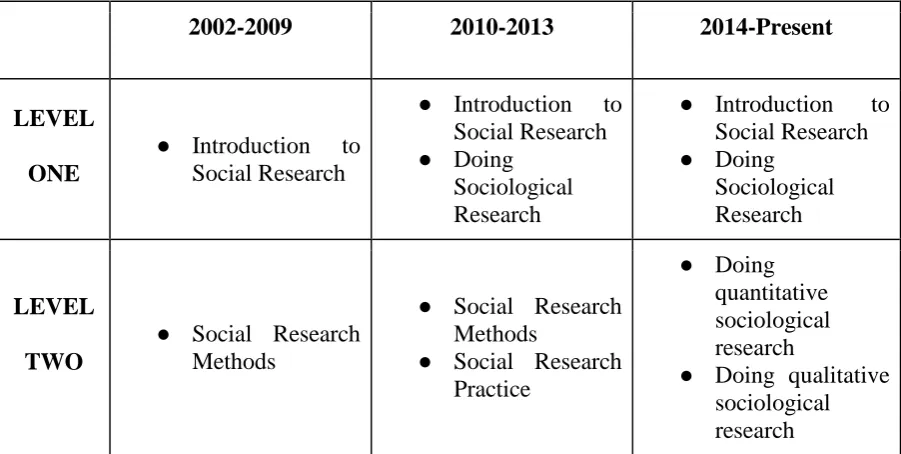
in the final year of study. In 2016, however, there are now: two 10 credit modules at level one
- ‘Introduction to social research’ and ‘Doing sociological research’; two twenty credit
modules at level two - ‘Doing quantitative sociological research’ and ‘Doing qualitative
sociological research’; and, a dissertation module at level three.
There was, however, an intervening stage of programme development that saw a ‘methods in
theory’ and ‘methods in practice’ split at level two (for an overview, see Clark et al., 2013).
Following the success of the practice-based module, the decision was taken to develop the
programme further by making both modules at level two largely inquiry-based. The
development of ‘the methods spine’ that now underpins the programme is summarised in Table
[image:11.595.68.519.541.768.2]1.
Table 1 Modules within ‘the methods spine’
2002-2009 2010-2013 2014-Present
LEVEL
ONE
Introduction to Social Research
Introduction to Social Research Doing
Sociological Research
Introduction to Social Research Doing Sociological Research LEVEL TWO
Social Research Methods
Social Research Methods
Social Research Practice
Doing quantitative sociological research
LEVEL
THREE Dissertation Dissertation Dissertation
Currently, all modules within the spine are predominantly inquiry-based in design and the
development of research, communication, and wider skills are progressively sequenced in both
scope and depth over the length of the course. The assessments for these modules currently
include: project reports, research posters, dissemination websites, reflexive journals of the
research process, oral presentations, and research proposals. Formative tasks also include
literature searching tasks and submitting applications to ethical review boards. Working both
individually and as part of a team, and culminating in a 15,000 word empirical dissertation, our
single honours students will have completed a total of five research projects by the time they
graduate.
Building on declarative and functioning knowledge of research design and research process at
level one (see Biggs, 1996), the specific techniques of quantitative provision are developed at
level two in the module Doing quantitative sociological research. The main aim of this module
is to provide students with a theoretical and practical foundation for conducting independent
quantitative social research. Assessment consists of a group-based research poster that uses
student-generated survey data to respond to a specific research brief, and an individual project
report based on the analysis of secondary data provided by the ESDS. Teaching material
consists of a variety of student-directed lectures, seminars, workshops, multiple-choice
questionnaires, and a series of bespoke inquiry-based workbooks to support the development
The workbooks integrate a number of worked ‘by-hand’ examples drawn from the datasets
provided by the ESDS, whilst also providing a ‘step-by-step’ guide to analysing the data using
PASW (IBM SPSS), a computer programme utilised to analyse quantitative datasets. They are
designed to be ‘narrative’, rather than mathematical, and aim to ensure that students understand
the principles of specific quantitative methods, before developing the ability of students to use
them for research purposes. The five workbooks cover a range of techniques that novice
researchers need in order to develop and carry out introductory quantitative projects. These
include: ‘Research Rationales, Research Questions and Research Hypothesis’; ‘Designing
Variables and Understanding Levels of Measurement’; ‘Describing Data’; ‘Using Chi-Square,
Phi and Cramer’s V’; and, ‘A guide to analysing data using PASW (IBM SPSS)’. They have
been designed to provide a comprehensive introduction to the key skills necessary to undertake
quantitative work, and many of the ideas that underpin more advanced analysis. Indeed, with
the knowledge that many undergraduate students need to develop confidence in handling
quantitative data, we specifically chose to integrate non-parametric tests into the workbooks
because of their verisimilitude with respect to introducing statistical ideas and interpretation.
Innovatively, these workbooks have been developed in two stages, and alongside two groups
of students who were encountering social statistics for the first time. Indeed, engaging students
in the design, integration, and development processes of embedding the workbooks within an
aligned methods curriculum has been especially helpful in developing an inquiry-based
approach to the development of quantitative skills. The cycle of evaluation and development
are detailed below.
Evaluation within any module or programme can take many forms. Whilst both informal
conversations with students, attendance, assessment outcomes, and critical reflection are a
staple of the reflexive practitioner, the analysis presented below specifically highlights the use
of two methods of formal evaluation that have been used in the development and integration
of the workbooks within the methods spine. Firstly, two focus groups were used to explore
students’ experience of the quantitative workbooks and opinions about quantitative research
methods more generally. Secondly, we analysed student evaluation data prior to and following
the changes to the sociological methods spine at the University of Sheffield. Adopting a
pragmatic approach to methodological choice and combining the use of both qualitative and
quantitative methods means that the strengths of one method essentially assist in compensating
for the weaknesses of another (Denzin, 1978).
The first focus group was conducted early in 2010 with six level 1 undergraduate sociology
and social policy students. These students were asked about their experiences and expectations
of quantitative research and the quantitative workbooks which were being developed to
ultimately be introduced into the curriculum. They were also asked to provide written thoughts
on quantitative methods before reading the workbooks. Written feedback from the students, in
addition to the comments in the focus group, enabled us to refine the workbooks in accordance
with their experiences. The first four workbooks were then utilised in the core sociological
studies research methods module ‘Social Research Principles’ which took place in the first
semester of level two in 2010-11. The final workbook - that detailed how to use PASW/SPSS
- was delivered in the module ‘Social Research Practice’.
The original workbooks were subsequently redesigned in 2013-14 and their content updated
new sections and further tasks for students. In addition, another workbook was developed
focusing on the use of secondary datasets and incorporating ESDS datasets. Once again five
students were recruited to participate in the project. These were level one students with limited
previous research methods experience, and no experience of working with PASW/SPSS. They
were asked to work through the newly redeveloped workbooks and provide feedback on both
content and the tasks. A subsequent focus group was conducted where they were asked about
their opinions about quantitative research and the value of the workbooks themselves.
Following some amendments, the redesigned workbooks were introduced into the curriculum
in 2014-15.
The focus groups enabled the students to express their own views and interpretations of the
workbooks in detail, and their views on quantitative research methods more generally. They
are especially useful in providing a detailed, contextual and multi-layered interpretation of a
particular social problem or social group (Mason, 2002). They lasted approximately one and a
half hours, and participants were selected as a result of recommendations by graduate teaching
assistants regarding their reliability in terms of attendance. As evidenced by their student
record, the student collaborators covered a range of abilities (relative to the institution). The
students were recruited through the use of a personal email asking them if they were willing to
take part in the research. Participants received payment for testing the workbooks and
attendance at the focus group. The focus groups were recorded, transcribed and pseudonyms
employed.
The process of data analysis that is presented below focused on identifying themes employing
an open, axial and selective coding process advocated by Strauss and Corbin (1990). Open
coding was then employed to collapse categories with similar semantic meaning derived from
open coding (Taylor-Gooby, 2005). The selective phase of coding involved a return to the data
to clarify at a higher level of abstraction the significance and scope of the themes emerging
during axial coding. These key themes were used to assist in the organisation of the findings.
Due to the limited sample size and strategy, theoretical saturation cannot be assumed. The study
is therefore illustrative rather than extensive, with quotes and examples utilized to indicate the
themes identified. The strength of this approach, however, is in developing a rich
“understanding of processes, motivations, beliefs and attitudes than can be gained from
quantitative research” (Rowlingson, 2002: 632). ‘Moderatum’ generalisations can be drawn
from the data which resemble modest, pragmatic generalisations drawn from personal
experience which bring a “semblance of order and consistency to social interaction” (Payne
and Williams, 2005: 297). They can provide powerful illustrations of the kinds of trends which
emerge from the data and are particularly useful when placed within the context of previous
research findings.
The quantitative elements of the evaluation entailed the use of student evaluation feedback.
This involved exploring the student evaluation scores prior to and following the introduction
of IBL methods, including the workbooks in the methods teaching, in sociological studies (pre
and post 2010-11). The analysis is limited by the fact that student evaluation data was not
available for all of the years, either because the information had not been collected or the data
has simply been lost. The number of respondents was not always available, but figures were
only collected when there were at least 25 respondents. Furthermore, the fact that the questions
asked in the surveys changed at certain points presented a challenge. However, two questions
did remain broadly the same and we present these as a point of comparison. The first is
satisfaction with the course.
Findings
The findings presented below offer insight into both developing resources that help to enable
inquiry-based approaches to quantitative research and students’ understandings of quantitative
research more generally. Indeed, in the process of exploring the impact of developing and
evaluating quantitative provision, a number of themes were developed that are presented and
discussed below. These include: expectations of quantitative research; usefulness of
quantitative techniques in sociology and social policy; the value of making ‘quants’ accessible;
statistics, stereotypes, and structural impediments; learning through doing and IBL; and,
students as partners. Results extracted from student evaluation forms are then presented and
discussed.
Expectations of quantitative research
The information we received from the students prior to engaging with the material is revealing
with respect to their expectations of learning quantitative methods. For instance, Fran’s initial
comments (2013) about her involvement in the project are particularly indicative of a student’s
attempt to understand statistics for the first time:
“My current level of ability in the area of quantitative research is relatively low and in a
formative stage. I feel that the literature surrounding ‘doing quantitative research’ is often
This notion of not being very competent at mathematics was a common theme. For instance,
Ellie (2013) also stated “I think that most students who do sociology that I know struggle with
thinking mathematically, which puts them off wanting to do anything with statistics because it
seems a bit complicated”. Across both focus groups there was a general consensus - and
concern - that learning and teaching should be targeted accordingly and provided at a suitable
level: “I feel that in order to consider conducting a quantitative social research it would be
essential for students to learn the basics in the simplest form” (Sarah, 2013). It was this
disjunction between perceived ability and level of expectation required that caused some
anxiety for students - as Kay (2010) pointed out: “quantitative methods was something I was
worried about”. Fran elaborated that this anxiety can quickly turn to indifference:
“… from speaking to my peers, I know that many people feel intimidated by certain quantitative
methods unless they come from a mathematical background. Often that lack of confidence leads
to indifference and a loss of interest in the subject matter … The literature surrounding social
research methods are not always easy to read and understand - especially when numbers
become involved - meaning people are often averse to learning about quantitative methods
(Fran, 2013).”
Indeed, where material is not presented in an appropriate manner, or where it is not linked to
the students’ discipline, many students are likely to agree with Linda’s (2010) assertion that
“quantitative research is a bit boring”. Indeed, this lack of interest in quantitative methods has
been commonly cited in the social sciences (Irvine et al., 1979; MacInnes, 2012).
Despite the tendency for students to worry about undertaking quantitative methods, especially
as a result of a lack of previous positive exposure, there was certainly evidence of students’
awareness of the importance of quantitative methods in their own studies, and in their overall
understanding of sociology more generally. Prior to completing the workbooks, our focus
group students felt that they lacked the skills to conduct their open independent quantitative
research. However, they clearly thought that developing these skills would be a good idea as it
would enhance their functioning knowledge and experience:
“I think I would find it difficult to conduct a project from start to finish, because I have a lack
of experience in conducting a project independently. I would like to learn more about the
processes required, as I think it would be useful for conducting my own research” (Al, 2013).
Elsewhere Ellie (2013) pointed out that whilst she recognised that “the whole maths thing puts
me off a little bit”, this was balanced by a healthy curiosity that led her to believe that “it would
be good to learn more about quantitative research”. Following completion of undertaking the
workbooks Mick (2010) similarly stated that “...having knowledge of how to do quantitative
research is quite good and really useful”, with Fran (2013) also eloquently recognising the
overarching value of quantitative skills to her own arguments and research:
“I would like to learn more about quantitative research as quite often interesting and/or
relevant facts within sociology that support points both in my own essays and within general
reading are of a quantitative statistical nature. Whilst I often feel more drawn to learning about
and carrying out qualitative research in sociological sense, it seems sensible to use mixed
methods research techniques to fully support ideas or theories. Sometimes quantitative
However, she went further to articulate the value of understanding quantitative material more
generally (c.f Gorrard, 2013):
“...analysing ‘easy to digest’ statistics and quantitative findings is vital to breaking down
common misconceptions which is integral to sociology ... learning more about quantitative
research would be essential to being successful within this course and learning more about
sociology and society in general.”
Against the popular stereotype, what is important to recognise here is that the students did not
identify themselves as particularly ‘anti-quantitative research’. Whilst they did acknowledge
that they were generally more qualitatively oriented, they also recognised that quantitative
research is important and they understood the need to engage with it – if it is presented in a
manner that is appropriate to their ability, confidence, and interest. Of course, the sample of
students presented here is limited and there is little doubt that militant ‘anti-quants’ students
do exist. However, resistance and relative indifference is not the same thing. Indeed, current
understanding of the processes by which students make decisions about methodological
interests and/or how and why they become disenfranchised with the idea of quantitative
research is not particularly well articulated within the literature.
Statistics, stereotypes and structural impediments
That said, the focus group data does offer some hints at how statistical stereotypes are
structurally reinforced. Indeed, whilst we have already highlighted the lack of widespread
interesting observations regarding the (purely didactic) teaching of quantitative research
methods at A Level were explored within the interviews. Ellie (2013) for example noted how
“at A Level they put quite a negative spin on quantitative data ... at A Level we just did pluses
and minuses of using quantitative methods but nothing practical”. In spite of the fact that the
data provided by the UK Data Service is incredibly robust, the problems of ‘official statistics’
were often presented as being so problematic they were not really worth bothering with at all.
Other participants also felt that the emphasis on quantitative research in A Level Sociology
was largely about emphasising the negative elements of social statistics rather than their
possibilities. Al (2013), for instance, stated that this often involved teachers developing lists of
the “pros and cons” of quantitative methods - with the “cons” list often appearing far weightier
than the “pros”. This kind of purely didactic approach has obvious implications for student’s
level of engagement (Petress, 2008). Furthermore, the A level syllabi places very little
emphasis on quantitative methods and it is possible for students to mostly avoid assessment in
this area (Williams et al., 2016).
This is certainly an area which needs further attention. Indeed, for our sociological students it
would appear that the process of disenfranchisement is already well formed before they arrive
at university, yet alone industry. Policies that are designed to support the development of
quantitative knowledge, such as Nuffield’s Q-Step programme and the HEA's strategic priority
on teaching research methods, are likely to be constrained by particular realisations of the A
level syllabus that are derisory toward quantitative appreciation generally, and near
non-existent in terms of skill-development specifically. Conforming to wider popular stereotypes
of maths and statistics, this means that those sociological students entering university are
already someway predisposed to be critical of such methods. This is likely to lead to lower
The value of making ‘quants’ accessible
Following the completion of the workbooks, however, the students in both of the focus groups
were generally very positive about the workbooks and the contribution they had made to their
knowledge, experience, and confidence. Using written and verbal feedback from them we
found that all of the students involved in the project felt using the workbooks had substantially
enhanced their quantitative knowledge and their ability to undertake a quantitative research
project. Sarah (2013), for instance, suggested:
“...[the] books definitely enhanced my knowledge of quantitative social research and
demonstrated new aspects of it and how it can be used in practice ... I was very pleasantly
surprised with how student friendly these workbooks were and they definitely changed my
attitude towards quantitative research and statistics.”
Al (2013) similarly emphasised the importance of the sociological content of the workbooks:
“I found it interesting because it was put into a sociological context, so there was some sort of
relevance to it, and the sort of topics I am interested in were integrated into the statistics.”
The relevance of the examples was also highlighted as an important factor by, Fran (2013)
amongst others:
“The information is rich and detailed without being over complicated. Examples that are
inspiration for topics of research relevant to students’ lives.”
Indeed, the importance of relating the techniques of quantitative methods to areas of both
student and disciplinary interest was clearly valued by all members of the focus groups. Not
only did it make the material meaningful, it also enabled them to take ownership of the ideas
that they chose to develop. Accessibility and relevance helped to facilitate the creativity needed
to develop their own ideas and learning experiences.
Learning through doing: inquiry-based learning
Consolidation exercises are a constant pedagogical feature within the workbooks. Generally,
these tasks encourage students to use the information they are learning about to develop their
own interests and/or skills. They might be asked to construct a rationale for a particular topic,
for instance, or analyse a table and compare their findings with an account offered in the book.
These exercises were designed to both enable students to develop their own research interests
and give them experience of the process of ‘doing research’. Indeed, the examples used within
the book are often aligned in that particular themes are repeated. So, for example, workbook
two introduces the problem of measuring ethnicity, with workbook three exploring the
relationship between ethnicity and ‘hours worked’, and workbook four exploring how ethnicity
and ‘fear of crime’ might be associated. This enables students to imagine the research as a
‘process’, something that was highlighted by the students. Linda (2010), for example, noted
that “it was good to learn about how to do research”, with Mick (2010) adding, “the idea of
understanding why and where it comes from is relevant rather than just exercises”. At the
same time, he emphasised the value of inquiry based learning more generally: “I like to have
student-centred approach to learning and teaching advocated by Levy et al. (2010) had a
positive impact on student engagement.
Indeed, the opportunity to ‘practice’ was deemed to be a useful way of developing quantitative
skills. For instance, Fran (2013) stated:
“...in terms of experience of quantitative methods within sociological research these workbooks
are effective as they provide simple exercises in order to practise methods that are previously
only abstract to the student”.
Ruth (2010) similarly acknowledged that she “would feel confident in undertaking a
quantitative project now”. By providing students with opportunities to use quantitative
methods in a manner which allowed them to focus upon their own areas research interest
appeared to enhance their confidence. This was enhanced yet further by being able to follow a
particular line of inquiry from start to finish.
Students as partners
Another feature of the development of the workbooks that was highlighted as beneficial by
students in both sets of focus groups was the fact that they were able to make a difference in
developing teaching resources. Indeed, the benefits of involving students as partners in the
design and delivery of curricula are well recognised within the pedagogical literature (see
Healey et al, 2014 for a review). Not only can it increase engagement and success, it has also
been shown to: develop the knowledge and skills to support employability; foster a greater
deeper appreciation of contributing to an academic community (see Trowler, 2010 and HEA,
2014b). These benefits were reflected across the focus groups with particular emphasis given
to the fact that they were able to indicate which tasks and explanations were likely to work best
and which needed alterations. For instance, Ruth (2010) noted, “I wish we could have this kind
of involvement in the development of other modules”, with Mick (2010) elaborating: “first
years usually just hand their work in, turn up to seminars and not say anything. People on my
course were interested in what I was doing with the workbooks. It is nice to be involved in stuff
like this”. Kay (2010) similarly highlighted how it elevated her learning experiences beyond
being a passive recipient of knowledge: “it's nice to not feel like we are just being told what to
learn and have a say”.
Student evaluation data
Beyond the specifics of the focus group data, it is also evident that the workbooks were
positively received when rolled out into ‘the methods spine’. Prior to the introduction of the
workbooks, module evaluation feedback for the level two module ‘Social Research Methods’
indicated that some students felt that on completion of the module they still “lack[ed]
confidence in the practical application of quantitative skills”.
Indeed, the figures presented in Table 2 show the average score out of 4 (1 = strongly disagree
to 4 = strongly agree) in relation to enjoyment/interest in the module and module satisfaction
for several years prior to 2010-11 and post 2010-11.
Table 2 Research methods module engagement and satisfaction (average mark out of 4)
Year Enjoyment/interest Quality/overall satisfaction
2002-3 1.64 2.1
2004-5 1.44 1.92
2005-6 1.2 1.76
2006-7 2.16 1.52
2010-11 3.4 3.7
2011-12 3.7 3.7
2012-13 3.4 3.3
2013-14 3.3 3.3
Source: Module evaluation data 2002-3 to 2013-14
Whilst we failed to locate the evaluation data for the periods 2007-2008, 2008-2009, and
2009-2010, as detailed earlier, 2010-11 saw research methods provision within the programme
increased from 20 to 40 credits in level 2, with an additional emphasis on inquiry based
learning. This was also the time that the quantitative workbooks were introduced.
It is evident from the table that the average scores in relation to the module feedback in relation
to enjoyment/interest and module satisfaction increased considerably after the changes were
implemented. For instance, in 2002-3 the average level of enjoyment/interest/engagement out
of 4 was 1.64 compared with 3.4 in 2010-11. In fact, following the introduction of the
years prior to the introduction of the changes. The overall quality/satisfaction with the module
showed similar trends improving from 2.1 in 2002-3 to 3.7 in 2010-11. Once again, following
the changes to the teaching in 2010-11, the quality/overall satisfaction has not dropped below
3. Before the changes, overall satisfaction was not higher than 2.1.
The general consensus of improvement is similarly reflected in the ‘open comments’ section
of the evaluation forms that were made by students after the introduction of the workbooks.
Not only did students comment on the helpfulness of the workbooks generally, they also
highlighted that: “lectures were broken up by exercises/discussions which makes them much
more interesting and useful instead of being lectured at for 2 hours”; “good interactive learning
in lectures”, “interactive aspects, activities - made lectures more engaging”; “I found the
examples given to explain things helpful; “the mathematics aspect was explained very clearly”;
“the lecturer was very enthusiastic and simplified matters by giving very good examples and
handbooks”; “workbooks = good idea”. Some students have also sought to specifically draw
attention to the type of learning that the workbooks encourage: “the workbooks/exercises
helped –practical based learning”, “inquiry based learning = very effective, better than lecture
based learning. Workbooks very useful!!!” (see Author, for further analyses of the
effectiveness of the workbooks).
Conclusion
This paper describes the development, integration, and evaluation of a series of ‘student-led’
inquiry-based quantitative workbooks within the methods spine of a sociology/social policy
undergraduate degree. It outlines how the workbooks were constructively aligned within the
generally. In doing so, it demonstrates how an ‘holistic curriculum design’ approach can enable
the development of a more coherent, and less fragmented, programme (Rust, 2000). The
evidence presented within the paper highlights some of the benefits of using IBL approaches
with respect to the learning of introductory quantitative methods, and offers some discussion
of the barriers to learning. It also provides some insight into how students might be better
engaged so they are in a position to respond to wider policy initiatives.
There are, of course, some limitations of the evidence presented within the paper and the
conclusions we can draw from it. Firstly, the size of the sample with respect to both the focus
groups and student evaluations are limited. The extent to which both the ideas and the data
presented will transfer elsewhere are likely to be constrained as a result. However, we would
highlight that although the formal presentation of the data here is restricted, it does not
contradict our own informal experiences of using the workbooks - either directly or indirectly
- or the overall impression of their usefulness within the methods spine. Secondly, our approach
to teaching research methods generally, and quantitative techniques specifically are also
located within one department in one very particular institution. As a result, any conclusions
drawn are not likely to be exhaustive of all student opinion about the learning and teaching of
quantitative across the gamut of sociology/social policy programmes, yet alone the social
sciences more generally. Further work needs to be done to more fully assess the barriers to
quantitative social science specifically, and the processes by which students become
disenfranchised with ‘quants’ more generally.
Thirdly, the methods by which we have evaluated the workbooks, and the programme more
generally, has been emergent rather than specifically planned. This is, perhaps, an inevitable
institutions and the time it takes to develop and integrate material into a three-year long degree.
Similarly, we recognise the limitations of relying on student feedback. However, we would
suggest that any approach to teaching and learning needs to be tempered with the continuous
development of knowledge, experience, and feedback. The practical requirements of teaching
within a higher education context rarely affords the opportunity of experimental approaches to
evaluation, and the speed at which opportunities for pedagogical development occur often
mean that more rigorous designs are difficult to anticipate. Equally, we keep in mind Williams’
et al. (2016) suggestion that the pursuit of student feedback is not the ‘be and end all’ of
evaluating quantitative provision. After all, feedback can always be made better by telling
students what they want to know, or giving them the assessments they can already do.
However, whilst students do not necessarily recognise, or listen to our ‘connected’ narratives
of tasks and assessments within the context of the methods spine, we would again seek to
highlight informal feedback that suggests our students do, when they receive their dissertation
mark and beyond, acknowledge the usefulness of the curriculum they have studied within. This
is not an exhortation to ‘trust us’. It is, however, a recognition that both curriculum delivery
and evaluation is a situated practice that requires continuous reflection with respect to
practitioner experience, student feedback, and the pedagogical literature. It is also to add to
growing evidence that ‘problem-based pedagogies’ - of which IBL is a part - increase
educational gain over and above purely didactic approaches to learning and teaching.
Indeed, this paper is important for a number of reasons. Firstly, it highlights that understanding
the perspective of students does matter with respect to teaching introductory quantitative
statistics. This means communicating with them in a manner that is familiar to them, and giving
them the opportunity to shape the curriculum to their own interests so they can take ownership
are many subtle differences within student cohorts and between departments, universities, and
disciplines. This is not the same as downplaying the importance of inquiry-based learning,
active-learning strategies, or problem-based pedagogies. It is, however, to note that the
realisation of these approaches, need to be tailored to the particular audience in question.
Secondly, the paper also highlights that whilst the popular stereotype of students who are
‘resistant’ to quantitative methods might hold some weight, it is not a natural state of being,
nor is it inevitable. Instead, general indifference is likely to be due to a process of
disenfranchisement that happens before and during their engagement with university. As a
result, we need to be careful that we are not simply treating the symptoms and instead begin to
look beyond, and engage with, those factors that influence the processes by which students
encounter research methods generally, and quantitative research specifically. Finally, we
would seek to highlight the importance of meaningfully engaging with students as partners in
the process - and it is a process - of designing, integrating, and evaluating material relating to
the learning and teaching of introductory quantitative social science.
References
Author
Arber S (2001) Secondary analysis of survey data, in N. Gilbert (Ed.) (2nd edn) Researching
Social Life. London: Sage.
Atkinson M and Hunt A (2008) Inquiry-guided learning in sociology. Teaching Sociology
36(1): 1-7.
Barraket J (2005) Teaching research method using a student-centred approach? Critical
reflections on practice. Journal of University Teaching and Learning Practice 2(2): 64-74.
347-364.
Byrne D (2012) UK sociology and quantitative methods: Are we as weak as they think? Or are
they barking up the wrong tree? Sociology 46(1): 13-24.
Earley MA (2014) A synthesis of the literature on research methods education. Teaching in
Higher Education 19(3): 242–253.
Gorard S (2013) Research Design: Creating Robust Approaches for the Social Sciences.
London: Sage.
Gorard S, Taylor C, Rushforth K and Smith E (2003) What is the Research Capacity of the UK
Education Research Community? Reconsidering the Shortage of Quantitative Skills
Phenomenon, Occasional Paper Series. Cardiff: University School of Social Sciences.
Healey M and Jenkins A (2009) Developing Undergraduate Research and Inquiry. York:
Higher Education Academy.
Healey M, Flint A and Harrington K (2014) Engagement through Partnership: Students as
Partners in Learning and Teaching in Higher Education. York: Higher Education Academy.
Higher Education Academy (2014a) HEA Framework for Partnership in Learning and
Teaching. York: Higher Education Academy.
Higher Education Academy (2014b) Teaching Research Methods in the Social Sciences:
http://www.heacademy.ac.uk/resources/detail/disciplines/Soc_Sci/Strategic_2013/ResearchM
ethods (accessed 10 July 2015)
Irvine J, Miles I and Evans J (1979) Demystifying Social Statistics. London: Pluto Press.
Levy, P and Petrulis, R (2012) How do first-year university students experience inquiry and
research, and what are the implications for the practice of inquiry-based learning?. Studies in
Higher Education, 37(1): 85-101.
Levy P, Sabine L, McKinney P, Nibbs A and Wood J (2010) The Sheffield Companion to
Arts and Social Sciences, University of Sheffield).
Lorenz F and Bruton B (1996) Experiments in surveys: Linking mass class questionnaires to
introductory research methods. Teaching Sociology 24(3): 264-271.
MacInnes J (2012) Quantitative Methods Teaching in UK Higher Education: The State of the
Field and How it Might be Improved. York: Higher Education Academy
Marsh C (1988) Exploring Data: An Introduction to Data Analysis for Social Scientists (1st
Edn). Cambridge: Polity Press.
Mason J (2002) Qualitative Researching. London: Sage.
McKinney J.C (1966) Constructive Typology and Social Theory. New York:
Appleton-Century-Crofts.
Mulryan-Kyne C (2010) Teaching large classes at college and university level: Challenges and
opportunities. Teaching in Higher Education 15(2): 175-185.
Parker J, Dobson A, Scott S, Wyman M and Landén A (2008) International Bench-marking
Review of Best Practice in the Provision of Undergraduate Teaching in Quantitative Methods
in the Social Sciences:
http://www.esrcsocietytoday.esrc.ac.uk/_images/International_benchmarking_undergraduate
_quantitative_methods_tcm8-2725.pdf (accessed 10 June 2015)
Parker J (2011) Best practices in Quantitative methods teaching: comparing social science
methods curricula across countries. In: Payne G and Williams M (eds) Teaching Quantitative
Methods: Getting the Basics Right. London: Sage, pp.32–48.
Payne G and Williams M (2005) Generalization in qualitative research. Sociology 39(2): 295–
314.
Payne G and Williams M (Eds.) (2011) Teaching Quantitative Methods: Getting the Basics
Right. London: Sage.
Rowlingson K (2002) Private pension planning: The rhetoric of responsibility, the reality of
insecurity. Journal of Social Policy 31(4): 623–42.
Rust C (2000) An opinion piece A possible student-centred assessment solution to some of the
current problems of modular degree programmes. Active Learning in Higher Education 1(2):
126–131.
Scheel E (2002) Using active learning projects to teach research skills throughout the sociology
curriculum. Sociological Practice: A Journal of Clinical and Applied Sociology 4(2): 145-170.
Strauss A and Corbin J (1990) Basics of Qualitative Research. London: Sage.
Taylor-Gooby P (2005) Uncertainty, trust and pensions: The case of the current UK reforms.
Social Policy and Administration 39(3): 217–32.
Trowler V (2010) Student Engagement Literature Review. York: Higher Education Authority.
Wiles R, Bardsley N and Powell J (2009) Consultation on Research Needs in Research
Methods in the UK Social Sciences. Southampton: University of Southampton, ESRC National
Centre for Research Methods.
Williams M, Collett C and Rice R (2004) Baseline Study of Quantitative Methods in British
Sociology. Birmingham/Durham: C-SAP/BSA.
Williams M, Payne G, Hodgkinson L (2008) Does Sociology Count? Student attitudes to the
teaching of quantitative methods. Sociology 42(5): 1003-1022.
Williams M, Sloan L, Cheung S, Sutton C, Stevens S and Runham L (2016) Can't count or
won't count? Embedding quantitative methods in substantive sociology curricula: a