2074
A Novel Blowfish Based-Algorithm To Improve
Encryption Performance In Hadoop Using
Mapreduce
Thoyazan Sultan Algaradi, B Rama
Abstract: Nowadays, Big data is an exclusive term which describes the intricate and large amount of any significance structured, semi-structured, and unstructured data taking into account its volume, veracity, and variety. However, the biggest challenge faced in this area is security. The encryption is one of the important techniques that highlight its role in solving many problems of security, especially in Hadoop where it proved its worthiness protecting sensitive data. In this paper, a novel blowfish-based algorithm including a key scheduling procedure is proposed and integrated with Hadoop. The proposed scheme ensures a high level of security against any attacks attempt. Here, a pre-configured programming model of MapReduce is utilized to deal with large amounts of data and encrypt them in a parallel way that ensures a shorter processing time. Results analysis of Performance of the proposed algorithm proves its effectiveness and superiority in comparison to the traditional blowfish algorithm. Besides, the proposed algorithm makes a fair balance between security, time-consuming, and performance.
Keywords: Big data, Hadoop, MapReduce, Encryption, cryptography, blowfish.
—————————— ——————————
1. INTRODUCTION
ig data is a set of intricate data with a massive size that is required to catch as well as to process, store or search [1]. Once it depicted as valuable information through its distinctive high volume, variety, and velocity, making specialized techniques is necessary to do perfect analytical procedures to transport it [2,3]. Some of the most important aspects that emerged recently that gaining a high concern related to the privacy and security of these big data, which has made most of the modern technologies work on these aspects [1]. Because of that, security issues have become newcomer concepts in the area of big data, which made the information security one of the glowing topics in the research field of computer science and technology [4]. In the term of information security, many extensible algorithms specialize in the field of encryption. which has shown great success through its usage [4, 5, 6]. It is known that there are two common types of encryption which classified as Asymmetric-key is known to be public-Asymmetric-key and symmetric-Asymmetric-key known to be secret-key encryption [5]. The perfect encryption system must consummate all the needs and requirement of big data such as high speed, size of those data and security. Recently there are many symmetric encryption techniques that tried to offer somewhat convincing solutions to cover these issues. RC6, MARS, 3-DES, DES, and blowfish are among the most prominent works that have emerged in this field. However, these algorithms are no longer sufficient to breed satisfactory outcomes consistent with the characteristics required for big data processing [2]. Because of the volume, velocity, and variety of big data is doubling day-by-day, creating more challenges for the encryption process [7]. Thus, it important to enhance security through the expansion and development of important encryption schemes to make them more scalable,
efficient and effective to keep up with all new. The huge CPU resource consumption is one of the challenges experienced by the encryption schemes involved in big data, which in its turn leads to low throughput. This led to doing more efforts to improve cryptographic systems, which in its turn led to the emergence of parallel computing which use multiple micro-processing elements to make it possible for several computations to carry out simultaneously within a single machine. Jayan et.al [8], proposed a modified RC4 algorithm which can work in parallel as it proposal work to collect the key with a number of threads and then combined with the plaintext. What makes their proposed in parallel by making each thread working on the processed part of the plain text using its own key and running them in parallel. Their proposed has been shown successfully compared to a number of encryption algorithms such as AES, DES, and RSA for its speed and time complexity. Where the time of its encryption and decryption founded to be lesser than other as well as it shows a less complexity. It is important more to mention that, Hadoop is a well-known and vastly used open-source implementation of the MapReduce framework in big data [9]. where it uses Hadoop distributed file system (HDFS) to stores a huge amount of data by dealing with MapReduce as a programming model to efficiently process data by generating a large data sets on a cluster with a parallel and distributed algorithm [10]. this is useful for large, long-running jobs that cannot handle within the scope of a single request. It is clear here, the work will be split to a number of blocks by a mapper, and the reducer will merge those blocks to get a single output. To ensure fault tolerance, three copies of each block are produced and store. As Hadoop is more vulnerable to attacks, Jayan and Upadhyay [11] used the modified RC4 algorithms [8]to enhance Hadoop data security by using MapReduce to reduce the cost of the algorithm by performing the encryption parallel using the Hadoop cluster. However, it is not very feasible as per the expected level. their work had the same idea of Desai et.al.[7] where they proposed a framework to reduce encryption costs through MapReduce, like a programming model for encrypting large amounts of data in a parallel and distributed fashion to improve the performance of encryption by using various conditions. They used AES encryption algorithm to provide high security but it is very B
————————————————
Thoyazan Sultan Algaradi is currently a Ph.D. scholar in the Department of Computer Science, Kakatiya University, Warangal, India, PH-917219775337. E-mail: [email protected]
2075 costly and complex. What made them to use MapReduce to
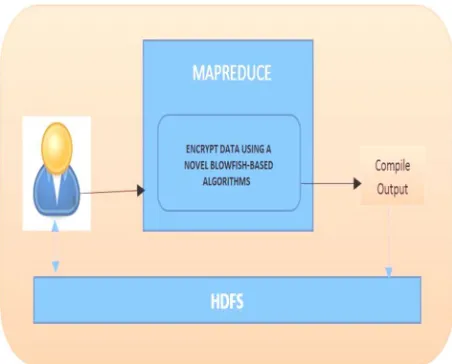
decrease the time and make it more efficient where the mapper encrypts different blocks instead of block by block and the reducer will merge each of them and store the output to HDFS. Their proposed show a better result than some other but the AES has certain limitations in case of security and scalability. After looking at many of the proposed papers, we found that one of the easiest algorithms with high efficiency compared to some counterparts is the blowfish algorithm. it considers as one of the strong and completely unbreakable encryption algorithms to date with the convenient design for any enhancement or modification in its structure [12]. It has a greater throughput than 3DES, DES, CAST-128, IDEA, and RC2 with better performance and efficiency for its analyzing Encryption/Decryption time and throughput and for the power consumption value where they concluded that blowfish. A. Kofahi at.al.[13] show that the blowfish algorithm is the fastest followed by the DES algorithm then the T-DES algorithm. Moreover, blowfish need the least amount of time for the file to encode and minimum time for text file decode as compare to the AES algorithm [14]. A new approach called a novel blowfish-based algorithm that is a new version of the classic blowfish algorithm. The general mechanism of the said algorithm is the complete encryption process that is more complex by processing multiple spaced blocks including the key scheduling algorithm. Then, the MapReduce framework as a programming model for encrypting large amounts of data in parallel and distributed fashion are used by implementing the proposed approach and the helping of the Hadoop cluster. Thus, the cost of encryption is reduced where MapReduce and a key are generated during the proposed modified blowfish encryption scheme. More clearly, we tried to mimics data encryption while transferring it from the user to Hadoop and how to store it in an effective way that ensures its security far from detection for any attempt, which targets it. By using a pre-configured programming model of MapReduce to deal with large amounts of data and encrypt it in a distributed and parallel way. with ensuring the speed of the processes. Then support this by including the novel blowfish-based algorithm, which encrypts data in a more complex way by processing multiple spaced blocks including the key scheduling algorithm. The basic goal of the novel base- blowfish algorithm is to upgrade the competence of work by reducing the time and process a large possibility of the data bits for each block. Where we will overcome, the most prominent obstacles that the original blowfish was had. Where the encryption will be process blocks with a larger size than that in the regular algorithm and do the complexity of processing blocks from different regions in return has been reduced the number of rounds used, then by using the Hadoop cluster and with the help of MapReduce, the cost of encryption will reduce more. The big file will be divided into small pieces called blocks, the data of each will be encrypted using proposed blowfish algorithm then create three copies of each before store it, which will be useful to ensure of tolerance fault. The key will send as a key-value pair to the reducer. The rest of the operations will work as the normal MapReduce. Fig.2. illustrate the general structure of the adopted scenario, which is as follows:
2 MATERIAL
AND
METHOD
2.1 Description of used material
2.1.1 Blowfish Algorithm
Blowfish is one of the most popular types with a keyed symmetric block cipher, which is distinguished by its efficiency and its guarantee in making the encryption process safe, strong and difficult to completely break until date. [12,15], in addition to its comfortable look and design, which makes it easy to understand, enhance, or modify [16]. It designed in 1993 by Bruce Schneider as an alternative to DES and can be used as a drop-in replacement for DES or IDEA [17]. The variable key length of blowfish algorithm is one of the pros that it gratifies, where it has 32bits up to 448 bits and handle 64-bit for each block size what makes it ideal for different use [16]. It requires a total of 512 iterations to drives an unchanged 18 sub-keys from a single initial key [18]. Since whenever the key size is larger, it will be complex to break the code. The algorithm divides the block into two parts each of 32-bits such as LE0 and RE0 and gets the ciphertext of 64-bit by combined the LE17 and RE17 after 16 rounds. The decryption process is not very different from the encryption expect that the keys will be used inversely. The encryption and decryption pseudo code is shown in fig 2.
Fig. 1. general structure of proposed approach
2076
Function F
This function takes the 32-bit input, which expresses the left part of the block that you are processing, and then splits it into four equal sections, each containing 8-bit, which can be expressed as a, b, c, and d. Then do the following:
F [a, b, c, d] = ((S1, a + S2, b mod2 ) XOR S3, c) + S4, d mod 2
Where the task is to get the final output, which combines the four parts after some operation on then as soon as possible. Fig.3 will clarify and simplify the understanding of the above [19,20].
Subkeys generation
Blowfish works at a pre-computed of a large number of sub-keys, which must establish before any encryption/decryption of data. P1, P2, …. P18, is 18 sub-keys, each of 32-bit will be generated as a p-array. There are also four 32-bit S-boxes each with 256 entries [19], The S-box and P-array generation process works as the steps in the following fig [19,21]:
1. Initialize first the P-array and then the four S-boxes, in order, with a fixed string. This string consists of the hexadecimal digits of π: -
P1 = 0x243f6a88 , P2 = 0x85a308d3 , P3 = 0x13198a2e , P4 = 0x03707344, etc.
2. XOR P1 with the first 32 bits of the key, XOR P2 with the second 32-bits of the key, and so on for all bits of the key (possibly up to P16). Repeatedly cycle through the key bits until the entire P-array has been XORed with key bits.
3. Encrypt the all-zero string with the Blowfish algorithm, using the subkeys.
4. Replace P1 and P2 with the output of step (3).
5. Encrypt the output of step (3) using the Blowfish algorithm with the modified subkeys.
6. Replace P3 and P4 with the output of step (5).
7. Continue the process, replacing all entries of the P-array, and then all four S-boxes in order, with the output of the continuously changing Blowfish algorithm.
It is worth mentioning that, to generate the entire required subkey, 512 iterations will be needed.
2.1.2 MapReduce:
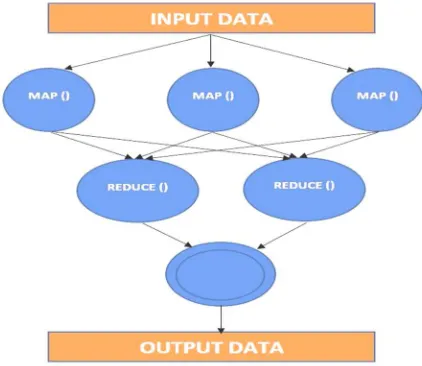
Mapreduce is the core component for data processing in Hadoop work as a sub-project of the Apache Hadoop project, which considers as a software framework that comfortable to deal with huge, long-running jobs that cannot be grip within the reach of a single request. It is useful for distributed processing with an efficient process and general data sets on the computing cluster [10]. it used to decrease the cost of security by automatically split the input data into a number of parts then run a program parallel on that data parts with handle most of the problems at once, such consistency and fault tolerance. It is a useful framework for big data to deal with high efficiency and guaranteed handling of a large cluster environment [11]. It has two separate tasks each of a distinct work where mapper doing as a converting task for a set of data from one form to another by broken the individual elements down into tuples (key/value pairs). Where the reducer will do the opposite, which takes in the combines of those data tuples based on the key and accordingly modifies the value of the key [22]. Fig.4 illustrates the general idea of MapReduce.
2.2 The novel blowfish-based algorithm:
2.2.1 The Proposed method
In this paper, we have proposed a novel blowfish-based encryption algorithm. This is because of its features that have been mentioned previously. Here we have made an adjustment algorithm to make it process the largest volume of data by processing more than one block of 128-bits as a one-block using operations equal to the number of one-blocks taken, in return has been reduced the number of rounds used. It processes blocks by dividing the total size of the block into two parts, then again dividing the first part into multiple parts of 64-bits and treating each part in a separate operation with its counterpart from the second part. Note that each operation can handle 128 bits since the size of the block to be taken for processing will depend on the number of operations, while we can increase the number of operation as we want such as:
Block size = number of operations *128 1 operation: 128bits
Fig. 4. MapReduce Workflow
2077 2 operations: 256 bits
3 operations: 384 bits 4 operations: 512 bit and so on.
Where the key will be extracted for each operation from the master key previously specified. The main purpose of the novel blowfish-based algorithm is to improve the efficiency of encryption, which the blowfish algorithm lacked, which will result in much faster execution of the encryption.
P- array generation
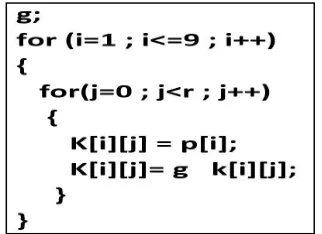
In the proposed algorithm, P-array is an array of size 9 elements each with 64-bit such as P= {P1, P2, P3, …., P9}, each element is used to encrypt one round as we will use 7 round only, until the last round is performed using the last two elements P8, P9. Because the proposed uses more than one operation, we have created the algorithm shown in fig5, which derive the keys for the operation from the original p-array, ensuring that each operation gets its own encryption key where the sub-key array of the proposed will be as following:
Here each column expresses the special keys to one of the operations, which will be used sequentially at each round. In other word, each row will express the key of each operation to encrypt one round.
Where g represents a randomly selected random number agreed by the sender and receiver by using a secret sharing channel, and r represents the number of operations.
novel blowfish-based algorithm
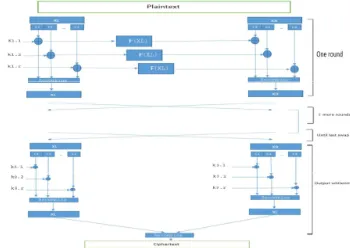
The basic idea that the proposed has focused is to doing a perfect modification to the blowfish algorithm to make it possible to handle the number of larger bits per block, using more than one operation, and doing the complexity for processing blocks from different operation regions in return has been reduced the number of rounds used, where will expand the number of bits taken and handling to double than that in the original blowfish for each operation and implement them in more complex way . Where the number of bits that can be processed per block depends directly on the number of operations to be used as mentioned previously. For that, we have formulated the proposed algorithm through the following steps:
Algorithm:
Step1: split X to XL and XR, where the taken of X length depend on the number of operations that will use such as:
X= number of operations *128
Steo2: divide each of XL and XR to some equal parts each of 64 bit such as:
XL= XL1, XL2, …, XLr XR= XR1, XR2, …, XRr
Step3: for the first round (i=1) Do the following: - on the first operation
XL1= XL1 ⊕ ki1 XR1= F(XL1) ⊕ XR1 - on the second operation
XL2= XL2 ⊕ ki2 XR2= F(XL2) ⊕XR2 .
. .
on the last operation XLr= XLr ⊕ Ki.r XRr = F(XLr) ⊕ XRr
Step4: Recombine XL1, XL2, ….….. XLr = XL. Recombine XR1, XR2, …….. XRr = XR.
Step5: Swap XL and XR and repeat steps from 2-4 for 7 times (i=7).
Step6: for the round of 8, Do the following - on the first operation
XL1= XL1 ⊕ k8.1 XR1= XR1 ⊕ k9.1 - on the second operation
XL2= XL2 ⊕ k8.2 XR2= XR2 ⊕ k9.2 . .
. .
- on the last thread
XLr = XLr ⊕ k8.r XRr= XRr ⊕ k9.r
Step7: Recombine XL1, XL2 …. XLr = XL. Recombine XR1, XR2 … XRr = XR.
Step8: Recombine XL and XR.
Fig.7 clarify and simplify the understanding of the above steps of the proposed:
2.2.2 Modified blowfish using MapReduce
Hadoop is a very famous and widely used open-source implementation of MapReduce [8] framework, the Hadoop distributed file system (HDFS) store a large amount of data, the mapper will divide the work into blocks and the reducer will merge the blocks producing a single output. For that, the novel blowfish-based algorithm is used for the encryption scheme to perform the encryption parallel using MapReduce of the Hadoop cluster. Where the parallel encryption processes of
2078 MapReduce can certainly improve performance and reduce
the cost of encryption because instead of encrypting blocks one by one, multiple mappers can work on encrypting different blocks [10], after which the reducer will combine all blocks and store them back in HDFS. For more clarify, big files will be split and mapped into a number of small blocks. Three copies of each block are produced and stored. This is to ensure fault tolerance. Before that, the data are encrypted using a novel blowfish-based algorithm. Then the key is sent as a key-value pair to the reducer. All other process is the same as the normal MapReduce.
3 DISCUSSION
AND
PERFORMANCE
ANALYSIS
3.1 Security Analysis:
Here, security analysis of the proposed method compared to some related algorithm is provided where the aspects of comparison are (cipher type, key size, block size, keyspace, and round), which shown in Table 1.
TABLE 1
Comparison of Algorithms base on Architecture
Security algorith ms
Cipher type
Key size Block size
keyspace Round
DES Symmet ric block
cipher
65 bits 64 bits
2
16
RC6 Symmet ric block
cipher
128,192 or 256
bits
128 bits
2 , 2 , 2
20
AES Symmet ric block
cipher
128,192 or 256
bits
128,192 or 256
bits 2 , 2 , 2
10,12, 14 Depen
d on the size of
the key IDEA Symmet
ric block cipher
128 bits 64 bits
2
8.5
Blowfish Symmet ric block
cipher
(32 –
448) bits 64 (2 − 2 ) 16
The propose
d method
Symmet ric block
cipher
(64 – 448) bits For each operatio
n
Each operatio
n (128 bits)
(2 − 2 ) For each operation
7
3.2 Visual assessment analysis:
It indicates the similarity between the input and the output, where it must be executed on the output to see if there is the ability to know and guess some useful information and which may be useful for the attacker and that by visual assessing the encrypted result, If this can be done by the attacker, it indicates that the scheme has failed in its first steps. As our work should aim to avoid this propose by generating complex output encryption that prevents the attacker from devising any useful information that can benefit.
in fig 6, shows the ciphertext of the plaintext of 384-bits encrypted with as three operations, the result shows the strength of the proposed method, where there is no such thing similar between the plaintext and the ciphertext at all because we process the bits here from different regions and distances. i.e. as we used here three operations, so the bits from 1 to 64 processed with the bits from 192-256 as one block and so on for the rest of the bits. thus, in turn, created apparent complexity, adding that the ciphertext gain strength towards any attempt to break. This makes us can say that the proposed algorithm is successful.
3.3 Keyspace analysis:
It refers to the algorithm's keyspace that measures the set of all possible permutations of a key. it increases the need to create cryptographic algorithms more efficient and sensitive to the simple change that may affect the key used during the encryption process [6]. Therefore, forcing us to take caution in determining the size of the key that will deal with the any proposed algorithm in the proportion that does not hinder the rest of the variables and make them more efficient and resistant to several attacks highlighted by a brute-force attack. As shown in table 1, the key size and keyspace of the blowfish algorithm are larger if compared to the rest of the algorithmthat have been compared with it. while in the proposed the key will be determined by the number of operations that will use, where each operation has the same size of blowfish key algorithm. where this key is differing for each operation, in other words, we will extract a new key for each operation by using a random number, that will make it stronger and more difficult for an attacker to break it.
3.4 Key sensitive analysis:
Key sensitivity analysis is aim to check the encryption scheme sensitivity towards change in initial conditions. It means that a slight change in encryption key should produce an entirely different ciphertext. In the proposed we extract the key for each operation from the main key which is different, in other words, derive the keys for the operation from the original
p-Fig.7. a novel blowfish-based algorithm
2079 array, ensuring where each operation gets its own encryption
key. Since each key is used to process a part of the block of the plain text, so any minor change in the main key will result in a change in the key of each operation used such as k1, k2, k3 and k4 as shown, which will increase the rate of change in the form of cipher and make it almost more different more than the methods compared. Fig 8 shows the procedures to derive keys from the main key itself as following:
3.5 Correlation analysis
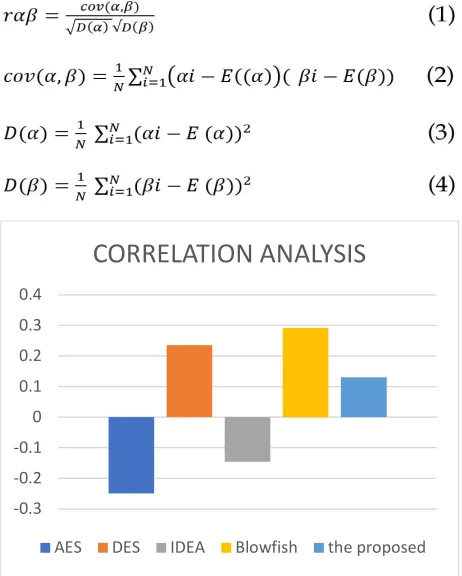
correlation analysis: it is a part of the statistical analysis that analyzes the confusion properties of encrypted data to show the relationship between the plaintext and ciphertext [23]. We can know the good algorithm through the results that must show encrypted data with zero correlation ideally. the following formulas will calculate the correlation plaintext, moreover, α and β denote two values for which correlation needs to be calculated, N refers to the total elements number obtained from the data, whereas E(α) = mean of α, and E(β)= mean of β.
As shown in figure 5 the smallest value of the correlation coefficient which is approaching the value of 0 has done in the proposed, thus it considers the better as compared to AES, DES, IDEA, and blowfish.
3.6 Information entropy analysis:
it is a way to measure the amount of randomness of a message m, it represents by H(S) and expressed as the following:
Where 𝑃(𝑆 ) refers to the probability symbol 𝑆. the ideal value, in this case, is H(S)=8 because there are 256 possible values for the message. Thus, any value approaching this value would mean that encrypted output is highly random in nature.
The randomness of ciphertext is measured by entropy, fig 10 show that the proposed provides satisfying results that come close to the ideal value 8 which make it better.
4 EXPERIMENTAL
SETUP
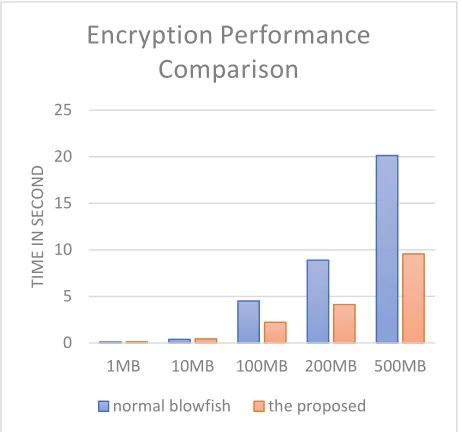
In this section, the performance evaluation of the current proposed using three operations will be presented through its implementation and the results obtained by using MapReduce and without using MapReduce then compare results with the normal blowfish algorithm, we will rebalance the load for distributed file system through simulation on Hadoop 1.x Ubuntu 14.04 using java implemented on Core i7 (9th generation) CPU of Lenovo laptop with 16GB RAM and 64 bit Windows 10 operation system. Moreover, we have used files created randomly. Fig 11 shows the time taken to implement the encryption of the proposed and normal blowfish algorithm for files of different sizes such as 1MB, 10MB, 100MB,200MB, and 500MB. We can see that It may be somewhat the results convergent when encrypting data of small size, but the proposed proves its worth more as the file size increases. where we observe that the results obtained by the proposed to encrypt the data with the size greater than 100 MB increased the power and safe consumption by about more than 50%, where the percentage increase whenever the size of encrypted file increase. which made it the best performance than the normal blowfish.
Fig.8. derived keys of operations from the main key
Fig 9: graphical representation of the correlation analysis. -0.3
-0.2 -0.1 0 0.1 0.2 0.3 0.4
CORRELATION ANALYSIS
AES DES IDEA Blowfish the proposed
2080 2.1.2
In the same manner, Fig 12 shows the time taken to implement the decryption of the proposed algorithm and normal blowfish algorithm for the same files encrypted previously.
Fig 13 shows the difference between the results obtained using MapReduce and without MapReduce. As we see, the proposed with MapReduce gave us less time to consume, moreover, the proposed was the best and the least.
5 CONCLUSION
In this work, we have tried to solve the problem of data security at HDFS storage level by proposed a novel blowfish based-algorithm to encrypt the data with extending the used key which proved the keyspace analysis, where we applied that with using of MapReduce in order to process the data in a faster manner. the timing graphs show that the novel blowfish-based algorithm Is the fastest to encrypt and decrypt data, then by using the Hadoop cluster and with the help of MapReduce, the cost of encryption reduced more by using parallel processing of map and reduce function. thus, through the use of the proposed we ensured the security of sensitive data at an HDFS storage level far from detection for any targeted attempt. In addition, the proposed algorithm makes a balance between security, time-consuming, and performance. where we observe that the results obtained by the proposed to encrypt the data increased the power and safe consumption by about more than 50%, where the percentage increase whenever the size of encrypted file increase. that was made it the bests performance. In addition, we discussed some of the concepts that used to measure performance analysis such as security analysis, visual assessment analysis, keyspace analysis, key sensitive analysis, correlation analysis, and information entropy analysis, which proved that the proposed is a good approach to carry out its work and accomplished data security.
Fig 11 Encryption Performance Comparison.
0 5 10 15 20 25
1MB 10MB 100MB 200MB 500MB
TI
M
E
IN
S
EC
O
N
D
Encryption Performance
Comparison
normal blowfish the proposed
Fig 12 Decryption Performance Comparison.
0 5 10 15 20 25
1MB 10MB 100MB 200MB 500MB
TI
M
E
IN
S
EC
O
N
D
Decryption Performance
Comparison
normal blowfish the proposed
Fig 13 Encryption Performance Comparison with and without MapReduce.
0 5 10 15 20 25
normal
blowfish proposedthe blowfishnormal proposedthe
TI
M
E
IN
S
EC
O
N
D
without MapReduce with MapReduce
Encryption Performance Comparison
with and without MapReduce
2081
REFERENCES
[1] Adluru, Pradeep, Srikari Sindhoori Datla, and Xiaowen Zhang. "Hadoop eco system for big data security and privacy." In Systems, Applications and Technology Conference (LISAT), 2015 IEEE Long Island, pp. 1-6. IEEE, 2015.
[2] De Mauro, Andrea, Marco Greco, and Michele Grimaldi. "What is big data? A consensual definition and a review of key research topics." In AIP conference proceedings, vol. 1644, no. 1, pp. 87-104. AIP, 2015.
[3] Hodeish, M.E. & Humbe, V.T. Multimed Tools Appl (2018) 77: 24937. https://doi.org/10.1007/s11042-018-5724-z [4] Le, Deguang, Jinyi Chang, Xingdou Gou, Ankang Zhang,
and Conglan Lu. "Parallel AES algorithm for fast data encryption on GPU." In Computer Engineering and Technology (ICCET), 2010 2nd International Conference on, vol. 6, pp. V6-1. IEEE, 2010.
[5] Maheswari, M. Indu, S. Revathy, and R. Tamilarasi. "Secure data transmission for multisharing in big data storage." Indian Journal of Science and Technology 9, no. 21 (2016).
[6] Hodeish, Mahmoud E., Linas Bukauskas, and Vikas T. Humbe. "A new efficient TKHC-based image sharing scheme over unsecured channel." Journal of King Saud University-Computer and Information Sciences (2019). [7] Desai, Sanket, Younghee Park, Jerry Gao, Sang-Yoon
Chang, and Chungsik Song. "Improving Encryption Performance Using MapReduce." In High Performance Computing and Communications (HPCC), 2015 IEEE 7th International Symposium on Cyberspace Safety and Security (CSS), 2015 IEEE 12th International Conferen on Embedded Software and Systems (ICESS), 2015 IEEE 17th International Conference on, pp. 1350-1355. IEEE, 2015.
[8] Disha Handa, Bhanu Kapoor PARC4: high performance implementation of RC4 Cryptographic Algorithm using parallelism. International Conference on Reliability, Optimization and Information Technology- ICROIT 2014. India, Feb 6-8 2014, 9(21).
[9] Dean, Jeffrey, and Sanjay Ghemawat. "MapReduce: simplified data processing on large clusters." Communications of the ACM 51, no. 1 (2008): 107-113
[10] Kadre, Viplove, and Sushil Chaturvedi. "AES–MR: A Novel Encryption Scheme for securing Data in HDFS Environment using MapReduce." International Journal of Computer Applications 129, no. 12 (2015): 12-19.
[11] Jayan, Anandu, and Bhargavi R. Upadhyay. "RC4 in Hadoop security using MapReduce." In Computational Intelligence in Data Science (ICCIDS), 2017 International Conference on, pp. 1-5. IEEE, 2017.
[12] Ganesan, Manikandan, G. Krishnan, and V. Vaidhyanathan. "A novel approach to the performance and security enhancement using blowfish algorithm." International Journal of Advanced Research in Computer Science 1, no. 4 (2010).
[13] Kofahi, Najib A., Turki Al-Somani, and Khalid Al-Zamil. "Performance evaluation of three encryption/decryption algorithms." In Circuits and Systems, 2003 IEEE 46th Midwest Symposium on, vol. 2, pp. 790-793. IEEE, 2003. [14] Maitri, Punam V., and Aruna Verma. "Secure file storage in
cloud computing using hybrid cryptography algorithm." In Wireless Communications, Signal Processing and
Networking (WiSPNET), International Conference on, pp. 1635-1638. IEEE, 2016.
[15] = A. Alabaichi, F. Ahmad and R. Mahmod, "Security analysis of blowfish algorithm," 2013 Second International Conference on Informatics & Applications (ICIA), Lodz,
2013, pp. 12-18.
doi: 10.1109/ICoIA.2013.6650222.
[16] Verma, Harsh Kumar, and Ravindra Kumar Singh. "Performance analysis of RC5, Blowfish and DES block cipher algorithms." International Journal of Computer Applications (0975–8887) Volume (2012).
[17] Schneier, Bruce. Applied cryptography: protocols, algorithms, and source code in C. john wiley & sons, 2007.
[18] Seth, Shashi Mehrotra, and Rajan Mishra. "Comparative analysis of encryption algorithms for data communication 1." (2011).
[19] Hawkes, P; Paddon, M.; Rose, G.G.; and de Vries, M.W. (2004). Primitive Specification for SSS. Qualcomm Australia
[20] Milad, A.A.; Muda, H.Z.; Muhamad Noh, Z.A.B.; and Algaet, M.A. (2012). Comparative study of performance in cryptography algorithms (Blowfish and Skipjack). Journal of Computer Science, 8(7), 1191-1197.
[21] Landge, I.; Contractor, B.; Patel, A.; and Choudhary, R. (2012), Image encryption and decryption using blowfish algorithm. World Journal of Science and Technology, 2(3),151-156.
[22] hadoop mapreduce tutorial,dezyre, www.dezyre.com/hadoop-tutorial/hadoop-mapreduce-tutorial.