Research Article
FORMULATION OPTIMIZATION, SCALE UP TECHNIQUE AND STABILITY ANALYSIS OF
NAPROXEN LOADED LIPOSPHERES
SATHEESH BABU N*
1, SENTHIL RAJAN D
2, PRABAKARAN L
3, VENKATA SRIKANTH MEKA
2, SURIYAKALA P.C
41 Faculty of Pharmacy, Lincoln University College, Petaling Jaya, Selangor, Malaysia,.2 School of Pharmacy, International Medical
University, Bukit Jalil, Malaysia., 3 Faculty of Pharmacy, aSIA Metropolitan University, Cheras, Malaysia., 4 Faculty of Medicine, Lincoln
University College, Petaling Jaya, Selangor, Malaysia. Email: [email protected]
Received: 19 December 2013, Revised and Accepted: 16 January 2014
ABSTRACT
The objective of this research was to formulate the anti-inflammatory drug (naproxen) to provide controlled release and minimizing local side effect by avoiding the drug release in the stomach region. Naproxen was entrapped with lipid-like cetyl alcohol, glyceryl mono stearate and stearic acid using melt dispersion technique. Effect of various formulation and process variables such as concentration of surfactant, concentration of
co-surfactant, on formulation parameters such as morphology, entrapment efficiency, and in vitro release of naproxen were studied. The lipospheres
were characterized for particle size, photo microscopy, scanning electron microscopy, FT-IR spectroscopy, drug entrapment efficiency, in vitro
release studies, and in vitro release kinetics. The shape of microspheres was found to be spherical, drug entrapment efficiency of various batches of microspheres was found to be ranging from 80 to 90 %. The in vitro drug release studies of optimized batches were carried out for up to 24 h using phosphate buffer pH 7.4 showed 80-85% drug release. The optimized formulation batch was considered for scale up process. The lipospheres obtained from the scale up were then characterized for particle size, drug loading and morphology and compared with non-scaled up optimized batch, thereby establishing successful process scale-up.
Keywords: naproxen, liposphere, scale up technique, optimization, encapsulation efficiency
INTRODUCTION
Osteoarthritis (OA) is a debilitating, progressive joint disease associated with aging process affecting approximately 40% of adults aged over 70 years [1]. OA is considered as a chronic disease with a long “silent” period that can be compared to a heart attack or stroke that represents the end stage of long-simmering cardiovascular disease [2]. Due to its multifactorial etiology and complex pathogenesis, there are currently no satisfactory treatments. NSAIDs are the most frequently prescribed treatment for osteoarthritis, a degenerative joint disease that causes pain, stiffness, and immobility. Naproxen [(S)-2-(6-methoxynaphthalen-2-yl) propianoic acid], is a non selective COX inhibitor widely used as an analgesic in the treatment of Osteoarthritis. Unfortunately, the bioavailability of naproxen via percutaneous absorption is rather poor [3], gastrointestinal ulcer, accompanied anaemia due to the bleeding, increase the risk of heart attacks, kidney failure. A research reports has suggested that though naproxen may indeed have excellent anti-inflammatory properties but the route of administration may be the key to attaining the necessary physiological concentration of naproxen to take full advantage. Different strategies, but are not limited to, solid dispersion [4], inclusion complexation [5], precipitation techniques [6] and EPAS Technique [7] have been used to increase bioavailability of poorly water soluble drugs. Inorder to avoid the gastric irritation, minimize the systemic toxicity, achieve better therapeutic effect, one promising strategy is to be develop and to achieve these goals.
The liposphere (LS) system has been developed in recent decades to deliver the bioactives via parenteral, oral and topical routes. LS consist of water dispersible solid microparticles of particle size between 0.2- 100 µm in diameter and composed of a solid hydrophobic core stabilized by phospholipid molecules embedded in their surface. Due to their solid lipid matrix, controlled release from these carriers is possible which is important to supply the drug over a prolonged period of time, minimal drug release at acidic pH range, decrease the dose frequency, better patient compliance can be achieved [8]. Taking the above result into account, this research work was designed and developed naproxen loaded lipospheres and
characterizes the morphology, particle size distribution, entrapment efficiency, and in vitro drug release. Once the optimized batch was determined, classical scale up was followed to produce gram amounts of lipospheres formulation. The lipospheres obtained from the scale up were then characterized for particle size, drug loading and morphology and compared with lab scale optimized batch, thereby establishing successful process scale-up.
MATERIALS AND METHODS
Materials
Naproxen was gifted by Enzo Life science (Malaysia),Glyceryl monostearate, Stearic acid, Cetyl alcohol, Poly vinyl alcohol were purchased from Alpha chemicals (Mumbai, India),and Phospholipon 80H was gifted by Lipoid (Germany). All other chemicals and reagents used in this research work were analytical grade.
Formulation of naproxen loaded lipospheres
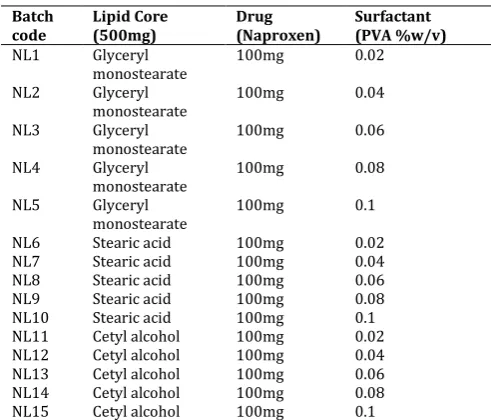
Table 1: Formulation of Naproxen Loaded Lipospheres by melt
Table 2: Effect of co-surfactant on Naproxen loaded lipospheres
Batch
Photomicroscopic analysis of naproxen loaded Lipospheres
The NR loaded lipospheres dispersion was placed on a slide for morphological examination under binocular optical microscope (Carl Zeiss, Model Axiolab A, Berlin, Germany) and photographed at a magnification of ×400 by means of a fitted camera (Panasonic, Japan).
Scanning electron microscopy
This technique was used to investigate the morphological characters of the lipospheres.
The morphology of LS was evaluated by scanning electron microscopy (SEM) observations (HITACHI Model S- 3000H). Samples were mounted on aluminium stubs and coated with gold using a vacuum evaporator. Samples were then examined with a SEM microscope at an accelerating voltage of 10 kV [9]
Determination of Entrapment efficiency
The drug was extracted from the dried LS material by addition of phosphate buffer (pH 7.4) depending on the drug entrapped. The obtained solutions were exposed to ultrasonic treatment for 30 min, and centrifuged at 1000 rpm for 10 mins. The supernatant was analysed at 230nm by UV spectroscopic method [10].
EE (%) = Amount of drug in LS (mg) X 100 Lipid mass (mg)
In vitro drug release of naproxen from lipospheres
To obtain quantitative and qualitative information on naproxen drug release from the LS, and possibly to correlate the experimental data with the release mechanism, the complete release profile of LS encapsulated drugs was determined by placing drug loaded LS in a buffer solution under USP dissolution test apparatus XII. Accurately weighed quantity of NR loaded LS (100mg equivalent weight of
Stability studies on optimized batch LS
The purpose of stability testing is to provide evidence on how the quality of a drug substance or drug product varies with the time under the influence of variety of environmental conditions such as temperature, humidity and light [11]. Stability studies of optimized lipospheres were performed for 90 days duration. All the stability samples were prepared in triplicate and were kept at amber glass bottle at refrigerator condition (2-8:C) and 25:C/ 60% RH; upto 90 days. Evaluation parameters for the stability study were selected depending upon the study objective. At each stability time point, LS samples were evaluated for particle size and drug content in order to establish the physical and chemical stability of the drug substance.
Scale up production of Naproxen loaded liposphere
The optimized lab scale was considered for the process of scale up operation. These include multistage process wherein each stage was optimized carefully. In the first stage, we expected to scale up 2X to produce 1 g of NL. The second stage, targeted to produce 2g of lipospheres. Subsequent stages would lead to 4 g and 5 g (10X) production of NL. For scaling up, the phase volume (aqueous) and stirring speeds were changed at each stage of scale up and remaining parameters kept same as lab scale production (table 3).
Table 3: Scale up production of Naproxen loaded lipospheres
RESULTS AND DISCUSSION
Formulation procedure
The lipospheres could be prepared by various techniques such as emulsification–solvent removal, spray drying, and organic phase separation, involve an extensive use of organic solvents. This aspect leads to environmental problems of pollution, toxicity due to incomplete solvent removal, and solvent impurities that may cause chemical degradation of the bioactive substances within the lipid matrix [8, 12]. It also complicates the process and increase the production cost. Therefore, this lipospheres research work was motivated to develop organic solvent-free processes, such as “Melt Dispersion” or “Hot Melt Encapsulation Technique”.
LS with the desired properties (excellent encapsulation efficiency, suitable release profile and particle distribution), influencing large number of factors, such as total volume and phase volume ratio, lipid concentration, type of surfactant, stirring speed, stirring time, temperature etc. The effect of each of these parameters has to be determined empirically, predictions and scale up remain a trouble [13]. Therefore, more information is required in order to discover the relevant parameters and save formulation development resources. We aimed to develop the liposphere as carrier for controlled delivery of Naproxen for the treatment of osteoarthritis. Furthermore, several process variables were assessed stage by stage in order to achieve optimal formulation conditions, including concentration of surfactant and co-surfactant. We maintained to change one variable in each series of investigation
Effect of lipid core
In the preliminary investigation, the effect of lipid core (GS, CA and SA) on the properties of the LS was studied and kept all other variables constant. Among these, cetyl alcohol was produced controlled particle size and shape. Based on these result, Cetyl alcohol was chosen for further investigation.
Influence of surfactant concentration
Surfactants as they are used to stabilize the lipospheres in the dispersion media (or emulsify the oil in water) may change the structure and entrapment efficiency of lipospheres. This occurs because of the interaction between the surfactant and lipids [13] In a first set of formulation trails, LS were prepared by melt dispersion technique using a lipid mixture constituted of drug and polar lipid (naproxen: cetyl alcohol- 1:5 ratio). The influence of surfactant concentrations on particle morphology and recovery were also evaluated (table 3). Since morphology is a crucial factor influencing the drug release profiles from lipospheres, this study is absolutely essential. As it is clearly appreciable from the results obtained, the addition of surfactants leads to variable effects on the size of LS droplets during the emulsification step, thus influencing the final LS size.
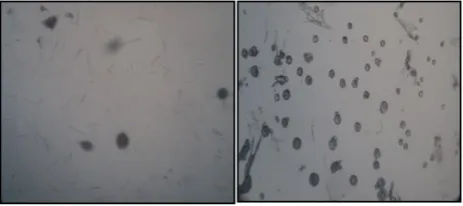
Fig. 1& 2: Photomicroscopic images show the effect of surfactant (PVA 0.02 and 0.04%w/v) on morphological character and entrapment efficiency of Naproxen loaded
lipospheres
Fig. 3& 4: Photomicroscopic images show the effect of surfactant (PVA 0.06 and 0.08%w/v) on morphological character and entrapment efficiency of Naproxen loaded
lipospheres
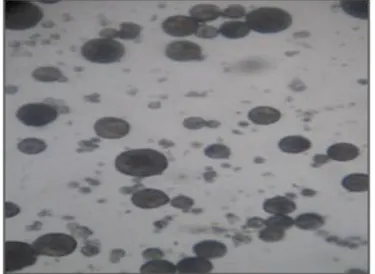
The effects of PVA concentration on the properties of the lipospheres were studied. In particular, LS was stabilized with PVA (at 0.02 and 0.04 %w/v), not able to produced spherical particles and most of the drugs particles were also not entrapped by lipid core (Fig.1&2). When the concentration of PVA was increased to 0.06 and 0.08 %w/v, the entrapment rate was slightly increased to 74% (Fig. 3&4). An improvement of LS features was obtained in terms of recovery, mean diameter, and more entrapment when PVA at 0.1%w/v used as a surfactant shown in fig. 5&6.
Fig. 5&6: Photomicroscopic images show the effect of surfactant (PVA 0.1%w/v) on morphological character and entrapment
efficiency of Naproxen loaded lipospheres at X5 and X45 magnification.
Fig. 7: The effect of surfactant concentration (PVA at 0.02, 0.04, 0.06 0.08 and 0.1% w/v) on mean diameter, entrapment
efficiency and yield of naproxen loaded lipospheres.
Influence of type and concentration of co-surfactants on LS
48µm. These batches were produced with controlled particle size and encapsulation efficiency; therefore, these batches were considered into further investigation (fig.10& 11).
Fig. 8 & 9: Photomicroscopic images show the effect of co-surfactant (Phospholipon 80G at 0.1%w/v) on morphological
characters of Naproxen loaded lipospheres.
Fig. 10: The scanning electron micrograph of NP-LS formulated under optimized condition.
Fig. 11: The effect of co-surfactant (Phospholipon 80Hat 0.2, 0.4, 0.6, 0.8 and 1.0 % w/v) on yield of Naproxen loaded lipospheres
compared with batch NL15.
In vitro drug release studies on naproxen loaded Lipospheres
The in vitro drug release studies of optimized batches (NL16, NL17, NL18, NL19 and NL20) were performed with phosphate buffer (pH 7.4) with 0.5%w/v SLS) carried out for upto 24 hr period and the results were depicted in (Fig. 12). The in vitro release studies of optimized batches were investigated and found that there was an initial rapid removal of the drug possibly by the drug associated loosely on the surface of the lipid matrix. This initial release was rapid (<10%), achieved at 2 hr and is termed as burst release. At 6th and 12th hr time intervals the drug release rate was achieved at nearly 40- 45%. The total cumulative drug releases of naproxen
loaded lipospheres were observed ~80% at the end of 24 h. In vitro
drug release curve of LS showed the rapid and sustained phase which indicates the in vitro release of LS exhibited biphasic phase.
Fig. 12: The in vitro drug release of optimized batch Naproxen loaded lipospheres at phosphate buffer medium (pH 7.4).
Stability studies on optimized batch lipospheres
During the storage condition, triglycerides undergo degradation to fatty acids and mono- and di-glycerides, which could compete with formulation excipients for positioning on the surface. Fatty acids and monoglycerides can form mixed micelles that might enhance the partitioning of hydrophobic drug out of the micro/nanoparticle. Therefore, the concentration of excipients and possible degradation products need to be determined to understand the stability of lipospheres.
The optimized formulations (NL16, NL17, NL18, NL19 and NL20) were stored in amber colored bottles kept under room temperature and refrigerator. The samples were analysed for particle size and drug content from various storage conditions for the Day 30, 60 and 90. The effect of storage condition on particle size, drug content are shown in Fig 13&14. These studies revealed that after 90 days of storage at 25:C the mean diameter and drug content of LS remain practically the same, which emphasizes the physical stability of these lipospheres.
Fig. 13: Photomicroscopic image (10X magnification) of OFXLS- 34 stored at 2-8:C after 90 days period.
Table 5: Stability studies on optimized liposphere batches.
Parameters
2-8 :C 25 :C / 60% RH
30 days 60 days 90 days 30 days 60 days 90 days
Mean diameter(µm) 48±0.531 47±0.496 45±0.314 46±0.531 48±0.531 48±0.531
Drug content (%) 99.87±0.4 98.52±1.07 98.37±1.39 98.47±1.14 98.75±1.23 97.71±0.46
Scale up production of Naproxen loaded lipospheres
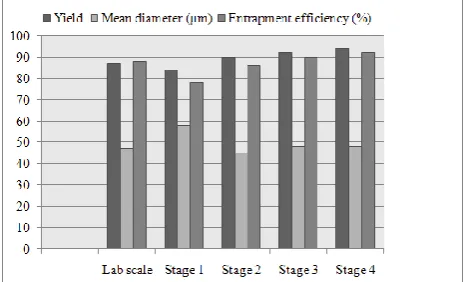
Scaling up the formulation process to produce large batches of lipospheres is the key to effective clinical use of liposphere based drug delivery systems [14-15]. To transform this lab scale formulation into large scale production, we investigated the various formulation parameters and their correlation in four sequential stages. Our aim was to produce NL with similar physicochemical characteristics in a scaled up batch production. The results from different stages of scale up formulations were shown in figure 15.
Fig. 15: Comparison of lab scale and scaled up production of Naproxen loaded lipospheres
In the first scale-up optimization stage, cetyl alcohol amount was increased from 500 mg to 1000 mg but the volume of aqueous phase and stirrer speed was not altered. This resulted in an increase in viscosity of the aqueous phase leading to larger particle size. To overcome this, at stage 3 the stirrer speed was increased from 500 to 1000 rpm and the aqueous phase volume was also increased from 100 ml to 200 ml. This resulted in average particle size of 47µm, an increase of about 2µm from the primary optimized batch.
The yield and encapsulation efficiency of LS were in the first stage scale-up was dropped by 3 and 9% respectively. Once we achieved the first stage, next we scaled up~4 times for producing 2 g of NL. The cetyl alcohol ratio was increased to 8X and the aqueous phase volume was increased to 250 ml and the stirrer speed was kept constant at 1000 rpm (stage 3). The resulting batch had an average particle size of 48 µm and 92% of drug loading. In the last stage (10X) of scale-up, the aqueous phase and stirrer speed was optimized at 250 ml and 1000rpm respectively.
With all these parameter combinations, the final scaled up batch soluble drugs/ lipophilic drugs was evaluated using naproxen as the drug candidates. The successful of this drug delivery may be because of high drug entrapment efficiency and favorable physicochemical characteristics of lipospheres, which facilitate more drug transportation to the blood via lymphatic route. The melt-dispersion method is simple, viable, and economical which does not imply the use of organic solvents. The method described achieves good incorporation efficiency and should be very useful for the development of controlled-release lipospheres of naproxen and other drug with similar solubility and melting characteristics.
Scaling up of the naproxen loaded lipospheres process is essential for the future development of liposphere drug delivery technologies. In this research work, we have made a successful effort towards formulating, optimizing and scaling up naproxen loaded lipospheres by using melt dispersion technique. The various formulation variables such as different lipid mixtures, types of surfactant and co-surfactant were used to optimize the formulation, which are directly plays important role in its morphology, size distribution, entrapment efficiency and control drug release. The use of PVA as the surfactant allowed the formation of spherical LS; further experiments were performed to better investigate the experimental parameters involved in the production of tiny LS with higher entrapment efficiency. LS, under appropriate experimental conditions, it was possible to entrap hydrophobic drugs and can control the release of the encapsulated drug. For these, Phospholipon 80H as co-surfactants were utilized for the betterment of liposphere production. In order to uptake the LS by lymphatic system, the particle size should be 10-30µm to achieve the desired particles different stirring speed was applied. The stirring speed was fixed at 500rpm to produce the desired particles without affect the entrapment efficiency. The size, entrapment efficiency and release rate of lipospheres can be controlled by the formulation variables, such as surfactant, cosurfactant, and stirring speed. After optimized the lab scale batch, scale up technique employed in various stages. The most important challenges while designing the scale up process were to control particle size while maximizing drug encapsulation efficiency which adequately achieved. This scale up practice can be further elaborated to produce more quantities which would demonstrate favorable for efficient manufacturing at an industrial scale.
ACKNOWLEDGMENTS
The authors are thankful to the Dean-Faculty of Pharmacy, and management of Lincoln University College, International medical university, Malaysia for their laboratory facilities and scanning electron microscopy studies respectively.
Conflict of Interests
We have no conflict of interests
REFERENCES
1. Oliviero F, Ramonda R, Punzi L. New horizons in osteoarthritis.
Swiss Med Wkly 140: w13098; 2010.
2. Kraus VB, Nevitt M, Sandell LJ. Summary of the OA biomarkers
workshop biochemical biomarkers: biology, validation, and clinical studies. Osteoarthritis Cartilage 18:742-745; 2009.
3. Singh P, Roberts MS, Skin permeability and local tissue
concentrations of Nonsteroidal anti-inflammatory drugs after topical application. J Pharmacol Exp Ther 1994;268:144-151. 4. Zerrouk N, Chemtob C, Arnaud P, Toscani S, Dugue J. In vitro
and in vivo evaluation of carbamazepine-PEG 6000 solid dispersions. Int J Pharm 2001; 225: 49-62.
5. Rogers TL, Nelsen AC, Brown JN, Sarkari M, Young TJ, Johnston
KP et al. A novel particle engineering technology to enhance dissolution of poorly water soluble drugs: spray-freezing into liquid. Eur J Pharm Biopharm 2002;54: 271-280.
6. Chen TJ, Young M, Sarkari RO, Johnston KP. Preparation of cyclosporine A nanoparticles by evaporative precipitation into aqueous solution. Int J Pharm 2002;242: 3-14.
7. Senthil Rajan D, Srinivasan R, Kumarappan C, Shamala N.
8. Cortesi R, Luca G. Production of lipospheres as carriers for bioactive compounds. Biomaterials 2002;23:2283-94.
9. Jong SW, Piao MG, Kim DD, Lyoo WS, Han-Gon Choi.
Development of cyclosporin A-loaded hyaluronic microsphere with enhanced oral bioavailability. International Journal of Pharmaceutics 2007;345:134-141.
10. Senthil Rajan D, Kumarappan C, Srinivasan R. Preparation and
enhanced In-Vitro diffusion Profile of Naproxen by EPAS Technique in Hydrogel formulation, Digest Journal of Nanomaterials and Biostructures 2013;8(1):25 - 33.
11. International Conference on Harmonisation, ICH 1997.
Harmonised Tripartite Guideline-Validation of Analytical Procedures: Methodology, fed regist, 62: 27463.
12. Satheesh Babu N, Gowthamarajan K. Manufacturing techniques
of Lipospheres: overview. International Journal of Pharmacy and Pharmaceutical Sciences 2011;3(4):17-21.
13. Satheesh Babu N, Prabakaran L. Effect of Processing Variables
on Characterization of Ofloxacin Loaded Lipospheres Prepared
by Melt Dispersion Technique. Current Drug Delivery2013;10:
517-526.
14. Amalendu P Ranjan, Anindita Mukerjee, Lawrence Helson,
Jamboor K Vishwanatha. Scale up, optimization and stability analysis of Curcumin C3 complex-loaded nanoparticles for cancer therapy. Journal of Nanobiotechnology 2012;10(38):1-18.
15. Sergio A, Galindo-Rodriguez, Francois Puel, Stephanie
Briancon, Eric Allemann, Eric Doelker, Hatem Fessi. Comparative scale-up of three methods for producing
ibuprofen-loaded nanoparticles. European Journal of