R E S E A R C H
Open Access
Exponential stabilization for nonlinear
switched stochastic systems with interval
time-varying delay under asynchronous
switching
Yongzhao Wang
1**Correspondence:
[email protected] 1School of Mathematics and
Statistics, Anyang Normal University, Anyang, China
Abstract
The paper investigates mean-square exponential stabilization for a class of nonlinear switched stochastic systems with interval time-varying delay under asynchronous switching. Specifically, the delay occurs not only in the state equation, but also in the switching signal from the controller, which brings the difficulty of controller design to achieve mean-square exponential stabilization. Based on the Lyapunov stability theory, a new piecewise multi-Lyapunov–Krasovskii functional dependent on the size of time delay is constructed. By utilizing the matrix inequality technique and the average dwell time approach, delay-dependent sufficient conditions are given to guarantee mean-square exponential stabilization for nonlinear switched stochastic systems under asynchronous switching. In accordance with the method, we also design state feedback controllers of the switched stochastic systems under asynchronous switching through special operations of matrices and Schur
complement. Finally, a numerical example and a practical example of river pollution control are provided to show the effectiveness of the approach proposed in this paper.
MSC: 93D20; 93E10; 93C10; 34D20
Keywords: Switched stochastic system; Asynchronous switching; Interval time-varying delay; Average dwell time; Lyapunov Krasovskii functional
1 Introduction
During the last two decades, hybrid systems have become increasingly important in con-temporary society both in science and technology due mainly to the fact that hybrid sys-tems have been extensively applied in many fields such as pattern recognition [1], network control [2], power systems [3], automotive systems [4], communication systems [5], neu-ral networks [6], and so on. A switched system is one of the special dynamic hybrid sys-tems that comprise a collection of subsyssys-tems equipped with a switching law orchestrating among these systems. Many of switched system models appear in the fields of industrial manufacturing, artificial intelligence, biochemical systems, actuator failures [7], and pop-ulation dynamics [8–10].
The analysis and synthesis are important issues in the study of switched systems, and they have attracted extensive attention from domestic and foreign scientific research. So far, much progress has been made and many remarkable achievements for various types of switched systems have been studied. For example, behavior analysis [11,12], property characterization [13], fault detection [14], and control synthesis [15–17]. These results show that stability is a crucial and fundamental problem for switched system with time delay. Essentially, time delay, perturbation, and stochastic term are common phenomena often encountered in real dynamical systems [18–20]. Moreover, the effect of time de-lays generally exists in system states and will be a source of control system instability, oscillation, and performance deterioration. As a result, the study of delay and stochastic term plays an important role in the stability analysis of switched system. With respect to those problems, we just mention here some representative work. In [21], a new method of uncertain matrix was proposed. Based on this approach, an exponential stabilization condition of nonlinear uncertain systems with time-varying delay was firstly established. By following this idea, [22] also studied the delay-dependent stability analysis and rele-vant control problems for nonlinear switched with interval time-varying delay based on Lyapunov–Krasovskii functional method. Robust guaranteed cost control for a class of un-certain neutral system with time-varying delays was investigated in [23], delay-dependent and delay-independent criteria were proposed for the stabilization of considered systems, state feedback control was considered to stabilize the uncertain neutral system, and upper bounds on the closed-loop cost function were also given. [24] obtained sufficient condi-tions with delay-dependent guaranteeing the exponential stability by a common Lyapunov functional (CLF). Recently analogous results have been found in [25], and [25] constructed a suitable Lyapunov–Krasovskii functional containing some novel triple integral terms with sufficient information about the actual sampling pattern. Based on the above discus-sion, the theory of time-delay systems can be divided into two classes: delay-independent control and delay-dependent control. To the best of our knowledge, delay-dependent sta-bilization condition gives less conservative result than the delay-independent one as it makes full use of information of the system. Specifically, systems with delay are of signif-icant interest not only for their applicability in practice but also for their interesting the-oretical properties. This is motivated by the need for systematic approach to investigate switched systems with delay.
(LMIs). Due to the switching instants of the controllers lagging behind those of the subsys-tems, [31] dealt with the problem of stabilization for a class of switched delay systems with polytopic type uncertainties under asynchronous switching, and the running time was di-vided into two parts: matched periods [tk+τd,tk+1),k= 1, 2, . . . and mismatched periods
[tk,tk+τd),k= 1, 2, . . . . In addition, by constructing the parameter-dependent Lyapunov–
Krasovskii functional and the average dwell time approach, the exponential stabilization problem for a class of nonlinear switched systems with mixed delays under asynchronous switching was investigated in [32]. In these papers mentioned above, the time delay is sim-ple and no stochastic items are considered. Searching for delay-dependent mean-square stability criteria for nonlinear switched stochastic systems with interval time-varying de-lays is obviously more preferable and challenging.
Furthermore, it is well known that few results have been devoted to the stability of non-linear switched stochastic systems with interval time-varying delay under asynchronous switching based on the average dwell time approach. This paper considers interval time-varying delay. It is natural to look for an alternative view to derive a less conservative con-dition for exponential stabilization of nonlinear switched stochastic systems under asyn-chronous switching. Moreover, we can hardly use the existing methods to investigate a stochastic switched system due to the impact of stochastic factor. This has motivated our present study on the following questions.
• Is it possible to find a delay-dependent multiple Lyapunov–Krasovskii functional that studies the matched periods and the mismatched periods of the nonlinear switched stochastic systems, respectively?
• Based on the average dwell time approach and Jense’s inequality, can we obtain a less conservative sufficient condition of mean-square exponential stabilization for nonlinear switched stochastic systems with interval time-varying delay under asynchronous switching?
• Can we design a mean-square exponentially stable feedback controller for switched nonlinear systems under asynchronous switching by the matrix deformation technique and Schur compensation?
through special operations of matrices and Schur complement without resorting to addi-tional constraints on the switching signal.
The remainder of this paper is organized as follows. In Sect.2, the problem description and preliminaries and some necessary lemmas are presented. Section3is devoted to deriv-ing the results on exponential stabilization for switchderiv-ing signals by the average dwell time approach and delay-dependent multi-Lyapunov–Krasovskii functional. Moreover, feed-back controller of nonlinear switched stochastic systems with interval time-varying delay under asynchronous switching is designed, which is the main result of this paper. In Sect.4, an example is given to illustrate the results. The paper is concluded in Sect.5.
The notations used in this paper are fairly standard.Rndenotes the n-dimensional
Eu-clidean space. AT denotes the transpose ofA. The symbol∗is used to denote the
cor-responding transposed block matrix. Diag{· · · }is a block-diagonal matrix.Irepresents the identity matrix in the block matrix, and 0 represents a zero matrix with appropriate dimensions. The notationP> 0 indicates thatPis a real symmetric and positive definite matrix, andλmin(λmax) is the minimum (maximum) eigenvalue ofP.
2 Preliminaries
Consider the following switched stochastic nonlinear systems with interval time-varying delay:
dx(t) =A1σ(t)x(t) +A2σ(t)x
t–h(t)+Bσ(t)u(t)
+Cσ(t)fσ(t)
t,x(t),xt–h(t)dt+Dσ(t)x(t)dω(t),
x(s) =φ(s), s∈[–hM, 0],
(1)
where x(t)∈Rnandu(t)∈Rm are, respectively, the state vector and the control input
of switched systems. φ(s)∈Rn is the initial condition and f
σ(t)(·) are nonlinear
func-tions. σ(t) : [0,∞]→M={1, 2, . . . ,n} is the switching signal. Specifically, denote Σ : {(t0,σ(t0)), . . . , (tk,σ(tk)), . . . ,k= 0, 1, 2, . . .}, where 0 =t0<t1<t2<· · ·<tk<· · ·, in which
t0 is the initial switching instant, tk denotes the kth switching instant. Forσ(tk) =i,
A1i,A2i,Bi,Ci,Di are constant matrices with appropriate dimensions. In this article, we
assume that the delay functionh(t) is interval time-varying and satisfies
hm≤d(t)≤hM, h˙(t)≤h< 1. (2)
ω(t) is a one-dimensional Brownian motion on a probability space (Ω,F,P) and it satisfies the following cases:
Edω(t)= 0, Edω2(t)=dt. (3)
fi(t,x(t),x(t–h(t))) are nonlinear perturbation functions, which satisfy the following
con-dition:
fiTt,x(t),xt–h(t)fi
t,x(t),xt–h(t)
≤xT(t)ViTVix(t) +xT
t–h(t)ΛTiΛix
whereViandΛiare known constant matrices. Note that the assumption on the nonlinear
perturbations is widely applicable in practice and considered by many researchers. When the controller synchronizes with the switching subsystem, the state feedback controller is often designed as
u(t) =Kσ(t)x(t), (5)
whereKi,i∈M, denotes the feedback gain matrix.
In practice, since it inevitably takes some time to identify the system modes and apply the matched controllers, the switching instants of the controllers lag behind those of the subsystems. At this point, we consider the state feedback given by
u(t) =Kσ(t–τd)x(t), (6)
whereτdis a known constant.
Remark1 In this paper,τdrepresents the period that the switching instants of the
con-troller lag behind those of the system. Specifically, the running time of switched system is divided into two parts: matched periods [tk+τd,tk+1),k= 1, 2, . . . , and mismatched periods
[tk,tk+τd),k= 1, 2, . . . . Correspondingly, we suppose that thejth subsystem is activated at
the switching instanttk–1, and theith subsystem is activated at the switching instanttk,
then the corresponding switching controllers are activated at the switchingtk–1+τdand
tk+τd, respectively.
The closed loop system of system (1) in the interval [tk,tk+1) can be represented as:
dx(t) =A¯1ijx(t)x(t) +A2ix
t–h(t)+Cifi
t,x(t),xt–h(t)dt
+Dix(t)dω(t), ∀t∈[tk,tk+τd); mismatched periods
dx(t) =A¯1ix(t)x(t) +A2ix
t–h(t)+Cifi
t,x(t),xt–h(t)dt
+Dix(t)dω(t), ∀t∈[tk+τd,tk+1); matched periods,
(7)
whereA¯1ij=A1i+BiKj,A¯1i=A1i+BiKi.
Definition 1 ([28]) The equilibriumx∗= 0 of the closed-loop system (7) is said to be mean-square exponentially stable under switching signalσ(t) if the solutionx(t) of system satisfies
Ex(t)2≤k sup –hM≤θ≤0
Ex(t0+θ) 2
e–α(t–t0), ∀t≥t
0 (8)
for constantsk≥1,α> 0.
Definition 2([33]) For anyT2>T1≥0, letNσ(T1,T2) denote the switching number of
σ(t) on an interval (T1,T2). If
holds for givenN0≥0,τα≥0, then the constantταis called the average dwell time andN0
is the chatter bound. Without loss of generality, we chooseN0= 0 in this paper.
Lemma 1(Schur complement) For a given matrixS11S12
∗ S22
with S11=ST11,S22=ST22,then
the following conditions are equivalent: (1) S< 0,
(2) S11< 0,S22–ST12S11–1S12< 0,
(3) S22< 0,S11–S12S22–1ST12< 0.
Lemma 2(Jensen’s inequality) For any symmetric and positive definite constant matrix
G∈Rl×l,scalarsαandβ:β<α,vector function x: [β,α]→Rlsuch that the integration
concerned are well defined,then
–
In this section, based on the Lyapunov stability theory, a new piecewise multi-Lyapunov– Krasovskii functional dependent on the size of time delay is constructed. Moreover, we give sufficient conditions for the mean-square exponential stabilization of system (7) by the average dwell time approach and Jensen’s inequality. In addition, the state feedback controllers of nonlinear switched systems are designed under asynchronous switching.
where
φi11=A¯T1iPi+PiA¯1i+Q1i+Q2i+Q3i+h2mR1i+h2MR2i+αPi+ViTVi,
φi22=ΛTiΛi– (1 –h)e–αhMQ1i, φ33i = –e–αhmQ2i,
φi44= –e–αhMQ
3i, φ66i = –e–αhmR1i, φ77i = –e–αhMR2i.
ϕ11i =A¯T1ijPi+PiA¯1ij+Q1i+Q2i+Q3i+h2mR1i+h2MR2i–βPi+ViTVi,
ϕ22i =ΛTiΛi– (1 –h)Q1i.
If the average dwell time of the switching signalσ(t)satisfies
τa>τa∗=
lnμ+ (α+β)τd
α , (13)
then the closed-loop system(7)is mean-square exponentially stabilizable under arbitrary switching signal for the feedback control(6).
Proof Whent∈[tk+τd,tk+1),σ(tk) =i∈M, switched systems run in matched periods.
The closed-loop system (7) is active within theith subsystem, and the correspondingith switching controller is also activated. We choose the Lyapunov–Krasovskii functional can-didate as follows:
V1σ(t)(t) =xT(t)Pσ(t)x(t) + t
t–h(t)
eα(s–t)xT(s)Q1σ(t)x(s)ds
+
t
t–hm
eα(s–t)xT(s)Q
2σ(t)x(s)ds
+
t
t–hM
eα(s–t)xT(s)Q
3σ(t)x(s)ds
+hm 0
–hm
t
t+θ
eα(s–t)xT(s)R1σ(t)x(s)ds dθ
+hM 0
–hM
t
t+θ
eα(s–t)xT(s)R
2σ(t)x(s)ds dθ. (14)
According to Itô’s differential formula, the stochastic differential is
dV1i(t) =LV1idt+ 2xT(t)PiDix(t)dω(t) (15)
with the infinitesimal operator
LV1i= 2xT(t)Pi ¯
A1ix(t)x(t) +A2ix
t–h(t)+Cifi
t,x(t),xt–h(t)
+xT(t)Q1ix(t) –
1 –h˙(t)e–αh(t)xTt–h(t)Q1ix
t–h(t)
+xT(t)DTiPiDix(t) +xT(t)Q2ix(t) –e–αhmxT(t–hm)Q2ix(t–hm)
+xT(t)Q3ix(t) –e–αhMxT(t–hM)Q3ix(t–hM) +hm2xT(t)R1ix(t)
–hm 0
–hm
eαθxT(t+θ)R
–α
Inequality (4) can be written as follows:
From (16), (17), and (18) we have
LV1i+αV1i≤xT(t)
PiA¯1i+A¯T1iPi+Q1i+Q2i+Q3i
+αPi+h2mR1i+h2MR2i+DTiPiDi+ViTVi
x(t)
+xT(t)PiCifi
t,x(t),xt–h(t)
+fiTt,x(t),xt–h(t)CTi Pix(t)
–fiTt,x(t),xt–h(t)fi
t,x(t),xt–h(t)
+xTt–h(t)ΛiTΛi– (1 –h)e–αhMQ1i
xt–h(t)
+xT(t)PiA2ix
t–h(t)+xTt–h(t)AT2iPix(t)
–e–αhm
t
t–hm
x(s)ds
T
R1i t
t–hm
x(s)ds
–e–αhmxT(t–h
m)Q2ix(t–hm)
–e–αhM
t
t–hM
x(s)ds
T
R2i t
t–hM
x(s)ds
–e–αhMxT(t–h
M)Q3ix(t–hM). (19)
Let
ξ(t) =
xT(t) xTt–h(t) xT(t–hm) xT(t–hM)
fiTt,x(t),xt–h(t)
t
t–hm
x(s)ds
T t
t–hM
x(s)ds
TT
.
According to (19), we can obtain
LV1i+αV1i≤ξT(t)Ξiξ(t). (20)
We can get
LV1i≤–αV1i. (21)
Then, using (9) and (13), we have
deαtV1i
=eαtαV1idt+LV1idt+ 2xT(t)PiDix(t)dω(t)
≤eαtαV1idt–αV1idt+ 2xT(t)PiDix(t)dω(t)
= 2eαtxT(t)PiDix(t)dω(t). (22)
Whent∈[tk,tk+τd), switched systems run in mismatched periods. The closed-loop
sys-tem (7) is active within theith subsystem and the correspondingjth switching controller is also activated. We choose the Lyapunov–Krasovskii functional candidate as follows:
V2σ(t)(t) =xT(t)Pσ(t)x(t) + t
t–h(t)
eβ(t–s)xT(s)Q
+
According to Itô’s differential formula, we have
–hM
Following the similar way, we have
≤ t
Considering the whole interval [t0,t), the Lyapunov–Krasovskii functionalV(t) is
Notice from (14) and (23) that
By Definition1, we know that the closed-loop system (7) is mean-square exponentially
stabilizable. This completes the proof.
Φ22i =diag{–Xi, –S1i, –S2i, –S3i, –T1i, –T2i},
then system(1)is mean-square exponentially stabilizable for arbitrary switching signal with the average dwell time satisfying(13).In addition,the feedback controller can be de-signed by the following formula:
Ki=YiXi–1, i∈M. (39)
Proof According toSi> 0,Ti> 0, we have
(Spi–Xi)TSpi–1(Spi–Xi)≥0 (p= 1, 2, 3),
(Tqi–Xi)TTqi–1(Tqi–Xi)≥0 (q= 1, 2).
Then the following inequality can be obtained:
where
Using Schur complement in (41), it can be concluded that (12) holds. By the same method, (38) implies (13). Correspondingly, controller gains are given by (39). The proof is
com-pleted.
Remark2 It is noticed that the Lyapunov–Krasovskii functional is delay-dependent in this paper. On the one hand, the important information ofhmandhM is taken into full
con-sideration, which may overcome the conservatism of quadratic mean-square exponential stability conditions for nonlinear switched stochastic systems with interval time-varying delay under asynchronous switching. On the other hand, the delay-dependent Lyapunov– Krasovskii functional is allowed to rise at both switching instants. However, the delay-dependent Lyapunov–Krasovskii functional is decreasing on the entire interval and the mean-square exponential stabilization for nonlinear switched stochastic systems is also guaranteed.
considered in [36] under asynchronous switching. In this paper, we consider stochastic disturbance and interval time-varying delay. Compared with [34–36], it is obvious that we have considered more external factors, and our switched systems model is more in line with engineering practice from the application level.
Remark4 [18] obtained sufficient conditions with delay-dependent guaranteeing the ex-ponential stability by a common Lyapunov functional (CLF). In fact, we deeply realize that common Lyapunov functional (CLF) may not satisfy all subsystems and become con-servative for switched systems. The multi-Lyapunov–Krasovskii functional (MLKF) and delay-dependent method are better choices. They provide a powerful framework for ana-lyzing the stability of switched nonlinear systems with interval time-varying delay.
Remark5 We now summarize the controller design procedures as follows. Step 1: The desired convergence ratesαandβare given. Choose a positive and
appropriate parameterμ.
Step 2: Define the variablesXi,S1i,S2i,S3i,T1i,T2i,Yi,i∈ {1, 2}to be solved.
Step 3: Describe the block form to give a linear matrix inequalities (LMIs). • Xi> 0,S1i> 0,S2i> 0,S3i> 0,T1i> 0,T2i> 0;
• (36), (37), and (38) are established Step 4: Complete LMIs model description. Step 5: Solve LMIs problems.
Step 6: Solve (42).
Then the obtained feedback controller will make the desired performance indices be sat-isfied.
4 Numerical example
In this section, a numerical example is presented to confirm the effectiveness of the pro-posed approach.
Table 1 Calculated upper delay boundhM
According to (13), we get the average dwell time
τa>τa∗=
Then the controller gains constructed by (39) are
K1=
By Theorem2, the maximum value of interval time-varying delayhM for the switched
systems (1) is provided in Table1for different values ofαandβ.
Figure 1Responses of state trajectories of an open-loop system
Figure 2Responses of state trajectories of a closed-loop system
Figure 3The switching law
and controller signals) are given in Figs.1,2, and3, respectively. It is clear that the open-loop system with initial statex(0) = (–2, 2)Tis not stable form in Fig.1. The closed-loop system with initial state x(0) = (–2, 2)T is mean-square exponentially stabilizable under
the designed asynchronous switching and controllers form in Fig.2and3. Therefore, the effectiveness of the designed asynchronous switching and controllers is fully illustrated.
Example2 The problem of water pollution is an important issue facing every country, and its development is of great significance to social development. In this section, an example of applying this system to water pollution control systems will be demonstrated.
dis-solved oxygen, respectively. Simultaneously, letp∗andq∗indicate the desired steady val-ues ofp(t) andq(t) in a reach of a polluted river, respectively. Moreover, we takep∗and
q∗as corresponding to some measure of water quality standards, given by the following definition:
x1(t) =p(t) –p∗, x2(t) =q(t) –q∗, x(t) =
xT1(t)xT2(t)T.
As a result, the dynamic equation forx(t) can be expressed as
dx(t) =Ax(t) +Ax¯ t–h(t)+Bu(t)dt+x(t)dω(t), (43)
river pollution system. We can learn the engineering significance of these parameters from [1]. This paper assumes that system actuators have good performance or failure, and ac-cording to the actual situation, we know that at least one actuator can ensure the normal operation of the river pollution system. In addition, for simulation of our purposes, we do not consider the nonlinear perturbation term, and the nonlinear perturbation term is not also considered in [26]. As a consequence, the river pollution system (43) can be modeled as a switched system consisting of two subsystems:
Figure 4State response of subsystem 1
Figure 5State response of subsystem 2
T11=
1.0812 0.2733 0.2733 1.0128
, T12=
1.3562 0.0738 0.0738 1.3792
,
T21=
1.3783 0.0367 0.0367 1.0917
, T22=
1.4923 0.2623 0.2623 1.8392
,
Y1=
0.9972 0.5377
, Y2=
0.8362 0.5849
.
Then the controller gains constructed by (39) are
K1=
2.5665 0.4042
, K2=
1.5996 0.6259
.
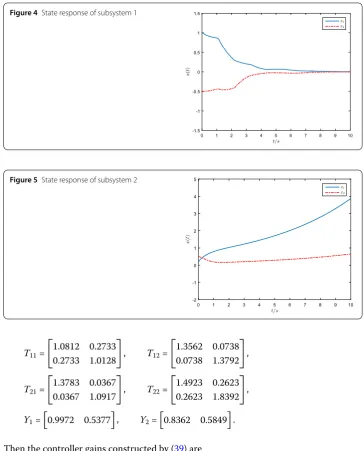
Figure4describes state response of subsystem 1 with the initial conditionx(0) = (1, –0.5)T. Figure5describes state response of subsystem 2 with the initial conditionx(0) = (0.2, 0.5)T.
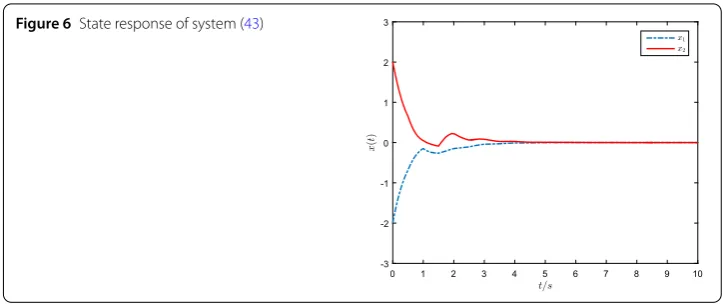
Through the designed switching signal and our approach, we can get that system (43) with the initial conditionx(0) = (2, –2)Tis mean-square exponentially stabilizable for any switching signal under the feedback control form Fig.6. As a consequence, this verifies the effectiveness of our results in the control of river pollution process.
5 Conclusions
Figure 6State response of system (43)
have investigated the problem of asynchronous switching for nonlinear switched stochas-tic systems with interval time-varying delay based on time-dependent switching signal for the matched and mismatched sections, respectively. By constructing a new multi-Lyapunov–Krasovskii functional, which is related to the size of the time delay, using the matrix inequality technique and the average dwell time approach, the mean-square expo-nential stabilization criteria for nonlinear switched stochastic systems with interval time-varying delay are obtained under asynchronous switching. Then, the proposed approach is extended to design state feedback controller for switched stochastic systems by special operations of matrices. Finally, the numerical example illustrates the effectiveness of the theoretical results. Compared with the existing results, the new condition is less conserva-tive. In order to better study the asynchronous switching issue, our future work will focus on extending the proposed method to a delay-dependent robust dissipative problem for a class of nonlinear switched systems with mixed delays and the stabilization of stochastic switched nonlinear systems with Markov jumps.
Acknowledgements
The author would like to thank the editor and the anonymous reviewers for their valuable comments and suggestions to improve this paper.
Funding
This work was supported by the National Natural Science Foundation for Young Scientists of China (Grant No. 71502050), the Key Scientific Research Projects of Colleges and Universities of Henan Province (No. 18A630001, 18A110008, and 18A110010).
Availability of data and materials
Data sharing not applicable to this article as no datasets were generated or analysed during the current paper.
Ethics approval and consent to participate Not applicable.
Competing interests
The author declares that there are no competing interests.
Consent for publication Not applicable.
Authors’ contributions
The author read and approved the final version of the manuscript.
Publisher’s Note
Springer Nature remains neutral with regard to jurisdictional claims in published maps and institutional affiliations.
References
1. Yu, P.A., et al.: Introduction to Control of Oscillations and Chaos. World Scientific, Singapore (1998)
2. Li, H.: Sampled-data state estimation for complex dynamical networks with time-varying delay and stochastic sampling. Neurocomputing138, 78–85 (2014)
3. Bishop, B.E., Spong, M.W.: Control of redundant manipulators using logic-based switching. In: Proceedings of the 37th IEEE Conference on Decision and Control, vol. 2, pp. 1488–1493. IEEE Press, New York (1998)
4. Liberzon, D.: Switching in Systems and Control. Birkhäuser, Boston (2003)
5. Zhang, L., Zhu, Y., Ning, Z., Yin, X.: Resilient estimation for networked systems with variable communication capability. IEEE Trans. Autom. Control61(12), 4150–4156 (2016)
6. Zhang, J., Ma, L., Liu, Y.: Passivity analysis for discrete-time neural networks with mixed time-delays and randomly occurring quantization effects. Neurocomputing216, 657–665 (2016)
7. Ma, L., Wang, Z., Han, Q.-L., Liu, Y.: Dissipative control for nonlinear Markovian jump systems with actuator failures and mixed time-delays. Automatica98, 358–362 (2018)
8. Kim, D.K., Park, P., Ko, J.W.: Output-feedbackh∞control of systems over communication networks using a deterministic switching system approach. Automatica40(7), 1205–1212 (2004)
9. Jeon, D., Tomizuka, M.: Learning hybrid force and position control of robot manipulators. IEEE Trans. Robot. Autom.
9(4), 423–431 (1993)
10. Zhang, L., Shi, P.: Stability,l2-gain and asynchronoush∞control of discrete-time switched systems with average dwell time. IEEE Trans. Autom. Control54(9), 2192–2199 (2009)
11. Zhu, Y., Zhong, Z., Basin, M.V., Zhou, D.: A descriptor system approach to stability and stabilization of discrete-time switched PWA systems. IEEE Trans. Autom. Control63(10), 3456–3463 (2018)
12. Xiang, W., Tran, H.-D., Johnson, T.T.: Robust exponential stability and disturbance attenuation for discrete-time switched systems under arbitrary switching. IEEE Trans. Autom. Control63(5), 1450–1456 (2018)
13. Su, X., Shi, P., Wu, L., Song, Y., et al.: Fault detection filtering for nonlinear switched stochastic systems. IEEE Trans. Autom. Control61(5), 1310–1315 (2016)
14. Sun, T., Zhou, D., Zhu, Y., Basin, M.V.: Stability, L2-gain analysis, and parity space-based fault detection for discrete-time switched systems under dwell-time switching. In: IEEE Transactions on Systems, Man, and Cybernetics: Systems (2018)
15. Ma, L., Wang, Z., Liu, Y., Alsaadi, F.E.: A note on guaranteed cost control for nonlinear stochastic systems with input saturation and mixed time-delays. Int. J. Robust Nonlinear Control27(18), 4443–4456 (2017)
16. Wang, H., Liu, P.X., Niu, B.: Robust fuzzy adaptive tracking control for nonaffine stochastic nonlinear switching systems. IEEE Trans. Cybern.48(8), 2462–2471 (2018)
17. Duan, C., Wu, F.: Analysis and control of switched linear systems via dwell-time min-switching. Syst. Control Lett.70, 8–16 (2014)
18. Chen, H., Shi, P., Lim, C.-C.: Stability of neutral stochastic switched time delay systems: an average dwell time approach. Int. J. Robust Nonlinear Control27(3), 512–532 (2017)
19. Xie, L.: Output feedbackh∞control of systems with parameter uncertainty. Int. J. Control63(4), 741–750 (1996) 20. Tian, Y., Cai, Y., Sun, Y.: Stability of switched nonlinear time-delay systems with stable and unstable subsystems.
Nonlinear Anal. Hybrid Syst.24, 58–68 (2017)
21. Dong, Y., Wang, X., Mei, S., Li, W.: Exponential stabilization of nonlinear uncertain systems with time-varying delay. J. Eng. Math.77(1), 225–237 (2012)
22. Dong, Y., Li, T., Mei, S.: Exponential stabilization and L2-gain for uncertain switched nonlinear systems with interval time-varying delay. Math. Methods Appl. Sci.39(13), 3836–3854 (2016)
23. Lien, C.-H.: Delay-dependent and delay-independent guaranteed cost control for uncertain neutral systems with time-varying delays via LMI approach. Chaos Solitons Fractals33(3), 1017–1027 (2007)
24. Sun, X.-M., Zhao, J., Hill, D.J.: Stability and L2-gain analysis for switched delay systems: a delay-dependent method. Automatica42(10), 1769–1774 (2006)
25. Wang, X., She, K., Zhong, S., Yang, H.: New result on synchronization of complex dynamical networks with time-varying coupling delay and sampled-data control. Neurocomputing214, 508–515 (2016)
26. Wang, Y.-E., Wu, B.-W., Wu, C.: Stability and L2-gain analysis of switched input delay systems with unstable modes under asynchronous switching. J. Franklin Inst.354(11), 4481–4497 (2017)
27. Wang, X., Zong, G., Sun, H.: Asynchronous finite-time dynamic output feedback control for switched time-delay systems with non-linear disturbances. IET Control Theory Appl.10(10), 1142–1150 (2016)
28. Lian, J., Ge, Y., Han, M.: Stabilization for switched stochastic neutral systems under asynchronous switching. Inf. Sci.
222, 501–508 (2013)
29. Wang, Y.-E., Zhao, J., Jiang, B.: Stabilization of a class of switched linear neutral systems under asynchronous switching. IEEE Trans. Autom. Control58(8), 2114–2119 (2013)
30. Lian, J., Ge, Y.: Robusth∞output tracking control for switched systems under asynchronous switching. Nonlinear Anal. Hybrid Syst.8, 57–68 (2013)
31. Wang, R., Shi, P., Wu, Z.-G., Sun, Y.-T.: Stabilization of switched delay systems with polytopic uncertainties under asynchronous switching. J. Franklin Inst.350(8), 2028–2043 (2013)
32. Wang, Y.: Exponential stabilization for a class of nonlinear switched systems with mixed delays under asynchronous switching. Complexity2018, 15 (2018)
33. Zhao, X., Zhang, L., Shi, P., Liu, M.: Stability of switched positive linear systems with average dwell time switching. Automatica48(6), 1132–1137 (2012)
34. Li, S., Xiang, Z.: Stabilisation of a class of positive switched nonlinear systems under asynchronous switching. Int. J. Syst. Sci.48(7), 1537–1547 (2017)
35. Xiang, Z., Wang, R.: Robust control for uncertain switched non-linear systems with time delay under asynchronous switching. IET Control Theory Appl.3(8), 1041–1050 (2009)