R E S E A R C H
Open Access
Chaotic behavior in a class of delay difference
equations
Zongcheng Li
*, Qingli Zhao and Di Liang
*Correspondence:
[email protected] Department of Mathematics, Shandong Jianzhu University, Jinan, Shandong 250101, P.R. China
Abstract
In this paper, we rigorously prove the existence of chaos in a class of delay difference equations, which can be viewed as a discrete analogue of a one-dimensional delay differential equation by using the Euler discretization. We first transform this class of delay difference equations into a high-dimensional discrete dynamical system. Then we prove that the map of the system is chaotic in the sense of both Devaney and Li-Yorke under some conditions, by employing the snap-back repeller theory. Finally, we give some computer simulations to illustrate the theoretical result.
MSC: 34C28; 37D45; 74H65
Keywords: chaos; delay difference equation; snap-back repeller; chaos in the sense of Devaney; chaos in the sense of Li-Yorke
1 Introduction
Time delay arises in many realistic systems with feedback in science and engineering. It is well known that time delays in feedback systems can have a considerable influence on the qualitative behavior of these systems. The existence of time delay may lead to some com-plex dynamic behaviors such as oscillation, divergence, bifurcation and chaos; see [–], and many references therein.
Recently, some researchers used the Euler discretization to explore the complex dynam-ical behaviors of nonlinear differential systems, such as determining the bifurcation dia-grams with Hopf bifurcation, observing stable or unstable orbits, and chaotic behavior; see [–]etc.However, some complicated behaviors such as chaos which they observed were obtained only by numerical simulations, and have not been proved rigorously. It is noted that there could exist some false phenomena only by virtue of numerical simula-tions. Therefore, the existence of chaotic behavior of these systems needs to be studied rigorously.
In this paper, we study the chaotic behavior of the following delay difference equation:
x(n+ ) =αx(n) +βx(n–k) –x(n–k), (.)
whereα,βare nonzero real parameters, andkis a positive integer.
Equation (.) can be viewed as a discrete analogue of the following one-dimensional delay differential equation by using the forward Euler scheme
˙
x(t) = –μx(t) +γx(t–τ) –x(t–τ), (.)
whereμ> andγ are real parameters,τ > is the delay. Equation (.) has been studied by [, ] for the periodic solutions, and it is a special case of the following equation:
˙
x(t) = –μx(t) +fx(t–τ), (.)
where μ> , τ > is the delay, andf is a one-dimensional nonlinear function. Equa-tion (.) is known as the Mackey-Glass equaEqua-tion and has found many applicaEqua-tions in physics [], population dynamics [], physiology [], medicine [], neural control [], and economy [].
The chaotic behaviors of equation (.) for some special forms off have been studied by many researchers. For example, Heiden and Mackey [], and Walther [], proved the existence of chaos in case of either piecewise constant or smooth but ‘nearly’ piecewise constantf. Lani-Wayda and Walther [, ] succeeded to prove chaos for certain smooth, nowhere constantf (and assumingμ= in (.)).
To the best of our knowledge, the research works on the chaotic behavior of equation (.) or its discrete analogue (.) with rigorously mathematical proof up to now are still few. The main purpose of this paper is to study the existence of chaos of equation (.) by using the snap-back repeller theory.
The rest of the paper is organized as follows. In Section , some basic concepts and lemmas are introduced. The transformation of the chaos problem is given in Section . In Section , it is rigorously proved that there exists chaotic behavior in the delay difference equation by using the snap-back repeller theory. Finally, an illustrative example is provided with computer simulations.
2 Preliminaries
In this section, some basic concepts and lemmas are introduced.
In , Li and Yorke [] considered a one-dimensional continuous map and obtained the well-known result, that is, ‘period implies chaos’. They first used the precise word ‘chaos’. However, to the best of our knowledge, there is no unified definition of chaos in mathematics up to now. Depending on the requirements in different problems, there ap-peared several different definitions of chaos, some are stronger and some are weaker. For convenience, we present two definitions of chaos in the sense of Li-Yorke and Devaney.
Definition . Let (X,d) be a metric space,f :X→Xbe a map, andSbe a set ofXwith at least two distinct points. ThenSis called a scrambled set offif for any two distinct points
x,y∈S,
(i) lim infn→∞d(fn(x),fn(y)) = ;
(ii) lim supn→∞d(fn(x),fn(y)) > .
The mapf is said to be chaotic in the sense of Li-Yorke if there exists an uncountable scrambled setSoff.
There are three conditions in the original characterization of chaos in Li-Yorke’s theo-rem []. Besides the above conditions (i) and (ii), the third one is that for allx∈Sand for all periodic pointspoff,
lim sup n→∞
But conditions (i) and (ii) together imply that the scrambled setScontains at most one pointxthat does not satisfy the above condition. So, the third condition is not essential and can be removed.
Definition .[] Let (X,d) be a metric space andVbe a set ofX. A mapf:V→Vis said to be chaotic onVin the sense of Devaney if
(i) the set of the periodic points off is dense inV; (ii) f is topologically transitive inV;
(iii) f has sensitive dependence on initial conditions inV.
In , Bankset al.[] proved that conditions (i) and (ii) together imply condition (iii) iff is continuous inVandV is infinite. So, condition (iii) is redundant in the above definition. It has been proved that under some conditions, chaos in the sense of Devaney is stronger than that in the sense of Li-Yorke [].
Remark . Some researchers consider that condition (i) in Definition . is not essential
in the chaotic behavior. In , Wiggins [, Definition ..] called the mapf chaotic onV if it satisfies conditions (ii) and (iii) in Definition .. So, some researchers use the term ‘chaos in the sense of Wiggins’. It is evident that chaos in the sense of Devaney is stronger than that in the sense of Wiggins.
In the following, byBr(z) andB¯r(z) denote the open and closed balls of radiusrcentered
atz∈X, respectively. For convenience, we present some definitions in [].
Definition .[, Definitions .-.] Let (X,d) be a metric space andf :X→Xbe a map.
(i) A pointz∈Xis called an expanding fixed point (or a repeller) off inBr¯ (z)for some constantr> , iff(z) =zand there exists a constantλ> such that
df(x),f(y)≥λd(x,y) ∀x,y∈ ¯Br(z).
The constantλis called an expanding coefficient off inBr¯ (z). Furthermore,zis called a regular expanding fixed point off inBr¯ (z)ifzis an interior point off(Br(z)). Otherwise,zis called a singular expanding fixed point off inBr¯ (z).
(ii) Assume thatzis an expanding fixed point off inB¯r(z)for somer> . Thenzis said
to be a snap-back repeller off if there exists a pointx∈Br(z)withx=zand
fm(x
) =zfor some positive integerm. Furthermore,zis said to be a nondegenerate snap-back repeller off if there exist positive constantsμandr<rsuch that
Br(x)⊂Br(z)and
dfm(x),fm(y)≥μd(x,y) ∀x,y∈Br(x).
zis called a regular snap-back repeller off iff(Br(z))is open and there exists a positive constantδsuch thatBδ(x)⊂Br(z)and for each positive constantδ≤δ, zis an interior point offm(B
Remark . In , Marotto [] introduced the concept of snap-back repeller for maps in the Euclidean spaceRn. It is obvious that Definition . extends the concept of
snap-back repeller to maps in metric spaces. According to the above classifications of snap-snap-back repellers for maps in metric spaces, the snap-back repeller in the Marotto paper [] is regular and nondegenerate.
We now present two lemmas which will be used in Section . The following Lemma . is similar to that Lemma . in [].
Lemma . Let h: [–r,r]⊂R→Rbe a continuously differentiable map.Assume that h() = ,h()= ,then for a sufficiently small neighborhood N of∈Rand any bounded interval I ofR,there exists a positive constantβ∗:=β∗(N,I)such that the equationβh(x) =
y has a solution x∈N for any|β|>β∗and y∈I.
Proof Sincehis continuously differentiable on [–r,r], andh() = ,h()= , for any suf-ficiently small neighborhoodN⊂[–r,r] of , there exist two neighborhoodsUandV of such thatU,V⊂Nandh:U→Vis a homeomorphism. In addition, for any bounded intervalI⊂R, there exists a positive constantβsuch that
β
I:=
β
y:y∈I
⊂V.
Takeβ∗:=β∗(N,I) =β, thenβI⊂Vfor any|β|>β∗. Hence, for anyy∈Iand|β|>β∗, the equationh(x) = βy,i.e.,βh(x) =yhas a solutionx∈U⊂N. This completes the proof.
Lemma .[, Theorem .] Let f:Rn→Rnbe a map with a fixed point z∈Rn.Assume that
() f is continuously differentiable in a neighborhood ofzand all the eigenvalues ofDf(z)
have absolute values larger than,which implies that there exist a positive constantr and a norm · inRnsuch thatf is expanding inBr¯ (z)in · ;
() zis a snap-back repeller off withfm(x
) =z,x=z,for somex∈Br(z)and some
positive integerm.Furthermore,f is continuously differentiable in some
neighborhoods ofx,x, . . . ,xm–,respectively,anddetDf(xj)= for≤j≤m– ,
wherexj=f(xj–)for≤j≤m– .
Then for each neighborhood U of z,there exist a positive integer k>m and a Cantor set⊂
U such that fk:→is topologically conjugate to the symbolic systemσ:+ →
+
.
Consequently,fk is chaotic onin the sense of Devaney and f is chaotic in the sense of Li-Yorke.Further,there exists an uncountable,perfect and compact set V ⊂Rn,containing the Cantor set,such that f(V) =V and f is chaotic on V in the sense of Devaney.
Remark . In Lemma ., it is only required thatf is continuously differentiable nearz
andxj(≤j≤m– ). So, it is easy to be satisfied by many maps in practical models. The conclusions of Lemma . are slightly different from the original Theorem . in []. From [, Theorem .], we get thatfkis chaotic onin the sense of Devaney. By [,
Lemma .], we obtain thatfkis chaotic in the sense of Li-Yorke. Consequently,fis chaotic
regular and nondegenerate snap-back repeller. Therefore, Lemma . can be briefly stated as the following: ‘a regular and nondegenerate snap-back repeller inRnimplies chaos in the sense of both Devaney and Li-Yorke’. We refer to [, ] for details.
3 Transformation of the chaos problem
In this section, we will transform the delay difference equation (.) into a (k+ )-dimen-sional discrete dynamical system, and give some definitions about chaos of the two sys-tems.
Letuj(n) :=x(n+j–k– ) for ≤j≤k+ , then system (.) can be transformed into the following (k+ )-dimensional discrete system
u(n+ ) = the same as that of its induced system (.) inRk+. So, we introduce some relative concepts for system (.), which are motivated from some works in [, Definitions . and .].
Definition . snap-back repeller of its induced system (.).
(iii) The concepts of density of periodic points, topological transitivity, sensitive dependence on initial conditions, and the invariant set for system (.) are defined similarly to those for its induced system (.) inRk+.
Definition . System (.) is said to be chaotic in the sense of Devaney (or Li-Yorke) on
V ⊂Rk+ if its induced system (.) is chaotic in the sense of Devaney (or Li-Yorke) on
V⊂Rk+.
4 Chaos in the system
Consider the fixed points of system (.). FromF(u¯) =u¯, we obtain that system (.) has the following three fixed points for–α
β < : So, in the following, we only show the fixed pointOcan be a regular and nondegenerate snap-back repeller of system (.) under some conditions.
Theorem . There exists a positive constantβsuch that for any|β|>β,the fixed point
O is a regular and nondegenerate snap-back repeller of system(.).Then system(.)and consequently,system(.),is chaotic in the sense of both Devaney and Li-Yorke.
Proof The idea in the proof is motivated by the proof of [, Theorem .]. We will ap-ply Lemma . to prove this theorem. So, it suffices to show that all the assumptions in Lemma . are satisfied. It is clear that the mapFin system (.) is continuously differen-tiable inRk+. So,Fsatisfies the differentiability in Lemma ..
First, we show that there exists a positive constantβsuch thatOis an expanding fixed point of the mapFin some norm inRk+for any|β|>β
which is a contradiction. Hence, it follows from the first condition of Lemma . that there exists a positive constantrand a norm·∗inRk+such thatOis an expanding fixed point ofFinB¯r(O) in the norm · ∗, that is,
F(x) –F(y)∗≥γx–y∗ ∀x,y∈ ¯Br(O),
whereγ > is an expanding coefficient ofFinB¯r(O), andB¯r(O) is the closed ball centered
Next, we show thatOis a snap-back repeller ofFin the norm · ∗. Suppose thatW⊂
¯
Br(O) is an arbitrary neighborhood ofOinRk+, then there exists a small intervalU⊂R containing such thatU ×U× · · · × U
k+
⊂W. In the following, we will show that there exists a positive constantβsuch that for any|β|>β, there exists a pointO∈W with
O=Osatisfying
Fk+(O) =O,
which implies thatOis a snap-back repeller ofF.
For convenience, leth(x) :=x( –x). It is clear thath(x) is continuously differentiable onRand satisfies
h() = , h() = > .
Fork= . From Lemma ., it follows that there exists a positive constantβ such that for any|β|>β, there exist two pointsx,x∈Usatisfying the following equations:
⎧ ⎨ ⎩
βh(x) = –α,
βh(x) = –αx.
(.)
SetO= (x,x)T∈R, then we get thatO∈U×U⊂WwithO=Ofor any|β|>β. It follows from (.) thatF(O) = (x, )T,F(O) = (, )T,F(O) =O.
Fork> , it also follows from Lemma . that there exists a positive constantβ∗ such that for any|β|>β∗, there exist two pointsx,x∈Usatisfying the following equations:
⎧ ⎨ ⎩
βh(x) = ,
βh(x) = –α.
(.)
Set O = (x,x, , . . . , )T ∈ Rk+, then we get that O ∈U ×U× · · · × U
k+
⊂W with
O =O for any |β| > β∗. It follows from (.) that F(O) = (x, , . . . , )T, Fj(O) = (, . . . , , , , . . . ,
j
)Tfor ≤j≤k+ , andFk+(O ) =O.
Takeβ:=max{β,β∗}. Then for any|β|>β, there exists a pointO∈WwithO=O satisfyingFk+(O
) =O, in the two cases. Fixβ≥max{β,β}. Then we get thatOis a snap-back repeller ofFfor|β|>β.
Now, we shall show that for|β|>β,
detDF(Oj)= , ≤j≤k+ ,
whereOj:=F(Oj–) for ≤j≤k+ . It is obvious thath(x) is continuously differentiable onRand satisfies
h() =h() = ,
h() = , h() = –.
Hence, from the second conclusion of (.), it follows that there exists a sufficiently small neighborhoodU⊂Rcontaining such thath(x)= for allx∈U. We can take suf-ficiently large β such that x,x obtained above also lie inU for|β|>β and satisfy equations (.) or (.). Consequently, we have
h(x)= , h(x)= . (.)
A direct calculation shows that for anyu= (u, . . . ,uk+)T∈Rk+,
detDF(u) = (–)kβh(u). (.)
Fork= , we get thatO= (x,x)T,O= (x, )T,O= (, )T∈R. It follows from the second conclusion of (.), (.) and (.) that for|β|>β,
detDF(Oj)= , for ≤j≤.
Fork> , we get that O= (x,x, , . . . , )T, O = (x, , . . . , , )T, andOj= (, . . . , , , , . . . ,
j
)T∈Rk+for ≤j≤k+ . Hence, from the second conclusion of (.), (.) and (.), we get that for|β|>|β|,
detDF(Oj)= , for ≤j≤k+ .
Therefore, all the assumptions in Lemma . are satisfied andOis a regular and non-degenerate snap-back repeller of system (.). Therefore, system (.),i.e., system (.), is chaotic in the sense of both Devaney and Li-Yorke. The proof is complete.
Remark . From the proof of Theorem ., we see there exists some positive constant βsuch that for any|β|>β, system (.) is chaotic in the sense of both Devaney and Li-Yorke. However, it is very difficult to determine the concrete valueβsince the expanding area of a fixed point is not easy to obtain. This will be left for our further research.
Remark . The system (.) consists of a k-dimensional linear subsystem and one-dimensional nonlinear subsystem. That is, the folding and stretching only occurs in the variableuk+, and all the other variablesujare replaced byuj+ for ≤j≤k. So, system (.) can be viewed as one of the simplest systems that can show higher-dimensional chaos. Consequently, system (.) can be viewed as one of the simplest delay difference systems that show chaos.
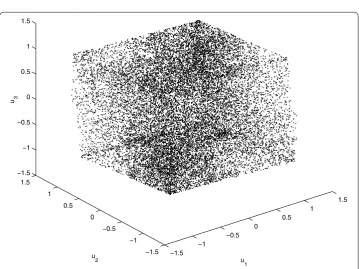
In order to help better visualize the theoretical result, two computer simulations are done, which exhibit complicated dynamical behaviors of the induced system (.),i.e., system (.). We takeα= –.,β= .,k= , for computer simulations. It follows from the proof of Theorem . thatOis an expanding fixed point of system (.) when|β|> +|α|= .. Furthermore, there exists some positive constantβ> . such that for|β|> β, we have two couples of pointsx≈.,x≈. satisfying equation (.) for
Figure 1 A dense orbit of system (3.1) in the (u1,u2) space forα= –0.1,β= 2.7,k= 1, andnfrom 0 to
20,000, with the initial conditionu(0) = (0.01, 0.01)T.
Figure 2 A dense orbit of system (3.1) in the (u1,u2,u3) space forα= –0.1,β= 2.7,k= 2, andnfrom 0
system (.),i.e., system (.), is chaotic in the sense of both Devaney and Li-Yorke. Some simulation results are shown in Figures - fork= , andnfrom to ,, respectively. It is a dense orbit in each picture, which clearly shows that the system has very complicated dynamical behaviors.
Competing interests
The authors declare that they have no competing interests.
Authors’ contributions
ZL carried out the main part of this manuscript. QZ and DL participated in discussion. All authors read and approved the final manuscript.
Acknowledgements
This work was supported by the National Natural Science Foundation of China (Grant Nos. 11101246 and 11101247).
Received: 4 December 2012 Accepted: 23 March 2013 Published: 10 April 2013 References
1. Busenbrg, S, Martelli, M: Delay Differential Equations and Dynamical Systems. Springer, Berlin (1991)
2. Jiang, M, Shen, Y, Jian, J, Liao, X: Stability, bifurcation and a new chaos in the logistic differential equation with delay. Phys. Lett. A350, 221-227 (2006)
3. Peng, MS, Uçar, A: The use of the Euler method in identification of multiple bifurcations and chaotic behavior in numerical approximations of delay differential equations. Chaos Solitons Fractals21, 883-891 (2004)
4. Peng, MS, Yuan, Y: Stability, symmetry-breaking bifurcation and chaos in discrete delayed models. Int. J. Bifurc. Chaos
18, 1477-1501 (2008)
5. He, ZM, Lai, X: Bifurcation and chaotic behavior of a discrete-time predator-prey system. Nonlinear Anal., Real World Appl.12, 403-417 (2011)
6. Fan, DJ, Wei, JJ: Bifurcation analysis of discrete survival red blood cells model. Commun. Nonlinear Sci. Numer. Simul.
14, 3358-3368 (2009)
7. Kaplan, JL, Yorke, JA: Ordinary differential equations which yield periodic solutions of differential delay equations. J. Math. Anal. Appl.48, 317-324 (1974)
8. Dormayer, P: The stability of special symmetric solutions of˙x=αf(x(t– 1)) with small amplitudes. Nonlinear Anal., Theory Methods Appl.14, 701-715 (1990)
9. Furomochi, T: Existence of periodic solutions of one-dimensional differential-delay equations. Tohoku Math. J.30, 13-35 (1978)
10. Gurney, WSC, Blythe, SP, Nisbeth, RM: Nicholson’s blowflies revisited. Nature287, 17-21 (1978) 11. Heiden, U: Delays in physiological systems. J. Math. Biol.8, 345-364 (1979)
12. Mackey, MC, Glass, L: Oscillation and chaos in physiological control systems. Science197, 287-289 (1977) 13. Mackey, MC, Heiden, U: The dynamics of recurrent inhibition. J. Math. Biol.19, 211-225 (1984)
14. Mackey, MC: Commodity price fluctuations: price dependent delays and nonlinearities as explanatory factors. J. Econ. Theory48, 497 (1990)
15. Heiden, U, Mackey, MC: The dynamics of production and destruction: analytic insight into complex behavior. J. Math. Biol.16, 75-101 (1982)
16. Heiden, U, Walther, HO: Existence of chaos in control systems with delayed feedback. J. Differ. Equ.47, 273-295 (1983) 17. Lani-Wayda, B, Walther, HO: Chaotic motion generated by delayed negative feedback, Part I: a transversality criterion.
Differ. Integral Equ.8, 1407-1452 (1995)
18. Lani-Wayda, B, Walther, HO: Chaotic motion generated by delayed negative feedback, Part II: construction of nonlinearities. Math. Nachr.180, 141-211 (1996)
19. Li, TY, Yorke, JA: Period three implies chaos. Am. Math. Mon.82, 985-992 (1975)
20. Devaney, RL: An Introduction to Chaotic Dynamical Systems. Addison-Wesley, New York (1987)
21. Banks, J, Brooks, J, Cairns, G, Davis, G, Stacey, P: On Devaney’s definition of chaos. Am. Math. Mon.99, 332-334 (1992) 22. Huang, W, Ye, XD: Devaney’s chaos or 2-scattering implies Li-Yorke’s chaos. Topol. Appl.117, 259-272 (2002) 23. Wiggins, S: Introduction to Applied Nonlinear Dynamical Systems and Chaos. Springer, New York (1990) 24. Shi, YM, Chen, GR: Chaos of discrete dynamical systems in complete metric spaces. Chaos Solitons Fractals22,
555-571 (2004)
25. Marotto, FR: Snap-back repellers imply chaos inRn. J. Math. Anal. Appl.63, 199-223 (1978)
26. Huang, Y, Zou, XF: Co-existence of chaos and stable periodic orbits in a simple discrete neural network. J. Nonlinear Sci.15, 291-303 (2005)
27. Shi, YM, Chen, GR: Discrete chaos in Banach spaces. Sci. China Ser. A34, 595-609 (2004); (English version48, 222-238 (2005))
28. Shi, YM, Yu, P: Chaos induced by regular snap-back repellers. J. Math. Anal. Appl.337, 1480-1494 (2008)
29. Shi, YM, Yu, P: Study on chaos by turbulent maps in noncompact sets. Chaos Solitons Fractals28, 1165-1180 (2006) 30. Shi, YM, Yu, P, Chen, GR: Chaotification of dynamical systems in Banach spaces. Int. J. Bifurc. Chaos16, 2615-2636
(2006)
doi:10.1186/1687-1847-2013-99
Cite this article as:Li et al.:Chaotic behavior in a class of delay difference equations.Advances in Difference Equations