R E S E A R C H
Open Access
Research of localization algorithm based on
weighted Voronoi diagrams for wireless
sensor network
Shaobin Cai
1*, Hongqi Pan
1, Zhenguo Gao
2, Nianmin Yao
1and Zhiqiang Sun
1Abstract
Wireless sensor network (WSN) is formed by a large number of cheap sensors, which are communicated by an ad hocwireless network to collect information of sensed objects of a certain area. The acquired information is useful only when the locations of sensors and objects are known. Therefore, localization is one of the most important technologies of WSN. In this paper, weighted Voronoi diagram-based localization scheme (W-VBLS) is proposed to extend Voronoi diagram-based localization scheme (VBLS). In this scheme, firstly, a node estimates the distances according to the strength of its received signal strength indicator (RSSI) from neighbor beacons and divides three beacons into groups, whose distances are similar. Secondly, by a triangle, formed by the node and two beacons of a group, a weighted bisector can be calculated out. Thirdly, an estimated position of the node with the biggest RSSI value as weight can be calculated out by three bisectors of the same group. Finally, the position of the node is calculated out by the weighted average of all estimated positions. The simulation shows that compared with centroid and VBLS, W-VBLS has higher positioning accuracy and lower computation complexity.
Keywords:WSN; Voronoi; Weight; Bisector
1 Introduction
Wireless sensor network (WSN) is a self-organizing distributed network system including plenty of tiny sen-sor nodes with the ability to communicate and calculate in a specific monitoring area. In the wireless sensor net-work, the node position information plays a very important role in monitoring activity. The monitoring information without location message is meaningless. Therefore, the re-search of wireless sensor network positioning technology is the key technology of WSN [1].
The existing location algorithm is divided into two major categories which are range-based and range-free. APS [2], AHLoS algorithm [3], trilateration algorithm [4], lateration algorithm [5], and alternating combination trilateration (ACT) [6] are typical range-based algo-rithms. Centroid algorithm [7], DV-hop algorithm [8], APIT algorithm [9], and amorphous algorithm [10] are typical range-free algorithms.
Literature [11] used Voronoi diagrams in wireless sensor node localization. In this algorithm, the midperpendiculars between each beacon node and its neighbor beacon node composed the Voronoi region boundaries. According to the properties of the Voronoi diagrams, we can see that the node to be located is in its nearest beacon node Voronoi region. Therefore, in literature [11], the algo-rithm weighted all the nodes within this region firstly and obtained all the beacon nodes’ Voronoi regions in order, then added different weight values to the ob-tained regions, and finally obob-tained the centroid of the largest weight value region as the estimated coordinate of the node to be located.
However, algorithm [11] using the midperpendicular of the beacon nodes as Voronoi diagram region boundaries could not reflect the relationship between the RSSI signal strength and the distance among the nodes. Therefore, in order to improve localization accuracy and reduce complex-ity of the algorithm, we improved the localization algorithm based on Voronoi diagrams. In the improved algorithm, we selected two beacon nodes' weighted bisector as the region boundaries, then calculated the two weighted bisector
* Correspondence:[email protected]
1
College of Computer Science and Technology, Harbin Engineering University, Harbin 150001, China
Full list of author information is available at the end of the article
intersection coordinates as estimate coordinates, and finally we regarded the weighted average values of all the estimate coordinates as the final estimate coordinates of the node to be located.
2 Positioning algorithm based on Voronoi
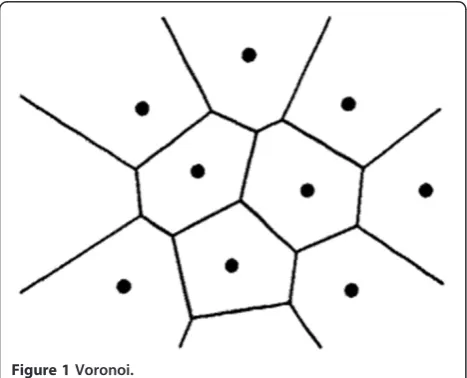
Voronoi diagram (Figure 1) refers to a point set in a given space, P= {P1,P2, P3,⋯Pn}, 3≤n<∞. The plane is
divided by the Voronoi diagram as follows:
V Pið Þ ¼ x∈V Pið Þjd xð ;PiÞ≤d x;Pj
j¼1;2;⋯n;j≠i:
In the previous formula, letxbe any point in the plane and d(x, Pi) be the Euclidean distance [11] between x
and the certain point Pi. In wireless sensor networks,
because RSSI signal values between nodes are inversely proportional to the square of their distances, then ac-cording to this property and the definition of Voronoi diagrams, we can describe WSN node localization as follows.
1. LetP1,P2,P3,⋯,,Pnbe beacon nodes in wireless
sensor network area andSbe node to be located.
2. We can suppose beacon nodesP1,P2,P3,⋯,Pj
communicate with the nodeS, and the nodeS
receives RSSI signal strength of the beacon node according to size ofRSSIP1>RSSIP2> ⋯; >RSSIPj. 3. According to the properties of the Voronoi
diagrams, we can see that the unknown nodeSis in the Voronoi region of beacon nodeP1. We compute
P1’s Voronoi regions and add the weight values
RSSIP1 to all the nodes within this area.
4. Remove the nodeP1, compute the Voronoi region of
P2, and assign node weight value RSSIP2. In this way,
eventually, we can obtain all beacon nodes of the Voronoi regions.
5. We can find the region with a maximum weight value and get the gravity coordinate as the calculation coordinate of the unknown nodeS.
3 Positioning algorithm based on weighted Voronoi In Voronoi diagram algorithm, the Voronoi region of beacon node Pi is made of midperpendiculars of this
beacon node and the beacon nodes around it. However, in fact, if the nodes have the same centroid and the greater the intensity of the RSSI signal the node re-ceived, the smaller the distance between nodes will be. Therefore, we can appropriately adjust the Voronoi re-gion of this node through the signal value. Thus, we can improve the localization accuracy and reduce com-putational complexity.
3.1 Algorithm basic ideas
We presume the node to be located S can receive the signal from beacon nodes P1, P2, P3,⋯, Pn. When Shas
the distance ofdi, dj(supposedi>dj) to any two beacon
nodesPi,Pj, the node to be locatedSandPi,Pjwill form
a triangleSPiPj. Let node Sbe in the line ofPiPj’s weight
bisector; we can select this line as the region boundaries of beacon nodes Pi and Pj. Then, we can select beacons
Pm,Pnand repeat the above method. We will get a more
accurate Voronoi region at last.
Because of the assumptiondi>dj, we know∠SPiPj>∠
SPjPi in the triangle SPiPj. For calculating the straight
line equation L of weight bisector, we need to get the slopekof Land the intersection coordinates Pbetween PiPjandL. With the properties of the straight slope, the
slope ofLis the opposite to the reciprocal slope of bottom edgePiPj, that iskL¼−xyj−xi
j−yi. We use the following three
cases to seek the intersection coordinateP(x0,y0):
1. ∠SPiPjis an acute angle (Figure2). We calculate the next formula first.
s1¼d2i−d2j þd2i;j
s2¼d2j−d2i þd2i;j
(
ð1Þ
We knows1ands2are both greater than zero from
the cosine law. Then, we can choose proportionality coefficientl¼s2
Because we have calculated the positions ofs1ands2
and the positions ofP1andP2have been known, we
can get the coordinateP(x0,y0).
x0¼xiþlxj
1þl ; y0¼ yiþlyj
1þl ð3Þ
TakingkLthat we have obtained andP(x0,y0) into
the equationy−y0=k(x−x0), we can receive the
equation as follows:
y¼kLxþ
yi−kLxiþl yj−kLxj
1þl ð4Þ
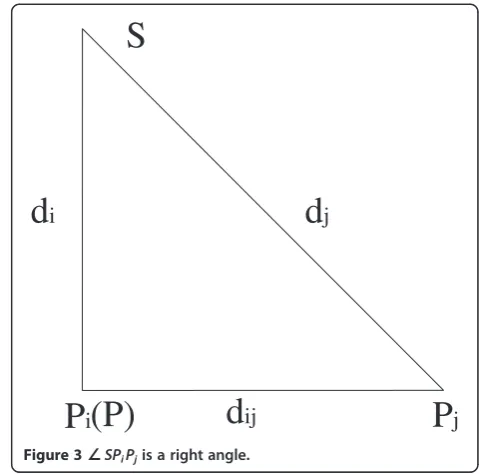
2. ∠SPiPjis a right angle (Figure3).
Straight lineLisPiSin the triangle, so straight line L’s slopekLis stillkL¼−yxjj−−xyii; the intersection ofL and bottom edgePiPjisPi(xi,yi). Then, we can get the equation of straight lineL:
y¼kLxþyi−kLxi ð5Þ
3. ∠SPiPjis an obtuse angle (Figure4). We still calculate
s1¼d2i −d2j þd2i;j
s2¼d2j −d2i þd2i;j
(
ð6Þ
At this time,s1> 0,s2< 0; then, the proportionality
coefficient isl¼−s2
s1.
In a similar way, we can get the coordinates P(x0,y0).
x0¼xi−lxj
1−l ; y0¼ yi−lyj
1−l ð7Þ
Then, get the equation ofL.
y¼kLxþ
l yj−kLxj
− yi−kLxi
l−1 ð8Þ
3.2 Algorithmic process
Localization algorithm based on weighted Voronoi diagrams works as follows:
1. The node to be locatedSbroadcasts around the informationRequestwith requesting location. 2. All beacon nodes that received theRequestreturn
the informationReplywhich contains its own location.
3. After nodeSreceives all the information, we sort the beacon nodes from big to small according to the signal intensity. We assume that the sorted order of beacon nodes isP1,P2,P3,⋯,Pk.
4. The bottom edge heights ofSP1P2,SP2P3,⋯,
SPk−1Pkform the equationsL1,L2,⋯,,Lk−1. 5. Next, we can get the intersectionQ1ofL1andL2,
Q2ofL2andL3,⋯, andQk−2ofLk−2andLk−1.
d
j
d
i
d
ij
P
j
P
i
S
(P)
Figure 3∠SPiPjis a right angle.
d
jd
id
ijP
jP
iS
P
Figure 4∠SPiPjis an obtuse angle.
d
jd
id
ijP
jP
iS
P
Then, we attach the RSSI signal values ofP1,P2,⋯ Pk−2to the nodesQ1,Q2,⋯,Qk−2as weighted values. 6. Calculate the weighted average coordinates from
nodeQ1to nodeQk−2.
4 Experiment and performance analysis of the positioning algorithm
In this section, we make the simulation analysis on per-formance comparison among the new algorithm, weighted centroid algorithm (W-Centroid) and Voronoi diagram-based localization scheme (VBLS) algorithm by MATLAB 7.0 (The MathWorks, Inc., Natick, MA, USA).
There are 25 beacon nodes distributed randomly in the region of 100 m × 100 m, among which Shadowing model is adopted to realize the communication.
Prð Þd Prð Þd0
db
¼−10βlog d d0
þXdb ð9Þ
In the previous equation, Pr(d0) andd0represent
ref-erence energy and refref-erence distance, respectively. β represents path loss coefficient (general value is 2 ~ 4), andXdbis a Gaussian variable that has an average value
of zero.
Figure 5 describes the relation between localization ac-curacy of the three algorithms and communication ra-dius. From Figure 5, we can see that weighted Voronoi diagram-based localization scheme (W-VBLS) algorithm’s relative errors decrease gradually with the increase of communication radius. When the communication radius is greater than 45 m, it is essentially flat with VBLS errors. As communication radius increases, the beacon nodes involved in the localization increases, the unknown node can gain more location information, and localization errors decrease.
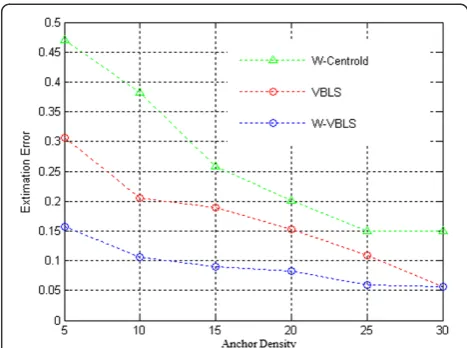
Figure 6 depicts the relation between localization accur-acy of the three algorithms and the number of nodes. As can be seen from Figure 6, with the number of beacon nodes increasing, the localization accuracy improves grad-ually. When beacon node increases to 25, localization ac-curacy has few changes. In order to locate, the VBLS localization algorithm must have at least four nodes, while the W-VBLS algorithm only needs three beacon nodes. Therefore, in case the beacon nodes are sparse, W-VBLS significantly has higher positioning accuracy than the other two algorithms.
Figure 7 depicts the relationship between the positioning accuracy of the three algorithms and noise. W-Centrold adopts the connectivity among nodes to positioning, while VBLS and W-VBLS positioning base on the size of the RSSI signal. In case the noise increases, W-Centrold posi-tioning algorithm only has small fluctuations, while VBLS and W-VBLS will have fluctuations with noise increasing.
Figure 7The relationship between accuracy and noise.
Figure 6The relationship between positioning accuracy and the number of beacon nodes.
When the noise reaches 0.5, positioning errors of the two algorithms are basically the same.
5 Conclusion
Based on the research of Voronoi diagram range-free localization algorithm, we propose a Voronoi diagram weighted localization algorithm. The algorithm uses the re-lationship between the distances among the nodes, and the RSSI signal intensity corrects the Voronoi diagram boundar-ies. At the same time, it reduces the number of minimum required localization beacon nodes and the complexity of the algorithm and improves the positioning accuracy.
Competing interests
The authors declare that they have no competing interests.
Acknowledgements
The paper is supported by the National Science Foundation of China (41176082, 61073182), supported by the Program for New Century Excellent Talents in University (NCET-13-0753), Specialized Research Fund for the Doctoral Program of Higher Education (20132304110031), and the Fundamental Research Funds for the Central Universities (HEUCFT1202).
Author details
1
College of Computer Science and Technology, Harbin Engineering University, Harbin 150001, China.2College of Automation, Harbin Engineering
University, Harbin 150001, China.
Received: 22 September 2013 Accepted: 17 March 2014 Published: 31 March 2014
References
1. L Sun, J Li, Y Chen, H Zhu,Wireless Sensor Network(Tsinghua University Press, Beijing, 2005), pp. 136–154
2. K Langendoen, N Reijers, Distributed localization in wireless sensor networks: a quantitative comparison. Comp. Netw.42(4), 499–518 (2003) 3. A Savvides, CC Han, MB Strivastava,Dynamic fine-grained localization in Ad-hoc
networks of sensors(Paper presented at the 7th annual international conference on mobile computing and networking, Rome, Italy, 2001), pp. 166–179
4. D Nicolescu, B Nath,Ad-hoc positioning systems (APS) using AOA
(Paper presented at the 22nd annual joint conference of the IEEE computer and communications, New York, 2003), pp. 1734–1743
5. D Niculescu, B Nath, Position and orientation in ad hoc networks. Ad Hoc Netw.2(2), 133–151 (2004)
6. Y Yu,Sensor Network Positioning Algorithm and Related Technology Research (Chongqing University, Chongqing, 2006)
7. N Bulusu, J Heidemann, D Estrin, GPS-less low cost outdoor localization for very small devices. IEEE Wirel. Commun.7(5), 27–34 (2000)
8. D Niculescu, B Nath, DV-based positioning in ad hoc networks. Telecommun. Syst.22(1–4), 267–280 (2003)
9. T He, C Huang, BM Blum, JA Stankovic, T Abdelzaher,Range-free localization schemes for large scale sensor networks(Paper presented at the 9th annual international conference on mobile computing and networking, San Diego, CA, USA, 2003), pp. 81–95
10. R Nagpal, H Shrobe, J Bachrach,Organizing a global coordinate system from local information on an ad-hoc sensor network(Paper presented at the second international conference on information processing in sensor networks, Palo Alto, CA, USA, 2003)
11. J Wang, L Huang, H Xu, B Xu, S Li, Based on Voronoi diagram without ranging wireless sensor network node positioning algorithm. Comput. Res. Dev.45(1), 119–125 (2008)
doi:10.1186/1687-1499-2014-50
Cite this article as:Caiet al.:Research of localization algorithm based
on weighted Voronoi diagrams for wireless sensor network.EURASIP
Journal on Wireless Communications and Networking20142014:50.
Submit your manuscript to a
journal and benefi t from:
7 Convenient online submission
7 Rigorous peer review
7 Immediate publication on acceptance
7 Open access: articles freely available online
7 High visibility within the fi eld
7 Retaining the copyright to your article