R E S E A R C H
Open Access
Galerkin method for the scattering problem
of strip gratings
Enxi Zheng
1*and Yujie Wang
1*Correspondence:
[email protected] 1School of Science, Dalian Maritime
University, Dalian, P.R. China
Abstract
In this paper, the diffraction problem of periodic strip gratings is considered. The previous study of this problem usually concentrated on the numerical method; however, we try to analyze this problem and the convergence of the numerical solution from the mathematical point of view in this work. By use of the Dirichlet to Neumann operator on the slit between two strips, we reformulate the problem to an operator equation. The well-posedness of the solution to the operator equation is proved. The Galerkin method is applied to solve this operator equation and the convergence result of the numerical solution is also derived. Finally, some numerical experiments are presented to show the effectiveness of our method and verify the theoretical convergence result.
Keywords: Strip grating; Dirichlet to Neumann map; Helmholtz equation; Galerkin method
1 Introduction
The scattering theory of periodic structures has a wide variety of applications, for ex-ample, the micro-optics and the antenna engineering. In optics, the periodic structure is also called diffraction gratings. Introduction to the problem of electromagnetic diffrac-tion through periodic structures and the corresponding numerical methods can be found in [1]. The reviews on the diffractive optics technology and the mathematical analysis of diffraction gratings are presented in [2] and [3], respectively.
In this paper, we focus on the diffraction problem of periodic perfectly conducting strip gratings. This is a classic model which has been investigated by many researchers. In [4] the method of moments (MoM) is employed to analyze the diffraction problem of strip gratings located in free space. In papers [5,6] the same numerical method is used to solve the strip grating problem where the strips are printed on a dielectric substrate. As to the improved MoM for scattering problem of periodic strip gratings, we refer to paper [7] and the references therein. In addition to the MoM, there are also many other numerical methods for the strip gratings problem. For example, the singular integral equation ap-proach is proposed to deal with the plane wave diffraction by an infinite strip grating at oblique incidence in [8]. Fourier modal method (FMM), also called combined boundary conditions method (CBCM), is introduced in [9–11]. CBCM is applied for solving finite strip grating problem in [11]. Because of the slow convergence and Gibbs phenomenon at the tips of the strips, CBCM has been substantially improved in [12] with the aid of adap-tive spatial resolution in [11]. The parametric formulation of CBCM in [12] improves the
convergence rate, the computational efficiency, and the numerical accuracy. In [13] the authors employ this improved method in multilayered structures of strip gratings. More references about CBCM can be found in [14]. In mathematics, because the grating diffrac-tion problem is governed by differential equadiffrac-tion, the finite difference method (FDM) and the finite element method (FEM) can also be applied in solving the problem. In the nu-merical experiment part of this paper, we compare our method with the FDM.
The studies above concentrate on the mathematical model and the numerical method of the strip gratings. In this paper, we will reformulate the diffraction problem of strip grating into an operator equation by use of the Dirichlet to Neumann (DtN) operator. Then we will give a rigorous mathematical analysis of the solution and the Galerkin method which is used to solve the operator equation. The convergence of the Galerkin method has also been verified by the numerical experiments.
The paper is organized as follows. In Sect.2, we give some notations for describing the strip gratings problem and reformulate this problem into an operator equation by use of DtN operator on the slit between two strips. In Sect.3, the well-posedness of the solution to the operator equation derived in Sect.2is proved. The well-posedness contains the ex-istence, the uniqueness, and the stability of the solution. In Sect.4, the Galerkin method is employed to solve the operator equation. The uniqueness and the convergence of the numerical solution are proved. We also obtain the error estimate of the numerical solu-tion in Theorem5. The concrete computing process is given at the end of this section. In Sect.5, some numerical experiments are presented to show the effectiveness of the Galerkin method and convergence order proved in Sect.4is also verified by numerical Example1in this section.
2 Formulation of the problem
In this section, some notations are firstly presented to help us describe the diffraction problem of periodic strip gratings with periodd. Then the definition of quasi-periodic, the famous Rayleigh expansion of diffraction field, and the DtN operator are introduced. Finally, we reformulate the diffraction problem into an operator equation through simple calculation and the knowledge prepared above.
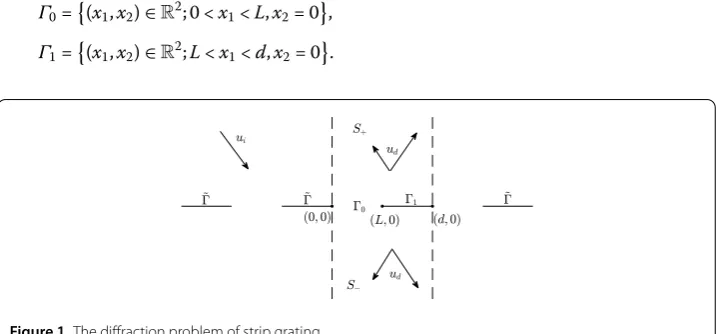
Assume that the length of each slit isL(L<d), and the slits are separated by perfect conductive material stripsΓ˜, see Figure1. Denote the slit and the perfect conductive strip in one period byΓ0andΓ1, respectively:
Γ0=
(x1,x2)∈R2; 0 <x1<L,x2= 0
,
Γ1=
(x1,x2)∈R2;L<x1<d,x2= 0
.
Furthermore, defineΓ as follows:
Γ =(x1,x2)∈R2; 0 <x1<d,x2= 0
.
Suppose that the domain
S=(x1,x2)∈R2; 0 <x1<d, (x1,x2) /∈Γ1
is filled with a homogeneous medium. LetS+andS–denote the domain upon and below
the strip gratings, respectively:
S+=
(x1,x2)∈R2; 0 <x1<d,x2> 0
,
S–=
(x1,x2)∈R2; 0 <x1<d,x2< 0
.
Assume that the plane waveui=eiαx1–iβx2is the incident wave upon the grating, whereα= ksinθ,β=kcosθ,k> 0 is the wave number, andθ∈(–π/2,π/2) is the angle of incidence. Denote the diffracted field byud. Then the total fieldutis
ut=
⎧ ⎨ ⎩
ui+ud, x2> 0,
ud, x2< 0,
(1)
and the diffraction problem of strip gratings reads as follows: when the incident fielduiis given, find the total fieldutsuch that
ut+k2ut= 0, inS, (2)
ut= 0, onΓ1. (3)
Among all the solutions of equations (2) and (3), we are interested in the quasi-periodic solution, i.e.,ute–iαxis a periodic function inx1with periodd. Moreover, we require the
diffracted fieldudto satisfy the bounded outgoing wave condition inS+andS–.
In domainsS+andS–, the famous Rayleigh expansion ofudis
ud(x1,x2) = ∞
n=–∞
anei(αn+α)x1+iβnx2, (x1,x2)∈S+, (4)
ud(x1,x2) = ∞
n=–∞
bnei(αn+α)x1–iβnx2, (x1,x2)∈S–, (5)
whereαn= 2πn/d,
βn=
⎧ ⎨ ⎩
(k2– (αn+α)2)1/2, n∈A, i((αn+α)2–k2)1/2, n∈/A, A={n∈Z,k2– (α
n+α)2> 0}andan,bnare coefficients to be determined. We further assume thatk=|αn+α|for everyn∈Zin order to avoid resonances. Define
u+d(x1) = lim
x2→0+
ud(x1,x2), u–d(x1) = lim
x2→0–
∂u+
For any quasi-periodic functionf(x1), i.e.,f(x1) has the following expansion:
f(x1) =
define the Dirichlet to Neumann operatorT1andT2as follows:
T1f(x1) =
By simple calculation, we can get
∂u+d
whereE0is the zero extension operator defined by the following:
∂u+i
Thus the diffraction problem of strip gratings can be reformulated into the operator equa-tion (17). Once the solution of (17) is derived, the diffraction fieldudand the total fieldut can be obtained through (4), (5), and (1).
3 Well-posedness analysis
In this section, we will prove the well-posedness of the solution to (17). In order to give the uniqueness and existence of the solution to (17), we introduce the following definitions of spaces and norms.
For any real numbers, define Sobolev spaces
Using the above notations, the operator equation problem (17) can be formulated as fol-In the following, we will present two lemmas about the properties of spacesH
1
posedness of the solution to equation (17).
Lemma 1 The operator T:H
Lemma 2 The embedding operator I∗:H
1 andRis the restriction operator fromH–
=
where C> 0is a constant independent of g.
Proof Define operatorB:H
1
derive the following two inequalities:
=
2 min{1,k}. By Lax–Milgram theorem, the operatorBhas a bounded inverse
B–1:H–12 pact operator, by use of Fredholm alternative theorem, the operator equationTu=ghas
a unique solutionu∈H
where C is a constant independent ofg.
4 Galerkin method
where
Proof For the finite dimensional problem (18), we only need to show that the homoge-neous equation
TuN,ϕm= 0, m= 1, 2, . . . ,N, (19)
has only one solutionuN = 0. From (19), we can getTuN,uN= 0. Thus the proof for uN= 0 is similar to Theorem1.
The next theorem follows from standard estimates for Galerkin method associated with compact operator equation, so we omit the proof here and refer to [15] for details.
Theorem 4 Assume thatβn= 0for all n∈Z,u is the solution of(17),and uNis the solution
where C is a positive constant independent of N.
Fors∈R, define spaceHps(Γ0) as follows:
With a little extension of Lemma 4.11 and Example 4.15 in [16] to quasi-periodic func-tions, the space Hαs,∗(Γ0) is equal toHps(Γ0), and the norms · s,∗,Γ0 and · s,p,Γ0 are
equivalent when 0 <s< 1. Then the conclusion of Theorem4can be rewritten as
Theorem 5 Assume thatβn= 0for all n∈Z,u∈Hps(Γ0) (s>12)is the solution of(17),and
where C is a positive constant independent of N.
Proof Because
In this section we demonstrate the numerical results of our method. All computations are performed using MATLAB. In all the following examples, we set the periodd= 4, the length of the slitL= 2, andΓ0={(x1, 0); 0 <x1< 2}.
Example1 In this example we consider the convergence results of our Galerkin method. Letu(x1) =x1(x1– 2),x1∈(0, 2) be the exact solution of the operator equation (17) with
k= 1,α= 0, and the corresponding right-hand side function
g(x1) = –2
Moreover,u(x1) has the following expansion:
Table 1 u–uN1
2,p,Γ0andu–uN12,∗,Γ0with respect toN
N 2 4 8 16 32 64
u–uN1
2,p,Γ0 9.0460E–02 2.6825E–02 7.1011E–03 1.8020E–03 4.5188E–04 1.1302E–04
order 1.7537 1.9175 1.9785 1.9956 1.9995
u–uN1
2,∗,Γ0 8.4367E–02 2.5019E–02 6.6220E–03 1.6799E–03 4.2110E–04 1.0522E–04
order 1.7537 1.9177 1.9788 1.9959 1.9997
Figure 2Numerical convergence results with respect toNin Example1
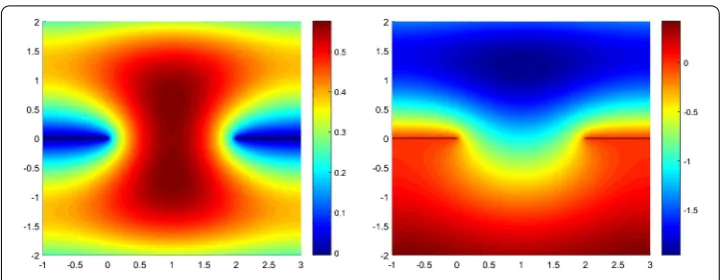
Figure 3Example2. (left) Absolute value of total fieldutonΓ0, (right) Absolute value of total fieldut
so we haveu(x1)∈H 5 2–ε
p (Γ0) withε> 0 arbitrarily small. Results are presented in Table1
and Fig.2. From these results, we can see that the errorsu–uN1
2,∗,Γ0andu–uN12,p,Γ0
decay rapidly with respect toN, and the corresponding convergence orders are coincident with Theorem5.
Figure 4Example2. (left) Real part of total fieldut, (right) Imaginary part of total fieldut
Figure 5Example3. (left) Absolute value of total fieldutonΓ0, (right) Absolute value of total fieldut
Figure 6Example3. (left) Real part of total fieldut, (right) Imaginary part of total fieldut
results of our Galerkin method with 20 dofs (degree of freedoms) are coincident with the results of FDM with 64 dofs, i.e., our Galerkin method needs fewer dofs than the FDM.
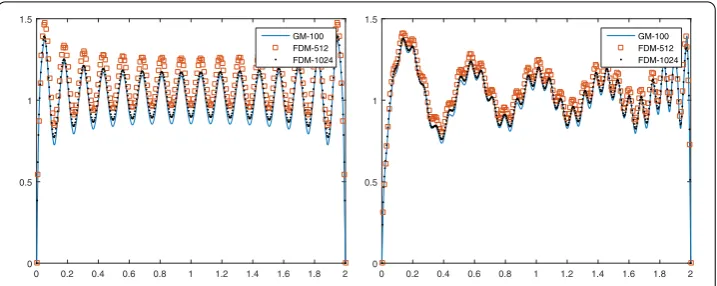
Figure 7Example4. (left) Absolute value of total fieldutonΓ0withk= 50 andθ= 0, (right) Absolute value of total fieldutonΓ0withk= 50 andθ=π/4
Figure 8Example4. (left) Absolute value of total fieldutonΓ0withk= 100 andθ= 0, (right) Absolute value of total fieldutonΓ0withk= 100 andθ=π/4
Example4 In this example, we consider the situation of large wave numberk= 50 and 100. Fork= 50, we setN= 100. The absolute values of total fieldsutonΓ0are presented in
Fig.7with incident anglesθ= 0 andθ=π/4, respectively. Fork= 100, we setN= 200. The absolute values of total fieldsutonΓ0are presented in Fig.8with incident anglesθ= 0
andθ=π/4, respectively. Also the numerical solutions given by the FDM are shown in these figures. Whenk= 50, compared with the FDM which needs 1024 dofs, our Galerkin method needs only 100 dofs to get reliable computational results. Whenk= 100, the FDM needs 2048 dofs, while our Galerkin method needs only 200 dofs.
6 Conclusion
In this paper, we study the scattering problem of strip gratings. By use of the continuity of the total field across the slit in one period and the Dirichlet to Neumann map, this problem is reformulated to an operator equation on the slit. The well-posedness of the solution to the operator equation is proved and Galerkin method is employed to solve this operator equation. We also derive the error estimate for the Galerkin method and numerical examples show that our method is effective.
Acknowledgements
Funding
This work is supported by the Fundamental Research Funds for the Central Universities (Grant no. 3132017053, 3132018226), the Doctoral Scientific Research Foundation of Liaoning Province (Grant no. 20170520289), TianYuan Special Funds of the National Natural Science Foundation of China (Grant no. 11626054), and the National Natural Science Foundation of China (Grant no. 11601056).
Abbreviations
MoM, method of moments; FMM, Fourier modal method; CBCM, combined boundary conditions method; FDM, finite difference method; FEM, finite element method; DtN, Dirichlet to Neumann; dofs, degree of freedoms.
Availability of data and materials
Not applicable.
Competing interests
The authors declare that they have no competing interests.
Authors’ contributions
The main idea of this paper was proposed by EZ, the theoretical analysis was carried out by the two authors together, and the numerical experiments were conducted by EZ. Both authors read and approved the final manuscript.
Publisher’s Note
Springer Nature remains neutral with regard to jurisdictional claims in published maps and institutional affiliations.
Received: 9 August 2018 Accepted: 29 January 2019
References
1. Petit, R.: Electromagnetic Theory of Gratings, vol. 22. Springer, Heidelberg (1980)
2. Bao, G., Cowsar, L., Masters, W.: Mathematical Modeling in Optical Science, vol. 22. SIAM, Philadelphia (2001) 3. Wilcox, C.H.: Scattering Theory for Diffraction Gratings. Applied Mathematical Sciences Ser., vol. 46. Springer, New
York (1984)
4. Uchida, K., Nora, T., Matsunaga, T.: Electromagnetic wave scattering by an infinite plane metallic grating in case of oblique incidence and arbitrary polarization. IEEE Trans. Antennas Propag.36(3), 415–422 (1988)
5. Wu, T.K.: Fast converging integral equation solution of strip gratings on dielectric substrate. IEEE Trans. Antennas Propag.35(2), 205–207 (1987)
6. Lee, C.W., Son, H.: Analysis of electromagnetic scattering by periodic strip grating on a grounded dielectric/magnetic slab for arbitrary plane wave incidence case. IEEE Trans. Antennas Propag.47(9), 1386–1392 (1999)
7. Florencio, R., Boix, R.R., Encinar, J.A.: Enhanced MoM analysis of the scattering by periodic strip gratings in multilayered substrates. IEEE Trans. Antennas Propag.61(10), 5088–5099 (2013)
8. Matsushima, A., Itakura, T.: Singular integral equation approach to plane wave diffraction by an infinite strip grating at oblique incidence. J. Electromagn. Waves Appl.4(6), 505–519 (1990)
9. Montiel, F., Neviere, M.: Electromagnetic study of the diffraction of light by a mask used in photolithography. Opt. Commun.101(3–4), 151–156 (1993)
10. Montiel, F., Neviere, M.: Perfectly conducting gratings: a new approach using infinitely thin strips. Opt. Commun.
144(1–3), 82–88 (1997)
11. Guizal, B., Felbacq, D.: Electromagnetic beam diffraction by a finite strip grating. Opt. Commun.165(1–3), 1–6 (1999) 12. Granet, G., Guizal, B.: Analysis of strip gratings using a parametric modal method by Fourier expansions. Opt.
Commun.255(1–3), 1–11 (2005)
13. Elamine, H., Guizal, B., Oueslati, M., Gharbi, T.: New reformulation of the Fourier modal method with spatial adaptive resolution for multilayered metallic strip grating. Opt. Commun.283(21), 4392–4396 (2010)
14. Li, L.: Fourier modal method. In: Popov, E. (ed.) Gratings: Theory and Numeric Applications, 2nd edn., pp. 1–40. Aix Marseille Université, Marseille (2014)
15. Wang, Y., Ma, F., Zheng, E.: Galerkin method for the scattering problem of a slit. J. Sci. Comput.70(1), 1–18 (2017) 16. Chandler-Wilde, S.N., Hewett, D.P., Moiola, A.: Interpolation of Hilbert and Sobolev spaces: quantitative estimates and