R E S E A R C H
Open Access
A modified kernel method for a
time-fractional inverse diffusion problem
Songshu Liu
1and Lixin Feng
2**Correspondence:
2School of Mathematical Sciences,
Heilongjiang University, Harbin, 150080, China
Full list of author information is available at the end of the article
Abstract
In this paper, we consider a time-fractional inverse diffusion problem, where the data is given atx= 1 and the solution is sought in the interval 0≤x< 1. Such a problem is obtained from the classical diffusion equation by replacing the first-order time derivative by the Caputo fractional derivative of order
α
∈(0, 1). We show that a time-fractional inverse diffusion problem is severely ill-posed and we further apply a modified kernel method to solve it based on the solution in the frequency domain. The corresponding convergence estimates are provided. Finally, an example is constructed to show the feasibility and efficiency of the proposed method.MSC: 35R25; 35R30; 47A52
Keywords: time-fractional inverse diffusion problem; ill-posed problem; regularization method; error estimate
1 Introduction
In the past decades, studies on the problems of the partial differential equation mainly focused on direct problems and inverse problems of integer order differential equation, and some numerical techniques have been proposed to solve integer order differential equation [–]. However, fractional derivatives calculus and fractional differential equa-tions have been used recently to solve a range of problems in mechanical engineering [], viscoelasticity [], electron transport [], dissipation [], heat conduction [, ], and high-frequency financial data [].
The time-fractional diffusion equation arises by replacing the standard time partial derivative in the diffusion equation with a time-fractional partial derivative. It is usually used to describe the anomalous diffusion (superdiffusion, non-Gaussian diffusion, subdif-fusion) which is not consistent with the classical Fick (or Fourier) law []. The direct prob-lem,i.e., initial value problem and initial boundary for time-fractional diffusion equation have been studied extensively in the past few years [–]. However, in some practical problems, the boundary data on the whole boundary cannot be obtained. We only know the noisy data on a part of the boundary or at some interior points of the concerned do-main. This leads to an inverse and ill-posed problem of the fractional diffusion equation, which means the solution does not depend continuously on the given known conditions. In this paper, we investigate an inverse problem of the time-fractional diffusion equation. This kind of ill-posed problem is important in many branches of engineering sciences [, ].
Due to the difficulty of the fractional derivative and the ill-posedness, to the authors’ knowledge, the results on inverse problem of the time-fractional diffusion equation are very few. The uniqueness of an inverse problem for a one-dimensional fractional diffusion equation was given in []. Cheng and Fu [] gave an iteration regularization method for a time-fractional inverse diffusion problem. Zheng and Wei [, ] investigated a time-fractional inverse diffusion problem by using a spectral regularization method and a modified equation method.
In this article, we consider the following time-fractional inverse diffusion problem (TFIDP):
where the time-fractional derivativeDα
tu(x,t) is the Caputo fractional derivative of order
α∈(, ) defined by []
where(·) is the gamma function.
The TFIDP is an inverse problem and is severely ill-posed. That means the solution does not depend continuously on the given data, and any small perturbation in the given data may cause large changes to the solution. In this paper, we will present a modified kernel method to construct a stable approximation solution of the TFIDP.
The rest of this paper is organized as follows. In Section , we demonstrate ill-posedness of the time-fractional inverse diffusion problem. In Section , a modified kernel method is used to solve problem (), and we also obtain the convergence estimates between the regularization solution and the exact solution based on thea prioriassumptions for the exact solution. In Section , an example is illustrated to show the main results. Finally, we conclude this paper in Section .
2 Ill-posedness of a time-fractional inverse diffusion problem
In order to apply the Fourier analysis of the time-fractional inverse diffusion problem, we extend all the functions to the whole line –∞<t<∞by defining them to be zero fort< whenever it is necessary. We also assume all the functions involvingtvariable are inL(R). Here, and in the following sections, we use the correspondingLnorm, as defined below:
be the Fourier transform of the functiong(t)∈L(R) and ·
pdenote theHpnorm,i.e.,
gp=
∞
–∞
+ξpg(ˆ ξ)dξ
.
Then, applying the Fourier transforming with respect totto problem (), we have []
ˆ
ux(x,ξ) = –(iξ)αu(x,ˆ ξ), ()
ˆ
u(,ξ) =g(ˆ ξ). ()
The solution of the above problem can be given by
ˆ
u(x,ξ) =el(ξ)(–x)g(ˆ ξ), ()
where
l(ξ) = (iξ)α=
⎧ ⎨ ⎩
|ξ|α(cosαπ
+isin
απ
), ξ≥, |ξ|α(cosαπ
–isin
απ
), ξ< .
For the above problem, note thatl(ξ) has a positive real part|ξ|αcosαπ
, the small error in the high-frequency components will be amplified by the factore|ξ|αcosαπ (–x). Therefore the TFIDP for recovering the temperatureu(x,t) from the measured datagδ(t) is severely
ill-posed. Here, suppose that the measured datagδ(t)∈L(R) satisfy
gδ(t) –g(t)≤δ, ()
where the constantδ> is the noise level.
To solve the problem (), a natural way to stabilize the problem is to eliminate the high frequencies or to replace the ‘kernel’el(ξ)(–x)by a bounded approximation.
We now list two kernels of regularization methods for solving the time-fractional inverse diffusion problem.
The first is
e(iξ)α(–x) χmax,
whereχmaxdenotes the characteristic function of interval [–ξmax,ξmax], andξmaxis a reg-ularization parameter. It corresponds to a spectral regreg-ularization method; see [].
The second is
e
(iξ)α +μξ(–x),
whereμis a regularization parameter. It corresponds to a modified equation method; see [].
In this article, we propose a regularization method by modifying the ‘kernel’ to deal with the difficulty of problem () as follows:
el(ξ)(–x) +βe|ξ|αcosαπ
,
Now, we will apply this regularization strategy to solve a time-fractional inverse diffusion problem and prove that this regularization strategy is feasible.
3 A modified kernel method and error estimates
In this section, we will construct regularization solution by modifying the ‘kernel’ and obtain convergence estimates.
Here, we give an approximate solution of problem () by perturbing the kernel of () as follows:
In order to obtain our main results, we first give two important lemmas. Here, we set
η=|ξ|αcosαπ
Combining () and (), we have
sup
Proof The proof of this lemma is similar to that of Lemma , we get the inequality ().
Theorem Suppose that uβ,δ(x,t)is the regularization solution for problem()with noisy
data gδ(t)and that u(x,t)is the exact solution for problem()with the exact data g(t).Let
the assumptiongδ(t) –g(t) ≤δbe satisfied and letu(,·) ≤E hold.If we choose
β=δ
E, ()
then for every x∈(, ),we obtain the following error estimate:
uβ,δ(x,·) –u(x,·)≤δxE–x. ()
Proof By Parseval’s identity and the triangle inequality, we have
Therefore,
uβ,δ(x,·) –u(x,·)≤δβx–+Eβx,
according to (), we can get the error estimate
uβ,δ(x,·) –u(x,·)≤δxE–x.
The error estimate in Theorem does not give any useful information on the continuous dependence of the solution atx= . To retain the continuous dependence of the solution atx= , one has to introduce a strongera prioriassumption.
We are now in the position to formulate the convergence rate forx= .
Theorem Suppose that uβ,δ(x,t)is the regularization solution for problem()with noisy
data gδ(t)and that u(x,t)is the exact solution for problem()with the exact data g(t).
Let the assumptiongδ(t) –g(t) ≤δbe satisfied and letu(,·)
then,for x= ,we obtain the following error estimate:
uβ,δ(,·) –u(,·)
Proof It is similar to Theorem ; we obtain
and
The purpose of this section is to present a numerical example and illustrate the accuracy and efficiency of the proposed method. Here, the proposed methods will be implemented in Matlab. In our numerical experiment, we fix the interval ≤t≤.
To illustrate the behavior of a modified kernel regularization method, we construct the test problems with a given functionf atx= , then we compute a data functiongatx= according tog(ˆ ξ) =e–l(ξ)fˆ(ξ), which is well-posed. We usually think that the computed datag is exact. The discrete noisy datagδ is obtained by adding a random noise to the
Then the total noiseδcan be measured in the sense of the root mean square error accord-ing to
δ:=gδ–gl=
n n
i=
gδ
i –gi
.
Here, the functionrandn(·) generates arrays of random numbers whose elements are normally distributed with mean , varianceσ= and standard deviationσ= , the func-tionrandn(size(g)) returns an array of random entries that has the same size asg.
Example Consider a smooth function
f(t) =
⎧ ⎨ ⎩
t/e–
t, t> ,
, others.
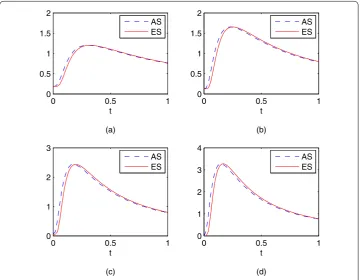
The comparison of the computational effects withα= .,ε= ., atx= ., ., ., are shown in Figure .
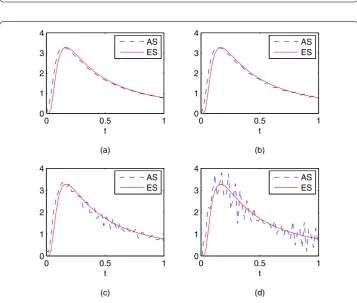
The comparison of the computational effects withα= .,x= , forε= ., ., ., . are shown in Figure .
The comparison of the computational effects withα= .,x= ,ε= . forγ = ., ., ., . are shown in Figure .
From Figures - (see also Tables -), we can find that the numerical results near the boundaryx= are better than the ones close tox= , and the smaller the parameterε,
Figure 1 The exact solution (ES) and its approximation solution (AS).α= 0.3,ε= 0.001 and(a)x= 0.8;
Figure 2 The exact solution (ES) and its approximation solution (AS).α= 0.4,x= 0 and(a)ε= 0.00001;
(b)ε= 0.0001;(c)ε= 0.001;(d)ε= 0.01.
Figure 3 The exact solution (ES) and its approximation solution (AS).α= 0.6,x= 0 and(a)γ= 0.6;
Table 1 The executing time for the running time program with differentxfor Example 1
x 0.8 0.5 0.2 0
t 9.420000 9.526000 9.483000 9.389000
Table 2 The executing time for the running time program with differentεfor Example 1
ε 0.00001 0.0001 0.001 0.01
t 9.241000 9.494000 9.531000 9.546000
Table 3 The executing time for the running time program with differentγ for Example 1
γ 0.6 0.7 0.8 0.9
t 9.346000 9.508000 9.514000 9.523000
the better the computed approximation is. Moreover, forx= , we can see that the smaller the parameterγ, the better the computed approximation is.
5 Conclusion
In this paper, we propose a modified kernel method for solving time-fractional inverse diffusion problem by producing a stable approximation solution. For this regularization strategy, in the presence of noisy data, we establish and prove the convergence estimates for the cases ≤x< under thea prioribound assumptions for the exact solution and the suitable choices of the regularization parameter. From the results of numerical simu-lations, it seems clear that the proposed method works well for the model problem with small measurement error.
Competing interests
The authors declare that they have no competing interests.
Authors’ contributions
The authors contributed equally to the writing of this paper. All authors read and approved the final manuscript.
Author details
1School of Mathematics and Statistics, Northeastern University at Qinhuangdao, Qinhuangdao, 066004, China.2School of
Mathematical Sciences, Heilongjiang University, Harbin, 150080, China.
Acknowledgements
This work was partially supported by National Natural Science Foundation of China (No. 11271113), the New Century Foundation of Heilongjiang Province (No. 1253-NECT-019) and Science and Technology Innovation Team in Higher Education Institutions of Heilongjiang Province (No. 2014TD005).
Received: 9 July 2015 Accepted: 26 October 2015 References
1. Arqub, OA, Al-Smadi, M: Numerical algorithm for solving two-point, second-order periodic boundary value problems for mixed integro-differential equations. Appl. Math. Comput.243, 911-922 (2014)
2. Arqub, OA, Al-Smadi, M, Momani, S, Hayat, T: Numerical solutions of fuzzy differential equations using reproducing kernel Hilbert space method. Soft Comput. (2015). doi:10.1007/s00500-015-1707-4
3. Arqub, OA, Al-Smadi, M, Shawagfeh, N: Solving Fredholm integro-differential equations using reproducing kernel Hilbert space method. Appl. Math. Comput.219, 8938-8948 (2013)
4. Arqub, OA, Abo-Hammour, Z: Numerical solution of systems of second-order boundary value problems using continuous genetic algorithm. Inf. Sci.279, 396-415 (2014)
5. Momani, S, Arqub, OA, Hayat, T, Al-Sulami, H: A computational method for solving periodic boundary value problems for integro-differential equations of Fredholm-Volterra type. Appl. Math. Comput.240, 229-239 (2014)
6. Alpay, D: Reproducing Kernel Spaces and Applications. Birkhäuser, Basel (2003)
7. Hon, YC, Wei, T: A fundamental solution method for inverse heat conduction problem. Eng. Anal. Bound. Elem.28, 489-495 (2004)
9. Chen, W, Ye, LJ, Sun, HG: Fractional diffusion equations by the Kansa method. Comput. Math. Appl.59, 1614-1620 (2010)
10. Yu, ZS, Lin, JZ: Numerical research on the coherent structure in the viscoelastic second-order mixing layers. Appl. Math. Mech.19, 717-723 (1998)
11. Scher, H, Montroll, EW: Anomalous transit-time dispersion in amorphous solids. Phys. Rev. B12, 2455-2477 (1975) 12. Szabo, TL, Wu, JR: A model for longitudinal and shear wave propagation in viscoelastic media. J. Acoust. Soc. Am.107,
2437-2446 (2000)
13. Gorenflo, R, Mainardi, F, Moretti, D, Pagnini, G, Paradisi, P: Discrete random walk models for space-time fractional diffusion. Chem. Phys.284, 521-541 (2002)
14. Metzler, R, Klafter, J: The random walk’s guide to anomalous diffusion: a fractional dynamics approach. Phys. Rep.339, 1-77 (2000)
15. Mendes, RV: A fractional calculus interpretation of the fractional volatility model. Nonlinear Dyn.55, 395-399 (2009) 16. Benson, DA, Wheatcraft, SW, Meerschaert, MM: The fractional-order governing equation of Lévy motion. Water
Resour. Res.36, 1413-1423 (2000)
17. Mainardi, F, Luchko, Y, Pagnini, G: The fundamental solution of the space-time fractional diffusion equation. Fract. Calc. Appl. Anal.4, 153-192 (2001)
18. Lin, YM, Xu, CJ: Finite difference/spectral approximations for the time-fractional diffusion equation. J. Comput. Phys.
225, 1533-1552 (2007)
19. Luchko, Y: Some uniqueness and existence results for the initial-boundary-value problems for the generalized time-fractional diffusion equation. Comput. Math. Appl.59, 1766-1772 (2010)
20. Mainardi, F, Pagnini, G: The Wright functions as solutions of the time-fractional diffusion equation. Appl. Math. Comput.141, 51-62 (2003)
21. Li, XJ, Xu, CJ: A space-time spectral method for the time fractional diffusion equation. SIAM J. Numer. Anal.47, 2108-2131 (2009)
22. Luchko, Y: Maximum principle for the generalized time-fractional diffusion equation. J. Math. Anal. Appl.351, 218-223 (2009)
23. Murio, DA: Stable numerical solution of a fractional-diffusion inverse heat conduction problem. Comput. Math. Appl.
53, 1492-1501 (2007)
24. Murio, DA: Time fractional IHCP with Caputo fractional derivatives. Comput. Math. Appl.56, 2371-2381 (2008) 25. Cheng, J, Nakagawa, J, Yamamoto, M, Yamazaki, T: Uniqueness in an inverse problem for one-dimensional fractional
diffusion equation. Inverse Probl.25, 115002 (2009)
26. Cheng, H, Fu, CL: An iteration regularization for a time-fractional inverse diffusion problem. Appl. Math. Model.36, 5642-5649 (2012)
27. Zheng, GH, Wei, T: Spectral regularization method for solving a time-fractional inverse diffusion problem. Appl. Math. Comput.218, 396-405 (2011)
28. Zheng, GH, Wei, T: A new regularization method for solving a time-fractional inverse diffusion problem. J. Math. Anal. Appl.378, 418-431 (2011)