R E S E A R C H
Open Access
Stability and
l
-gain analysis for 2D discrete
switched systems with time-varying delays in
the second FM model
Shipei Huang and Zhengrong Xiang
**Correspondence:
[email protected] School of Automation, Nanjing University of Science and Technology, Nanjing, 210094, People’s Republic of China
Abstract
This paper is concerned with the problems of stability andl2-gain analysis for 2D (two-dimensional) discrete switched systems with time-varying delays described by the second FM state-space model. Firstly, we introduce the definition of the average dwell time for a 2D discrete switched system, which is an extension of the ‘average dwell time’ concept of a 1D (one-dimensional) switched system. Secondly, based on the average dwell time approach, delay-dependent sufficient conditions for the existence of the exponential stability for the 2D discrete switched system are derived andl2-gain performance for the considered system is also analyzed. All the obtained results are formulated in a set of LMIs (linear matrix inequalities). Finally, a numerical example is given to illustrate the effectiveness of the proposed results.
Keywords: 2D systems; switched systems; time-varying delays;l2-gain; average dwell time; linear matrix inequality
1 Introduction
D (Two-dimensional) systems, which are a class of multi-dimensional systems, have re-ceived considerable attention over the past few decades due to their wide applications in many areas such as multi-dimensional digital filtering, linear image processing, signal pro-cessing, and process control [–]. The D system theory is frequently used as an analysis tool to solve some problems,e.g., iterative learning control [, ] and repetitive process control [, ]. The problems on realization, stability analysis, stabilization, filter design, and so on for D ornD systems have attracted a great deal of interest by many researchers. Xuet al.[, ] investigated the realization of D systems, and the problems of stability and stabilization for these systems were studied extensively in [–]. The observer and filter design problems have also been considered in [–].
It is known that modeling uncertainties and disturbances are unavoidable in practical systems, and it is important to investigate the problems ofH∞ control and robust
stabi-lization of D systems. Recently, many results onH∞ control for D systems have been
presented in [–]. Because time delays frequently occur in practical systems and are often the source of instability, theH∞control problem for a class of D discrete systems with state delays has also been investigated in [, ].
On the other hand, since switched systems have numerous applications in many fields, such as mechanical systems, automotive industry, switched power converters, this class of
systems has also attracted considerable attention during the past several decades [–]. Recently, some approaches have been applied widely to deal with these systems; see, for example, [–] and references cited therein. As stated in [, ], in many modeling problems of physical processes, a D switching representation is needed. One can cite a D physically based model for advanced power bipolar devices and heat flux switching and modulating in a thermal transistor. At present, there have been a few reports on D dis-crete switched systems. Benzaouiaet al.[] firstly considered D switched systems with arbitrary switching sequences, and the process of switch is considered as a Markovian jumping one. In addition, the stabilization problem of discrete D switched systems was also studied in []. In [], we extended the concept of average dwell time in D switched systems to D switched systems and designed a switching rule to guarantee the exponen-tial stability of D switched delay-free systems. However, to the best of our knowledge, no works have considered the disturbance attenuation property of D switched systems to date. Moreover, because of the complicated behavior caused by the interaction between the continuous dynamics and discrete switching, the problem of disturbance attenuation performance analysis for D switched systems is more difficult to study, and the meth-ods proposed in [–] cannot be directly applied to such systems. This motivates the present study.
In this paper, we are interested in investigating the issues of the exponential stability and l-gain analysis for D discrete switched systems with time-varying delays represented by
the second FM model. The main contributions of this paper can be summarized as fol-lows: (i) Based on the average dwell time approach, a delay-dependent exponential stabil-ity criterion for such systems is obtained and formulated in terms of LMIs (linear matrix inequalities); (ii) The Lyapunov-Krasovskii function with exponential term, which is dif-ferent from the previous ones, is constructed to investigate the stability of the considered systems; and (iii) In order to investigate the disturbance attenuation property of the con-sidered systems, we for the first time introduce the concept ofl-gain for a D switched
system, which is an extension of thel-gain performance index in the D case. Thel-gain
performance index can characterize the disturbance attenuation property of the underly-ing systems, and then, based on the established stability results, delay-dependent sufficient conditions for the existence ofl-gain performance are derived in terms of LMIs, which
can be easily verified by using some standard numerical software. The proposed method can also be applied to non-switched D discrete linear systems.
This paper is organized as follows. In Section , problem formulation and some nec-essary lemmas are given. In Section , based on the average dwell time approach, delay-dependent sufficient conditions for the existence of the exponential stability andl-gain
property are derived in terms of a set of matrix inequalities. A numerical example is pro-vided to illustrate the effectiveness of the proposed approach in Section . Concluding remarks are given in Section .
Notations Throughout this paper, the superscript ‘T’ denotes the transpose, and the
no-tationX≥Y(X>Y) means that matrixX–Yis positive semi-definite (positive definite, respectively). · denotes the Euclidean norm.Irepresents an identity matrix with an appropriate dimension.diag{ai}denotes a diagonal matrix with the diagonal elementsai,
byZ+. Thelnorm of a D signalw(i,j) is given by
w=
∞
i=
∞
j=
w(i,j)
andw(i,j) belongs tol{[,∞), [,∞)}ifw<∞.
2 Problem formulation and preliminaries
Consider the following D discrete switched systems with time-varying delays described by the second FM model:
x(i+ ,j+ ) =Aσ(i,j+)x(i,j+ ) +Aσ(i+,j)x(i+ ,j) +Aσd(i,j+)xi–d(i),j+
+Aσd(i+,j)xi+ ,j–d(j)
+Bσ(i,j+)w(i,j+ ) +Bσ(i+,j)w(i+ ,j), ()
z(i,j) =Hσ(i,j)x(i,j) +Lσ(i,j)w(i,j),
where x(i,j)∈Rn is the state vector, w(i,j)∈Rq is the noise input which belongs to
l{[,∞), [,∞)},z(i,j)∈Rp is the controlled output. iandjare integers inZ+. σ(i,j) : Z+×Z+→N ={, , . . . ,N} is the switching signal. N is the number of subsystems. σ(i,j) =k,k∈N, denotes that thekth subsystem is active.Ak
,Ak, Akd,Adk,Bk,Bk,Hk,
andLkare constant matrices with appropriate dimensions.d
(i) andd(j) are delays along
horizontal and vertical directions, respectively. We assume thatd(i) andd(j) satisfy
d≤d(i)≤d, d≤d(j)≤d, ()
whered,d,d, andddenote the lower and upper delay bounds along horizontal and
vertical directions, respectively.
In this paper, it is assumed that the switch occurs only at each sampling point ofiorj. The switching sequence can be described as
(i,j),σ(i,j)
,(i,j),σ(i,j)
, . . . ,(iπ,jπ),σ(iπ,jπ)
, . . . , ()
where (iπ,jπ) denotes theπth switching instant. It should be noted that the value ofσ(i,j)
only depends uponi+j(see the references [, ]).
Remark If there is only one subsystem in system (), it will degenerate to the following
D system:
x(i+ ,j+ ) =Ax(i,j+ ) +Ax(i+ ,j) +Adx
i–d(i),j+
+Adx
i+ ,j–d(j)
+Bw(i,j+ ) +Bw(i+ ,j),
z(i,j) =Hx(i,j) +Lw(i,j).
For system (), we consider a finite set of initial conditions, that is, there exist positive integerszandzsuch that
⎧ ⎪ ⎪ ⎪ ⎪ ⎪ ⎪ ⎪ ⎪ ⎨ ⎪ ⎪ ⎪ ⎪ ⎪ ⎪ ⎪ ⎪ ⎩
x(i,j) =hij, ∀≤j≤z,i= –d, –d+ , . . . , ,
x(i,j) =vij, ∀≤i≤z,j= –d, –d+ , . . . , ,
h=v,
x(i,j) = , ∀j>z,i= –d, –d+ , . . . , ,
x(i,j) = , ∀i>z,j= –d, –d+ , . . . , ,
()
wherez<∞andz<∞are positive integers,hijandvijare given vectors.
Definition System () withw(i,j) = is said to be exponentially stable under the
switch-ing signalσ(i,j) if for a givenZ≥, there exist positive constantscandξ such that
i+j=D
x(i,j)≤ξe–c(D–Z)
i+j=Z
x(i,j)C ()
holds for allD≥Z, where
i+j=Z
x(i,j)C sup –d≤θh≤, –d≤θv≤
i+j=Z
x(i–θh,j)
,x(i,j–θv)
,
η(i–θh,j)
,δ(i,j–θv)
,
η(i–θh,j) =x(i–θh+ ,j) –x(i–θh,j),
δ(i,j–θv) =x(i,j–θv+ ) –x(i,j–θv).
Remark From Definition , it is easy to see that whenZis given,i+j=Zx(i,j)
C will
be bounded andi+j=Dx(i,j)will tend to be zero exponentially asDgoes to infinity,
which also meansx(i,j)will tend to be zero exponentially.
Definition [] For anyi+j=D>Z=iZ+jZ, letNσ(i,j)(Z,D) denote the switching
number of the switching signalσ(i,j) on an interval (Z,D). If
Nσ(i,j)(Z,D)≤N+ D–Z
τa
()
holds for givenN≥,τa≥, then the constantτa is called the average dwell time and
Nis the chatter bound.
Remark Definition is an extension of the ‘average dwell time’ concept in a D switched
system, which can be seen in []. In what follows, based on the extended average dwell time concept, we will investigate the problems of stability andl-gain analysis for a D
Remark Similar to the D switched system case, Definition means that if there ex-ists a positive numberτasuch that the switching signalσ(i,j) has the average dwell time
property, the average time interval between consecutive switching is at leastτa. The
av-erage dwell time method is used to restrict the switching number of the switching signal during a time interval such that the stability or other performances of the system can be guaranteed.
Definition Consider D discrete switched system (). For a given scalarγ > , system
() is said to havel-gainγ under the switching signalσ(i,j) if it satisfies the following
conditions:
() Whenw(i,j) = , system () is asymptotically stable; () Under the zero boundary condition, it holds that
∞
i=
∞
j=
z<γ
∞
i=
∞
j=
w, ∀=w∈l
[,∞), [,∞),
where
w=
∞
i=
∞
j=
w(i,j+ ) w(i+ ,j)
, z=
∞
i=
∞
j=
z(i,j+ ) z(i+ ,j)
.
Remark It is not difficult to see that Definition is an extension of thel-gain
perfor-mance index in the D case.γ characterizes the disturbance attenuation performance. The smallerγ is, the better performance is.
Definition Consider D discrete switched system (). For a given scalarγ > , system
() is said to have weightedl-gainγ under the switching signalσ(i,j) if it satisfies the
following conditions:
() Whenw(i,j) = , system () is asymptotically stable; () Under the zero boundary condition, it holds that
∞
i=
∞
j=
αi+jz<γ
∞
i=
∞
j=
w
, ∀=w∈l
[,∞), [,∞).
Remark Similar to the D switched system case, Definition means that system () can
also have disturbances attenuation properties when it satisfies conditions () and () in Definition .
Lemma ConsiderD discrete switched system().Suppose that there exist a series of C
functions Vk:Rn→R(k∈N)and two positive scalarsλ andλfor which the following inequality holds:
λx(i,j)≤Vk
x(i,j)≤λx(i,j)C, ∀i,j∈Z+,∀k∈N ()
if there exists a number <α< for which Vk(x(i,j))along with the solution of system()
satisfies the inequality
i+j=D
Vk
x(i,j)≤α
i+j=D– Vk
andμ≥such that
i+j=mπ Vσ(iπ,jπ)
x(i,j)≤μ
i+j=(mπ)–
Vσ(iπ–,jπ–)
x(i,j), π= , , . . . , ()
thenD discrete switched system()is exponentially stable for every switching signal with the average dwell time scheme
τa>τa∗=
lnμ
–lnα. ()
Proof Letχ=Nσ(i,j)(Z,D) denote the switch number of switching σ(i,j) on an interval
[Z,D), and let (iπ–χ+,jπ–χ+), (iπ–χ+,jπ–χ+), . . . , (iπ,jπ) denote the switching points of
σ(i,j) over the interval [Z,D). Denotingmi=ii+ji,i=π–χ+ , . . . ,π, it follows from
() and () that
i+j=D
Vσ(iπ,jπ)
x(i,j)< αD–mπ
i+j=mπ Vσ(iπ,jπ)
x(i,j)
≤μαD–mπ
i+j=(mπ)–
Vσ(iπ–,jπ–)
x(i,j)
< μαD–mπαmπ–mπ–
i+j=(mπ–)–
Vσ(iπ–,jπ–)
x(i,j)
=μαD–mπ–
i+j=(mπ–)–
Vσ(iπ–,jπ–)
x(i,j)<· · ·
< μχαD–Z
i+j=Z
Vσ(iπ–χ,jπ–χ)
x(i,j). ()
According to Definition , one obtains
χ=Nσ(i,j)(Z,D)≤N+ D–Z
τa
. ()
Then from (), we have
i+j=D
Vσ(iπ,jπ)
x(i,j)
<μχαD–Z
i+j=Z
Vσ(iπ–χ,jπ–χ)
x(i,j)
=μNe–(–lnτaμ–lnα)(D–Z)
i+j=Z
Vσ(iπ–χ,jπ–χ)
x(i,j). ()
From (), we get
i+j=D
x(i,j)≤λ– λμNe–(– lnμ
τa–lnα)(D–Z)
i+j=Z
x(i,j)C. ()
Therefore, according to Definition , system () is exponentially stable under the average
3 Main results
3.1 Stability analysis
Theorem Consider system()with w(i,j) = .For a given positive constantα< ,if there
exist positive definite symmetric matrices Pkh,Pk
v,Qkh,Qkv,Whk,Wvk,Rkh,Rkv,and matrices
with appropriate dimensions,k∈N,such that
⎡
hold,then under the average dwell time scheme
τa>τa∗=
lnμ
whereμ≥and satisfies
Pkh≤μPhl, Phl ≤μPkh, Qkh≤μQlh,
Qlh≤μQkh, Whk≤μWhl,
Whl≤μWhk, Rkh≤μRlh, Rlh≤μRkh,
Pkv≤μPvl, Plv≤μPvk, Qkv≤μQlv,
()
Qlv≤μQkv, Wvk≤μWvl, Wvl≤μWvk,
Rkv≤μRlv, Rlv≤μRkv, ∀k,l∈N,
the system is exponentially stable.
Proof See the Appendix for the detailed proof, it is omitted here.
Remark In Theorem , we propose a sufficient condition for the existence of
exponen-tial stability for the considered D discrete switched system (). It is worth noting that this condition is obtained by using the average dwell time approach.
3.2 l2-gain performance analysis
Theorem Consider system().For given positive constantsγ andα< ,if there exist
positive definite symmetric matrices Pk
h,Pkv,Qhk,Qkv,Whk,Wvk,Rkh,Rkv,and matrices Nk= Nk
Nk
,Nk
= Nk
Nk
,Mk
= Mk
Mk
,Mk
= Mk
Mk
,Xk=XkXk
∗ Xk
> and Yk=Yk Yk
∗ Yk
> with
appropriate dimensions,k∈N,such that()and the following inequality
⎡ ⎢ ⎢ ⎢ ⎢ ⎢ ⎢ ⎢ ⎢ ⎢ ⎢ ⎢ ⎣
T
(Pkh+Pkv)
dTRkh
dTRkv T ∗ –γI BT
(Pkh+Pkv)
dBTRkh
dBTRkv LTk
∗ ∗ –γI BT
(Pkh+Pkv)
dBTRkh
dBTRkv LTk
∗ ∗ ∗ –(Pk
h+Pvk)
∗ ∗ ∗ ∗ –Rkh
∗ ∗ ∗ ∗ ∗ –Rk
v
∗ ∗ ∗ ∗ ∗ ∗ –I
⎤ ⎥ ⎥ ⎥ ⎥ ⎥ ⎥ ⎥ ⎥ ⎥ ⎥ ⎥ ⎦
< , ()
where
=
Hk Hk ,
hold,then under the average dwell time scheme(),the system is exponentially stable and has weighted l-gainγ.
Proof It is easy to get that () can be deduced from (), and according to Theorem , we can obtain that system () is exponentially stable.
Now we are in a position to consider thel-gain performance of system () under the
where
˜
=
⎡ ⎢ ⎢ ⎢ ⎢ ⎢ ⎢ ⎢ ⎢ ⎢ ⎢ ⎢ ⎢ ⎢ ⎣ ˜
HkTHk HkTLk HkTLk
∗ ˜ HkTLk HkTLk
∗ ∗ –αdQk
h
∗ ∗ ∗ –αdQk
v
∗ ∗ ∗ ∗ –αdWk
h
∗ ∗ ∗ ∗ ∗ –αdWk
v
∗ ∗ ∗ ∗ ∗ ∗ ˜ LkTLk
∗ ∗ ∗ ∗ ∗ ∗ ∗ ˜
⎤ ⎥ ⎥ ⎥ ⎥ ⎥ ⎥ ⎥ ⎥ ⎥ ⎥ ⎥ ⎥ ⎥ ⎦ ,
˜
= –αPkh+Whk+ (d–d+ )Qkh+HkTHk,
˜
= –αPkv+Wvk+ (d–d+ )Qkv+HkTHk,
˜
=˜=LkTLk–γI.
Then by the Schur complement lemma, we can obtain from () and () that
Vkh(i+ ,j+ ) +Vkv(i+ ,j+ )
–αVkh(i,j+ ) –αVkv(i+ ,j) +z–γw< . ()
Summing up both sides of () fromD– to with respect tojand toD– with respect toiand applying the zero boundary condition, one gets
i+j=D
Vσ(iπ,iπ)(i,j) <α
i+j=D–
Vσ(iπ,iπ)(i,j) –
i+j=D– (i,j)
<αD–mπ
i+j=mπ
Vσ(iπ,iπ)(i,j) –
D–
m=mπ–
i+j=m
αD––i–j(i,j)
≤μαD–mπ
i+j=(mπ)–
Vσ(iπ–,iπ–)(i,j) –
D–
m=mπ–
i+j=m
αD––i–j(i,j)
<
i+j=mπ–
μαD–(mπ–)V
σ(iπ–,iπ–)(i,j) –μα
D–mπ
i+j=mπ– (i,j)
–
D–
m=mπ–
i+j=m
αD––i–j(i,j)
=
i+j=mπ–
μNσ(i,j)(i+j,D)αD–(mπ–)V
σ(iπ–,iπ–)(i,j)
–
D–
m=mπ–
i+j=m
μNσ(i,j)(i+j+,D)αD––i–j(i,j)
<
i+j=mπ–
μNσ(i,j)(i+j,D)αD–mπ–V
σ(iπ–,iπ–)(i,j)
–
D–
m=mπ––
i+j=m
≤
i+j=(mπ–)–
μNσ(i,j)(i+j–,D)αD–mπ–V
σ(iπ–,iπ–)(i,j)
–
D–
m=mπ––
i+j=m
μNσ(i,j)(i+j+,D)αD––i–j(i,j)
<· · ·
<
i+j=
μNσ(i,j)(i+j,D)αD–V
σ(,)(i,j)
–
D–
m=
i+j=m
μNσ(i,j)(i+j+,D)αD––i–j(i,j), ()
where
(i,j) =z–γw=
z(i+ ,j) z(i,j+ )
–γ
w(i+ ,j) w(i,j+ )
.
Under the zero initial condition, it holds that
i+j=
μNσ(i,j)(i+j,D)αD–V
σ(,)(i,j) = . ()
Thus we have
D–
m=
i+j=m
μNσ(i,j)(i+j+,D)αD––i–j(i,j) < –
i+j=D
Vσ(iπ,iπ)(i,j) < . ()
Multiplying the both sides of () byμ–Nσ(i,j)(,D), we get the following inequality:
D–
m=
i+j=m
μ–Nσ(i,j)(,i+j+)αD––i–j(i,j) < . ()
That is,
D–
m=
i+j=m
μ–Nσ(i,j)(,i+j+)αD––i–jz
<
D–
m=
i+j=m
μ–Nσ(i,j)(,i+j+)αD––i–jw
.
Note thatNσ(i,j)(,i+j+ )≤(i+j)/τa, then using (), we have
μ–Nσ(i,j)(,i+j+)=e–Nσ(i,j)(,i+j+)lnμ≥e(i+j)lnα. ()
It follows that
D–
m=
i+j=m
e(i+j)lnααD––i–jz<
D–
m=
i+j=m
μ–Nσ(i,j)(,i+j+)αD––i–jw
()
⇒
D–
m=
i+j=m
αD–z<γ
D–
m=
i+j=m
⇒
According to Definition , we obtain that system () is exponentially stable and has
weightedl-gainγ. The proof is completed.
Remark We would like to stress that thel-gain performance analysis problem of D
discrete switched systems is firstly considered in the paper. Although some results on l-gain performance analysis of D systems have been obtained in [–], the existing
methods proposed in these papers cannot be directly applied to D switched systems. In Theorem , sufficient conditions for the existence ofl-gain performance for system ()
are derived in terms of a set of LMIs.
Remark As for the applicability of Theorem , it is easy to see that a largerα and a
largerγ will be favorable to the feasibility of matrix inequality (), while a smallerαis more expectable to decreaseτa∗, and a smaller γ means the better performance of the system. Thus for the first time, we can chose a smallerαand a smallerγ, and then, by adjusting the values ofαandγ, we can find a feasible solution.
Remark It is noticed that whenμ= inτa>τa∗=
common Lyapunov function exists for all subsystems. Then from () we get
Thus
Therefore,l-gain is achieved for switched system () under arbitrary switching. We state
the fact in the following corollary.
Corollary Consider system().For given positive constantsγ andα< ,if there exist
positive definite symmetric matrices Pk
h=Ph,Pkv=Pv,Qkh=Qh,Qkv=Qv,Whk=Wh,Wvk=
> with appropriate dimensions such that()and()
hold for k∈N,then theD discrete switched system()achieves the l-gain under arbitrary switching signals.
4 Numerical example
In this section, we present an example to illustrate the effectiveness of the proposed ap-proach. Consider system () with parameters as follows:
According to Remark , we can firstly takeα= . andγ= ., then solving () and () gives rise to the following solution:
Ph=
. –. –. .
, Ph=
. –. –. .
,
Pv=
. –. –. .
, Pv=
. –. –. .
,
Qh=
. –. –. .
, Qh=
. –. –. .
,
Qv=
. –. –. .
, Qv=
. –. –. .
,
Wh=
. –. –. .
, Wh=
. –. –. .
,
Wv=
. –. –. .
, Wv=
. –. –. .
,
Rh=
. . . .
, Rh=
. . . .
,
Rv=
. –, –, .
, Rv=
. –. –. .
,
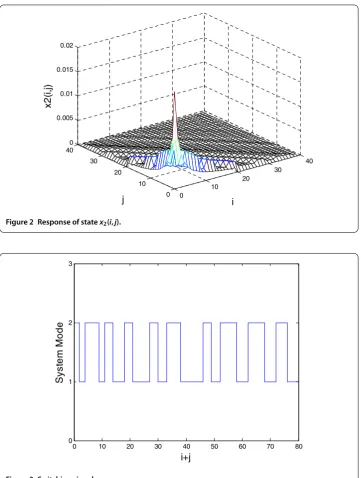
andμ= ., then we obtain from () thatτa∗= .. Choosingτa= , some simulation
results are shown in Figures -, where the boundary condition of the system is
x(i,j) =
(j+ ), ∀≤j≤,i= , x(i,j) =
(i+ ), ∀≤i≤,j= ,
Figure 2 Response of statex2(i,j).
Figure 3 Switching signal.
andw(i,j) = .exp(–.π(i+j)). It can be seen from Figures - that the system is asymptotically stable. Furthermore, when the boundary condition is zero, by computing, we get∞i=∞j=αi+jz
= . and
∞
i=
∞
j=w= ., and it satisfies
condi-tion () in Definicondi-tion . Therefore, it can be observed that the system has weightedl-gain γ = .. This demonstrates the effectiveness of the proposed approach.
5 Conclusions
This paper has investigated the problems of stability andl-gain analysis for D discrete
Then some sufficient conditions for the existence of weightedl-gain for the considered
system are derived in terms of LMIs. Finally, an example is also given to illustrate the applicability of the proposed results. Our future work will focus on extending the pro-posed results to other kinds of D discrete switched systems such as D discrete switched stochastic systems or D discrete switched nonlinear systems.
Appendix
Proof of Theorem It is assumed that the kth subsystem is active on the interval [mπ,mπ+), and thelth subsystem is active on the interval [mπ–,mπ). Now we consider
the Lyapunov function candidate for thekth subsystem
Vk
x(i,j)=Vkhx(i,j)+Vkvx(i,j), ()
where
Vkhx(i,j)=
g=
Vgkhx(i,j),
Vhk(i,j) =x(i,j)TPkhx(i,j),
Vhkx(i,j)=
i–
r=i–d(i)
x(r,j)TQkhx(r,j)αi–r–,
Vhkx(i,j)=
i–
r=i–d
x(r,j)TWhkx(r,j)αi–r–,
Vhkx(i,j)=
–d
s=–d+
i–
r=i+s
x(r,j)TQkhx(r,j)αi–r–,
Vhkx(i,j)=
s=–d+
i–
r=i+s–
η(r,j)TRkhη(r,j)αi–r–,
Vkvx(i,j)=
g=
Vgkvx(i,j),
Vvkx(i,j)=x(i,j)TPkvx(i,j),
Vvkx(i,j)=
j–
t=j–d(j)
x(i,t)TQkvx(i,t)αj–t–,
Vvkx(i,j)=
j–
t=j–d
x(i,t)TWvkx(i,t)αj–t–,
Vvkx(i,j)=
–d
s=–d+
j–
t=j+s
x(i,t)TQkvx(i,t)αj–t–,
Vvkx(i,j)=
s=–d+
j–
t=j+s–
η(r,j) =x(r+ ,j) –x(r,j),
δ(i,t) =x(i,t+ ) –x(i,t).
Then we have
Vhk(i+ ,j+ ) –αVhk(i,j+ )
=xT(i+ ,j+ )Phkx(i+ ,j+ ) –αxT(i,j+ )Pkhx(i,j+ ),
Vhk(i+ ,j+ ) –αVhk(i,j+ )
≤x(i,j+ )TQk
hx(i,j+ ) –x
i–d(i),j+ T
Qk hx
i–d(i),j+
αd
+
i–d
r=i+–d
x(r,j+ )TQkhx(r,j+ )αi–r,
Vhk(i+ ,j+ ) –αVhk(i,j+ )
=x(i,j+ )TWhkx(i,j+ ) –x(i–d,j+ )TWhkx(i–d,j+ )αd,
Vhk(i+ ,j+ ) –αVhk(i,j+ )
= (d–d)x(i,j+ )TQkhx(i,j+ ) – i–d
r=i–d+
x(r,j+ )TQkhx(r,j+ )αi–r,
Vhk(i+ ,j+ ) –αVhk(i,j+ )
≤dη(i,j+ )TRkhη(i,j+ ) – i–
r=i–d
η(r,j+ )TRkhη(r,j+ )αd,
Vvk(i+ ,j+ ) –αVvk(i+ ,j)
=xT(i+ ,j+ )Pvkx(i+ ,j+ ) –αxT(i+ ,j)Pkvx(i+ ,j),
Vvk(i+ ,j+ ) –αVvk(i+ ,j)
≤x(i+ ,j)TQkvx(i+ ,j) –xi+ ,j–d(j) T
Qkvxi+ ,j–d(j)
αd
+
j–d
t=j+–d
x(i+ ,t)TQkvx(i+ ,t)αj–t,
Vvk(i+ ,j+ ) –αVvk(i+ ,j)
=x(i+ ,j)TWvkx(i+ ,j) –x(i+ ,j–d)TWvkx(i+ ,j–d)αd,
Vvk(i+ ,j+ ) –αVvk(i+ ,j)
= (d–d)x(i+ ,j)TQkvx(i+ ,j) – j–d
t=j+–d
x(i+ ,t)TQkvx(i+ ,t)αj–t,
Vvk(i+ ,j+ ) –αVvk(i+ ,j)
≤dδ(i+ ,j)TRkvδ(i+ ,j) – j–
t=j–d
η(i,j+ ) =x(i+ ,j+ ) –x(i,j+ )
For simplicity, we denote
Vkh(i,j) =Vkhx(i,j), Vkv(i,j) =Vkvx(i,j), Vk(i,j) =Vk
Notice that the following equations hold for any matricesNk=N k
with appropriate dimensions:
= αdxT(i,j+ )Nk
> , the following equations also hold:
=dαd
+
Thus it follows from ()-() that
Thus () can be directly obtained. Moreover, by (), we can find two positive scalarsλ
andλsuch that () holds, where
λ=min
k∈N
λmin
Pkh+λmin
Pkv,
λ=max
k∈N
λmax
Pkh+λmax
Pkv+dλmax
Qkh+dλmax
Qkv+dλmax
Whk
+dλmax
Wvk+ (d–d)λmax
Qkh
+ (d–d)λmax
Qkv+dλmax
Rkh+dλmax
Rkv.
In addition, () can be deduced from (), thus by Lemma , we can conclude that D
discrete switched system () is exponentially stable.
Competing interests
The authors declare that they have no competing interests.
Authors’ contributions
SH carried out the main results of this article and drafted the manuscript. ZX directed the study and helped with the inspection. All the authors read and approved the final manuscript.
Acknowledgements
This research was supported by the National Natural Science Foundation of China under Grant Nos. 60974027 and 61273120.
Received: 3 November 2012 Accepted: 22 February 2013 Published: 14 March 2013 References
1. Du, CL, Xie, LH: Control and Filtering of Two-Dimensional Systems. Springer, Berlin (2002) 2. Kaczorek, T: Two-Dimensional Linear Systems. Springer, Berlin (1985)
3. Lu, WS: Two-Dimensional Digital Filters. Dekker, New York (1992)
4. Owens, DH, Amann, N, Rogers, E, French, M: Analysis of linear iterative learning control schemes - a 2D systems/repetitive processes approach. Multidimens. Syst. Signal Process.11(1-2), 125-177 (2000)
5. Li, XD, Ho, JKL, Chow, TWS: Iterative learning control for linear time-variant discrete systems based on 2-D system theory. IEE Proc., Control Theory Appl.152(1), 13-18 (2005)
6. Bochniak, J, Galkowski, K, Rogers, E, Mehdi, D, Kummert, O, Bachelier, A: Stabilization of discrete linear repetitive processes with switched dynamics. Multidimens. Syst. Signal Process.17(2-3), 271-295 (2006)
7. Galkowski, K, Rogers, E, Xu, S, Lam, J, Owens, DH: LMIs - a fundamental tool in analysis and controller design for discrete linear repetitive processes. IEEE Trans. Circuits Syst. I, Fundam. Theory Appl.49(6), 768-777 (2002) 8. Xu, L, Wu, LK, Wu, QH, Lin, ZP, Xiao, YG: On realization of 2D discrete systems by Fornasini-Marchesini model. Int.
J. Control. Autom. Syst.3(4), 631-639 (2005)
9. Xu, L, Wu, QH, Lin, ZP, Xiao, YG: A new constructive procedure for 2-D coprime realization in Fornasini-Marchesini model. IEEE Trans. Circuits Syst.54(9), 2061-2069 (2007)
10. Lin, ZP: Feedback stabilization of MIMOnD linear systems. IEEE Trans. Autom. Control45(12), 2419-2424 (2000) 11. Xu, L, Yamada, M, Lin, ZP, Saito, O, Anazawa, Y: Further improvements on Bose’s 2D stability test. Int. J. Control. Autom.
Syst.2(3), 319-332 (2004)
12. Lin, ZP, Lam, J, Galkowski, K, Xu, SY: A constructive approach to stabilizability and stabilization of a class ofnD systems. Multidimens. Syst. Signal Process.12(3-4), 329-343 (2001)
13. Fornasini, E, Marchesini, G: Stability analysis of 2-D systems. IEEE Trans. Circuits Syst.27(10), 1210-1217 (1980) 14. Ye, SX, Wang, WQ: Stability analysis and stabilisation for a class of 2-D nonlinear discrete systems. Int. J. Syst. Sci.42(5),
839-851 (2011)
15. Paszke, W, Lam, J, Galkowski, K, Xu, SY, Lin, ZP: Robust stability and stabilisation of 2D discrete state-delayed systems. Syst. Control Lett.51(3-4), 277-291 (2004)
16. Chen, SF: Delay-dependent stability for 2D systems with time-varying delay subject to state saturation in the Roesser model. Appl. Math. Comput.216(9), 2613-2622 (2010)
17. Feng, ZY, Xu, L, Wu, M, He, Y: Delay-dependent robust stability and stabilisation of uncertain two-dimensional discrete systems with time-varying delays. IET Control Theory Appl.4(10), 1959-1971 (2010)
18. Xu, HL, Lin, ZP, Makur, A: The existence and design of functional observers for two-dimensional systems. Syst. Control Lett.61(2), 362-368 (2012)
19. Xu, SY, Lam, J, Zhou, Y, Lin, ZP, Paszke, W: RobustH∞filtering for uncertain 2-D continuous systems. IEEE Trans. Signal Process.35(5), 1731-1738 (2005)
21. Xie, LH, Du, CL, Soh, YC, Zhang, CS:H∞and robust control of 2-D systems in FM second model. Multidimens. Syst. Signal Process.13(3), 265-287 (2002)
22. Du, CL, Xie, LH, Zhang, CS:H∞control and robust stabilization of two-dimensional systems in Roesser models. Automatica37(2), 205-211 (2001)
23. Yang, R, Xie, LH, Zhang, CS:H2and mixedH2/H∞control of two-dimensional systems in Roesser model. Automatica
42(9), 1507-1514 (2006)
24. Xu, JM, Yu, L:H∞control of 2-D discrete state delay systems. Int. J. Control. Autom. Syst.4(4), 516-523 (2006) 25. Xu, JM, Yu, L: Delay-dependentH∞control for 2-D discrete state delay systems in the second FM model.
Multidimens. Syst. Signal Process.20(4), 333-349 (2009)
26. Hespanha, JP, Morse, AS: Stability of switched systems with average dwell time. In: Proceedings of the 38th IEEE Conference on Decision and Control, pp. 2655-2660 (1999)
27. Zhai, GS, Hu, B, Yasuda, K, Michel, AN: Stability analysis of switched systems with stable and unstable subsystems: an average dwell time approach. In: Proceedings of the American Control Conference, pp. 200-204 (2000)
28. Xiang, ZR, Wang, RH: Robust stabilization of switched non-linear systems with time-varying delays under asynchronous switching. Proc. Inst. Mech. Eng., Part I, J. Syst. Control Eng.223(8), 1111-1128 (2009)
29. Xiang, ZR, Wang, RH: Robust control for uncertain switched non-linear systems with time delay under asynchronous switching. IET Control Theory Appl.3(8), 1041-1050 (2009)
30. Sun, XM, Zhao, J, David, JH: Stability andL2-gain analysis for switched delay systems: a delay-dependent method.
Automatica42(10), 1769-1774 (2006)
31. Wang, YJ, Yao, ZX, Zuo, ZQ, Zhao, HM: Delay-dependent robustH∞control for a class of switched systems with time delay. In: IEEE International Symposium on Intelligent Control, pp. 882-887 (2008)
32. Sun, YG, Wang, L, Xie, GM: Delay-dependent robust stability andH∞control for uncertain discrete-time switched systems with mode-dependent time delays. Appl. Math. Comput.187(2), 1228-1237 (2007)
33. Wang, R, Liu, M, Zhao, J: ReliableH∞control for a class of switched nonlinear systems with actuator failures. Nonlinear Anal. Hybrid Syst.1(3), 317-325 (2007)
34. Benzaouia, A, Hmamed, A, Tadeo, F: Stability conditions for discrete 2D switching systems, based on a multiple Lyapunov function. In: European Control Conference, pp. 23-26 (2009)
35. Benzaouia, A, Hmamed, A, Tadeo, F, Hajjaji, AE: Stabilisation of discrete 2D time switching systems by state feedback control. Int. J. Syst. Sci.42(3), 479-487 (2011)
36. Xiang, Z, Huang, S: Stability analysis and stabilization of discrete-time 2D switched systems. Circuits Syst. Signal Process.32(1), 401-414 (2013)
doi:10.1186/1687-1847-2013-56