Peter M. Ainsworth
London School of Economics and Political Science
All rights reserved
INFORMATION TO ALL USERS
The quality of this reproduction is dependent upon the quality of the copy submitted.
In the unlikely event that the author did not send a complete manuscript and there are missing pages, these will be noted. Also, if material had to be removed,
a note will indicate the deletion.
Dissertation Publishing
UMI U615902
Published by ProQuest LLC 2014. Copyright in the Dissertation held by the Author. Microform Edition © ProQuest LLC.
All rights reserved. This work is protected against unauthorized copying under Title 17, United States Code.
ProQuest LLC
789 East Eisenhower Parkway P.O. Box 1346
f J .
M kttU dW n i "• 1% <*0®
andEctwwwrSoieoGf
Contents
I n t r o d u c t i o n ... 8
1. E SR and O S R ... 9
2. R am sey-Sentences and E S R ... 10
3. W E SR an d S E S R ... 13
C h a p t e r 1: W e a k E p i s t e m i c S t r u c t u r a l R e a l i s m ...17
1. T he No M iracles A rg u m e n t... 19
1.1. First Interpretation o f the No Miracles A rg u m en t... 21
1.2. Second Interpretation o f the No Miracles A rg u m en t...24
1.3. Third Interpretation o f the No Miracles A rg u m en t... 25
1.4. Laudan’s Objections to the No Miracles A rg u m en t... 27
1.5. A Related Objection to the No Miracles A rg u m en t... 28
1.6. The Redundancy o f the No Miracles A rg u m en t...30
1.7. The Underdetermination Objection to I B E ... 31
1.8. Psillos’ Defence o f I B E ... 33
1.9. The “Double Standards” Defence o f I B E ...38
1.10. Section S u m m ary ...39
2. T he Pessim istic I n d u c tio n ... 40
2.1. Lewis’ Objection to the Pessimistic In d u ctio n ...42
2.2. Lange’s Objection to the Pessimistic In d u ctio n ...44
2.3. Psillos’ Response to the Pessimistic In d u ctio n...47
2.4. Kitcher’s Response to the Pessimistic In d u ctio n... 49
2.5. W orrall’s Response to the Pessimistic In d u ctio n ...52
2.6. A Novel Response to the Pessimistic In d u ctio n ...56
2.7. Section S u m m ary... 58
3. C h a p te r S u m m a r y ...58
C h a p t e r 2 : A n O b j e c t i o n to W E S R ...61
1. T he O bservational T erm /T heoretical T erm D is tin c tio n ... 61
1.3.Van Fraassen on the Observable/Unobservable D istin ctio n... 65
2. T he O ld Term /N ew T erm D is tin c tio n ... 69
2.1. Hempel and L e w is ...69
2.2. The Munich Structuralists...73
3. T he C ru d e Fact/Scientific F act D is tin c tio n ... 74
4. C h a p te r S u m m a r y ...76
C h a p t e r 3 : S t r o n g E p i s te m ic S t r u c t u r a l R e a l i s m ... 78
1. R ussell’s Sem antic A rgum ent fo r S E S R ...79
1.1.Russell’s Principle o f A cquaintance... 79
1.2. Russell’s Indirect R ea lism ... 84
1.3. Russell’s Argument for his Structuralist T h e s is ...86
1.4. Kripkean Objections to the Principle o f A cquaintance...88
1.5. A Formal Objection to the Principle o f A cquaintance...90
2. R ussell’s Epistem ic A rgum ent fo r S E S R ... 94
2.1. The Helmholtz-Weyl P rin cip le... 94
2.2. The Mirroring Relations P rin cip le ...96
3. R ussell’s Sem antic A rgum ent A dapted fo r W E S R ... 100
4. M axw ell’s Scientific A rgum ent fo r S E S R ... 103
5. Z a h a r’s A dverbialist A pproach to S E S R ...107
5.1. Zahar’s Version o f S E S R ... 107
5.2. Zahar’s Argument for S E S R ...110
6. C h a p te r S u m m a r y ... 113
C h a p t e r 4 : N e w m a n ’s O b j e c t i o n ... 114
1. T he O b je c tio n ...114
1.1. Newm an’s V e rsio n ... 114
1.2. Demopoulos and Friedman’s and Ketland’s V e rsio n s... 118
2. Replies th a t A bandon the R am sey-Sentence A p p ro ach to E S R .... 124
2.1. Redhead’s R e p ly ... 124
2.2. French and Ladyman’s R e p ly ... 126
3.2. Cruse’s R e p ly ...133
3.3. Melia and Saatsi’s R e p ly ... 141
4. Replies that Argue that Some Structures/Relations are Privileged 143 4.1. A Camapian R e p ly ... 144
4.2. Votsis’ R e p ly ... 147
4.3. The Merrill/Lewis/Psillos R e p ly ... 150
5. Chapter S u m m ary ... 155
C h a p t e r 5: O n tic S t r u c t u r a l R e a l i s m ... 156
1. Three Types of O S R ... 157
l.l .O S R l ...157
1.2. OSR2 and M etaphysics... 162
1.3. OSR2 and P h y sic s... 165
1.4. OSR2 and Rigid D esignators...167
1.5. O S R 3 ...169
2. The Incoherence O b jection ... 170
3. Arguments in Favour of O S R ... 173
3.1. The Argument from C oherence/Parsim ony...173
3.2. The Argument from Quantum P h y sic s... 174
3.3. Objections to the Premise o f the Argument from Quantum Physics . 178 3.4. Objections to the Form o f the Argument from Quantum Physics .... 181
3.5. The Argument from Space-Time T h e o rie s... 185
4. Chapter S u m m ary... 191
C o n c l u s i o n ... 192
A p p e n d i x 1: C h a k r a v a r t t y ’s S e m ir e a lis m ... 198
1. Chakravartty on Entity R e a lism ... 198
2. Chakravartty on E S R ...201
3. An Objection to Semirealism ... 202
Introduction
The first fully elaborated statement o f structural realism can be found in the work o f Russell (1912, 1927) (although Worrall [1989, 1994] argues that the doctrine can also be found in the writings o f Duhem [1906] and Poincare [1903]). Russell him self abandoned the position in the face o f Newm an’s objection (Newman, 1928). The doctrine was revived four decades later by Maxwell (1968, 1970a, 1970b), who both coined the term, “structural realism” and introduced the Ramsey-sentence approach to the doctrine, which is adopted by most contemporary structural realists.1 There was, however, another lull in the interest in structural realism throughout most o f the 1970s and 1980s. Contemporary interest in the doctrine can be traced back to Worrall (1989, 1994) who argued that it allows one to reconcile the two most powerful arguments in the scientific realism debate: the “pessimistic induction” (also known as the pessimistic metainduction) (in favour o f scientific antirealism) and the “no miracles argument” (in favour o f scientific realism). Over the last ten years or so numerous positions calling themselves “structural realism” have emerged, most notably the “ontic structural realism” first proposed by Ladyman (1998).
The first aim o f this thesis is to distinguish the different types o f structural realism that have been proposed and provide a clear statement o f each. This work is carried out, in outline, in this introduction. The question addressed in the main body o f the thesis is whether or not any o f these forms o f structural realism is tenable.
1 As we shall see, Russell’s approach to structural realism is similar to, but distinct from,
the Ramsey-sentence approach.
2 Chakravartty (1998, 2004) has put forward a position he calls “semirealism”, which he
maintains is a form o f structural realism. His position is discussed in appendix 1 (which is
best read after chapter 1), where it is argued that although semirealism has some o f the
characteristics o f structural realism it is significantly different from the versions o f
structural realism that are discussed in the main body o f this thesis. Other doctrines that are
still more distantly related to structural realism, e.g. “structural empiricism” (see, for
example, Bueno, 1999 and van Fraassen, 2006) are not discussed at all in this thesis, as
1. ESR and OSR
Structural realism comes in two main forms: epistemic structural realism (ESR) (discussed in chapters 1 to 4 o f this thesis) and ontic structural realism (OSR) (discussed in chapter 5 o f this thesis).
The ESRist upholds two main theses. On the one hand there is the “realist” thesis:
Mature scientific theories provide us with a substantial amount o f knowledge about both the observable and the unobservable world.
On the other hand there is the “structuralist” thesis, which, as a very rough
first approximation, we may state as follows:
All we know o f the unobservable world is its structure.
The OSRist upholds the same realist thesis, but a different structuralist thesis, which (again as a very rough first approximation) we may state as follows:
The world is a structure.
The ESRist’s position will be further explained in section 2 o f this introduction. Exactly what the OSRist’s position really amounts to is not further discussed until chapter 4.4
3 The qualification “mature” is important: the ESRist, like the conventional realist, does not
commit him self to realism with respect to all scientific theories. Moreover, the
“knowledge” that science is supposed to provide is taken to include claims that are not
strictly true, but only approximately true. Spelling out what maturity and approximate truth
are may not be easy (although Worrall [1989] has argued that it is straightforward to
explicate maturity: he suggests that a theory is mature if and only if it correctly predicts an
empirically confirmed result that it was not engineered to yield) but these issues will be
2. Ramsey-Sentences and ESR
From a formal point o f view, languages are built out o f two types o f term:5 logical terms and non-logical terms. In a language o f second-order logic these two groups consist o f the following:
[1] Logical terms:
(1) logical connectives Qt~?\ etc.) (ii) quantifiers (“V”, “3”)
(iii) individual and predicate variables (xi, X2,... and Xi, X2...) and possibly:
(iv) the identity predicate (“=”)
[2] Non-logical terms:
(i) a number o f names (ai, a2. ..) denoting objects and
(ii) a number o f predicates (Pi, P2. ..) denoting properties and relations.
The claim that “all we know o f the external world is its structure” might suggest that the ESRist thinks that our knowledge o f the external world is purely structural (that it consists o f only logical terms). Despite the way they sometimes talk, this is not a view that any serious ESRist has ever adopted (at least, not for very long: as we shall see, Maxwell held this position in 1965 but had abandoned it by 1968) but it is a view sometimes imputed to ESRists by their critics.
4 Both the ESRist and the OSRist presuppose a number o f other philosophically
controversial theses, e.g. the thesis that the external world is not created by our minds and
the thesis that theoretical terms are (at least putatively) referring expressions. However,
arguments for and against the realist and structuralist theses have formed the basis for most
o f the discussion o f structural realism in the literature, and will also form the basis for most
o f the discussion in this thesis.
5 Sometimes the word “term” is used by logicians as a synonym for “name”. Throughout
The Ramsey-sentence approach to ESR was first proposed by Maxwell (1968) and is adopted by most (but not all) modem ESRists. Let an observational term be a non-logical term that refers to an observable object, property or relation and a theoretical term be a non-logical term that refers to an unobservable object, property or relation. The Ramsey-sentence o f a theory is obtained from a sentence expressing the theory by first replacing the theoretical terms (names and predicates) in the sentence with new variables (using the same variable for each occurrence o f the same term, and different variables for different terms). The resulting formula is then turned into a sentence (the theory’s Ramsey-sentence) by binding the variables with the appropriate existential quantifiers (placed at the start o f the formula, so that every occurrence o f the same new variable is in the scope o f the same quantifier). Note that, in general (as long as the original sentence contains at least one theoretical predicate) constructing the Ramsey-sentence o f a theory will require a language o f second-order logic.6
Maxwell provides an example (Maxwell, 1970a, p. 186). Consider the “theory” expressed by the sentence:
Vx([Ax & Dx] —> 3yCy)
where “A ” and “D” are “theoretical” predicates such that “A x” means “x is a radium atom” and “Dx” means “x radioactively decays” and “C” is an “observational” predicate such that “Cx” means “x is a click in a suitably located Geiger counter”. Its Ramsey-sentence is:
3X3YVx([Xx & Yx] -» 3yCy)
6 Zahar (2001, p. 236) points out that we can construct an equivalent sentence using a
first-order language that contains the predicates “being a set” and “ e ”. However, we would o f
course have to leave these unRamseyfied, and it is hard to see what justification there could
be for that, unless one was prepared to take them as logical predicates, like “=”.
7 O f course this doesn’t express any real “theory” and is moreover false: if a radium atom
decays on Mars there will not be a click in a suitably located Geiger counter, because there
The ESRist (if he takes the Ramsey-sentence approach to ESR), elaborates his structuralist thesis as follows:
A theory’s Ramsey-sentence is as much as a theory reliably tells us about the world.
Depending on the basis on which they make this assertion, ESRists may argue that either, (i) the Ramsey-sentence o f a theory is the true logical form o f the theory, so believing in the theory’s Ramsey-sentence is believing the theory, or, (ii) the Ramsey-sentence o f a theory is not the true logical form o f the theory, so believing in the theory’s Ramsey-sentence is not the same as believing the theory. These different approaches are considered in more detail in due course.
Notice that, when it is elaborated this way, the ESRist’s structuralist thesis has the following corollary:
The knowledge provided by our mature scientific theories consists (in its ultimate form) o f statements constructed using only logical and observational terms.
This corollary is a claim the instrumentalist would also endorse. ESR remains distinct from instrumentalism because the instrumentalist claims that our theories provide knowledge only about the observable world, whereas the ESRist maintains that the Ramsey-sentences o f our theories provide knowledge about both the observable world and about the structure o f the unobservable world.
observational vocabulary. However, depending on how the observational term/theoretical term distinction is drawn it may be true that Ramsey- sentences can’t tell us anything substantial about the unobservable world (this issue will be discussed in chapter 4).
Given that ESR has been explicated in terms o f Ramsey-sentences, one may wonder if ESR is any more “structural” than conventional scientific realism: after all, the Ramseyfied version o f a sentence is no more closely linked to the structures that satisfy it than is the original sentence. However, although there isn’t any particularly intimate relation between structural realism and structures (in the set-theoretic sense) the term “structural” is not totally inappropriate: the ESRist maintains that theoretical predicates (and the sets that provide the extensional interpretation o f these predicates) should not be given an intensional interpretation, but should be treated purely extensionally, i.e. treated in a purely mathematical or “structural” way.
On a related issue, proponents o f the “semantic” view o f theories may object to the characterisation o f ESR given here, which takes for granted that theories are linguistic objects (an assumption that they reject). However, the syntactic view/semantic view debate is orthogonal to the issues discussed in this thesis. One can be a structural realist and advocate either the syntactic or the semantic view o f theories. Although structural realism has been explicated in terms o f the syntactic view in this thesis the substantive points that will be made about it are independent o f this view. There is some further discussion o f this issue in chapter 4.
3. WESR and SESR
access, and the external world, to which we do not (this internal/external distinction is sometimes called the phenomenal/noumenal distinction or the
O
mental/physical distinction).
It is important to separate the internal/external distinction from the observable/unobservable distinction. W ithin the indirect realist framework the observable/unobservable distinction may be roughly characterised as a distinction between those external objects, properties and relations (e.g. tables, redness9) that have a direct counterpart in internal experience and those external objects, properties and relations (e.g. quarks, strangeness) that do not. Because the phrase “direct counterpart” is so vague this characterisation does not succeed in unambiguously drawing the intended distinction, but hopefully the general idea is clear enough. Some attempts that have been made to draw this distinction more clearly are discussed in chapter 2.
The essential difference between WESR and SESR is that while the WESRist thinks that theoretical terms (i.e. terms referring to unobservable objects, properties and relations) need to be Ramseyfied (leaving Ramsey-sentences containing only logical and observational terms) the SESRist thinks that external terms (i.e. terms referring to external objects, properties and relations) need to be Ramseyfied (leaving Ramsey- sentences containing only logical and internal terms). The version o f ESR outlined in the previous section is thus WESR. The SESRist’s structuralist thesis can still be stated as:
A theory’s Ramsey-sentence is as much as a theory reliably tells us about the world.
8 SESR will not be criticised for relying on indirect realism in this thesis. This is because
indirect realism seems to me a plausible view. But it should be noted that for an advocate o f
direct realism (i.e. the view that we have direct access to the external world) SESR is a non
starter.
9 In fact, the indirect realist might say that we need to distinguish two “redness” predicates:
one that refers to the redness o f internal objects (sense-data) and another that refers to the
redness o f external (physical) objects. This issued will be discussed in more detail in
But because o f his different approach to Ramseyfication, the SESRist’s structuralist thesis has a somewhat different corollary, viz:
The knowledge provided to us by our mature scientific theories consists (in its ultimate form) o f statements constructed using only logical and internal terms.
As we shall see, the main argument for the SESRist’s structuralist thesis, which was first advanced by Russell (1912, 1927) is actually only an argument for this corollary (but the thesis does seem highly plausible, given the corollary). In fact, as Russell was writing before the Ramsey-sentence approach to ESR was developed we may take it that, for Russell at least, this “corollary” is the structuralist thesis.
In fact, although the example o f Ramseyfication that was given in the previous section is M axwell’s own and it suggests W ESR he him self was a SESRist. He makes this quite clear when he states that, “My own view ...is that all items should be considered theoretical [meaning that terms referring to them should be Ramseyfied] unless they occur in direct experience; since I reject any form o f direct realism, this means that the observable [meaning the things referred to by terms that do not need to be Ramseyfied] is instantiated only in inner events o f observers” (Maxwell,
1970a, p. 181).
On the face o f it, however, Ramseyfying all terms except those that refer to items o f internal experience will result in the Ramsey-sentences o f most (if not all) theories being purely formal, and thus entirely devoid o f empirical content, because, on the face o f it, most (if not all) theories do not deal with items o f internal experience at all. Take for example the toy theory given above. Clicks in suitably placed Geiger counters are not items o f internal experience, so (taking the SESRist line) the predicates referring to them should also be Ramseyfied away, leading to the following Ramsey- sentence for the theory:
which is purely formal, and therefore has no empirical content.
The proponent o f SESR can avoid this unwelcome conclusion by arguing that although most theories, in themselves, are not directly about internal experience they are nonetheless connected to internal experience by auxiliary theories, which are always implicitly held. For example, we implicitly hold that we will have an experience o f a sense-data Geiger counter click only if, (i) there is a (real) Geiger counter click, (ii) we are hallucinating Geiger counter clicks, (iii) we are dreaming about Geiger counter clicks, (iv) somebody is playing a practical joke,...A longside the theory:
Vx([Ax & Dx] -> 3yCy)
we would thus also hold:
3x(C ’x & Eax) —> (3y[Cy] v H a...)
where a is a constant referring to oneself, “C ’x” means “x is a sense-data Geiger counter click”, “Exy” means “x experiences y”, “Cx” means the same as before and “Hx” means “x is hallucinating Geiger counter clicks”. The combined theory we hold is thus expressed by the sentence:
Vx([Ax & Dx] -> 3yCy) & (3x[C ’x & Eax] -> [3y(Cy) v H a...])
Taking the SESRist approach to Ramseyfication one obtains something like the following Ramsey-sentence o f the combined theory:
3 W 3X 3Y 3Z ...Vx([Wx & Xx] -> 3yY y)& (3x[C’x & Eax] -> [3yYy v Z a...])
Chapter 1
Weak Epistemic Structural Realism
As explained in the introduction to this thesis, the difference between WESR and SESR is that while the WESRist thinks that theoretical terms (i.e. terms referring to unobservable objects, properties and relations) need to be Ramseyfied (leaving Ramsey-sentences containing only logical and observational terms) the SESRist thinks that external terms (i.e. terms referring to external objects, properties and relations) need to be Ramseyfied (leaving Ramsey-sentences containing only logical and internal terms).
Given a reasonably charitable reading, Worrall (1989, 1994) appears to be espousing a form o f WESR. However, comments like the following (where Worrall discusses the shift from Fresnel’s theory o f light to M axwell’s):
There was an important element o f continuity in the shift from Fresnel to Maxwell - and this was much more than a simple question o f carrying over the successful empirical
content...the continuity is one o f fo rm or structure not o f content. (Worrall, 1989, p. 157, original emphasis)
have led Psillos (1999, chapter 7) to attribute to him a view very different from WESR, the view that the only element o f continuity across scientific revolutions (and thus the only aspect o f theories about which we should be realists) are uninterpreted equations, which are somehow supposed to carry with them empirical content. Such a view would be absurd because (as Psillos goes on to point out) carrying over empirical content requires, o f course, much more than just carrying over uninterpreted equations (clearly, an uninterpreted equation has no empirical content: the different theories describing the behaviour o f pendulums, o f masses on springs and o f voltages in circuits with a condenser and a solenoid all use the equation
9 9
The view ascribed to Worrall here is that the equations are preserved along with the interpretations o f some o f the terms in the equations. Specifically, the terms that are interpreted as denoting observable objects, properties and relations keep the same interpretations. This view is not only more reasonable but also appears to be better supported by W orrall’s case study.1 For example, consider one o f the equations (relating the intensities o f incident, reflected and refracted beams o f light when light passes from one medium to another) that is preserved in the Fresnel/Maxwell episode:
R/I = tan(i-r)/tan(i+r)
While the interpretations o f I and R vary between Fresnel and Maxwell (being taken as amplitudes o f vibration o f a [postulated] mechanical ether and a [postulated] non-mechanical electromagnetic field respectively) the interpretations o f i and r (as the angles made by the incident and refracted light beams with the normal to the boundary between the media) are the same in both theories. To retain empirical adequacy Maxwell had to retain not only the structure o f Fresnel’s equations but also the interpretation o f the observational terms.
It is also clearly not enough ju st to retain the equations that link I and R to i and r. Maxwell also needed to retain the equations that link I and
9 9
R to observed light intensities, i.e. I = Ii and R = Ir (where Ii and Ir are the intensities o f light, polarised in the plane o f incidence, o f the incident and reflected beams respectively) and the interpretations o f the “observational” terms (Ii and Ir) in these equations. Maxwell was only free to reinterpret the theoretical terms (I and R). So the case suggests that there is continuity (not just o f the equations but also) o f the interpretations o f some o f the terms in the equations (the observationally interpreted terms) across scientific revolutions.
1 In fact, Worrall has confirmed (in a personal communication) that this is the view he
W orrall’s argument for W ESR is based on the claim that it can reconcile the two most powerful arguments in the scientific realism debate: the “no miracles argument” (in favour o f scientific realism) and the “pessimistic induction” (also known as the pessimistic metainduction) (in favour o f scientific antirealism). In section 1 o f this chapter the no miracles argument is discussed: it is argued that whilst W ESR could accommodate (a form of) this argument, the argument is flawed, so this is no particular virtue o f WESR. In section 2 the pessimistic induction is discussed: it is argued that while (a form of) this argument does have some force the W ESR isf s response to the argument is not particular convincing (no more convincing, in fact, than the conventional realist’s response). It is therefore concluded that W orrall’s argument for WESR is not compelling.
1. The No Miracles Argument
The no miracles argument has been called the “ultimate” argument for realism (Putnam, 1979, p. 73). The argument runs roughly as follows: some scientific theories enjoy enormous empirical success; if these theories are not even approximately true, this appears to be miraculous; on the other hand the approximate truth o f such theories would explain their success; as we don’t want to accept miracles, we should thus accept that such theories are approximately true (at least, in the absence o f another explanation o f their success).
The structural realist’s realist thesis was stated in the introduction to this thesis as follows:
2 Although Worrall never puts it this way, we can think o f him as using the no miracles
argument to support the structural realist’s realist thesis and the pessimistic induction to
support the WESRist’s structuralist thesis.
3 Note that the argument relies on the notion o f approximate truth. It would obviously be
too strong if it were phrased in terms o f absolute truth. After all, Newton’s theory o f
gravitation was astonishingly successful and so is general relativity, but since the theories
are contradictory they can’t both be absolutely true (whereas it seems possible that they
Mature scientific theories provide us with a substantial amount o f knowledge about both the observable and the unobservable world.
If (following Worrall) we define mature scientific theories as those that are successful then this thesis is supported by the no miracles argument, assuming that the totality o f the theories that (according to the no miracles argument) we can take to be approximately true can be said to provide us with a substantial amount o f knowledge about both the observable and the unobservable world.
However, it may be wondered whether or not this rendering o f the no miracles argument is compatible with the ESRist’s structuralist thesis. The ESRist’s structuralist thesis is that a theory’s Ramsey-sentence is as much as a theory reliably tells us about the world, i.e. that a theory’s
Ramsey-sentence is all that we can take to be approximately true, whereas the upshot o f the no miracles argument is that the theory is itself approximately true. As noted in the introduction to this thesis, the ESRist may think that the Ramsey-sentence o f a theory is the true logical form o f the theory, or that it is something quite distinct from the theory. In the former case he can accept the no miracles argument in this form (since the Ramsey-sentence o f the theory is taken to be the true logical form o f the theory to say that a theory’s Ramsey-sentence is approximately true is to say that the theory is approximately true). However, if the ESRist holds that the Ramsey-sentence o f the theory is something quite distinct from the theory then the no miracles argument in this form is not compatible with his structuralist thesis.
In either case, however, the ESRist could endorse the following variant o f the no miracles argument: some scientific theories (e.g. general relativity) appear to enjoy enormous empirical success; if the Ramsey-sentences o f these theories are not even approximately true this appears to be miraculous; on the other hand if the Ramsey-sentences o f these theories were approximately true then this would explain their success; as we don’t want to accept miracles, we should thus accept that the Ramsey-sentences o f
definitely compatible with the ESRist’s structuralist thesis, whilst it still seems to support his realist thesis: the thesis that mature scientific theories provide us with a substantial amount o f knowledge about both the observable and the unobservable world. Although Worrall does not explicitly put forward this version o f the no miracles argument, it seems to be the only version o f the argument that unambiguously supports the WESRist position, and, since he does take the no miracles argument to support this position, it seems reasonable to attribute this version o f the argument to him.4
1.1. First Interpretation o f the No Miracles Argument
Magnus and Callender (2004), following Howson (2000), suggest the following reconstruction o f the no miracles argument:
Premise 1: x is probably a successful theory.
Premise 2: If x is an approximately true theory then it would probably be a successful theory.
Premise 3: If x is not an approximately true theory then it would be a miracle if x is a successful theory.
Conclusion: If x is a successful theory then x is probably an approximately true theory.
Let Ax mean that x is an approximately true theory. Let Sx mean that x is a successful theory. Let P(X) be the probability o f X and P(X|Y) be the probability o f X conditional on Y. Then the argument runs as follows:
Premise 1: P(Sx) ~ 1
4 This version o f the no miracles argument has been put forward explicitly by Cruse and
Papineau: “The Ramsey sentence realist says that we should believe in the approximate
truth o f a successful theory’s Ramsey sentence, on the grounds that it would be a miracle
that the theory were successful, were its Ramsey sentence not true” (Cruse and Papineau,
Premise 2: P(Sx|Ax) ~ 1 Premise 3: P(Sx|~Ax) ~ 0
Conclusion: P(Ax|Sx) ~ 1
This argument is valid. First note that P(Ax) ~ 1:
P(Sx) = P(Sx|Ax).P(Ax) + P(SxhA x).P(-A x) So, P(Sx) = P(Sx|Ax).P(Ax) + P(SxhA x).(l-P[A x])
So, P(Ax) = (P[Sx] - P[SxhA x]) / (P[Sx|Ax] - P[Sx|"Ax]) So, P(Ax) ~ 1 (using premises 1-3)
Bayes’ theorem states that:
P(Ax|Sx) = (P[Ax].P[Sx|Ax]) / P(Sx)
So, P(Ax|Sx) ~ 1 (using the result just obtained and premises 1 and 2)
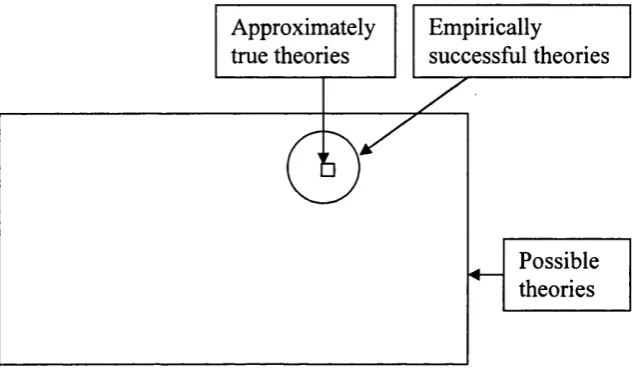
So the argument is valid. However, as Magnus and Callender (2004) point out, it is not sound. Their objection to the argument is (in essence) that premises 1 and 3 will only both seem plausible if one equivocates over the reference class. Suppose that the reference class is the set o f all possible theories. Then premise 1 is surely false, because it is surely not the case that a theory selected at random from the set o f all possible theories will probably be successful. (Without premise 1 the argument is not valid. A counterexample is illustrated in figure la .5) So suppose instead the reference
5 Indeed, even if we were to retain a weakened version o f premise 1, to the effect that it
would not be a miracle for a given theory to be successful, then the argument would still not
be valid. The argument would then run as follows:
Premise 1: P(Sx) > m
Premise 2: P(Sx|Ax) « 1
Premise 3: P(Sx|~Ax) < m
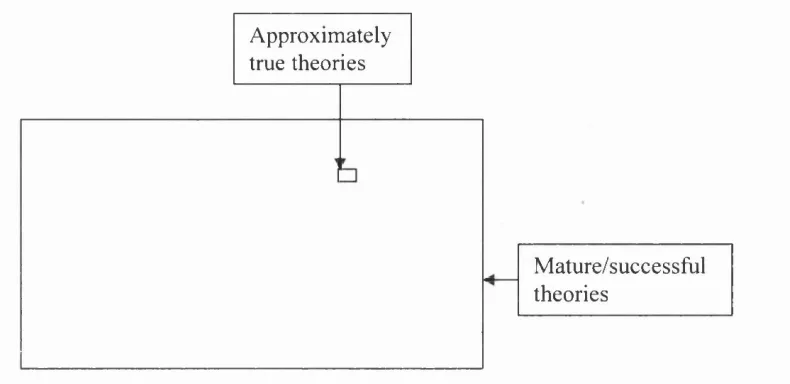
class is the set o f mature theories. If, following Worrall (1989), we define a theory to be mature if and only if it is successful, then premise 1 is certainly true, in fact P(Sx) = 1. But now premise 3 is false, because P(Sx|_iAx) = 1, because all theories in the reference class are successful, irrespective o f whether or not they are approximately true. (W ithout premise 3 the argument is not valid. A counterexample is illustrated in figure lb.)
Empirically successful theories Approximately
true theories
Possible theories
Figure la: This illustrates a situation in which, (i) If x is an approximately true theory then it is probably a successful theory: P(Sx|Ax) » 1 (in fact, P[Sx|Ax] = 1), (ii) If x is not an approximately true theory then it would be a miracle if x is a successful theory: P(Sx|^Ax) ~ 0, but, (iii) It is not the case that if x is a successful theory then x is probably an approximately true
theory: P(Ax|Sx) is n o t« 1.
(where m is some small probability such that the occurrence o f an event is miraculous if
and only if the probability o f the event is less than m). This is not valid. If we take m to be
0.0010005 then a counterexample is provided when one in a million theories is
approximately true, 1001 in a million theories are successful and all approximately true
theories are successful. In that case, (i) P(Sx) = 0.0010010 (so P[Sx] > m), (ii) P(Sx|Ax) = 1
(so P[Sx|Ax] w 1), (iii) P(Sx|~Ax) = 0.0010000 (so P[Sx|-A x] < m), but, (iv) P(Ax|Sx) =
0.0009990 (so P[Ax|Sx] is not « 1). Indeed, in this counterexample not only is a successful
theory probably not approximately true, it would be a miracle if a successful theory turned
[image:24.595.46.368.229.418.2]Approximately true theories
Mature/successful theories
Figure lb: This illustrates a situation in which, (i) x is probably a successful theory: P(Sx) » 1 (in fact P[Sx] = 1), (ii) If x is an approximately true theory
then it is probably a successful theory: P(Sx|Ax) w 1 (in fact, P[Sx|Ax] = 1), but, (iii) It is not the case that if x is a successful theory then x is probably an approximately true theory: P(Ax|Sx) is not » 1.
1.2. Second In terp retatio n of the No M iracles A rgum ent
Another attempt to reconstruct the no miracles argument probabilistically might run as follows:
Premise 1: If x is an approximately true theory then it would not be a miracle if x is a successful theory.
Premise 2: If x is not an approximately true theory then it would be a miracle if x is a successful theory.
Conclusion: If x is a successful theory then x is relatively likely to be an approximately true theory (i.e. a theory from the set o f successful theories is more likely to be approximately true than a theory from the set o f all theories).
[image:25.595.55.450.72.264.2]Premise 1: P(Sx|A x)» 0 Premise 2: P(Sx|~Ax) ~ 0
Conclusion: P(Ax|Sx) > P(Ax)
This argument is valid and also (plausibly) sound. Bayes’ theorem states:
P(Ax|Sx) = P(Ax).P(Sx|Ax) / P(Sx)
So, P(Ax|Sx) > P(Ax) if and only if P(Sx|Ax) / P(Sx) > 1 So, P(Ax|Sx) > P(Ax) if and only if P(Sx|Ax) > P(Sx)
So, P(Ax|Sx) > P(Ax) if and only if P(Sx|Ax) > P(Sx|Ax).P(Ax) + P (SxhA x).P(-A x)
So, P(Ax|Sx) > P(Ax) if and only if P(Sx|Ax) > P(Sx|Ax).P(Ax) + P (S xbA x).(l - P[Ax])
The second inequality follows from P(Sx|Ax) > P(Sx|~Ax) (provided P[Ax] ^ 1), which follows from premises 1 and 2 o f the argument. So it follows from the premises o f the argument that P(Ax|Sx) > P(Ax) (i.e. the argument is valid).
The problem with this attempt to reconstruct the no miracles argument is that the conclusion o f the argument is not the conclusion the realist wants. What the scientific realist wants is that it is likely that a successful theory is approximately true, i.e. that P(Ax|Sx) > 0.5 (i.e. what he wants is not the result that a theory from the set o f successful theories is more likely to be approximately true than a theory from the set o f all theories but the result that a theory from the set o f successful theories is actually likely to be approximately true). But, even if the premises o f the argument are true, P(Ax|Sx) can be made arbitrarily small by making P(Ax) small enough. This is apparent from figure la. Hence, although this argument may show that success makes approximate truth relatively likely it requires an additional argument to show that success makes approximate truth likely, which, so far, the realist has failed to supply.
The third interpretation o f the no miracles argument, which is the most commonly proposed, is that the argument is an instance o f the argument form known as “inference to the best explanation” (IBE). IBE is (allegedly) a form o f inference that is often used in science. If we have a theory that explains some phenomenon better than any other theory (that we know of) then scientists (allegedly) infer from this that the theory is (approximately) true. So instances o f IBE take the following form (in the following p is a description o f an established phenomenon and T is a statement o f a theory):
Premise 1: p
Premise 2: T is the best explanation o f p
Conclusion (via IBE): T is approximately true
We might call this a “ground level” IBE. When the no miracles argument is construed as an instance o f IBE, it is a kind o f “meta level” IBE: the phenomenon in question is taken to be the success o f some scientific theory, T, and the theory that (allegedly) offers the best explanation o f this fact is the theory that T is approximately true. I.e. the no miracles argument runs as follows:
Premise 1: T has been successful
Premise 2: The theory that T is approximately true is the best explanation o f the fact that T has been successful
Conclusion (via IBE): The theory that T is approximately true is approximately true
approximately true, so they must think that the approximate truth o f the approximate truth o f T is the same as the approximate truth o f T. But this is not obvious: it seems possible that it could be approximately true that T is approximately true even if T is radically false. However, let’s leave this point aside, since there are less linguistically frustrating difficulties with this interpretation o f the no miracles argument, which are discussed in subsections 1.4-1.6.
1.4. Laudan’s Objections to the No Miracles Argument
Laudan’s (1981) main objection to the no miracles argument is based on the pessimistic induction. Roughly speaking, he argues that there have been many successful theories in the history o f science that (we now believe) are not even approximately true and that we should infer from this that it is not a miracle for a radically false theory to be successful. Hence the no miracles argument is undermined. The pessimistic induction will be examined in more detail in section 2.
Another objection Laudan brings against the no miracles argument is that approximate truth could not in any case be invoked to explain success because there is no real reason to think that the fact that a theory is approximately true implies that the theory will be successful.6 Laudan objects that proponents o f the no miracles argument have not provided an account o f approximate truth, so the claim that approximate truth implies success is open to question. He insists that the realist needs, “more than a promissory note that somehow, someday, someone will show that approximately true theories must be successful theories” (Laudan, 1981, p.
1125).
Laudan is certainly right that the connection between the approximate truth o f a theory and its success has not been rigorously demonstrated. Indeed, Worrall freely admits (1989, p. 106) that his use o f
6 Laudan accepts, o f course, that a true theory would be successful. He balks only at the
realist’s assumption that an approximately true theory would also, probably, be successful
the no miracles argument is based on the intuition that there is a connection between the two. However, although this might throw some doubt on the legitimacy o f the no miracles argument, it does not completely undermine it, because it does seem intuitively reasonable to suppose there is a connection between the approximate truth o f a theory and its success.
1.5. A Related Objection to the No Miracles Argument
Notwithstanding what has been said in subsection 1.4, it seems that the (second) premise o f the IBE interpretation o f the no miracles argument, which states that, “the theory that T is approximately true is the best explanation o f the fact that T has been successful” is false. It seems that even if we put Laudan’s worries aside and accept that approximate truth would imply success, approximate truth (or even complete truth) would not in any case explain success.
Suppose we ask o f a given theory, “Why is it so successful?” and we are told that it is because, “It is approximately true” (or something like this). We should not be satisfied with this answer. We think that the success o f the theory requires an explanation (presumably) because success is not a characteristic that we would generally expect a theory to display, i.e. because we believe that o f all the possible theories that we might have devised, not many would have been successful. The answer given is explanatory only if success is a characteristic we would generally expect an approximately true theory to display, i.e. we believe that all (or at least most) o f the approximately true theories that we might have devised would have been successful. But this implies that, o f all the possible theories that we might have devised, not many are approximately true. So approximate truth is not a characteristic we would generally expect a theory to display. As it is not as if we had to choose from a list o f possible theories, knowing in advance which ones were approximately true, the reply to our question seems only to raise another question, “Why is the theory that we devised approximately true?”. Approximate truth can’t appropriately explain
truth: approximate truth is no more a characteristic that we would expect a theory to display than is success.
The problem is highlighted by making a no miracles style argument in a more commonplace setting. Suppose I am watching the national lottery, and the first five balls that are drawn match five o f the numbers on my ticket. It would be a miracle if this ju st happened by chance. On the other hand it would be no miracle (in fact, it would be bound to happen) if I had a winning ticket (i.e. a ticket on which all six numbers match). As we don’t want to accept miracles we should thus accept that I have a winning ticket (at least, in the absence o f another explanation o f why the first five numbers match). In this context it is (I hope) obvious that the proposed explanation is inadequate, because the hypothesis that I have a winning ticket is obviously in need o f an explanation at least as much as the fact it is invoked to explain. Likewise, the approximate truth o f a theory is at least as much in need o f an explanation as its success. (Peter Lipton suggested this comparison at a conference.)
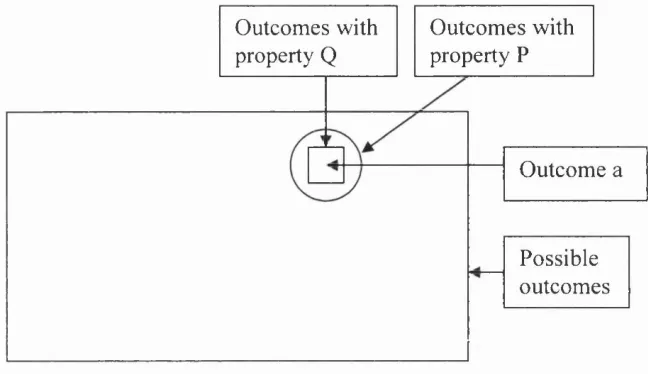
The situation is illustrated in more general terms in figure 2. Suppose we have some outcome, a, with a surprising property, P (surprising in the sense that most outcomes do not have the property). If we ask “Why does a have property P?” and we are told that it is because, “It has property Q” we are being fobbed off, unless we can explain why a has property Q in a non-circular manner (e.g. by pointing out that we selected a from the class o f outcomes with this property).
Outcomes with property P Outcomes with
property Q
Outcome a
Possible outcomes
Figure 2: The large rectangle represents the space o f possible outcomes (e.g. theories). The circle represents outcomes with property P (e.g. the property o f being empirically successful). The square represents outcomes with property Q (e.g. being approximately true).
1.6. The R edundancy of the No M iracles A rgum ent
Instances of IBE are not, of course, deductively valid: the (seemingly) best explanation o f some fact may not turn out to be the true explanation o f that fact (if indeed there is an explanation of it at all). In fact, antirealists often claim that inferences o f this form have no legitimacy at all (in particular, the antirealist denies that the inference to unobservables is legitimate, despite the fact they might offer the best explanation o f an observable phenomenon). Consequently, as Fine (1984, pp. 1187-1189) has pointed out, if the no miracles argument is construed as an instance o f IBE it appears to be monumentally question begging: it will never convince the antirealist since he doesn’t accept that the form of inference it exemplifies is in general legitimate. It is simply preaching to the converted or, at best, the agnostic.7
7 Zahar claim s that “F in e’s argument is predicated on a con ten tiou s assum ption, nam ely that
scien tific realism d eserves its name: SR [i.e. scien tific realism ] is taken to be an em pirical hypothesis w h ose factual basis con sists o f the su ccesses o f various scien tific theories.”
(Zahar, 2 0 0 1 , p. 58, original em phasis). Zahar g o es on to argue that scien tific realism is not
an em pirical hypothesis but is rather a m etaphysical h yp oth esis and then con clu d es that
[image:31.595.61.385.76.263.2]Moreover, if someone does accept that IBE is legitimate, the no miracles argument is completely redundant, since he will accept the simpler ground level IBE that can be less problematically used to reach the desired conclusion that our best scientific theories are approximately true.
So the debate really comes down to this: should we accept that IBE is a legitimate form o f inference? If yes, then we can use a ground level IBE to infer that our best theories are approximately true. (And if, contrary to what has been suggested, the premises o f the no miracles argument are true then we could also use the no miracles argument to reach this conclusion, but it would be unnecessary to do so.) If no, then we can use neither the ground level IBE, nor the meta level IBE o f the no miracles argument, and the realist must look elsewhere for an argument to support his position. Let us turn then to consider the arguments for and against the legitimacy o f IBE.
1.7. The Underdetermination Objection to IBE
Why does the antirealist (claim to) reject IBE? One reason is suggested by the argument known as the underdetermination o f theory by evidence. We invariably base our theories, and test them against, a finite amount of evidence. But any finite amount o f evidence could be accommodated by infinitely many theories. The antirealist argues that although some o f these theories may be better than others for pragmatic or aesthetic reasons, there is no reason to think that any one o f them is more likely to be true than any other. Hence an inference to the best explanation is not very likely to be an inference to a true explanation.
One might take issue with the claim that any finite amount o f evidence could be accommodated by infinitely many theories. Or claim that, even if this is so, all the infinitely many theories that accommodate a
substantial amount evidence are likely to be approximately true, so we can,
However, Fine claims only that the antirealist doesn’t generally accept the form o f
inference that the no miracles argument exemplifies and this claim in no way rests on the
assumption that scientific realism is an empirical hypothesis, so Zahar seems to be way o ff
with reasonable safety, infer the approximate truth o f any o f them. However, these are not good responses to the underdetermination argument, as is evident if we consider the argument in its “curve-fitting” form. In this form the argument goes as follows. Given any finite number o f data points (no matter how large) we can draw infinitely many curves that pass through all o f them. Hence any finite amount o f evidence can be accommodated by infinitely many theories. Moreover, the evidence does not even force on us a curve that approximates the true curve (i.e. the curve that represents the actual relation between the variables represented on the axes) to any reasonable degree: although infinitely many curves will be rather similar to the true curve (in some sense that could be made precise, e.g. - assuming the graph has two axes - in the sense that the area between the curve and the true curve is small or in the sense that for every value o f the x co-ordinate both curves have a similar value o f the y co-ordinate) infinitely many will be radically different to the true curve (in the same sense) (if we choose a curve somewhere in the “middle” the maximum possible inaccuracy is minimised, in an intuitive sense, but it still has no finite bound, according to either o f the measures suggested above). Hence any finite amount o f evidence can be accommodated by infinitely many theories that are not even approximately true.
O f course, realists have replied to this argument, often arguing that we have more than just empirical evidence to help us determine the true curve. E.g. it has been argued that we (somehow) know that nature is simple, relative to our way o f viewing it, so the simplest curve is most likely to be the true one. But, as noted, the antirealist will say that although there maybe pragmatic and aesthetic reasons to prefer the simplest curve there are no good epistemic reasons: the assumption that nature is simple, relative to our way o f viewing it might be pragmatically and aesthetically justified, but it is not epistemically justified.
same empirical success that any given successful theory enjoys and although infinitely many o f these will be approximately true, infinitely many will be radically false. So, unless we are prepared to swallow the view that we know that nature is simple, relative to our way o f viewing it, it would not be miraculous if our theory were one o f the radically false ones.
1.8. Psillos’ Defence of IBE
Psillos (1994, chapter 4) appears to deploy two quite separate arguments in defence o f IBE. Firstly, he argues that IBE can be justified. His argument for this runs as follows:
the best explanation o f the instrumental reliability o f scientific methodology is that background theories are relevantly approximately true. These background scientific theories have themselves been typically arrived at by abductive reasoning. Hence it is reasonable to believe that abductive reasoning is reliable: it tends to generate approximately true theories. (Psillos, 1999, p. 80)
As Psillos is aware, this argument is circular: IBE is used to infer the conclusion that IBE is reliable. In fact there are two uses o f IBE in the argument. The first instance is a generalised form o f the no miracles argument (generalised in so far as it discusses scientific theories in general, rather than one particular theory):
Premise 1: Scientific theories are successful.
8 It has been suggested to me that the realist can reply here that the radically false successful
theories are unlikely to remain successful in the future. It is true that infinitely many o f
these radically false theories will cease to be successful in the future (as long as there is at
least some evidence collected in the future). However, as there will only be a finite amount
o f evidence collected up to any given time in the future there will always be infinitely many
Premise 2: The theory that scientific theories are approximately true is the best explanation o f the fact that scientific theories are successful.
Conclusion (via IBE): The theory that scientific theories are approximately true is approximately true.
The (abbreviated) conclusion o f the generalised no miracles argument is then used as a premise in a second instance o f IBE:
Premise 1: Scientific theories are approximately true.
Premise 2: The theory that scientific theories are arrived at via a reliable rule o f inference is the best explanation o f the fact that scientific theories are approximately true.
Conclusion (via IBE): The theory that scientific theories are arrived at via a reliable rule o f inference is approximately true.
As scientific theories are (allegedly) arrived at via IBE, this implies that it is (approximately) true that IBE is a reliable rule o f inference: which is (approximately) the conclusion that Psillos desires.
Psillos argues that although circular this justification o f IBE is not viciously circular. He distinguishes between “premise-circular” arguments, where the conclusion o f the argument is among the premises o f the argument and “rule-circular” arguments, where the conclusion o f the argument is that the form o f inference deployed in the argument is legitimate. Perhaps an example will help to clarify the difference. The following is a premise-circular justification o f modus ponens:
Premise: Modus ponens is legitimate.
Conclusion: Modus ponens is legitimate.
Premise 1: If the absolute is perfect then modus ponens is legitimate. Premise 2: The absolute is perfect
Conclusion (via modus ponens): Modus ponens is legitimate.
This is rule-circular because the conclusion o f the argument is that modus ponens is legitimate and modus ponens is used to obtain the conclusion from the premises.
The foregoing justification o f IBE is rule-circular, since IBE is used to reach the conclusion (that IBE is reliable) from the premises but it is not premise-circular (since no premise in the argument states that IBE is reliable) and Psillos claims that rule-circular arguments (unlike premise- circular arguments) are not viciously circular.
However, it is hard to see why rule-circular arguments should be thought o f as any less vicious than premise-circular arguments, particularly as rules o f inferences can often be converted into premises, and vice versa. For example, in some systems o f first-order logic there is a rule o f “universal generalisation” : if, in a deduction, one has obtained the formula a
then (with some restrcitions) one may also infer V x a from the premises o f the deduction (cf. Suppes, 1957, p. 99). On the other hand, in other systems there is no such rule, rather all the formulas o f the form a -» V x a (with some restrictions) are taken as premises that may be used at any time in any deduction, and one has the rule o f modus ponens, allowing one to achieve the same results (cf. Enderton, 2001, p. 112).
justification exists). He draws a parallel here to justifications o f deductive rules o f inference. In fact he claims that, “The situation is totally analogous to the defence o f deductive reasoning. There is no way in which one can persuade a deductively blind person o f the soundness or rationality o f deductive arguments” (Psillos, 1999, p. 88, original emphasis).
There are two points to note here. Firstly, Psillos appears to be conceding that his argument will not convince the antirealist: as Lipton (2001, p. 349) notes, to deem a form o f inference basic is tantamount to conceding that a sceptic with regard to that form o f inference cannot be answered. Secondly, as Lipton also notes, Psillos’ analogy between justifying IBE and justifying deductive inferences is not exactly apposite, because one is very hard pressed to find a deductive sceptic, whereas antirealists who profess to be sceptics with regard to IBE are relatively common. As Lipton puts it, “it does not appear that our inductive practices, as the realist construes them, are in fact basic for all o f us” (Lipton, 2001, p. 349). In a sense then, it is more problematic to deem IBE basic than it is to deem various forms o f deductive inference basic, simply because there are apparently more IBE sceptics than deductive sceptics. (O f course that does not mean that IBE isn’t basic: it just means that if we deem it basic there are lots o f people whom, we have to concede, we cannot convert.)
Psillos’ second defence o f IBE is to suggest that it needs no justification. He claims that the correct attitude towards rules o f inference is not “guilty until proven innocent” but rather “innocent until proven guilty” (cf. Psillos, 2001b, p. 368) so that even if IBE cannot be justified and is no more basic than any other rule o f inference it is nonetheless legitimate to use it:
This seems to suggest that no rule o f inference is more basic than another; that all rules o f inference are bom equal. However, a blanket innocent until proven guilty policy is unworkable. Suppose we start with the assumption that both induction and counter-induction (cf. Salmon, 1966, pp. 12-17) are innocent. There are then two ways in which we can proceed: either we can prove counter-induction guilty using an inductive argument:
Premise: Counter-induction has been unreliable in the past
Conclusion (via induction): Counter-induction will be unreliable in the future
or we can prove induction guilty using a counter-inductive argument:
Premise: Induction has been reliable in the past
Conclusion (via counter-induction): Induction will be unreliable in the future
If we proceed by the latter route we will be left believing that counter induction, but not induction, is a reliable form o f inference (and, in the absence o f induction, it seems there will be no possible way in which counter-induction could ever be found guilty). But surely we don’t want to be left believing this. Yet, without pre-judging the case, there seems to be nothing to choose between these two routes. So it seems that we must pre judge the case, i.e. we must hold a selective policy, whereby some mles are
guilty until proven innocent and others innocent until proven guilty (so, after all, we must take some mles o f inference as more basic than others).9 In that case, however, it remains open as to whether or not IBE is one o f the former or the latter, so Psillos can’t well argue from the premise that there is no
9 We can’t hold all rules to be guilty until proven innocent because if one did so one would
reason to doubt IBE to the conclusion that IBE is legitimate, because the antirealist may believe that IBE is guilty until proven innocent. It seems then that Psillos’ second argument in favour o f IBE will also not convince the antirealist that IBE is legitimate.
1.9. The “Double Standards” Defence o f IBE
Inferring any universal law - even a simple empirical generalisation - from a finite number o f observations, requires an application o f IBE. For example, we infer from a finite number o f observations o f green emeralds that all emeralds are green. But that is not the only hypothesis that would explain the observations. Another such hypothesis is that all emeralds are grue, or that all emeralds are gred, etc.10 We infer that all emeralds are green because that seems to us the best o f these hypotheses (for some reason that is, admittedly, obscure). Or, to take a less contrived example (discussed by Poincare [1903] and Worrall [forthcoming]), we infer from a finite number o f observations o f the positions o f the planets that that the planets orbit the Sun in (approximate) ellipses. But the finite observations o f the planets could also be explained by a number o f hypotheses suggesting that the planets orbit the Sun in much more devious ways, and ju st happen to lie on (approximate) ellipses whenever we make an observation.
Even antirealists (at least in the scientific realism debate) are not usually sceptics with regard to inferences to simple empirical generalizations like these. Hence, despite what they might claim, antirealists are not total sceptics with regard to IBE. But (so the “double standards” defence o f IBE goes) unless they can say why some instances o f IBE (inferences to simple empirical generalizations) are legitimate whereas others are not there seems to be no justification for being a selective IBE sceptic, and antirealists seem to have an unacceptable double standard. In
inference) because a proof o f innocence must require at least one rule o f inference to go
through.
10 Where an object is grue if and only if it is green upto a particular future time, t, and blue
after t and an object is gred if and only if it is green upto t and red after t (cf. Goodman,
the absence o f a justification for this selective scepticism the antirealist ought either to become a thoroughgoing IBE sceptic, and therefore an inductive sceptic, or accept IBE in other cases. If he takes the former route his position is unassailable. But no one really would take that route. So he must take the latter route. But if he accepts IBE is legitimate in general, then he will accept at least the ground level IBE discussed above (if not the no miracles argument itself), which already suggests that our best scientific theories are approximately true.
Van Fraassen (1989) has a response to this “double standards” argument. To understand his response we must distinguish two conceptions o f rationality. According to one, “what is rational to believe is exactly what one is rationally compelled to believe” (van Fraassen, 1989, p. 170) whereas according to the other (which van Fraassen favours), “what is rational to believe includes anything that one is not rationally compelled to disbelieve” (van Fraassen, 1989, pp. 170-171).
For van Fraassen IBE is better seen as a tool o f inference than as a
rule o f inference. He accepts that it is rational to use IBE to form beliefs (as long as these beliefs are logically consistent) but he does not accept that it is irrational to refrain from using IBE in some or (presumably) all cases. So he thinks it is perfectly rational for the antirealist to use IBE to arrive at beliefs about simple empirical regularities, but to refrain from using IBE to arrive at beliefs involving unobservables. He presumably also thinks that it is perfectly rational for the realist to use it in both cases (as long as the beliefs he forms are logically consistent) and for the inductive sceptic to use it in neither. For van Fraassen rationality perm its us to use IBE (within certain bounds) but it never obliges us to use it.
The antirealist’s so-called double standard only seems irrational if one thinks o f IBE as a rule o f inference, whose dictates must be obeyed (on pain o f irrationality). If it is rather a tool o f inference that we are free to use it as liberally or parsimoniously as we please then the antirealist’s double standard is not irrational.