THE DEVELOPMENT OF THE KEY PERFORMANCE INDICATORS FOR SCHOOL
CLASSROOM FACILITIES
Nurul Syakima Mohd Yusoff
1*, Maimunah Sapri
2, Ibrahim Sipan
3and Masitah Muhibudin
41Department of Real Estate, Faculty of Geoinformation and Real Estate
2, 3, 4 Centre for Real Estate Studies, Institute for Smart Infrastructure and Innovative Construction Universiti Teknologi Malaysia, 81310 UTM Skudai Johor, Malalysia
*Email: [email protected]
Abstract
The performance of facilities in the school environment has an impact on student learning performance. Towards improving the facilities performance, the identification of the relevant indicators for school facilities is necessary. This paper presents the initial study of identifying the Key Performance Indicators (KPIs) for the school classroom facilities. It begins with the identification of the key performance indicators (KPIs) for classroom facilities based on general indicators gathered from the literature review. Apart of discussion on questionnaire development, it discusses the results of the survey. Respondents’ backgrounds, the descriptive analysis results regarding the students’ opinions of classroom facilities, and the KPI ranking for classroom facilities are among the main focus of the analysis. These KPIs could be used as a guide to improve the FM performance in schools. An improvement in FM performance will, in turn, enhance the performance of the facilities provided.
Keywords: facilities, school classroom, key performance indicators, student performance
1.0 INTRODUCTION
The Malaysian Government has established the National Asset & Facility Management (NAFAM) program and issued a manual of building guidelines and rules for planning in 2008 given that the number of government assets and facilities are increasing from time to time. The manual includes guidelines for school buildings and lists the facilities to be provided in schools. According to the “Building Guidelines and Specifications” (2008) by the Economic Planning Unit of Malaysia, there are five types of facilities provided in government schools in Malaysia. The types of facilities provided are administration spaces, academic spaces, support facilities, laboratories, and optional spaces.
Facilities provided at government schools should now follow the formulated guidelines. Nonetheless, the guideline has less emphasis on the measurement of facilities performance. The performance of facilities should be measured in order to identify the condition and to improve its
effectiveness and efficiency. Thus, to measure facilities performance, the identification of the Key Performance Indicators (KPIs) is needed.
This paper aims to enhance the provision of school classroom facilities as an approach to improve students’ performance. There are many facilities provided in schools to support learning activities, but this paper only focusing on the classroom perspectives. Therefore, the following objectives have been formulated, which are to discuss the importance of facilities performance measurement for the classroom, to identify the key performance indicators (KPIs) for the classroom facilities and to rank the key performance indicators for classroom facilities
2.0 THE ROLES OF PERFORMANCE MEASUREMENT IN FM
the efficiency by which resources are transformed into goods and services, the quality of those outputs and outcomes and the effectiveness of organizational operations in terms of their specific contributions to organisational objectives (Amaratunga & Baldry, 2002). In other words, the performance measurement can be defined as a process of quantifying the efficiency and effectiveness of an action.
The application of performance measurement can provide major benefits to organisations. Besides that, it is necessary to assess the performance for decision-making management (Amaratunga and Baldry (2002). Furthermore, Neely (1999), outlined the reasons why performance measurement continues to be of interest to management researchers and practitioners:
i. The changing nature of work ii. Increasing competition
iii. Specific improvement initiatives iv. National and international awards v. Changing organisational roles vi. Changing external demands
vii. The power of information technology.
In addition, the performance measurement systems should provide timely, accurate feedback on the efficiency and effectiveness of operations to influence management decisions and employee behaviours (Kaplan, 1991; Kuoet al., 1999). Moreover, in order to ensure that the quality and productivity is continuously improved, performance measures can be implemented at three different levels (Neely et al., 1995):
i. Individual performance measures. ii. The set of performance measures,
namely, the performance measurement system as an entity.
iii. The relationship between the performance measurement system and the environment within which it operates.
The performance measurement is correlated with the quality of FM functions (Amaratunga & Baldry, 2002). Moreover, in the FM context, performance measurement is a systematic process to assess the facilities provided in order to maintain the facilities and ensure their effective and efficient use. Besides that, the
facilities performance is a common term used to identify the conditions of facilities provided in any aspect, whether overall poor, fair or excellent performance. Moreover, the facilities performance should be measured in order to recognise the condition of the facilities and to improve its effectiveness and efficiency.
2.1 School Facilities Performance
Usually, a classroom consists of several basic facilities such as; furniture (table, chairs, and bookshelf), lighting, ventilation and teaching aided facilities (blackboard/whiteboard, notice board, etc). Nonetheless, there are others elements to be considered in the classroom like size, space layout, colour; temperature; noise; decoration; adequacy, efficiency and economy; and safety, health and comfort. The provision of these facilities in relation to students’ performance will be discussed further.
i. Size
The optimal size of a classroom depends on the size of the student body (Castaldi, 1982). Stockard and Mayberry (1992) found that student achievement in sometimes better in smaller classes than in larger classes. Therefore, the effect of class size on achievement is curvilinear. Howley (1995) stated that no matter the size distribution, the smaller schools in the distribution enhance achievement. In addition, smaller classrooms often had more friendly environments, climates that were more conducive to learning, individualised instruction, more interested students and less apathy, friction and frustration (Stockard & Mayberry, 1992).
ii. Lighting
performance (Morris, 2003; Phillips, 1997). Ott (1976) stated that students in standard lighting were observed fidgeting, leaping from their seats, flailing their arms, and paying little attention to their teachers, while students in full-spectrum lit classrooms settled down more quickly and paid more attention to their teachers. Hence, lighting should be adequate for students to learn well, and many studies have reported findings on the optimal lighting levels (Mayron et al., 1974).
Colour and lighting complement each other. The colour element in the classroom facility refers to the use of colour schemes and classifications in the building (Tanner & Lackney, 2006). The influences on interior colouring in academic performance have been investigated by several researchers and have been shown to have an effect an achievement (Tanner & Lackney, 2006; Castaldi, 1982).
iii. Decoration
Decoration plays a critical role in ensuring a comfortable environment (Leung & Fung, 2005; Castaldi, 1982). Appropriate decoration will attract students’ attention to learning activities. The learning environment can be improved by providing age-appropriate furniture, adjustable lighting, colourful carpets, live plants, pictures and a bulletin board (Leung & Fung, 2005).
iv. Temperature
The most important individual building element found to affect student achievement was temperature control (Leung & Fung, 2005; Mendell & Heath, 2005; Kincaid, 2003; Morris, 2003; Earthman, 2002; Lyons, 2001; Lackney, 1999; Castaldi, 1982). Temperature influences thermal comfort, which subsequently affects health, working performance and social behaviour (Castaldi, 1982). Lackney (2000) postulated that thermal conditions below optimum levels affect dexterity, while higher than optimal temperatures decrease general alertness and increase physiological stress.
v. Ventilation
Good ventilation in a classroom is very important as it influences student performance (Leung &
Fung, 2005; Earthman, 2002; Lyons, 2001; Lackney, 1999; Castaldi, 1982). Good ventilation can provide quality indoor air and improve working productivity. The indoor environments in schools have been of particular public concern (Mendell & Heath, 2005). Research on indoor air quality has found symptoms of sick building syndrome such as irritated eyes, noses and throats, respiratory infections, nausea, dizziness, headaches and fatigue or sleepiness (EPA, 2003). According to Morris (2003), another significant health risk related to poor ventilation is the presence of mould spores in the atmosphere and on surfaces which can cause a variety of health problems such as minor allergic reactions, exacerbation of asthma, and even brain damage. Kennedy (2001) stated that children breathe a greater volume of air in proportion to their body weight than adults. Thus, schools need good ventilation because schools have much less floor space per person than found in most office buildings (Crawford, 1998).
vi. Noise
vii. Space Layout
Space management refers to workspace planning such as classroom layout. Facility managers, therefore, need to arrange classroom furniture in ways that maximise mobility and minimise physical barriers in order to ensure proximity between teachers and students (Leung & Fung, 2005; Lackney, 1999; Castaldi, 1982).
viii. Adequacy, Efficiency and Economy
Castaldi (1982) stated that adequacy, efficiency and economy should be taken into consideration in planning school facilities. The relevant elements include the size, shape, function and type of space, environmental control, atmosphere, maintenance and operation, storage and design (Castaldi, 1982).
ix. Safety, Health and Comfort
Energy is important for heating, ventilating, artificial lighting and cooling, which are essential for health and comfort (Castaldi, 1982). Safety hazards may be present in schools due to building design, site planning, selection of floor materials and the locations of obstacles such as fire extinguishers, water fountains, electrical floor stubs and protruding pipes (Castaldi, 1982). Although safety cannot always be completely assured, every effort must be made to achieve as high a safety level as possible to ensure the facilities are in good condition. Furthermore, human comfort is conducive to effectual learning. Therefore, comfortable lighting, humidity and temperature, seating, colours, ventilation and acoustical environment are important to improve facilities performance and learning outcomes (Castaldi, 1982; Lackney, 1999).
3.0 METHODOLOGY
As a quantitative study, hence, a questionnaire survey was conducted to identify the KPIs for classroom facilities. The survey data were analysed using frequency and descriptive analysis.
3.1 Questionnaire Development
The questionnaire survey was divided into two parts. The first part of the questionnaire focused on the respondents' backgrounds such as their gender, ethnicity, age and location of their school. The second part of the questionnaire focused on the students' opinions of the classroom facilities that influence their performance in school. Then, students have to rank the KPI for school classroom facilities. Most of the KPI-related studies identified in the literature review used the Likert scale technique to gather the data from respondents.
The students were asked their opinions about the classroom facilities provided in their schools. Based on the literature review, 43 indicators of classroom facilities were grouped into 10 KPIs, namely, classroom design, furniture, noise, decoration, other building features, support facilities, lighting, temperature, ventilation, and security and safety facilities.
3.2 Sampling
As an initial study, the questionnaire was distributed to 200 respondents who were students in four secondary schools in Johor. The main selection of four secondary schools is based on their area and location which is as an intervening factor in influencing the student performance. Therefore, from four schools, two of them were from rural areas and another two from urban areas. The others selection criteria are their accessibility and school ranking. It is important in order to certify the validity of data. This relatively small number of respondents was selected for the questionnaire because the purpose of the questionnaire was to explore the topic with the students and to obtain the students’ opinions with a view to identifying the KPIs for school classroom facilities based on the general indicators taken from the literature review.
4.0 FINDINGS
4.1 Key Performance Indicators for School Classroom Facilities
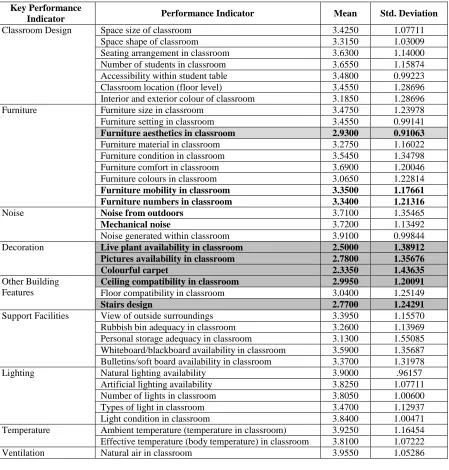
There were 43 indicators which were grouped into 10 KPIs; classroom design, furniture, noise, decoration, other building features, support facilities, lighting, temperature, ventilation, and security and safety facilities. These indicators were analyzed by descriptive analysis. The mean scores indicated that most of the indicators received more than 3.0. It means that the indicators which received the mean scores of 3.0
and above are important and should be taken into consideration when evaluating the classroom facility performance. The following six indicators received mean scores of less than 3.0: furniture aesthetics in the classroom, the availability of live plants in the classroom, the availability of pictures in the classroom, colorful carpet, ceiling compatibility in the classroom and the design of stairs (as highlighted in the Table 1). These six indicators are considered as unimportant and should be dropped from further analysis.
Table 1: Performance indicators for school classroom facilities Key Performance
Indicator Performance Indicator Mean Std. Deviation
Classroom Design Space size of classroom 3.4250 1.07711
Space shape of classroom 3.3150 1.03009
Seating arrangement in classroom 3.6300 1.14000
Number of students in classroom 3.6550 1.15874
Accessibility within student table 3.4800 0.99223 Classroom location (floor level) 3.4550 1.28696 Interior and exterior colour of classroom 3.1850 1.28696
Furniture Furniture size in classroom 3.4750 1.23978
Furniture setting in classroom 3.4550 0.99141
Furniture aesthetics in classroom 2.9300 0.91063 Furniture material in classroom 3.2750 1.16022 Furniture condition in classroom 3.5450 1.34798
Furniture comfort in classroom 3.6900 1.20046
Furniture colours in classroom 3.0650 1.22814
Furniture mobility in classroom 3.3500 1.17661 Furniture numbers in classroom 3.3400 1.21316
Noise Noise from outdoors 3.7100 1.35465
Mechanical noise 3.7200 1.13492
Noise generated within classroom 3.9100 0.99844 Decoration Live plant availability in classroom 2.5000 1.38912 Pictures availability in classroom 2.7800 1.35676
Colourful carpet 2.3350 1.43635
Other Building Features
Ceiling compatibility in classroom 2.9950 1.20091 Floor compatibility in classroom 3.0400 1.25149
Stairs design 2.7700 1.24291
Support Facilities View of outside surroundings 3.3950 1.15570 Rubbish bin adequacy in classroom 3.2600 1.13969 Personal storage adequacy in classroom 3.1300 1.55085 Whiteboard/blackboard availability in classroom 3.5900 1.35687 Bulletins/soft board availability in classroom 3.3700 1.31978
Lighting Natural lighting availability 3.9000 .96157
Artificial lighting availability 3.8250 1.07711
Number of lights in classroom 3.8050 1.00600
Types of light in classroom 3.4700 1.12937
Light condition in classroom 3.8400 1.00471
Temperature Ambient temperature (temperature in classroom) 3.9250 1.16454 Effective temperature (body temperature) in classroom 3.8100 1.07222
Support air facilities in classroom 4.0900 1.12616
Outdoor air quality 3.8200 1.15511
Security & Safety Facilities
Health safety adequacy in classroom 3.0650 1.50068 Fire hazard adequacy in classroom 3.4400 1.37691 Security system availability for classroom 3.2700 1.43436
4.2 KPI Ranking for School Classroom
Facilities
Table 2 presents the results of the KPI ranking for school classroom facilities performance evaluation. The ranking results showed that the most influential KPI was ventilation which received an average mean score of 3.96. This was followed by temperature (3.87), noise (3.78), lighting (3.77), classroom design (3.45), furniture (3.40), support facilities (3.35), security and safety facilities (3.26) and other building features (3.04).
Table 2: KPI ranking for school classroom facilities
Key Performance Indicator Average Mean Scores
1 Ventilation 3.96
2 Temperature 3.87
3 Noise 3.78
4 Lighting 3.77
5 Classroom Design 3.45
6 Furniture 3.40
7 Support Facilities 3.35 8 Security & Safety Facilities 3.26 9 Other Building Features 3.04
5.0 DISCUSSION
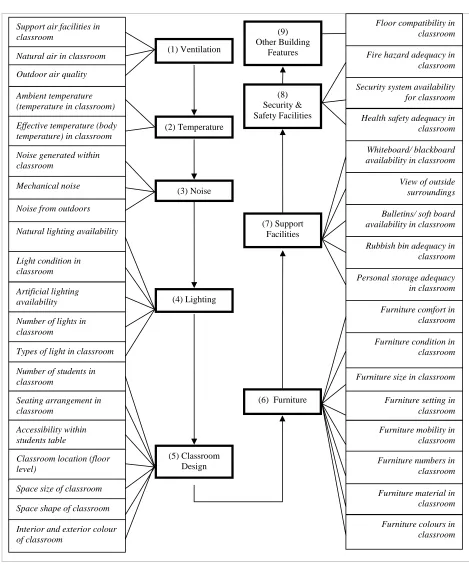
As stated before, 43 indicators in ten KPI groups were gathered from the literature. However, the analysis showed that six indicators should be excluded from further analysis because the mean scores were less than 3.0. The first ranked KPI for school classroom facilities performance was ventilation, followed by temperature, noise, lighting, classroom design, furniture, support facilities, security and safety facilities, other building features, and decoration. However, the decoration KPI was excluded in entirety because all of the indicators in that KPI group received mean scores of less than 3.0. The new list of KPIs
for classroom facilities performance is summarized in Figure 1. The KPIs and their indicators are listed based on their ranking.
6.0 CONCLUSION
To achieve a good quality of students’ performance, the classroom facilities in school should be fit for their purpose and perform well. Therefore, the performance of classroom facilities should be measured to determine the facilities’ effectiveness. In reference to the context of the study, it can be concluded that the role of performance measurement is to guide decisions on maintaining and designing the new installation or refurbishment of classroom facilities in order to provide an effective environment for the students which in turn can have a positive effect on their performance in school. Therefore, performance measurement is needed to evaluate the performance of classroom facilities. Through performance measurement, the problems of classroom facilities can be identified and improvements can be made.
Since the elements of size, density, location, noise, temperature and air quality have an impact on facilities performance and on students’ performance in school, therefore, it requires an efficient monitoring system to evaluate the functionality and performance of the facilities. As such, this study has been conducted. The KPIs were identified by analysing the questionnaire data using descriptive analysis. The questionnaire obtained students’ opinions about their classroom facilities. The importance of the KPI indicators was measured and the KPIs were ranked.
Figure 1: New list of KPIs for classroom facilities performance
(1) Ventilation
(2) Temperature
(3) Noise
(4) Lighting
(5) Classroom Design
(6) Furniture (8) Security & Safety Facilities
(7) Support Facilities
Support air facilities in classroom
Natural air in classroom
Outdoor air quality
Ambient temperature (temperature in classroom)
Effective temperature (body temperature) in classroom
Noise generated within classroom
Mechanical noise
Noise from outdoors
Natural lighting availability
Light condition in classroom
Artificial lighting availability
Number of lights in classroom
Types of light in classroom
Number of students in classroom
Seating arrangement in classroom
Accessibility within students table
Classroom location (floor level)
Space size of classroom
Space shape of classroom
Interior and exterior colour of classroom
Furniture colours in classroom Furniture material in
classroom Furniture numbers in
classroom Furniture mobility in classroom Furniture setting in
classroom Furniture size in classroom Furniture condition in
classroom Furniture comfort in
classroom Personal storage adequacy
in classroom Rubbish bin adequacy in
classroom Bulletins/ soft board availability in classroom
View of outside surroundings Whiteboard/ blackboard availability in classroom Health safety adequacy in
classroom Security system availability
for classroom Fire hazard adequacy in classroom
(9) Other Building
Features
REFERENCES
Amaratunga, D., and Baldry, D. (2002).Moving from performance measurement to performance management. Facilities, 20(5), 217.
Amaratunga, D. and Baldry, D. (2002). Performance measurement in facilities management and its relationships with management theory and motivation.
Facilities, 20(10), 327–336.
Castaldi, B. (1982). Educational Facilities: Planning, Modernization, and Management
(2nd ed.). Boston: Allyn & Bacon.
Crawford, G. N. (1998). Going Straight to the Source. American School & University,
70(6): 26–28.
Cronbach, L. J., and Shavelson, R. J. (2004). My Current Thoughts on Coefficient Alpha and Successor Procedures. Educational and
Psychological Measurement, 64(3), 391–
418.
Earthman, 2002; Earthman, G. I. (2002). School Facility Conditions and Student Academic
Achievement.UC Los Angeles: UCLA’s
Institute for Democracy, Education, and Access.
EPA, (Environmental Protection Agency). (2003).
Indoor air quality and student performance
(No. EPA 402-K-03-006). Washington, D.C.: Environmental Protection Agency. Gliem, J. A., and Gliem, R. R. (2003).
Calculating, interpreting, and reporting Cronbach’s Alpha Reliability Coefficient for Likert-Type Scales. In Midwest Research to Practice Conference in Adult, Continuing, and Community Education. 8-10 October 2003. The Ohio State University, Columbus, OH, Vol. 88, 1-7.
Howley, C. (1995). The Matthew Principle: A West Virginia Replication? Education
Policy Analysis Archives, 3(18), n18.
Kaplan, R. S. (1991). New Systems for Measurement and Control. The Engineering
Economist, 36(3), 201–218.
Kennedy, M. (2001). Into Thin Air. American
School & University, 73(6), p32.
Kincaid, D. (2003). A Starting-Point for Measuring Physical Performance. Facilities,
12(3), 24–7.
Kuo, C. H., Dunn, K. D., and Randhawa, S. U. (1999). A Case Study Assessment of Performance Measurement in Distribution Centers. Industrial Management and Data
Systems, 99(1), 54–63.
Lackney, J. A. (2000). Thirty-Three Educational Design Principles for Schools & Community
Learning Centers. ERIC Clearinghouse.
Lemasters, L. K. (1997). A Synthesis of Studies
Pertaining To Facilities, Student
Achievement, and Student Behavior.Virginia
Polytechnic Institute and State University. Leung, M., and Fung, I. (2005). Enhancement of
Classroom Facilities of Primary Schools and Its Impact on Learning Behaviors of Students. Facilities, 23(13/14), 585–94. Low, S. P., Liu, J. Y., and Oh, K. H. (2008).
Influence of Total Building Performance, Spatial and Acoustic Concepts on Build Ability Scores of Facilities. Facilities,
26(1/2), 85–104.
Low, S. P., Liu, J., and Lim, J. (2008).Implications of Thermal and Building Integrity Performance on Build Ability of a Worker Dormitories Project.
Structural Survey, 26(2), 142.
Lyons, J. B. (2001). Do School Facilities Really Impact a Child’s Education. CEFPI Brief.
Issue Trak, 1–6.
Mayron, L. W., Ott, J., Nations, R., and Mayron, E. L. (1974). Light, Radiation and Academic Behavior: Initial Studies on the Effects of Full-Spectrum Lighting and Radiation Shielding on Behavior and Academic Performance of School Children.
Intervention in School and Clinic. Published
by Hammill Institute and Sage Publications. Mendell, M. J., and Heath, G. A. (2005). Do Indoor Pollutants and Thermal Conditions in Schools Influence Student Performance? A Critical Review of the Literature. Indoor Air,
15(1), 27–52.
among Teachers. University of Georgia, Athens.
Neely, A. (1999). The Performance Measurement Revolution: Why Now and What Next?
International Journal of Operations and
Production Management, 19, 205–228.
Ott, J. N. (1976). Influence of Fluorescent Lights on Hyperactivity and Learning Disabilities.
Journal of Learning Disabilities, 9(7), 417–
422.
Phillips, R. W. (1997). Educational Facility Age and the Academic Achievement and Attendance of Upper Elementary School
Students. University of Georgia.
Schneider, M. (2002). Do School Facilities Affect
Academic Outcomes? ERIC Publications.
Stockard, J., and Mayberry, M. (1992). Effective
Educational Environments. Corwin Press.
Tanner, C. K., and Lackney, Jeffery A. (2006).
Educational Facilities Planning:
Leadership, Architecture, and Management.
Pearson Allyn and Bacon.
Uline, C., and Tschannen-Moran, M. (2008). The Walls Speak: The Interplay of Quality Facilities, School Climate, and Student Achievement. Journal of Educational
Administration, 46(1), 55–73.
Unit Perancangan Ekonomi (Economic Planning Unit) (2008). Garis Panduandan Peraturan Bagi Perancangan Bangunan. Jabatan Perdana Menteri.
Yang, Y., and Green, S. B. (2011). Coefficient Alpha: A Reliability Coefficient for the 21st Century? Journal of Psycho Educational