ABSTRACT
NAVORAPHAN, KANYAMAS. Argument Generation for a Biomedical Domain. (Under the direction of Nancy L. Green and James C. Lester.)
Discourse generation is a critical task of natural language generation. In this thesis, we
introduce an approach to discourse generation for qualitative causal probabilistic domains
that incorporates argumentation into the generation process. The discourse generation
process uses three modules: a qualitative causal probabilistic domain model, a genre-specific
discourse grammar, and a normative argument generator. The model of discourse generation
has been implemented for the domain of clinical genetics. In conjunction with GenIE, a
prototype intelligent system for generating the first draft of a patient letter on behalf of a
genetic counselor, the discourse grammar exploits general information about clinical genetics
as well as documentation about a specific patient's case provided by a genetic counselor, to
create discourse plans. The argument generator generates arguments for the claims passed to
it from the discourse grammar using domain-independent argument strategies. An important
contribution of the thesis is a modification of the argument generator to support interactive
Argument Generation for a Biomedical Domain
by
Kanyamas Navoraphan
A thesis submitted to the Graduate Faculty of North Carolina State University
In partial fulfillment of the Requirements for the degree of
Master of Science
Computer Science
Raleigh, North Carolina
2008
APPROVED BY:
___________________________ ___________________________
Dr. Robert D. Rodman Dr. R. Michael Young
___________________________ ___________________________
DEDICATION
To life, and what remains of it
Carpe diem: Seize the day
-BIOGRAPHY
Kanyamas Navoraphan was born in Bangkok, Thailand, in 1976. She received her Bachelor
of Arts degree in English from Chulalongkorn University, Bangkok, Thailand in 1996. She
then obtained a second Bachelor of Science degree in Computer Science from University of
Hawaii at Manoa in Honolulu, Hawaii in 2000. After working as a Software Engineer with
Synopsys Inc., Mountain View, California for five years, from July 2000 to August 2005, she
joined the graduate program at the Computer Science Department in North Carolina State
University in the fall of 2005. Her dream is to combine the knowledge in both the language
and the computer science fields in the area of natural language processing, specifically
ACKNOWLEDGEMENTS
I would like to express my sincere gratitude to the following people without whose help and
support I could not have achieved what I have.
My advisor, Dr. Nancy L. Green, for her continued guidance and support, and especially for
spending endless hours perfecting my thesis.
My co-advisor, Dr. James C. Lester, for introducing me to Dr. Green, and for his help in
reviewing the final draft of my thesis.
The members of my committee, Dr. Robert D. Rodman and Dr. R. Michael Young for their
academic support.
My project partner, Rachael Dwight, for insightful discussions throughout the course of the
project.
My friend, Valuncha Paterson, for her help in formatting my thesis, and for giving me the
much-needed encouragement throughout the course of my thesis writing.
My friend, Jeremy Paterson, for his help in reviewing my thesis.
My friend, Emilie Wang, for her help in providing me valuable feedbacks during my thesis
defense preparation.
My parents, for providing me the greatest gift of education, for their unconditional love and
understanding, and for being there for me, always.
The rest of my family and friends, for their love and support, without whom I would not be
who I am today.
This material is based upon work supported by the National Science Foundation under
TABLE OF CONTENTS
LIST OF TABLES ... vii
LIST OF FIGURES ... viii
INTRODUCTION ...1
1.1. Genetics Background ...2
1.2. Related Work ...3
1.3. Thesis Organization ...6
DOMAIN MODEL ...7
2.1. Qualitative Probabilistic Network ...7
2.2. Implementation ...8
2.3. Qualitative Relations... 14
OVERVIEW OF KNOWLEDGE BASES ... 18
3.1. Cystic Fibrosis ... 18
3.2. Achondroplasia ... 22
3.3. Familial Hypercholesterolemia ... 26
3.4. Phenylketonuria ... 28
DISCOURSE GRAMMAR ... 31
4.1. Overview ... 32
4.2. Discourse Plan ... 34
ARGUMENT GENERATION ... 39
5.1. Elements of Arguments ... 39
5.3. Complex Argument Generation ... 49
5.4. Implementation ... 51
INTERACTIVE DRIVER ... 57
6.1. Finite State Machine ... 58
6.2. User Interface ... 62
6.3. Implementation ... 65
6.4. Example Dialogues ... 68
CONCLUSION ... 80
7.1. Summary ... 80
7.2. Future Work ... 81
REFERENCES... 82
APPENDIX ... 85
LIST OF TABLES
Table 2-1: A full set of node types and their descriptions [Green, 2005]. ...9
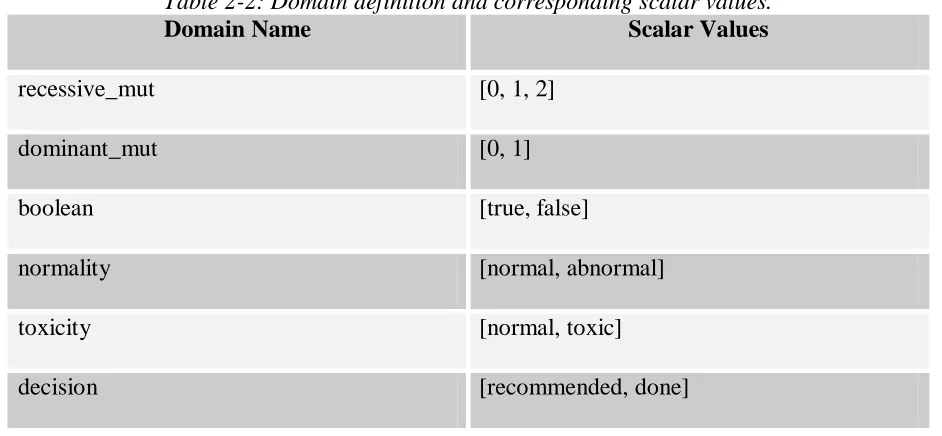
Table 2-2: Domain definition and corresponding scalar values. ... 10
Table 4-1: List of nucleus-satellite RST relations used in the Discourse Grammar. ... 33
Table 4-2: List of multinuclear RST relations used in the Discourse Grammar. ... 34
Table 5-1: The six elements of argument in Toulmin’s argument structure [Toulmin, 2003]. ... 39
Table 6-1: List of possible choices and corresponding actions in Argument Generation state. ... 60
Table A-1: Non generic events in the Cystic Fibrosis KB. ... 97
Table A-2: Generic events in the Cystic Fibrosis KB. ... 99
Table A-3: Non-generic events in the Achondroplasia KB. ... 100
Table A-4: Generic events in the Achondroplasia KB. ... 102
Table A-5: Non-generic events in the Familial Hypercholesterolemia KB. ... 103
Table A-6: Generic events in the Familial Hypercholesterolemia KB. ... 105
Table A-7: Non-generic events in the Phenylketonuria KB.... 105
LIST OF FIGURES
Figure 2-1: Examples of S+andS– relations. ... 14
Figure 2-2: Example of a Y+relation. ... 15
Figure 2-3: Example of a Y–relation. ... 16
Figure 3-1: The pretest state of the Cystic Fibrosis KB. ... 19
Figure 3-2: The posttest state of the Cystic Fibrosis KB. ... 20
Figure 3-3: The future state of the Cystic Fibrosis KB. ... 21
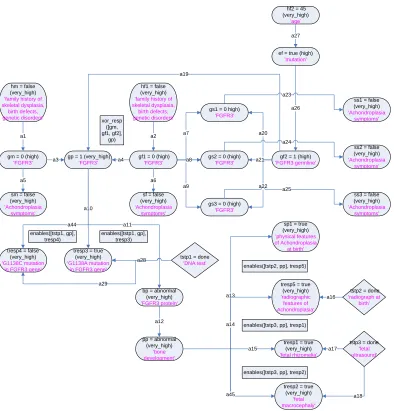
Figure 3-4: The pretest state of the Achondroplasia KB. ... 23
Figure 3-5: The posttest state of the Achondroplasia KB. ... 24
Figure 3-6: The future state of the Achondroplasia KB. ... 25
Figure 3-7: The pretest state of the Familial Hypercholesterolemia KB. ... 26
Figure 3-8: The posttest state of the Familial Hypercholesterolemia KB. ... 27
Figure 3-9: The posttest state of the Phenylketonuria (PKU) KB. ... 28
Figure 3-10: The future state of the Phenylketonuria (PKU) KB. ... 29
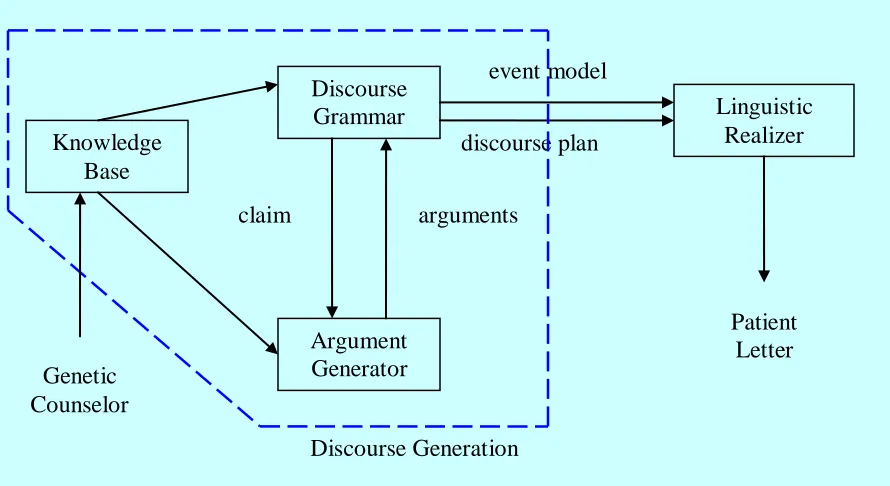
Figure 4-1: The discourse generation process. ... 31
Figure 4-2: A rough organization of the dplan. ... 35
Figure 5-1: The RST representation of an argument [Green, 2007]. ... 40
Figure 5-2: The applicability constraint of the E2C argument scheme. ... 41
Figure 5-3: Constraints of a variant of the E2C argument scheme. ... 42
Figure 5-4: Another variant of the E2C argument scheme. ... 43
Figure 5-5: The three applicability constraints of the NE2C argument scheme. ... 44
Figure 5-7: The E2XORC argument scheme. ... 47
Figure 5-8: A sample scenario illustrating a variant of the ELIM argument scheme. ... 48
Figure 5-9: An example of a complex argument generation. ... 50
Figure 5-10: The data exchange between the discourse generator and the argument generator.... 51
Figure 5-11: An RST tree before and after pruning. ... 56
Figure 6-1:FSM representing the interactive argument generator’s architecture. ... 58
Figure 6-2: Detailed FSM during the Argument Generation state.... 61
Figure 6-3: Example user interaction during KB, KB state, and node selections. ... 62
Figure 6-4: Argument Listing Format. ... 63
Figure 6-5: An example of user interaction during warrant selection. ... 63
Figure 6-6: Sample Test KB. ... 68
Figure A-1: Section 1 of the Cystic Fibrosis dplan. ... 87
Figure A-2: Section 2 of the Cystic Fibrosis dplan. ... 88
Figure A-3: Section 3 of the Cystic Fibrosis dplan. ... 89
Figure A-4: Section 4 of the Cystic Fibrosis dplan. ... 900
Figure A-5: Section 1 of the Achondroplasia dplan. ... 91
Figure A-6: Section 2 of the Achondroplasia dplan. ... 92
Figure A-7: Section 3 of the Achondroplasia dplan. ... 93
Figure A-8: Section 1 of the Familial Hypercholesterolemia dplan. ... 94
Figure A-9: Section 2 of the Familial Hypercholesterolemia dplan. ... 95
CHAPTER 1
INTRODUCTION
The goal of this research is to develop GenIE, a prototype intelligent system for generating
the first draft of a patient letter on behalf of a genetic counselor, using general information on
clinical genetics as well as specific documentation about the patient‟s case provided by the
genetic counselor. The work done for this thesis focuses on the reimplementation of the
GenIE prototype first described in [Green, 2006], using a new discourse grammar that
generates discourse plans employing Rhetorical Structure Theory (RST) relations [Mann and
Thompson, 1988] as specified in [Green, 2007]. The work also includes an implementation
of domain models for four new genetic diseases partly based on case studies in [Korf, 2000]
and [Nussbaum, McInnes, and Willard, 2001], and implementation of an interactive
argumentation driver.
Like many other natural language generation (NLG) systems [Reiter and Dale, 2000], GenIE
uses a nonlinguistic domain model. Generation is performed in two stages: discourse generation, and then linguistic realization. The scope of this thesis covers the domain model
The domain model is a causal probabilistic knowledge base, designed specifically to store information related to clinical genetics. Discourse generation is divided into two separate parts, namely the discourse grammar, and argument generation. The output from discourse generation is in the format to be used as input to the linguistic realizer at a later time.
Because the work on linguistic realization is incomplete at this point, as part of the work done on this thesis, we have also implemented an interactive driver for the argument
generator that can be used to partially validate the intermediate outputs as far as argument
generation is concerned. The last part of this thesis describes the interactive driver. All
implementation for this thesis was done using the logic programming language Prolog.
1.1. Genetics Background
According to [Baker et al., 2002; Harper, 1998], genetic counseling is the process by which a patient who is at risk of a genetic disorder seeks advice on how to deal with such disease
from a genetic counselor. The advice ranges in nature from the general characteristics of the
disease, its symptoms and consequences, the probability of developing and transmitting it, as
well as the options and procedures available to prevent or treat the disease. Genetic
counselors generally work as members of a healthcare team to identify families at risk and
investigate problems present in the family. Then, they go on to meet with the patient and his
family to review available testing options, discuss risk of complications, interpret test results,
An important task performed by a genetic counselor is to educate the patient about his
disease. It is thus important that the counselor be able to communicate in terms that are
comprehensible to a lay audience. Sending letters with details summarizing the services and
information provided is a way to keep the patient informed about his health conditions.
Adequate understanding of the health conditions in turn enables the patient to be more
actively involved in his own healthcare. This type of standard document designed to record
the counselor‟s reasoning for medical as well as legal purposes is called a patient letter.
1.2. Related Work
Argument generation is among the topics that attract research interest in the area of NLG due
to the fact that argument is, by nature, a highly structured form of text [Reed and Long, 1998]. Zukerman et al. have done work on an argument generation system called NAG (Nice Argument Generator) [Zukerman et al., 2000], which relies on domain models that are based on a Bayesian Network formalism. Unlike NAG, GenIE‟s domain model uses a qualitative
probabilistic network formalism as its main representation. Also, whereas NAG generates
arguments using standard deductive and Bayesian argumentation strategies, GenIE‟s
argument strategies are based on analysis of a corpus of genetic counseling patient letters.
[Reed and Long, 1997] present a framework that supports the modeling of argument structure
using a hierarchical planner. First, an abstract plan is generated through operators that encode
deductive argument schemes. These operators complete the plan by fulfilling its
maximize persuasive effects as well as coherency of the argument. In their subsequent work,
[Reed and Long, 1998] describe Rhetorica, an abstraction-based planning system that uses deductive, refutation, and inductive generalization operators to generate complex argument
structure. The planning occurs at a level that is more abstract than RST. This extra layer is
introduced specifically to represent argumentative relationships that cannot be expressed with
RST. Like Rhetorica, GenIE also uses argument schemes to support its generation of arguments at a level that is more abstract than RST.
[Branting et al., 1999] describe a legal document drafting system that relies on both domain knowledge as well as discourse knowledge to generate legal arguments. Similar to GenIE,
the system uses a discourse grammar to define the organization of the document, and then
fills in the content with legal reasoning. However, in GenIE, we separate the task of domain
reasoning from argument generation.
[Grasso et al., 2000] present Daphne, a nutrition counseling system that uses an argumentation theory framework to provide healthy nutrition advice. Like GenIE, though the
system has been implemented to work in a healthcare-related domain, the domain knowledge
was kept as a well-defined component separate from the argumentative tactics that are
expressed in general terms and thus make Daphne extendable to other domains. Unlike
GenIE, Daphne is intended to generate persuasive arguments in interactive dialogue with
users based on informal argumentation theories [Perelman and Olbrechts-Tyteca, 1969]
The goal of the GenIE project [Green, 2005; Green, 2006; Green, 2007; Green, submitted] is
to investigate generation of scientific arguments for lay audiences. The testbed for the
research is the development of a natural language generation system for drafting genetic
counseling patient letters. After collecting a corpus of patient letters from genetic counselors,
Green developed and formally validated the inter-coder reliability of a coding scheme for
annotating genetic counseling patient letters [Green, 2005]. The coding scheme provides a
conceptual model of single-factor genetic disease that is used in expert-lay communication in
this domain. This conceptual model of genetic disease was used to guide design of the
domain model in the GenIE architecture [Green, 2006]. The domain model is represented as
a qualitative probabilistic network. This architecture also makes use of a genre-dependent
discourse grammar and non-genre-specific argument schemes that map formal
(domain-independent) properties of a qualitative probabilistic network to functional elements of
Toulmin‟s [Toulmin, 2003] model of argument (e.g., data, claim, and warrant). In a study of
pragmatic features of argumentation in the corpus, [Green, 2007] presents extensions to
Rhetorical Structure Theory [Mann and Thompson, 1988] incorporating Toulmin‟s
components of arguments. Finally, [Green, submitted] presents a dialogue game for
challenging and asking follow-up questions to arguments generated in the GenIE
1.3. Thesis Organization
This thesis is organized as follows: Chapter 2 discusses the domain model. Chapter 3
describes in detail the four knowledge bases used to test the system. Discourse generation is
presented in two chapters: Chapter 4 presents the first part of generation using the discourse
grammar, and Chapter 5 presents the second part, argument generation. Chapter 6 describes
the interactive driver, a tool used to test the functionality of the system as far as argument
generation is concerned. Chapter 7 concludes the discussion and notes directions for future
CHAPTER 2
DOMAIN MODEL
The domain model is a knowledge base (KB) containing information about a patient‟s case
and general information about genetic disease. This chapter describes the implementation of
the KB as a qualitative probabilistic network (QPN). The next chapter explains the four KBs
implemented for this thesis.
2.1. Qualitative Probabilistic Network
A qualitative probabilistic network is a directed acyclic graph whose nodes represent random
variables and whose edges represent the dependencies between the random variables. The
idea of a QPN was introduced as an abstraction of a Bayesian Belief Network, where
numerical probability relations are replaced with qualitative influences and synergies
[Wellman, 1990, Druzdzel and Henrion, 1993]. QPNs are thus ideal for situations where
numerical probabilities are either unavailable or unnecessary to complete the tasks at hand.
For GenIE, we need a model of the patient‟s case that can be used to generate arguments in
the patient letters for the diagnosis and other conclusions of medical experts. For example,
given the diagnosis reported by the genetic counselor, GenIE will search its KB for evidence
domain reasoning, it is sufficient for the domain model in GenIE to use qualitative
constraints as described in [Green, 2006]. The constraints are described in section 2.3.
2.2. Implementation
A KB contains one or more QPNs. Each network is a directed acyclic graph (DAG). Each
graph describes the disease at a specific period of time. Each node of the DAG represents
either a random or a decision variable, depending on its type. In GenIE, a random variable
node is simply called a node whereas a decision variable node is called a dnode. Each node consists of five different attributes, namely
node identifier (ID)
type
domain
role
node description
Node IDs are unique within each KB. For consistency purposes, we use the same naming
convention across all KBs. The first part of a node ID represents its type, whereas the second
part denotes the genealogical role of the person the node is describing, followed by an
optional third part which is a numerical index to distinguish a group of nodes that refer to the
same abstract variable type for the same family member. For example, we can expect a node
genotype). Similarly, the nodes sp1 and sp2 will most likely describe two different symptoms (s for symptom) the proband is experiencing.
Table 2-1: A full set of node types and their descriptions [Green, 2005].
Type Description node dnode
history Demographic or predispositional factor (e.g., gender,
ethnicity, age, family history of a specific mutation,
environmental risk factor)
yes no
genotype A pair of alleles1 of a gene inherited from parents yes no genotype_germline A pair of alleles of a gene resulting from mutation rather
than inheritance
yes no
event Event that results in a change in an individual‟s genotype at
different points in his life cycle and/or in different cells
yes no
biochemistry Manifestation of an individual‟s genotype at the biochemical
level, e.g., a shortened protein
yes no
physiology Manifestation of an individual‟s genotype at the
physiological level, e.g. in metabolism
yes no
symptom Manifestation of an individual‟s genotype that is observable
without performing a test, e.g., some type of birth defects
yes no
test Event of performing a test no yes
test result Result of a test yes no
complication Undesirable side effect of a test, e.g., fetal damage yes no
1
Table 2-1 (continued).
Type Description node dnode
behavior An activity performed by an individual which can be
observed
yes no
treatment A specific procedure used for the cure of a disease or a
condition
no yes
A small set of node types was identified in [Green, 2005] to cover the extent of KB contents
used in this research. Table 2-1 lists the full set of all node types including their brief
descriptions. The set reflects a simplified model used by genetic counselors to communicate
with their clients.
The domain attribute of a node indicates the range of values the node is allowed to take.
Table 2-2 below shows the domain definition with corresponding scalar values.
Table 2-2: Domain definition and corresponding scalar values.
Domain Name Scalar Values
recessive_mut [0, 1, 2]
dominant_mut [0, 1]
boolean [true, false]
normality [normal, abnormal]
toxicity [normal, toxic]
Table 2-2 (continued).
Domain Name Scalar Values
nninteger any non-negative integer
real_0_1 any real number between 0 and 1
The role and node description attributes of a node indicate the role in the family tree and the specific concept represented by the node, respectively. Every KB consists of one or more
node definitions for the role proband. Following standard convention in genetics, other roles such as father, mother, future_sibling, and offspring are specified relative to the proband. Like a node‟s ID, its role and description together can be used to uniquely distinguish one
node from the others.
A graph is defined by the KB state at a particular time (pretest, posttest, future, etc.), and a
list of arcs it contains. Each directed arc that connects one node to another has a unique
identifier with respect to the KB. The same arc may occur in more than one graph, and does
not necessarily occur in every graph. Each graph has one root node called superroot, of which other nodes are descendants. This special dummy node was introduced in the effort to
keep each graph a connected network2. Without superroot, we would have ended up with dangling decision nodes, specifically dnodes of type test, which typically do not connect to any other nodes in the pretest graphs. This will be illustrated in the next chapter.
2
A node may have different states, representing its possible states at a specific time. Each
node state is explicitly defined with three components, including a node ID, a KB state, and
an assignment list. In the current implementation, the assignment list contains at most one
element. Each element of an assignment list is a tuple, consisting of an assignment and its
corresponding probability. An assignment is in the form of [Op, Value] for numeric values, where Op is one of {=, >=, =<, >, <}, or Value alone if nonnumeric. A probability is of the form [Ptype, Pvalue] where Ptype is the name of a defined probability value format, and
Pvalue is the probability value. The probability value represents the degree of belief in different states of a node. Probability type can be either qualitative or quantitative. In the
current implementation, Ptype is qualitative, with an allowable scale of [very_low, low, high,
very_high]. For decision nodes where no probability is required, an empty list is put in the place of its probability. Examples of state definitions include the following:
state(tstp, pretest, [[recommended, []]]).
Paraphrase: In the pretest graph, the proband’s test is recommended. state(sm, posttest, [[false, [qual, high]]]).
Paraphrase: In the posttest graph, the belief that the mother does not have symptoms is high.
state(gp, future, [[[=, 2], [qual, very_high]]]).
In the current implementation, no more than one state predicate is defined per variable per KB state. However, it is possible for a variable‟s state to change from one KB state to the
next. For example, in the pretest KB state, the state of a test node is generally defined to be
recommended, whereas in the posttest state, the node‟s state usually changes to done.
Apart from concepts represented by nodes and the relationships among them represented by
arcs, the domain model also stores epidemiological statistics related to the concepts used in
the network. For example, in the Achondroplasia KB (described in the next chapter), we
have:
statistic(cprob([[G, [=, 1]]], [range, [0.03, 0.07]], [[C, true]]), research) :- node(G, genotype, dominant_mut, Who, ‘FGFR3’),
node(C, complication, Boolean, Who, ‘sudden death in first year’). P(sudden death in first year = true │FGFR3 genotype = 1) = 3-7 %
Paraphrase: The rate of sudden death during the first year for Achondroplasia patient having 1 mutation of the FGFR3 genotype is 3-7 %.
The information, though it plays no role in domain reasoning, will be used as backing for an
argument. This process will be described in detail in the next chapter.
For information that is neither a fact nor derivable by argument, the domain model also
contains a status predicate to indicate that it is assumed. For example, in the Cystic Fibrosis KB (described in the next chapter), we have:
2.3. Qualitative Relations
To support reasoning, the domain model uses qualitative constraints based upon formal
relations of qualitative influence, product synergy, and additive synergy [Druzdzel and
Henrion, 1993]. In this section, we describe the constraints used in the four KBs covered in
this thesis.
Figure 2-1: Examples of S+andS– relations.
Nodes are connected to one another by directed arcs that represent a qualitative influence,
either positive or negative. A qualitative influence from node A to node B expresses how the value of A influences the probability of a value of B. Specifically, node A having a positive qualitative influence on node B, denoted S+ ([A, VA], [B, VB]), means that the state of A
reaching its threshold value VA makes it more likely for Bto reach its threshold value VB. For
example, a parent having one or more mutated alleles of the CFTR gene increases the
likelihood that the offspring will inherit one mutated allele from that parent. On the other gp
proband: CFTR
S+
S+([gm, [≥, 1]], [gp, [≥, 1]])
trtp
proband: lung‟s transplantation
cp
proband: respiratory failure
S–
S– ([trtp, done], [cp, true]) gm
hand, node C having a negative qualitative influence on node D, denoted S– ([C, VC], [D, VD]), means that the state of C reaching its threshold value VC makes it less likely for D to
reach its threshold value VD. For example, a lung transplantation done on a patient makes it
less likely he will experience a respiratory failure.
Figure 2-2: Example of a Y+relation.
Product and additive synergies model interaction between various influences, describing the
relation between a set of variables and their direct descendant in a graph. An additive synergy
expresses how the value of nodes A and B jointly influences the probabilities of node C
[Wellman, 1990]. A positive additive synergy of nodes A and B on their common child node
C, denoted Y+ ([[A, VA], [B, VB]], [C, VC]), expresses that the state of A reaching its
threshold value VA makes it more likely for the state of B reaching its threshold value VB to
influence Cto reach its threshold value VC. For example, a CF patient having bacteria in his
lung secretion increases the chance of his viscous lung secretion resulting in a respiratory
infection. Similarly, a negative additive synergy of nodes A and B on their common child sp
proband: respiratory infection
Y+([[ep, true], [pp, true]], [sp, true])
ep
proband: bacteria in lung secretion
pp
proband: viscous lung secretion
node C, denoted Y– ([[A, VA], [B, VB]], [C, VC]), expresses that the state of A reaching its
threshold value VA makes it less likely for the state of B reaching its threshold value VB to
influence C to reach its threshold value VC. For example, a CF patient taking caloric
supplements decreases the chance of his malabsorption resulting in a growth failure.
Figure 2-3: Example of a Y–relation.
A negative product synergy of nodes A and B on their common child node C, denoted X– ([[A, VA], [B, VB]], [C, VC]), expresses that either the state of A reaching its threshold value VA or the state of B reaching its threshold value VB makes it more likely for C to reach its
threshold value VC. Negative product synergy can be used to represent mutually exclusive
alternative diagnoses that could account for the same symptom, or to represent autosomal
dominant inheritance, an inheritance pattern where inheriting one mutated allele of a
genotype (from either parent) may lead to health problems. Examples of an X– relationship
can be seen in either the Achondroplasia KB or the Familial Hypercholesterolemia KB. sp
proband: growth failure
Y– ([[trtp, done], [pp, true]], [sp, true]) pp
proband: malabsorption
trtp
proband: caloric supplements
In contrast, autosomal recessive inheritance, an inheritance pattern in which two mutated
copies of a gene, one inherited from each parent, can be represented by zero product synergy. A zero product synergy of nodes A and B on their common child node C, denoted X0 ([[A,
VA], [B, VB]], [C, VC]), expresses that together the state of A reaching its threshold value VA
and the state of B reaching its threshold value VB make it more likely for C to reach its
threshold value VC. Examples of an X0 relationship can be seen in either the Cystic Fibrosis
KB or the Phenylketonuria KB, both of which are described in the next chapter.
CHAPTER 3
OVERVIEW OF KNOWLEDGE BASES
We use a total of four sample knowledge bases (KB) to test the functionality of our system.
All KBs were partly based on case studies found in clinical genetics textbooks. Each
describes a specific patient case of a particular genetically transmitted disease which is either
autosomal recessive or autosomal dominant. In an autosomal recessive disorder, the patient
inherits the recessive trait from both parents who are carriers, each contributing one of the
similar alleles. On the other hand, in autosomal dominant inheritance, the patient needs only
one copy of the abnormal gene from either parent in order for the trait to become apparent. In
this chapter, we describe each KB in detail, and provide graphs of each KB that show the
relationships among concepts. In each graph, the blue arrows represent S+ relations, the red
arrows S–, while the X and Y relations are explicitly tagged.
3.1. Cystic Fibrosis
The Cystic Fibrosis (CF) KB [Nussbaum, McInnes, and Willard, 2001] describes a proband
who, prior to testing, was suspected of having cystic fibrosis, an autosomal recessive disorder
caused by inheriting two mutated alleles of the CFTR (cystic fibrosis transmembrane
conductance regulator) gene, one from each parent. CF is most commonly found in
Caucasian populations. The disease frequency is 1 per 2500, whereas a carrier frequency is
affected child, the risk of cystic fibrosis recurrence in future offspring is 25% [Korf, 2000].
Studies show that the false-negative rate of carrier screening is about 1-2% [Nussbaum,
McInnes, and Willard, 2001].
hm = true (high)
'N European ancestry'
gm = 1 (high)
‘CFTR’
sm = false (high)
'CF symptoms'
hf = true (high)
'N European ancestry'
gf = 1 (high)
‘CFTR’
sf = false (high)
'CF symptoms'
gp = 2 (high)
‘CFTR’
bp = abnormal (high)
'CFTR protein'
pp2 = abnormal (very_high)
'pancreas enzyme level'
pp1 = true (very_high)
'viscous lung secretion'
pp3 = true (high)
'malabsorption'
sp2 = true (high)
'growth failure'
sp1 = true (very_high)
'respiratory infections'
ep1 = true (high)
'bacteria in lung secretion' a1 a2 a5 a3 a4 a6 a7 a19 a10 a20 a21 a11 a12 tstp = recommended 'sweat'
joint_resp([gm, gf], gp)
enables([ep1, pp1], sp1)
Figure 3-1: The pretest state of the Cystic Fibrosis KB.
Both parents were of northern European ancestry, but neither showed any CF symptoms. The
observed: respiratory infections and growth failure. Bacteria in the proband‟s lung secretion
is assumed to have enabled a viscous lung secretion to cause the respiratory infections. The
growth failure, on the other hand, was believed to have been caused by malabsorption
resulting from an abnormal level of pancreas enzyme due to the CFTR mutation. The clinic
recommended that a sweat test be done on the proband. Figure 3-1 illustrates the
relationships among all concepts described at this state.
hm = true (high)
'N European ancestry'
gm = 1 (very_high)
‘CFTR’
sm = false (high)
'CF symptoms'
hf = 1 (high)
'N European ancestry'
gf = 1 (very_high)
‘CFTR’
sf = false (high)
'CF symptoms'
gp = 2 (very_high)
‘CFTR’
bp = abnormal (very_high)
'CFTR protein'
pp2 = abnormal (very_high)
'pancreas enzyme level'
pp1 = true (very_high)
'viscous lung secretion'
pp3 = true (high)
'malabsorption'
sp2 = true (high)
'growth failure'
sp1 = true (very_high)
'respiratory infections'
ep1 = true (high)
'bacteria in lung secretion' a1 a2 a5 a3 a4 a6 a7 a19 a10 a19 a20 a21 a11 a12
tresp = abnormal (very_high) 'NaCl level' a9 a14 a13 trtp3 = recommended 'clearance of secretions' trtp1 = recommended 'antibiotic'
tstp = done
'sweat'
joint_resp([gm, gf], gp)
enables([ep1, pp1], sp1) enables([tstp, bp], tresp)
a8
After testing, the initial diagnosis was further confirmed by the abnormal Sodium Chloride
(NaCl) level revealed by the sweat test. Two separate treatments were recommended,
including an antibiotic to help inhibit the growth of the bacteria in lung secretion, as well as a
clearance of the secretions. Figure 3-2 shows the KB at this particular state.
hm = true (high)
'N European ancestry'
gm = 1 (very_high)
‘CFTR’
sm = false (high)
'CF symptoms'
hf = 1 (high)
'N European ancestry'
gf = 1 (very_high)
‘CFTR’
sf = false (high)
'CF symptoms'
gp = 2 (very_high)
‘CFTR’
bp = abnormal (very_high)
'CFTR protein'
pp2 = abnormal (very_high)
'pancreas enzyme level'
pp1 = true (very_high)
'viscous lung secretion'
pp3 = true (high)
'malabsorption'
sp2 = true (high)
'growth failure'
sp1 = true (very_high)
'respiratory infections'
ep1 = true (high)
'bacteria in lung secretion' a1 a2 a5 a3 a4 a6 a7 a19 a10 a8 a20 a21 a11 a12
tresp = abnormal (very_high)
'NaCL level'
a9 a14
a13
a23
cp1 = true (high)
'loss of functional lung tissue'
cp2 = true (high)
'respiratory failure'
a15
a16 hp1 >= 30
(very_high)
'years old'
a17
a18 gs = 2 (high)
‘CFTR’ a24 a25 trtp4 = recommended 'pancreas enzyme replacement' trtp5 = recommended 'caloric supplements' trtp2 = recommended 'lung transplantation' trtp3 = recommended 'clearance of secretions' trtp1 = recommended 'antibiotic' a22 tstp = done
'sweat'
joint_resp([gm, gf], gp)
enables([hp1,cp1], cp2)
inhibits([trtp2, cp1], cp2) enables([ep1, pp1], sp1)
inhibits([trtp5, pp3], sp2) enables([tstp, bp], tresp)
joint_resp([gm, gf], gs1)
ss = true (high)
'CF symptoms'
a36
The future KB state is depicted in Figure 3-3. It represents the information that the proband
may need a lung transplantation by the age of 30, the recommendation of the use of caloric
supplements to inhibit growth failure and a pancreas enzyme replacement to remedy the
abnormal enzyme level, and the prediction that it is highly likely that a future sibling of the
proband will inherit the disease as well.
3.2. Achondroplasia
In the Achondroplasia KB [Nussbaum, McInnes, and Willard, 2001], the proband was
referred to the clinic since he had typical physical features of achondroplasia3 at birth.
Neither the parents nor the three paternal half-siblings of the proband showed any signs of
achondroplasia. There was also no family history of this autosomal dominant disease on
either the mother‟s or father‟s side. The clinic suspected that the father may have developed a
newly mutated gene which in turn was transmitted to the child. This was based on the fact
that the father was 45 years old. Studies show that the fathers of children affected with
achondroplasia tend to be older than the population mean for fathers at the time of
conception of the child [Korf, 2000]. A high rate of mutation is found in the male population
aged 35 and above, whereas no such effect is seen on the female counterpart. A DNA test as
well as a radiograph and a fetal ultrasound were recommended. Figure 3-4 shows the KB at
this state.
3
hm = false (very_high) 'family history of skeletal dysplasia,
birth defects, genetic disorders'
gm = 0 (high) 'FGFR3'
sm = false (very_high) 'Achondroplasia
symptoms'
hf1 = false (very_high) 'family history of skeletal dysplasia,
birth defects, genetic disorders'
gf1 = 0 (high) 'FGFR3'
sf = false (very_high) 'Achondroplasia
symptoms' gp = 1 (high)
'FGFR3'
gf2 = 1 (high) 'FGFR3 germline' gs1 = 0 high)
'FGFR3'
gs2 = 0 (high) 'FGFR3'
gs3 = 0 (high) 'FGFR3'
ss1 = false (very_high) 'Achondroplasia
symptoms'
ss2 = false (very_high) 'Achondroplasia
symptoms'
ss3 = false (very_high) 'Achondroplasia symptoms' a1 a5 a3 a2 a4 a6 a9 a8 a7 a20 a21 a22 a23 a24 a25 a19
bp = abnormal (high) 'FGFR3 protein'
pp = abnormal (high) 'bone development'
ef = true (high) 'mutation' hf2 = 45 (very_high) ‘age’ a11 a12 a27 a26
sp1 = true (very_high) 'physical features of Achondroplasia at birth' a13 tstp1 = recommended 'DNA test' tstp2 = recommended 'radiograph at birth' tstp3 = recommended 'fetal ultrasound' xor_resp ([gm, gf1, gf2], gp)
Figure 3-4: The pretest state of the Achondroplasia KB.
The DNA test revealed both the G1138A and the G1138C mutations in the proband‟s FGFR3
(Fibroblast Growth Factor Receptor 3) gene. A positive result of the G1138A mutation
typically yields a 98% accuracy rate in the diagnosis of achondroplasia, whereas
approximately 1-2% of the patients testing positive for the G1138C mutation end up having
the disease [Nussbaum, McInnes, and Willard, 2001]. The radiograph test further confirmed
fetal rhizomelia (a disproportion in the length of the upper arms and thighs) and fetal
macrocephaly (an abnormal largeness of the head). Figure 3-5 illustrates the KB at this state.
hm = false (very_high) 'family history of skeletal dysplasia,
birth defects, genetic disorders'
gm = 0 (high) 'FGFR3'
sm = false (very_high) 'Achondroplasia
symptoms'
hf1 = false (very_high) 'family history of skeletal dysplasia,
birth defects, genetic disorders'
gf1 = 0 (high) 'FGFR3'
sf = false (very_high) 'Achondroplasia
symptoms' gp = 1 (very_high)
'FGFR3'
gf2 = 1 (high) 'FGFR3 germline' gs1 = 0 high)
'FGFR3'
gs2 = 0 (high) 'FGFR3'
gs3 = 0 (high) 'FGFR3'
ss1 = false (very_high) 'Achondroplasia
symptoms'
ss2 = false (very_high) 'Achondroplasia
symptoms'
ss3 = false (very_high) 'Achondroplasia symptoms' a1 a5 a3 a2 a4 a6 a9 a8 a7 a20 a21 a22 a23 a24 a25 a19
bp = abnormal (very_high) 'FGFR3 protein'
pp = abnormal (very_high)
'bone development'
ef = true (high) 'mutation' hf2 = 45 (very_high) ‘age’ a10 a12 a27 a26
sp1 = true (very_high) 'physical features of Achondroplasia
at birth'
tresp2 = true (very_high)
'fetal macrocephaly' tresp5 = true
(very_high) 'radiographic
features of Achondroplasia'
tresp1 = true (very_high) 'fetal rhizomelia'
a18 a16
a17 tresp3 = true
(very_high) 'G1138A mutation
in FGFR3 gene' tresp4 = false
(very_high) 'G1138C mutation
in FGFR3 gene'
a13 tstp1 = done
'DNA test'
tstp2 = done 'radiograph at
birth'
tstp3 = done 'fetal ultrasound' a14 a15 a45 a44 a28 a28 a29 enables([tstp1, gp], tresp3) enables([tstp1, gp], tresp4)
enables([tstp2, pp], tresp5)
enables([tstp3, pp], tresp1)
enables([tstp3, pp], tresp2) xor_resp
([gm, gf1, gf2],
gp)
a11
Figure 3-5: The posttest state of the Achondroplasia KB.
The clinic further predicted that it is possible the proband will encounter complications in his
symptoms which may lead to sudden death during the first year of age. Studies show that the
[Nussbaum, McInnes, and Willard, 2001]. The counselor also recommended specific
treatments for complications during infancy and early childhood, as well as for complications
during later childhood and early adulthood. Figure 3-6 shows this future KB state.
hm = false (very_high) 'family history of skeletal dysplasia,
birth defects, genetic disorders'
gm = 0 (high) 'FGFR3'
sm = false (very_high) 'Achondroplasia
symptoms'
hf1 = false (very_high) 'family history of skeletal dysplasia,
birth defects, genetic disorders'
gf1 = 0 (high) 'FGFR3'
sf = false (very_high) 'Achondroplasia
symptoms' gp = 1 (very_high)
'FGFR3'
gf2 = 1 (high) 'FGFR3 germline' gs1 = 0 high)
'FGFR3'
gs2 = 0 (high) 'FGFR3'
gs3 = 0 (high) 'FGFR3'
ss1 = false (very_high) 'Achondroplasia
symptoms'
ss2 = false (very_high) 'Achondroplasia
symptoms'
ss3 = false (very_high) 'Achondroplasia symptoms' a1 a5 a3 a2 a4 a6 a9 a8 a7 a20 a21 a22 a23 a24 a25 a19
bp = abnormal (very_high) 'FGFR3 protein'
pp = abnormal (very_high)
'bone development'
ef = true (high) 'mutation' hf2 = 45 (very_high) ‘age’ a11 a10 a12 a27 a26
sp1 = true (very_high) 'physical features of Achondroplasia
at birth'
tresp2 = true (very_high)
'fetal macrocephaly' tresp5 = true
(very_high) 'radiographic
features of Achondroplasia'
tresp1 = true (very_high) 'fetal rhizomelia'
a18 a16
a17 tresp3 = true
(very_high) 'G1138A mutation
in FGFR3 gene' tresp4 = false
(very_high) 'G1138C mutation
in FGFR3 gene'
a13 tstp1 = done
'DNA test'
tstp2 = done 'radiograph at
birth'
tstp3 = done 'fetal ultrasound' a14 a15 a45 a44 a28 a28
cp1 = true (high) 'complications in
first year' a30 cp2 = true (high)
'sudden death in first year'
a31
cp4 = true (high) 'complications during later childhood and early adulthood' a29 a33 cp3 = true (high)
'complications during infancy and
early childhood' a32 trtp2 = reocmmended 'unspecified-2' a35 trtp1 = reocmmended 'unspecified-1' a34 inhibits([trtp1, pp], cp3)
enables([tstp1, gp], tresp3) enables([tstp1, gp],
tresp4)
enables([tstp2, pp], tresp5)
enables([tstp3, pp], tresp1)
enables([tstp3, pp], tresp2) xor_resp
([gm, gf1, gf2],
gp)
inhibits([trtp2, pp], cp4)
3.3. Familial Hypercholesterolemia
hp1 = false (high)
'French Canadian ancestry'
hp2 = false (high)
'family history of CHD'
gp =1 (high)
'LDLR'
gc1 = 1 (high)
'LDLR'
gc2 = 1 (high)
'LDLR'
gc3 = 1 (high)
'LDLR'
bp = abnormal (high)
'elevated LDL'
bc1 = abnormal (high)
'elevated LDL'
bc2 = abnormal (high)
'elevated LDL'
bc3 = abnormal (high) 'elevated LDL' a1 a2 a19 a17 a18 a5 a20 a21 a22
sp = true (very_high)
'myocardial infarction'
bhp2 = true (very_high)
'smoker'
bhp1 = true (very_high)
'mild obesity'
bhp3 = true (very_high) 'physical inactivity' a6 tstp1 = recommended 'gene test' tstp2 = recommended 'LDL test' tstc1 = recommended 'LDL test' tstc2 = recommended 'LDL test' tstc3 = recommended 'LDL test' enables([bhp1
, bp], sp) enables([bhp2, bp], sp)
enables([bhp3, bp], sp) a7
a8 a9
Figure 3-7: The pretest state of the Familial Hypercholesterolemia KB.
In the Familial Hypercholesterolemia KB [Nussbaum, McInnes, and Willard, 2001], the
proband was referred to the clinic after he experienced a symptom of myocardial infarction
(commonly known as a heart attack). The counselor initially diagnosed him with familial
hypercholesterolemia, a genetic disorder characterized by very high LDL (low-density
lipoprotein) cholesterol and early cardiovascular disease. Studies show that this autosomal
dominant disease is more prevalent in the French Canadian population. Even though the
proband has neither French-Canadian ancestry nor any family history of the disease, several
also suspected that all three offspring of the proband may have also inherited the disease.
Thus both a gene test and an LDL test were recommended for the proband himself and an
LDL test was recommended for all of his offspring. Figure 3-7 shows the relationships
between the concepts described at this state.
hp1 = false (high)
'French Canadian ancestry'
hp2 = false (high)
'family history of CHD'
gp =1 (very_high)
'LDLR'
gc1 = 1 (very_high)
'LDLR'
gc2 = 1 (very_high)
'LDLR'
gc3 = 0 (very_high)
'LDLR'
bp = abnormal (very_high)
'elevated LDL'
tresp1 = true (very_high)
'mutation in 1 allele'
bc1 = abnormal (very_high)
'elevated LDL'
bc2 = abnormal (very_high)
'elevated LDL'
bc3 = normal (very_high)
'elevated LDL'
tresc1 = true (very_high)
'LDL result'
tresc2 = true (very_high)
'LDL result'
tresc3 = false (very_high) 'LDL result' a1 a2 a15 a16 a19 a17 a18 a5 a20 a21 a22 a23 a26 a28 a4
sp = true (very_high)
'myocardial infarction'
bhp2 = true (very_high)
'smoker'
bhp1 = true (very_high)
'mild obesity'
bhp3 = true (very_high) 'physical inactivity' a10 a11 a12 a7 a9 a8 a6 a13
tresp2 = true (very_high)
'LDL result'
a14 tstp1 = done
'gene test'
tstp2 = done
'LDL test' tstc1 = done 'LDL test' tstc2 = done 'LDL test' tstc3 = done 'LDL test' trtp1 = recommended 'weight loss'
trtp2 = recommended 'stop smoking' trtp3 = recommended 'exercise' trtp4 = recommended 'drug’ trtp5 = recommended 'low-cholesterol diet' a3 a24 a25 a27 enables([bhp1 , bp], sp)
enables([bhp2, bp], sp)
enables([bhp3, bp], sp) enables([tstp1, gp], tresp1)
enables([tstp2, gp], tresp1) enables([tstc1, bc1], tresc1)
enables([tstc2, bc2], tresc2)
enables([tstc3, bc3], tresc3)
The proband‟s gene test confirmed a mutation of the LDLR gene in one allele. The LDL test
also revealed an elevated level of LDL choresterol in the proband, as well as two out of three
of his offspring. Approximately 5% of the patients who have high LDL end up actually
having the disease [Nussbaum, McInnes, and Willard, 2001]. The counselor recommended a
drug treatment along with a low-cholesterol diet for the proband. At the same time, he was
encouraged to stop smoking, undergo a weight loss, and start exercise regularly. Figure 3-8
shows the KB at this state.
3.4. Phenylketonuria
gm = 1 (very_high)
'phenylalanine gene'
sm = false (very_high)
'PKU symptoms'
gp = 2 (very_high)
'phenylalanine gene'
gf = 1 (very_high)
'phenylalanine gene'
sf = false (very_high)
'PKU symptoms'
bp = toxic (very_high) 'phenylalanine substrate level' trtp1 = recommended 'low phenylalanine diet started early in
life'
tstp = done
'phenylalanine concentration'
tresp = true (very_high) 'phenylalanine concentration' a1 a2 a3 a4 a5
a8 a6 a7
enables([tstp, bp], tresp) joint_resp([gm, gf], gp)
Figure 3-9: The posttest state of the Phenylketonuria (PKU) KB.
In the Phenylketonuria (PKU) KB [Korf, 2000], the proband was initially referred to the
clinic for a phenylalanine concentration test following an abnormal result of a standard
newborn screening. The test result revealed an abnormally high phenylalanine level,
counselor believed both parents were carriers, each contributing one mutated gene to their
offspring, even though neither of them displayed any PKU symptoms. The counselor
recommended that a low phenylalanine diet be started for the proband. This is very
important, especially for the first few years of life during which brain development is taking
place. The KB at this state is depicted in Figure 3-9.
gm = 1 (very_high)
'phenylalanine gene'
sm = false (very_high)
'PKU symptoms'
gp = 2 (very_high)
'phenylalanine gene'
gf = 1 (very_high)
'phenylalanine gene'
sf = false (very_high)
'PKU symptoms'
bp = toxic (very_high) 'phenylalanine substrate level' trtp1 = recommended 'low phenylalanine diet started early in
life'
tstp = done
'phenylalanine concentration'
tresp = true (very_high) 'phenylalanine concentration' a1 a2 a3 a4 a5
a8 a6 a7
bo = toxic (high)
'fetal phenylalanine
level'
po = true (high)
'damage to development of major organ systems'
trtp2 = recommended
'low phenylalanine diet started prior to
pregnancy'
pp = true (high)
'central nervous system damage'
sp = true (high)
'delayed cognitive development'
so2 = true (high)
'low birth weight'
so1 = true (high)
'congenital heart disease'
so3 = true (high)
'developmentally impaired' a9 a10 a11 a12 a13 a14 a15 a16
enables([tstp, bp], tresp) joint_resp([gm, gf], gp)
inhibits([trtp2, bp], bo)
In the future, the counselor believed the proband had a chance to experience damage to her
central nervous system, which in turns would lead to a delayed cognitive development.
Furthermore, the counselor also predicted that the proband was likely to give birth to an
offspring who would have been exposed to an abnormally high phenylalanine level in the
fetal environment, resulting in the damage to development of its major organ systems,
including the brain. It is common for such infant to have low birth weight, congenital heart
disease, and inadequate brain development at the time of birth. A low phenylalanine diet was
CHAPTER 4
DISCOURSE GRAMMAR
The discourse generation process used in GenIE involves three separate modules: a
qualitative causal probabilistic domain model, a genre-specific discourse grammar, and a
normative argument generator [Green, 2006]. The first component was discussed in Chapter
2. This chapter presents the second component – the discourse grammar. The final
component – the argument generator, will be discussed in detail in the next chapter.
Figure 4-1: The discourse generation process.
event model
Discourse Generation
discourse plan Knowledge
Base
Discourse Grammar
Argument Generator
Linguistic Realizer
Patient Letter
claim arguments
As illustrated in Figure 4-1 above, the discourse grammar extracts information from the
knowledge base to construct a claim. The claim is then passed on to the argument generator
which in turn returns a list of arguments that support the claim. An output of the DG is a
discourse plan that is later converted into an English text by the linguistic realizer.
Accompanying the discourse plan is an event model containing the event propositions
referred to by the discourse plan. The final English text output is the first draft of a patient
letter generated by GenIE.
4.1. Overview
The discourse grammar (DG) determines the organization of the patient letter to be
generated, initially as a generic outline and later instantiated with information specific to a
patient‟s case. The DG rules are based upon an analysis of the corpus done in a previous
study, [Green, 2006], as well as a description of standard practice in genetic counseling
[Baker et al., 2002]. The format of the DG output has been designed so that it can be easily turned into natural language sentences.
The DG generates a data structure called the discourse plan or dplan, a list of trees whose internal nodes specify discourse relations, and whose leaves specify propositions in the form
of events [Green, 2007]. Discourse relations are based upon a modified version of Mann and
Thompson‟s Rhetorical Structure Theory (RST) [Mann and Taboada, 2007], a theory of text
and text generation. Table 4-1 shows the list of nucleus-satellite RST relations used in the
DG, whereas Table 4-2 shows the list of multinuclear RST relations used.
Table 4-1: List of nucleus-satellite RST relations used in the Discourse Grammar.4
Relation Name Nucleus Satellite
Attribution A claim The person to whom a claim is
attributed
Background Text whose understanding is being
facilitated
Text for facilitating
understanding
Condition Action or situation whose occurrence
results from the occurrence of the
conditioning situation
Conditioning situation
Evaluation A situation An evaluative comment about
the situation
Evidence A claim Information intended to increase
the reader‟s belief in the claim
Purpose An intended situation The intent behind the situation
4
Table 4-2: List of multinuclear RST relations used in the Discourse Grammar.5
Relation Name Each Nucleus
Conjunction The items are conjoined to form a unit in which each item plays a
comparable role
Disjunction An item presents a (not necessarily exclusive) alternative for the other(s)
List An item comparable to others linked to it by the List relation
Narration6 Each argument is in temporal order
Event propositions are represented in the form of the four-place predicate:
event(ID, Modality, Semantics, Graph)
where ID uniquely identifies the event, Modality consists of a list of features that describe the event such as time, duration, polarity, probability, etc., Semantics describes the event in terms of its type of action and the semantic roles of the individuals involved in the action,
and Graph tells which KB state the event is based upon.
4.2. Discourse Plan
The starting rule of the DG generates four main sections of a patient letter in the form of a
discourse plan or dplan. Figure 4-2 below shows a rough organization of the dplan. The four main sections of the dplan are
5
The first three relations were extracted from a complete list in [Mann and Taboada, 2007]. 6
Preliminary diagnosis: doc_pretest
Final diagnosis: doc_diagnosis
Origin of genetic condition: doc_source
Future risk: doc_sibling_risk
dplan
doc_pretest doc_diagnosis doc_source doc_sibling_risk
narration
referral_event pretest_diagnosis testing test_result retract_initial_diagnosis
Figure 4-2: A rough organization of the dplan.
The four sections together form an initial outline of the information to be presented in the
letter, including various claims that require an argument to support their validity. Each of the
claims is then passed to the argument generator described in the next chapter. The
information returned by the argument generator is added to the initial outline, thus
completing the structure that will later be transformed by the linguistic realizer into English
The first section, doc_pretest, narrates the events involving the referral event that brought the proband to the clinic leading to a preliminary diagnosis of what genotype(s) caused the
symptoms. The DG consults the KB to get specific information on the list of symptoms the
proband was experiencing as well as the list of genotypes the proband was suspected of
having, then constructs the claim that the said genotype was responsible for the said
symptom(s). Also provided is the list of tests that had been done on the proband, together
with corresponding test results. The final optional subsection handles the case when the
preliminary diagnosis has been disconfirmed by the test results.
The second section of the letter, doc_diagnosis, presents the final diagnosis following the testing done on the proband. This posttest diagnosis is later backed up by the results of
specific tests done on the proband when the DG invokes the argument generator to get
arguments to support the claim.
The third section, doc_source, describes the source of the proband‟s genotype. The structure varies depending whether the disease of interest is an autosomal recessive or autosomal
dominant disorder. For an autosomal recessive case, information on both parents is included,
whereas for an autosomal dominant case, only the information relevant to the carrier is
The fourth section, doc_sibling_risk, provides information on potential risk of disease inheritance for the proband‟s future siblings. The risk is presented in terms of the probability
that a future offspring of the same pair of parents may inherit the same disease.
In the case where no particular information is available, the entire section will be replaced
with a null clause ([] – an empty list in Prolog), indicating that such detail is to be ignored
during English text generation. With it being the most important piece of information, the
second section, doc_diagnosis, is the only section that is required in the dplan. Without a proper diagnosis, there would be no reason for a patient letter to be generated in the first
place. Detailed examples of dplans for the four KBs covered in this thesis are shown in the appendix section.
Each of the DG rules used to construct the dplan consists of one or more nonterminals and/or predicates provided in the KB‟s Application Program Interface (API). The predicates are
used to access specific details in the KB that are to be included in the content of the patient
letter. For example, the predicate get_symptoms_set(Graph, Who, SymptomList) returns a list of symptoms the person Who was experiencing at the time of Graph (pretest, posttest, or future). Similarly, get_genotype_set, get_test_set, and get_test_result_set, each return a list of mutated genes, tests, and test results for the requested person and time, respectively.
Once information is obtained from the KB through the APIs, corresponding event
turns supplies arguments that support the claim. The next chapter describes the process of
CHAPTER 5
ARGUMENT GENERATION
The argument generator (AG) generates arguments for the claims passed to it from the DG,
using non-domain-specific argument strategies [Green, 2006]. The arguments justify the
conclusions of the genetic counselor about the patient‟s case. The following sections explain
first the layout of arguments according to Toulmin‟s model and then the argument schemes
used in GenIE. The last section presents some implementation details of the AG.
5.1. Elements of Arguments
According to Toulmin‟s model of argument structure [Toulmin, 2003], every acceptable
argument shares the same layout of basic elements, consisting of six interrelated components,
as listed in Table 5-1 below.
Table 5-1: The six elements of argument in Toulmin’s argument structure [Toulmin, 2003].
Element of Argument Definition
Claim The assertion that is to be established
Data The evidence supporting the claim
Warrant The reasoning that justifies the claim
Table 5-1(continued).
Element of Argument Definition
Rebuttal The condition that undermines the warrant or the backing
Qualifier The degree of certainty expressed for the claim
In GenIE, argument strategies map formal properties of the domain model to the data and
warrant supporting a claim and to the backing of a warrant [Green, 2006]. The next section
describes the different argument schemes. Each argument is translated into an RST tree
format after it is generated before adding it to the dplan. Figure 5-1 illustrates the RST representation of an argument [Green, 2007].
Figure 5-1: The RST representation of an argument [Green, 2007].
5.2. Argument Schemes
An analysis of the corpus done in a previous study in [Green, 2006] resulted in seven
different argument strategies to cover the argument generation needed for our domain. All of
the arguments generated for each sample KB were constructed using one or more of these n
s n s
background
warrant evidence
data claim
seven argument schemes. A number of arguments were formed as sequences of arguments.
An example of such complex arguments is elaborated in Section 5.3. Let us first look at each
of the seven argument schemes in detail.
Argument Scheme: E2C (Effect to Cause)
Claim: A ≥ VA
Data: B ≥ VB
Warrant: S+ ([A, VA], [B, VB])
Applicability Constraint: ¬ ( CX– ([[C, VC], [A, VA]], [B, VB]), C ≥ VC)
Figure 5-2: The applicability constraint of the E2C argument scheme.
The Effect-to-Cause argument scheme justifies a belief in a claim based on a possible causal
effect. In this strategy, the claim that the value of A has reached its threshold value VA is
supported by the data that the value of B has reached its threshold value VB. The warrant is
S+ ([A, VA], [B, VB]), i.e., that the state [A, VA] could be responsible for the state[B, VB]. An
S+
X– A