A PRACTICAL CONCEPTUAL ENHANCEMENT MODEL FOR THE DEVELOPMENT PROPOSAL APPROVAL PROCESS
CHIN WEN AUN
DEVELOPMENT PROPOSAL APPROVAL PROCESS
CHIN WEN AUN
A thesis submitted in fulfilment of the
requirements for the award of the degree of
Doctor of Philosophy (Land Administration and Development)
Faculty of Geoinformation and Real Estate
Universiti Teknologi Malaysia
iii
To
ACKNOWLEDGEMENT
This thesis would not have been possible to successful completion without the
assistance and support from many people. First and foremost, I deeply appreciate and
extend my sincere gratitude to my great supervisor, Dr Khadijah Binti Hussin for her
unconditional support, enduring patience, valuable advice, consultation, kindness,
motivation and enthusiasm. It is a pleasure of having the opportunity being guiding
by her.
Special thanks also go to the OSC departments, planning department, building
department, engineering department in Johor state and various participants for their
co-operation and willingness to give their time, effort and expert opinions in assisting
the researcher to achieve objectives of this study. Without their support, this thesis
cannot be successfully completed.
Lastly, I would like to express my deepest gratitude to my family members
and all my friends, for their encouragement, sacrifice, continuous support and
unceasing patience which helped me throughout writing this thesis.
v
ABSTRACT
ABSTRAK
vii
TABLE OF CONTENTS
CHAPTER TITLE PAGE
DECLARATION ii DEDICATION iii
AKNOWLEDGEMENTS iv
ABSTRACT v
ABSTRAK vi
TABLE OF CONTENTS vii
LIST OF TABLES xix
LIST OF FIGURES xxii
LIST OF ABBREVIATIONS xxvii
LIST OF APPENDICES xxix
1 INTRODUCTION 1
1.1 Preamble 1
1.2 Research Problems 2
1.3 Research Gaps 16
1.4 Research Questions 17
1.5 Research Aim 18
1.6 Objectives of the Research 18
1.7 Research Contribution 18
1.8 Scope of Research 20
1.9.1 Literature Review 22
1.9.2 Identification of the Elements of Development Proposal Approval Process Enhancement based on the
Service Perspective 22
1.9.3 Evaluation the Existing Model of Development Proposal Approval
Process (DPAP) 22
1.9.4 Developing a Conceptual Enhancement Model of the Development Proposal Approval
Process (DPAP) 23
1.9.5 Validation of Conceptual Enhancement Model of the Development Proposal Approval
Process (DPAP) 24
1.10 Thesis Outline 25
2 MALAYSIA DEVELOPMENT PROPOSAL
APPROVAL PROCESS 27
2.1 Introduction 27
2.2 A Crucial Brief Overview in Malaysia Project
Development Procedures 28
2.2.1 Planning Process Legislature 28
2.2.2 General Development Plan
Implementation 30
2.2.3 Stages of Development 31
2.3 Review of World Bank Doing Business Report Against Malaysia Development Proposal
Approval Process 35
2.3.1 Dealing with Construction Permits
Methodology by World Bank Group 38
2.3.2 Overview Malaysia and the Top Ten Best Practice in Dealing with
Construction Permits 41
ix
2.4 Development Proposal Approval/Application Process Before and After OSC Mechanism Implementation and OSC Online
Implementation 44
2.4.1 Development Proposal Approval/ Application Process before
Implementation of OSC Mechanism 45
2.4.2 Development Proposal Approval/ Application Process after OSC
Mechanism Implementation 46
2.4.2.1 Alternative Concurrent
Application 48
2.4.2.2 Process Description 49
2.4.2.3 Sub Section Summary 52
2.4.3 Development Proposal Approval/ Application Process OSC Online
Implementation 54
2.4.4 Sub Section Summary 57
2.5 Scholarly Literature of Development Proposal
Approval/Application Process 58
2.6 Current Malaysia Government Enhancement Initiative in Development Proposal Approval
Process 69
2.7 Overview of Development Proposal Approval
Process against the Service Perspectives 73
2.7.1 Service 74
2.7.2 Service Concept 77
2.7.3 Relationship between Service Concept /Perspectives with Expectation of World Bank Doing Business and Development Proposal Approval
Process 81
2.8 The Relevant Theories in Development Proposal
Approval Process Enhancement 84
2.8.1 Unified Services Theory 84
2.8.2 Knowledge Management Theory 87
2.8.4 Information Processing Theory 98
2.8.5 Sub Section Summary 100
2.9 The Fundamental of Development Proposal Approval Process Enhancement based on the
Service Perspective 101
2.10 Summary 106
3 DOMINANT ELEMENTS, COMMON
PRACTICES, ACTIVITIES AND MODELLING TECHNIQUES FOR DEVELOPING THE CONCEPTUAL ENHANCEMENT MODEL OF THE DEVELOPMENT PROPOSAL APPROVAL
PROCESS 107
3.1 Introduction 107
3.2 The Five Dominant Elements 108
3.3 People 109
3.3.1 Work System 112
3.3.1.1 Work/Job Designs for
Employee 113
3.3.1.2 Work Flexibility 114
3.3.1.3 Enhancing Decision Making 114
3.3.2 People Training and Development
(Empower Employees) 114
3.3.2.1 Build Knowledge 115
3.3.2.2 Build Skills 116
3.3.2.3 Build Capabilities 116
3.3.2.4 Personal Characteristics of
the Workforce 117
3.3.3 People Behavior (People Well-Being) 117
3.3.3.1 Safety and Health 118
3.3.3.2 Providing Useful Benefit to
Employees 119
3.3.3.3 Evaluate Staff Satisfaction 119
xi
3.4 Technology 120
3.4.1 Website Design 123
3.4.2 Reliability 124
3.4.3 Responsiveness 124
3.4.4 Assurance 125
3.4.5 Personalization 126
3.4.6 Summary Associated Activities for
each of the Common Practices 126
3.4.6.1 Information 127
3.4.6.2 Interaction 128
3.4.6.3 Ease of Use 128
3.4.6.4 Accessibility 129
3.4.6.5 Active Service Recovery 129
3.5 Specific Processes 130
3.5.1 Best Practices 135
3.5.2 Process Thinking 135
3.5.3 Process Improvement 136
3.5.4 Process Redesign 136
3.5.5 Process Reengineering 137
3.5.6 Summary Associated Activities for
each of the Common Practices 137
3.5.6.1 Eliminate Waste 138
3.5.6.2 Minimize Waste 139
3.5.6.3 Simplify Processes 139
3.5.6.4 Combine Process Steps as
Possible 140
3.5.6.5 Design Processes with
Alternative Paths 140
3.5.6.6 Think Parallel but Not Linear 141
3.5.6.7 Collect Data Once at Its
3.5.6.8 Use Technology to Improve
Processes 141
3.5.6.9 Let Customers Assist in the
Process 142
3.5.6.10 Empower Employees 142
3.5.6.11 Assign Order to a Single
Employee 143
3.5.6.12 Make Resources More Specialized or More
Generalist 143
3.5.6.13 Reduce Customer Contact 144
3.6 Physical Facilities 144
3.6.1 Operational Perspective 146
3.6.1.1 Well Designed for
Technologies Used 147
3.6.1.2 Must Fully Signed to Move Customers through the Entire
Process 148
3.6.1.3 Easy to Understand and
Implement 148
3.6.1.4 Provide a Fallback System Providing Relief and
Assistance 148
3.6.1.5 Must be Standard Across All
Service Location 149
3.6.1.6 Easily Adaptable to All
Levels 149
3.6.1.7 In Order to Maximize Output 150
3.6.2 Locational Perspective 150
3.6.2.1 Convenient 151
3.6.2.2 Easy to Access 151
3.6.2.3 Visibility 152
3.6.3 Atmospheric and Image Perspective 152
3.6.3.1 Colors Implemented in
xiii
3.6.3.2 Furniture Implemented in
Working Environmental 154
3.6.3.3 Structure Design of the
Working Environmental 154
3.6.4 Consumer Use Perspective 155
3.6.4.1 User-Friendly 156
3.6.4.2 Functional Equivalent 156
3.6.4.3 Pretesting New Procedures
and Equipment 157
3.6.4.4 Demonstrating the Equipment and Providing Educational
Assistance 157
3.6.4.5 Continually Monitoring and
Evaluating thePerformance 157
3.6.5 Contact Personnel Perspective 158
3.6.5.1 Facilities should be Designed so that Each Contact
Person‟s Task is Correctly
Located Spatially 159
3.7 Equipment 159
3.7.1 Workplace/Administrative Equipment 160
3.7.1.1 Provided Sufficient Common
Administrative Equipment 161
3.7.1.2 Provided Sufficient
Application Form 162
3.7.1.3 Provided Sufficient Template
/Guideline 163
3.7.2 Computer/Technology Equipment 163
3.7.2.1 Provided Sufficient and Achieve the Minimum Requirement in Device or
Computer 164
3.7.2.2 Provided Sufficient and Achieve the Minimum Requirement in Hardware/
3.7.2.3 Provided Sufficient and Achieve the Minimum Requirement in Dedicated
Line 166
3.8 Identify the Most Appropriate Modelling Technique for Developing the Conceptual Enhancement Model of the Development
Proposal Approval Process 167
3.8.1 Definition the Conceptual Enhancement Model of the Development Proposal Approval Process based on the Service
Perspective 167
3.8.2 Identification of Modelling Objectives 169
3.8.3 Identification of Required Perspective
and Characteristics 170
3.8.4 Identification of Alternative Modelling
Techniques 173
3.8.5 Evaluation of the Modelling Technique /Methods Based on Required
Perspective and Characteristics 180
3.8.6 Selection Appropriate Method 185
3.9 Developing of a Conceptual Enhancement Model of the Development Proposal Approval
Process 186
3.10 Summary 191
4 RESEARCH METHODOLOGY 192
4.1 Introduction 192
4.2 Research Methodology Design 192
4.3 Research Procedures 195
4.4 Literature Review (Stage I) 197
4.5 Identify the Elements of DPAP Enhancement
based on the Service Perspective (Stage II) 200
4.5.1 Dominant Elements (Core Process) of DPAP Enhancement based on the
xv
4.5.2 Elements of “Common Practices” in DPAP Enhancement based on the
Service Perspective 201
4.5.3 Elements of “Activity” in DPAP Enhancement based on the Service
Perspective 202
4.6 Evaluate the Existing Model of the DPAP
(Stage III) 203
4.7 Developing a Conceptual Enhancement Model
of the DPAP (Stage IV) 206
4.8 Validation of Conceptual Enhancement Model
of the DPAP (Stage V) 208
4.8.1 Verification of Conceptual Enhancement Model of the Development Proposal Approval
Process 209
4.8.1.1 Research Area Selection 210
4.8.1.2 Sampling and Survey Design
and Procedure 210
4.8.1.3 Establishment of Research Instruments (Measurement
Techniques) 216
4.8.1.4 Data Analysis and
Discussion 223
4.8.2 Effectiveness Study of Conceptual Enhancement Model of the
Development Proposal Approval
Process 226
4.8.2.1 Effectiveness Study Area
Selection 228
4.8.2.2 Questionnaire and Data
Inquiry 228
4.8.2.3 Respondents Participating in
the Effectiveness Study 231
4.8.2.4 Pilot Testing 232
4.8.2.5 Data Analysis and
4.8.3 Feasibility Study of Conceptual Enhancement Model of the Development Proposal Approval
Process 234
4.8.3.1 Feasibility Survey Area
Selection 235
4.8.3.2 Questionnaire and Data
Inquiry 236
4.8.3.3 Respondents Participating in
the Feasibility Study 239
4.8.3.4 Pilot Testing 240
4.8.3.5 Data Analysis and
Discussion 241
4.9 Summary 242
5 VALIDATION OF CONCEPTUAL
ENHANCEMENT MODEL OF THE
DEVELOPMENT PROPOSAL APPROVAL
PROCESS 244
5.1 Introduction 244
5.2 Verification of Conceptual Enhancement Model
of the Development Proposal Approval Process 245
5.2.1 Quantitative Analysis of Conceptual Enhancement Model of the
Development Proposal Approval
Process 246
5.2.1.1 Overall Observation to the Conceptual Enhancement Model of the Development Proposal Approval Process
(Section B) 247
5.2.1.2 Verify the Core Processes of Conceptual Enhancement Model of the Development Proposal Approval Process
xvii
5.2.1.3 Verify the Common Practices of Conceptual Enhancement Model of the Development Proposal Approval Process
(Section D) 249
5.2.1.4 Verify the Activities of Conceptual Enhancement Model of the Development Proposal Approval Process
(Section E) 251
5.2.2 Qualitative Analysis of Conceptual Enhancement Model of the
Development Proposal Approval
Process 255
5.2.3 Model Revised 259
5.2.4 Sub Section Summary 262
5.3 Effectiveness Study of Conceptual Enhancement Model of the Development Proposal Approval
Process 263
5.3.1 Sub Section Summary 271
5.4 Feasibility Study of Conceptual Enhancement Model of the Development Proposal Approval
Process 274
5.4.1 Interpretation of the Results Drawn
from the Feasibility Study 289
5.4.1.1 Functional Feasibility 289
5.4.1.2 Operational Feasibility 290
5.4.1.3 Economic Feasibility 291
5.4.1.4 Legal Feasibility 292
5.4.1.5 Organizational Feasibility 293
5.4.2 Sub Section Summary 293
5.5 Summary 294
6 CONCLUSIONS AND RECOMMENDATIONS 297
6.1 Introduction 297
6.2.1 Elements of the DPAP Enhancement
based on the Service Perspective 298
6.2.2 The Existing Model of the DPAP 300
6.2.3 The Conceptual Enhancement Model of the Development Proposal Approval
Process 301
6.2.4 Validation of Conceptual Enhancement Model of the Development Proposal
Approval Process 303
6.3 Limitation of the Study 310
6.4 Recommendations for Future Work 311
REFERENCES 313
xix
LIST OF TABLES
TABLE NO. TITLE PAGE
1.1 Summary Problem Persist of One Stop Centre (OSC) Implementation In Terms of Timeliness and
Effectiveness of the Approval Processes 7
2.1 Best Practice in Dealing with Construction Permits
Ranking Index, Year 2013/2014 42
2.2 Process Description for Concurrent Development Proposal Approval/Application Process within Four
(4) Months 50
2.3 Process Description for Concurrent Development Proposal Approval/Application Process within Six
(6) Months 52
2.4 Comparison Before and After OSC Implementation in Development Proposal Approval/Application
Process 53
2.5 OSC Mechanism and OSC Online Characteristic
Overview 55
2.6 Comparison between OSC Mechanism and OSC
Online System 55
2.7 1. Comparison the Average Time in Approval Process between OSC Mechanism and OSC Online
Platform 56
2.8 Summary of Scholarly Literature 61
2.9 Summaries of Service Classification Schemes 68
2.10 Summary of Service Definition 74
2.11 Further Descriptions of Tacit and Explicit
Knowledge 88
2.13 Development Proposal Approval Process (OSC
Machanism Implementation) Decision Making 92
3.1 Required Perspectives of Conceptual Enhancement Model of the DPAP based on the Service
Perspective 171
3.2 Required Characters of Conceptual Enhancement Model of the DPAP based on the Service
Perspective 172
3.3 Comparison of Alternative Modelling Approach 174
3.4 Alternative Modelling Technique Overview 175
3.5 Process Modelling Techniques Analysis 181
3.6 Evaluation of the Modelling Technique in Developing a Conceptual Enhancement Model of
the Development Proposal Approval Process 183
3.7 Process Flow Chart (PFC) Developing Procedures 187
3.8 The Table of Development Proposal Approval Process (DPAP) Enhancement based on the Service
Perspective Components 188
4.1 Sample Sizes 212
4.2 Example of Likert Scale Employ in This Research 218
4.3 Range of Mean Score for Determine the Level of
Agreement and Important 226
4.4 Questions and Data Inquiry Design 229
4.5 List of Respondents Participating in the
Effectiveness Study 232
4.6 Feasibility Aspects Emphasis in Determined the Validity of the “Conceptual Enhancement Model of
the Development Proposal Approval Process” 237
4.7 List of Respondents Participating in the Feasibility
Study 239
5.1 Range of Mean Score for Determine the Level of
Agreement and Important 246
5.2 Mean Analysis for Overall Observation to the Conceptual Enhancement Model of the
xxi
5.3 Mean Analysis for Core Processes of Conceptual Enhancement Model of the Development Proposal
Approval Process 249
5.4 Mean Analysis for Common Practices of Conceptual Enhancement Model of the
Development Proposal Approval Process 250
5.5 Mean Analysis for Activities of Conceptual Enhancement Model of the Development Proposal
Approval Process 252
5.6 Summarise Amendments of Conceptual
Enhancement Model of the Development Proposal
Approval Process 260
5.7 Summarize Results drawn from the Effectiveness
Study 269
5.8 Comparison between “Conceptual Enhancement Model of the Development Proposal Approval
Process” with Previous Study 296
LIST OF FIGURES
FIGURE NO. TITLE PAGE
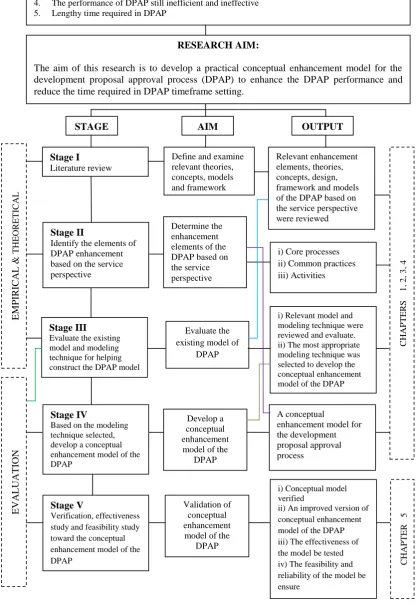
1.1 Summary of Research Methodology 21
2.1 National Development Planning Framework 31
2.2 Project Development Life Cycle Procedures 32
2.3 Process of Development Approval 34
2.4 Times, Cost and Number of Procedures to Comply
with Formalities to Build a Warehouse 39
2.5 Building a Warehouse According to Dealing with Construction Permits Topic (Ranking is Based on
the Indicators of Procedure, Time and Cost) 41
2.6 Theoretical World Bank Doing Business Summary 44
2.7 Flow Chart of Concurrent Development Proposal Approval/Application Process within Four (4)
Months 49
2.8 Flow Chart of Concurrent Development Proposal Approval/Application Process within Six (6)
Months 51
2.9 Transformation of OSC to OSC Online Process
Overview 55
2.10 Theoretical Development Proposal Approval/
Application Process Summary 57
2.11 Service Concept Basic Structure Model 78
2.12 Proposed Service Design Planning Model 79
2.13 Service Strategy Triad 80
2.14 Basic Relationship Structure of Service Concept/ Perspective, DPAP and World Bank Doing
xxiii
2.15 Summary of Relationship between Service Concept/Perspectives with Expectation of World
Bank Doing Business and DPAP 83
2.16 Service Process According to the UST 85
2.17 UST Extension Transformation Context 87
2.18 The Relationships between the Phases and
Routines of a Decision Process 95
2.19 The Information-Processing Approach to Human
Performance 99
2.20 The Extended Information Processing System 99
2.21 The Fundamental Stages of Development Proposal Approval Process Enhancement based on the
Service Perspective 103
2.22 Framework of Development Proposal Approval Process Enhancement based on the Service
Perspective 104
3.1 The Five Dominant Elements 109
3.2 Common Practices of People Element 111
3.3 The Satisfaction to the Management and
Administration of DPAP in Term of Service and Staffing, Courses/Training, Management,
Cooperation between Departments and Welfare 112
3.4 Common Practices of Work System 113
3.5 Common Practices of People Training and
Development 115
3.6 Common Practices of People Behavior (People
Well-Being) 118
3.7 Optimizing the Relationship between the People, Process and Technology to Achieve True
Operational Efficiency 121
3.8 Relationship between the People, Process and
Technology 122
3.9 Common Practices of Technology Element 123
3.10 Summary Associated Activities for Technology
Common Practices 127
3.12 Process Model 131
3.13 Four (4) Stages of Improvement Process Design/
Redesign Overview 133
3.14 Process Performance Measurement Framework 133
3.15 Common Practices of Specific Processes Element 134
3.16 Summary Associated Activities for Specific
Process Common Practices 138
3.17 Common Practices of Physical Facilities Elements 146
3.18 Common Practices of Operational Perspective 147
3.19 Common Practices of Locational Perspective 151
3.20 Common Practices of Atmospheric and Image
Perspective 153
3.21 Common Practices of Consumer Use Perspective 155
3.22 Common Practices of Contact Personnel
Perspective 158
3.23 Common Practices of Equipment Element 160
3.24 Common Practices of Workplace/Administrative
Equipment 161
3.25 Common Administrative/Office Equipment
Provided 162
3.26 Common Practices of Computer/Technology
Equipment 164
3.27 Technology Device/Computer Provided 165
3.28 Hardware/Memory Provided 165
3.29 Dedicated Line Provided 166
3.30 Example of a Service Blueprint 186
3.31 Conceptual Enhancement Model of the
Development Proposal Approval Process 190
4.1 Research Onion 193
4.2 The Nested Approach 193
4.3 The Similarities between „Nested Approach‟ and
„Research Onion‟ 194
xxv
4.5 Example: Johor Bahru City Council Organizational
Structure Flow Chart 214
5.1 The Revised Version of “Conceptual Enhancement Model of the Development Proposal Approval
Process” 261
5.2 Question 1: The functions of the “Conceptual Enhancement Model of the Development Proposal
Approval Process” are clear and understandable 275
5.3 Question 2: The sequence of the process of “ Conceptual Enhancement Model of the Development Proposal Approval Process ” are
properly arranged and systematically 276
5.4 Question 3: The step in the “Conceptual Enhancement Model of the Development Proposal Approval Process” is sufficient and to
operationally manageable 277
5.5 Question 4: With regarding to the result obtain in effectiveness study, The “Conceptual Enhancement Model of the Development Proposal Approval Process” is an adequate instrument to help in reduce the time required in the DPAP timeframe setting and easier the operational
process execution in DPAP 278
5.6 Question 5: The “Conceptual Enhancement Model of the Development Proposal Approval Process” is an adequate instrument to raise the effectiveness of
DPAP 279
5.7 Question 6: Consideration with the outcome of effectiveness study, the “Conceptual Enhancement Model of the Development Proposal Approval Process” would satisfy the government
department‟s responsibility needs 280
5.8 Question 7: The “Conceptual Enhancement Model of the Development Proposal Approval Process” is adaptable with normal government department
responsibility operation and performance 281
5.9 Question 8: Consideration with the outcome of effectiveness study, the “Conceptual Enhancement Model of the Development Proposal Approval Process” would help in enhance the DPAP
5.10 Question 9: Consideration with the outcome of effectiveness study, the “Conceptual Enhancement Model of the Development Proposal Approval Process” would help to achieve the better ranking
in the World Bank Doing Business Report 282
5.11 Question 10: The “Conceptual Enhancement Model of the Development Proposal Approval
Process” is economically viable 283
5.12 Question 11: Your department is willing to allocate budget to proceeding or implemented the “Conceptual Enhancement Model of the Development Proposal Approval Process” if
necessary 284
5.13 Question 12: Your department is willing to continuously financially support to proceeding or implemented the “Conceptual Enhancement Model of the Development Proposal Approval Process” if
necessary 284
5.14 Question 13: The “Conceptual Enhancement Model of the Development Proposal Approval Process” has brought any conflict to the legal
requirements in your departments 285
5.15 Question 14: The “Conceptual Enhancement Model of the Development Proposal Approval Process” has brought any conflict to the restricted
area in your departments 286
5.16 Question 15: Your department is interested to implement the “Conceptual Enhancement Model
of the Development Proposal Approval Process” 287
5.17 Question 16: The “Conceptual Enhancement Model of the Development Proposal Approval Process” is able to gain the management support in
your department 288
5.18 Question 17: Your department is intends to distribute, propose and promote the “Conceptual Enhancement Model of the Development Proposal Approval Process” to other government
xxvii
LIST OF ABBREVIATIONS
DPAP MHLG OSC DTCP HDA NLC TCPA UBBL PLC FDI NDPF NPC SPC CCC SPS EIA C&S M&E STP MIP EoDB APEC - - - - - - - - - - - - - - - - - - - - - -
Development Proposal Approval Process
Ministry of Housing and Local Government
One Stop Center
Department of Town and Country Planning
Housing Development Act
National Land Code
Town and Country Planning Act
Uniform Building By Law
Project Life Cycle
Foreign Direct Investment
National Development Planning Framework
National Physical Council
State Planning Committee
Certificate of Completion of Compliance
Principal Submitting Person
Environmental Impact Assessment
Civil and Structural
Mechanical and Electrical
Sewerage Treatment Plan
Malaysian Institute of Planners
Ease of Doing Business
OECD - Organisation for Economic Co-operation and Development
PFC - Process Flow Chart
DFD - Data Flow Diagram
RAD - Role Activity Diagrams
IDEF0 - Integrated Computer Aided Manufacturing Definition
PN - Petri-nets
SPSS - Statistical Package for the Social Science/Statistical Product and Service Solutions
TNB - Tenaga National Berhad
MBJB - Johor Bahru City Council/Majlis Bandaraya Johor Bahru MPJBT - Johor Bahru Tengah Municipal Council/Majlis Perbandaran
Johor Bahru Tengah
MPBP - Batu Pahat Municipal Council/Majlis Perbandaran Batu Pahat
MPKluang - Kluang Municipal Council/Majlis Perbandaran Kluang MPKulai - Kulai Municipal Council/Majlis Perbandaran Kulai MPMuar - Muar Municipal Council/Majlis Perbandaran Muar
MPPG - Pasir Gudang Municipal Council/Majlis Perbandaran Pasir Gudang
MDKT - Kota Tinggi District Council/Majlis Daerah Kota Tinggi MDL - Labis District Council/Majlis Daerah Labis
MDM - Mersing District Council/Majlis Daerah Mersing MDPontian - Pontian District Council/Majlis Daerah Pontian MDSegamat - Segamat District Council/Majlis Daerah Segamat
MDSR - Simpang Renggam District Council/Majlis Daerah Simpang Renggam
xxix
LIST OF APPENDICES
APPENDIX TITLE PAGE
A Sample of Expert Interview Questionnaire Survey
Form 336
B Sample of Effectiveness Study Questionnaire
Survey Form 343
C Sample of Feasibility Study Questionnaire Survey Form
INTRODUCTION
1.1 Preamble
This research explores development proposal approval process (DPAP)
enhancement through the service perspective. The current research attempted to
establish the importance of service perspective in enhancing the development
proposal approval process (DPAP) performance. The research would create mutual
benefits for both the government departments and the applicants. Eventually, this
research would create a new potential area and open new avenues of opportunity to
link the service perspectives with DPAP enhancement in order to strengthen the
DPAP performance and reduce the time required in DPAP timeframe setting.
This chapter is an introductory division which provided a brief overview on
the topic and the motivation for the research. It comprised background of the study,
the nature of the investigated problem, the research questions, the research aim and
objectives, the scope of the research and the justification for the research. The
significant contribution of the study was also presented. This chapter also provided
2
1.2 Research Problems
Shelter is among one of the basic needs for the mankind. Therefore, real
estate sector is playing a very important role to the mankind and there is always
inextricable link among the natural environment, structural environment (sustainable
planning) and social environment. Any sustainable society with stainable conserve
and natural resources and national economic growth would be impossible without
proper management in the real estate sector (Cheng and Hu, 2010; Efe and Aydin,
2009). One of the greatest problems in early 1990‟s is that the improper planning and
management in real estate development causes the global environmental problems
such as deforestation. Lack of re-stocking forest land in turn leads to several issues
including ozone layer depletion, global warming, air and water pollution, toxic
wastes dump problem, disaster of flooding, deforestation and the consequent climate
change (Cheng and Hu, 2010; Efe and Aydin, 2009; Adler and Ziglio, 1996; Costello
and Preller, 2010; Esra Cengiz, 2013; Thomas, 2001; Earp and Ennett, 1991; Frank
and Engelke, 2001).
In addition, improper and poor management in the real estate sector also
results in human health problems and unsatisfying human settlements like the poor
housing and home conditions; development projects that generate noise, air or other
forms of pollution; development projects which conflict with existing uses in the
area; inappropriate or poorly sited development; inadequate facilities or
infrastructure (car parking, sewage treatment plant, access roads, drainage, water
supply, energy efficiency); buildings that are structurally weak and are prone to
hurricanes, earthquakes or other disaster events; development projects which have
serious negative impacts on the country‟s sensitive environment (particularly its
beaches/coastal areas); projects/buildings that increase traffic congestion on nearby
streets and etc. All of these are caused by the improper, poor and unfriendly planning
or management in the real estate sector (Cheng and Hu, 2010; Efe and Aydin, 2009;
Adler and Ziglio, 1996; Badland and Schofield, 2005; James and Donna, 2002;
Costello and Preller, 2010; Wilkison and Reed, 2008; Esra Cengiz, 2013; Thomas,
2001; Bogner and Wilhelm, 1996; Burden, 2000; Cervero and Kockelman, 1997; De
Groot and Van Den Born, 2003; Earp and Ennett, 1991; Ewing and Cervero, 2001;
Apart from this, the national economic growth is also negatively affected by
the improper planning or unfriendly management in the real estate sector. Economic
recession, human financial problems, labor force problems, social issues and etc. are
additional problems arising out of the improper planning or unfriendly management
in the real estate sector. According to the Organization for Economic Co-operation
and Development (OECD), real estate sector is a significant contributor to the
country‟s economy and should be based on the fact that all development takes place
at an appropriate time and place. Specific areas of land development are only more
suitable for specific types of activities and some activities have negative impacts on
the development environments. Moreover, each of the development projects often
prevents its use for another activity at the same time. Therefore, improper planning
or unfriendly management in the real estate sector not only slow down the national
economic progress but also affect the tourism sector, manufacturing industry,
agricultural development, jobs available to the country‟s labor force or even in
revenue to finance government and public operations (Giles-Corti, 2006; Ross, 1997;
Christopher and Somerville, 2000; Erwin and Frans, 1994; Chen X.W, 2012; Cheng
and Hu, 2010; Frank, 2000; Ewing and Cervero, 2001; De Groot and Van Den Born,
2003; Cervero and Kockelman, 1997; Thomas, 2001; Wilkinson and Reed, 2008;
Costello and Preller, 2010; Efe and Aydin, 2009).
Due to these facts, sustainable planning and management in the real estate
sector is essential to ensure that all real estate development occurs in the right place,
at the right time; They should satisfy the basic social or human needs; overcome the
arising problems; and serve as an integral part of the process of national growth and
development. Therefore, the development control responsibility by the government is
an important one to evaluate applications for development permission; grant or refuse permission; ensure that the environment and natural resources are managed
carefully and prudently for the enjoyment of present and future generations as well as
conforms to a pre-determined set of policies or standards. Based on the subsection
19(1) of Act 172: “No person, other than the local authorities, shall, commence,
undertakes, or carry out any development unless planning permission in respect of
the development has been granted to him under Section 22 (treatment of application
or extended under Subsection 24(3) [lapse of planning permission])”. This means
4
planning approval in accordance with the relevant authorities before any physical
work can begin on site in order to seek sustainable planning and manages in the real
estate development. In other words, only after all required applications have been
approved, can the physical work commence on site. The process on obtaining all the
planning approval from the relevant authorities can be defined as “development
proposal approval/application process stage”. This stage also can be referred to as “predevelopment stage”, “initiation and planning stage”, “preconstruction stage” and “before development stage” (Kerzner, 2009; PMI, 2004; Aziz et al., 2011; HDA,
2010; DTCP, 2013). Essentially, this “development proposal approval/application
process stage” is in the first stage for all the projects development. This stage is
playing a significant role and will determine the overall project development process
in the flow of activities. As a result, the development proposal approval/application
process is significant for all the real estate development.
In general, there are four (4) main planning applications that need to be
submitted during the development proposal approval/application process which are
(i) application for conversion and subdivision (124A)/application for surrender and
re-alienation (204D), (ii) planning permission application (Subsection 21[1], Act
172), (iii) building plan application (Section 70, Act 133) and (iv) road and drainage
plan application (Section 9, Act 133)/earthworks plan application (Section 70A, Act
133). All of this application must be endorsed by Land Office, Local Authority
Planning Department, Local Authority Building Department, Local Authority
Engineering Department and Technical Department (MHLG, 2008). Before 2007,
these four planning applications were executed separately or submitted by stages in
development proposal approval/application process which the applicants are needed
to apply the land matters first according to the NLC section 124A (application for
conversion and subdivision) and section 204D (application for surrender and
re-alienation) before submitting the application for planning permission under
subsection 21(1), Act 172 in second stage. Only after getting the endorsement from
Land Office and Local Authority Planning Department, can applicant enter the third
stage; building plan application under section 70 of Act 133. In the same way, only
after getting the approval from Local Authority Building Department can the
applicant move forward to the final stage which is application for road and drainage
strict order, meaning that without getting approval in first stage the second stage
cannot be started. The same applies to the third and fourth stage. These multiple-step
process may lead to several issue such as creating unnecessary delay or lengthening
of the time required for getting the planning approval (Lee J.Q, 2010), red-tape from
Local Authority in the application of land development (Ng S.Y, 2008), delay in
getting approval according to the Section 124A & 204A-204H National Land Code
(NLC) ( Mohamad Fariz, 2009), unsystematic approval process (MHLG, 2008) and
etc. In light of these facts, there are numeral enhancement methods, initiatives or
approaches proposal by the researcher and government departments to seek to
address the issues such as i) encourage using the pre-consultation method between
the applicant with the local authority and external technical agency; ii) proposed
templates, checklist and guidelines by DTCP and MHLG; iii) restructure,
reengineering, reinvention the process execution (Abdul Jalil, 2004; Durst and
Newell, 1999; Majed and Mohamed Zairi, 2000, Henry, 1996); iv) adopt the
sequential descriptions approaches, behavioral or decision-making approaches,
production-based approaches and structures of provision approach in the land
development process (Gore and Nicholson, 1991) and v) adopt the “STAIR” model
for managing and measuring the government performance (Mary and Tatiana, 2003).
However, even the above-mentioned enhancement methods, initiative or approaches
failed to address the efficiency and effectiveness of the development proposal
approval/application process. In other words, the problems in delay or required
lengthening time for getting the planning approval still cannot be solved.
In response to this, in 2007, “One Stop” Concept has been adopted in
Malaysia government to enhance the development proposal approval/application
process. Basically, the “One Stop Shop Concept” or “One Stop Business Centers”
had been promoted by many countries as a new approach to enhance the government
development service delivery system. The “one stop shop concept” can be defined
as an association with arrangements which bring the related development function
together and intend to expedite the development process. Based on the previous
literature, one stop approach to development process not only increases the
efficiency and effectiveness of the service and user benefits but also addresses
6
development control procedures, associated uncertainties, inflexibility administrative
processes and departmental jurisdiction (Evans, 1995; Keogh and Evans, 1992).
Nevertheless, Blakely (1994) from the United States referred to this concept
as “One Business Centers”. The “One Business Centers” is defined as an important
economic development tool and as part of local economic development strategies
which bring integrated information together on planning and development matters.
Illsley et al. (2000). Further discussion and support were provided by Blakely (1994)
who pointed out that this “One Business Centers” would create a good business
climate in encouraging new business start-ups, facilitating business expansion,
eliminating frustrating referrals and attracting new forms to the locality as well as
providing positive value to economic planning and development matters. In addition,
Burdett (1997) from United Kingdom stated that the term of “One Stop Shops” or
“One Stop Concept” has been introduced basically as a single contact point for
council services. This new approach is in response to the client focused agenda to
increase the consideration of interface between service providers and their clients
(for example improving access to information and provision of effective advice and
guidance) (Ross and Rowan-Robinson, 1994; Illsley et al., 1997). Based on the
Illsley, et al. (2000) the term of “One Stop Shops” or “One Stop Concept” actually brings the meaning of: “providing variety of services from a single location or access
to services offered by a single organization or access to a range of organizations
offering similar or related services within a single locality”.
As a result of this, our former Prime Minister Dato' Seri Abdullah Ahmad
Badawi has introduced One Stop Centre (OSC) mechanism in year 2007 to improve
the development services delivery system and expedite the process in getting
approvals for development projects (The Sun, Monday, 16 April 2007, 08:13am).
Several objectives and goals are included in this OSC mechanism such as i) to
coordinate and facilitate the approval process for all the development proposal plans,
ii) to reduce the processing time and expedite the process and iii) to standardize the
procedures and process for development proposals applications (MHLG, 2008).
Through implementation of the OSC mechanism, the development proposal
approval/application process enables the stage or concurrent submission of
OSC mechanism shortened the time required for processing the development
proposal approval/application process either through Build Then Sell (BTS) Concept
or Sell Then Build (STB) Concept (The Sun, 2007, April 16). Nonetheless, several
problems still persist in many areas of the One Stop Center (OSC) mechanism
implementation in development proposal approval/ application process. In particular,
the problems were presented concerning timeline, efficiency and effectiveness (Refer
to Table 1.1).
Table 1.1: Summary Problem Persist of One Stop Centre (OSC) Implementation In Terms of Timeliness and Effectiveness of the Approval Processes
Procedures & Application
1. Discrepancies still exist in the procedure of Planning Approval application among Local Authorities (LA).
Some LA permits feedback up to 3 months given by technical apartments in comparison to the 14 days‟ timeline stated in the procedures by MHLG. This will make the approval process 6 months or more in comparison to original 3 months;
OSC submission checklist issued by LA is sometimes unclear and confusing as well as constantly changing. Confusion among consultants was also created as a result of imposed additional condition.
e.g. LA were required 6 sets of drawing plans comparison to checklist by MHLG requests only 4 sets of such plan.
2. Pre-submission discussion
Prior to the official submission to OSC, discussion on unofficial pre-submission is proceeded jointly by the Principal Submitting Persons (PSP) and the relevant technical departments for most LAS. Acceptance of submission is based upon agreed decision made by all technical departments. This is the precondition for the acceptance of submission, resulting in time-consuming pre-submission checking.
3. Comments from Technical Department
Within 14 working days, comments on the part of all related internal and external departments should be submitted upon submission of plans to OSC. However, additional and new comments by the very apartments could occur after resubmission of the plans to comply with the first list of comments. This time-consuming and repetitious process will negatively affect the efficiency regarding the approval timeline for OSC.
4. To submit building plans for BOMBA approval
Additional time is required on the part of Bomba to assess the building plans and 14 working days is often too short. When Bomba failed to meet the deadline, OSC receive „sokongan letter‟, from other departments instead, an OSC meeting on the building plan application will be held. Bomba will be asked to give on-the-spot opinion in the meeting and Bomba may reject the plan, leading to the forfeited processing fees. This has negative influence on the developer.
5. Requirements of copies of title, title search and quit rent may lead to waste of resources
6. Delay to approval process may be caused by the interference on the part of Planning Department in OSC concerning the building plan application.
8
Table 1.1: Summary Problem Persist of One Stop Centre (OSC) Implementation In Terms of Timeliness and Effectiveness of the Approval Processes (Continue)
Approval
1. Lengthy approval process
Approval process is time-consuming despite the fact that OSC set the 6 months‟ timeframe (for Sell-Then-Build project). Simultaneous submission does not lead to simultaneous approval issuing time. Time to obtain approval might be longer than 1 year in some cases from the date of submission.
It has become more complicated to obtain approval as Building Plan approval is based on the approval on both internal and external departments. It takes longer time on the part of external departments. The same situation may happen to some departments of LA to process the application and approval.
2. Endorsement of plan
It takes more than 2 months for some local authorities concerning endorsing and issuing Planning Approval letter as it has to be tabled in the OSC meeting first.
3. Notice of meeting
Very short notices (often 1 day notice) are given to Developers, Consultants and Architects in attending OSC meeting carried out by LA and without listing the agenda of meeting.
4. Validity period of approval
The date of OSC meeting marks the first day of the 1 year validity for any approval. Developers need to appeal as this given time is not enough in comparison to the time needed for the actual approval.
Timeliness And Effectiveness
1. Longer approval process even with pre-submission meetings prior to OSC submission. 14 days‟ time frame is given to each technical department to submit their comments for tabling in the OSC meeting. However, after being approved by OSC meeting, there is no control on the time frame for issuance of formal approval to applicants.
2. While LA requires applicants to revert by a stated time period or face penalty/ cancellation, the letters issued are often received after the deadline given.
3. The effectiveness of OSC is still questionable since OSC only plays the role of coordinator and application receiver. They are unable to control time frame or to advice on what is required by each technical department for submission.
Source: Survey Among Members On Rehda Malaysia
Based on the persisting problems exist in One Stop Center (OSC) mechanism
can be stated that the efficiency and effectiveness of the development proposal
approval/application process with implementation of OSC mechanism still
questionable. Perhaps, the government have solved the numeral problems arising in
development proposal approval/application process with implementation of OSC
reorganization but the remaining problems cannot be fully addressed. On the similar
note, the issue of delay or lengthening of the time required for getting the planning
approval still arises in certain development projects. According to the Hambleton et
al. (1995), the same situation also occurs in UK in the process of implementing one
stop shop concept in local authorities. The effectiveness and accountability of the
inter-professional working is also in question. This was also discussed by Illsley et
al. (2000) in highlight that several problems arose in UK for one stop shop concept
implementation: conflicting advice given by different officers and departments, lack
of co-ordination between officers from different departments, officers participating
in development control committee meetings who have not been involved and lack of
staff back-up.
Because of the above-mentioned problems in development proposal
approval/application on the implementation of the One Stop Center (OSC)
mechanism, the government departments have adopted the technology to further
enhance the development proposal approval/application process. According to the
World Bank and IFC (2013), more than 100 of the 183 economies conducted
electronic systems for their services ranging. That is to say Governments around the
world are making greater use of technology to improve the effectiveness of their
processes execution. Market leads to gradual evolution of ICT and technology which
in turns causes the evolution of the e-governance, e-service and digital information.
With the development of the internet, the government started to enable their land
administration system on the internet as they became more service oriented
(Williamson et al., 2005; Rajabifard et al., 2007). As a result, the OSC Online was
officially launched in 4 Jan 2011 as an instrument to further enhance the
development proposal approval/application process and solve the emerging
problems. The OSC online is a transformation of the OSC mechanism via the
internet. The alternative view to look at OSC Online is to regard it as an online
platform for submission and processing application for development proposal. Other
than that, one of the main purposes to carry out government OSC online is to replace
the application in manual mode of OSC mechanism which was seen as much
burdened and complicated for local authority parties and for the applicants. Because
of this, the OSC Online system enables PSP/SP to submit the applications directly to
10
involves two main modules which are e-Submission and e-Processing and includes
eight (8) additional modules such as application, service request, reference,
e-guide, e-enquiry, e-complaint, e-payment and e-report card. The main objective of
transformation from OSC mechanism to OSC online is to reduce the transaction time
by half, enable an online comprehensive land database collection and make the
application process more efficient, effective and systematical.
However, the implementation of the OSC Online system also cannot fully
address the previous arising issues. The major weaknesses still lie in the development
proposal approval/application process of both implementation of OSC mechanism
and OSC online. The government organization fail to realize that i) the number of
approval/application process steps remains the same as this online platform merely
acts as a platform with little help in expediting the development proposal
approval/application process (other words, OSC online still depending on the
approval/application process and procedures), ii) still depending on the person in
charge (such as the department in charge late given the comments or
approval/endorsement, OSC online platform cannot do anything and will not
facilitate the expedition of the development proposal approval/application process),
iii) System still not stable and in on going updating, iv) all the data will be lost if
system is hacked by virus, v) if the system breaks all the process will be delayed and
damaged, resulting in more time in the application process, vi) more applicants even
in related person in charge (government staff) are still not so familiar with the system,
which will add additional burden to their work, and vii) the system might be less
secure if someone know the user PIN number or the system is hacked by someone
else even that the system protected by public key infrastructure technology.
In light of that, the enhancement of development proposal approval/
application process still needs further investigation. Even after the transformation by
government from before OSC mechanism implementation to OSC implementation
until OSC online implementation, persisting problems still exist, especially in the
form of development proposal approval/application process performance (efficiency
and effectiveness of the process) and lengthy time required for getting the planning
approval. It might also be good for government to adopt the other countries‟
practice in places like Hong Kong SAR, China, it takes only 6 procedures and 71
days in the time required for getting the planning approval. While, for Georgia it
only takes 9 procedures and 73.5 days. Even in countries like Singapore, Bahrain,
United Arab Emirates and Taiwan, China, it took only 11 procedures, 12 procedures,
12 procedures, 10 procedures and 26 days, 60 days, 44 days, and 94 days
respectively in the time required for getting the planning approval. According to the
Luis Guillermo Plata (former minister of commerce, industry and tourism of
Colombia) stated that: “every country is unique and all different, however each
country can go through the certain things, certain key lessons and apply those lessons
and see how other country work in their environment” (World Bank and IFC, 2013).
However, even though the Malaysia government attempts to adopt the certain things,
certain key lessons and apply the lessons based on the other country to enhance the
development proposal approval/application process but the efficiency and
effectiveness in the development proposal approval/application process is still
unsatisfactory and cannot help much in reducing the time required for getting the
planning approval. This is because of the development proposal approval/application
process in Malaysia is comprises three level of government, viz. level 1: national
planning, level 2: regional/state planning and level 3: local planning and these would
cause lengthy time required for getting the planning approval if compare to the other
country.
Other than that, based on the development proposal approval/application
process can be seen as the enhancement with much more emphasis on the elements
of i) “People” [the development proposal approval/application process always
involves “a multiplicity of decisions and actions” (Drewett, 1973) and “presented as a set of decision chains” (Donnelly et al., 1964; Weiss et al., 1966) as well as the key
decisions of the development proposal approval/application process with regards to
what decisions will be given, who make them at the various stages (Drewett, 1973)
and each decision is as unlocking to the next stage of the process (Gore and
Nicholson, 1991)], ii) “Technology” (evolution of ICT, greater use of technology
device, OSC online and etc. To enhance the development proposal
approval/application process), iii) “Processes” (specific processes, process
re-engineering, restructure and redesign for helping in enhance the development
12
environmental, e-Readiness and etc. which would influence the development
proposal approval/application process performance) and “Equipment” (computer
equipment and office equipment which insufficiently provided will slow down the
development proposal approval/application process performance) (MHLG, 2008; Ng
S.Y, 2008; Mohamad Fariz, 2009; Lee J.Q, 2010; The World Bank and IFC, 2012).
Therefore, it is evident that the development proposal approval/application process
performance are strongly influence by the element of people, technology, processes,
physical facilities and equipment to achieve better, more efficient and effective
approval process. Moreover, each of these elements is usually interdependent on
each other. This is the reason why even several ideas and initiative providers from
government organization for development proposal approval/application process
enhancement also cannot obtain desirable results due to the expectation setting in
government organizations. In other words, most of the ideas and initiative propose by
government organizations only focus on particular element such as process
re-engineering, restructure, improvement, redesign, upgrading IT infrastructure and
system, enhancing employee competency, common utility trench/ service protocol,
upgrading GIS, manpower redeployment and etc (Osborne and Gaebler, 1992;
Frederickson, 1996; Durst and Newell, 1999; MHLG, 2013; Abdul Jalil, 2004) and
the government organizations failed to realize that each of these elements are
basically interdependent on each other. Therefore, it is necessary for government to
raise awareness in this regard.
For these reasons and in order to bridge this gap, there is a need to understand
and involve the service in development proposal approval/application process
enhancement. Looking from the theory, concept and foundational of service
perspective, the service delivery system should take into consideration the
interdependent indicators among people, technology, processes, physical facilities
and equipment by which the service is created and delivered (Heskett, 1987; Chase
and Bowen, 1991). All of these mentioned are always a concern in the development
proposal approval/application process enhancement. Therefore, by adopting the
service perspective in development proposal approval/application process
enhancement would play an important role to achieving better, and more efficient
and effective on the development proposal approval/application process. However,
way for enhancement as well as knowledge according to the service perspective to
create an enhancement in development proposal approval/application process is still
rare among the government organizations. As a result of this, government
organizations should put emphasis on this service perspective in order to enhance the
development proposal approval/application process performance and its
effectiveness.
Basically, the service elements are becoming increasingly important in many
developed countries, and most of the organizations starting to put emphasis on this
service perspectives. By focusing on this service perspective, it will enable the
organization to improve their understanding on the customers‟ needs and
expectations so as to achieve the organization‟s goal as well as for better
enhancement in organization activity and planning. Therefore, many sectors started
to venture into this idea by incorporating the service elements into organization
improvement. Other than that, the processes of re-engineering, restructuring,
improving, redesigning, reinventing, reorganizing, administrative reform and
modernization commonly used as a method to enhance the government organization
activities, but perceived as inefficient and ineffective (Osborne and Gaebler, 1992;
Frederickson, 1996; Durst and Newell, 1999). Because of this, the role of the service
perspective as a new way of exploring the government organization improvement
cannot be overlooked. Machuca et al (2007) stated that service industry played an
important role with contributions between 60% and 80% of Gross Domestic Product
(GDP) and was recognized as an important contributor to the economy in many
developed countries. The same was true in economic sector, industry sector and
public sector, manufactured, financial, marketing, consumer behavior, human
resource management, telecommunications and operations (Johnston, 1994). These
paradigms are showing that most of the organizations started to put emphasis,
concern, shifting as well as adoption on service perspectives in organization
improvement. Thus, this great role of service perspective cannot be denied in the real
estate sector.
Hence, the global competition, market liberalization, devolution and
information revolution, service element, service delivery system and service
14
government organizations and their employees (Mary and Tatiana, 2003). In line
with that, most of government organizations began to include the service perspective
or service management concept in real estate sector. Despite the increasing research
on service perspective in global context, relatively little research applied the idea of
service perspective at Malaysia government organization in real estate sector
especially in terms of the development proposal approval/application process. Based
on the discussion above, the service perspective is playing a key factor for
development proposal approval/application process enhancement and among the
most crucial resources in enhancing and affecting the development proposal
approval/application process performance. However, these service perspectives still
obtain less concern as a way to enhance the government organization activity in
development proposal approval/application process compared with other cases or
fields. In other words, the Malaysia government organizations are yet to investigate
the service perspectives as a way for measuring or enhancing the government
performance within the development proposal approval/ application process. As a
result of this, it is necessary to bring government organization‟s attention to service
perspective since it is still under research in real estate field especially at
development proposal approval/application process.
Furthermore, in contemporary time, most of the organizations in developed
nations started to put emphasis on service perspectives and began to adopt them in
organization improvement. The service design and service delivery system success
framework or model has addressed the user satisfaction and applied in many areas by
the researchers (Chase, 1987 & 1981; Lovelock, 1983; Schmenner, 1986; Shostack,
1987; Wemmerloev, 1990; Silvestro et al., 1992; Kellog and Nie, 1995; Tinnilae and
Vepsaelaeinen, 1995; Lovelock and Yip, 1996; Collier and Meyer, 1998). However,
there are yet appropriate framework or model looking at service perspectives
proposed as a tool for the development proposal approval/application process
enhancement currently exist. Therefore, the current study tried to explore in this
aspect to fill up the existing gap in order to enhance the development proposal
approval/application process enhancement and reduced the time required in the
timeframe setting. Based on the discussion above, the development proposal
approval/application process enhancement mostly are focused on studying particular
employee competency and etc (MHLG, 2013; Abdul Jalil, 2004; Ng S.Y, 2008; Lee
J.Q, 2010; Mohamad Zahirin, 2010; Nina, 2010; Mohamad Zamri, 2010; Mohamad
Khasri, 2010; Mohamad Sabri, 2010; Lim L.L, 2011; Tan J.H, 2011) but the
government organizations failed to realize that basically the elements of people,
technology, processes, physical facilities and equipment are interdependent on each
other. Because of this, the Malaysia government organizations have not given
enough concern in this area in order to enhance the development proposal
approval/application process performance (MHLG, 2013). From this, it is evident
that most of the presented works done of development proposal approval/application
process enhancement are only concerned in specific process or technology. All of
these not covered in the scientific study. Therefore, this current study attempts to
bridge this gap to develop a “conceptual enhancement model of the DPAP” from the
service perspective in order to enhance the development proposal
approval/application process performance and reduced the time required in the
development proposal approval/application process timeframe setting.
To sum up, the problem statement in this research can be divided into three major issues.
(i) Most research on service perspective were seen in economic sector as well as
in industry sector which focused on the manufactured good, financial
services, marketing, consumer behavior, telecommunications and operations
(Johnston, 1994; Lovelock, 1983; Sasser et al, 1978; Zeithaml et al, 1985).
Moreover, the service perspective is playing a key success factor for
development proposal approval/application process enhancement and as
among the most crucial resources in enhancing and affecting the development
proposal approval/application process performance and effectiveness.
However, little attention has been paid to real estate sector even lesser in
development proposal approval process. Therefore, this study aims to
increase government awareness in this service perspective since it is still
under research for development proposal approval/application process
enhancement.
(ii) Lack of knowledge and experience at development proposal approval/
16
literature search, the development proposal approval/application process
basically put much emphasis on the elements of people, technology, specific
processes, physical facilities and equipment. According to the service
perspective, each of these elements should be interdependent on each other to
achieve the better, more efficient and effective in development proposal
approval/application process. However, interaction between each element of
service perspective as well as knowledge to create an enhancement in
development proposal approval/application proc