Edith Cowan University Edith Cowan University
Research Online
Research Online
Theses : Honours Theses
2011
Predictive and adaptive game development a practical application
Predictive and adaptive game development a practical application
of development models to the independent video game industry
of development models to the independent video game industry
Liam A. HuntEdith Cowan University
Follow this and additional works at: https://ro.ecu.edu.au/theses_hons
Part of the Computer Engineering Commons Recommended Citation
Recommended Citation
Hunt, L. A. (2011). Predictive and adaptive game development a practical application of development models to the independent video game industry. https://ro.ecu.edu.au/theses_hons/26
This Thesis is posted at Research Online. https://ro.ecu.edu.au/theses_hons/26
Edith Cowan University
Copyright Warning
You may print or download ONE copy of this document for the purpose
of your own research or study.
The University does not authorize you to copy, communicate or
otherwise make available electronically to any other person any
copyright material contained on this site.
You are reminded of the following:
Copyright owners are entitled to take legal action against persons
who infringe their copyright.
A reproduction of material that is protected by copyright may be a
copyright infringement.
A court may impose penalties and award damages in relation to
offences and infringements relating to copyright material. Higher
penalties may apply, and higher damages may be awarded, for
offences and infringements involving the conversion of material
into digital or electronic form
.Predictive and Adaptive Game Development: A practical application
of development models to the independent video game industry.
Liam Hunt
Bachelor of Creative Industries
Faculty of Education and Arts
i
Abstract
Through the process of researching a number of game and system development models, this study defines two archetypical development models - the predictive and the adaptive. Using each of these models, two video games have been developed in order to measure the practical effect that they can have on the design, development process and player experience of a game. Using the knowledge gained through playtesting and an analysis of the relationship between each game and its development methodology, a number of development guidelines and recommendations have been specifically constructed for use by independent games developers. The practical development and written component of this project aim to answer the following research questions: how does choosing between a predictive and adaptive development model archetype affect the design, development process and player experience of a game?; and how can components from a variety of game design and development models be integrated into development guidelines and recommendations for independent video game developers?
The predictive development model archetype is primarily influenced by Royce’s (1970) ‘Waterfall’ design model, while the adaptive development model archetype is primarily influenced by Keith’s (2010) Agile approach. The way in which this study’s final guidelines and recommendations are tailored to independent games development has largely been influenced by Kerr’s (2006) analysis of the video game industry, as well as the experience and suggestions of a number of accomplished games developers. The entirety of this study has been conducted though a design-based research methodology within an action research framework. Through the analysis of this project’s two games and their development processes, a dialog is created between different development methodologies (from both a games and system development background), as well as the theoretical and practical components of game development. Ultimately it is concluded that while predictive and adaptive development approaches to game development will affect a game in specific, predictable ways, independent developers must use a knowledge of development methodologies to select components specifically tailored to their individual projects.
ii I certify that this thesis does not, to the best of my knowledge and belief:
(i) Incorporate without acknowledgement any material previously submitted for a degree or diploma in any institution of higher education;
(ii) Contain any material previously published or written by another person, except where due reference is made in the text; or
(iii) Contain any defamatory material.
I also grant permission for the Library at Edith Cowan University to make duplicate copies of my thesis as required.
Signed, Date:
iii
Contents
Introduction 1
Research Questions 3
Literature Review
Formal game and system development models Game design theory
Significance of independent development in the modern video game industry Conclusion 4 4 8 12 17 Theoretical Framework 19 Methodology Limitations 23 26 Development Dematerialized Cursed 28 28 34 Playtesting 40 Discussion Design reflection Development Player experience 46 46 49 51
Recommendations and Conclusions 55
References 60
Appendices
Appendix 1 - Predivtive game design document Appendix 2 - Predictive level designs
Appendix 3 - Sample predictive concept art Appendix 4 - Final debugging change list Appendix 5 - Playtesting questionnaire
62 62 69 73 75 76
1
Introduction
According to Forbes’ Mary Jane Irwin (2008), of all video games that enter into production, only 4% end up making a profit. Of the games that are actually completed and reach store shelves, still only 20% are profitable. Typically a game will have to be revised throughout its design process, increasing costs and development time, with “about 60% of a game's budget [being] spent reworking or redesigning a game” (Irwin, 2008). With such a small amount of video games being successfully completed and turning in a profit, it is important to have a formal understanding of game development processes, and the ways in which they can make or break a game before it even reaches a player’s system.
Game design is more than planning out the story, gameplay features and assets of a game. The process involves designing these elements in such a way that they fit into a cohesive whole, allowing them to work together in bringing the player an experience that is
memorable, enriching, and ultimately fun. In order to develop and structure the elements of a system effectively, it is important that we have a set of formalised models, processes and theories that can be employed to inform every aspect of its construction (Adler, 2005). This study involved investigating two identified game development methodology archetypes; predictive and adaptive, and practically analysing them in order to identify aspects of both that can be employed to effectively develop a game in an independent context.
With the advent of digital distribution services such as Xbox Live Arcade, Steam and the iPhone store, independent game development has become a much more viable industry with the shift of video games into a ‘multi-medium’ (Ip, 2008). The commercial and critical success of independent titles such as Minecraft, Super Meat Boy, World of Goo and Braid demonstrate that it is viable for independent developers to not only make a living though their craft, but to become internationally recognised as competitors to larger budget developers. With the growth of this sector of video games development, it is important to carry out an investigation into what formal game development methodologies and theories may be suitable for use in such an industry.
This study establishes of series of development recommendations and guidelines for use by small start-up teams or independent developers. These recommendations and guidelines have been synthesised though the combination of different elements from two separate
2 development methodology archetypes, namely predictive and adaptive development (both of which are explained in more greater later in this submission). The effects and implications of these two approaches have been identified through the thorough analysis of the development process and playtesting feedback of two games, one developed adaptively and the other developed predictively.
3
Research Questions
In order to practically investigate the ways in which the choice of a development model can affect the game it is used to develop, as well as devise formalised methods specifically designed to assist the growing industry of independent games development, two research questions were identified:
• How does choosing between a predictive and adaptive development model archetype affect the design, development process and player experience of a game?
• How can components from a variety of game design and development models be
integrated into development guidelines and recommendations for independent video game developers?
The exploration of these questions has involved a definition of predictive and adaptive model archetypes, developed through an analysis of models and methodologies used in game
development, traditional software engineering and project management. These development archetypes informed the development of two games (one using each model), which have been analysed to draw a clear comparison and contrast between the ways in which different
development models and approaches can influence the design, development process and final player experience of a game. This analysis has been drawn from validated guidelines for effective design and explored within the context of a review of the role of independent games within the video game industry as a whole.
4
Literature Review
This literature review has been split into three main sections. The first section details various theories and studies concerning game design, as well as the ways in which games can be segmented into core components that can be analysed and measured. The second section explores independent games development, the various theories and practices that currently exist within this field, and its place within the modern video games industry. The final section investigates pre-established formal game and system development models, mainly concerning Royce’s (1970) ‘Waterfall’ model and Keith’s (2010) Agile game development with Scrum, including a comparison between predictive and adaptive archetypes.
Game design theory
In order to properly analyse the two games developed for this a project firm understanding of what a game is must be established, along with the fundamental components that make up gameplay and what comprises a good game. To measure the effect that predictive and adaptive development approaches can have on a game, a theoretical basis and game design lexicon must be determined, along with criteria that can be used to assess the quality of each developed game.
Huizinga (1955;2005) identifies the phenomenon of play as universal between cultures and species, used as a means to learn, relieve stress and have fun. He argues that play satisfies a human need beyond the purely biological, existing outside the realm of normal life, providing people with a simulated way to explore their limits and surroundings within an ordered and structured framework. Games are an example of such a framework used for the facilitation of play, structured by a set of rules or parameters and most commonly including an overall goal for the player to achieve. However, the specific components that must be included for a play activity to be considered a game are widely debated.
Juul (2005) provides a brief definition of a game as follows:
A game is a rule-based system with a variable and quantifiable outcome, where different outcomes are assigned different values, the player exerts effort in order to influence the outcome, the player feels emotionally attached to the
5 outcome, and the consequences of the activity are negotiable(Juul, 2005, p.
36).
Salen & Zimmerman (2004), in a simpler form, define a game as “a system in which players engage in an artificial conflict, defined by rules, that results in a quantifiable outcome” (Salen & Zimmerman, 2004, p. 81). In both cases, rules are defined as an essential component of a game and necessary to the organised structure of play, whether they are implicit or explicit. Both definitions acknowledge that a game is a system which will result in an outcome that can be quantified; a player who reaches one of the outcomes of a game should be able to recognise and define it.
Oxland (2004) provides a practical analysis of a number of components that are inherent in all games, in terms of their function and application in video games.
• Rules and boundaries guide and structure gameplay, encapsulating the game space in order to remove player ambiguity in regards to what they are able or not able to do. • Feedback is another method through which players can be guided, whether given
explicitly or implicitly, exposing the game’s rules and boundaries in various ways to promote proper gameplay.
• Interface consists of the way in which a player is allowed to interact (and thus play) with the game system, facilitating gameplay while virtually standing in for the movement of their own bodies in analogue games.
• Goals, quests and challenges are the quantification of a game’s outcome (or many outcomes), providing the player with motivation for gameplay.
• Balance is the way in which all these components of a game are structured in order to complement each other and ultimately encourage the player to willingly play within the defined rules towards an outcome that they have some motivation to achieve.
Adams (2010) argues that the two conceptual components that create gameplay within a video game are core mechanics and user interface. Core mechanics are more specific than rules and are the implementation of a game’s underlying mathematical systems and models. Core mechanics determine exactly what the player can do along with the subsequent effect that their actions will have on the game world. These mechanics can be expressed in an algorithmic form and drive the very heart of the game; without them, there would be no interaction. The user interface sits between these core mechanics and the player, translating
6 their inputs into perceivable outputs. This is parallel to Oxland’s (2004) description of
interface as an essential game component, both guiding and tutoring the player in what actions they may take, while acting as an embodiment of the rules and boundaries that limit and frame these actions.
The mechanics of a game are the underlying components that drive action and through their affordances and limitations, construct rules and goals. The game components identified by Oxland (2004) are all influenced by the mechanics that have been built into the game’s fundamental systems. Jarvinen (2008) identifies a game’s mechanics as the essential core of gameplay, working together to provide the player with access to the game in such a way that they are able to progress towards their goal. Individual mechanics are often simple, self contained tasks, such as aiming, shooting, moving and jumping, and in most cases are operated by the player in parallel (e.g. they may move and shoot simultaneously). Jarvinen (2008) classifies game mechanics into one of three categories: primary/sub mechanics are those that work towards the highest order goal for the player (e.g. jumping on an enemy in Mario). Modifier mechanics are those that change gameplay in such a way that the player changes their behaviours (e.g. collecting a star in Mario). Glocal mechanics are those that form the culmination of local goals into a global victory condition (e.g. reaching the end of the end of a level in Mario before the time runs out). In order for the mechanics and
individual elements in a game to work in unison and construct a cohesive and playable whole, they must be balanced.
Balance can be described as a sense of equilibrium and harmony between challenge and achievement, mediated by feedback within the rules and boundaries of a game. Rolling & Adams (2003) define a balanced game as “one where the main determining factor for success of the player is the skill level of that player” (Rolling & Adams, 2003, p. 240). Commonly, balance is achieved within a game through rigorous testing, trials and tweaking, which can consume a large amount of time and effort on the part of the quality assurance testers. Rollings & Adams (2003) identify two broad classes of balance in video games: static balance and dynamic balance. Static balance involves constructing the rules and their
interactions in such a manner that they are fair and avoid promoting dominant play strategies too greatly. Employing static balance aims to ensure that a game begins at a point of
equilibrium, ensuring all players are afforded the same initial chance of success. Dynamic balance involves tweaking game elements during play in order to provide the player with
7 consistent challenge and avoid a sense of stagnation. A common example of such balancing is shifting a game’s difficulty level to match a player’s performance – if they constantly succeed the game gets harder, if they constantly fail the game gets easier.
For a game’s elements to be balanced, the testers of that game should know how properly analyse the way in which they interact with the player and each other. Consalvo & Dutton (2006) propose a methodology for the qualitative study of games that is broken into four main areas: object inventory, interface study, interaction map and gameplay log. Object inventory is a catalogue of every object in a game including the ways in which the player can interact with it, the method and purpose of its use, the way it is represented, and the
behaviours it promotes. Interface study observes the ways in which the player is able to interact with the game and the means through which the game communicates with the player, which allows for an analysis of which information is given privilege and the limits that are imposed on gameplay. Interaction map involves an examination of the choices players are given when interacting with NPCs (Non Playable Characters) or other players, documenting their limits, flexibility, meanings and significance to the development of the game as a whole. Gameplay log is an exploration of the game as a whole, specifically the gameplay that
emerges from the combination of its individual elements. This final area is where a game’s balance, or lack of balance, becomes apparent, following the ways in which the player is encouraged to act by the affordances and restrictions of the game mechanics and their subsequent enjoyment or frustration.
In order to illuminate bugs, balance issues, unusable mechanics or confusing game elements, many developers will playtest their games before final release. Playtesting generally involves gathering feedback from a number of potential consumers who have been allowed to test the game before it is released. Davis, Steury & Pagulayan (2005) propose a particular playtesting method whose goal is to “give game designers quantitative evaluations from players about how they experience the game” (Davis, Steury & Pagulayan, 2005). Their playtesting method involves one-on-one moderation in standardised environments, including large sample sizes of test subjects (approximately 25-35 people) who represent the entire demographic of the game’s target audience. Subjects are given around an hour to play the game and construct their first impression and then are posed a number of questions that require standardized, quantifiable answers (e.g. a rating between 1 and 10). Testers subsequently interview the
8 subject in a more open ended manner, allowing them to justify their responses to the first set of questions and elaborate on their overall gameplay experience.
The playtesting method proposed by Davis, Steury & Pagulayan (2005) ultimately focuses on assessing a game’s playability, problem areas and impact on a subject’s overall experience, aiming to identify issues and problems encountered in order to find areas to improve. It and other playtesting methods are used to determine whether players will perceive a game as fun and enjoyable, challenging, innovative and novel. Davis, Steury & Pagulayan (2005) assert that questions posed to playtesting subjects should be asked in reference and comparison to other games they have played. By relating their experience playing a game to previous gameplay experiences, subjects can identify what worked and what didn’t without having to be articulate in game design and mechanics.
An understanding of the elements of game design is crucial to both the task of developing two quality games and the construction of this study’s guidelines and recommendations for independent game developers. These guidelines and recommendations are structured around addressing issues highlighted by the literature, such as the definition of rules and the
balancing of mechanics, focusing on steps that directly influence the end experience of a final game. Therefore a study such as this benefits from the existing work done on playtesting and game analysis, in order to identify the strengths and weaknesses of specific games that can be used as a basis for exploring how different development approaches can contribute to the quality of the resultant games and their benefits for independent developers.
Significance of independent development in the modern video game industry
In order to adapt the above generic principles for use by independent game developers an understanding of the modern independent games industry must be established, including the way in which development within differs from that of the games industry at large.
According to a 2009 study by IpsosMediaCT (2010), 67% of U.S. households play computer or video games, with national video game sales reaching 10.5 billion dollars. Game players are 60% male and 40% female, with their average age being 34. The top selling genres of 2009 were sports, action, family entertainment and shooters, respectively. All of these statistics suggest that video games are assuming the mantle of a mainstream medium and the
9 average person who plays games is becoming increasingly closer to the statistically average person in society. The increasing diversity of the audience that games can be targeted towards suggests an opportunity for increasingly diverse gameplay experiences, with the rise of smart phones and the internet allowing for low budget games to reach and appeal to a global
market.
As asserted by Ip (2008), the increasingly diverse video game audience can be attributed to the convergence of new technologies and content with the games industry. The integration of technologies such as social networking, motion controls and downloadable content has resulted in the establishment of new genres and forms of gameplay, targeted at demographics that may have previously been considered ‘non-gamers’. Ip (2008) demonstrated that video games have become a ‘multi-medium’, consisting of elements traditionally associated with other media such as books, film and music. He asserts that the video games industry is developing into “a market in which emphasis is firmly placed on users, user-generated content, and the idea of universal access” (Ip, 2006, p. 220).
Kerr (2006) identifies the games industry as a ‘cultural industry’, noting its general high risk and production costs, low reproduction costs and low ratio of product financial success. Independent, small or ‘mini’ games are characterised as possessing a number of revenue models and involving "shorter development cycles and lower production costs" (Kerr, 2006, p. 61). Such games thus allow more experimental and less proven concepts, due to their lower risks.
Kerr (2006) observes that the majority of games are developed or owned by those that fund them (the publisher), who thus are justified in overseeing management. This results in restricting of creative control and aggressive negotiations with contracted developers, due to the fact that the publisher is the one that bears the initial financial risk and investment. He argues that the current structure of the video games industry is focused on maximising economic value, subsequently seeking to minimise risk and focus on proven and marketable concepts. Although Kerr (2006) condemns this as stifling innovation and creativity, he rationalises it by pointing out that a company will always be primarily focused on profit and asserts that independent developers still exist that, alongside with academics, artists and user groups, still “contribute to overall innovation and diversity in the industry" (Kerr, 2006, p. 73). Due to the high cost, high risk nature of the modern video game industry, low budget
10 independent games development has become a testing ground for new ideas, and an area where new developers can develop and market their games without the necessary publisher relationship inherent in the larger budget areas. Economically, this has become sustainable through the rise of digital distribution markets such as Xbox Live Arcade, Steam and the iPhone market.
Although independent games generally have a significantly smaller user base than large budget mainstream games, they still have the potential for large profit margins due to their relatively lower budgets. Shakar & Bayus (2002) compare the unit and software sales
between two systems made by Sega (higher user base) and Nintendo (lower user base), from 1993 through to 1995. Shakar & Bayus (2002) argue through their analysis and subsequent findings that Nintendo was able to gain greater profit through a stronger network of users, and that a large customer network does not necessarily guarantee high sales. Rather than designing a video game or system to target the largest potential audience, it can be better to specifically target a smaller group of people and use less development resources. By building confidence in a niche user base, independent developers can construct the foundations
necessary to develop games using a progressively larger budget, attracting a progressively larger audience through the strength of their base network.
In order to successfully develop independent games, game developer Jacob Stevens (2009) provides a number of tips specifically designed to be used in low budget and small team ventures. He argues that in order for an independent team to be successful all members must have demonstrated independent self-motivation and the team must choose the correct
distribution platform for their design idea. Other preliminary methods that can be put in place before development of the game begins include planning the game around the team’s pre-established strengths (not attempting to learn a large number of new skills) and setting limits on gameplay and scope in order to refine and limit the concepts that are created. As an approach to the practical development of the game, Stevens (2009) argues that iterative prototyping and play testing is the best way to ensure the final game is successful. He emphasizes the importance of involving test players and their constant feedback in the
development process. Contrary to systems development methodologies, Stevens (2009) plays down the importance of design documentation, arguing that in a small team time would be better spent on the development of the game itself.
11 In an interview published by Christian Nutt (2011) of Gamasutra with a number of
successful independent game developers, Jake Kazdal (developer of the video game Rez) echoes Steven’s (2009) insistence of including outsider parties to playtest the game at different stages, in order to ensure that it can be understood by those who did not develop it. Kazdal attributes the success of his games to merciless marketing and demonstration to the people who would be potential buyers, highlighting the folly of independent developers solely focusing on the game’s practical development. In the same interview by Christian Nutt (2011), Daniel Cook of independent development company Spry Fox agrees that prototyping is necessary to ensure a game remains fun and playable, in addition to iterating as often as possible. Cook insists that all members of an independent development team must work well together and should respect the act of designing a game as completely separate to other disciplines such as art or programming.
Although acknowledging the independent games industry as a source of new ideas and innovation, Grossman (2003) asserts that independent developers would also benefit from the ideas and lessons learnt by those in the mainstream games industry. In a series of
post-mortems by experienced developers, he examines the different things that went right and wrong in a number of commercial game projects. Most developers cited a lack of planning or foresight into game design choices as being as source of trouble, often extending
development times and costs, as well as forcing the development team to cut features from the project. In many cases, a lack of management or proper deference to a central creative source created inconsistencies and misconceptions during the development process. This caused the final game to be incoherent and lacking unity, or forced necessary revisions and re-design. Grossman (2003) notes that, for start-up independent developers, ambition must be restrained and a project’s limits must be defined early in order to avoid the feature creep and overtasking inherent when developing with youthful, enthusiastic teams. In contrast to accomplished mainstream developers, he labels the inexperience of most independent developers as both beneficial and perilous. Such developers are more likely to try new methods, ideas and innovations in development due to their lack of engrained knowledge but can often ignore vital practical elements of developing a real, playable game in favour of being caught up in the romanticism and excitement of their dream concept.
In order to construct effective game development guidelines and recommendations for independent developers the recommendations of successful developers in the field must be
12 taken into account, while considering the reflections and post-mortem advice of professionals working with a larger budget. As the independent games market has only relatively recently become an economically viable means of professional games development, the unique nature of its place in the industry at large will play a large role in the final recommendations for new developers. In this sense, areas that require consideration include the implications and
practical impact of working alone or in a small team, developing on a small budg et with a low level of experience, releasing content in a digital market, and the ways in which these factors will affect the structure of a game development process.
Formal game and system development models
In order to apply game design theory and an awareness of the independent games industry to the development of a successful game, one must have a formal, proven plan or model to structure it around. Valuable guidelines and recommendations for independent games development can only be constructed through an understanding of existing games
development models, as well as the systems development models they were adapted from and influenced by.
There are a large number of pre-conceived approaches to traditional systems and software development, described by the USA Department of Health & Human Services as a
“framework that is used to structure, plan, and control the process of developing an
information system” (Department of Health & Human Services - USA, 2008). Some of these methodologies include Waterfall, Prototyping, Incremental and Spiral. Each of these
methodologies are structured in a linear or iterative fashion, or sometimes a combination of both. Adler (2005) argues that such formalised and structured models when developing a system are necessary in order to ensure that it is completed within a reasonable timeframe and budget, stressing the fact that within professional fields only a small percentage of projects are adequately finished within the initial time and cost allocations. He asserts that having a planned approach and project schedule before development begins can minimise the already high risks within the chaotic field of software development. Specifically, Adler (2005) identifies a number of ways in which development models can assist companies including bureaucratic rationalisation in order to reduce uncertainty, modularity in order to reduce interdependence, and automation in order to reduce task complexity.
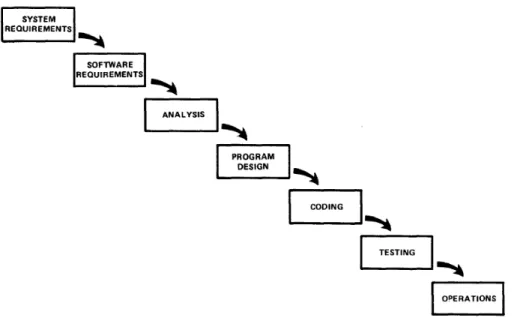
13 The necessity and benefit of using a formal model in order to structure the development of large software systems is further explored by Royce (1970). He argues that although all software systems must go through two common steps of analysis and coding, any large project will be doomed to failure unless proper time and effort is also allocated to the identification of the system’s requirements, documentation, planning, designing and testing. It is here that Royce’s (1970) model of software development is introduced, later dubbed by others as the ‘Waterfall’ approach. In a basic sense, the model consists of 7 steps: system requirements, software requirements, analysis, program design, coding, testing and
operations. In order to ensure that the final project is as user friendly, bug free and coherent as possible, Royce (1970) suggests that once initial requirements have been identified, approximately one third of the development time should be allocated to creating an initial prototype of the final system that is complete in intended functionality. This practice is intended to reduce the resources used in the project’s test phase, allowing for the developers to practically test and revise their system long before it reaches a customer’s hands.
Figure 1. Waterfall model diagram. (Royce, 1970, p. 329).
Overall, Royce’s (1970) model is structured in a mostly linear manner, but involves an iterative aspect in the preliminary prototyping of the system. It could be described as predictive as it involves an identification and definition of the final system and its functionalities prior to its actual development or coding phase. The USA Department of Health & Human Services (2008) describes its strengths as being measurable in terms of
14 costs and time, and allowing new team members to enter the design process while using the established documentation to understand the project's overall scope. Its weaknesses are cited as mainly involving its inflexibility and lack of room to respond to any changes or alterations, especially towards the end of the project.
In the field of traditional software system design, the USA Department of Health & Human Services (2008) identifies a number of other commonly used formal models, each of which can be used to suit specific types of projects depending on their strengths and weaknesses. Prototyping involves breaking a project into small manageable segments, involving the user or client throughout the entire process. Its strengths include greater user satisfaction,
flexibility and quick identification of problems. However, its weaknesses include added costs and time, lack of documentation and potentially false user expectations.Incremental is described as both linear and iterative, involving either a series of iterations of Royce’s (1970) 7 steps, or the use of his model’s first 4 steps to plan and document, then developing and coding through Prototyping. Its strengths are described as allowing exploitation of knowledge gained from incrementing and allowing formal control when planning the project. Its
weaknesses include a lack of consideration for business and technical requirements as well as encouraging difficult problems to be put off to demonstrate early success.
Another software development model that combines both linear and iterative frameworks is the Spiral model. Proposed by Bohem (1986), Spiral development involves breaking down the completion of a project into a number of cycles, all of which follow a common set of increasingly larger steps. Each cycle begins with a determination of the objectives,
alternatives and constraints of the current aspect of the project, followed by an analysis and resolution of the potential risks involved. At this stage a prototype of the current project is designed and developed, then verified and prepared for use in the next development cycle. The final step of each cycle involves planning for the next cycle in the project, gradually increasing in scope as the development process progresses.
15
Figure 2. Spiral model diagram. (Department of Health & Human Services – USA, 2008, p. 6).
The USA Department of Health & Human Services (2008) identifies the Spiral model’s focus on risk analysis and avoidance as its major strength. Additionally it highlights the fluidity of each software cycle’s methodology, allowing for the adoption of Waterfall, Prototyping or Incremental approaches in each iteration, depending on the project’s current needs.
Conversely the Department of Health & Human Services (2008) cite this fluidity as a potential weakness due to the fact that there are no definite or exact steps to follow, thus requiring the assistance of a skilled project manager. Additional weaknesses include the lack of firm deadlines and Spiral’s relative complexity in comparison to other development models.
Hayes & Games (2008) discuss ways in which the use of systematic and formal development processes can educate on the subject of game design itself. They argue that it is important for game design novices to structure their work around a pre-conceived pattern, taking time to plan and consider the design and overall structure of their game (both on a macro and micro scale) before undertaking the task of actually coding and building the game itself. Hayes & Games (2008) stress the need for enhanced focus on teaching better design thinking to novices, including “more sophisticated and useful understandings and practices” (Hayes & Games, 2008, p. 328). Through the undertaking of developing a game though a proper educational scaffolding, game design practices can be taught and practically built upon by ‘learning by doing’. Formal development models can facilitate learning by providing an
16 evenly rounded development process, such as by allowing time for analysis, planning,
development (coding) and testing. They can be used to guide the uninitiated so that they do not jump straight into coding and miss out on the overarching lessons that the other stages can teach about game design on a more macro scale.
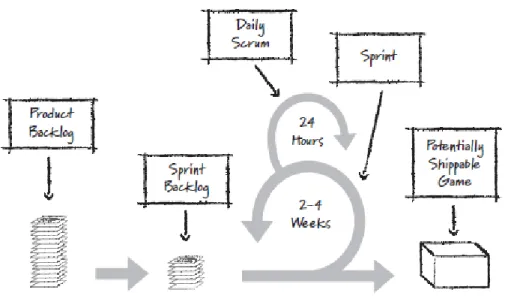
The purpose of using a formalised development model that allows for iteration and re-adjustment is recognised in the Agile methodology of game development. Keith (2010) discusses the use and application of this methodology through an iterative development framework named Scrum, specifically tailored to break down the process of creating a game into a series of task focused ‘sprints’. In order to facilitate these sprints, a game is broken up into groups of related tasks or features that must be completed and are documented in a project backlog. Every two to four weeks the game development team will meet to re-assess the current state of the game, selecting a number of tasks from the backlog that they can independently work on to fashion into a playable, potentially shippable release of that specific feature. Keith (2010) argues that as much new knowledge is generated during the design process, constant iterations are needed in order to incorporate this knowledge into the final product. He stresses that working prototypes, playable demonstrations and constant adaption are integral to producing a fun, coherent game, rather than comprehensive design documents and pre-planning.
17 Aside from being iterative by being structured around a series of task iterations and revisions, Keith’s (2010) Agile game development model with Scrum could be labelled as adaptive. In this sense, although a final game is planned from the beginning of the development cycle, the developers constantly adapt the game’s features (and thus final form) throughout the
development cycle, in response to feedback from prototyping and demonstrations. This differs from other more archetypically predictive development models such as Royce’s (1970) model by allowing a compromise of the initial project vision. Such a model identifies the development process as an evolving entity that the developers must work to
accommodate, as opposed to something that can strictly be controlled by tight management and comprehensive documentation.
Bohem’s (1986) Spiral model is an example of a model which can potentially sit between the adaptive and predictive archetypes. It seeks to predict the generic process that every iteration of a project’s development can undergo, while allowing for multiple and increasingly
complex development cycles in order to adapt and inform the final product. Depending on the current needs, identified risks and consumer demands at any stage in the development
process, the spiral model can waver between the two archetypes, allowing for the introduction of elements from other development models.
Overall, predictive models would be preferable when there is a pre-defined customer expectation or specific structure the game must withhold at all costs, allowing for a definite vision of the final product to be established long before it takes a playable form. Adaptive models encourage change and thus will not usually allow for all aspects of a game to be planned in unison, seeking to allow a game’s final project to be a direct response to its
development process and the lessons learnt within. Through the analysis of different software development models however, one can see that such models are rarely purely adaptive or predictive, often incorporating elements primarily from one archetype but possessing a few from the other.
Conclusion
Although many theories have been established in the field of games culture and game studies, the technical development and methodologies of game development have been addressed in less depth. The majority of existing development models have been created for use in the
18 field of software systems development and, while they can be adapted for game development, are not specifically tailored for use by games developers. Due to its roots in systems
development and programming, many elements of game design are often assumed or
accepted and are rarely criticised, deconstructed or analysed for use in specific scenarios. As shown by the section on formal game and system development models, there are relatively few examples of a formalised approach to structuring the design of a game within a pre-conceived and tested model. The majority of methodologies taken and used by developers can be described as predictive; comprehensively planning as a separate task prior to actual development, or adaptive; using multiple iterations and prototypes to shape a game and its design based on feedback and analysis.
Overall, there has been an extremely small amount of formal investigation into the
independent games industry and the different methods in which games can be developed in an independent context. The majority of literature on the subject is largely anecdotal, or is constructed from interviews and discussions with developers concerning their personal experience. However, it has been demonstrated that the popularity and economic value of independent games is growing through different channels and methods than previously used in mainstream games, in some cases even outselling and outperforming their higher budget brethren. In light of this growth, this study endeavours to fill a portion of the apparent
theoretical gap, incorporating various existing theories with the practical design, development and analysis of two games. The two games have been developed with an understanding of effective game design theories, and have been analysed in terms of their rules and boundaries, feedback, interface, goals, challenges and balance, using a series of formalised testing
methods. The findings resulting from the creation and analysis of these games will be used to construct a series of guidelines and recommendations to guide inexperienced independent game developers.
19
Theoretical Framework
In order reach a common understanding of the salient characteristics of predictive and adaptive development archetypes for the purposes of this study, their differences must be discussed in order to avoid any later confusion.
Predictive and adaptive development models can be distinguished by their approach to the planning and structure of a project. A predictive model will follow a top-down approach, specifying and planning a final project in its entirety before it enters development. In this sense, the use of such a model will generally be executed in a linear fashion, completing each aspect of the project before moving on to the next, with the entire development process being structured around documentation devised in the initial planning stages. An adaptive model will follow a bottom-up approach, involving minimal initial planning and documentation, instead initially focusing on development. Aspects of the project are developed iteratively, placing a large focus on analysis, revisal and re-designing.
Overall, predictive models would be preferable when there is a pre-defined customer expectation or specific structure the game must withhold at all costs, allowing for a definite vision of the final product to be established long before it takes a playable form. Adaptive models encourage change and thus will not usually allow for all aspects of a game to be planned in unison, seeking to allow a game’s final project to be a direct response to its development process and the lessons learnt within.
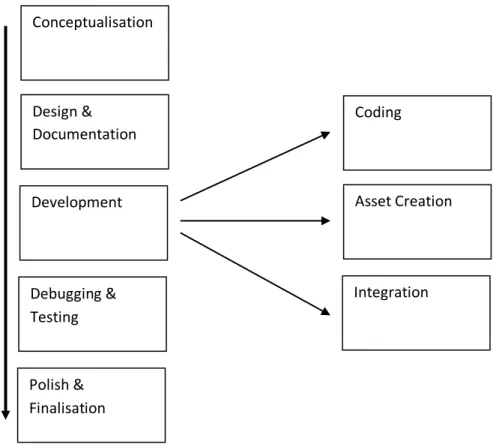
20 Figure 4 demonstrates a sample framework for a predictive development archetype while Figure 5 demonstrates a sample framework for an adaptive development archetype.
Figure 4. Predictive development framework Conceptualisation Design & Documentation Development Debugging & Testing Polish & Finalisation Coding Asset Creation Integration
21
Figure 5. Adaptive development framework.
Conceptualisation
Add Components Refine & Polish Prototype
Test & Debug
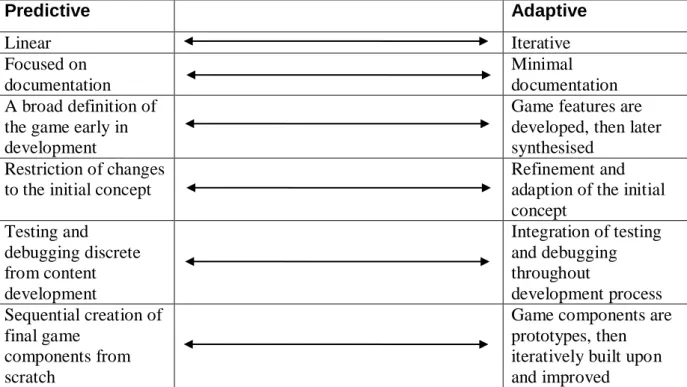
22 In many cases, the different salient characteristics of predictive and adaptive development methodologies can be expressed as opposites. Ideally, the type of hybrid development methodology approach that has been recommended for use by independent game developers would likely possess a mix of characteristics that would sit somewhere between those of a predictive or adaptive approach. Table 1 represents these competing characteristics as a continuum, where approaches may sit at a particular point on each of the dimensions identified.
Table 1. Predictive – adaptive characteristic continuum.
Predictive Adaptive Linear Iterative Focused on documentation Minimal documentation A broad definition of
the game early in development
Game features are developed, then later synthesised
Restriction of changes to the initial concept
Refinement and adaption of the initial concept Testing and debugging discrete from content development Integration of testing and debugging throughout development process Sequential creation of final game components from scratch
Game components are prototypes, then iteratively built upon and improved
23
Methodology
This project involved an investigation of archetypical theoretical development models for the development of video games, including the construction of two games based upon these models. For the purposes of the project, the term archetype has been defined as “the original pattern or model from which all things of the same kind are copied or on which they are based; a model or first form” (Dictionary.com Unabridged, n.d.). Criteria identified in the literature review was used to gauge the quality of the elements in each game and identify any problem areas or outstanding issues. The differences in design, development process and player experience of the two games (from both the researcher’s and playtesters’ perspectives) was then triangulated in order to first identify the contributing effect of their different
development methodologies, and then inform the construction of a set of guidelines and recommendations specifically tailored for independent games development. As such, the methodology can be defined as design-based research within an action research framework.
Action research is defined by O’Brien (1998) as “learning by doing”, involving a researcher identifying a problem, reflexively endeavouring to solve it, measuring success and potentially embarking on another method of solution. Overall it is structured to shape practical work through theory, using the results of that work to transform the existing theories. The entire research process and methodology of this project will be structured around the core focus of action research; completing a task in order to improve the theories that informed it.
As detailed by Baumgartner et al (2002) design-based research involves undertaking of research through theory driven design, enactment (implementation), analysis and re-design of a system. As a sub-set of action research, design-based research involves the combination of theory and practice into an iterative process, specifically to facilitate the reflexive
development of a system that will be analysed in order to build upon the theories that informed its construction. Ultimately, design-based research attempts to combine informed theoretical research with practice, and thus is suitable in such a practical field as game design.
The basis of this project’s methodology in action research facilitates the completion of a task multiple times (practically testing an archetypical game development model) in order to use the lessons learnt from those iterations to improve the quality of a final product (the
24 methodology of action research through the task of developing two games independently and measuring their success in order to address issues and improve development theories in independent games development. Through an analysis of the two games that have been developed, the final outcome (strengths, weaknesses, and structure) of each game has been linked to the development approach used to create it. In this sense, the use of design-based research has assisted the project through its ability to “generate plausible causal accounts because of its focus on linking processes to outcomes in particular settings” (Baumgartner et al, 2002, p. 6). Through the exploration of the cause/effect relationship between the final product of a game and the development methodology used to construct it, guidelines and recommendations will be constructed for independent games development in an endeavour to capitalise on the strengths of each, while avoiding their weaknesses.
The merging of theory and practice makes design-based research within an action research framework an ideal methodology for this study. As evidenced in the literature review, there exists a segregation between ideologies and development methods in the video games industry. In an independent context, a final game product would benefit from increased developer awareness of the effects and implications of the identified archetypical predictive and adaptive approaches. Through the use of the previously detailed research methodology, both development approaches have been allowed to inform the final guidelines and
recommendations for independent games development at the conclusion of this study.
The method through which this study endeavoured to answer the research questions can be broken down into three individual tasks for each question. To recap, the first question is:
• How does choosing between a predictive and adaptive development model archetype affect the design, development process and player experience of a game?
To investigate how development models affected the design of a game, a retrospective study has been conducted upon the two games created, using the qualitative method outlined by Consalvo & Duttton (2006). This study includes an object inventory, interface study,
interaction map and gameplay log, looking at the meanings and promoted player experiences within the games. Through keeping a development journal throughout the process of creating both games, an analysis has been undertaken of the problems, issues, successes and failures that materialised as a result of their respective development methodologies and thus the ways in which they affect the games’ development.
25 To investigate how different development models can affect a player’s experience of a game, a series of playtests were constructed using the method outlined by Davis, Steury &
Pagulayan (2005). During these playtests, the researcher sat with select subjects while they played each game, observing the way in which they behave and react to the game elements. Each playtesting participant, after playing each game, was posed with a set of standardised questions asking them to numerically rate certain aspects of the game and respond to a set of statements on the Likert scale (strongly agree to strongly disagree). Following these
quantitative questions the subject was asked three open-ended questions, in order to identify any areas they specifically enjoyed, areas they deemed problematic, and any possible changes or additions to the game they would recommend.
The second research question is:
• How can components from a variety of game design and development models be integrated into an effective process for independent video game developers? A variety of game design and development models have be identified through research (featured in the literature review), and used to construct a definition of two methodological archetypes: the predictive and the adaptive. The two games subsequently created for this project were then each developed according to one of these archetypes. To identify effective processes and practices for independent video game developers, the unique methods used by a number of successful developers within the independent field were researched and
investigated. These processes were framed within the current state of the video game industry at large, as well its smaller independent sector.
As per the first research question, the two games created have been analysed in terms of the ways in which their development archetype affected their design, development and final player experience. This analysis was applied to the findings on independent video game development and the independent video game industry, in order to construct guidelines and recommendations for independent games development. These guidelines and
recommendations were tailored towards the needs of independent developers and the
demands of both the modern video game industry and modern players, in order to facilitate a unique process useable by new and inexperienced developers.
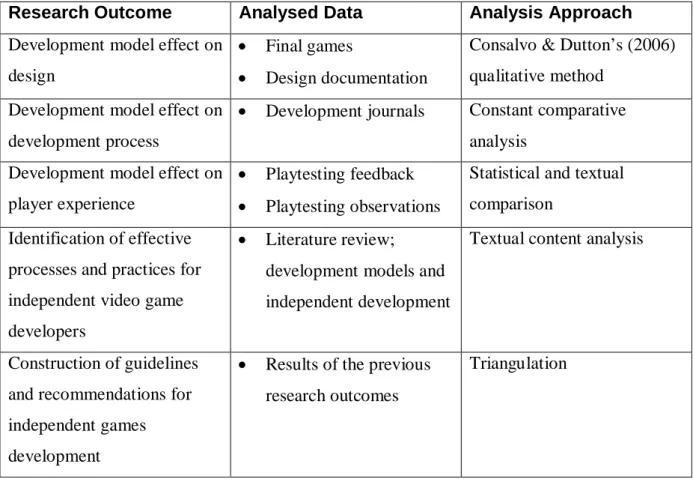
Table 2 summarises the approach taken to address the research questions. For each question a range of specific outcomes has been identified with the data required to explore those
26 outcomes and the analytical approach taken with this data. Triangulation has been possible through the use of multiple forms of data and analytical approaches that enable comparison between these.
Table 2. Summary of research outcomes, analysed data and analysis approach.
Research Outcome Analysed Data Analysis Approach
Development model effect on design
• Final games
• Design documentation
Consalvo & Dutton’s (2006) qualitative method
Development model effect on development process
• Development journals Constant comparative analysis
Development model effect on player experience
• Playtesting feedback • Playtesting observations
Statistical and textual comparison
Identification of effective processes and practices for independent video game developers
• Literature review; development models and independent development
Textual content analysis
Construction of guidelines and recommendations for independent games development
• Results of the previous research outcomes
Triangulation
Limitations
A number of factors limit the usefulness of a direct statistical comparison of the playtesting data gathered for this project. Due to the iterative nature of this project it can be reasonably assumed that the development of the first game, including the skills gained and lessons learned by the developer, influenced the development of the second game and thus resulted in higher playtesting scores. Additionally, although both games were developed to be of a similar genre they contain different mechanics and core challenge types, which in turn could have influenced playtester feedback based on the gameplay styles they generally prefer.
In order to combat these limitations, the discussion of the way in which each development methodology archetype affected the design, development process and player experience of its respective game focuses on identifying recurring instances where salient aspects of the
27 development approach affected definable elements of each game. These effects on game elements do not include those consciously and deliberately added by the developer to adhere to the game concept, rather focusing on highlighting unforseen areas of differencing balance, polish, playability and prioritisation.
28
Development
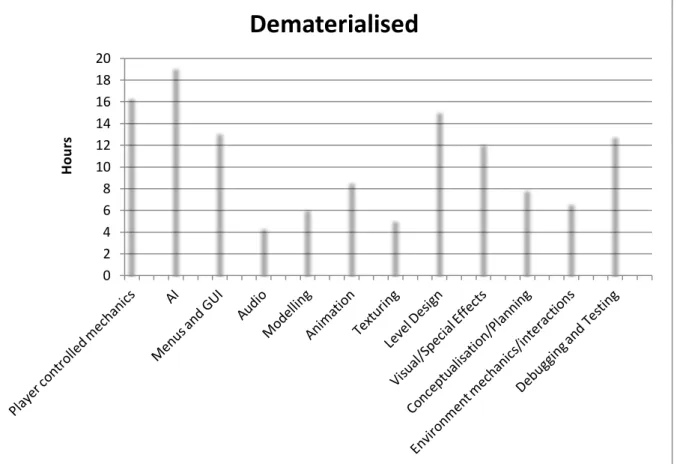
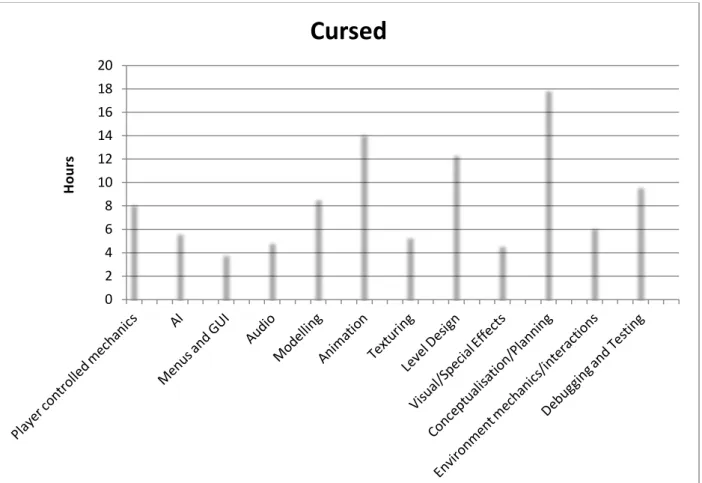
The development of the two games took place over the period of 10 weeks, allowing 5 weeks for each. The first, titled ‘Dematerialized’, was developed according to an adaptive archetype while the second, titled ‘Cursed’, was developed according to a predictive archetype. During the development of each game a daily development log was maintained, detailing the tasks that were completed every day, the amount of time spent on each task and any problems or issues that arose during development. In addition to these logs, at the end of every week of development a weekly of build of each game in their current state was saved, in order to be able to practically analyse the way in which they evolved from a simple concept to a fully playable game. A consolidated summary of the development process of each game is detailed below, including graphical representations (Figures 10 & 11) of the number of hours spent on each generic task during the games’ development (derived from the development logs).
Dematerialized
As the first game was developed according to an adaptive methodology, no formal planning was undertaken before development began. The game was based around a loose pre-planned concept, driven by providing the player with the ability to freely teleport around a 2D platforming environment. The initial concept was planned to be primarily involve combat (psychomotor) challenges with some minor puzzle elements, focusing on using teleportation to outsmart enemies and quickly attack them from multiple directions.
Week 1
The first week of development primarily focused on the construction of the underlying player driven mechanics, as well as an animated and controllable player model. The player model’s appearance was designed based on two factors; making it fit in with a ‘virtual’ visual motif, and allowing it to be animated quickly and easily. Animations were created based on what looked good within the constraints of the model. The player attacking system was originally designed to be a three hit combo (later revised to two) and was planned to be further
developed for use in the game’s original beat-em-up concept.
The biggest initial difficulty that was encountered during development was the teleportation mechanic, largely due to the fact that 2D mouse movement needed to be interpreted in a non-orthographic 3D scene (causing issues with raycasting calculations). Additionally, systems
29 needed to be put in place to stop the player from being allowed to teleport into solid objects, which could not be detected (to the developers knowledge) with the raycast functions build into Unity. Because of these mechanics based difficulties, the majority of time spend during week 1 was spent on programming tasks, resulting in a very bland look in the weekly build (shown in Figure 6), but setting up the core gameplay for the final game.
Figure 6. Dematerialized week 1 build.
Week 2
Week two was characterised by the start of proper level planning and development, and was the point in the game’s development process where its overall concept shifted towards more of a focus on puzzle elements rather than combat challenges. This shift was primarily due to the realisation of the amount of time it would take to introduce good melee fighting
mechanics, from both a programming and animation perspective. Instead, a decision was made to have the main challenges of the game stem from the interaction of the main teleportation mechanics with a combination of simple and predictable entities (teleport jammers, basic enemies, level geometry). Dematerialized’s adaptive development approach helped it in this way by allowing it to be adapted to a revised scope, but also hindered it in the compromise of its initial concept and the redundancy of previously constructed elements that never made it into the final game (e.g. the 3rd attack animation, the ‘intelligent’ player clone enemy).
No insurmountable problems were encountered in week two, allowing both the creation of number of new elements and some time to be spent on the visual and aesthetic design of the game, as demonstrated in Figure 7. The general framing story was devised and introduced in
30 the beginnings of a basic tutorial level, but in many ways was tacked on as it was not
originally planned to be a part of the game from the beginning of development.
Figure 7. Dematerialized week 2 build.
Week 3
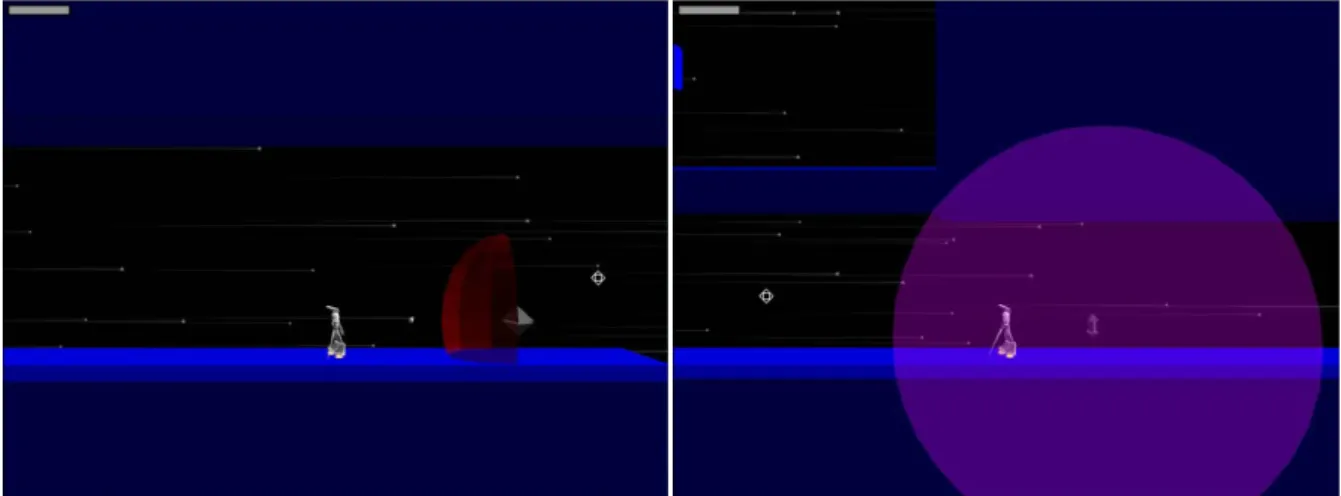
The third week of development was punctuated by the decision to cut the game’s original scope from 25 levels including 5 bosses to 10 levels including 2 bosses (one of which is shown in Figure 8). This decision was made to allow the game to appear more polished, and was informed by the realisation of the fact that most players and markers would not ever play long enough to reach the end of the original concept. Many small mechanical changes were made to add polish and accessibility to the game (e.g. respawning delays, level transitions, teleportation approximation), but the largest task of the week was adding animated textures into the game to give it’s visuals a more dynamic feel. As the developer had no prior experience with traditional 2D animation, learning how to complete this task consumed a great deal of time, which in retrospect was not justified by the amount of difference it made to the final game.
Other small visual changes were made, including adding a red aura to any dangerous objects and creating a new shape for enemy bullets (as to stand out from the circular background objects). A number of levels were created through experimenting (rather than pre-planning) with the now mostly finished enemy and object catalogue, and the first boss was constructed in order to provide a break from the usual puzzle solving with a more psychomotor based challenge.
31
Figure 8. Dematerialized week 3 build.
Week 4
The penultimate week of development saw the completion of all levels but the final boss, and the beginning of more rigorous playtesting and balancing. As in the previous week, the levels were created through the process of placing a number of objects in a scene and experimenting with their layout, allowing the pre-established mechanics to combine with these objects to create emergent challenges. Additionally, some levels were created by updating and tweaking previously discarded concepts, reducing some level of development redundancy.
Aside from level construction, the largest task of the week was the creation of various GUI based elements, including the main menu (shown in Figure 9), intro sequence and prologue level prompts. The greatest difficulty encountered in this task stemmed from the fact that there were no pre-established plans for the game’s story (aside from a vague setting), thus giving rise to the difficult task of using the limited GUI to establish a narrative link to the gameplay in a way that would be interesting and motivating to the player.
32
Figure 9. Dematerialized week 4 build.
Week 5
The very first task undertaken in the final week of development, implementing the level select and global time tracking, proved to be problematic and time consuming as a result of a lack of understanding of how to use Unity’s GUI systems. The final level that needed to be created was the final boss, which demanded a great deal of time to be spent on tweaking and revising to be a challenge befitting of the end of the game. A lot of time in this week was spent debugging, polishing and balancing, resulting in levels being re-ordered and allowing me to detect and rectify a number of issues which were only encountered in the final compiled game (e.g. pausing by setting the game’s timescale to 0 caused a severe drop in performance).
The greatest issue encountered in this week was completely unforseen and had nothing to do with the actual development of the game; the audio designer’s computer crashed and
destroyed the majority of the pre-constructed music and sound effects. As an emergency measure in order to produce something useable in a short time, the audio designer gathered
33 and modified some old music and sound effects he had previously created for other projects, while the developer used a freeware sound generator (Bfxr) and Audacity to create some extra sound effects. As Dematerialized was being developed adaptively, what could have been a disaster was quickly and easily managed; the development schedule was adapted to allow some time to create extra sound effects, while the game’s theme was loose and abstract enough to seamlessly incorporate a different audio style than planned.
Figure 10 shows a breakdown of number of hours spent on each generic task during the Dematerialized’s development, derived from daily hours documented in the development logs.
Figure 10. Dematerialized development log task breakdown.
0 2 4 6 8 10 12 14 16 18 20 H ou rs
Dematerialised
34 Cursed
The second game was developed according to a predictive methodology, requiring the construction of a set of formal design documents before development began. Due to this, the first week of the game was spent entirely planning, constructing a game design document, a set of level design storyboards and drawing concept art (evidence of this planning can be seen in the appendices). While this initial week would allow for the game’s original concept to be firmly embedded in the final product, it effectively took a week away from the actual
development of the playable game.
Week 1
Before beginning the five weeks of developing Cursed, the developer had devised a relatively well defined concept of how final game was to look and play. As a result of this, the
construction of the game design document (see Appendix 1) and concept art (see Appendix 3) was not very mentally taxing and did not take up a large amount of time. The only aspect of the game design document that needed some extra in-depth consideration was the asset catalogue, as it needed to be large enough to allow for visual and mechanical variety, but small enough to keep the time spent modelling, animating and texturing to an acceptable level.
The most difficult task of this week was by far the level design storyboards (see Appendix 2). Due to the fact that the main challenges in Cursed were planned to come in the form of environment based logic puzzles, constructing the level storyboards essentially became the construction of every challenge the player would encounter in the game. The task of coming up with 14 different logic puzzles within a short one week period proved to be extremely mentally taxing, and while they did not take much time to draw onto a storyboard, the developer found that he could not create more than a few at a time before becoming creatively exhausted.
Week 2
The majority of the first week of actual game development was spent modelling, animating and implementing the player character model, ensuring they move in a sufficiently realistic manner. As the developer was still quite new to organic character modelling and animation, the process of creating the player character was arduous, time consuming, and took a large
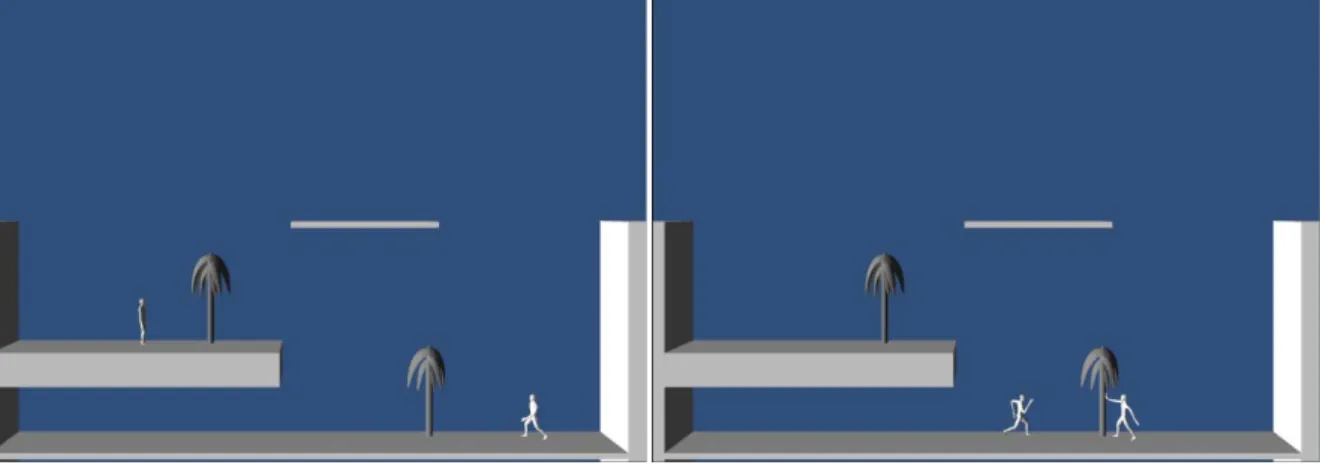
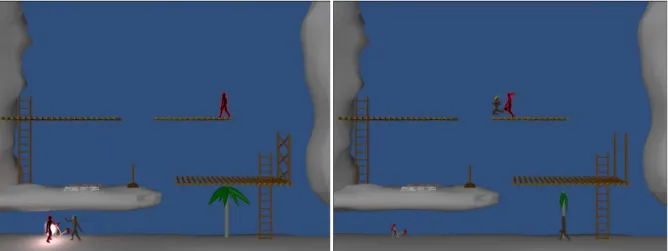
35 amount of research and learning. The final day of the week saw the construction of the first heal object (which failed to animate) and the basic movement AI of the cursed characters (based on raytracing to detect the player), as demonstrated in Figure 11.
After spending week 1 entirely planning, it was a little worrying and frustrating that the majority of week 2 was spend on creating a single (albeit important) asset. Due to the nature of Cursed’s predictive development approach, there was the concern that perhaps certain crucial assets would cause unforseen issues that would slow down the creation for the game, and thus cause it to be unfinished at the end of its reduced development time frame. However in retrospect, spending a large time on getting the player character model and controls set up correctly at the beginning of development most likely saved time later in the testing and debugging phases, and thus was overall beneficial.
Figure 11. Cursed week 2 build.
Week 3
The most immediately obvious addition to the game in week 3 was a large number of 3D models. The majority of level geometry and heal objects were created, and the player model was fitted with a mask and various jewellery (see Figure 12). Another important visual milestone was the beginning of texture and material creation.
A number of final gameplay mechanics were created, including cursed healing detection and response (demonstrated in Figure 12) and player-level interaction. Player-level interaction proved to be one of the most difficult mechanics to implement, creating unforseen problems with gate movement when a lever is pulled and requiring a multitude of player movement overrides when attempting to climb a ladder. These issues were resolved with perseverance