ImmunoTargets and Therapy
ImmunoTargets and Therapy 2016:5 37–45
Dove
press
submit your manuscript | www.dovepress.com
R e v I e w
open access to scientific and medical research
Open Access Full Text Article
37
Immunotherapy for tuberculosis: future prospects
Getahun Abate
1Daniel F Hoft
1,21Department of Internal Medicine,
Division of Infectious Diseases, Allergy and Immunology, 2Department
of Molecular Microbiology and Immunology, Saint Louis University, St. Louis, MO, USA
Correspondence: Getahun Abate Department of Internal Medicine, Division of Infectious Diseases, Allergy and Immunology, Saint Louis University, Doisy Research Center, 8th floor, 1100 S. Grand Blvd, St. Louis, MO 63104, USA Tel +1 314 977 5500
email [email protected] Daniel F Hoft
Department of Internal Medicine, Division of Infectious Diseases, Allergy and Immunology, Saint Louis University, Doisy Research Center, 8th floor, 1100 S. Grand Blvd, St. Louis, MO 63104, USA Tel +1 314 977 5500
Fax +1 314 771 3816 email [email protected]
Abstract: Tuberculosis (TB) is still a major global health problem. A third of the world’s population is infected with Mycobacterium tuberculosis. Only ∼10% of infected individuals develop TB but there are 9 million TB cases with 1.5 million deaths annually. The standard prophylactic treatment regimens for latent TB infection take 3–9 months, and new cases of TB require at least 6 months of treatment with multiple drugs. The management of latent TB infection and TB has become more challenging because of the spread of multidrug-resistant and extremely drug-resistant TB. Intensified efforts to find new TB drugs and immunotherapies are needed. Immunotherapies could modulate the immune system in patients with latent TB infection or active disease, enabling better control of M. tuberculosis replication. This review describes several types of potential immunotherapies with a focus on those which have been tested in humans.
Keywords: tuberculosis, HDT, immunotherapy, treatment
Introduction
Tuberculosis (TB) remains a major global public health problem. It is estimated that
a third of the world’s population is infected with Mycobacterium tuberculosis, the
causative agent of TB. There are
∼
9 million new cases of TB with 1.5 million deaths
annually.
1Effective management of TB infection and TB disease requires treatment
for at least 6 months. This long treatment duration, coupled with side effects of
anti-TB drugs, leads to noncompliance resulting in the emergence of drug-resistant anti-TB.
Of note, drug-resistant TB is more difficult to treat and significantly increases TB
control program costs in high TB endemic countries which have meager resources
to begin with.
2The World Health Organization reports that several countries have increasing numbers
of patients with multidrug-resistant (MDR)-TB, TB caused by M. tuberculosis resistant to
at least isoniazid and rifampin.
1To make the situation worse, only 20% of MDR-TB cases
were started on appropriate drugs, with
,
50% successful treatment outcome.
1Further-more, the number of MDR-TB cases increased three-fold between 2009 and 2013, mainly
due to lack of effective treatment.
1In addition, several countries with high prevalence
of MDR-TB also suffer from increasing numbers of cases of extensively drug-resistant
(XDR)-TB with resistance to isoniazid, rifampin, fluoroquinolones, and aminoglycosides.
The treatment of XDR-TB is even more difficult and the outcome unpredictable.
1,3Thus,
MDR- and XDR-TB are major global public health problems because of the lack of
effective treatment, the need for a much longer duration of treatment with second line
ImmunoTargets and Therapy downloaded from https://www.dovepress.com/ by 118.70.13.36 on 22-Aug-2020
For personal use only.
Number of times this article has been viewed
This article was published in the following Dove Press journal: ImmunoTargets and Therapy
Dovepress
Abate and Hoft
or experimental drugs, and the risk of further spread locally
and more widely through immigration. Enhanced efforts to
develop new TB therapeutics are urgently needed. The progress
in TB drug development has been slow and none of the new
drugs tested so far have allowed standard treatment regimen
shortening.
4Host-directed therapy using immunomodulators
is a promising approach which must be explored for better
control of TB. This paper reviews the strategies and prospects
for TB host-directed therapy immunotherapeutics.
TB latency, host immunity, and
M. tuberculosis
adaptation
A better understanding of the nature of host–pathogen
interac-tions is required for the development of immunotherapeutics
and to predict the roles of new immunotherapeutics for the
management of TB infection and/or disease. It is interesting
to note that only
∼
10% of M. tuberculosis-infected individuals
develop TB, but how the majority of infected people control
or clear the infection is not fully known. Until recently, it
was believed that latent TB infection (LTBI) is a state of
mycobacterial dormancy during which the immune system
contains virtually all persisting M. tuberculosis organisms in
a static state within granulomas.
5–8An emerging consensus
resulting in a paradigm shift in the field maintains that both
active TB and LTBI represent dynamic spectra with variable
levels of actively replicating and inactive bacilli in different
granulomas present in the same infected individual.
9,10The immune response can greatly alter the proportions
and absolute numbers of actively replicating M. tuberculosis
in infected persons with concomitant changes in TB disease
risks. Because the infection is largely intracellular during
paucibacillary LTBI and early reactivation disease, T-cell
responses are critically important for protective immunity.
CD4
+
, Th1, and CD8
+
T-cell responses are involved in
the control of M. tuberculosis replication in vivo, as are
the cytokines they produce (eg, interferon [IFN-
γ
], tumor
necrosis factor [TNF]-
α
, and interlukin [IL]-2).
11–13How-ever, these responses alone appear insufficient for bacterial
clearance as these T-cell subsets peak during active TB
dis-ease and decrdis-ease after spontaneous immunologic control
without eradication of TB infection. Other immune subsets
which tend to accumulate in mucosal tissues, including
γδ
T-cells,
14,15CD1 restricted T-cells,
16and mucosa-associated
invariant T-cells,
17,18can impact on the levels of protective
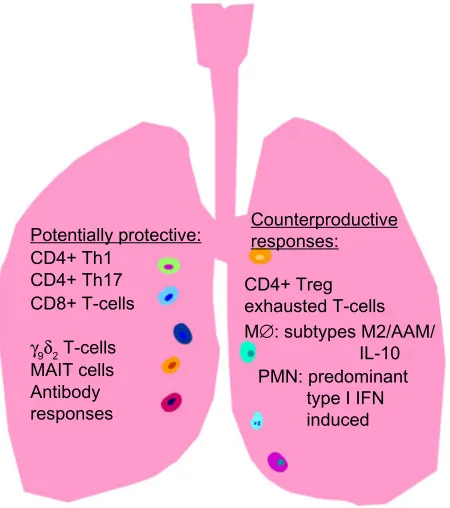
responses. Figure 1 summarizes protective and
counter-productive immune responses in TB.
M. tuberculosis has an incredible capacity to adapt
in vivo to a variety of stressful conditions. Pathogenic
M. tuberculosis can replicate intracellularly in professional
mononuclear phagocytes despite numerous mechanisms
available to kill intracellular bacilli. The pathogen switches
from predominant glucose metabolism when replicating at
high rates extracellularly to lipid-based metabolism after
uptake in phagosomes of mononuclear phagocytes. The
organism thrives in aerobic conditions reaching its highest
levels of replication, but can also survive prolonged periods of
microaerophilic and even anaerobic conditions. Certain gene
sets or regulons are activated intracellularly (eg, DosR) and
are thought to be involved in persistence of M. tuberculosis
during LTBI.
19In addition, other genes associated with
reactivation of LTBI have been identified (eg,
resuscitation-promoting factors).
20–22Although previous data suggest that
TB immunity is predominantly directed against antigens
pro-duced by replicating M. tuberculosis, there is a growing body
of evidence that latency-specific antigens are targeted as well.
M. tuberculosis mediates multiple immune evasion strategies,
including blockade of major histocompatibility complex
expression,
23–25prevention of phagolysosomal fusion,
26–28and
inhibition of IFN-
γ
signaling.
29–34However, the majority of
Potentially protective: CD4+ Th1
CD4+ Treg exhausted T-cells M∅: subtypes M2/AAM/
IL-10 PMN: predominant
type I IFN induced CD4+ Th17
CD8+ T-cells
MAIT cells Antibody responses γ9δ2 T-cells
Counterproductive responses:
Figure 1 Tuberculosis (TB)-specific mucosal immune responses are important
for protection against latent TB infection (LTBI) reactivation. Th1 CD4+ and Th17 CD4+ T-cells, CD8+ T-cells, γ9δ2 T-cells, mucosa-associated invariant T (MAIT) cells,
and sIgA/IgG antibody responses are potentially protective against LTBI reactivation which could reduce both TB disease and TB transmission.
Notes: All of these T-cell responses will be considered major targets for
immunotherapy in this project because they can recognize intracellular Mycobacterium tuberculosis, the major pathogen reservoir during LTBI. Mucosal antibody responses also could protect against initial infection and transmission, and are being studied in other funded work by our consortium of investigators. CD4+ regulatory T-cell, T-cell exhaustion, alternatively activated macrophages unable to kill intracellular
M. tuberculosis and type I IFN-induced polymorphonuclear (PMN) leukocytes can negatively regulate protective immunity in the lung.
ImmunoTargets and Therapy downloaded from https://www.dovepress.com/ by 118.70.13.36 on 22-Aug-2020
Dovepress Immunotherapy for tuberculosis
persons infected with TB never develop disease, indicating
that the host–pathogen balance can be tipped in favor of the
host leading to protective immunity.
Most primary and reactivation TB disease occurs in the
lung, and this is the main source of TB transmission. These
clinical facts combined with the accumulated knowledge in
this area indicate that an optimally effective immunotherapy
will need to target mucosal immunity in the lung.
TB immunotherapeutics
Immunotherapies ideally should modulate the immune
system in a way that helps the host control or eliminate
M. tuberculosis. Whole mycobacteria,
35,36mycobacterial
products,
37–39cytokines, and drugs have been considered
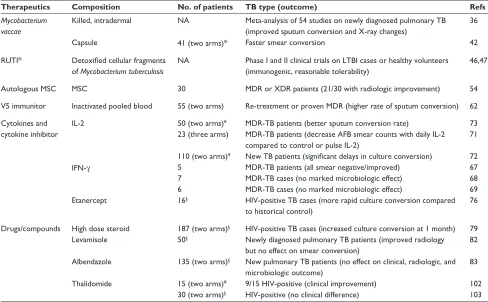
as possible immunomodulators. Table 1 summarizes
host-directed immunotherapeutics which have been tested for the
treatment of TB in humans.
M. vaccae
and other atypical mycobacteria
There are some controversies on the benefits of Mycobacterium
vaccae-based immunotherapy. A single injection enhanced
sputum culture conversion at 1 month and led to marked
radiographic improvement at 6 months,
40but these promising
findings were not reproducibly found in other studies.
41None-theless, meta-analysis of 54 studies using intradermal injection
of M. vaccae reported that immunotherapy based on M. vaccae
could enhance sputum conversion and improve radiographic
changes.
36Similarly, oral administration of M. vaccae enhanced
sputum conversion in newly treated TB patients.
42Other
envi-ronmental mycobacteria, such as M. indicus pranii, also have
shown promising results in animal models.
43RUTI
®RUTI is a therapeutic vaccine made of detoxified cellular
fragments of M. tuberculosis, delivered in liposomes. It is
pre-pared by mechanically disrupting colonies of M. tuberculosis
in phosphate-buffered saline with 4% TritonX114, heating at
65°C for 40 minutes followed by lyophilization and
encapsu-lation in liposomes made of phosphatidyl choline.
44In mice
and guinea pigs, this therapeutic vaccine was found to have
potential for both prophylaxis and immunotherapy.
45So far,
it has been shown in Phase I and II clinical trials involving
healthy volunteers and cases with LTBI that this vaccine is
safe and immunogenic.
46,47Table 1 Immunomodulating host-directed therapies for treatment of TB in humans
Therapeutics Composition No. of patients TB type (outcome) Refs
Mycobacterium vaccae
Killed, intradermal NA Meta-analysis of 54 studies on newly diagnosed pulmonary TB (improved sputum conversion and X-ray changes)
36
Capsule 41 (two arms)Φ Faster smear conversion 42
RUTI® Detoxified cellular fragments
of Mycobacterium tuberculosis
NA Phase I and II clinical trials on LTBI cases or healthy volunteers (immunogenic, reasonable tolerability)
46,47
Autologous MSC MSC 30 MDR or XDR patients (21/30 with radiologic improvement) 54
v5 immunitor Inactivated pooled blood 55 (two arms) Re-treatment or proven MDR (higher rate of sputum conversion) 62 Cytokines and
cytokine inhibitor
IL-2 50 (two arms)¥
23 (three arms) 110 (two arms)¥
MDR-TB patients (better sputum conversion rate)
MDR-TB patients (decrease AFB smear counts with daily IL-2 compared to control or pulse IL-2)
New TB patients (significant delays in culture conversion)
73 71 72
IFN-γ 5
7 6
MDR-TB patients (all smear negative/improved) MDR-TB cases (no marked microbiologic effect) MDR-TB cases (no marked microbiologic effect)
67 68 69 etanercept 16§ HIv-positive TB cases (more rapid culture conversion compared
to historical control)
76
Drugs/compounds High dose steroid 187 (two arms)§ HIv-positive TB cases (increased culture conversion at 1 month) 79
Levamisole 50§ Newly diagnosed pulmonary TB patients (improved radiology
but no effect on smear conversion)
82 Albendazole 135 (two arms)§ New pulmonary TB patients (no effect on clinical, radiologic, and
microbiologic outcome)
83
Thalidomide 15 (two arms)¥
30 (two arms)§
9/15 HIv-positive (clinical improvement) HIv-positive (no clinical difference)
102 103
Notes: Φ, different groups including drug-susceptible and drug-resistant cases; ¥, newly diagnosed pulmonary TB with drug-resistant or MDR-TB as exclusion criteria; §, newly diagnosed pulmonary TB and no drug susceptibility data reported. All TB cases were treated with multidrug-treatment regimen.
Abbreviations: AFB, acid-fast bacilli; HIV, human immunodeficiency virus; IFN, interferon; IL, interleukin; LTBI, latent TB infection; MDR, multidrug-resistant; MSC,
mesenchymal stem cells; NA, not applicable; XDR, extensively drug-resistant; TB, tuberculosis.
ImmunoTargets and Therapy downloaded from https://www.dovepress.com/ by 118.70.13.36 on 22-Aug-2020
Dovepress
Abate and Hoft
DNA vaccines
A number of DNA vaccines expressing relevant M.
tubercu-losis genes, Hsp65, ESAT-6, and Ag85A, have demonstrated
activity in M. tuberculosis-infected mice resulting in a one
to three log improvement in M. tuberculosis clearance.
48–51More interestingly, an intramuscular DNA vaccine
contain-ing Hsp65 and IL-12 genes improved the survival of mice
infected with MDR-/XDR-TB.
52This particular vaccine
uses plasmid cDNA3.1 as a vector expressing Hsp65 and
IL-12 incorporated into virus-free envelopes derived from
the hemagglutinating virus of Japan. Furthermore, this same
DNA vaccine provided a 40% improvement in survival of
M. tuberculosis-infected primates.
52These encouraging
results suggest that some DNA vaccines may advance into
human clinical trials as adjuncts to chemotherapy.
Autologous MSC
Mesenchymal stem cells (MSC) are progenitor cells
constitut-ing a small proportion (0.01%) of the bone marrow.
53,54MSC
are present in various tissues and organs, including lungs,
55,56and are involved in the repair of damaged tissues.
57,58These
cells have been tested for their potential to transform chronic
tissue inflammation into an environment capable of
induc-ing robust pathogen-specific immune responses. A recent
review describes the interaction of MSC with different cells
of the immune system.
59Immunomodulatory functions of
MSC are mediated by both cell-to-cell contact and release of
soluble mediators, such as tumor growth factor (TGF)-
β
and
prostaglandin E2.
59A Phase I study with MSC given to 30
MDR- or XDR-TB patients demonstrated that administration
of MSC within 4 weeks of initiation of anti-TB drugs was
safe and improved radiological changes.
54v5 immunitor
V5 immunitor, derived from chemical- and heat-inactivated
pooled blood from hepatitis B and C virus-positive blood
donors, was originally developed for the management of
chronic hepatitis B and C.
60The exact contents and how this
product modulates the immune system remain to be
inves-tigated. It has been assumed that some of the blood donors
had LTBI and may have circulating M. tuberculosis antigens
which may stimulate immune responses.
61It is also possible
that circulating cytokines and/or chemokines in the pooled
blood, if they are not inactivated during chemical/heat
treat-ment, enhance T-cell responses to M. tuberculosis antigens
in TB patients. Alternatively, other unknown components
present could have adjuvant properties. In a Phase I clinical
trial, V5 immunitor oral therapy resulted in a markedly
better sputum smear conversion at 1 month after initiation
of treatment.
62,63Cytokines and inhibitors
M. tuberculosis is an intracellular organism residing mainly
in monocytes/macrophages.
64This makes cellular immune
responses essential for inhibiting intracellular growth and
limiting dissemination. M. tuberculosis-specific T-cells
produce cytokines and effector molecules, such as perforin,
granzymes, and granulysin.
65,66Thus, cytokines which
enhance the expansion of T-cells and activation/ differentiation
of antigen presenting cells may help control infection. To this
effect, IL-2, IFN-
γ
, IL-12, and anti-TNF-
α
have been tried
in small numbers of clinical cases. Although it is difficult
to develop definitive conclusions from limited, and in most
cases nonrandomized trials, the adjunct use of cytokines
or anticytokines has shown some promise. Moreover, host
inflammatory response mediated by Th1 cytokines can
cause substantial morbidity; therefore, the doses and timing
of administration of cytokines may affect the outcome. The
adjunct use of IFN-
γ
and IL-12 in some cases of MDR-TB
resulted in favorable outcomes.
67–69Adjunct aerosolized
IFN-
γ
administered at a dose of 500
µ
g three times a week for
a total of 4 weeks to five MDR-TB patients was well tolerated
and led to smear conversion in all cases.
67A similar study on
six MDR-TB patients using aerosolized IFN-
γ
at a dose of
2 million units three times a week for 6 months showed that
all patients reverted back or remained culture positive at the
end of treatment.
69This may also indicate that the response
to IFN-
γ
may vary from patient to patient. In murine TB
models, IFN-
γ
administered with intranasal IgA resulted in
decreases in M. tuberculosis load in the lungs.
70Despite some
controversial results regarding the effects of IL-2 tested in
new TB cases,
71,72intradermal injection of 500,000 IU of IL-2
every other day at the first, third, fifth, and seventh months
of drug treatment of 25 MDR-TB patients led to a higher
rate of sputum conversion compared to controls receiving
only drug-treatment.
73IL-2 also enhanced the activities of a
pyrophosphate to enhance
γδ
T-cell responses and decrease
residual M. tuberculosis in the lungs of infected monkeys.
74Anti-TNF-
α
antibodies which are commonly used for
treat-ment of severe rheumatological disorders increase the risk
of reactivation of TB.
75However, in active TB, anti-TNF-
α
may enhance culture conversion when combined with TB
multidrug therapy,
76probably by delaying the formation of
the so-called “persister” forms of tubercle bacilli, leading
to increased susceptibility to drug-mediated bactericidal
activity. Etanercept, an anti-TNF-
α
, administered at a dose
ImmunoTargets and Therapy downloaded from https://www.dovepress.com/ by 118.70.13.36 on 22-Aug-2020
Dovepress Immunotherapy for tuberculosis
of 25 mg subcutaneously twice a week was tested on new
pulmonary TB cases who were human immunodeficiency
virus (HIV)-positive with a CD4 count
.
200/
µ
L. The
trial included age- and sex-matched controls and showed
that sputum culture conversion was slightly more rapid in
etanercept treated patients.
76The role of etanercept
admin-istered in the continuation phase of treatment to shorten the
duration of treatment may need to be studied. Similarly,
inhibitors of IL-4 and TGF-
β
were shown to enhance Th1
type immunity and help reduce M. tuberculosis bacterial load
in the lungs of infected mice.
77,78Antibodies
M. tuberculosis infection induces both celI-mediated and
antibody responses. It has been shown that B-cell-deficiency
leads to higher bacterial burden and worse outcome following
M. tuberculosis infection.
79,80Monoclonal antibodies against
specific M. tuberculosis antigens have shown some
conflict-ing results.
81–83This could be partly because of differences in
types of antibodies and routes of administration. Using sera
from bacillus Calmette-Guerin (BCG)-vaccinated
individu-als, we had shown that antibodies enhance internalization
of mycobacteria by phagocytic cells.
84Interestingly, these
antibodies from vaccinated individuals significantly increased
the ability of macrophages to kill intracellular mycobacteria
and led to marked increase in M. tuberculosis-specific
cell-mediated immunity.
84Further works to identify the
combi-nations of monoclonal antibodies, routes, and frequency of
administration in animal models may be needed before M.
tuberculosis-specific antibodies are tested in clinical trials.
Drugs
Certain host-directed therapies focus on drugs as
immuno-modulators to facilitate M. tuberculosis clearance. Steroids,
levamisole, and vitamin D have been tried in humans. High
dose steroids have been tried in HIV-positive TB patients.
85Although steroid-enhanced culture conversions at 1 month
have been observed, the side effects appeared to outweigh
the benefits. The antihelminthic drugs, levamisole and
albendazole, have been tested in combination with standard
anti-TB drugs in new cases of pulmonary TB. Helminth
infections induce Th2 predominant immune responses.
86Moreover, helminth coinfection leads to Th2 and regulatory
T-cell dominant immune responses impairing TB-protective
Th1 responses.
86,87Therefore, treatment of helminth
infec-tions may modulate the immune response, inducing subsets
more able to limit the progression of disease. Unfortunately,
the results with antihelminthic drugs have not been very
encouraging so far. Levamisole given to new TB patients
resulted in improvements in radiological findings but no
change in smear conversion rate.
88Recently, a randomized
clinical trial with albendazole for 3 days in combination with
standard anti-TB drugs in patients with pulmonary TB and
helminth coinfection demonstrated no difference in clinical
score, smear conversion, and imaging changes compared to
placebo.
89The roles of nutritional status, degree of
immu-nosuppression from TB disease, and HIV coinfection on the
outcomes of the adjunct use of antihelminthic drugs need to
be studied further. The use of vitamin D for TB predates TB
chemotherapy. Vitamin D activates macrophages via toll-like
receptor signaling pathway leading to increased production
of mycobactericidal peptides, cathelicidin, and its active
form LL-37.
90Unfortunately, clinical trials with vitamin D
supplements have resulted in controversial results.
91Other drugs targeting tyrosine kinases and phagosomal
acidification, autophagy, hydrolysis of cyclic adenosine
monophosphate and cyclic guanosine monophosphate,
inflammation, angiogenesis, and epidermal growth factor
receptor have shown encouraging results in murine TB
models. Imatinib is an inhibitor of Abelson tyrosine kinase
used mainly in the treatment of Philadelphia
chromosome-positive chronic myelogenous leukemia. Because Abelson
tyrosine kinase is important for the regulation of
lyso-somal pH in macrophages, inhibition of its function decreases
lysosomal pH and enhances the ability of macrophages to kill
M. tuberculosis.
92Furthermore, the use of imatinib alone or
in combination with rifampin has been found to decrease the
bacterial load in the lungs of M. tuberculosis-infected mice.
93This drug appears to be generally safe although there are case
reports of interstitial lung disease associated with imatinib
and nilotinib, a second generation tyrosine kinase
inhibi-tor.
94,95Metformin, an antidiabetic agent, is an autophagy
inducer via activation of adenosine monophosphate-activated
protein kinase. Metformin inhibited the intracellular growth
of M. tuberculosis, restricted disease immunopathology,
and enhanced the efficacy of conventional anti-TB drugs
in mice.
96Moreover, in a retrospective study of TB patients
with diabetes mellitus, it was found that patients who were
on metformin had fewer pulmonary cavities and significantly
better survival.
96Similarly, other autophagy inducers, such
as statins (simvastatin, rosuvastatin) and gefitinib (an
inhibi-tor of epidermal growth facinhibi-tor recepinhibi-tor), were shown to
decrease bacterial load in M. tuberculosis-infected mice.
97,98The safety and efficacy of imatinib, metformin, and statin
in murine TB studies make them potential candidates for
human clinical trials.
ImmunoTargets and Therapy downloaded from https://www.dovepress.com/ by 118.70.13.36 on 22-Aug-2020
Dovepress
Abate and Hoft
Treatment with the anti-inflammatory drug, ibuprofen,
resulted in decreases in the size and number of lung lesions,
decreases in bacillary load, and improvement in survival of
M. tuberculosis-infected C3HeB/FeJ mice.
99Ibuprofen also
enhances the anti-TB activities of the anti-TB drug,
pyrazi-namide, during the initial phase of treatment.
100Similarly,
other drugs which may reduce inflammation, prostaglandin
E2 and zileuton (a leukotriene inhibitor), decrease lung
colony forming units and improve survival in mice infected
with M. tuberculosis.
101Phosphodiesterase inhibitors, such
as sildenafil and cilostazole, likely by interfering with the
breakdown of cyclic adenosine monophosphate and cyclic
guanosine monophosphate and interfering with downstream
signaling events, shorten the duration of TB treatment in
mice.
102CC-3052, a new phosphodiesterase-4 inhibitor and
thalidomide analogue, decreased lung pathology and bacterial
load significantly when combined with isoniazid in a rabbit
TB model.
103Knowledge gaps and novel strategies
Most of the studies on immunotherapy so far have focused on
TB treatment. This may help shorten standard treatments or
improve the management of MDR/XDR-TB. Because a third
of the population is infected with M. tuberculosis,
immuno-therapeutics which enhance the eradication of latent infection
could have a major impact on TB control. The effects of new
immunotherapeutics/vaccines on the progression or
reactiva-tion of LTBI in humans remain to be studied.
Because most cases of TB are pulmonary,
immunothera-peutics may give a better outcome if they modulate mucosal
immune responses. Lessons from TB vaccine studies should
be applied to new immunotherapeutics. Numerous animal
and human studies demonstrate that in general, mucosal
vaccinations induce more effective mucosal immunity than
systemic vaccinations. With regard to TB mucosal
immu-nity, murine studies with BCG and new TB vaccines clearly
demonstrated that mucosal vaccination via the intranasal
route induced superior protection against subsequent aerosol
challenges with M. tuberculosis.
104–106It was further shown
that mucosal T-cells present in the lung airways of mice
post-vaccination were the best predictors of protective immunity,
and when transferred intratracheally these cells alone could
protect against M. tuberculosis aerosolized challenges.
105,107Therefore, approaches which facilitate the recruitment of
relevant M. tuberculosis-specific T-cells to the lung and limit
nonspecific inflammation should be studied. Host-directed
therapy potentially could provide exciting new avenues for
the management of LTBI and TB disease, providing hope
of shortening standard LTBI and TB treatments as well as
improving treatment of MDR/XDR-TB.
Disclosure
The authors report no conflicts of interest in this work.
References
1. World Health Organization. Global Tuberculosis Report. Geneva: World Health Organization; 2014.
2. Sinanovic E, Ramma L, Vassall A, et al. Impact of reduced hospitali-sation on the cost of treatment for drug-resistant tuberculosis in South Africa. Int J Tuberc Lung Dis. 2015;19(2):172–178.
3. Pietersen E, Ignatius E, Streicher EM, et al. Long-term outcomes of patients with extensively drug-resistant tuberculosis in South Africa: a cohort study. Lancet. 2014;383(9924):1230–1239.
4. Working Group on New TB Drugs. Drug Pipeline. Available from: http://www.newtbdrugs.org/pipeline.php. Accessed January 25, 2016. 5. Corper HJ, Cohn ML. The viability and virulence of old cultures of
tubercle bacilli; studies on 30-year-old broth cultures maintained at 37 degrees C. Tubercle. 1951;32(11):232–237.
6. Wayne LG. Dormancy of Mycobacterium tuberculosis and latency of disease. Eur J Clin Microbiol Infect Dis. 1994;13(11):908–914. 7. Wayne LG, Hayes LG. An in vitro model for sequential study of
shiftdown of Mycobacterium tuberculosis through two stages of non-replicating persistence. Infect Immun.1996;64(6):2062–2069. 8. Wayne LG. In Vitro model of hypoxically induced nonreplicating
persistence of Mycobacterium tuberculosis. Methods Mol Med. 2001;54:247–269.
9. Barry CE 3rd, Boshoff HI, Dartois V, et al. The spectrum of latent tuberculosis: rethinking the biology and intervention strategies.
Nat Rev Microbiol. 2009;7(12):845–855.
10. Lin PL, Flynn JL. Understanding latent tuberculosis: a moving target.
J Immunol. 2010;185(1):15–22.
11. Brighenti S, Andersson J. Induction and regulation of CD8+ cytolytic T cells in human tuberculosis and HIV infection. Biochem Biophys Res
Commun. 2010;396(1):50–57.
12. Seder RA, Darrah PA, Roederer M. T-cell quality in memory and protection: implications for vaccine design. Nat Rev Immunol. 2008;8(4):247–258.
13. Han Q, Bagheri N, Bradshaw EM, Hafler DA, Lauffenburger DA, Love JC. Polyfunctional responses by human T cells result from sequential release of cytokines. Proc Natl Acad Sci U S A. 2012; 109(5):1607–1612.
14. Yao S, Huang D, Chen CY, et al. Differentiation, distribution and gammadelta T cell-driven regulation of IL-22-producing T cells in tuberculosis. PLoS Pathog. 2010;6(2):e1000789.
15. Li B, Rossman MD, Imir T, et al. Disease-specific changes in gammadelta T cell repertoire and function in patients with pulmonary tuberculosis. J Immunol. 1996;157(9):4222–4229.
16. Montamat-Sicotte DJ, Millington KA, Willcox CR, et al. A mycolic acid-specific CD1-restricted T cell population contributes to acute and memory immune responses in human tuberculosis infection. J Clin
Invest. 2011;121(6):2493–2503.
17. Chua WJ, Truscott SM, Eickhoff CS, Blazevic A, Hoft DF, Hansen TH. Polyclonal mucosa-associated invariant T cells have unique innate functions in bacterial infection. Infect Immun. 2012;80(9): 3256–3267.
18. Gold MC, Cerri S, Smyk-Pearson S, et al. Human mucosal associa-ted invariant T cells detect bacterially infecassocia-ted cells. PLoS Biol. 2010;8(6):e1000407.
19. Park HD, Guinn KM, Harrell MI, et al. Rv3133c/dosR is a transcription factor that mediates the hypoxic response of Mycobacterium tubercu-losis. Mol Microbiol. 2003;48(3):833–843.
ImmunoTargets and Therapy downloaded from https://www.dovepress.com/ by 118.70.13.36 on 22-Aug-2020
Dovepress Immunotherapy for tuberculosis
20. Tufariello JM, Mi K, Xu J, et al. Deletion of the Mycobacterium tuberculosis resuscitation-promoting factor Rv1009 gene results in delayed reactivation from chronic tuberculosis. Infect Immun. 2006;74(5):2985–2995.
21. Kana BD, Gordhan BG, Downing KJ, et al. The resuscitation-promoting factors of Mycobacterium tuberculosis are required for virulence and resuscitation from dormancy but are collectively dispensable for growth in vitro. Mol Microbiol. 2008;67(3):672–684.
22. Russell-Goldman E, Xu J, Wang X, Chan J, Tufariello JM. A Myco-bacterium tuberculosis Rpf double-knockout strain exhibits profound defects in reactivation from chronic tuberculosis and innate immunity phenotypes. Infect Immun. 2008;76(9):4269–4281.
23. Noss EH, Harding CV, Boom WH. Mycobacterium tuberculosis inhibits MHC class II antigen processing in murine bone marrow macrophages.
Cell Immunol. 2000;201(1):63–74.
24. Pai RK, Convery M, Hamilton TA, Boom WH, Harding CV. Inhibition of IFN-gamma-induced class II transactivator expression by a 19-kDa lipoprotein from Mycobacterium tuberculosis: a potential mechanism for immune evasion. J Immunol. 2003;171(1):175–184.
25. Boom WH, Canaday DH, Fulton SA, Gehring AJ, Rojas RE, Torres M. Human immunity to M. tuberculosis: T cell subsets and antigen processing. Tuberculosis (Edinb). 2003;83(1–3):98–106.
26. Sturgill-Koszycki S, Schlesinger PH, Chakraborty P, et al. Lack of acidification in Mycobacterium phagosomes produced by exclusion of the vesicular proton-ATPase. Science. 1994;263(5147):678–681. 27. Pethe K, Swenson DL, Alonso S, Anderson J, Wang C, Russell DG.
Isolation of Mycobacterium tuberculosis mutants defective in the arrest of phagosome maturation. Proc Natl Acad Sci USA. 2004; 101(37):13642–13647.
28. Rohde K, Yates RM, Purdy GE, Russell DG. Mycobacterium tuber-culosis and the environment within the phagosome. Immunol Rev. 2007;219:37–54.
29. Ting LM, Kim AC, Cattamanchi A, Ernst JD. Mycobacterium tubercu-losis inhibits IFN-gamma transcriptional responses without inhibiting activation of STAT1. J Immunol. 1999;163(7):3898–3906.
30. Kincaid EZ, Ernst JD. Mycobacterium tuberculosis exerts gene-selective inhibition of transcriptional responses to IFN-gamma without inhibiting STAT1 function. J Immunol. 2003;171(4):2042–2049.
31. Nagabhushanam V, Solache A, Ting LM, Escaron CJ, Zhang JY, Ernst JD. Innate inhibition of adaptive immunity: Mycobacterium tuberculosis-induced IL-6 inhibits macrophage responses to IFN-gamma. J Immunol. 2003;171(9):4750–4757.
32. Fortune SM, Solache A, Jaeger A, et al. Mycobacterium tuberculosis inhibits macrophage responses to IFN-gamma through myeloid differen-tiation factor 88-dependent and -independent mechanisms. J Immunol. 2004;172(10):6272–6280.
33. Banaiee N, Kincaid EZ, Buchwald U, Jacobs WR, Jr., Ernst JD. Potent inhibition of macrophage responses to IFN-gamma by live virulent Mycobacterium tuberculosis is independent of mature mycobacterial lipoproteins but dependent on TLR2. J Immunol. 2006;176(5):3019–3027.
34. Benson SA, Ernst JD. TLR2-dependent inhibition of macrophage responses to IFN-gamma is mediated by distinct, gene-specific mecha-nisms. PLoS One. 2009;4(7):e6329.
35. Wang P, Wang L, Zhang W, et al. Immunotherapeutic efficacy of recom-binant Mycobacterium smegmatis expressing Ag85B-ESAT6 fusion protein against persistent tuberculosis infection in mice. Hum Vaccin
Immunother. 2014;10(1):150–158.
36. Yang XY, Chen QF, Li YP, Wu SM. Mycobacterium vaccae as adjuvant therapy to anti-tuberculosis chemotherapy in never-treated tuberculosis patients: a meta-analysis. PLoS One. 2011;6(9):e23826.
37. Yang S, Li F, Jia S, et al. Early secreted antigen ESAT-6 of Mycobac-terium Tuberculosis promotes apoptosis of macrophages via target-ing the microRNA155-SOCS1 interaction. Cell Physiol Biochem. 2015;35(4):1276–1288.
38. Van Rhijn I, Moody DB. CD1 and mycobacterial lipids activate human T cells. Immunol Rev. 2015;264(1):138–153.
39. Dey B, Dey RJ, Cheung LS, et al. A bacterial cyclic dinucleotide activates the cytosolic surveillance pathway and mediates innate resis-tance to tuberculosis. Nat Med. 2015;21(4):401–406.
40. Johnson JL, Kamya RM, Okwera A, et al. Randomized controlled trial of Mycobacterium vaccae immunotherapy in non-human immunodefi-ciency virus-infected Ugandan adults with newly diagnosed pulmonary tuberculosis. The Uganda-Case Western Reserve University Research Collaboration. J Infect Dis. 2000;181(4):1304–1312.
41. Johnson JL, Nunn AJ, Fourie PB, et al. Effect of Mycobacterium vaccae (SRL172) immunotherapy on radiographic healing in tuberculosis.
Int J Tuberc Lung Dis. 2004;8(11):1348–1354.
42. Butov DA, Efremenko YV, Prihoda ND, et al. Randomized, placebo-controlled Phase II trial of heat-killed Mycobacterium vaccae (Immodulon batch) formulated as an oral pill (V7). Immunotherapy. 2013;5(10):1047–1054.
43. Gupta A, Ahmad FJ, Ahmad F, et al. Efficacy of Mycobacterium indicus pranii immunotherapy as an adjunct to chemotherapy for tuberculosis and underlying immune responses in the lung. PLoS One. 2012;7(7):e39215.
44. Cardona PJ, Amat I, Gordillo S, et al. Immunotherapy with fragmented Mycobacterium tuberculosis cells increases the effectiveness of chemo-therapy against a chronical infection in a murine model of tuberculosis.
Vaccine. 2005;23(11):1393–1398.
45. Vilaplana C, Gil O, Caceres N, Pinto S, Diaz J, Cardona PJ. Prophy-lactic effect of a therapeutic vaccine against TB based on fragments of Mycobacterium tuberculosis. PLoS One. 2011;6(5):e20404. 46. Vilaplana C, Montane E, Pinto S, et al. Double-blind, randomized,
placebo-controlled Phase I Clinical Trial of the therapeutical anti-tuberculous vaccine RUTI. Vaccine. 2010;28(4):1106–1116. 47. Nell AS, D’Lom E, Bouic P, et al. Safety, tolerability, and
immunogenic-ity of the novel antituberculous vaccine RUTI: randomized, placebo-controlled phase II clinical trial in patients with latent tuberculosis infection. PLoS One. 2014;9(2):e89612.
48. Lowrie DB, Silva CL. Enhancement of immunocompetence in tuber-culosis by DNA vaccination. Vaccine. 2000;18(16):1712–1716. 49. Okada M, Kita Y, Nakajima T, et al. Novel prophylactic vaccine using
a prime-boost method and hemagglutinating virus of Japan-envelope against tuberculosis. Clin Dev Immunol. 2011;2011:549281. 50. Tanghe A, D’Souza S, Rosseels V, et al. Improved immunogenicity and
protective efficacy of a tuberculosis DNA vaccine encoding Ag85 by protein boosting. Infect Immun. 2001;69(5):3041–3047.
51. Derrick SC, Yang AL, Morris SL. A polyvalent DNA vaccine express-ing an ESAT6-Ag85B fusion protein protects mice against a primary infection with Mycobacterium tuberculosis and boosts BCG-induced protective immunity. Vaccine. 2004;23(6):780–788.
52. Okada M, Kita Y, Nakajima T, et al. Novel therapeutic vaccine: gran-ulysin and new DNA vaccine against tuberculosis. Hum Vaccin. 2011; 7 Suppl:60–67.
53. Herzog EL, Chai L, Krause DS. Plasticity of marrow-derived stem cells.
Blood. 2003;102(10):3483–3493.
54. Skrahin A, Ahmed RK, Ferrara G, et al. Autologous mesenchymal stromal cell infusion as adjunct treatment in patients with multidrug and extensively drug-resistant tuberculosis: an open-label phase 1 safety trial. Lancet Respir Med. 2014;2(2):108–122.
55. Hogan BL, Yingling JM. Epithelial/mesenchymal interactions and branching morphogenesis of the lung. Curr Opin Genet Dev. 1998;8(4):481–486.
56. Sabatini F, Petecchia L, Tavian M, Jodon de Villeroche V, Rossi GA, Brouty-Boye D. Human bronchial fibroblasts exhibit a mesenchymal stem cell phenotype and multilineage differentiating potentialities.
Lab Invest. 2005;85(8):962–971.
57. Tropea KA, Leder E, Aslam M, et al. Bronchioalveolar stem cells increase after mesenchymal stromal cell treatment in a mouse model of bronchopulmonary dysplasia. Am J Physiol Lung Cell Mol Physiol. 2012;302(9):L829–L837.
58. Sinclair K, Yerkovich ST, Chambers DC. Mesenchymal stem cells and the lung. Respirology. 2013;18(3):397–411.
ImmunoTargets and Therapy downloaded from https://www.dovepress.com/ by 118.70.13.36 on 22-Aug-2020
Dovepress
Abate and Hoft
59. Joshi L, Chelluri LK, Gaddam S. Mesenchymal Stromal cell therapy in MDR/XDR tuberculosis: a concise review. Arch Immunol Ther Exp
(Warsz). 2015;63(6):427–433.
60. Batdelger D, Dandii D, Jirathitikal V, Bourinbaiar AS. Open-label trial of therapeutic immunization with oral V-5 Immunitor (V5) vaccine in patients with chronic hepatitis C. Vaccine. 2008;26(22):2733–2737. 61. Butov DA, Pashkov YN, Stepanenko AL, et al. Phase IIb randomized
trial of adjunct immunotherapy in patients with first-diagnosed tuber-culosis, relapsed and multi-drug-resistant (MDR) TB. J Immune Based
Ther Vaccines. 2011;9:3.
62. Arjanova OV, Prihoda ND, Yurchenko LV, et al. Adjunct oral immuno-therapy in patients with re-treated, multidrug-resistant or HIV-coinfected TB. Immunotherapy. 2011;3(2):181–191.
63. Butov DA, Efremenko YV, Prihoda ND, et al. Adjunct immune therapy of first-diagnosed TB, relapsed TB, treatment-failed TB, multidrug-resistant TB and TB/HIV. Immunotherapy. 2012;4(7):687–695. 64. Jiao X, Lo-Man R, Guermonprez P, et al. Dendritic cells are host cells
for mycobacteria in vivo that trigger innate and acquired immunity.
J Immunol. 2002;168(3):1294–1301.
65. Flesch I, Kaufmann SH. Mycobacterial growth inhibition by interferon-gamma-activated bone marrow macrophages and differential suscep-tibility among strains of Mycobacterium tuberculosis. J Immunol. 1987;138(12):4408–4413.
66. Feng CG, Bean AG, Hooi H, Briscoe H, Britton WJ. Increase in gamma interferon-secreting CD8(+), as well as CD4(+), T cells in lungs following aerosol infection with Mycobacterium tuberculosis. Infect
Immun. 1999;67(7):3242–3247.
67. Condos R, Rom WN, Schluger NW. Treatment of multidrug-resistant pulmonary tuberculosis with interferon-gamma via aerosol. Lancet. 1997;349(9064):1513–1515.
68. Giosue S, Casarini M, Ameglio F, et al. Aerosolized interferon-alpha treatment in patients with multi-drug-resistant pulmonary tuberculosis.
Eur Cytokine Netw. 2000;11(1):99–104.
69. Koh WJ, Kwon OJ, Suh GY, et al. Six-month therapy with aerosolized interferon-gamma for refractory multidrug-resistant pulmonary tuber-culosis. J Korean Med Sci. 2004;19(2):167–171.
70. Balu S, Reljic R, Lewis MJ, et al. A novel human IgA monoclonal antibody protects against tuberculosis. J Immunol. 2011;186(5): 3113–3119.
71. Johnson BJ, Bekker LG, Rickman R, et al. rhuIL-2 adjunctive therapy in multidrug resistant tuberculosis: a comparison of two treatment regimens and placebo. Tuber Lung Dis. 1997;78(3–4):195–203. 72. Johnson JL, Ssekasanvu E, Okwera A, et al. Randomized trial of
adjunc-tive interleukin-2 in adults with pulmonary tuberculosis. Am J Respir
Crit Care Med. 2003;168(2):185–191.
73. Shen H, Min R, Tan Q, et al. The beneficial effects of adjunctive recombinant human interleukin-2 for multidrug resistant tuberculosis.
Arch Med Sci. 2015;11(3):584–590.
74. Chen CY, Yao S, Huang D, et al. Phosphoantigen/IL2 expansion and differentiation of Vgamma2Vdelta2 T cells increase resistance to tuberculosis in nonhuman primates. PLoS Pathog. 2013;9(8): e1003501.
75. Fallahi-Sichani M, Flynn JL, Linderman JJ, Kirschner DE. Differen-tial risk of tuberculosis reactivation among anti-TNF therapies is due to drug binding kinetics and permeability. J Immunol. 2012;188(7): 3169–3178.
76. Wallis RS, Kyambadde P, Johnson JL, et al. A study of the safety, immunology, virology, and microbiology of adjunctive etanercept in HIV-1-associated tuberculosis. AIDS. 2004;18(2):257–264.
77. Hernandez-Pando R, Orozco-Esteves H, Maldonado HA, et al. A combination of a transforming growth factor-beta antagonist and an inhibitor of cyclooxygenase is an effective treatment for murine pulmonary tuberculosis. Clin Exp Immunol. 2006;144(2):264–272. 78. Roy E, Brennan J, Jolles S, Lowrie DB. Beneficial effect of
interleukin-4 antibody when administered in a murine model of tuber-culosis infection. Tubertuber-culosis (Edinb). 2008;88(3):197–202.
79. Vordermeier HM, Venkataprasad N, Harris DP, Ivanyi J. Increase of tuberculous infection in the organs of B cell-deficient mice. Clin Exp
Immunol. 1996;106(2):312–316.
80. Maglione PJ, Xu J, Chan J. B cells moderate inflammatory progression and enhance bacterial containment upon pulmonary challenge with Mycobacterium tuberculosis. J Immunol. 2007;178(11):7222–7234. 81. Lopez Y, Yero D, Falero-Diaz G, et al. Induction of a protective response
with an IgA monoclonal antibody against Mycobacterium tuberculosis 16kDa protein in a model of progressive pulmonary infection. Int J Med
Microbiol. 2009;299(6):447–452.
82. Roy E, Stavropoulos E, Brennan J, et al. Therapeutic efficacy of high-dose intravenous immunoglobulin in Mycobacterium tuberculosis infection in mice. Infect Immun. 2005;73(9):6101–6109.
83. Hamasur B, Haile M, Pawlowski A, Schroder U, Kallenius G, Svenson SB. A mycobacterial lipoarabinomannan specific monoclonal antibody and its F(ab’) fragment prolong survival of mice infected with Mycobacterium tuberculosis. Clin Exp Immunol. 2004;138(1):30–38. 84. de Valliere S, Abate G, Blazevic A, Heuertz RM, Hoft DF. Enhance-ment of innate and cell-mediated immunity by antimycobacterial antibodies. Infect Immun. 2005;73(10):6711–6720.
85. Mayanja-Kizza H, Jones-Lopez E, Okwera A, et al. Immunoadjuvant prednisolone therapy for HIV-associated tuberculosis: a phase 2 clinical trial in Uganda. J Infect Dis. 2005;191(6):856–865.
86. Chatterjee S, Nutman TB. Helminth-induced immune regulation: implications for immune responses to tuberculosis. PLoS Pathog. 2015;11(1):e1004582.
87. Abate E, Belayneh M, Idh J, et al. Asymptomatic helminth infection in active tuberculosis is associated with increased regulatory and Th-2 responses and a lower sputum smear positivity. PLoS Negl Trop Dis. 2015;9(8):e0003994.
88. Singh MM, Kumar P, Malaviya AN, Kumar R. Levamisole as an adjunct in the treatment of pulmonary tuberculosis. Am Rev Respir Dis. 1981;123(3):277–279.
89. Abate E, Elias D, Getachew A, et al. Effects of albendazole on the clinical outcome and immunological responses in helminth co-infected tuberculosis patients: a double blind randomised clinical trial. Int J
Parasitol. 2015;45(2–3):133–140.
90. Liu PT, Stenger S, Li H, et al. Toll-like receptor triggering of a vitamin D-mediated human antimicrobial response. Science. 2006;311(5768):1770–1773.
91. Selvaraj P, Harishankar M, Afsal K. Vitamin D: Immuno-modulation and tuberculosis treatment. Can J Physiol Pharmacol. 2015;93(5):377–384. 92. Bruns H, Stegelmann F, Fabri M, et al. Abelson tyrosine kinase controls
phagosomal acidification required for killing of Mycobacterium tuber-culosis in human macrophages. J Immunol. 2012;189(8):4069–4078. 93. Napier RJ, Rafi W, Cheruvu M, et al. Imatinib-sensitive tyrosine kinases
regulate mycobacterial pathogenesis and represent therapeutic targets against tuberculosis. Cell Host Microbe. 2011;10(5):475–485. 94. Go SI, Lee WS, Lee GW, et al. Nilotinib-induced interstitial lung disease.
Int J Hematol. 2013;98(3):361–365.
95. Lee NR, Jang JW, Kim HS, Yhim HY. Imatinib mesylate-induced interstitial lung disease in a patient with prior history of Mycobacterium tuberculosis infection. Korean J Intern Med. 2015;30(4):550–553. 96. Singhal A, Jie L, Kumar P, et al. Metformin as adjunct antituberculosis
therapy. Sci Transl Med. 2014;6(263):263ra159.
97. Parihar SP, Guler R, Khutlang R, et al. Statin therapy reduces the mycobacterium tuberculosis burden in human macrophages and in mice by enhancing autophagy and phagosome maturation. J Infect Dis. 2014;209(5):754–763.
98. Stanley SA, Barczak AK, Silvis MR, et al. Identification of host-targeted small molecules that restrict intracellular Mycobacterium tuberculosis growth. PLoS Pathog. 2014;10(2):e1003946.
99. Vilaplana C, Marzo E, Tapia G, Diaz J, Garcia V, Cardona PJ. Ibupro-fen therapy resulted in significantly decreased tissue bacillary loads and increased survival in a new murine experimental model of active tuberculosis. J Infect Dis. 2013;208(2):199–202.
ImmunoTargets and Therapy downloaded from https://www.dovepress.com/ by 118.70.13.36 on 22-Aug-2020
ImmunoTargets and Therapy
Publish your work in this journal
Submit your manuscript here: http://www.dovepress.com/immunotargets-and-therapy-journal
ImmunoTargets and Therapy is an international, peer-reviewed open access journal focusing on the immunological basis of diseases, potential targets for immune based therapy and treatment protocols employed to improve patient management. Basic immunology and physiology of the immune system in health, and disease will be also covered. In addition, the journal will focus on the impact of
manage-ment programs and new therapeutic agents and protocols on patient perspectives such as quality of life, adherence and satisfaction. The manuscript management system is completely online and includes a very quick and fair peer-review system, which is all easy to use. Visit http://www.dovepress.com/testimonials.php to read real quotes from published authors.
Dovepress
Dove
press
Immunotherapy for tuberculosis
100. Byrne ST, Denkin SM, Zhang Y. Aspirin and ibuprofen enhance pyrazinamide treatment of murine tuberculosis. J Antimicrob
Chemother. 2007;59(2):313–316.
101. Mayer-Barber KD, Andrade BB, Oland SD, et al. Host-directed therapy of tuberculosis based on interleukin-1 and type I interferon crosstalk.
Nature. 2014;511(7507):99–103.
102. Maiga M, Ammerman NC, Maiga MC, et al. Adjuvant host-directed therapy with types 3 and 5 but not type 4 phosphodiesterase inhibitors shortens the duration of tuberculosis treatment. J Infect Dis. 2013; 208(3):512–519.
103. Subbian S, Tsenova L, O’Brien P, et al. Phosphodiesterase-4 inhibition combined with isoniazid treatment of rabbits with pulmonary tubercu-losis reduces macrophage activation and lung pathology. Am J Pathol. 2011;179(1):289–301.
104. Chen L, Wang J, Zganiacz A, Xing Z. Single intranasal mucosal Mycobacterium bovis BCG vaccination confers improved protection compared to subcutaneous vaccination against pulmonary tuberculosis.
Infect Immun. 2004;72(1):238–246.
105. Santosuosso M, Zhang X, McCormick S, Wang J, Hitt M, Xing Z. Mechanisms of mucosal and parenteral tuberculosis vaccinations: adenoviral-based mucosal immunization preferentially elicits sustained accumulation of immune protective CD4 and CD8 T cells within the airway lumen. J Immunol 2005;174(12):7986–7994.
106. Santosuosso M, McCormick S, Zhang X, Zganiacz A, Xing Z. Intranasal boosting with an adenovirus-vectored vaccine markedly enhances protection by parenteral Mycobacterium bovis BCG immunization against pulmonary tuberculosis. Infect Immun. 2006;74(8):4634–4643.
107. Jeyanathan M, Heriazon A, Xing Z. Airway luminal T cells: a new-comer on the stage of TB vaccination strategies. Trends Immunol. 2010;31(7):247–252.
ImmunoTargets and Therapy downloaded from https://www.dovepress.com/ by 118.70.13.36 on 22-Aug-2020