Division II
STATE-OF-THE-ART AND FUTURE TREND OF INTEGRITY
ASSESSMENT TECHNLOGY OF HTGR SG HELICAL HEAT
EXCHANGE TUBES WITH SMALL BENDING RADIUS
Dong Jianling1, Zhichun Yang2, Zhang Qijiang3,4, Xu Yu5
1 Professor, INET, Tsinghua University, Beijing 100084, P.R. of CHINA
2 Representative Office in the Wuchang Shipbuilding Factory, Wuhan, Hubei 430064, P.R. of CHINA 3 Graduate Student, INET, Tsinghua University, Beijing 100084, P.R. of CHINA
4 Shanghai Nuclear Engineering Research and Design Institute, Shanghai 200233, P.R. of CHINA 5 Nuclear and Radiation Safety Center, Beijing 100082, P.R. of CHINA
ABSTRACT
Helical steam generator tube of HTGR(High Temperature Gas Cooled Reactor)is the boundary for both the primary coolant loop and the secondary loop. It prevents radioactive substance of the primary coolant loop from discharging into the secondary loop. It’s of great significance to estimate the safety of steam generator tubes and keep them unbroken through an operational period.
Curvature radius of the helical steam generator tube of HTGR is small, so tube cracks cannot be detected by using eddy current detection for volumetric in-service inspection. The basic idea to solve the problem is to use leakage monitoring system to detect the leak rate of tubes, then obtain the crack size according to the relationship between the leak rate and the crack size, finally to access the stability of the crack using fracture mechanics. This paper presents state-of-the-art and future trend of the technology.
INTRODUCTION
The helical SG (steam generator) tube of HTGR is the barrier between the primary coolant loop with radioactivity and the secondary loop without radioactivity. Therefore, it is of great significance to assess integrity of steam generator tubes and guarantee their safety through an operational period.
The traditional PWR SG adopts U type tubes as heat exchange units, defects of the tube can be detected by eddy current and
ultrasonic
testing method. In December, 2007, IAEA issues a report: Strategy for Assessment of WWER Steam Generator Tube Integrity, prepared within the framework of the Coordinated Research Project on Verification of WWER Steam Generator Tube Integrity (IAEA, 2007). The report describes a proven approach to steam generator heat transfer tube integrity assessment which consists of three critical elements: degradation assessment, condition monitoring, and operational assessment. When using the strategy, defects of the heat transfer tube has to be detected by eddy current testing method, if this approach can provide assurance that the steam generators will continue to satisfy the appropriate performance criteria.On the other hand, the SGs of HTGR, SMART and IRIS all adopts helical tubes as heat transfer units. Radius of helical tubes is too small or length is too great to use eddy current testing method or other volumetric detecting method, such as
ultrasonic
testing method, to detect defects on the tube wall.In 2001, the SG heat transfer tube integrity assessment method based on leak rate monitoring was put forward to assure the integrity of helical SG tubes, where eddy current inspection cannot be used (Dong Jianling, 2001). From then on, much research work, such as integrity assessment process, stress and strain distribution of the heat transfer tubes, etc., has been conducted. The paper summarizes the state-of-the-art of the technology. At the last of the paper, the future trend of the new technology is also given.
BASIC IDEA OF THE INTEGRITY ASSESSMENT TECHNOLOGY FOR SG HEAT EXCHANGER TUBE
The basic idea is to use leakage detecting system mounted in the primary loop to monitor leakage of the heat transfer tubes; if the leakage is detected by the leak detecting system, to compute the crack size according to the relationship between crack size and leak rate; to compare it to the critical crack size: if the crack size is greater than the critical crack size, the crack will propagate unsteadily at any time, so tube plugging or repairs is necessary, and if the crack size is less than the critical crack size, the crack has not propagated yet, or propagates steadily. According to the propagating velocity of the crack, whether the crack will survive until the next inspection period can be judged, or how long of the inspection interval can be decided.
It should be mentioned that three key elements are the prerequisite to use the idea. The first one is the leakage detecting system. The second one is to obtain the critical crack size of the tube. And the third is to have the relevant relationship between the leak rate and the crack size. With them, fracture mechanics calculations can be carried out to assess the stability of the crack and life-span of the SG tubes.
There are some equations to describe the relevant relationship and to calculate the critical size of tubes with through wall a crack (Zahoor A. 1989, Paris P C, 1983). But whether these equations are suitable to use needs verifying experimentally.
INTEGRITY ASSESSMENT PROCESS FOR HTGR SG HEAT EXCHANGE TUBE
For the case that the volumetric in-service inspection of SG tubes is hard to carry out, or in the location where volumetric in-service inspection is too hard to realize because of high radioactivity, the integrity assessment process can be described as follows according to the basic idea above:
(1) To obtain the stress distribution of SG tubes
With the establishment of the FE simplified model for SG tubes, the stress distribution under normal operational conditions and design basis accidents can be determined, and dangerous sections can be found. Then these sections are considered as key points to be considered.
(2) To get tube leak rate of previous operation period and recognize the tube with a through wall crack The leak rate of the crack can be real-time monitored by the three leakage monitoring systems during the previous operation period, which are mounted in the primary coolant loop. But these systems cannot tell which heat exchange tube is the one with a crack. By conducting the tube pressure test in the tube side, or helium leakage test in the SG shell side, the tube with through wall crack can be recognized.
Based on the relevant relationship between leak rate and the crack size, the equivalent crack size correspond to the leak rate can be calculated.
(4) To compute the critical crack size, dc
Based on the relevant relationship between the cracks size and burst pressure, the critical crack size under normal operation conditions and design basis accidents can be calculated. The safe allowable critical crack size da is equal to dc/Sa, where Sa is safety coefficient. According to the document (US Nuclear
Regulatory Commission (2007)), the Sa can be 2. After de is obtained, it is compared with dc.
If de ≥dc/Sa, the crack will propagate unsteadily at any time, plugging or repair has to be conducted to
prevent more serious results.
If de< dc/Sa, the crack has not propagated yet, or propagates steadily, which cannot pose a threat to the
tube integrity for the time being. But it should be analysed whether the crack can survive until the next outage for in-service inspection.
(5) To obtain the load of SG tubes during the previous operational period
During the operation of SG tubes, there exists pressure oscillation. In order to analyse fatigue crack propagation, the load changes of SG tubes during the previous operation period, which can be set as the input conditions of fatigue crack propagation and life prediction, should be obtained.
(6) To compute the crack propagation length in the next operational period
Load changes of SG tubes during the previous operation obtained in the above step, are put into a crack propagation analysis, such as NASGRO, as the input conditions. Then the fatigue propagation of this crack is analysed to compute the propagation length of this crack in the next operational period.
(7) To determine the integrity of SG tubes, and take proper safety measures
If the crack will propagate to critical crack size before the next in-service inspection interval, appropriate measures, such as plugging or repair, should be taken to deal with it in advance, or SG operational period should be shortened.
It is obvious that to complete the integrity assessment process above, much research work has to be done. These are monitoring of leak rate; determination of the relevant relationship between crack size and leak rate; and the critical crack size, etc. (DONG,
et al, 2011
), (Zhang Qijiang,et al, 2013
).DETECTING LEAK RATE OF HEAT EXCHANGE TUBES
To take HTR-10 as an example, where there are three sets of sensitive humidity-meters in its gas sampling and analysis system to provide a highly sensitive detection method for monitoring heat exchange tube leak rate. During normal reactor operation, the primary loop humidity is less than 2 ppm. If the humidity is great than 2ppm, there exists leakage from the SG tube. The reactor shutdown system will shut down the reactor when tube leak rate detected by the humidity systems exceed prescribed limits.
CRACK PROPAGATION TEST
For tube specimen with axial through wall crack, critical burst pressure, and crack area opening under different pressure etc. can be measured by loading test inside the tube specimen.
Tube Specimen with Axial Through Wall Cracks
technology is chosen for machining of cracks on tube specimen, and this processing technology can precast crack with width of tens of microns on tubes to simulate the real cracks on SG tube wall. A serial of axial through wall cracks of different sizes are precast in the tube wall, such as axial through wall cracks, length pf which is 4mm, 8mm and 12mm, respectively.
Traditional Test Method of Loading on Tube Specimen
Traditional loading test method of a tube specimen is closing the two ends of the specimen, then pumping pressure medium into the specimen. With the pressure increases, pressure medium exerts pressure on inside surface of the tube specimen and leaks through the artificial through wall crack. If pressure is high enough, the crack begins to propagate. This kind of test can be done at atmospheric pressure or at high temperature and high pressure. Safety measures should be taken according the test pressure and temperature.
Disadvantages of the traditional loading test method are as follows:
(1) When test is conducted at high temperature and high pressure, pressure medium leaked from the crack can be dangerous to a test personnel. Usually, test at high temperature and pressure needs more rigorous measure for the test facility;
(2) During the loading process, pressure medium leaks from the through wall crack. The development or enlargement of the through wall crack during pressure testing can lead to large leak rates that prevent further pressurization. The pressure at the crack location could then be significantly less than the pressure at the supply location. This will impair the nominal measuring ranges;
(3) In high pressure test, maintaining high pressure at the leaking location of the tube means expensive test facility needs to be built.
New Test Method of Loading on Tube Specimen
In order to overcome the disadvantages of the traditional loading test method, a new method of loading tube with a through wall crack was put forward. The main idea is to use hydraulic expansion lever of liquid bag as test auxiliary equipment to conduct pressure test without leakage of pressure medium.
For the loading test at room temperature, the out layer of a hydraulic expansion lever of liquid bag is rubber. Usually, a hydraulic expansion lever of liquid bag is used as a tool to in high pressure heat exchanger (Liu Bo, 2006). But in this paper, the hydraulic expansion lever is used in loading tests of tube with a through wall crack. Its working principle can be described as follows:
At first, the hydraulic expansion lever is put into the tube, then liquid of high pressure is pumped into the inner side of the liquid bag. Under the effect of the pressure, the liquid bag expands and fits the inner surface of the tube. With the pressure increases further, loading the inner side surface can be realized.
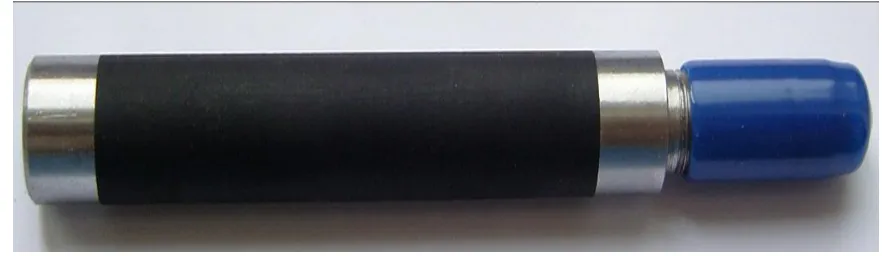
Figure 1 and figure 2 is the axial section and the entity of the hydraulic expansion lever of liquid bag, respectively.
(1) Pressure medium of high pressure is sealed by the flexible container, so the pressure medium does not leak and contact with the inner surface of the tube. Therefore, the method is suitable for determining the fracture property of tubes made of different materials;
(2) Pressure exerted on the inner surface is even, and there is almost no tube deformation along the axial direction;
(3) Pressure medium of high temperature and high pressure cannot leak, so the test cannot pose a threat to a test personnel. Therefore the method can be used in the test of high temperature and pressure;
(4) There is no leak during the process, so no great pressure fluctuations could happen;
(5) There is no need to supply new pressure medium, so the test facility using the method is simple and easy to use.
Figure 1 Axial section of a hydraulic expansion lever of liquid bag
Figure 2 Entity of the hydraulic expansion lever of liquid bag
Test facility and specimen
High pressure pump is used to apply pressure on inner side of the tube. As the pressure is applied on the inner side of the tube specimen by the hydraulic expansion lever, the crack growth can be recorded by high-resolution camera. During the test, pressure gauge and pressure sensor installed in the oil circuit captures pressure signals, which are passed into the computer through data acquisition card.
After crack propagation tests, the relationship that burst pressure changes with crack shape and size, the relationship that crack area opening changes with pressure and crack size can be obtained. Then the fracture mechanics analysis FE models can be modified by the comparison between the test results and the FEA (finite element analysis) results.
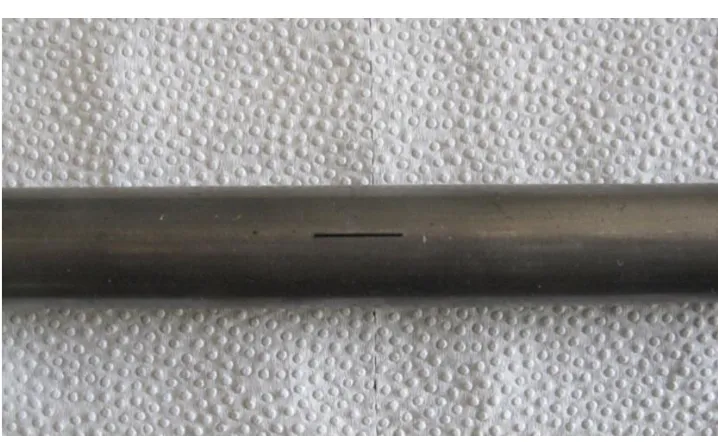
Figure 4 is a test specimen with an artificial through wall crack, width and length of which are 0.2mm and 6mm, respectively.
Figure 3 Test facility
STRESS ANALYSIS MODELS
During operation of SG, locations of cracks in tubes are closely related to the stress distribution. Meanwhile, in order to obtain the crack size by the relevant relationship between the crack size and leak rate, it is necessary to establish the stress distribution of SG tubes under normal operational conditions and design basis accidents. Therefore to establish the effective mechanics models is very important for the integrity assessment of the tube.
SG of HTR-10 uses helical coil tubes as the heat exchange tubes, and the geometry dimensions must be obtained to build the three-dimensional solid model. The first three helical tube sections are warm-up section and phase-change section with diameter of 18 mm and thickness of 3mm, respectively. The final helical tube section is superheated section with a diameter of 18mm and a thickness 2mm. The bending radius of the tube is 56mm. Each helical tube section has 23 turns with a distance between the turns of 22.5mm. Then CATIA is used to build the 3-D model, ABAQUS used to build the FE model and to do the stress analysis.
Since the 3-D model is a simplified model, it needs to be verified. Helical coil tubes of different cycles are built, and the analysis results have verified the accuracy of the simplified models.
MEASUREMENT OF FRACTURE PARAMETER OF HEAT EXCHANGE TUBE
Fracture parameters of SG tubes is required in the integrity assessment process. On one hand, fracture parameters of the source material cannot be used because fracture properties of SG tubes have changed during their manufacturing process. On the other hand, size of tubes in the thickness direction is too small to cut a piece of proper-sized experimental specimen out of steam generator tubes. For these reasons, the J integral of cracks on surface of steam generator tubes are studied and calculated with ABAQUS, and the relationship between J integral and crack length, crack depth, internal pressure are explored. Critical J integral (J1c) of axial through-wall crack on SG tubes is obtained by substituting critical burst pressure
into FEA model.
FRACTURE ANALYSIS MODELS
In the safety evaluation of SG tubes, the most important two factors are the crack behaviour, including the initiation and propagation of the crack, and the leak rate from the crack. And most safety assessment methods are carried out specific to these two factors.
Because volumetric in-service inspection is not applicable to SG tubes of HTGR, and SG tubes having no corresponding models in stress intensity factor manual, finite element analysis becomes a very suitable method under this circumstance.
After analysis of the FE models of SG tubes with axial through wall cracks, the relationship that burst pressure changes with crack size, and the relationship that leak rate changes with pressure and crack size, and the crack propagation law under low cycle fatigue loads have been obtained.
ANALYSIS OF CREEP PROPERTY
US Nuclear Regulatory Commission (2007) points out that if the operation temperature of a reactor is greater than 371℃, it is necessary to consider the effect of creep on structure safety. Creep of materials is an important factor to have influence on structure residual life assessment (Warwic Payten 2006). Under the accident of loss of water of secondary loop in HTGR, the temperature of the steam generator exchange tube is much greater than 371℃, so creep phenomenon is serious. Therefore, it is necessary to consider the influence on the tube safety.
Some research work on static load safety of steam generator tubes subjected to external pressure and their creep properties has also been conducted. Models of steam generator tubes containing various types of defects are established on ABAQUS. FEA is conducted on these models to get the distribution of stress and equivalent creep strain under static external pressure. Safety of steam generator tubes under external pressure has been estimated by comparing the maximum stress and maximum equivalent creep strain with prescribed limits. High-temperature creep property of steam generator tubes under internal pressure is also studied.
FUTURE TREND OF THE NEW TECHNOLOGY
(1) In the loading test by using hydraulic sleeve technique, it is hard to catch the stress and strain distribution of crack surface, especially crack-tip. So accurate fracture parameter cannot be obtained because accurate stress distribution cannot be measured. The reason for this is that light cannot form effective interference and diffraction on tube curved surface, so measurement with optical method cannot be used. In the future, moire interference technology suitable for curved surface should be developed. Besides, width of the artificial crack is too great. Next, the excimer laser processing technology can be amended, or more advanced processing technology, such as Femtosecond Laser, can be used to improve the machining precision, to machining cracks more similar to the real cracks.
(2) In the paper, loading tests on tube with axial cracks have been conducted. Actually, there exist circumferential welds in the HTGR SG helical exchange tube. In order to obtain the relevant relationship between the leak rate and the circumferential through wall crack, loading tests on tube specimen with circumferential through wall crack will be conducted in the future.
(3) Up to now, loading tests on tube with an axial through wall crack are conducted at room temperature. In some cases, to simulate the real load case, the test should be done at high temperature. So hydraulic expansion lever of liquid bag that can be used at high temperature should be developed.
(4) It is supposed that width of the rectangle crack is same along its depth. Actually, it is possible that crack section is trapezoid, ellipse or other irregular shape. In the future, crack models of various sections could be established to be used to calculate J integral and explore the crack propagation law.
ACKNOWLEDGEMENTS. This study has been supported by the State High Technology Research and Development Program: “Study on Steam Generator Tube Integrity Evaluation and Life-Span Predication” (2008AA04Z402).
REFERENCES
IAEA. Strategy for Assessment of WWER Steam Generator Tube Integrity, Report prepared within the framework of the Coordinated Research Project on Verification of WWER Steam Generator Tube
Integrity, December, 2007.
Dong Jianling, Zhang Xiaohang, Yin Dejian, Fu Jiyang. Stress analysis and calculation of the SG heat transfer tube of HTR-10, Nuclear Power Engineering. Vol.22, 2001, pp.433-447. (In Chinese). Zahoor A. Ductile Fracture Handbook. CA: Electric Power Research Institute, 1989.
Paris P C, Tada H. The Application of Fracture Proof Design Methods Using Tearing Instability Theory to Nuclear Piping Postulating Circumferential TW Cracks. NUREG/CR-3464, 1983
Dong Jianling, Xu Yu. Fatigue Life Predication for Steam Generator Tubes with a Crack. Transactions, SMiRT 21.
Dong Jianling, Xu Yu. Study on Fracture Analysis Model for the Steam Generator Tubes. Transactions, SMiRT 21.
Dong Jianling, Xu Yu. Steam Generator Heat Transfer Tube Integrity Based on Leak Rate Detecting. Transactions, SMiRT 21.
Zhang Qijiang, Dong Jianling, Zhu Xinyu, Xu Yu, Hui Hu. A New Experimental Method for the Measurement of Fracture Parameters. Transactions,SMiRT 22, San Francisco, USA, August 17-23, 2013.
Liu Bo, Liu Jun. The Application of Hydraulic Expanding in High–Pressure Heater Manufacturing,
BOLIER MANUFACTURING, No. 4. Pp.54-55
US Nuclear Regulatory Commission. Standard Review Plan: 3.6.3 Leak-Before-Break Evaluation Procedures, 2007.