The ACL RD-TEC 2.0: A Language Resource for Evaluating Term Extraction
and Entity Recognition Methods
Behrang QasemiZadeh
†and Anne-Kathrin Schumann
‡ †DFG Collaborative Research Centre 991, Heinrich-Heine University D¨usseldorf ‡Department of Applied Linguistics, Translation and Interpreting, Saarland University[email protected], annek [email protected]
Abstract
This paper introduces theACL Reference Dataset for Terminology Extraction and Classification, version 2.0 (ACL RD-TEC 2.0). The ACL RD-TEC 2.0 has been developed with the aim of providing a benchmark for the evaluation of term and entity recognition tasks based on specialised text from the computational linguistics domain. This release of the corpus consists of 300 abstracts from articles in the ACL Anthology Reference Corpus, published between 1978–2006. In these abstracts,terms(i.e., single or multi-word lexical units with a specialised meaning) are manually annotated. In addition to their boundaries in running text, annotated terms are classified into one of the seven categoriesmethod,tool,language resource (LR),LR product,model,measures and measurements, andother. To assess the quality of the annotations and to determine the difficulty of this annotation task, more than 171 of the abstracts are annotated twice, independently, by each of the two annotators. In total, 6,818 terms are identified and annotated, resulting in a specialised vocabulary made of 3,318 lexical forms, mapped to 3,471 concepts. We explain the development of the annotation guidelines and discuss some of the challenges we encountered in this annotation task.
Keywords:Terminology, Term Extraction, Term Classification, Entity Recognition, Evaluation Corpus, Language Resource.
1. Introduction
Terminology mining methods are the cornerstone of mod-ern information systems. These methods are concmod-erned with the automatic analysis of languages for special pur-poses—for example, to facilitate knowledge acquisition from text, to enhance the interoperability when commu-nicating knowledge between communities or across lan-guages, to provide information summaries, and so on. One way or another, these methods deal with the extraction of lexical items known asterms.
Linguistically, a term is a lexical unitthat carries a spe-cialised meaning in a particular context (e.g., see Faber and Rodr´ıguez (2012)). According to their lexical forms, terms are eithersimple(made of one word/token) or com-plex (i.e., multi-word units). The extraction of terms has been addressed under various names, different condi-tions (e.g., by restriccondi-tions applied to their input and out-put), and for colourful purposes. The most familiar exam-ples, perhaps, are methods for automatic term extraction (ATR), key-phrase extraction, and entity extraction—see QasemiZadeh (2015, chap. 3) for an explanation of similar-ities and differences between these methods. The evalua-tion of all these methods, however, has been tackled in a similar fashion.
The black-box, data-driven evaluation process—as initiated in the series of message understanding conferences (MUC) and still used in semantic evaluation workshops (SemEval), etc.—is the dominant methodology for assessing and com-paring the performance of term extraction methods.1 MUC-like evaluation systems consist of two major components. The first component is a gold dataset: that is, a collec-tion of manually annotated text. The second component is a collection of performance measures (e.g., precision, re-call, . . . ). Using the performance measures, an extraction
1
SeeLehnert et al. (1994) for a detailed description.
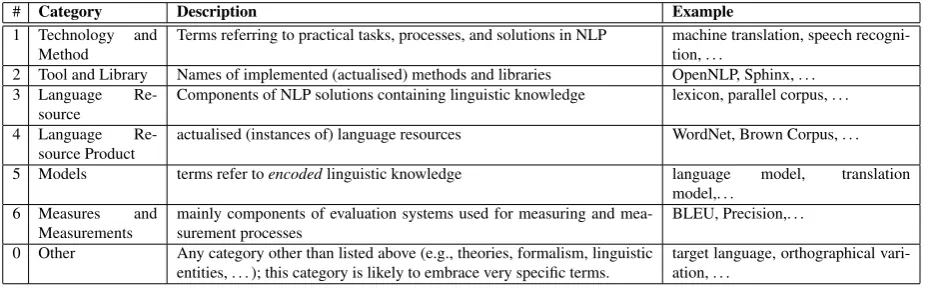
method is then assessed by comparing its output to the an-notations in the ’gold standard’. This paper introduces the ACL RD-TEC 2.0 that has been developed to serve as the first component of this kind of evaluation methodology. Previously introduced by QasemiZadeh and Handschuh (2014), theACL RD-TECprovides manual annotations for a set of more than 80,000 lexical units extracted from the ACL Anthology Reference Corpus—also known as the ACL ARC (Bird et al., 2008). These lexical units are manually annotated either as valid or invalid terms. Valid terms are then further categorised astechnology and non-technology terms.2 Hence, the ACL RD-TEC is suitable for the evaluation of ATR and term classification methods. In this second release, the ACL RD-TEC dataset is ex-tended in two ways. First, instead of providing annotations for a list of isolated lexical units, 300 abstracts from the ACL ARC have been fully annotated for the terminology they contain. Two annotators3 (with expertise in computa-tional linguistics) have carefully read these abstracts, and in accordance with a detailed set of guidelines, they have marked lexical boundaries for all the terms they encoun-tered. Secondly, we have extended the term categorisation scheme. Instead of technology and non-technology terms, terms have been semantically grouped into 7 co-hyponym categories (see Table1). An example of an annotated ab-stract is shown in Listing 1. Consequently, apart from ATR and term classification, the second release of the ACL RD-TEC is suitable for the evaluation of entity recognition methods.
In the remainder of this paper, Section2 further explains the motivation behind the development of this resource. In Section 3, we describe the process of developing the an-notation guidelines. In Section4, we report changes that
2
ACL RD-TEC is available through ELDA (Behrang Qasem-iZadeh, 2014).
3
# Category Description Example 1 Technology and
Method
Terms referring to practical tasks, processes, and solutions in NLP machine translation, speech recogni-tion, . . .
2 Tool and Library Names of implemented (actualised) methods and libraries OpenNLP, Sphinx, . . . 3 Language
Re-source
Components of NLP solutions containing linguistic knowledge lexicon, parallel corpus, . . .
4 Language Re-source Product
actualised (instances of) language resources WordNet, Brown Corpus, . . .
5 Models terms refer toencodedlinguistic knowledge language model, translation model,. . .
6 Measures and Measurements
mainly components of evaluation systems used for measuring and mea-surement processes
BLEU, Precision,. . .
0 Other Any category other than listed above (e.g., theories, formalism, linguistic entities, . . . ); this category is likely to embrace very specific terms.
[image:2.595.65.531.68.212.2]target language, orthographical vari-ation, . . .
Table 1: Semantic categories in the ACL RD-TEC 2.0.
Listing 1: Example of an annotated abstract.
<?xml version="1.0" encoding="UTF-8" standalone="
,→ no"?>
<Paper acl-id="P05-2016">
<Title>Dependency-Based Statistical Machine
,→ Translation</Title> <Section>
<SectionTitle>Abstract</SectionTitle>
<S>We present a <term class="tech">Czech-English
,→ statistical machine translation system</
,→ term> which performs <term class="tech">
,→ tree-to-tree translation</term> of <term
,→ class="other">dependency structures</term>
,→ .</S>
<S>The only <term class="lr">bilingual resource</
,→ term> required is a <term class="lr">
,→ sentence-aligned parallel corpus</term>.</
,→ S>
<S>All other <term class="lr">resources</term>
,→ are <term class="other">monolingual</term>
,→ .</S>
<S>We also refer to an <term class="measure(ment)
,→ ">evaluation method</term> and plan to
,→ compare our <term class="other">system’s
,→ output</term> with a <term class="measure(
,→ ment)">benchmark system</term>.</S> </Section>
</Paper>
are observed in the inter-annotator agreement during this procedure. In Section5, we report the current state of the corpus and its manual annotations. We conclude in Sec-tion6 by discussing challenges met during the process of annotating this corpus.
2. Why AC RD-TEC?
Searching publications and browsing language resource di-rectories, one finds that several datasets comparable to the ACL RD-TEC already exist—for example the GENIA (Kim et al., 2003) or the CRAFT corpora (Bada et al., 2012). Therefore, it is likely that a curious mind points to these resources and asks ‘why do we need ACL RD-TEC?’. Firstly, for computational linguists, the use of resources in domains other than computational linguistics—for exam-ple, the GENIA corpus in the domain of molecular
biol-ogy—is hindered by an obstacle: the minimal prerequisite knowledge that is required to understand this literature (not to mention the specialised discourse and style of writing in these domains). An understanding of these texts, perhaps, is essential to enable a computational linguist to first com-prehend and then describe a linguistic phenomenon. Hence, text mining in a specialised domain is often conducted by a team that includes experts in the domain under investiga-tion, or computational linguists who have specialized train-ing (as best exemplified by research teams conducttrain-ing bio-text mining). Conducting bio-text analyses and lexicography in domains other than computational linguistics, therefore, may not be the first, best choice for computational linguists. Secondly, existing corpora and resources for benchmarking terminology extraction methods largely ignore the tempo-ral aspect of the development of terms (and thus knowledge and technologies). In this sense, the ACL ARC and conse-quently the ACL RD-TEC 2.0 are unique resources: The annotated corpus contains scientific texts published during more than three decades.4 Therefore, this resource can be employed as a valuable asset in research investigating the history of science (e.g., as inSchumann and QasemiZadeh (2015b)), apart from trending tasks such astrend analysis (e.g.,Mariani et al. (2014)).
Thirdly, in the development of the ACL RD-TEC, an im-portant emphasis has been put on the transparent develop-ment of the resource. We believe that the difficulty of the problem of identifying terms (i.e., their lexical boundaries in running text as well as their semantic connotations) has been largely overlooked. We claim that annotating terms and building specialised vocabularies is a much harder task than building resources for similar tasks such as named en-tity recognition. Deciding whether a lexical unit (i.e., either a word or a phrase) in a given context is a term or not is not a straightforward decision. Decisions of this type are likely to be influenced by presupossitions and extra-linguistic fac-tors such as text length, etc.
To investigate this problem, apart from keeping an inven-tory of the changes applied during the development of the guidelines, more than 171 abstracts in the ACL RD-TEC were annotated by 2 experts. By publishing these
anno-4
tations separately in one resource,5 we aim to provide a resource which addresses the requirements for qualitative assessments of the difficulties that are encountered when developing specialised vocabularies.
3. Development of the Annotation Guidelines
The guidelines used for the development of the ACL
RD-TEC 2.0 can be found in Schumann and QasemiZadeh
(2015a). Initially, these guidelines were drafted based on those previously used for the development of the first re-lease of the dataset (seeQasemiZadeh (2014)). Apart from providing general information about the task (such as a con-cise theoretical background, information about the text be-ing annotated, examples, . . . ), the guidelines consist of a number of concrete rules and criteria which are categorised assemantic,linguistic, andformal.
The semantic criteria elaborate an organisation of terms into several categories of concepts (see Table 1). Formal criteriaspell out rules for deciding about the boundaries of terms, one of the major challenging tasks in the annotation process—for example, rules for dealing with term abbre-viation sequences (such as “machine translation (MT)”), rules for deciding whether adjectival modifiers should be included into the term span as well as rules describing how to split longer noun phrases containing several term candi-dates (e.g. “TREC 2003 and TREC 2004 QA tracks” and “automatic evaluation of machine translation and document summarization”). Finally,linguistic criteriaenumerate lin-guistic characteristics of terms (of which the most impor-tant one is that annotations are restricted to nominals).
In order to develop and refine these three criteria, we em-ployed an iterative process of annotating a small, fixed set of abstracts (Figure1). In the first iteration, a set of 10 ab-stracts was selected randomly. Independently of each other, we annotated these abstracts. In turn, using a tool that was developed to compare annotations against each other, the annotators found and discussed conflicting annotations (re-garding the boundaries of terms and their semantic cate-gorisations). As the outcome of this discussion, the guide-lines were elaborated and new rules were added, when nec-essary. Using the new, refined guidelines, the same pro-cedure was repeated: a set of 22 abstracts was annotated from scratch, and the resulting annotations were compared to refine the guidelines. This iterative process was repeated until we agreed that the guidelines were sufficient and could not be improved (i.e.,fouriterations altogether). Interested readers can find additional information about the evolution of the guidelines by browsing the document history ap-pended to the guidelines document.
For asserting annotations in the abstract, we simply use text editors and tags in a ’semi-XML’ format. The sanity of manual annotations is then checked using a self-coded Java tool and in turn the annotated abstract files are converted to a valid XML format as shown in Listing1.
5And, by encouraging the annotation of these abstracts by
ad-ditional members of the community.
Initial Guidelines + Fixed Small Set of Abstracts
Manual Annotation
[image:3.595.309.517.69.148.2]Finding and Discussing Conflicts Refining Guidelines
Figure 1: The iterative process of developing and refining the annotation guidelines: Given a small, fixed set of ab-stracts, the initial guidelines were refined through an itera-tive process to achieve higher inter-annotator agreement.
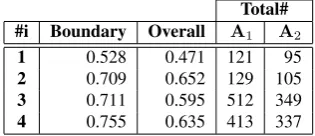
Total# #i Boundary Overall A1 A2
1 0.528 0.471 121 95
2 0.709 0.652 129 105 3 0.711 0.595 512 349 4 0.755 0.635 413 337
Table 2: Changes in the inter-annotator agreement achieved through the iterative refinement of the guidelines. Agree-ment is assessed using the F-scores when all the annotations from different abstracts are consolidated in one list. #i de-notes the number of iterations; Total# shows the number of annotations asserted by the first (i.e., A1) and the second
annotator (A2) in each iterations. Note that for #i=3 and 4,
12 additional abstracts are added.
4. Inter-Annotator Agreement During the Develop-ment of the Guidelines
In this section, we report the statistics regarding the inter-annotator agreement (IAA) during the process of develop-ing the guidelines. Since we cannot give a clear estima-tion of the number of possible terms—and their length—in the text being annotated (given the fact that many terms are multi-word units), chance-corrected IAA measures such as Cohen’sκcannot be applied in this context. Simply put, in order to use chance-corrected measures such as Cohen’s
κ, the set of entities in the annotation task must be known prior to the task.6
To assess the IAA, we calculate the F-score measure as follows:
F-score= 2×r×p
r+p , (1)
in whichp(i.e., precision) andr(i.e., recall) are computed asp= |tp|
|tp|+|fp|, andr= |tp|
|tp|+|fn|. In these equations,|tp| denotes the number of lexical items that are annotated as termsby both of the annotators;|fp|denotes the number of lexical items that are annotated as terms only by the first annotator; similarly,|fn|is the number of lexical items that are annotated as terms only by the second annotator.7
6
Assuming that the number of possible terms in text is very large, the hypothetical probability of chance agreement, in fact, approaches 0 (i.e.,pe→0). Note that from an ultimate
perspec-tive, any combination of words in a sentence can be a term. If|W| is the number of words in a given sentenceS, potentially there are 2|W|terms inS. Thus, the claim thatpe→0seems reasonable.
7
[image:3.595.344.502.222.290.2]#i Boundary Overall
µ σ µ σ
[image:4.595.99.243.68.137.2]1 0.49 0.039 0.423 0.04 2 0.692 0.044 0.638 0.032 3 0.724 0.04 0.602 0.039 4 0.741 0.023 0.63 0.018
Table 3: Changes in the inter-annotator agreement achieved through the iterative refinement of the guidelines using the averaged F-scores. F-scores are computed per abstract and then are averaged as a figure of merit of the agreement be-tween annotators. #i denotes the number of iterations; µ
andσdenote the arithmetic mean and the standard devia-tion, respectively.
To count the number of the true and false positives as well as the false negatives, in the first instance, we use exact matches for comparing the term boundaries and their se-mantic classes. As an example, consider the text snippet:
. . . for robust natural language processing in . . .
If the first annotator marks “robust natural language pro-cessing” and the second annotator marks “natural language processing” as a term, then we count these annotations as unmatched (i.e., either asfalse positiveorfalse negative de-pending on which annotator is taken as a reference8). Since the boundaries of the two terms do not match, their seman-tic classes will also remain unmatched.
Given the description above, we compute and report theF -scores (see Equation1) for the assessment of the IAA for:
(a) Only the term boundaries: In the example above, us-ing this measure, it is verified whether both annota-tors mark “statistical natural language processing” as a term.
(b) Overall: Both term boundaries and their assigned se-mantic classes are matched. Using this measure, we check whether the annotations are indeed identical on both categories. Thus, the reported F-score for item (a) sets the upper bound limit for theOverall perfor-mance.
These measures are reported for each of the four iterations. Table2lists the computed F-scores when annotations from all the abstracts are consolidated in one list (to cancel bias that may result from the difference in the length and num-ber of sentences in abstracts). Similar results are reported in Table3where the computed F-scores are averaged over the set of abstracts in the pilot annotation task. That is, the F-Scores are first computed per abstract file and then they are averaged to report the overall performance. These averaged numbers may better represent the performances of annota-tors when they deal with different topics in the corpus (e.g., machine translation, anaphora resolution, etc.). Table4 de-tails the number of annotated terms and their distribution in the envisaged semantic classes.
To further detail the performance of annotators in the sub-task of assigning semantic classes to terms, we report the
8Note that choosing the reference annotator does not affect the
computed F-scores.
inter-annotator agreements on this sub-task by limiting the input only to the subset of terms that both annotators have identified—that is, an intersection of resulting annotations for term boundaries (see Table 4, numbers embraced in parentheses). For this case, however, we use Cohen’s κ
as an indication of the inter-annotator agreement. For the obtained set of annotations in each iteration,κis measured using:
κ=po−pe
1−pe, (2)
where the observed agreement probabilitypois given by:
po=
1
|T|
X
c∈C
ac, (3)
whereacis the number of terms assigned to the same se-mantic class c ∈ Cby both annotators, andT is the total number of annotated terms (|T|). Likewise, the probability of agreement by chance (pe) is given by:
pe=X
c∈C
pc×p0c, (4)
wherepcandp0care the probabilities of assigning semantic categorycto a term by the first and the second annotator, respectively.9Table5shows the computedκfor each itera-tion; similar to Table2and3, these numbers are computed for (a) when all terms (of identical span) are collected from different abstracts and compared in one go, and (b) whenκ
scores are computed per abstract and then averaged. As shown, while IAA is “mostly” satisfactory (F-Score above 0.70 for term boundaries and F-Score andκaround 0.60in semantic class assignment), it is still far from com-plete agreement. Despite our efforts during this proce-dure—that is, extensive discussions as well as the elabora-tion of the criteria in the guidelines both for term bound-aries and semantic classes—we were not able to always resolve conflicts and choose one of the suggested values for term boundaries or semantic classes as the “correct an-swer”. As mentioned earlier, presuppositions and the level of the annotators’ expertise in topics they deal with, as well as factors such as text length, the style of writing (and even inaccurate assertions by the authors of the original text) may well play a role in the motivation of disagreement. These factors certainly must be taken into consideration when developing and evaluating term recognition and clas-sification methods.
To emphasise and investigate the difficulty of the task, we report theself-agreement for annotating a fixed set of ab-stracts using the same guidelines. In a first session, each annotator performed the annotations for 10 abstracts; in a second session a day after this first session, the annotator repeated the annotation task for these 10 abstracts. Ta-ble6 reports the agreement between annotations obtained from these two sessions for each of the annotators. As Ta-ble6 shows, even a highly trained annotator cannot reach a 100% agreement on annotating term boundaries and se-mantic classes with himself (herself)—that is, annotations
9Note thatmodelandmeasure(ment)have been added as
Iterations
1 2 3 4
Category A1 A2 A1 A2 A1 A2 A1 A2
LR 7 (5) 7 (6) 6 (5) 11 (10) 41 (31) 49 (45) 28 (19) 27 (25)
LR-Prod 0 (0) 0 (0) 0 (0) 0 (0) 6 (5) 8 (7) 1 (1) 0 (0)
Measure(ment) 0 (0) 0 (0) 0 (0) 0 (0) 0 (0) 0 (0) 51 (31) 35 (23) Model 0 (0) 0 (0) 0 (0) 0 (0) 0 (0) 0 (0) 15 (12) 34 (31) Tech 45 (21) 48 (26) 47 (28) 38 (28) 141 (83) 85 (72) 137 (100) 99 (91)
Tool 1 (0) 1 (0) 1 (1) 1 (1) 6 (2) 16 (16) 4 (4) 2 (2)
[image:5.595.89.505.68.192.2]Other 68 (31) 39 (25) 75 (49) 55 (44) 318 (185) 191 (166) 177 (116) 140 (111) Total# 121 (57) 95 (57) 129 (83) 105 (83) 512 (306) 349 (306) 413 (283) 337 (283)
Table 4: Distribution of the assigned semantic classes per annotator per iteration. Numbers in parentheses show the statistics only for the subset of text spans that are marked as term by both annotators.
Averagedκper Abst.
#iteration κ µ σ
1 0.76 0.584 0.156
2 0.787 0.774 0.048
3 0.608 0.56 0.107
[image:5.595.84.257.243.308.2]4 0.67 0.656 0.057
Table 5: IAA using Cohen’sκonly for the subset of terms with identical boundaries, when all annotated terms are compared disregarding the abstract file they appear in, and (b) when theκscore is measured per abstract and averaged to report the performance.
Annotator Boundary Overall κCategory
µ σ µ σ µ σ
1 0.881 0.093 0.854 0.006 0.889 0.019 2 0.823 0.029 0.713 0.036 0.562 0.138
Table 6: Self-agreement in the annotation task: The same set of abstracts are annotated using the same guidelines in two sessions that were apart a day. Reported numbers are computed similarly to those reported in Table3and Table5 (i.e., they are averaged over the abstracts).
produced by one annotator for the same text in two different sessions are not identical. The reported self-agreement in Table6, perhaps, can be viewed as a realistic upper bound baseline for the assessment of IAA scores.
Category A1 A2 IAAo
LR 125 (95) 127 (109) 0.69 LR-Prod 22 (18) 14 (13) 0.667 Measure(ment) 119 (90) 119 (90) 0.63 Model 91 (77) 232 (202) 0.44 Tech 720 (589) 713 (629) 0.738 Tool 50 (43) 42 (41) 0.826 Other 1459 (1108) 1169 (936) 0.678 Total# 2586 (2020) 2416 (2020) 0.727
Table 7: Statistics for the 171 abstract files that are anno-tated twice. A1 and A2 denote annotators. Parenthesised
numbers show the count of commonly identified terms boundaries (i.e., both annotators agree on term boundaries, but not necessarily on semantic classes). The IAAoshows
the F-Score resulting from the identification of terms with identical boundaries and semantic classes.
5. Statistics for the Annotated Abstracts
The ACL RD-TEC 2.0 consists of 300 annotated abstracts. To choose these abstracts, we employed stratified random sampling. Abstracts that could be extracted automatically using the ParsCit tool (Councill et al., 2008) (about 8500 abstracts) from the raw text files are grouped by their year of publication (i.e., 1965–2006). For each year’s publica-tions (beginning from 1978), a number of abstracts are se-lected randomly while maintaining each year’s proportional share in the overall number of publications. The result-ing 300 abstracts are then segmented into sentences10 in which OCR11and segmentation errors are corrected manu-ally. The result is a corpus of 1,384 sentences and 33,216 tokens.
Among these 300 abstracts, 171 are annotated twice (i.e., independently by each of the annotators). Hence, the pub-lished dataset contains 471 annotated files: 179 abstracts annotated only once (by one of the annotators), 171 ab-stracts annotated by the first annotator, and the same set of 171 abstracts annotated by the second annotator. Note that these abstracts are labelled in a way that they can be grouped by the year of their publication and annota-tor; therefore, one may fuse or remove annotations from the files according to the evaluation context. The double-annotated 171 abstracts consist of 817 sentences and 19,476 tokens. In total, in these 171 abstracts, both annotators have identified 2,020 common term boundaries which re-sults in an F-score of 0.808 for the identification of term boundaries. The overall F-score performance (i.e., anno-tated terms with the same boundary and the same semantic class as explained in Section4) is 0.727.
Table7details statistics about the number of terms marked by each annotator and their agreement for the assignment of semantic classes. For instance, as shown in the first row of Table 7, the first annotator identifies 125 terms of se-mantic classLRwhere the second annotator identifies 127 LR terms. Amongst the 125 terms that the first annotator marked as LR, only 95 are also identified as valid terms by the second annotator. These 95 terms, however, are not necessarily classified as LR by the second annotator as indi-cated in the table (see IAAo). As shown, the highest
agree-ment has been achieved in annotating terms that refer to
10
Using OpenNLP pre-trained sentence splitting (https:// opennlp.apache.org/.)
11
[image:5.595.53.289.392.439.2] [image:5.595.70.268.602.700.2]Semantic Categories
[image:6.595.90.507.68.134.2]Abstract Sentence Term LR LR-Prod Measure(ment) Model Tech Tool Other Annotator 1 189 900 2857 145 27 131 102 790 54 1608 Annotator 2 282 1301 3961 231 33 183 328 1124 83 1979 Total# 471 2201 6818 376 60 314 430 1914 137 3587 Unique# 300 1384 4849 276 47 218 338 1314 94 2562
Table 8: Statistics for the ACL RD-TEC 2.0: Shown are the number of annotated units, and the distribution of the semantic classes assigned to terms by each annotator (first and second row). The row marked by ’total#’ shows the sum of all entities, including identical annotations that are manually asserted by both annotators. The ’unique#’ row, however, shows the numbers for uniquely asserted entries in the dataset. As mentioned earlier, the 4,849 term annotations yield to a specialised vocabulary of size 3,318.
specific software packages (i.e., category tool), while the least reliable annotations are for the categorymodel. We conclude this section by reporting detailed statistics for various linguistic entities and annotations in this release of the corpus (see Table8).12 The corpus is freely available to download from the LINDAT/CLARIN Infrastructure (see (QasemiZadeh and Schumann, 2016)).
6. Discussion
Building on knowledge gathered from previous experience in the development of the first release of the ACL RD-TEC, the ACL RD-TEC 2.0 annotates terms in 300 abstracts and classifies them into 7 categories of concepts. Half of the abstracts in this release of the corpus are double-annotated and they are published independently with the (additional) goal of providing material for analysing annotators’ agree-ment and investigating difficulties in constructing termino-logical resources.
The ACL RD-TEC 2.0, by all means, is still far from being an ideal resource for benchmarking terminology extraction and classification. However, as a wise man once said, ‘per-fection is the enemy of good’; despite all its shortcomings, the ACL RD-TEC 2.0 brings us a step closer towards build-ing a resource of familiar texts for computational lbuild-inguists who are interested in topics such as terminology extraction, history of science, and automatic content analysis of schol-arly publications.
The presented work and the annotation scheme can be ex-tended in many ways: Semantic categories can be refined and extended, many layers of annotations must be added to the corpus (e.g., term variants must be marked, morpho-syntactic information must be inserted, and so on). Apart from these classic considerations, during the development of this resource, we have identified a number of linguis-tic phenomena that have been less discussed in terminol-ogy publications, particularly in the context of language re-source development.
We have found contextual variation and ellipsis to consti-tute a source of challenge and conflict during the annota-tion task. In many cases, authors shorten terms and use just the head of the nominal group instead of the whole term. In particular, this is often the case in anaphoric contexts (e.g., as in “. . . our method . . . ”, “. . . proposed algorithm. . . ”).
12The corpus can be browsed on-line, seehttp://pars.ie/
lr/acl_rd-tec; see also ACL RD-TEC 2.0 in the kontext sys-tem: https://lindat.mff.cuni.cz/services/kontext/ run.cgi/first_form?corpname=aclrd20_en_a.
Deciding whether to annotate these structures or not was a source of controversy during our annotation task. While we have omitted this type of structure from this release of the corpus, more elaboration on this topic is certainly an in-teresting avenue for future work. We encountered a similar problem when annotating coordinate structures (e.g., as in “. . . information extraction and retrieval. . . ”).
In addition, the study of systematic polysemy in specialised text can be an interesting future research. In the context of our annotation task, for example, we noticed that terms that are often classified as “method” are also used to denote the specific “problem” (or “task”) that they are designed for. In many occasions, annotation of these terms were a cause of disagreement between the annotators. Lastly, we recognise that the annotation of linguistic units other than nominals (e.g. verbs and adjectives) is also important for building a comprehensive resource.
7. Acknowledgements
The work described in this paper was partially funded by the DFG (Deutsche Forschungsgemeinschaft) through the Cluster of Excellence “Multimodal Computing and Inter-action” and the “Collaborative Research Centre 991 (CRC 991): The Structure of Representations in Language, Cog-nition, and Science”. We are grateful to Prof. Elke Teich and Prof. Laura Kallmeyer for supporting development and dissemination of this resource.
8. Bibliographical References
Bada, M., Eckert, M., Evans, D., Garcia, K., Shipley, K., Sitnikov, D., Baumgartner, W., Cohen, K., Verspoor, K., Blake, J., and Hunter, L. (2012). Concept annotation in the CRAFT corpus. BMC Bioinformatics, 13(1):161. Bird, S., Dale, R., Dorr, B., Gibson, B., Joseph, M.,
Kan, M.-Y., Lee, D., Powley, B., Radev, D., and Tan, Y. F. (2008). The ACL Anthology Reference Corpus: A Reference Dataset for Bibliographic Research in Com-putational Linguistics. In Proceedings of the Interna-tional Conference on Language Resources and Evalua-tion, LREC 2008, Marrakech, Morocco, May. ELRA. Councill, I. G., Giles, C. L., and Kan, M.-Y. (2008).
Parscit: an open-source CRF reference string parsing package. InProceedings of the International Conference on Language Resources and Evaluation, LREC 2008, Marrakech, Morocco, May. ELRA.
Cog-nitive Linguistics View of Terminology and Specialized Language, volume 20 ofApplications of Cognitive Lin-guistics, pages 9–33. Walter de Gruyter.
Kim, J.-D., Ohta, T., Tateisi, Y., and Tsujii, J. (2003). GE-NIA corpus—a semantically annotated corpus for bio-textmining. Bioinformatics, 19(Suppl 1):i180–i182. Lehnert, W., Cardie, C., Fisher, D., McCarthy, J., Riloff, E.,
and Soderland, S. (1994). Evaluating an information ex-traction system. Journal of Integrated Computer-Aided Engineering, 1(6).
Mariani, J., Paroubek, P., Francopoulo, G., and Hamon, O. (2014). Rediscovering 15 Years of Discoveries in Language Resources and Evaluation: The LREC Anthol-ogy Analysis. InProceedings of the International Con-ference on Language Resources and Evaluation, LREC 2014, Reykjavik, Iceland, May. ELRA.
QasemiZadeh, B. and Handschuh, S. (2014). The
ACL RD-TEC: A dataset for benchmarking terminology extraction and classification in computational linguistics. In Proceedings of the International Workshop on Com-putational Terminology, Computerm 2014, Dublin, Ire-land, August. ACL.
QasemiZadeh, B., (2014). The ACL RD-TEC: Annotation Guideline (Ver 1.0). National University of Ireland. QasemiZadeh, B. (2015). Investigating the Use of
Distri-butional Semantic Models for Co-Hyponym Identifica-tion in Special Corpora. Ph.D. thesis, NaIdentifica-tional Univer-sity of Ireland, Galway, July.
Schumann, A.-K. and QasemiZadeh, B., (2015a).
The ACL RD-TEC Annotation Guidelines. Saar-land University and National University of
Ire-land, ver. 2.6 edition. Available from http:
//pars.ie/publications/papers/pre-prints/ acl-rd-tec-guidelines-ver2.pdf.
Schumann, A.-K. and QasemiZadeh, B. (2015b). Tracing Research Paradigm Change Using Terminological Meth-ods: A Pilot Study on ’Machine Translation’ in the ACL Anthology Corpus. InProceedings of the International Conference on Terminology and Artificial Intelligence, TIA 2015, Granada, Spain, November. CEUR Workshop Proceedings.
9. Language Resource References
Behrang QasemiZadeh. (2014). ACL RD-TEC: A
Refer-ence Dataset for Terminology Extraction and Classifi-cation Research in Computational Linguistics. Behrang QasemiZadeh, distributed via ELRA, Terminology, 1.0, ISLRN 699-305-362-089-6.