22
Contour Crafting
A POTENTIAL REVOLUTION IN THE CONSTRUCTION INDUSTRY
Nohil
B. Thakur
Civil Engineering Department
Vishwakarma Institute of Information Technology, Pune. [email protected]
Abstract- As we already know the world population has now exceeded the 7 billion mark, and if the prognosis of the United Nations comes true, there will be 9.2 billion people in 2050. As the case is today, most of the people will want to live in the megacities because they promise a better life and wealth. Due to this, the population density in the cities would increase like never before. This would lead to redevelopment and slum rehabilitation projects to be undertaken on large scale. Imagine a situation wherein a huge bunch of people will need an urgent space to live in. Thus, a situation will arise whence the cities will have to grow rapidly but also sustainably, keeping in mind the environmental effects and also the economy.Contour Crafting is an emerging technology that uses robotics to construct free form structures by repeatedly laying down layers of material such as concrete. This has a great potential in automated construction of whole structures as well as sub-components. Using this process, a single house or a colony of houses, each with possibly a different design, may be automatically constructed in a single run. Tool path planning and optimization benefits the technology by increasing the efficiency of construction of complicated structures. This research has intended to provide a systematic solution for improving the overall system efficiency and realizing the automation of the CC technology for building custom-designed houses. CC can automatically construct custom-designed structures by repeatedly laying down construction material. CC has the capability to fabricate with thick layers using various materials and without compromising surface quality unlike other automation methods.
1. INTRODUCTION
The 3D Printing Technology is one the most prolific of the latest technological inventions that world has seen in the recent years. It has got numerous applications in the industrial field, the Construction Industry being one of them. If this technology is used judiciously, it has a potential to completely revolutionize the construction industry. In developing nations like our India, this technology if harnessed with a proper insight could prove to be a boon.
3D Printing (also known as Additive manufacturing) is a process for making a three dimensional object of almost any shape from a 3D model or other electronic data source. It is primarily an additive process in which successive layers of material are laid down under computer control.
Although the Additive Manufacturing technique was invented in 1984, it was not known as 3D printing then, until 1995. But this technology remained dormant for many years until recently in the year 2012 when the market for 3D printing went up by 29% due to extensive research and new applications for the same
being recognized by the researchers in few parts of the world.
Some studies also indicate that 3D printing could become a mass market product enabling consumers to save money associated with purchasing common household objects. For example, instead of buying a factory made object in the store, a person might instead print it at home from a downloaded 3D model. If this becomes true then it would be great revolution the worldwide market and inflation rates may also come down.
2. 3D-PRINTED HOUSES: CONTOUR CRAFTING
International Journal of Research in Advent Technology (E-ISSN: 2321-9637)
Special Issue
National Conference
“VishwaCon'16”, 19 March 2016
23 Contour Crafting is a layered fabrication technology
[image:2.595.63.287.107.383.2]developed by Dr. Behrokh Khoshnevis of the University of Southern California. Contour Crafting technology has great potential for automating the construction of whole structures as well as sub-components. Using this process, a single house or a colony of houses, each with possibly a different design, may be automatically constructed in a single run, embedded in each house all the conduits for electrical, plumbing and air-conditioning.
Fig. 1 A typical 3D printing Equipment for Contour Crafting
3. CONTOUR CRAFTING COMPARED TO OTHER METHODS
A. Speed of Construction
Construction Rate is the most prominent advantage when it comes to this technology. While the conventional building routine requires atleast about a month construction of a single house unit excluding painting work, the contour crafting technique boasts of completing a multiple units within 24 hours. Imagine the difference in production rate that might occur if multiple units are simultaneously equipped and set forward for a project.
B. Cost of Construction
Cost Saving is another major factor worthy of a note. The cost of constructing a single storied house having a built up area of 1000 sq.ft. by conventional methods is about 2000INR per Sq.ft which amounts to 2000000 INR. But using the Contour crafting technology this can be achieved merely in the range of 6000 USD per unit which amounts to about 360000 INR. Thus, it can be seen that a large scale production will prove to be very beneficial from the economic point of view. The Table given below explains how and by what range the cost savings would be possible by use of contour crafting.
TABLE I
Cost Savings In Contour Crafting Compared To Conventional Construction
Project
Parameter Savings How?
Financing 20-25%
Short project Length & Control Over Marketing Time
Materials 25-30%
Negligible wastage, No Requirement of Formwork
Labour 50-75%
Automation of Construction Process
C. Architectural Flexibility
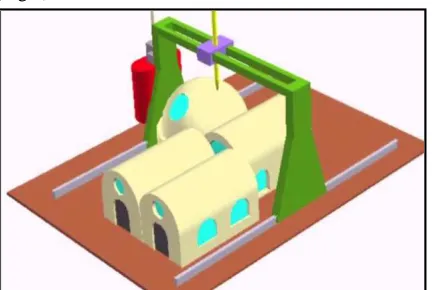
[image:2.595.64.278.387.524.2]Architectural Flexibility is another aspect where Contour Crafting will be having an edge against other construction techniques. Irregular and dome shaped structures will also be able to be constructed with ease (Fig 3).
Fig. 2 An Artistic Impression of a large 3D printer at work
[image:2.595.318.534.552.697.2]The graphs shown above show the superiority of contour crafting method over the other methods in terms of speed and cost of construction as well as architectural flexibility.
D. Environmental Impact
Environmental Impact of the construction practices is something that most concerns the environmentalists. This is because the process involved in construction of any structure by conventional methods involves lot of wastage of materials as well as emission of lot of Carbon Dioxide into the environment. But in case of the 3D printing technique the material constituting the ink for printing the components of the building includes recycled industrial wastes along with certain binding material. The wastage of material can also be avoided since the exact quantity of material used for construction can be worked out by the computerized equipment digitally.
Fig. 4 & 5 - Comparison Charts showing cost efficiency and Speed of Construction
Masonry and Contour Crafting.
The graphs shown above show the superiority of contour crafting method over the other methods in cost of construction as well as
Environmental Impact of the construction practices is something that most concerns the environmentalists. This is because the process involved in construction of re by conventional methods involves lot of wastage of materials as well as emission of lot of Carbon Dioxide into the environment. But in case of the 3D printing technique the material constituting the the components of the building includes recycled industrial wastes along with certain binding material. The wastage of material can also be avoided since the exact quantity of material used for construction can be worked out by the computerized
Quality Control
Complete mechanization can be achieved using this technique. The only requirement of
supervising staff and a couple of labour
unavoidable circumstances. Even the plumbing fixtures and the steel reinforcements can be installed using these multipurpose 3D printers. Moreover, the
formwork will also be p
construction of cantilever projections. The mechanized work will also ensure that the quality of construction remains uniform and error free.
4. DRAWBACKS
A. Employment Issues
When it comes to drawbacks, one of the most alerting facts is that due to complete mechanization, the labour class will suffer due to lack of job opportunities. Indian construction industry provides jobs for millions of people. If the implementation of such automated construction facilities takes place, l
lose their jobs resulting in a situation of distress.
B. Strength of Construction
Another drawback is the strength of construction which is less in comparison to conventional concrete structures. This is mainly because of the lack of compaction of the material placed in construction. But this shortcoming as of now is not of much importance to designers since this technology is in use only for the low cost house construction.
advancement of research in this field, techniques be developed to overcome this shortcoming.
0 5 10 15 20
CO2 Emission Embodied Energy 10E*05
J/kg
#CMU- Concrete Masonry Unit $
CC- Contour Crafting
Comparison Charts showing cost and Speed of Construction for Concrete Masonry and Contour Crafting.
Fig. 6 Comparison Charts showing CO
energy for Concrete Masonry and Contour Crafting.
24 Complete mechanization can be achieved using this technique. The only requirement of personnel will be a supervising staff and a couple of labourers in some Even the plumbing fixtures and the steel reinforcements can be installed using these multipurpose 3D printers. Moreover, the need for formwork will also be practically nil except for construction of cantilever projections. The mechanized work will also ensure that the quality of construction remains uniform and error free.
When it comes to drawbacks, one of the most alerting facts is that due to complete mechanization, the labour e to lack of job opportunities.The Indian construction industry provides jobs for millions of people. If the implementation of such automated construction facilities takes place, lots of people will
ing in a situation of distress.
Another drawback is the strength of construction which is less in comparison to conventional concrete structures. This is mainly because of the lack of paction of the material placed in construction. But this shortcoming as of now is not of much importance to designers since this technology is in use only for the low cost house construction. Moreover, with advancement of research in this field, techniques will be developed to overcome this shortcoming.
Embodied Energy CMU
CC 10E*03
J/kg
International Journal of Research in Advent Technology (E-ISSN: 2321-9637)
Special Issue
National Conference
“VishwaCon'16”, 19 March 2016
25 CASE STUDY
In China, a company named WinSun Decoration Design Engineering has built ten 3D printed houses entirely out of recycled materials in less than 24 hours. The printer used for this purpose was assembled by importing its parts from overseas. It measures 32 meters long by 10 meters wide and is 6.6 meters in height. The printer is capable of printing houses having a plan area of about 200sq.m. The materials used for construction included a mixture of industrial wastes and other inexpensive materials.
Fig. 7 The 3D printing Equipment used by WinSun Corporation, China
[image:4.595.66.284.260.419.2]The construction task was fully automated and there was no requirement of labour at all. The approximate cost for construction of each unit was under 5000 USD, which is quite an achievement for a relatively new construction process.
Fig. 8 A typical house constructed using 3D printing technology by WinSun Corporation, China
INDIAN SCENARIO
India is one of the fast developing nations of the world which is facing an acute shortage of space due to major population migrating towards the big cities in search for jobs and better living. As a result of this various
redevelopment projects are being undertaken in the mega cities. But with the use of conventional techniques the rate of construction is very slow to match the demand for space and moreover the harm to the environment due to these construction practices is very alarming. Also the rate of construction is bound by the economy as the cost involved in the redevelopment and city expansion projects is huge.But with the advent of contour crafting technology, all of these shortcomings can be mitigated if given a broad platform in our country. This paves the way for complete mechanization in the industry and what better example than this technology would be needed to provide the onset for it.
THE FUTURE…
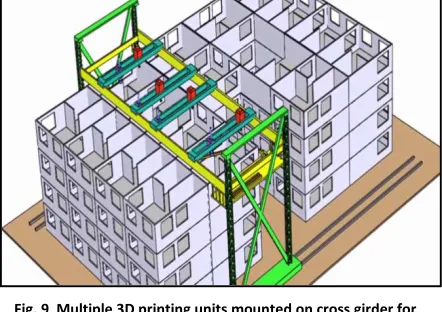
The Contour Crafting is a recently invented technology. The main purpose for its invention was the problem of conventional construction practices being slow and costly. But if we take a peek into the future, this technology has a lot to offer than just low cost or emergency housing. This technology can be improvised to put to use for construction tall skyscrapers, for construction of buildings having unique or irregular shapes and also for undertaking construction works on our neighboring planets and the moon. The following figures showcase the architectural perspectives of the various techniques that might be used in the future.
[image:4.595.316.537.466.622.2]6. CURRENT DEVELOPMENTS WORLDWIDE
Fig. 9 Multiple 3D printing units mounted on cross girder for construction of a skyscraper.
[image:4.595.64.287.525.671.2]26 A New York City Architect/Contractor Adam Kushner
has begun the construction of the first ever 3D printed estate which will feature a 2400 Sq.ft. home, with 4 bedrooms and a swimming pool. The rebar’s to be used in the constructed will also be automatically placed using the 3D printer itself.
The Chinese have built another gigantic 3D Printer (fig.11) which will be used to print a replica of the world famous ‘Temple Of Heaven’ which is located in central Beijing. The replica will be 7 meters in diameter and 8 meters high, and is expected to take around 6 months to complete.
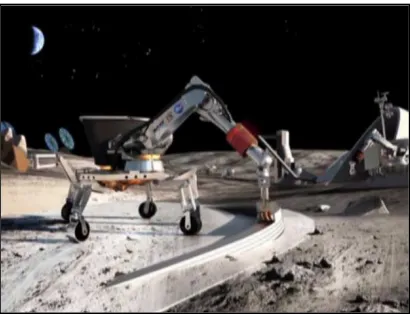
In USA, NASA is sponsoring a project in co-ordination with University Of Southern California headed by Dr. Behrokh Khoshnevis himself.
The project is based on building bots similar to the 3D printers used in Contour Crafting which would be used to construct roads, landing pads, hangars for landing, radiation proof walls etc. on the lunar surface.
5. CONCLUSION
Though the contour crafting technology is still in its developing stages, it promises to be a great benefactor in the future. Moreover, if India promotes research in such a potential field at such an early stage it would impact the economy of the country as a whole, since construction is the 2nd major industry only to agriculture in India.
One of the drawbacks of this technique is lack of job opportunities for the labour class. But, when seen from another perspective, this may potentially be an advantage in the future in the future because there is an increasing lack of availability of skilled labour,day by day, and automatized construction technique will reduce the dependency of the industry on the labour.
Having stated earlier that this technology is just in its beginning stage, there is possibility that further developments may even be able to make it usable in skyscraper construction in future. Thus, I conclude by saying that the advantages that this technology offers is far too good for the industry to ignore and sincere efforts must be taken to develop the technology further deeper to utilize its benefits.
REFERENCES
[1] Research by Dr. Behrokh Khoshnevis, University
of Southern California-
http://www.contourcrafting.org/
[2] http://gizmodo.com/you-can-now-3d-print-a-model-of-your-new-house-1541513335 [3]
3DPrinterPlans-http://3dprinterplans.info/3d- printer-plans-news-round-up-for-wednesday-16042014/
[4] CNN/WhatsNextBlogs||http://whatsnext.blogs.cnn. com/2013/07/31/study-at-home-3-d-printing-could-save-consumers-thousands/
[5] http://3dprint.com/12034/3d-printed-house-pool-ny/
[image:5.595.65.270.362.519.2][6] http://3dprint.com/7181/china-huge-3d-printer/ [7]
FutureTalk||http://3dprinting.com/news/future-talk-3d-printing-entire-house-less-20-hours/ [8]
http://contourcrafting.org/wp-content/uploads/2013/04/mega1.pdf&sa=U&ved= 0ahUKEwiYnrzckbjLAhUPA44KHZKZABoQFg gSMAE&sig2=2u9MPa7b1qMa6_xhRaxIUQ&us g=AFQjCNHC5ebO5Ot5-S9HmHNFpcrFgmMJtg