Open Access
Research
The role of single N-glycans in proteolytic processing and cell
surface transport of the Lassa virus glycoprotein GP-C
Robert Eichler
1,2, Oliver Lenz
1,3, Wolfgang Garten*
1and Thomas Strecker
1Address: 1Institut für Virologie der Philipps-Universität Marburg, Hans-Meerwein-Str. 3, 35037 Marburg, Germany, 2Abbott GmbH & Co KG,
Max-Planck-Ring 2, 65205 Wiesbaden, Germany and 3Tibotec BVBA, Gen De Wittelaan L 11B 3, 2800 Mechelen, Belgium
Email: Robert Eichler - [email protected]; Oliver Lenz - [email protected]; Wolfgang Garten* - [email protected]; Thomas Strecker - [email protected]
* Corresponding author
Abstract
Lassa virus glycoprotein is synthesised as a precursor (preGP-C) into the lumen of the endoplasmic reticulum. After cotranslational cleavage of the signal peptide, the immature GP-C is posttranslationally processed into the N-terminal subunit GP-1 and the C-terminal subunit GP-2 by the host cell subtilase SKI-1/S1P. The glycoprotein precursor contains eleven potential N-glycosylation sites. In this report, we investigated the effect of each N-glycan on proteolytic cleavage and cell surface transport by disrupting the consensus sequences of eleven potential N-glycan attachment sites individually. Five glycoprotein mutants with disrupted N-glycosylation sites were still proteolytically processed, whereas the remaining N-glycosylation sites are necessary for GP-C cleavage. Despite the lack of proteolytic processing, all cleavage-defective mutants were transported to the cell surface and remained completely endo H-sensitive. The findings indicate that N-glycans are needed for correct conformation of GP-C in order to be cleaved by SKI-1/S1P.
Background
Lassa virus belongs to the family of Arenaviridae which includes other important human pathogens like Machupo virus, Junin virus, Guanarito virus and Sabia virus as well as the prototype of this family, Lymphocytic Choriomen-ingitis virus (LCMV). Lassa virus is endemic in certain parts of West Africa and causes an estimated 150 000 clin-ical cases of a systemic viral illness per year, with a mortal-ity rate of 10–15% [1]. Lassa fever is not only a public health concern in endemic areas, it is also sporadically exported to other parts of the world [2].
Lassa virus is an enveloped virus with a bi-segmented RNA genome which encodes four viral proteins in an ambi-sense coding strategy: the glycoprotein precursor preGP-C, a nucleoprotein (NP), the viral polymerase L and the
matrix protein Z (for review see [3]). The Lassa virus glyc-oprotein is translated as an inactive precursor (pre-GP-C) into the lumen of the endoplasmic reticulum and is then cotranslationally cleaved into GP-C and a stable signal peptide [4]. The latter one plays an important role in the subsequent posttranslational maturation cleavage of GP-C into its subunits GP1 and GP2 [5,6]. Lassa virus GP-GP-C is cleaved at the C-terminus of a non-basic amino acid resi-due of the cleavage motif R-R-L-L by the subtilase SKI-1/ S1P, which is unusual for fusiogenic glycoproteins of enveloped viruses [7]. So far, only viral glycoproteins of the arenavirus family and the glycoprotein of the Crimean-Congo hemorrhagic fever virus belonging to the family of Bunyaviridae are known to be cleaved by SKI-1/ S1P, an enzyme that normally plays a role in regulation of the lipid metabolism of the cell [6,8-10]. Fusiogenic glyc-Published: 31 May 2006
Virology Journal 2006, 3:41 doi:10.1186/1743-422X-3-41
Received: 01 February 2006 Accepted: 31 May 2006
This article is available from: http://www.virologyj.com/content/3/1/41
© 2006 Eichler et al; licensee BioMed Central Ltd.
oproteins of most other enveloped viruses are proteolyti-cally cleaved C-terminally of a single arginine residue or at a multibasic recognition motif by the subtilase furin [11].
N-glycans play not only an important role in folding and intracellular transport of viral glycoproteins but also are known to modulate their antigenicity and activity [12-21]. Glycoproteins of arenaviruses vary considerably in number and position of potential N-glycosylation sites as shown by an N-glycosylation prediction program (Table 1). The Lassa virus glycoprotein GP-C contains eleven potential N-glycosylation consensus sites (N-X-S/T, in which X can be any amino acid except proline), where seven of these are located in the GP1- and four in the GP2-subunit (Table 1). Using limited N-Glycanase digestion, Wright et al. [22] demonstrated for LCMV GP that five potential glycosylation sites on GP-1 were utilized and two of the three sites on GP-2. However, for Lassa virus GP it has not yet been shown which sites are actually used and how N-glycosylation affects the characteristics of the glyc-oprotein in respect to cleavage and transport along the exocytotic pathway. To address this question, we investi-gated in the present report each potential N-glycosylation site of the Lassa virus glycoprotein concerning N-glycan maturation, cleavage of GP-C and glycoprotein transport to the cell surface. We provide evidence that each of the 11 N-glycosylation sites is used for N-glycan attachment. However, seven N-glycan mutants failed in their ability to get proteolytically processed, while 4 N-glycosylation sites are individually dispensable for cleavage of GP-C. Further-more, we demonstrate that both uncleaved precursor and
cleavage-defective N-glycan mutants are transported to the cell surface and remain mannose-rich.
Materials and methods
Cell cultureVero cells were cultured in Dulbecco's Modified Eagle's Medium (DMEM, GIBCO) supplemented with 10% fetal calf serum (FCS), 100 units/ml penicillin, and 0.1 mg/ml streptomycin.
Antibodies
Oligopeptide comprising the amino acids 477–491 of preGP-C was chemically synthesized and covalently linked to keyhole limpet hemocyanin (KLH, Pierce) as a carrier protein by the cross-linker agent N- [α -maleimi-doacetoxy] succinimide ester (AMAS) and used for repeated immunization of rabbits as described before [7]. The obtained antiserum Rb-α-GP2 was tested by peptide standard ELISA [18] and used for immunoblot analyses.
Mutation and vectorial expression of recombinant Lassa virus glycoprotein
The full length glycoprotein of Lassa virus (strain Josiah) was expressed using the beta-actin promotor-driven pCAGGS vector [6,23]. Lassa virus N-glycosylation mutants were generated by recombinant PCR using over-lapping oligonucleotides, which will be made available on request. Sequences of mutants were confirmed by DNA sequencing. Vero cells were transfected with wild type and mutated recombinant DNA using Lipofectamine 2000 (Gibco/Invitrogen).
Table 1: Comparison of potential N-glycosylation sites between different Arenavirus glycoproteins. Numbers indicate amino acid (aa) position of serine/threonine of potential N-glycosylation sites in Arenavirus glycoproteins. Gene bank accession numbers for viral sequences: Lassa-Josiah (J04324), LCMV-Arm (P09991), Mopeia (M33879), Tacaribe (NC_004293), White Water Arroyo (AF228063), Guanarito (AY129247), Sabia (U41071), Junin (D10072), Machupo (AY129248), Pichinde (AF081554).
Potential N-glycosylation sites in Arenavirus glycoproteins
GP-1 GP-2
Virus N GP-1 N GP-2 N GP-C aa
length GP-C
Lassa - - - 81 91 101 111 - - 121 - - 169 - - 226 7 - 367 375 392 397 4 11 491
LCMV - - - 87 97 - 116 - - 126 - - 173 - - 234 6 - 373 - 398 403 3 9 498
Mopeia - - - 80 90 100 110 - - 120 - - 168 - - 224 7 - 365 373 390 395 4 11 489
Machupo - - - 85 97 - - - - 139 168 - 180 - - - 5 - 370 378 395 400 4 9 496
Tacaribe - - - 85 97 - - - 166 - 178 - - - 4 - 357 365 382 387 4 8 483
Sabia - 71 - - 90 101 - - 127 - - 173 180 - - 224 7 - 362 370 387 392 4 11 488
Guanarito - - - - 90 - - - 127 - - - 176 204 - 216 5 316 353 361 378 383 4 9 479
Junin - - - - 97 107 - - - 180 - - - 3 - 359 367 384 389 4 7 495
Whitewater - - 75 - 90 - - - 128 - 167 - 178 - - 217 6 317 354 362 379 384 5 11 480
Cell surface biotinylation assay, immunoprecipitation and treatment with glycosidases
Wild type glycoprotein of Lassa virus or N-glycosylation mutants were expressed in Vero cells. At 24 h post-trans-fection, cells were washed three times with cold phos-phate-buffered saline (PBS) and then cell surface was incubated twice for 15 min at 4°C with 2 mg/ml sulfo-N-hydroxysuccinimidobiotin (Pierce) by adding 1 ml of the biotinylating reagent. After biotinylation, cells were washed twice with cold PBS containing 0.1 M glycine and three times with PBS. Cells were lysed in 0.5 ml RIPA (1% Triton X-100, 1% sodium deoxycholate, 0.1% SDS, 0.15 M NaCl, 10 mM EDTA, 10 mM iodacetamide, 1 mM phe-nylmethylsulfonyl fluoride, 50 units/ml aprotinin, and 20 mM Tris-HCl), followed by centrifugation for 30 min at 20 000 g. The supernatant was immunoprecipitated with anti-GP-C at a final dilution of 1:1000. After addition of 30 µl protein A-Sepharose CL-4B (Sigma), immunocom-plexes were washed three times with RIPA. Then samples were treated with either endo-β-N-acetylglucosaminidase H (endo H; New England Biolabs) or N-glycosidase F (PNGase F; New England Biolabs) according to the instructions of the manufacturer, or left untreated. Sam-ples were resuspended in reducing sample buffer for SDS-polyacrylamide gel electrophoresis (PAGE), followed by separation on a 12% polyacrylamide gel, before proteins were blotted to nitrocellulose. Biotinylated cell surface proteins were detected by incubation with a streptavidin-biotinylated horseradish peroxidase complex (Amersham Pharmacia Biotech) diluted 1:2000 in PBS. Proteins were visualized with the enhanced chemiluminescence system (Amersham Pharmacia Biotech) by exposure to an autora-diography film (Kodak BIOMAX).
Results and discussion
Mutation of potential N-glycosylation sites of Lassa virus preGP-C
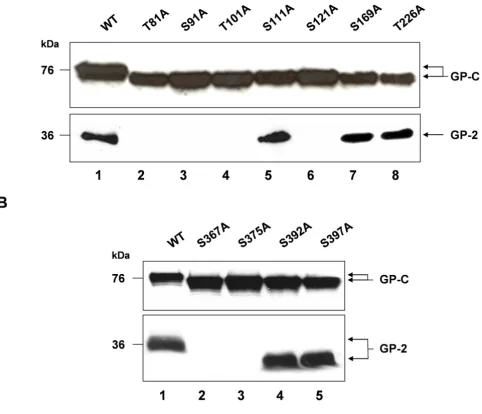
Lassa virus preGP-C contains 11 potential N-glycosylation sites, 7 in the GP-1- and 4 in the GP-2-subunit (Fig. 1). To investigate whether each N-glycosylation site is used for N-glycan attachment, the corresponding serine or threo-nine residues of potential N-glycosylation motifs (N-X-S/ T) were individually changed to alanine. GP-1 mutants were designated T81A, S91A, T101A, S111A, S121A, S169A and T226A and GP-2 mutants S367A, S375A, S392A and S397A. All cDNA constructs were expressed transiently in Vero cells using the beta-actin promoter-driven mammalian expression vector pCAGGS. Western blotting was performed using antiserum directed against the C-terminus of GP-2. As shown in Fig. 2A (lanes 2–8, upper panel) and Fig. 2B (lanes 2–5, upper panel), all mutants showed faster migration on a SDS gel compared to wild-type GP-C indicating that each N-glycosylation site is used for N-glycan attachment. Next we determined the effect of the individual N-glycans on the maturation cleavage by analysing the presence of the cleaved subunit GP-2. Disruption of the N-glycosylation sites within the GP-1 mutants S111A, S169A and T226A has no influence on GP-C cleavage (Fig. 2A, lanes 5, 7 and 8, lower panel). In contrast, the lack of N-glycan attachment of the GP-1 mutants T81A, S91A, S101A and S121A abolished the proteolytical processing by SKI-1/S1P (Fig. 2A, lanes 2–4 and 6, lower panel). Among the four N-glycosylation sites of GP-2, only GP-C of the mutants S392A and S397A are further cleaved into GP-1 and GP-2 similar to fully glyco-sylated wild-type GP-C (Fig. 2B, lanes 4 and 5, lower panel), whereas no cleavage of the glycoprotein was observed within the mutants S367A and S375A (Fig. 2B, lanes 2 and 3, lower panel). Due to the high resolution of the acrylamid gel electrophoresis, the GP-2 subunit of
Schematic diagram of Lassa virus glycoprotein
Figure 1
mutants S392A and S397A revealed significantly faster electrophoretic mobility than wild type GP-2 (Fig. 2B; lanes 4–5, lower panel) showing that the respective N-gly-cosylation sites are used for N-glycan attachment.
Cell surface transport of GP N-glycosylation mutants N-glycosylation has long been known to be essential for correct folding and intracellular transport of viral
glyco-proteins, as shown for instances for influenza hemagglu-tinin [19]. In order to investigate the importance of the individual N-glycosylation sites of Lassa virus GP-C for intracellular trafficking we analysed cell surface expres-sion of the mutated glycoproteins using a biotinylation approach. Transfected Vero cells were labelled with non-membrane-permeating biotin as described in material and methods. After biotinylation, cells were lysed and GP-Proteolytic processing of N-glycosylation mutants
Figure 2
C and GP-C N-glycan mutants were immunoprecipitated using polyclonal antiserum directed against the C-termi-nus of GP-C. The precipitates were separated on an SDS gel and transferred to nitrocellulose. Surface-expressed glycoprotein protein was then visualised with a streptavi-din-peroxidase complex. Fig. 3A (lanes 2–8) and B (lanes 2–5) demonstrate that all GP-1 and GP-2 N-glycosylation mutants are transported to the cell surface in a similar manner compared to wild-type GP indicating that a loss of a single N-glycosylation attachment site and proteolytic cleavage are not necessary for cell surface transport of GP.
For LCMV it was shown that maturation cleavage deficient mutants are efficiently transported to the cell surface [10]. Both cleavage and cell surface expression of LCMV GP-C are impaired in parallel either when no N-glycosylation occurs or a proline residue is present at position 110 [22,24]. Since many cleavage deficient mutants have been shown to exhibit regular cell surface transport, the two reported cases in which cell surface expression was abol-ished might be due to misfolding in the endoplasmic reticulum with subsequent degradation [22,24].
Cell surface transport of GP-C N-glycosylation mutants
Figure 3
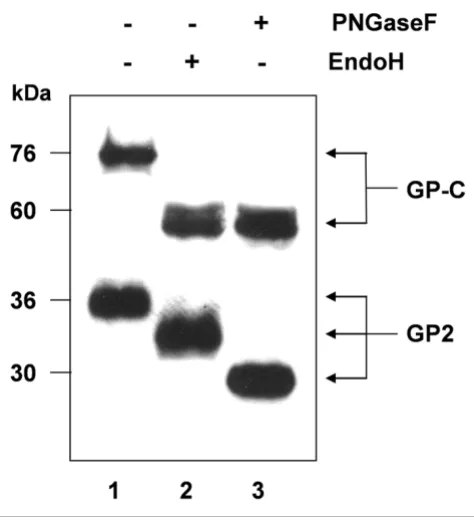
Transport of endo H-sensitive GP-C to the cell surface LCMV and Lassa virus GP-C are cleaved by the same pro-tease, SKI-1/S1P, although proteolytic processing of the GPs occurs in different subcellular compartments. Lassa virus GP-C is cleaved early along the secretory pathway in the ER or an early Golgi stack, whereas LCMV GP-C is cleaved in the Golgi or post-Golgi compartment [6,10,22]. Furthermore, for LCMV GP-C it has been shown that transition of mannose-rich carbohydrates to complex carbohydrates occurred before maturation cleav-age [22]. In order to analyse the glycosylation status of Lassa virus glycoproteins on the outer cell membrane, cell surface biotinylation was combined with a subsequent detachment of mannose-rich N-glycans by digestion with endo H or removal of complex N-glycans using PNGase F (Fig. 4). The GP-2 subunit is detectable at the cell surface and displays partial endo H-resistance confirming a mod-ification of its carbohydrate decoration during glycopro-tein transport to the cell surface (lane 2). Interestingly, the
glycoprotein precursor GP-C which is transported to the cell surface remains completely endo H-sensitive suggest-ing that cleavage might be a prerequisite for further com-plex glycosylation. In addition, uncleaved endo H-sensitive Lassa virus GP-C is also transported to the cell surface of SKI-1/S1P deficient cells (data not shown).
The finding that only an endo H-sensitive form of Lassa virus GP-C was found at the cell surface suggests that par-tial endo H-resistance of the Lassa virus glycoprotein is only acquired when the glycoprotein is cleaved into its subunits. This observation is in contrast to findings for the LCMV glycoprotein where an endo H-resistant form of GP-C was described [22]. However, since cleavage of Lassa virus GP-C by SKI-1/S1P occurs earlier in the exocytotic pathway than LCMV GP-C [6,10,22], cleavage of Lassa virus GP-C occurs prior to trimming of the mannose-rich N-glycans to complex sugar types.
It can not be ruled out that the use of glycosylation sites and the N-glycan trimming differs between recombinant expressed glycoproteins and GP in LASV-infected cells. It was shown recently that recombinant expressed M protein of SARS-CoV gained complex-type N-glycosylation whereas in SARS-CoV infected cells N-glycosylation of M remained endo H-sensitive [25]. However, in general a good correlation between results obtained after solitary expression and studies using the homologues viral system have been observed. To address this kind of issues, the development of a "reverse genetic system" for LASV will be necessary that would allow analysing the role of glyco-sylation of GP in the correct viral context.
Conclusion
Taken together, our study suggest that individual N-linked oligosaccharides of the Lassa virus glycoprotein differ greatly in terms of their importance for correct protein folding which seems to be important for activation cleav-age by SKI-1/S1P. The differences between the precursor glycoprotein C and the cleaved subunits 1 and GP-2, not only with respect to N-glycosylation, remain an enigma since only the cleaved glycoprotein subunits are incorporated into virus particles [6].
Abbreviations
aa; amino acid; DMEM, Dulbecco's Modified Eagle's Medium; GP, glycoprotein, PCR, polymerase chain reac-tion; Endo H, endoglycosidase H; PNGase F, peptide-N-glycosidase F; RIPA, radio immunoprecipitation assay; SKI-1/S1P, subtilisin kexin isoenzyme-1/site 1 protease; SDS-PAGE, sodium dodecyl sulfate-polyacrylamide gel electrophoresis; Tris, tris-(hydroxymethyl)-ami-nomethan.
Glycosidase sensitivity of cell surface transported Lassa virus glycoprotein
Figure 4
Publish with BioMed Central and every scientist can read your work free of charge "BioMed Central will be the most significant development for disseminating the results of biomedical researc h in our lifetime."
Sir Paul Nurse, Cancer Research UK
Your research papers will be:
available free of charge to the entire biomedical community
peer reviewed and published immediately upon acceptance
cited in PubMed and archived on PubMed Central
yours — you keep the copyright
Submit your manuscript here:
http://www.biomedcentral.com/info/publishing_adv.asp
BioMedcentral
Competing interests
The author(s) declare that they have no competing inter-ests.
Authors' contributions
RE and TS carried out experiments, participated in the analysis of the results and drafted the manuscript. OL helped to draft the manuscript and revised it critically. WG designed the study, participated in the analysis of the results and helped to draft the manuscript. All authors read and approved the final manuscript.
Acknowledgements
We thank E. Lecompte, M. Eickmann and H.-D. Klenk for helpful discus-sions and P. Neubauer-Rädel for excellent technical assistance. This work was supported by the Deutsche Forschungsgemeinschaft, Sachbeihilfe Ga 282/4-1, SFB 286 TP1, and the Graduiertenkolleg Protein Function at the Atomic Level.
References
1. McCormick JB, Fisher-Hoch SP: Lassa fever. Curr Top Microbiol Immunol 2002, 262:75-109.
2. Gunther S, Emmerich P, Laue T, Kuhle O, Asper M, Jung A, Grewing T, ter Meulen J, Schmitz H: Imported lassa fever in Germany: molecular characterization of a new lassa virus strain. Emerg Infect Dis 2000, 6(5):466-476.
3. Gunther S, Lenz O: Lassa virus. Crit Rev Clin Lab Sci 2004,
41(4):339-390.
4. Eichler R, Lenz O, Strecker T, Garten W: Signal peptide of Lassa virus glycoprotein GP-C exhibits an unusual length. FEBS Lett
2003, 538(1-3):203-206.
5. Eichler R, Lenz O, Strecker T, Eickmann M, Klenk HD, Garten W:
Identification of Lassa virus glycoprotein signal peptide as a
trans-acting maturation factor. EMBO Rep 2003,
4(11):1084-1088.
6. Lenz O, ter Meulen J, Klenk HD, Seidah NG, Garten W: The Lassa virus glycoprotein precursor GP-C is proteolytically proc-essed by subtilase SKI-1/S1P. Proc Natl Acad Sci U S A 2001,
98(22):12701-12705.
7. Lenz O, ter Meulen J, Feldmann H, Klenk HD, Garten W: Identifica-tion of a novel consensus sequence at the cleavage site of the Lassa virus glycoprotein. J Virol 2000, 74(23):11418-11421. 8. Sanchez AJ, Vincent MJ, Nichol ST: Characterization of the
glyc-oproteins of Crimean-Congo hemorrhagic fever virus. J Virol
2002, 76(14):7263-7275.
9. Vincent MJ, Sanchez AJ, Erickson BR, Basak A, Chretien M, Seidah NG, Nichol ST: Crimean-Congo hemorrhagic fever virus glyc-oprotein proteolytic processing by subtilase SKI-1. J Virol
2003, 77(16):8640-8649.
10. Beyer WR, Popplau D, Garten W, von Laer D, Lenz O: Endoprote-olytic processing of the lymphocytic choriomeningitis virus glycoprotein by the subtilase SKI-1/S1P. J Virol 2003,
77(5):2866-2872.
11. Klenk HD, Garten W: Host cell proteases controlling virus pathogenicity. Trends Microbiol 1994, 2(2):39-43.
12. Bagai S, Lamb RA: Individual roles of N-linked oligosaccharide chains in intracellular transport of the paramyxovirus SV5 fusion protein. Virology 1995, 209(1):250-256.
13. Doms RW, Lamb RA, Rose JK, Helenius A: Folding and assembly of viral membrane proteins. Virology 1993, 193(2):545-562. 14. Hu A, Cathomen T, Cattaneo R, Norrby E: Influence of N-linked
oligosaccharide chains on the processing, cell surface expres-sion and function of the measles virus fuexpres-sion protein. J Gen Virol 1995, 76 ( Pt 3):705-710.
15. Klenk HD, Wagner R, Heuer D, Wolff T: Importance of hemag-glutinin glycosylation for the biological functions of influenza virus. Virus Res 2002, 82(1-2):73-75.
16. Koch M, Pancera M, Kwong PD, Kolchinsky P, Grundner C, Wang L, Hendrickson WA, Sodroski J, Wyatt R: Structure-based, targeted deglycosylation of HIV-1 gp120 and effects on neutralization sensitivity and antibody recognition. Virology 2003,
313(2):387-400.
17. Moll M, Kaufmann A, Maisner A: Influence of N-glycans on processing and biological activity of the nipah virus fusion protein. J Virol 2004, 78(13):7274-7278.
18. Munk K, Pritzer E, Kretzschmar E, Gutte B, Garten W, Klenk HD:
Carbohydrate masking of an antigenic epitope of influenza virus haemagglutinin independent of oligosaccharide size.
Glycobiology 1992, 2(3):233-240.
19. Roberts PC, Garten W, Klenk HD: Role of conserved glycosyla-tion sites in maturaglycosyla-tion and transport of influenza A virus hemagglutinin. J Virol 1993, 67(6):3048-3060.
20. Segawa H, Yamashita T, Kawakita M, Taira H: Functional analysis of the individual oligosaccharide chains of sendai virus fusion protein. J Biochem (Tokyo) 2000, 128(1):65-72.
21. Wagner R, Heuer D, Wolff T, Herwig A, Klenk HD: N-Glycans attached to the stem domain of haemagglutinin efficiently regulate influenza A virus replication. J Gen Virol 2002, 83(Pt 3):601-609.
22. Wright KE, Spiro RC, Burns JW, Buchmeier MJ: Post-translational processing of the glycoproteins of lymphocytic choriomenin-gitis virus. Virology 1990, 177(1):175-183.
23. Niwa H, Yamamura K, Miyazaki J: Efficient selection for high-expression transfectants with a novel eukaryotic vector.
Gene 1991, 108(2):193-199.
24. Beyer WR, Miletic H, Ostertag W, von Laer D: Recombinant expression of lymphocytic choriomeningitis virus strain WE glycoproteins: a single amino acid makes the difference. J Virol 2001, 75(2):1061-1064.
25. Voss D, Kern A, Traggiai E, Eickmann M, Stadler K, Lanzavecchia A, Becker S: Characterization of severe acute respiratory syn-drome coronavirus membrane protein. FEBS Lett 2006,