An Improved CRF based Chinese Language Processing System for SIGHAN
Bakeoff 2007
Xihong Wu, Xiaojun Lin, Xinhao Wang, Chunyao Wu, Yaozhong Zhang and Dianhai Yu Speech and Hearing Research Center
State Key Laboratory of Machine Perception, Peking University, China, 100871
{wxh,linxj,wangxh,wucy,zhangyaoz,yudh}@cis.pku.edu.cn
Abstract
This paper describes three systems: the Chinese word segmentation (WS) system, the named entity recognition (NER) sys-tem and the Part-of-Speech tagging (POS) system, which are submitted to the Fourth International Chinese Language Processing Bakeoff. Here, Conditional Random Fields (CRFs) are employed as the primary mod-els. For the WS and NER tracks, the n-gram language model is incorporated in our CRFs based systems in order to take into ac-count the higher level language information. Furthermore, to improve the performances of our submitted systems, a transformation-based learning (TBL) technique is adopted for post-processing.
1 Introduction
Among 24 closed and open tracks in this bakeoff, we participated in 23 tracks, except the open NER track of MSRA. Our systems are ranked 1st in 6 tracks, and get close to the top level in several other tracks. Recently, Maximum Entropy model(ME) and CRFs (Low et al., 2005)(Tseng et al., 2005) (Hai Zhao et al., 2006) turned out to be promising in natu-ral language processing tracks, and obtain excellent performances on most of the test corpora of Bake-off 2005 and BakeBake-off 2006. Compared to the gen-erative models, like HMM, the primary advantage of CRFs is that it relaxes the independence assump-tions, which makes it able to handle multiple inter-acting features between observation elements (Wal-lach et al., 2004).
However, the ME and CRFs emphasize the rela-tion of the basic units of sequence, like the Chinese characters in these tracks. While, the higher level information, like the relationship of the words is ig-nored. From this point of view, the n-gram language model is incorporated in our CRFs based systems in order to cover the word level language information.
Based on several pilot-experimental results, we found that the tagging errors always follow some patterns. In order to find those error patterns and cor-rect the similar errors, we integrated the TBL post-processor in our systems. In addition, extra train-ing data, which is transformed from People Daily Corpus (Shiwen Yu et al., 2000) with some auto-extracted transition rules, is used in each corpus for the open tracks of WS.
The remainder of this paper is organized as fol-lows. The scheme of our three developed systems are described in section 2, 3 and 4, respectively. In section 5, evaluation results based on these systems are enumerated and discussed. Finally some conclu-sions are drawn in section 6.
2 Word Segmentation
The WS system mainly consists of three compo-nents, CRFs, n-gram language model and post-processing strategies.
2.1 Conditional Random Fields
model, CRFs relax the constraint of the indepen-dence assumptions, and therefore turn out to be more suitable for natural language tasks.
CRFs model the conditional distributionp(Y|X)
of the labels Y given the observations X directly with the formulation:
Y is the label sequence, X is the observation se-quence,Z(X)is a normalization term,fk is a fea-ture function, andcis the set of cliques in Graphic.
In our tasks,C ={(yi−1, yi)},Xis the Chinese character sequence of a sentence.
To label a Chinese character, we need to define the label tags. Here we have six types of tags ac-cording to character position in a word (Hai Zhao et al., 2006):
tag={B1, B2, B3, I, E, S}
“B1, B2, B3, I, E” represent the first, second, third, continue, and end character positions in a multi-character word, and “S” is the single-character word tag.
The unigram feature templates used here are:
Cn(n=−2,−1,0,1,2)
CnCn+1(n=−2,−1,0)
CnCn+1Cn+2(n=−1)
Where C0 refers to the current character and
C−n(Cn)is thenth character to the left(right) of the current character. We also use the basic bigram fea-ture template which denotes the dependency on the previous tag and current tag.
2.2 Multi-Model Integration
In order to integrate multi-model information, we use a log-linear model(Och et al., 2002) to compute the posterior probability:
WhereW is the word sequence, andC is the char-acter sequence. The decision rule here is:
W0 = argmaxW{P r(W|C)}
The parameters αM
1 of this model can be opti-mized by standard approaches, such as the Mini-mum Error Rate Training used in machine transla-tion (Och, 2003). In fact, the CRFs approach is a special case of this framework when we define
M = 1and use the following feature function:
h1(W, C) =logPλ(Y|X) (4)
In our approach, the logarithms of the scores gen-erated by the two kinds of models are used as feature functions:
The first feature function(Eq.5) comes from CRFs. Instead of computing the score of the whole la-bel sequenceY with character sequenceXthrough
Pλ(Y|X)directly, we try to get the posterior prob-ability of a sub-sequence to be tagged as one whole wordPλ(wi|C). Then we combine all the score of words together. The second feature function(Eq.6) comes from n-gram language model, which aims to catch the words information.
The log-linear model with the feature functions described above allows the dynamic programming search algorithm for efficient decoding. The system generates the word lattice with posterior probability
Pλ(wi|C). Then the best word sequence is searched on the word lattice with the decision rule(Eq.3).
Since arbitrary sub-sequence can be viewed as a candidate word in word lattice, we need to deal with the problem of OOV words. The unigram of an OOV word is estimated as:
U nigram(OOV W ord) =pl (7)
wherepis the minimal value of unigram scores in the language model; l is the length of the OOV word, which is used as a punishment factor to avoid overemphasizing the long OOV words (Xin-hao Wang et al., 2006).
2.3 Post-Processing Strategies
2.4 Training Data Transition
For the WS open tracks, the unique difference from closed tracks is that the additional training data is supplemented for model refinement.
For the Simplified Chinese tracks, the additional training data are collected from People Daily Cor-pus with a set of auto-extracted transition rules. This process is performed in a heuristic strategy and con-tains five steps as follows:
(1) Segment the raw People Daily texts with the responding system for the closed track of each cor-pus.
(2) Compare the result of step 1 with People Daily Corpus to get the conflict pairs. For example,
{pair1:ࡾᄶ vs. ࡾᄶ } (Zhemin Jiang) {pair2:ਆ൭ሂ vs. ਆ ൭ ሂ}
(catch with two hands)
In each pair, the left phrase follows the People Daily Corpus segmentation guideline, while the right one is the phrase obtained from step 1.
(3) Divide the pairs into two sets:the first set con-tains the pairs with right phrase appearing in the tar-get training data; the other pairs are inthe second set.
(4) Select sentences which contain the left phrase of the pairs inthe second setfrom People Daily Cor-pus.
(5) Transform these selected sentences by replacing their phrase in the left side of the pair inthe first set to the right one. This is used as our transition rules.
3 Named Entity Recognition
The named entity recognition track is viewed as a character sequence tagging problem in our NER sys-tem and the log-linear model mentioned above is employed again to integrate multi-model informa-tion. To find the error patterns and correct them, a TBL strategy is then used in the post-processing module.
3.1 Model Description
In this NER track, we employe the log-linear model and use the logarithms of the scores generated by the two types of models as feature functions. Besides CRFs, another model is the class-based n-gram
lan-guage model:
h1(Y, X) = logPcrf(Y, X)
= logPλ(Y|X) (8)
h2(Y, X) = logPclm(Y, X) (9)
Y is the label sequence andX is the character se-quence.
CRFs are used to generate the N-best tagging re-sults with the scores of whole label sequenceY on character sequenceX byPλ(Y|X). And then, the log-linear model is used to reorder the N-best tag-ging results by integrating the CRFs score and the class-based n-gram language model score together. CRFs
In this track, one Chinese character is labeled by a tag of ten classes, which denoting the beginning, continue, ending character of a specified named en-tity or a non-enen-tity character. There are three types of named entities in these tracks, including person name, location name and organization name.
In CRFs, the basic features used here are:
Cn(n=−2,−1,0,1,2)
CnCn+1(n=−2,−1,0,1)
CnCn+2(n=−1)
Besides basic unigram features, the bigram transi-tion features considering the previous tag is adopted with templateCn(n=−2,−1,0,1,2).
Class-Based N-gram Language Model
For the class-based n-gram language model, we define that each character is a single class, while each type of named entity is viewed as a single class. With the character sequence and label sequence, the class sequence can be generated. Take this sentence for instance:
၈Ѿঘ၇ڏѩ҂ડቀ
(But Ibrahimov is not satisfied)
Table 1 shows its class sequence. Class-based n-gram language model can be trained with class se-quence.
3.2 TBL
character sequence ၈ Ѿ ঘ ၇ ڏ ѩ ҂ ડ ቀ
label sequence N Per-B Per-C Per-C Per-C Per-C Per-E N N N N
class sequence PERSON ѩ ҂ ડ ቀ
Table 1: A class sequence example
Transformation-based learning is a symbolic ma-chine learning method, introduced by (Eric Brill, 1995). The main idea in TBL is to generate a set of transformation rules that can correct tagging errors produced by the initial process.
There are four main procedures in our TBL framework: An initial state assignment which is op-erated by the system we described above; a set of al-lowable templates for rules, ranging from words in a 3 positions windows and name entity information in a 3-word window with their combinations consid-ered, and rules which are learned according to the tagging differences between training data and results generated by our system, at last, those rules are in-troduced to correct similar errors.
4 POS Tagging
The POS tagging track is to assign the part-of-speech sequence for the correctly segmented word sequence. In our system, for the CTB corpus, the CRFs are adopted; however for the other four cor-pora, considering the limitations of resources and time, the ME model is adopted. To improve the per-formance of ME model, the POS tag of the previous word is taken as a feature and the dynamic program-ming strategy is used in decoding.
In the closed track, the features include the basic features and their combined features. Firstly the pre-vious and next words of the current word are taken as the basic features. Secondly, based on the anal-ysis of the OOV words, the first and last characters of the current word, as well as the length of the cur-rent word are proven to be effective features for the OOV POS. Furthermore since the long distance con-straint word may impact the POS of current word (Yan Zhao et al., 2006), in the open track, a Chi-nese parser is imported and the word depended on the current word is extracted as feature.
5 Experiments and Results
We have participated in 23 tracks, except the open NER track of MSRA. CRFs, ME model and n-gram language model are adopted in these systems. Our implementation uses the CRF++ package1provided by Taku Kudo, the Maximum Entropy Toolkit2
pro-vided by Zhang Le, and the SRILM Toolkit propro-vided by Andreas Stolcke (Andreas Stolcke et al., 2002).
5.1 Chinese Word Segmentation
In the closed tracks, CRFs and bigram language model are trained on the given training data for each corpus. In order to integrate these two models, it is necessary to train the corresponding parameterαM
1 with Minimum Error Rate Training approache based on a development data. Since the development data is not provided in this bakeoff, a ten-fold cross val-idation approach is employed to implement the pa-rameter training. A set of papa-rameters can be trained independently, and then the mean value is calculated as the estimation of each parameter.
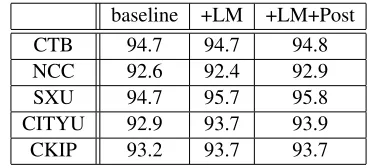
Table 2 gives the results of our WS system for closed tracks.
baseline +LM +LM+Post CTB 94.7 94.7 94.8 NCC 92.6 92.4 92.9 SXU 94.7 95.7 95.8 CITYU 92.9 93.7 93.9 CKIP 93.2 93.7 93.7
Table 2: Word segmentation performance on F-value with different approach for the closed tracks
In the open tracks, as we do not have enough time to finish the parameter estimation on the new data, our system adopt the same parametersαM
1 used in closed tracks. The unique difference from closed
1http://chasen.org/taku/software/CRF++ 2http://homepages.inf.ed.ac.uk/s0450736/maxent
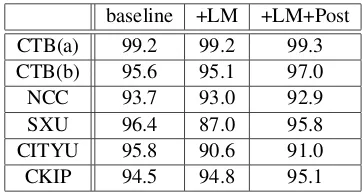
tracks is that extra training data is added for each corpus to improve the performance. For the Sim-plified Chinese tracks, additional data comes from People Daily Corpus which is transformed by our transition strategy. At the same time, for the Tra-ditional Chinese tracks, adTra-ditional data comes from the training and testing data used in the early Bake-off. However, we implement two systems for the CTB open track. The system (a) takes the training and testing data used in the early Bakeoff as addi-tional data, and System (b) takes the translated Peo-ple Daily Corpus as additional data. Table 3 gives the results of our open WS system.
baseline +LM +LM+Post CTB(a) 99.2 99.2 99.3 CTB(b) 95.6 95.1 97.0 NCC 93.7 93.0 92.9 SXU 96.4 87.0 95.8 CITYU 95.8 90.6 91.0 CKIP 94.5 94.8 95.1
Table 3: Word segmentation performance on F-value with different approach for the open tracks
The result shows that the system performance is sensitive to the parametersαM1 . Although we train the useful parameter for closed tracks, it plays a bad role in open tracks as we do not adapt it for the ad-ditional training data.
5.2 Named Entity Recognition
In the closed NER tracks, CRFs and class-based tri-gram language model are trained on the given train-ing data for each corpus. The same approach em-ployed in the WS tracks is adopted to train the corre-sponding parameterαM
1 in our NER systems. Mean-while, the TBL rules trained via five-fold cross val-idation approach are also used in post-processing procedure. Table 4 reports the results of our closed NER system.
5.3 POS Tagging
The experiments show that the CRFs/ME method is superior to the TBL method, and the concurrent er-rors for these two methods are less than 60%. There-fore we adopted TBL to correct the output results of CRFs/ME: If the output tags of CRFs/ME and
baseline +LM +LM+Post MSRA 89.3 89.7 89.9 CITYU 79.3 80.6 80.5
Table 4: Named entity recognition F-value through different approaches for the closed tracks
TBL are not consistent and the output probability of CRFs/ME is below a certain threshold, the TBL results are fixed. Here the 90% of the training set is taken as the training data and remained 10% is separated as the development data to get the thresh-old, which is 0.60 for the CRFs, and 0.90 for the ME. In addition, the POS tagged corpus of the Chi-nese Treebank 5.0 from LDC is added to the training data for CTB open track. In our system, the Berke-ley Parser (Slav Petrov et al., 2006) is adopted to obtain the long distance constraint words. The per-formance achieved by the methods described above on each corpus are reported in Table 5.
CRFs/ME CRFs/ME CRFs/ME TBL +TBL +TBL
+Syntax CTIYU 88.7 87.7 89.1 89.0
CKIP 91.8 91.4 92.2 92.1
CTB 94.0 92.7 94.3 96.5
NCC 94.6 94.3 94.9 95.0
PKU 93.5 93.2 94.0 94.1
Table 5: POS tagging performance on total-accuracy with different approach
6 Conclusion
References
Jin Kiat Low, Hwee Tou Ng and Wenyuan Guo. 2005. A Maximum Entropy Approach to Chinese Word Seg-mentation. Proceedings of the Fourth SIGHAN Work-shop on Chinese Language Processing.pp. 161-164. Jeju Island, Korea.
Huihsin Tseng, Pichuan Chang, Galen Andrew, Daniel Jurafsky, Christopher Manning. 2005. A Conditional Random Field Word Segmenter for Sighan Bakeoff 2005. Proceedings of the Fourth SIGHAN Workshop on Chinese Language Processing.pp. 168-171. Jeju Island, Korea.
Hai Zhao, Chang-Ning Huang and Mu Li. 2006. An Improved Chinese Word Segmentation System with Conditional Random Field. Proceedings of the Fifth SIGHAN Workshop on Chinese Language Processing.
pp. 162-165. Sydney, Australia.
Hanna M. Wallach. 2004. Conditional Random Fields: An Introduction. Technical Report, UPenn CIS TR MS-CIS-04-21.
Shiwen Yu, Xuefeng Zhu and Huiming Duan. 2000. Specification of large-scale modern Chinese corpus.
Proceedings of ICMLP’2001. pp. 18-24. Urumqi, China.
Fei Sha and Fernando Pereira. 2003. Shallow Parsing with Conditional Random Fields. Proceedings of Hu-man Language Technology/NAACL.pp. 213-220. Ed-monton, Canada.
Franz Josef Och and Hermann Ney. 2002. Discrimi-native training and maximum entropy models for sta-tistical machine translation. Proceedings of the 40th Annual Meeting of the Association for Computational Linguistics (ACL).pp. 295-302. Philadelphia, PA.
Franz Josef Och. 2003. Minimum Error Rate Train-ing in Statistical Machine Translation.Proceedings of the 41th Annual Meeting of the Association for Com-putational Linguistics (ACL).pp. 160-167. Sapporo, Japan.
Xinhao Wang, Xiaojun Lin, Dianhai Yu, Hao Tian, Xi-hong Wu. 2006. Chinese Word Segmentation with Maximum Entropy and N-gram Language Model.the Fifth SIGHAN Workshop on Chinese Language Pro-cessing.pp. 138-141. Sydney, Australia.
Eric Brill. 1995. Transformation-based error-driven learning and natural language processing: a case study in Part-of-Speech tagging.Computational Lingusitics.
21(4).
Yan Zhao, Xiaolong Wang, Bingquan Liu, and Yi Guan. 2006. Fusion of Clustering Trigger-Pair Features for POS Tagging Based on Maximum Entropy Model.
Journal of Computer Research and Development.
43(2). pp. 268-274.
Andreas Stolcke. 2002. SRILM - An Extensible Lan-guage Modeling Toolkit. Proceedings of International Conference on Spoken Language Processing.pp. 901-904. Denver, Colorado.