Copyright2001 by the Genetics Society of America
Differential Evolution of Eastern Equine Encephalitis Virus Populations in
Response to Host Cell Type
Lynn A. Cooper* and Thomas W. Scott
†*Department of Entomology, University of Maryland, College Park, Maryland 20742 and†Department of Entomology,
University of California, Davis, California 95616
Manuscript received November 8, 1999 Accepted for publication December 26, 2000
ABSTRACT
Arthropod-borne viruses (arboviruses) cycle between hosts in two widely separated taxonomic groups, vertebrate amplifying hosts and invertebrate vectors, both of which may separately or in concert shape the course of arbovirus evolution. To elucidate the selective pressures associated with virus replication within each portion of this two-host life cycle, the effects of host type on the growth characteristics of the New World alphavirus, eastern equine encephalitis (EEE) virus, were investigated. Multiple lineages of an ancestral EEE virus stock were repeatedly transferred through either mosquito or avian cells or in alternating passages between these two cell types. When assayed in both cell types, derived single host lineages exhibited significant differences in infectivity, growth pattern, plaque morphology, and total virus yield, demonstrating that this virus is capable of host-specific evolution. Virus lineages grown in alternation between the two cell types expressed intermediate phenotypes consistent with dual adaptation to both cellular environments. Both insect-adapted and alternated lineages greatly increased in their ability to infect insect cells. These results indicate that different selective pressures exist for virus replication within each portion of the two-host life cycle, and that alternation of hosts selects for virus populations well adapted for replication in both host systems.
A
S a group, the arthropod-borne viruses (arboviruses) The stability of the EEE virus in nature is consistent with the observation that, in general, arbovirus populations include many important human and animalpatho-gens. In nature arboviruses are routinely maintained by tend to be genetically conserved over both time and space (Beaty et al. 1988; Weaver et al. 1992; Scott transmission cycles involving the passage of virus
be-tween susceptible vertebrate hosts and hematophagous et al. 1994; Cilnis et al. 1996; Mackenzie et al. 1996; Poidingeret al.1997). The constraints associated with a arthropod vectors. By definition arboviruses are spread
two-host life cycle may favor the maintenance of specific by biological transmission and must be able to replicate
viral genotypes (Scottet al.1994;Weaveret al.1999) within both vertebrate and invertebrate hosts
(Cham-and has often been suggested as the underlying mecha-berlainandSudia1961;Turell1988).
nism for the observed stability of arbovirus genomes. Eastern equine encephalomyelitis virus (EEE; family
Previous studies with other Togavirus systems indicate Togaviridae, genus Alphavirus) is an arbovirus that is
that both phenotypic and genotypic characteristics can endemic to the eastern half of North America, Central
be influenced by host cell type and that differential America, and South America. In the United States, it is
selection for host-specific mutants is possible (Kowal maintained in a sylvatic transmission cycle involving a
and Stollar 1981). Host-associated limitations on variety of passerine bird species and the enzoonotic
growth, virion biochemistry, plaque morphology, tem-mosquito vector,Culiseta melanura(ScottandWeaver
perature sensitivity, and infectivity have been docu-1989). Occasionally other vertebrates are infected. The
mented (Gliedmanet al.1975;RenzandBrown1976; virus is particularly virulent for humans, horses, and
Luukkonen et al.1977;SymingtonandSchlesinger gamebirds (Scottet al.1994).
1978;KowalandStollar1981;DurbinandStollar Despite the potentially high mutation rate of its RNA
1984, 1986;BrownandCondreay1986;Straussand genome (Steinhauer and Holland 1987), multiple
Strauss 1994;Heidneret al.1996). Thus, virus infec-studies have described a high degree of antigenic
con-tion and replicacon-tion are expected to be dissimilar within servation and slow rates of molecular evolution for the
vertebrate and arthropod hosts. This led to the sugges-EEE virus (Roehrig et al. 1990; Weaver et al. 1991,
tion that the presence of host-specific selective pressures 1992, 1993a,b;StrizkiandRepik1994;Weaver1995).
limit the rate of evolution by imposing a fitness trade-off; that is, optimization to one host decreases viral fitness in the alternate host (StraussandStrauss1994;
Corresponding author:Lynn A. Cooper, School of Veterinary
Medi-Novellaet al.1995). An alternative explanation for the
cine, Louisiana State University, Baton Rouge, LA 70803.
E-mail: [email protected] lack of expected variation in arbovirus populations is
cell line (BHK-21) was used for production and quantification that, through time, arboviruses have evolved to
max-of all viral stocks (ScottandBurrage1984). imize replication in both vertebrates and invertebrates
Avian cells: A Peking duck embryo (PDE) cell line was by simultaneously adapting to the dual selective pres- obtained (American Type Culture Collection, Rockville, MD) sures associated with obligate cycling between two differ- at the ninth passage and subcultured for up to 18 passages thereafter. This cell line has previously been shown to support ent kinds of hosts. Under such a model, virus
popula-the replication of EEE virus to high titers and displays cyto-tions that are continually cycled between two hosts grow
pathic effects (MarcoviciandPrier1968). well and maintain high fitness in both systems.
Mosquito cells:The C7-10 cell line was obtained (V. Stollar, Our long-term research objective is to examine the Rutgers University) at the second passage and continuously role of different hosts in arbovirus evolution using an subcultured thereafter. This subclone of the C6/36 larvalAedes albopictuscell line (Igarashi1978) is unusual among arthro-alphavirus study system to more fully understand the
pod cell cultures in that it displays marked cytopathic effects relationships of alphaviruses and perhaps arboviruses
following infection by the EEE virus (Sarverand Stollar
in general to their vertebrate and invertebrate hosts. 1977).
Toward that end, we conceived and initiated a series of EEE virus stock:For all of our experiments we used a low experiments. The first, described herein, was to use a passage North American EEE virus; strain 82V-2137 isolated in 1982 from a pool of naturally infected Florida mosquitoes cell culture system to generate derived virus lineages
(N. Karabatsos, Centers for Disease Control and Prevention, that had been repeatedly transferred through either
Fort Collins, CO). The strain was originally isolated in primary vertebrate or invertebrate cells or in alternating passages duck embryo cells and then passaged twice in African green between these two cell types. In subsequent experiments monkey kidney (Vero) cells. In addition to its known passage we repeated this design using intact animal hosts. Once history, an additional advantage of using this virus is that its entire nucleotide sequence is known (ChangandTrent1987; generated and stored in a frozen state, these lineages
Weaveret al.1993b). For our studies, we generated a plaque-could then be examined for host-specific adaptations
purified stock virus on BHK-21 cells and stored multiple ali-by various means or passaged further. For instance, viral quots at ⫺70⬚. This ancestral stock was used as the starting fitness assays could be performed to determine the pres- virus population from which all subsequent lineages were de-ence or absde-ence of fitness costs under the trade-off rived and served as the control population against which
de-rived virus lineages were compared. model using the previously generated virus lineages.
Virus quantification:The total number of virions present Ultimately, individual virus lineages could be
molecu-was estimated in BHK-21 cells either by 50% tissue culture larly characterized to determine the genetic correlates infectious dose (TCID50;ReedandMuench1938) or by dupli-of observed host-specific phenotypic changes. cate plaque assay in six-well plates (Cooperet al.2000). Follow-In this article, we describe the first of these experi- ing a 48-hr incubation period, cells were examined for
cyto-pathic effect or plaques, respectively. ments in which we compared the growth characteristics
Statistical procedures:Parametric statistics were used when of multiple EEE virus lineages adapted to replication
the assumptions of normality and homogeneity of variances in different host cell types using standard virological were met or could be satisfied by an appropriate data transfor-methods. Our study consisted of two parts. First, we mation. Data sets that did not satisfy these assumptions were determined whether the presence of different selective analyzed by nonparametric procedures. Probability (P) values equal to or less than 0.05 were considered to be biologically pressures associated with replication within a single cell
significant. Mean comparison procedures were employed only type, vertebrate or invertebrate, results in divergent
vi-after significance differences were detected by an overall analy-rus populations. Second, we determined whether vianaly-rus sis of variance (ANOVA). Means were compared by the least populations transferred between vertebrate and inverte- significant differences test (LSD; Sokal and Rohlf 1981). brate cells evolve to display growth characteristics com- Mean data are most often displayed as the arithmetic mean
⫾the standard error of the mean (SEM). mon to virus populations adapted to either of the single
Selective passages:Thirty virus lineages were derived from cell types. Upon entering into these studies, we did
a single vial of the original virus clone. Ten lineages were not attempt to predict the direction or nature of virus serially propagated in mosquito cells, 10 in avian cells, and adaptation. Rather, we sought to describe phenotypic 10 were alternated between these two cell types. The alternated changes by using standard virological and statistical lineages were first passed through insect cells, which resulted in their final passage being through the avian cell line. Serial analyses and to interpret the evolutionary significance
passages were carried out in six-well tissue culture plates con-of these results within the context con-of current alphavirus
taining confluent cell monolayers covered by 4 ml of liquid
literature. media. The number of cells per well averaged between 105
and 107. Virus amplification was allowed to proceed for 48 hr and was confirmed by the presence of cytopathic effects. An aliquot of each lineage was harvested, quantified as MATERIALS AND METHODS
TCID50/ml on BHK-21 cells, and frozen at⫺70⬚. A total of 10 selective passages were performed for each treatment group.
Media and cell lines:All cell lines were maintained in
mini-mum essential medium (Eagle) with Earle’s balanced salt solu- To minimize the effects of defective interfering particles, the TCID50 value from the previous passage was used to dilute tion supplemented with 10% fetal calf serum. Routine cell
maintenance was carried out in a 5% CO2 atmosphere at each lineage to ensure that the multiplicity of infection (MOI) wasⵑ0.1 for each round of virus amplification. By maintaining ambient temperatures of 37⬚and 28⬚for vertebrate and insect
cells, respectively. a constant MOI for each lineage at each passage, we ensured that the virion to cell ratio was always equal among the three
treatment groups, regardless of each lineage’s starting titer. Patterns of virus growth:Growth patterns were determined by 24-hr growth curves. After the tenth selective passage, three A consistent MOI also allowed us to maintain a large
popula-tion size of between 104and 106virions at each selective pas- randomly selected lineages from each selection series and three replicates of the ancestral virus stock were inoculated sage. All selective passages and assays were carried out at 34.5⬚
to avoid the unintended selection of temperature-sensitive onto insect and avian cell monolayers following the proce-dures previously outlined for the selective passages. Aliquots mutants. Time-dependent changes in virus growth patterns
were assessed after the tenth passage by a factorial ANOVA of the culture media were taken every 2 hr for 24 hr, and the titer of free virions (i.e., those present in the culture media using the BHK-21 cell TCID50values calculated for all 30
lin-eages at each of the 10 passages (SteeleandTorrie1980). not in the cells) was determined by duplicate plaque assay on BHK-21 cells. Differences in growth patterns between the
Relative detection of viruses in different cell types:Because
we examined the effects of cell-specific virus adaptation, our treatment groups for each cell type were analyzed using a factorial ANOVA (SteeleandTorrie1980).
ability to accurately quantify the number of virions present in
any given sample was essential. Preliminary testing for cell- Ability to infect insect cells:The techniques ofJohnston
andSmith(1988) were modified and used to test the ability specific changes in virus infectivity was accomplished by
de-termining virus titers as TCID50 for each of the 30 derived of the derived lineages to infect the C7-10 cell line. Approxi-mately 200 virions were inoculated onto C7-10 insect cell virus lineages and the ancestral control in each of three cell
types, insect (C7-10), avian (PDE), and mammalian (BHK- monolayers (MOI⬍0.0001) and given 1 hr at 34.5⬚to pene-trate the cells. Excess medium was removed, and the cells 21). Following the tenth selective passage, a single aliquot of
each lineage was simultaneously quantified (in triplicate) on were exposed to trypsin for 5 min to detach cells from the culture plate and to remove any virions adsorbed to cells. each of the three cell types. This allowed detection of host
range mutants (i.e., viruses not capable of growth in certain Remaining virions that had not entered cells were removed by two rounds of low-speed centrifugation. Washed cells were cell types), as well as a determination of the susceptibility of
each cell line to viruses that had undergone different selective resuspended in fresh media and distributed as 75-l aliquots into multiple 96-well plates containing BHK-21 cell mono-regimes. The mean TCID50values of each lineage for each
cell type were calculated, analyzed by ANOVA, and compared layers. The plates were examined at 72 hr for cytopathic effects, and the number of virions that had entered insect cells was by the LSD procedure (Sokaland Rohlf1981). Data were
rank transformed prior to statistical analysis. determined by the number of wells in which cytopathic effects in BHK-21 cells were observed. Concurrent plaque assays of
Plaque morphology and size: Altered plaque appearance
each inoculum on BHK-21 cell monolayers were used to deter-was used as an initial indicator of lineage divergence. When
mine plaque-forming units in the original sample. For each grown on BHK-21 cells, the clonal ancestral population was
lineage, relative infectivity was calculated as the total number made up of virions that caused uniformly large round plaques.
of positive wells divided by the total number of plaque-forming Therefore, to assess if selective passages had resulted in the
units. In all statistical analyses, assays were blocked by time. emergence of different virus populations the appearance and
Data was rank transformed and analyzed by ANOVA, and the relative size of each lineage’s viral plaques were recorded
means were compared by LSD (Glantz1992). Comparable following plaque assays on BHK-21 monolayers. This initial
assays to examine the relative abilities of each lineage to infect screening subjectively determined the number of distinct
avian (PDE) cells were also attempted. plaque phenotypes within each derived lineage. Plaque
pheno-type determinations were made based on relative plaque size and several general morphological features, which included
the following. The overall shape of the plaque was scored as RESULTS either round or star-like, the former being symmetrical with
Differentiation during serial passage: Cytopathic ef-a uniformly smooth perimeter ef-and the lef-atter ef-asymmetricef-al
with irregular borders. For plaque size determinations, only fects were used to verify viral replication and were de-well-isolated plaques were measured. Size was measured as tected for every lineage at every passage indicating that maximum plaque diameter using a dissecting stereo micro- no replication failures or lineage extinctions occurred. scope fitted with an ocular micrometer. To control for daily
However, decreases in cytopathic effects were observed variations, ancestral virus was concurrently assayed and used
in 3 of the 10 insect cell adapted lineages (lineages as a standard population against which each experimental
designated as 1, 2, and 3). Results of a factorial analysis lineage was compared. Values are expressed as a percentage
of the control value. Up to 50 plaques were examined for of the mean TCID50 values in BHK-21 cells that were each lineage and its corresponding ancestral control. Signifi- observed for each of the three passage groups over the cant mean differences between individual lineages and the
course of the 10 selective passages (raw data not shown) ancestral control, as well as those between passage groups,
are summarized in Table 1. Although the growth tem-were determined by the Kruskal-Wallis statistic using the 50
perature, MOI, and replication period were equal for individual plaque measurements from each of the 10 lineages.
Significant differences between treatment groups were deter- each of the 30 lineages, significant differences in growth mined by an ANOVA followed by the LSD means procedure patterns were detected indicating that virus divergence
(SokalandRohlf1987). had occurred during 10 selective passages. Virus
lin-Virus yields:Fecundity was measured as the level of virus
eages adapted to the type of cell(s) through which they production at the end of a 48-hr growth period. After the
were passaged (P⫽0.001). Adaptation was time depen-tenth selective passage aliquots of each of the 30 derived
lineages and the ancestral control were diluted, as in the dent in that not all lineage groups adapted equally over selective passages, inoculated onto insect and avian cell mono- time (P⬍0.0001), and adaptation was interactive with layers, and allowed to replicate for 48 hr. Culture supernatants cell type (P⬍0.0001).
were harvested and the number of virions was quantified by
Relative detection of viruses in different cell types: duplicate plaque assays on BHK-21 cells. Differences in virus
Overall differences in the abilities of the insect, avian, production between passaged groups were analyzed by a
TABLE 3 TABLE 1
Factorial analysis of variance of TCID50values observed for Mean number of plaque morphologies and relative
plaque sizes of tenth passage EEE virus lineages 30 EEE virus populations over the course of 10 serial passages
from each selective regime
Source of variation Fvalue Probability
Mean no. of Mean plaque Type of cell(s) 9.05 0.001 Passage history plaque types size Adaptation over time 56.70 ⬍0.0001
Interactions between 10.04 ⬍0.0001 Avian cells 1.4b(0.16) 79.34a(4.47) Insect cells 2.1a(0.28) 9.60b(5.81) cell type and time
Alternated cells 1.5ab(0.17) 84.66a(4.96) Analysis was performed using the TCID50values in BHK-21
cells that were observed for each of the 30 derived lineages Mean plaque size was measured relative to that of the ances-over the course of 10 selective passages through insect cells tral control population and is expressed as a percentage of or vertebrate cells or in alternation between both cell types. that value. Values within a column that do not share a common letter are significantly different at the 0.05 level by the LSD method. Means are shown as (⫾SEM).
in Table 2. Highly significant differences were detected between cell types in their abilities to detect viruses
generated by each of the three selective regimes. Initial plaque morphology occurred during the 10 selective passages (Table 3). The ancestral control population side-by-side titrations (n ⫽ 8) in which the ancestral
virus stock was used as a control population indicated formed uniformly large smooth plaques on BHK-21 cells. After 10 passages, the plaques of one insect, two that significant differences between cell types existed
even in the absence of any host-specific viral adaptation, avian, and three alternated lineages were indistinguish-able from those of the ancestral control. However, the in that the insect, avian, and mammalian cell lines each
registered a different level of virus within identical sam- remaining derived lineages displayed a variety of plaque types. The minimum number of distinct plaques within ples of the population (F⫽99.11; d.f. 2, 21;P⬍0.0001).
The lowest estimates of control virus were produced by a lineage was one for populations that were completely homogeneous. The maximum number observed within the PDE avian cell line, C7-10 insect cells registered the
next highest mean value, and BHK-21 mammalian cell a single lineage was three. On average, virus lineages that were adapted to insect cells had the most diversity line was most susceptible to infection and replication.
When similar assays were performed with derived lin- in plaque types per lineage and those adapted to avian cells the least.
eages that had undergone selective passages, significant
differences in cell susceptibility were again observed When the mean plaque size of each tenth passage population was compared to that of the ancestral con-(insect adapted:F⫽ 4.75; d.f. 2, 27;P⫽0.0171; avian
adapted:F⫽ 55.17; d.f. 2, 27;P⬍ 0.0001; alternating: trol, significant decreases in size were detected in 100% (10/10) of the insect-adapted, 80% (8/10) of the avian-F ⫽23.08; d.f. 2, 27;P ⬍0.0001). As with the control
population, the highest mean levels of virus replication adapted, and 60% (6/10) of the alternated lineages. Differences in mean plaque size on BHK-21 cells were were detected by the BHK-21 cell line and the lowest by
the PDE line. Because the BHK-21 cell line consistently also detected between the three treatment groups (AN-OVA;F⫽6.68; d.f. 2, 27;P⫽0.004). Lineages adapted detected the highest mean number of virions, these cells
were used for all further quantitative assays. to growth in insect cells had the greatest average reduc-tions in plaque size.
Plaque morphology and size:Significant changes in
TABLE 2
Relative abilities of insect (C7-10), avian (PDE), and mammalian (BHK-21) cell lines to detect virions
Assay cell type
Passage series C7-10 PDE BHK-21
Insect cells 7.77a(0.60) 7.05b(0.37) 7.89a(0.57) Avian cells 7.79b(0.16) 7.49b(0.10) 8.89a(0.06) Alternating 8.49a(0.11) 7.32b(0.17) 8.66a(0.14) Ancestral control 8.87b(0.09) 8.23c(0.03) 9.46a(0.06)
Figure1.—Forty-eight-hour EEE virus production on the Peking duck embryo cell line at 34.5⬚. Experimental lineages were adapted to growth on insect cells or vertebrate cells or in alternation between these two cell types for 10 selective passages. Values are shown for each of the 10 lineages in a treatment group. Bold horizontal lines represent the mean of the 10 replicates. The means of groups that do not share
Figure3.—Twenty-four-hour EEE virus growth curves on
a common letter are significantly different at the P⬍0.05
the Peking duck embryo avian cell line at 34.5⬚. After 10 level.
selective passages, three randomly chosen lineages were tested from each of the three treatment groups, along with three replicates of the ancestral virus population. Data shown for Similar passage history did not result in complete
each time point are mean values calculated from the three phenotypic convergence. A high degree of within treat- chosen lineages. (⫹) Mosquito, (䉭) avian, (䊊) alternating, ment variation in plaque size was confirmed by Kruskal- (䉬) ancestor.
Wallis analysis for all three passage groups, indicating unequal divergence of lineages maintained under
com-mon selective pressures (insect adapted:H⫽104.005, adapted to growth on insect cells had⬎10-fold reduc-d.f. 9,P⬍0.0001; avian adapted:H⫽96.129, d.f. 9,P⬍ tion in virus yield from C7-10 cells compared to lineages 0.0001; alternating:H⫽115.229, d.f. 9,P⬍ 0.0001). from the other three passage series. No significant re-Virus yield from different cell types:When tested on ductions in virus yield from insect cells were observed the PDE avian cell line, significant differences in virion for lineages adapted to avian cells or alternating be-production were detected among treatment groups tween avian and mosquito cells. Virus populations that (Figure 1). Lineages that had alternated between cell alternated between insect and avian cells grew well in types produced significantly more virions than did the both cell types.
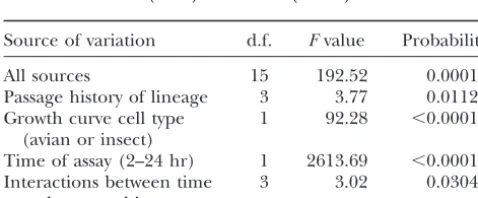
ancestral stock on PDE cells. Significant differences Temporal growth patterns on different cell types:The were also detected when similar assays were performed 24-hr growth curves of three randomly chosen virus using the C7-10 insect cell line (Figure 2). Lineages lineages from each of the passage series on both avian and insect cells are summarized in Figures 3 and 4, respectively. An overall analysis of variance for both sets of growth curve data revealed that the 10 selective passages had resulted in significantly altered temporal growth patterns (Table 4). These results confirmed that lineages adapted to the different cell culture regimes grew differently and that these differences were depen-dent on passage history and the type of cells used in the growth curve assay. Significant time by treatment and time by cell type effects (P ⫽ 0.03 and 0.0017, respectively) further confirmed the existence of differ-ent temporal growth patterns.
The most striking differences in growth patterns were observed during replication on insect cells (Figure 4).
Figure2.—Forty-eight-hour EEE virus production on the
C7-10 mosquito cell line at 34.5⬚. Experimental lineages were During the eclipse phase (0–4 hr postinfection) insect-adapted to growth on insect cells or vertebrate cells or in adapted lineages appeared highly infectious to the in-alternation between these two cell types for 10 selective pas- sect cells. Virion production by insect-adapted lineages sages. Values are shown for each of the 10 lineages in a
treat-on insect cells began to level off atⵑ16 hr postinfection ment group. Bold horizontal lines represent the mean of 10
whereas those of the other treatment groups continued replicate lineages. The means of groups that do not share a
Figure5.—Relative abilities of derived EEE virus popula-tions (tenth passage) to infect C7-10 mosquito cells at 34.5⬚. Log transformed data are shown for each of the 10 lineages in a treatment group. Values ⱕ1% are shown as 100. Bold horizontal lines represent the mean of the 10 replicate lin-eages. The means of groups that do not share a common
Figure4.—Twenty-four-hour EEE virus growth curves on letter are significantly different at theP⬍0.05 level.
the C7-10 mosquito cell line at 34.5⬚(n⫽3). After 10 selective passages, three randomly chosen lineages were tested from each of the three treatment groups, along with three replicates
5). When compared to their ancestral control, lineages of the ancestral virus population. Data shown for each time
point are the mean values calculated from the three chosen adapted to replication on insect cells were, on average, lineages. (⫹) Mosquito, (䉭) avian, (䊊) alternating, (䉬) an- almost 40 times as infectious to insect cells. Likewise, cestor. virus lineages that had replicated on insect cells at every
other passage exhibited dramatic gains, averaging an 18-fold increase in infectivity. Interestingly, for both of This resulted in a difference in virion production after
these treatment groups the number of infectious parti-24 hr, at which time the number of virions produced by
cles that were detected in the insect cell assay was often the insect-adapted lineages was an order of magnitude
above the independent estimate of BHK-21 plaque-lower than those of the other treatment groups. An
forming units used to measure initial virus input. This analysis of all pairwise comparisons revealed that the
gave rise to percentages of⬎100% infectivity, indicating growth patterns of the insect-adapted lineages were
sig-that more virions were able to infect insect cells than nificantly different from those of all other treatment
were detected by the BHK-21 plaque assay system. In groups. Significant differences were also detected
be-contrast, the 10 lineages passed only through avian cells tween the ancestral control population and all three
did not evolve to be highly infectious to insect cells and experimental groups when assayed on insect cells.
had mean infectivity scores that were not statistically Ability to infect insect cells: Significant differences
different from that of the ancestral control population (Block F ⫽ 2.85, d.f. 9, P ⫽ 0.0168; Treatment F ⫽
(P⫽0.13). 61.22, d.f. 3, P⬍0.0001) were observed when derived
To determine if their increased ability to infect insect and control virus populations were tested for their
abil-cells was due to immediate prior growth in this cell line, ity to initiate an infection in C7-10 insect cells (Figure
three randomly chosen insect-adapted lineages (lin-eages 5, 7, and 10) were back-passed once through the PDE avian cell line and then retested against the control
TABLE 4
population. All three lineages continued to display
sig-Overall factorial analysis of variance for viral growth patterns
nificant increases in insect cell infectivity following a
observed during the first 24 hr of replication in
single passage through avian cells (Wilcoxon
signed-avian (PDE) and insect (C7-10) cells
rank test; Z ⫽ ⫺2.195; P ⫽ 0.0282), thus supporting the hypothesis that genetic adaptation(s) to infect insect Source of variation d.f. Fvalue Probability
cells had occurred during the 10 selective passages. All sources 15 192.52 0.0001
Comparable assays to examine the relative abilities of Passage history of lineage 3 3.77 0.0112
each lineage to infect avian (PDE) cells were attempted. Growth curve cell type 1 92.28 ⬍0.0001
However, our infectivity assay is dependent upon isolat-(avian or insect)
Time of assay (2–24 hr) 1 2613.69 ⬍0.0001 ing a single infected cell. The highly adhesive properties Interactions between time 3 3.02 0.0304 of the avian cells made it impossible for us to carry out and passage history this assay because we were not able to achieve adequate
separation of the monolayer into distinct single cell Virus populations were sampled every 2 hr during the assay.
DISCUSSION to rather large fitness differences when a more sensitive assay system is employed (Hollandet al.1991). We did, We found that EEE virus populations are capable of
however, measure fecundity and infectivity separately, rapid evolution in response to new cellular
environ-both of which can contribute to overall viral fitness. The ments, that different selective pressures exist for virus
advantage of such an approach for an arbovirus system replication in vertebrate and invertebrate cells, and that
is that by examining the biological properties of evolving transfer in a two-host cycle selects for virus populations
virus populations, we gained insights into traits that that are well adapted for replication in both hosts.
Re-can influence the pathogenesis or host range of this sults from our study add detail to those previously
re-medically important group of viruses (Crillet al.2000). ported by other investigators (Novellaet al.1995, 1999;
Our results indicate that there are at least two mecha-Weaveret al.1999) in confirming that virus evolution
nistic components of EEE virus evolution: high fecun-was not random. Overall, our results indicate that virus
dity and rapid colonization. Increased virion production populations from the same selective regime were more
may be advantageous in two ways. First, if multiple viri-similar to each other than they were to those with
differ-ons simultaneously infect a naive host, their progeny ent passage histories. Common growth traits in lineages
may directly compete for the remaining cellular re-from the same selective regime suggest that each group
sources. Virions that are able to overwhelm their com-of 10 lineages may have followed a fairly consistent
pat-petitors by quickly achieving numerical superiority will tern of differentiation in response to common selective
have an increased chance of colonizing the remaining pressures. Such similarities most likely arose in response
uninfected cells (Olmsted et al.1984). Second, large to selection for virions with increased replicative fitness
virus populations within infected hosts may enhance (Bullet al.1997).
transmission to the next host in the transmission cycle Interestingly, despite their common ancestry and
sub-(ChamberlainandSudia1961). Mosquito infection is sequent exposure to identical passage conditions,
con-known to be dose dependent (Hardyet al.1983;Hardy siderable within-treatment variation occurred among
1988), and the induction of high viremias in infected the 10 derived lineages in each selective regime.
Hetero-avian hosts is expected to favor transmission to mosqui-geneity among similarly passaged virus populations may
toes (StraussandStrauss1994). High virus produc-reflect nonsynchronous adaptation and be the result of
tion in mosquitoes will similarly be beneficial for trans-premature sampling of continually evolving virus
popu-mission. Rapid expansion of EEE virus populations in lations. In other words, 10 selective passages may not
mosquitoes increases the likelihood that virions will suc-have allowed each lineage enough time to maximize its cessfully infect vector salivary glands and be transmitted fitness in a new cellular environment. If this is true, to a susceptible vertebrate host (Weaver et al. 1993a; further passages may result in more consistent patterns Scott et al.1994; Straussand Strauss1994). Thus, of adaptation and perhaps more homogeneous lineages a high rate of virion production is advantageous in both (Newmanet al.1985;Novellaet al.1995;Elenaet al. arthropod and vertebrate hosts. Interestingly, we ob-1996). Alternatively, additional passages could result in served that alternated lineages had the highest average the emergence of phenotypically and/or genotypically virion production on both cell lines.
distinct virus lineages, each of which followed a different Increased insect cell infectivity appears to be an im-evolutionary course to optimize its replicative fitness. portant EEE virus adaptation. We found that insect-Under this scenario, the heterogeneity within a treat- adapted and alternated lineages increased their effi-ment that we detected after only 10 selective passages ciency of infection for insect cells. Conversely, the may reflect the evolution of lineages that utilized multi- ancestral virus and lineages adapted to growth only in ple solutions to adapt to their common cellular environ- avian cells remained relatively noninfectious. Viruses ment. In either case, additional studies that examine adapted to growth in insect cells may be more infectious the growth characteristics and the genetic makeup of because they are better able to locate and attach to the these evolving virus lineages over time are needed to limited number of available receptors (Ludwig et al.
resolve these issues. 1996). It is unfortunate that we were technically unable
Because our initial study design included a relatively to run similar assays in our chosen avian cell line to large number of replicate lineages (n ⫽ 10) for each determine if similar adaptations occurred in lineages cell type, we were able to measure within treatment adapted to these cells.
long, but the ability to transmit virus declines over time performance in the other. In this regard, our results agree with those ofNovellaet al.(1999) but are differ-(Scott et al.1994). Superinfection inhibition among
closely related viruses is a common phenomenon in cell ent from those ofWeaver et al.(1999). Both of these recently published studies used an experimental design culture systems and can occur within infected mosquito
vectors (StollarandShenk1973;PelegandStollar similar to ours to examine host-specific evolution in populations of vesicular stomatitis virus (VSV) and EEE 1974;Daveyet al.1979;Karpfet al.1997;L. A. Cooper
and T. W. Scott,unpublished data). For this reason virus, respectively. What differ among the three studies are the number of replicate lineages, the number of primary colonization of certain cell types may be an
advantage for transmission. For example, rapid coloni- selective passages, and the methodology used to assess viral fitness.
zation of mosquito salivary gland cells presumably
pre-vents superinfection by competing virus genotypes and Despite their differences, all three studies found that alternated virus lineages performed well in both verte-is highly adaptive because it accelerates virus transmverte-is-
transmis-sion. brate and invertebrate cells. By using standard
virologi-cal methods, we found that viruses adapted to alterna-The observed decreases in total virus production
within the insect-adapted lineages when grown in insect tion between cell types had high virion production on both cell types and also gained in their ability to infect cells may have been favored by a negative association
between total virion production and the speed of coloni- insect cells. Novella et al. (1999) similarly reported that alternated populations of VSV displayed increased zation. This kind of negative association is supported
by temporal patterns of EEE virus infection and growth fitness on both vertebrate and invertebrate cell types and concluded that slow rates of arbovirus evolution in C7-10 mosquito cells (Figure 4). In insect cells, where
receptors are relatively rare (Ludwiget al.1996), selec- are not necessarily due to an adaptive compromise for virus replication in different cell types. Weaver et al. tion appears to favor rapid entry into cells over the
ability to grow to high titer. (1999) also reported that alternating replication in dual hosts increased virus fitness in either host alone. The low level of virus production in insect cells by
viruses adapted to that cell type was unexpected. Our For alphaviruses, dual hosts, most often mosquitoes and vertebrates, appear necessary for sustained virus experimental design ruled out that low yields were
at-tributable to complicating factors such as host range amplification (Scottet al.1994). Because they are re-stricted to obligate cycling within a two-host transmis-mutants, defective interfering particles, or immediate
past replication in insect cells. Furthermore, our results sion cycle and they have the ability to rapidly adapt to new cellular environments, it is not surprising that are not unique to EEE virus. Similar decreases in viral
yield following insect cell adaptation have been re- alphaviruses have evolved to maximize their fitness in a two-host life cycle.
ported for Sindbis virus (HertzandHuang1995).
Like-wise, attenuated, rapidly penetrating Sindbis virus vari- Although we found that different selective pressures exist for viruses that are restricted to replication in only ants also display cell-specific changes in infectivity
(Baricet al.1981). one host, lineages grown in alternation between hosts
expressed intermediate phenotypes consistent with dual Adaptation of viral populations to multiplicity of
in-fection and the presence of competing virion popula- adaptation to both cellular environments. We conclude that different selective pressures exist for alphavirus rep-tions has been well documented in a variety of other
RNA virus systems (Sevilla et al. 1998; Turner and lication within each component of their two-host trans-mission cycle and that alternation between hosts selects Chao1998;Turneret al.1999). Strong intrahost
com-petition between virions can explain the apparently non- for virus populations that are well adapted for both. adaptive decreases in fecundity observed for insect cell We thank the Entomology Department at the University of Mary-adapted lineages. We speculate that viruses that have land, College Park, and Leslie H. Lorenz for help in completing these studies; Dennis Brown and Victor Stollar for providing cell lines; Nick
incurred a fitness cost in fecundity have gained a fitness
Karabatsos for providing the original virus isolate; John Holland for
advantage through superior colonization ability, a
situa-helpful discussions on virus evolution; and three anonymous reviewers
tion that may or may not result in a net loss of virus
for their critical reading of this manuscript. Partial financial support
fitness. The exact relationship between these two traits for this work was provided by the Maryland Agricultural Research and their effect on overall virus fitness deserves addi- Station competitive grants program.
tional study. Interestingly, this hypothesized trade-off was not seen in lineages that were alternated between
insect and avian cells. Alternating EEE virus lineages LITERATURE CITED
increased insect cell infectivity while maintaining a high
Baric, R. S., D. W. Trent andR. E. Johnston, 1981 A Sindbis
rate of replication on both cell types. virus variant with a cell-determined latent period. Virology110:
237–242.
Although multiple lines of evidence suggested that
Beaty, B. J., D. W. TrentandJ. T. Roehrig,1988 Virus variation
differential evolution occurred between the insect- and
and evolution: mechanisms and epidemiological significance, pp.
avian-adapted EEE virus lineages, we found no evidence 127–152 inThe Arboviruses: Epidemiology and Ecology, Vol. I, edited
byT. P. Monath.CRC Press, Boca Raton, FL.
Brown, D. T.,andL. D. Condreay,1986 Replication of Alphavi- mosquito-borne Flaviviruses and Alphaviruses enzootic in Austra-lia. Virus Genes11(2/3): 225–237.
ruses in mosquito cells, pp. 171–207 inThe Togaviruses and
Flavivir-Marcovici, M., andJ. E. Prier, 1968 Enhancement of St. Louis
uses, edited by S. SchlesingerandM. Schlesinger. Plenum
arbovirus plaque formation by neutral red. J. Virol.2(3): 178–181. Press, New York.
Newman, C. M., J. E. CohenandC. Kipnis,1985 Neo-Darwinian Bull, J. J., M. R. Badgett, H. A. Wichman, J. P. Huelsenbeck, D. M.
evolution implies punctuated equilibrium. Nature315:400–401. Hilliset al., 1997 Exceptional convergent evolution in a virus.
Novella, I. S., D. K. Clarke, J. Quer, E. A. Duarte, C. H. Leeet
Genetics147:1497–1507.
al., 1995 Extreme fitness differences in mammalian and insect Chamberlain, R. W.,andW. D. Sudia,1961 Mechanisms of
trans-hosts after continuous replication of vesicular stomatitis virus in mission of viruses by mosquitoes. Annu. Rev. Entomol.6:371–
sandfly cells. J. Virol.69(11): 6805–6809. 390.
Novella, I. S., C. L. Hershey, C. Escarmis, E. DomingoandJ. J. Chang, G. J.,andD. W. Trent,1987 Nucleotide sequence of the
Holland,1999 Lack of evolutionary stasis during alternating genome region encoding the 26S mRNA of Eastern equine
en-replication of an arbovirus in insect and mammalian cells. J. Mol. cephalomyelitis virus and the deduced amino acid sequence of
Biol.287(3): 459–465. the viral structural proteins. J. Gen. Virol.68:454–455.
Olmsted, R. A., R. S. Baric, B. A. SawyerandR. E. Johnston,1984 Cilnis, M. J., W. KangandS. C. Weaver,1996 Genetic conservation
Sindbis virus mutants selected for rapid growth in cell culture of Highlands J viruses. Virology218:343–351.
display attenuated virulence in animals. Science225:424–427. Cooper, L. A., B. J. Sina, M. J. TurellandT. W. Scott,2000 Effects
Peleg, J.,andV. Stollar,1974 Homologous interference inAedes
of initial dose on eastern equine encephalitis virus dependent
aegypti cell cultures infected with Sindbis virus. Arch. Gesamte mortality in intrathoracically inoculatedCuliseta melanura
mosqui-Virusforsch.45:309–318. toes. J. Med. Entomol.37:815–819.
Poidinger, M., S. Roy, R. A. Hall, P. J. Turley, J. H. Scherretet
Crill, W. D., H. A. WichmanandJ. J. Bull,2000 Evolutionary
al., 1997 Genetic stability among temporally and geographically reversals during viral adaptation to alternating hosts. Genetics
diverse isolates of Barmah Forest virus. Am. J. Trop. Med. Hyg.
154:27–37.
57(2): 230–234. Davey, M. W., R. J. MahonandA. J. Gibbs,1979 Togavirus
interfer-Reed, L. J.,andH. A. Muench,1938 A simple method for estimating ence inCulex annulirostrismosquitoes. J. Gen. Virol.42:641–643.
fifty percent endpoints. Am. J. Trop. Med. Hyg.27:493–497. Durbin, R. K.,andV. Stollar,1984 A mutant of Sindbis virus with
Renz, D.,andD. T. Brown,1976 Characterization of Sindbis virus a host-dependent defect in maturation associated with
hypergly-temperature-sensitive mutants in cultured BHK-21 andAedes
al-cosylation of E2. Virology135:331–344.
bopictus(mosquito) cells. J. Virol.19:775–781. Durbin, R. K.,andV. Stollar,1986 Sequence analysis of the E2
Roehrig, J. T., R. A. Hunt, G. J. Chang, B. Shelk, R. A. Bolinet
gene of a hyperglycosylated host restricted mutant of Sindbis
al., 1990 Identification of monoclonal antibodies capable of virus and estimation of mutation rates from frequency revertants.
differentiating antigenic varieties of Eastern equine encephalo-Virology154:135–143.
myelitis viruses. Am. J. Trop. Med. Hyg.42:394–398. Elena, S. F., V. S. CooperandR. E. Lenski,1996 Punctuated
evolu-Sarver, N.,andV. Stollar,1977 Sindbis virus-induced cytopathic tion caused by selection of rare beneficial mutations. Science
effect in clones of Aedes albopictus (Singh) cells. Virology 80: 272:1802–1804.
390–400. Glantz, S. A.,1992 Primer of Biostatistics, Ed. 3. McGraw-Hill, New
Scott, T. W.,andT. G. Burrage,1984 Rapid infection of salivary York.
glands inCuliseta melanurawith Eastern equine encephalitis virus: Gliedman, J. B., J. B. SmithandD. T. Brown,1975 Morphogenesis
an electron microscopic study. Am. J. Trop. Med. Hyg.33:961– of Sindbis virus in culturedAedes albopictuscell. J. Virol.16(4):
964. 913–926.
Scott, T. W.,andS. C. Weaver,1989 Eastern equine encephalomy-Hardy, J. L., 1988 Susceptibility and resistance of vector mosquitoes,
elitis virus: epidemiology and evolution of mosquito transmission. pp. 87–126 in The Arboviruses: Epidemiology and Ecology, Vol. I,
Adv. Virus Res.37:277–328. edited by T. P.Monath. CRC Press, Boca Raton, FL.
Scott, T. W., S. C. WeaverandV. L. Mallampalli,1994 Evolution Hardy, J. L., E. J. Houk, L. D. KramerandW. C. Reeves,1983
In-of mosquito-borne viruses, pp. 293–324 inEvolutionary Biology of
trinsic factors affecting vector competence of mosquitoes for
arbo-Viruses, edited byS. S. Morse.Raven Press, New York. viruses. Annu. Rev. Entomol.28:229–262.
Sevilla, N., C. M. Ruiz-Jarabo, G. Gomez-Mariano, E. Baranowski Heidner, H. W., T. A. KnottandR. E. Johnston,1996 Differential
andE. Domingo,1998 An RNA virus can adapt to the multipli-processing of Sindbis virus glycoprotein PE2 in cultured verte- city of infection. J. Gen. Virol.
79:2971–2980.
brate and arthropod cells. J. Virol.70(3): 2069–2073. Sokal, R. R.,andF. J. Rohlf,1981 Biometry, Ed. 2. W. H. Freeman, Hertz, J. M.,andH. V. Huang,1995 Host-dependent evolution of New York.
the Sindbis virus promoter for subgenomic mRNA synthesis. J. Sokal, R. R.,andF. J. Rohlf,1987 Introduction to Biostatistics, Ed.
Virol.69(12): 7775–7781. 2. W. H. Freeman, New York.
Holland, J. J., J. C. de la Torre, D. K. ClarkeandE. Duarte, Steele, R. G.,andJ. H. Torrie, 1980 Principles and Procedures of 1991 Quantification of relative fitness and great adaptability of Statistics, Ed. 2. McGraw-Hill, New York.
clonal populations of RNA viruses. J. Virol.65(6): 2960–2967. Steinhauer, D. A.,andJ. J. Holland,1987 Rapid evolution of RNA Igarashi, A.,1978 Isolation of a Singh’sAedes albopictuscell clone viruses. Annu. Rev. Microbiol.41:9–33.
sensitive to Dengue and Chikungunya viruses. J. Gen. Virol.40: Stollar, V.,andT. E. Shenk,1973 Homologous viral interference
531–544. inAedes albopictuscultures chronically infected with Sindbis virus.
Johnston, R. E.,andJ. F. Smith,1988 Selection for accelerated J. Virol.2:592–595.
penetration in cell culture coselects for attenuated mutants of Strauss, J. H.,andE. G. Strauss, 1994 The alphaviruses: gene Venezuelan equine encephalitis virus. Virology162:437–443. expression, replication, and evolution. Microbiol. Rev. 58(3): Karpf, A. R., E. Lenches, E. G. Strauss, J. H. StraussandD. T. 491–562.
Brown,1997 Superinfection exclusion of Alphaviruses in three Strizki, J. M.,andP. M. Repik,1994 Structural protein relationships mosquito cell lines persistently infected with Sindbis virus. J. Virol. among Eastern equine encephalitis viruses. J. Gen. Virol. 75:
71(9): 7119–7123. 2897–2909.
Kowal, K. J.,and V. Stollar,1981 Temperature sensitive host- Symington, J.,andM. J. Schlesinger,1978 Characterization of a dependent mutants of Sindbis virus. Virology114:140–148. Sindbis virus variant with altered host range. Arch. Virol. 58:
Ludwig, G. V., J. P. KondigandJ. F. Smith,1996 A putative receptor 127–136.
for Venezuelan equine encephalitis virus from mosquito cells. J. Turell, M.,1988 Horizontal and vertical transmission of viruses by
Virol.70(8): 5592–5599. insect and tick vectors, pp. 127–152 inThe Arboviruses: Epidemiology
Luukkonen, A., C. Von BonsdorffandO. Renkonen,1977 Charac- and Ecology, Vol. I, edited byT. P. Monath.CRC Press, Boca terization of Semliki Forest virus grown in mosquito cells. Com- Raton, FL.
parison with the virus from hamster cells. Virology78:331–335. Turner, P. E.,andL. Chao,1998 Sex and the evolution of intrahost Mackenzie, J. S., M. Poidinger, M. D. Lindsay, R. A. Halland competition in RNA Virusφ6. Genetics150:523–532.
frequencies confirm limit to coinfection in the RNA bacterio- al., 1993a Diversity within natural populations of eastern equine phageφ6. J. Virol.75(3): 2420–2424. encephalomyelitis virus. Virology195:700–709.
Weaver, S. C.,1995 Evolution of Alphaviruses, pp. 501–530 inMolec- Weaver, S. C., A. Hagenbaugh, L. A. Bellew, S. V. Netsov, V. E.
ular Basis of Virus Evolution, edited byA. Gibbs, C. Calisherand Volchov et al., 1993b A comparison of the nucleotide se-F. Garcia-Arenal.Cambridge University Press, Cambridge, UK. quences of eastern and western equine encephalomyelitis viruses Weaver, S. C., T. W. ScottandR. Rico-Hesse,1991 Molecular with those of other alphaviruses and relate RNA viruses. Virology
evolution of Eastern equine encephalomyelitis virus in North 197:375–390.
America. Virology182:774–784. Weaver, S. C., A. C. Brault, W. KangandJ. J. Holland,1999
Ge-Weaver, S. C., R. Rico-HesseandT. W. Scott,1992 Genetic diver- netic and fitness changes accompanying adaptation of an arbovi-sity and slow rates of evolution in New World alphaviruses. Curr. rus to vertebrate and invertebrate cells. J. Virol.73(5): 4316–4326. Top. Microbiol. Immunol.176:99–117.