ISSN(Online): 2319-8753 ISSN (Print): 2347-6710
I
nternational
J
ournal of
I
nnovative
R
esearch in
S
cience,
E
ngineering and
T
echnology
(A High Impact Factor & UGC Approved Journal)
Website: www.ijirset.com
Vol. 6, Issue 8, August 2017
A Review on Modeling of Temperature
Distribution at Tool Workpiece Interface
during Machining Process
Arun Kumar1, Sukhdeep S. Dhami2
M.E. Student, Department of Mechanical Engineering, NITTTR, Chandigarh, India1 Professor, Department of Mechanical Engineering, NITTTR, Chandigarh, India2
ABSTRACT:Rise in temperature during metal cutting operation has been problem for engineers from beginning. Excessive rise in temperature has severe effects on workpiece quality, tool wear and on tool life. Moreover high cutting temperature also affects the microstructure and hardness of the cutting tool. Magnitude of cutting temperature strongly depends on cutting conditions, tool geometry, workpiece and tool material. Engineer and scientist are doing their endless effort to find optimum cutting conditions for minimum heat generation. This will increase tool life, improve surface finish and decrease production cost. This paper represents various temperature measurement techniques and how cutting conditions during turning operation on materials affects the magnitude of heat generation thus tool wear, tool life and workpiece quality.
KEYWORDS:Modeling methods, Cutting temperature, cutting parameters, Tool wear, surface roughness, optimization.
I. INTRODUCTION
Machining is used to produce components of required dimensions and surface finish by removing extra material with the help of cutting tool [1]. Out of all components in engineering more than half undergo machining operations. So it become very important process should take place in such a way so that tool life must increase and overall cost of machining operation must decrease. Cutting parameters and heat generated during machining affects the performance of tool. To find efficient cutting parameters experimental as well as modeling technique are widely used [2]. Temperature also affect the tool wear hence it is important to know temperatureat cutting zone [3]. During machining process increase in temperature cause reduction in tool life. Also quality of machined surface, structural alteration of tool and workpiece material depends on maximum temperature, temperature gradient and on cooling rate of both tool and workpiece [4]. For high speed machining and maximum tool lifeseveral suitable techniques like dry cutting, cryogenic cooling, minimum quantity of lubricantand compressed air can be used [5]. Cutting fluid act as lubricant and hence help in reducing temperature rise while machining operation [6]. In order to increase the tool life and quality of machined component it is important to find optimum cutting parameters and predict the magnitude of heat generation and temperature rise during the process.
Heat generation during machining
ISSN(Online): 2319-8753 ISSN (Print): 2347-6710
I
nternational
J
ournal of
I
nnovative
R
esearch in
S
cience,
E
ngineering and
T
echnology
(A High Impact Factor & UGC Approved Journal)
Website: www.ijirset.com
Vol. 6, Issue 8, August 2017
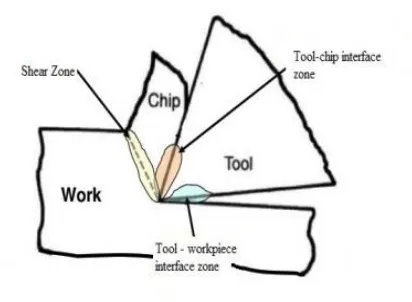
Figure 1. Heat Generation Zone
i. Shear Zone: - In this zone major portion of energy is converted into heat and actual plastic deformation occurs. This heat raises temperature of chip. As chip slide on the tool, some portion of heat goes along with chip and rest is retained by workpiece. Around 80-85% amount of heat produced in the shear zone.
ii. Tool-chip interface zone: - During movement of heated chip over tool, friction occur between the contact surfaces and cause generation of heat again. Some portion of heat carried away by chip and rest is retained in tool. About 15-20% amount of heat produced in this zone.
iii. Tool workpiece interface Zone: - During machining operation portion of tool flank rub against the workpiece and become cause of heat generation due to friction. About 1-3% amount of heat produced in this zone. This heat produced both in tool and workpiece but its effect on tool is more pronounced and cause very high temperature at tool tip and area near tool tip.[3,7].
II. RELATEDWORK
A brief review of current status of research work carried out by various investigators is given below.
Effects of temperature on workpiece quality and on tool life
Quality and structural alteration of machined surface depends on cutting parameters and cutting temperature. During machining heat generated and possible negative effects of cutting temperature on the machined component are Surface degradation by quick erosion, oxidation etc. Micro cracks may be generated on the surface. Inaccurate machined parts may be produced in terms of dimension due to expansion and contraction because of thermal effect. In continuous cutting operation tool wear mode occur mainly due to plastic deformation of tool. Since strength of cutting tool strongly depends on the cutting temperature magnitude during cutting operation. Hence to predict plastic deformations in cutting edge it become very important to determine correct distribution of temperature in cutting edge [8]. During machining workpiece and tool are subject to mechanical and thermal loads. This causes mechanical deformation and thermal expansion because friction process converts the mechanical energy into heat [9].Due to thermal effect Cutting tool elongate and position of cutting edge shifted [10].
ISSN(Online): 2319-8753 ISSN (Print): 2347-6710
I
nternational
J
ournal of
I
nnovative
R
esearch in
S
cience,
E
ngineering and
T
echnology
(A High Impact Factor & UGC Approved Journal)
Website: www.ijirset.com
Vol. 6, Issue 8, August 2017
than other two and at low cutting speed indirect cryo treated perform best than other two but at higher cutting speed dry condition provide better surface finish. For flank wear at low cutting speed direct cryogenic condition show minimum flank wear and at high cutting speed indirect cryo treated perform better than dry cutting condition.
Panda et al. [6] applied Taguchi L16 orthogonal design and studied surface roughness on EN31 workpiece with
multi-layer coated TiCN /Al2O3/TiN cutting tool while performing turning operation in dry condition. RSM technique used
for development of mathematical model. Cutting parameters for surface roughness are optimize by using Taguchi technique. From experiments it is concluded that feed is most dominant factor for surface roughness.
Thakare and Nordgren [8] investigated temperature distribution using experimental technique and finite element analysis. CVD coated carbide insert used while performing turning operation on AISI 4340. From experiment it is concluded that temperature distribution in steady state and from experimental technique are same.
Hormanet al. [10] investigated effect of temperature on blunting of tool and wear characteristics in continuous wood cutting process. Numerical method was used to find out the temperature distribution in the blade.Results are compared with experimental and analytical results. Numerical solution obtained from Boundary Element Method. Conclusion drawn from results that temperature of blade depends on several factors, continuity of cutting process, shape of tool, cutting speed and depth of cut.
Ghodam [11]investigated effect of coated and uncoated carbide tool on tool life during machining of EN8 alloy steel under dry cutting conditions. CVD coated insert CNMG120408 PR 4225 used for comparison with uncoated carbide insert. Temperature is measured with tool work thermocouple. During experiment only speed and feed are vary and depth of cut was kept constant. Experimental results revealed that coated tool resist heat generation, so coating of the tool increase the tool life for the same cutting condition used for uncoated tool.
Senthil and Senthil [12]investigated effect of cutting parameters on flank wear in wet dry, and gas cooled machiningwhile performing turning operation with uncoated carbide cutting tool insert CNMG120408 on super duplex stainless steel SAF 2507. Taguchi approach used and wear measured by tools maker microscope. To optimize the experimental result RSM technique used and for optimizes value tool wear analysewith scanning electron microscope.
Bhoyar and Kamble [13] developed a model to find the temperature distribution in machining of EN 24 steel using finite element analysis software Deform 3D. Temperature was measured with optical infrared pyrometer having range 00 to 5200C. Conclusions drawn from experimental results that deform 3D program estimate accurate temperature and tool wear increase the cutting forces thus increase temperature magnitude.
Pragatheswaran et al. [14]enquired the effects of cutting speed, feed, depth of cut on the surface finish of Aluminium alloy 5083 with tungsten carbide insert. During machining various other factors find out like temperature by using k-type thermocouple, force measurement by piezoelectric dynamometer and tool wear by using tool maker microscope.
Shivade [15] applied Taguchi orthogonal design array approach during machining of EN 8 steel using the carbide cutting tool for optimizing the cutting speed and depth of cut for surface roughness and tool tip temperature. ANOVA and Taguchi’s L9 orthogonal array design was used. Surface roughness measured by surf tester and tip temperature measured by thermometer. From experimental results it is concluded that with increase in speed and depth of cut surface roughness decrease. Out of these two speed has greatest effect. Tool tip temperature increase with speed, depth of cut and depth of cut has the dominant effect.
Mondelin [16] investigated surface integrity during turning of 15-5PH stainless steel. While performing turning operation extreme heat is generated in cutting zone. In order to predict the surface integrity metallurgical model was prepared and implemented in numerical model.
ISSN(Online): 2319-8753 ISSN (Print): 2347-6710
I
nternational
J
ournal of
I
nnovative
R
esearch in
S
cience,
E
ngineering and
T
echnology
(A High Impact Factor & UGC Approved Journal)
Website: www.ijirset.com
Vol. 6, Issue 8, August 2017
parameter. Crater and flank wear was analysed. Also surface roughness was studied. Temperature modeling simulation result through FEA was compared with experimental results. Temperature during turning controlled by fuzzy logic control system. Experiment Showed that proposed device was successful in controlling the temperature in chip tool interface thus tool wear also. Surface roughness was not changed due to non-modification of parameter feed and depth of cut.
Measurement and modeling technique of temperature
Ravindran [1]established 3D model through FEM approach using ANSYS 16 to simulate turning of Al 7075-T6 with uncoated carbide tool. It is concluded that out of speed, feed and depth of cut speed is the most dominant factor and temperature will rise with increase in speed.
Kannan [2]conducted experiments to minimize the temperature in tool chip area during machining of EN31 steel alloy with tungsten carbide cutting tool. DX9 software used for design of experiment and ABAQUS used for FEA model of chip formation. Conclusion drawn from experiments that Speed will be dominant factor for increment of temperature during machining.
Akhilet al. [3] Studied effects of speed, feed and depth of cut on heat generation at tool tip during turning operation of mild steel by high carbon tip tool. K type of thermocouple was used for temperature measurement having temperature measurement range in between -200 to 12500C. Experimental results show that cutting conditions behave linearly and optimum condition for minimum temperature at tool tip is medium feed, low depth of cut and high cutting speed.
Gosai and Bhavsar [4]applied Central Composite Design (CCD) based on RSM on cutting parameters for minimizing the temperature. Tool life depends on cutting temperature, so experiment was performed on EN36 by taking CNMG4325 TN2000 coated carbide insert. To obtain required number of combination for experiments Design of expert software was used. From experiments it is concluded that depth of cut is the highest affecting parameter for heat generation.
Vipindaset al. [7] developed finite element model to predict tool-chip interface temperature during micro machining of Titanium alloy. Experiments wereperformed on Ti-6Al-4V with tungsten Carbide micro end mill tool. Energy formed in primary and secondary zones were estimated by Thermo-mechanical model. Temperature distribution in workpiece was estimatedusing the heat generated in the primary and secondary deformation zones. ABAQUSsoftware was used for simulation of temperature distribution in chip and tool. Simulated results were compared from literature. Maximum temperature was obtained at the tool chip interface. As undeformed chip thickness increases, temperature at the tool chip interface increases.
Schindler et al. [9] developed 3D Finite Element model to find distribution of temperature in turning operation. Cutting conditions was chosen to perform turning operation on aluminium wrought alloy Al 2024. Cutting tool material for the experiments was polycrystalline diamond. To determine temperature distribution in the workpiece three Ni-Cr-Ni thermocouples was used and to find distribution of temperature, modeling of workpiece was done by the use of FEA software. Moreover deflection and thermal expansion of workpiece also shown in modeling process. Continuous removal of material was considered and this allow actual workpiece diameter after turning operation.
ISSN(Online): 2319-8753 ISSN (Print): 2347-6710
I
nternational
J
ournal of
I
nnovative
R
esearch in
S
cience,
E
ngineering and
T
echnology
(A High Impact Factor & UGC Approved Journal)
Website: www.ijirset.com
Vol. 6, Issue 8, August 2017
Carvalhoet al. [19]enquired temperature at tool-chip interface using technique of inverse heat conduction. Workpiece material during experiment was grey cast iron FC20EB 126 ABNT and insert was cemented SNUN12040408 K20/Brassinter. This work develop a technique by use of which temperature can be find out at insert tip, tool and on shim.
Abdilet al. [20]investigatedtool chip temperature and tool temperature simultaneously by using infrared radiation pyrometer and k- type thermocouple respectively. Turning operation was performed on the AISI 4140 alloy steel of hardness 50HRC by using PVD TiAlN-TiN-coated WNVG080404-IC907 insert. Taguchi L18 method was used and temperature magnitude observed during experiment validated by FEM. Experimental results showed that cutting speed has dominant effect on generation of cutting temperature and on tool chip interface temperature.
Bagheri and Mottaghizadeh [21] applied full-factorial design to enquired the temperature at tool-chip interface. Turning operation was performed on ST37 steel with HSS cutting tool. Temperature measured with two different techniques are embedded thermocouple and infrared camera. Experimental results compared with the FLUENT and MSC.SuperForm software. From results it is concluded that cutting temperature increase with increase in Speed, feed and depth of cut and speed is dominant factor.
Rathod and Razik [22]investigated the difference of temperature measurement between Experimental technique and EFA. For this analysis experiments were performed by using HSS tool and Carbide tool. FLUKE 62 max IR thermometer used for temperature measurement having temperature measurement range -400 to 6500C. Result shows only 4% difference obtain in temperature measurement techniques and cutting speed is most dominant factor for temperature generation.
Jagadeesh [23]investigated effects of deep cryogenic over untreated coated carbide insert TN 2000 while machining of C-40 and EN 353. With different cutting parameter tool tip temperature and cutting forces was determined. With increment of speed cutting forces decrease but more decrement observes in cryo treated tool. With increment in depth of cut tool tip temperature increase but less amount of increment observe in croyotreated tool. With increase in feed cutting force decrease but more decrement observe in cryotreated tool.
Mia and Dhar [24] modeled average temperature at tool workpiece interface while performing turning operation on AISI600 steel. In dry and high pressure coolant environment coated carbide insert was used. To predict temperature tool-work thermocouple was used. RSM and ANN technique were used with full factorial approach to find temperature generated during machining. ANN model was found to be higher accurate.
Carlos [25] investigated temperature distribution at tool chip interface. Novel technique was used for measurement of temperature distribution. Machining was performed on Ti6Al4V and on Inconel 718. During the study, transparent yttrium aluminum garnet (YAG) tools was used to provide an optical path for the chip-tool interface. From experimental results it is concluded that tool chip interface temperature is almost same for both Ti6Al4V and Inconel 718 when YAG tool is used except at large feed more than 100 µm.
Klocke[26] modeled two scale finite element model to calculate thermal deformation. Turning operation was performed on AISI 1045. This approach consists of two sub model. First sub model related to chip formation model and used for calculation of temperature distribution in chips, tool, workpiece and heat. Second sub model is used to calculate deformation produced in the workpiece and to calculate the instantaneous temperature distribution. Orthogonal cutting process used for validating the chip formation model and thermal imaging of orthogonal process is used to validate workpiece model.
ISSN(Online): 2319-8753 ISSN (Print): 2347-6710
I
nternational
J
ournal of
I
nnovative
R
esearch in
S
cience,
E
ngineering and
T
echnology
(A High Impact Factor & UGC Approved Journal)
Website: www.ijirset.com
Vol. 6, Issue 8, August 2017
Ajayiet al. [28] predicted distribution of stress and temperature with finite element analysis in order to identify optimum cutting conditions. Workpiece material was AISI 316L and cutting tool is HSS. Effects of flow stress and friction between chip tool interfaces in FE simulation are also analysed. Friction model and cutting speed are varied to predict the temperature distribution effect on workpiece and chip tool interface. Results shows that increasing the coefficient of friction will increase the temperature and force, thus higher the coefficient of friction will leads to increase in temperature and force.
Klocke [29] analytical modeling technique was used to draw the relationship between temperature distribution and chip geometry. Temperature is directly affected by thermo mechanical properties of workpiece, tool, chip geometry parameters and process parameters. Model is programmed and confirmed by longitudinal turning experiments and a validated FEM model of longitudinal turning of AISI 1045.
Goyalet al. [30]studied various experimental techniques for measurement of temperature generated during machining process and concluded that no technique is perfect and give accurate results and no technique is developed which can be used in all cutting conditions.
Mzad [31] developed mathematical procedure for calculating the heat flux and measured surface temperature with infrared thermometer having temperature range of –35 to 900 °C. Workpiece of steel and bronze were used for turning tests, and for milling a workpiece of aluminium is tested. The graphs obtained of the temperature variation with time are exported into the software Table Curve 2D for polynomial interpolation. Third-order spline approximation was used to represent the measured temperature. If time derivatives are not calculated with sufficient accuracy then unwanted oscillations can be produced in the calculated heat flux and surface temperature.
Putz [32]studied comparison of numerical solution, analytical approach and experimental results. Numerical and analytical model are verifiedby cutting experiments. Milling operation on S235 steel performed with uncoated carbide insert and with the use of thermal camera tool temperature was measured. For simulation DEFORM and MSC.MARC software were used.
Baohaiet al. [33] developed an analytical model for end milling operation to predict cutting tool temperature. Tool temperature is measured by single wire thermocouple. Results showed that with increment of cutting speed magnitude of temperature generation decrease but increase with feed per tooth. Finite element simulation was used for modeling purpose. Comparison between predicted and experimental temperature shows close relation.
Mia et al. [34] developed predictive model for calculation of average tool workpiece interface temperature. Coated
carbide inserts used for hard turning of AISI 1060 steel. Artificial Neural Network (ANN) and Response Surface Methodology (RSM) were used to determine temperature magnitude in respect of cutting speed, feed and material hardness. Full factorial design approach was used. Tool work thermocouple used for measurement of temperature. To know accuracy of model Mean Absolute Percentage Error (MAPE) and Variance (ANOVA) were used. The accuracy of the ANN and RSM model was found to be 99%. Both these models are acceptable. It is observed that accuracy of ANN model is higher. These models, if employed are expected to provide a better control of cutting temperature in turning of hardened steel.
Chinchanikar andChoudhury [35] studied average chip tool interface temperature with K type of thermocouple. Turning operation was performed on the AISI 4340 steel with coated insert namely CVD-applied multi-layer TiCN/Al2O3/TiN and PVD applied single-layer TiAlN. CCD technique used with value of alpha 1.6817. From
experimental results it is concluded that interface temperature will be higher for CVD-coated multi-layer tool in comparison to single-layer TiAlN and speed is the most dominant factor followed by feed and depth of cut has very negligible effect on cutting temperature.
ISSN(Online): 2319-8753 ISSN (Print): 2347-6710
I
nternational
J
ournal of
I
nnovative
R
esearch in
S
cience,
E
ngineering and
T
echnology
(A High Impact Factor & UGC Approved Journal)
Website: www.ijirset.com
Vol. 6, Issue 8, August 2017
Empirical process model was used to calculate the cutting forces and heat flux. Comparison was made between calculated data and simulated data. The comparison showed that shape derivative, workpiece temperature and workpiece deformation are predicted accurately.
Joshi et al. [37] investigated temperature distribution in laser assisted machining by performing operation on Ti-6Al-4V alloy. To show transient temperature distribution finite element model was developed. The Gaussian beam profile of the laser spot is selected for analysis. The parametric studies show that temperature decrease with increase in spot radius, scanning speed and increase with laser power. Simulation was done using ANSYS software. To study and predict temperature distribution in depth on workpiece finite element analysis was used so that we can find optimum depth for laser assisted machining.
Schweinochet al. [38] investigated thermal loading in milling processes with model. Dynamic tool behaviour was investigated and relation was drawn between process parameters. Both have large influence on the thermal loading of
the workpiece.
Putz [39] developed numerical simulation method for calculation of heat sources and heat flux in milling processes. Non-steady-state heat flux into the workpiece, chips and the tool are computed numerically. The numerical models are fitted and verified by experiments on S235 steel. Temperature measured through thermal camera and thermocouple. Two dimensional cutting simulations were conducted using DEFORM software and two model use FE program MSC.MARC. The simulations show a good match with the force and temperature measurements of the cutting processes.
Mohandas et al. [40] Enquired heat measurement and surface integrity during hard turning process. Workpiece material for the operation was chrome plated EN 24 substrate and TiAlN coated PCBN insert used as cutting tool. Nose radius, cutting edge angle, feed, depth of cut and cutting speed are variables during the operations. Temperature developed on insert, chip and workpiece was studied. Taguchi approach was used for design of experiment. K type thermocouple was used for temperature measurement. It is observed from the results that maximum heat was developed 2mm from cutting edge on top diagonal. Nature of fracture of chip was observed through SEM and confocal microscope.
Summary of reviewed papers
The following inferences are drawn by reviewing the above mentioned literatures.
Table 1: Summary of reviewed papers
Objectives Method and instruments used Dominant parameters
Effects of temperature on workpiece quality and on tool life [5,6,12,13,15,17].
Tool maker microscope
LOM
BSE
SEM
MATLAB
Machine Vision
Surface profile gauge
Taylor Hobson roughness tester
Wear mostly takes place by abrasion action and flank wear cause tool failure.Cutting speed, feed and depth of cut all affect the surface roughness.
Measurement and modeling technique of temperature [1,3,13,18,21,22,30
FEM
DX 9
K type thermocouple
ISSN(Online): 2319-8753 ISSN (Print): 2347-6710
I
nternational
J
ournal of
I
nnovative
R
esearch in
S
cience,
E
ngineering and
T
echnology
(A High Impact Factor & UGC Approved Journal)
Website: www.ijirset.com
Vol. 6, Issue 8, August 2017
Measurement of temperature
To find temperature at tool, chip and workpiece scientists and researcher developed various methods. These methods are categorising as [30]
i. Analytical method: - This method use mathematical equation or model to find temperature. Since this method is very quick and simple but less accurate.
ii. Experimental Method: - This method performed experimentally on the workpiece hence it is time consuming but very accurate. Hence researcher main focus is on this method.
iii. Software method: - Finite element analysis method.
Experimental method
Techniques for measurement of temperature rise during metal cutting available in literature are studied and they are i. Thermocouple technique- tool-work thermocouple technique [3,14,18,30] Transverse thermocouple technique
and embedded thermocouple technique ii. Thermal paint technique [21,30] iii. Fine powder technique [21,30]
iv. Infrared Radiation Pyrometer technique [21,22,30]
Modeling of temperature
Measurement of temperature at tool chip interface is not easy. Analytical methods are time consuming and thermocouple technique is costly hence Finite Element Analysis can be used to find parameters and temperature [3]. This approach is also used to find out the stress stain analysis, fluid problems, thermal problems etc. [21]. Finite element analysis is one of most useful approach to find the heat generation during machining operations [13]. There are many software tools for finite element analysis like Abaqus [3,13], ANSYS [1,22], deform 3D [13] etc.
III. CONCLUSION
By studying the endless efforts of engineers and scientists it is concluded that determination of cutting temperature is very important because present machining is high speed machining leads to generation of high temperature at tool, work and tool- work interface which results in rapid tool wear and tool failure. Temperature variation in the material also affects the microstructure, hardness and workpiece surface characteristics. Since collection of data from experimental machining process is very costly. So, there is strong motivation for development of methodology that can explain machining phenomena using modeling approach. Modeling helps in determining plastic deformation, strength of tool material and calculation of the heat generated and heat partition in the chip, tool and workpiece. Hence rate of heat flow in workpiece can be calculated easily by use of Finite Element Analysis. In order to reduce such deformations cutting conditions need to be determined. Finite element simulations allow optimization prior to actual machining. Thus modeling of temperature will help in predicting the most affected area due to cutting temperature.
37,39,40]. Infrared radiation Pyrometer
Inverse heat conduction method
Deform 3D
Infrared Camera
Ansys Software
ISSN(Online): 2319-8753 ISSN (Print): 2347-6710
I
nternational
J
ournal of
I
nnovative
R
esearch in
S
cience,
E
ngineering and
T
echnology
(A High Impact Factor & UGC Approved Journal)
Website: www.ijirset.com
Vol. 6, Issue 8, August 2017
REFERENCES
[1]. Ravindran, V. N. and R, J. B. (2015), “Thermal Analysis of Machining Al 7075 – T6 Using Carbide Tipped Tool”, International Journal of Innovations in Engineering and Technology (IJIET), Vol. 5 No.4, pp. 160-166.
[2]. Kannan Nair, M. R. and ShyamSundar, V. (2015), “ Optimization Of Tool Chip Contact Area In Turning Operation Using Finite Element Thermal Analysis,” International journal of Advance Research In Science and Engineering (IJARSE), Vol. 4 No. 11, pp. 1-11.
[3]. Akhil C. S., Ananthavishnu M. H., Akhil C. K., Afeez P. M., Akhilesh R., and Rahul. Rajan (2016), “Measurement of Cutting Temperature during Machining”, IOSR Journal of Mechanical and Civil Engineering (IOSR-JMCE), Vol. 13 No. 2, pp. 102–116.
[4]. Gosaia, M. and Bhavsar, S. N. (2016), “Experimental Study on Temperature Measurement in Turning Operation of Hardened Steel (EN36),” in
Automation and Mechatronics Engineering 2016 proceeding of the 3rd International Conference on Innovations in Gujarat, India, 2016, Elsevier Procedia, pp. 311–318.
[5]. Chetan.,Behera, B. C., Ghosh, S. and Rao, V. P. (2014), “Effect of direct and indirect cryogen application methods on the turning forces, Tool Wear and surface finish of a Nickel Based Alloy”, in Manufacturing Technology, Design and Research 2014 proceeding of the 5th
International & 26th All India Conference in Guwahati, Assam, India, 2014, pp. 108-114.
[6]. Panda, A., Dutta, S.K., Sahoo, A.K., Rout, A.K., and Routra, B.C. (2014), “Experimental investigation on surface roughness characteristics in hard turning on EN 31 steel using coated carbide insert: taguchi and mathematical approach”, in Manufacturing Technology, Design and Research 2014 proceeding of the 5th International & 26th All India Conference in Guwahati, Assam, India, 2014, pp. 177-183.
[7]. Vipindas, K., N., A. K. , Anchana, P. and Mathew, J. (2016) “ Modeling and Experimental Investigations of Temperature Distribution during Micro Machining of Titanium Alloy” in Manufacturing Technology, Design and Research Conference proceedings of 6 th international and
27th all india conference in Maharashtra, India,2016 , pp. 1565-1568.
[8]. Thakare, A. and Nordgren, A. (2015), “Experimental Study and Modeling of Steady State Temperature Distributions in Coated Cemented Carbide Tools in Turning”, in Modelling of Machining Operations 2015 proceeding of the 15th CIRP Conference in Karlsruhe, Germany, 2015, Elsevier, pp. 234-239.
[9]. Schindler S., Zimmermann M., Aurich J.C. and SteinmannP. (2013), “Modeling deformations of the workpiece and removal of material when turning”, in Modeling of Machining Operations proceeding of the 14th CIRP Conference in Turin, Italy Elsevier Procedia, 2013, pp. 39-44. [10]. Horman, I., Busuladžic, I., and Azemovi, E. (2013) “Temperature Influence on Wear Characteristics and Blunting of the Tool in Continuous
Wood Cutting Process”, in Intelligent Manufacturing and Automation 2013 proceeding of the International Symposium in Zadar, Croatia, 2013, Elsevier Procedia , pp. 133-140.
[11]. Ghodam, S. D. (2014), “Temperature Measurement Of A Cutting Tool in Turning Process by Using Tool Work Thermocouple”, International Journal of Research in Engineering and Technology (IJRET), Vol. 3 No. 4, pp. 831–835.
[12]. Kumar, K. S. and Senthilkumaar, J. S. (2014), “Analysis of Flank Wear and Chip Morphology when Machining Super Duplex Stainless Steel in a Gas Cooled Environment”, International Journal of Engineering and Technology (IJET), Vol. 5 No. 6, pp. 5045-5056.
[13]. Y. R. Bhoyar and P. D. Kamble, “Finite Element Analysis on Temperature Distribution in Turning Process Using Deform-3D,” IJRET, Volume 2, Issue5, 2013.
[14]. Pragatheswaran, L. Verma, R., and sharma, B.(2015), “Prediction Of Process Parameters In Machining Of Aluminium Alloy 5083 Using Central Composite Design And Genetic Algorithm”, International Journal Of Innovative Research & Development, Vol. 4 No. 3, pp. 153-162. [15]. Shivade, A.S., Bhagat, S., Jagdale S., Nikam, A. and Londhe P. (2014 ),“ Optimization of Machining Parameters for Turning using Taguchi
Approach,” International Journal of Recent Technology and Engineering,Vol. 3, No. 1, pp.145-149,2014.
[16]. Mondelin, A., Valiorgue, F., Feulvarch, E., Rech, J., and Coret, M. (2011), “Surface integrity prediction in finish turning of 15-5PHstainless steel”, in Surface Integrity 2011 proceeding of the 1st CIRP conference, 2011, Elsevier Procedia, pp. 270 – 275.
[17]. Silva, G.C.,Malveira, B. M, Carneiro, J.R.G., Brito, P.P., Silva and T.A. (2017), “Wear and thermal analysis of WC inserts in turning operations by fuzzy modelling”, in Modelling of Machining Operations 2017 proceeding of the 16th CIRP Conference in Burgondy,
France,2017, Elsevier Procedia, pp. 523-528.
[18]. Abhang, L.B and Hameedullah M., (2010), “Chip-Tool Interface Temperature Prediction Model for Turning Process”, International Journal of Engineering Science and Technology (IJEST), Vol. 2 No. 4, pp. 382–393.
[19]. S. R. Carvalho, S. M. M. Lima, A. R. Machado, and G. Guimaraes (2006), “Temperature determination at the chip – tool interface using an inverse thermal model considering the tool and tool holder,” Journal of Materials Processing Technology, Vol.179 No.1-3, pp. 97–104. [20]. Kus, A., Isik, Y., Cakir, M.C., Coukun, S., and Ozdemir, K.. (2015), “Thermocouple and Infrared Sensor-Based Measurement of Temperature
Distribution in Metal Cutting”, journal of sensors, Vol. 15 No. 1, pp. 1274-1291.
[21]. Bagheri, M. and Mottaghizadeh, P. (2012), “Analysis of Tool-Chip Interface Temperature with FEM and Empirical Verification”, International Journal of Mechanical, Aerospace, Industrial, Mechatronic and Manufacturing Engineering, Vol. 6 No. 8, pp. 1766-1775.
[22]. Rathod, S. H. and Razik, M. (2014), “Finite Element Analysis of Single Point Cutting Tool,” International Journal of Modern Engineering Research (IJMER), Vol. 4 No. 3, pp. 12-19.
[23]. H N Jagadeesh, B S Ajay Kumar, Chethan T Gowda, Nikhil J and Nikith S. (2015), “Effect of deep cryogenic treatment on coated cemented carbide turning insert”, International Journal of Manufacturing and mechanical Engineering, Vol.1 No. 1, pp 15-21.
[24]. Mia, M. and Dhar, N. R. (2016), “Response surface and neural network based predictive models of cutting temperature in hard turning”,
Journal of Advanced Research, Vol. 7 No. 6, pp. 1035-1044.
[25]. Gonzalez, J. C. G., Kingsley, W. M. andMadhavan, V. “Tool Rake Face Temperature Distribution when Machining Ti6Al4V and Inconel 718”, in Manufacturing Research 2016 proceeding of the 44th North American conference, Elsevier Procedia, pp. 1369–1381.
ISSN(Online): 2319-8753 ISSN (Print): 2347-6710
I
nternational
J
ournal of
I
nnovative
R
esearch in
S
cience,
E
ngineering and
T
echnology
(A High Impact Factor & UGC Approved Journal)
Website: www.ijirset.com
Vol. 6, Issue 8, August 2017
[27]. Kryzhanivskyy, V., Bushlya, V., Gutnichenko, O., Petrusha, I. A. and Ståhl, J. E. (2015), “Modelling and Experimental Investigation of Cutting Temperature when Rough Turning Hardened Tool Steel with PCBN Tools”, in Modelling of Machining Operations 2015 proceedings of the 15th CIRP conference in Karlsruhe, Germany, 2015, Elsevier Procedia, pp. 489-495.
[28]. Ajayi, O.O., Abiola, A., Ogbonnaya, M. and Micheal A. (2017)”Development of thermomechnical model for analysis of effects of friction and cutting speed on temperature distribution around AISI 316L during orthogonal machining”, in international conference on sustainable materials processing and manufacturing 2017 in Kruger National Park, South Afraica, 2017, Elsevier Procedia“, pp. 682-687, 2017.
[29].Klocke, F., Lung, D., Veselovac D. and buchkremer (2015)” An analytical model of temperature distribution in chip breakage location of metal cutting operation”, in modelling of machining operation 2015 proceedings of 15th CIRP conference in Karlsruhe, Germany, 2015 Elsevier Procedia, pp. 240-245,2015.
[30]. Goyal, A., Dhiman, S., Kumar, S., and Sharma, R. (2014), “A Study of Experimental Temperature Measuring Techniques used in Metal Cutting,” Jordan Journal of Mechanical and Industrial Engineering (JJMIE), Vol. 8 No. 2, pp. 82–93
[31]. Mzad, H. (2015) “A simple mathematical procedure to estimate heat flux in machining using measured surface temperature with infrared laser”, Journal of Case Studies in Thermal Engineering, Vol. 106, pp128-135, 2015.
[32]. Putz, M., Oppermann, C., Braunig, M. and Karagüzel, U. (2017), “Heat Sources and Fluxes in Milling: Comparison of Numerical, Analytical andExperimental Results”, in CIRP Conference on Modelling of Machining Operations proceeding of the CIRP Conference in Burgondy, France,2017, Elsevier Procedia pp.97-103.
[33]. Baohai, W., Di, C., Xiaodong, H., Dinghua, Z. and kai, T. (2016), “Cutting Tool Temperature Prediction Method Using Analytical Model for End Milling”, Chinese Journal of Aeronautics, Vol. 29 No. 6, pp. 1788-1794.
[34]. Mia M. and Dhar N. R (2016)“Response surface and neural network based predictive models of cutting temperature in hard turning”, Journal of Advanced Research, Vol. 7, No. 6 pp. 1035-1044.
[35]. Chinchanikar, S. and. Choudhury, S.K, (2014) “Evaluation of Chip-Tool Interface Temperature: Effect of Tool Coating and Cutting Parameters during Turning Hardened AISI 4340 Steel”, ICMPC 2014, Elsevier Procedia, pp.996-1005, 2014.
[36]. Denkena, B, Schmidt, A., Maaß, P., Niederwestberg, D., Niebuhr, C.andVehmeyer, J, (2015) “Prediction of Temperature Induced Shape Deviations in Dry Milling”, in Modelling of Machining Operations 2015 proceeding of the 15th CIRP Conference in Karlsruhe, Germany,
2015, Elsevier Procedia ,pp. 340-345.
[37]. Joshi, A., Kansara, N., Das, S., Kuppan, P., and Venkatesan, K. (2014), “A Study of Temperature Distribution for Laser Assisted Machining of Ti-6Al-4V Alloy”, in Manufacturing and Management 2014 proceeding of the 12thGobal Congress in, Vellore, India, 2014, Elsevier Procedia, pp. 1466-1473, 2014.
[38]. Schweinoch, M., Joliet, R., Kersting, P., and Zabel, A. (2015), “Model-Based Investigation of Thermal Loading in Milling Processes Including Chatter”, in Aerospace Industry 2015 proceeding of the 15th Machining Innovations Conference in, Hannover, Germany, 2015, pp.85-90. [39]. Putz, M., Oppermann, C., Semmler, U., Braunig, M., and Karagüzel U. (2017), “Consistent Simulation Strategy for Heat Sources and Fluxes
in Milling”, in Manufacturing Engineering 2017 proceeding of the 10th CIRP Conference on Intelligent Computation in , Ischia, Italy, 2017, Elsevier Procedia. pp. 239 – 244.