NEW DEVELOPMENTS FOR THE DETERMINATION OF
PROBABILISTIC IN-STRUCTURE RESPONSE SPECTRA
Wen H. Tong1, Ilie Petre -Lazar2, Frederic Turpin2, Steve Short1, Thi-Lien Do2, Hugo Jadot21
Simpson Gumpertz & Heger Inc, California, U.S.A. 2
Electricité de France, Nuclear Engineering Division, France
ABSTRACT This paper presents recent probabilistic seismic response analysis studies performed in the frame work of the Seismic Probabilistic Safety Assessment. Guidance for calculating probabilistic In-Structure Response Spectra (ISRS) are found in ASCE 4 and EPRI TR-103959 which explicitly accounts for randomness of the input ground motion and uncertainty of the soil properties and the building
properties. Generally, SSI analysis of 3D models are recommended to calculate probabilistic (50th and 84th percentiles) ISRS to a site-specific Uniform Hazard Response Spectra (UHRS). The main challenge in applying the probabilistic method for the French fleet of reactors is to perform such complex SSI analyses in a compressed schedule. The following approaches were adopted in the recent studies.
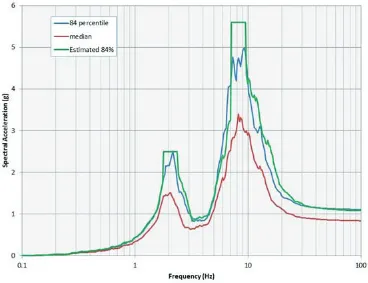
1. Probabilistic response analysis was performed for the unique building (e.g., reactor building) and a representative building of the power plant, and deterministic response analyses were performed for the remaining buildings. An approach for estimating the median and 84th percentile ISRS from response evaluation by deterministic analysis was developed.
2. As the French PSHA practice is to provide free field surface UHRS, site response analysis was performed to develop the input motion appropriate for the embedded foundations to benefit from the vertical spatial variation of the ground motion. The strain-compatible soil properties and their distributions were determined and used for the SSI analysis.
3. In order to reduce the time required for developing 3D finite element models, good quality 3D lumped mass stick models which are available from past studies were used. A method was developed to update the lumped mass stick models to account for vertical amplification of floors and/or horizontal amplification of flexible diaphragms.
INTRODUCTION
The French nuclear safety is based on Periodic Safety Review (PSR) every 10 years. Seismic studies should be performed in case of a hazard increase and if the engineering practice progresses and outdates the original design. This good practice leads to continuous safety improvements based on deterministic check of the initial Design Case and on Seismic PSA.
The In-Structure Response Spectra (ISRS) is only a part of an SPSA which has multiple steps. However, in our experience this step is very important in order to identify the margins and the uncertainties. The general procedure for determining the ISRS is summed up in this paper.
GENERAL METHODOLOGY FOR THE IN-STRUCTURE RESPONSE
SPECTRA (ISRS)
The goal of this effor t is to obtain the probabilistic in-structure response spectra (ISRS) at
locations of safety related systems and components in buildings. Evaluation of probabilistic
seismic response requires consideration of realistic building models, input motions from the
updated PSHA, earthquake strain-compatible soil prope rties, response simulations by
soil-structure interaction (SSI) computer programs, and estimation of the variability of all required
parameters. Probabilistic seismic response analysis invo lves multiple simulations of response
evaluation employing stratified sampling o f the probability distributions that mode l variability in
soil, structure, and input motion by Latin Hypercube Sampling (LHS). By the use of LHS, the
maximum amount of information may be obtained from a limited number of simulations. Thirty
simulations are judged to be sufficient to obtain stable median and 84
thpercentile results. From
the thirty computed results, median and 84
thpercentile ISRS may be evaluated.
Thirty SSI analyses for every plant safety-related building are very demanding from a schedule
perspective. Hence, full probabilistic analyses are performed for a limited number of buildings
and deterministic median-centered analyses are performed for the remaining buildings. For the
deterministic cases, only a single SSI analysis is performed with best estimate input motion and
soil and structure properties. Median and 84
thpercentile ISRS may be estimated from cases
where both probabilistic and deterministic analyses have been performed. All analyses
performed follow the combination of guidance from ASCE 4, the American national consensus
standard for seismic analysis of nuclear facilities and French practice for performance of seismic
response analyses.
FINITE ELEMENT MODEL UPDATING
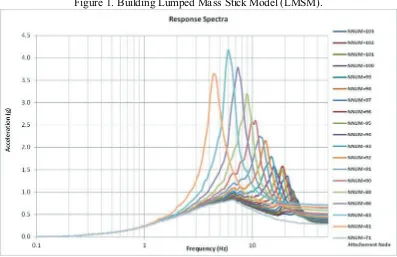
Existing lumped mass stick models (LMSMs) were available. The models needed to be converted to software compatible with the SSI computer programs. The conversion was verified by comparison of modal analysis results for frequencies, mode shapes, and mass participation factors and by examination of one g static analysis results. A shortcoming of the LMSMs is that slab and diaphragm flexibility were not modelled as the existing models assumed rigid slab/diaphragms. To model slab behavior, arrays of eighteen vertical single degree of freedom (SDOF) oscillators are placed throughout the structure. The frequencies of the eighteen oscillators vary from 4.5 Hz to 30.0 Hz in intervals of 1.5 Hz. A low mass is used for each oscillator, so the response of the overall structural model is not altered by the added oscillators. The mass of the attachment node is reduced by the mass of the added oscillators such that the global mass of the structure remains unchanged. Horizontal oscillators are added to model diaphragm behavior where the span to depth of the diaphragm is more than 1.5. This diaphragm oscillator is tuned to the computed diaphragm fundamental frequency.
Figure 1. Building Lumped Mass Stick Model (LMSM).
DETERMINATION OF THE EMBEDED RAFT INPUT MOTION FROM
THE FREE FIELD SURFACE UHRS
It is the French practice to determine the seismic hazard at the free field surface level. The free field
100,000 year UHRS is the seismic input motion for seismic response analyses. Acceleration time
histories are developed to match the target response spectrum very closely, within ±10%, per French practice. Thirty sets of acceleration time histories were developed for the probabilistic seismic SSI response analyses. Five sets of acceleration time histories were developed for the deterministic median-centred seismic SSI response analyses. Each time history set includes three components, two in the horizontal direction and one in the vertical direction.
The buildings are embedded structures that are analyzed as surface-founded structures because they are surrounded by adjacent buildings in close proximity. The control point for seismic input motion is at the base of the foundation for these structures. The foundation motion at the truncated soil column surface is determined in a probabilistic manner as follows:
• Deconvolve 30 surface time histories with 30 random soil profiles to an outcrop at a rock half-space elevation
• Develop a smooth median rock outcrop spectra and corresponding random 30 time histories • Convolve 30 rock outcrop time histories with 30 random soil profiles to the surface as a check
and to foundation elevation for input to building analyses
For probabilistic seismic response analyses, the resulting ground motions are scaled using LHS to account for directional variability, and the resulting motions are used as input for the probabilistic SSI analysis. Logarithmic standard deviation of 0.18 was used for horizontal motion and 0.25 was used for vertical motion. Ground motions are not scaled for directional variability for deterministic SSI analysis. For fragility calculations, the effect of directional variability is included in both probabilistic analysis results and probabilistic results estimated from deterministic analyses.
An approach to develop the strain-compatible soil profile was developed starting from the low strain geological properties profiles.
Sixty actual earthquake records with magnitude and distance that most contribute to the seismic hazard were selected. These records were individually scaled up or down such that the average spectrum of the sixty spectra approximates the UHRS. Next, sixty low-strain soil profiles using LHS based on beta of 0.35 for low-strain shear modulus and a beta of 0.3 for low-strain reference soil damping were developed assuming that properties of the soil layers are fully correlated.
Then sixty deconvolution analyses were performed with iterations to account for nonlinear soil behavior using SHAKE91, resulting in sixty soil profiles of strain-compatible shear modulus and damping in each soil layer. From these profiles, the mean, median, 16%, and 84% strain-compatible soil profile were estimated; from these statistics, thirty soil profiles were created again using LHS. The resulting randomized thirty soil profiles with correlated soil stiffness and damping were used for the subsequent probabilistic SSI seismic response analyses. The median soil profile has been used for the deterministic SSI seismic response analyses.
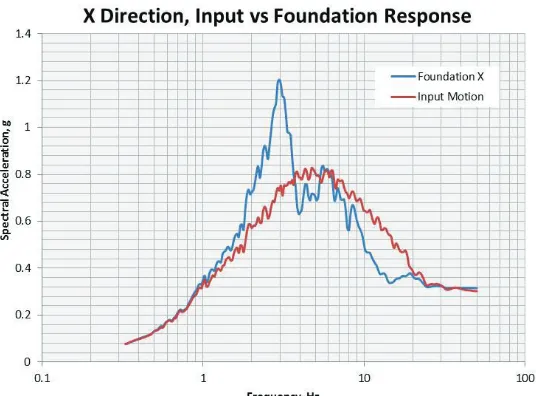
the process for obtaining the earthquake strain-compatible soil properties. Figure 3 provides an example of the foundation motion from the SSI analysis with the free field input motion. It may be seen that SSI may increase response at lower frequencies where soil and structure frequencies align but reduce response at higher frequencies.
Figure 3. Comparison of Free Field Surface Motion and Foundation Motion.