Enhanced Security System Of Data Sharing For Dynamic
Groups In The Cloud
M.Sai Nandini, Mrs.V.Baby,
M.Tech(SE), Associate Professor,
[email protected] [email protected]
Abstract:The approach of the circulated figuring makes accumulating outsourcing transform into a rising example, which propels the sheltered remote data reviewing an intriguing issue that appeared in the examination composing. Starting late some investigation consider the issue of secure and powerful open data uprightness checking on for shared dynamic data. In any case, these plans are so far not secure against the crash of circulated stockpiling server and denied accumulate customers in the midst of customer repudiation in rational appropriated stockpiling system. In this paper, we comprehend the interest ambush in the leaving design and give a compelling open respectability assessing plan with secure social affair customer repudiation in perspective of vector obligation and verifier-neighborhood foreswearing gather signature. We layout a strong arrangement in perspective of our arrangement definition. Our arrangement supports individuals when all is said in done checking and viable customer revocation and besides some wonderful properties, for instance, certainly, viability, countability and traceability of secure social occasion customer disavowal. Finally, the security and test examination show that, differentiated and its appropriate plans our arrangement is moreover secure and powerful....
Keywords
Public integrity auditing, victor commitment, group signature, cloud computing, dynamic data.
1. Introduction
The improvement of distributed computing spurs endeavors and relationship to outsource their data to untouchable cloud authority associations (CSPs), which will upgrade the limit control of benefit constrain adjacent contraptions. Starting late, some business conveyed capacity organizations, for instance, the fundamental storing organization (S3) [1] on-line data fortification organizations of Amazon and some practical cloud based programming Google Drive [2], Dropbox [3], Mozy [4], Bitcasa [5], and Memopal [6], have been worked for cloud application. Since the cloud servers may
reestablish an invalid result on occasion, for instance, server hardware/programming disillusionment, human help and harmful attack [7], new sorts of affirmation of data reliability and accessibility are required to guarantee the security and assurance of cloud customer's data.
To beat the above fundamental security trial of the present circulated stockpiling organizations, essential replication and traditions like Rabin's data dispersing plan [8] are far from realistic application. The formers are not practical in light of the way that a current IDC report suggests that data age is outpacing limit availability [9]. The later traditions ensure the openness of data when a lion's share of storage facilities, for instance, k-out-of-n of shared data, is given. Regardless, they don't give confirmations about the availability of each vault, which will oblige the affirmation that the traditions can provide for depending parties.
For giving the dependability and openness of remote cloud store, a couple of game plans [10], [11] and their varieties [12], [13], [14], [15], [16], [17], [18] have been proposed. In these game plans, when an arrangement supports data modification, we call it dynamic arrangement, by and large static one (or compelled dynamic arrangement, if an arrangement could just successfully reinforce some predefined operation, for instance, join). An arrangement is straightforwardly sure suggests that the data genuineness check can be performed by data proprietors, and by any untouchable evaluator. In any case, the dynamic designs above focus on the circumstances where there is a data proprietor and simply the data proprietor could alter the data.
invigorate the data for a social occasion is uncalled for the data proprietor. It will make colossal correspondence and estimation overhead data proprietor, which will realize the single motivation behind data proprietor. To help multiple customer data operation, Wang Et al. [22] proposed a data trustworthiness in perspective of ring mark. In the arrangement, the customer repudiation issue isn't considered and the assessing incurred significant injury is straight to the social event size and data gauge. To furthermore enhance the past arrangement and care gather customer denial, Wang et al. [23] formed an arrangement in perspective of delegate re-marks. Regardless, the arrangement acknowledged that the private and confirmed channels exist between each pare of substances and there is no interest among them.
Moreover, the looking at cost of the arrangement is straight to the get-together size. Another undertaking to improve the past arrangement and make the arrangement productive, versatile and connivance safe is Yuan and Yu [24], who created a dynamic open respectability auditing plan with gather customer denial. The makers made polynomial confirmation marks and grasp middle person name revive techniques in their arrangement, which impact their arrangement to help open checking and powerful customer renouncement.
In any case, in their arrangement, the makers don't consider the data riddle of social event customers. It infers that, their arrangement could productively support plaintext data invigorate and uprightness assessing, while not ciphertext data. In their arrangement, if the data proprietor insignificantly shares a social affair key among the get-together customers, the relinquishment or denial any get-together customer will oblige the get-get-together customers to invigorate their basic key. Moreover, the data proprietor does not take part in the customer renouncement organize, where the cloud itself could coordinate the customer denial arrange. For this circumstance, the plot of denied customer and the cloud server will offer chance to pernicious cloud server where the cloud server could invigorate the data an indistinguishable number of time from illustrated and give a true blue data finally. To the best of our knowledge, there is still no response for the above issue transparently reliability inspecting with group customer change.
The deficiency of above plans rouses us to research how to diagram a productive and strong arrangement, while finishing secure social affair customer denial. To the end, we propose an improvement which not simply support group data encryption and unraveling in the midst of the data change getting ready, yet moreover recognizes
successful and secure customer denial. Our thinking is to apply vector obligation plot [25] over the database. By then we utilize the Asymmetric Group Key Agreement (AGKA) [26] and store up marks [27] to help ciphertext data base invigorate among pack customers and capable social affair customer renouncement separately.
Specifically, the social event customer use the AGKA tradition to scramble/unscramble the offer database, which will guarantee that a customer in the get-together will have the ability to encode/interpret a message from some other get-together customers. The social occasion stamp will keep the game plan of cloud and repudiated cluster customers, where the data proprietor will take an interest in the customer disavowal arrange and the cloud couldn't deny the data that last changed by the denied customer.
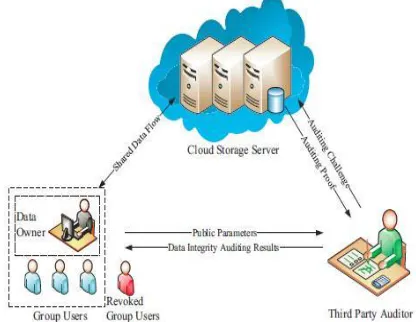
Figure 1. The cloud storage model
In this paper, we also consider the issue of understanding open uprightness assessing for conferred dynamic data to assemble customer disavowal. Our duties are three folds:
1) We research on the ensured and productive shared data facilitate checking on for multi-customer operation for ciphertext database.
2) By combining the primitives of victor obligation, disproportionate social occasion key assention and get-together check, we propose a successful data assessing plan while meanwhile giving some new features, for instance, traceability and countability.
3) We give the security and adequacy examination of our arrangement, and the examination happens exhibit that our arrangement is secure and productive.
2.
Problem Statement
In the disseminated stockpiling exhibit as showed up in Figure 1, there are three substances, to be particular the conveyed stockpiling server, accumulate customers and a Third Part Auditor (TPA).
Social affair customers contain a data proprietor and different customers who are endorsed to get to and change the data by the data proprietor. The dispersed stockpiling server is semi-trusted, who gives data accumulating organizations to the social occasion customers. TPA could be any substance in the cloud, which will have the ability to lead the data uprightness of the regular data set away in the cloud server. In our structure, the data proprietor could encode and exchange its data to the remote dispersed stockpiling server. Similarly, he/she shares the advantage, for instance, get to and modify (arrange and execute if central) to different social event customers.
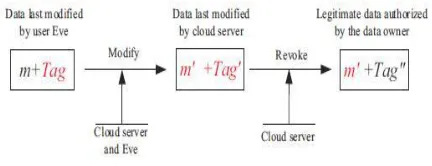
Figure 2. Security problem of server proxy group user revocation
The TPA could capably check the respectability of the data set away in the conveyed stockpiling server, even the data is once in a while invigorated by the social affair customers. The data proprietor is remarkable in connection to the following social event customers, he/she could securely deny a get-together customer when a get-get-together customer is found malevolent or the understanding of the customer is slipped by.
2.2 Threat Model and Security Goals
Our risk exhibit considers two sorts of strike:
1) An attacker outside the social occasion (join the repudiated total customer circulated capacity server) may make them learn of the plaintext of the data. As a general rule, this kind of attacker needs to at lease break the security of the grasped accumulate data encryption plot.
2) The disseminated stockpiling server schemes with the disavowed pack customers, and they have to give an illegal data without being distinguished. Everything considered, in cloud condition, we expect that the dispersed stockpiling server is semi-trusted. In this way, it is sensible that a denied customer will interest with the cloud server and offer its riddle gather key to the disseminated stockpiling server. For this circumstance, in spite of the way that the server
middle person total customer revocation way [24] brings much correspondence and count cost saving, it will make the arrangement questionable against a vindictive appropriated stockpiling server who can get the secret key of denied customers in the midst of the customer repudiation organize. Along these lines, a vindictive cloud server will have the ability to impact data m, to last balanced by a customer that ought to have been repudiated, into a malicious data m′. In the customer repudiation process, the cloud could make the poisonous data m′ twist up detectably significant.
To beat the issues above, we intend to achieve the going with security destinations in our paper:
1)Security. An arrangement is secure if for any database and any probabilistic polynomial time adversary, the enemy can't induce a verifier to recognize an invalid yield.
2) Correctness. An arrangement is correct if for any database and for any revived data m by a real assembling customer, the yield of the check by a reasonable dispersed stockpiling server is reliably the regard m. Here, m is a ciphertext if the arrangement could successfully reinforce encoded database.
3)Efficiency. An arrangement is successful if for any data, the computation and limit overhead contributed by any client customer must be self-governing of the traverse of the normal data.
4) Countability. An arrangement is countable, if for any data the TPA can give a proof to this terrible lead, when the corrupt conveyed stockpiling server has disturbed the database.
5) Traceability. We require that the data proprietor can take after the last customer who invigorate the (data thing), when the data is delivered by the age computation and each check made by the customer is true blue.
3.
Design Methodology
A. Existing System:
data proprietor and simply the data proprietor could alter the data.
• To support multiple customer data operation, Wang et al. proposed a data uprightness in light of ring mark.
• To moreover enhance the past arrangement and care gather customer foreswearing, Wang et al. created an arrangement in light of mediator re-marks.
• Another try to upgrade the past arrangement and make the arrangement capable, versatile and assention safe is Yuan and Yu, who sketched out a dynamic open uprightness assessing plan with pack customer dissent. The makers arranged polynomial confirmation marks and grasp go-between name revive frameworks in their arrangement, which impact their arrangement to help open checking and viable customer disavowal.
Damages of Existing System:
• In the Wang et al. plot, the customer foreswearing issue isn't considered and the investigating incurred significant injury is straight to the social occasion size and data measure.
• However, the arrangement expected that the private and checked channels exist between each consolidate of substances and there is no interest among them. Similarly, the assessing cost of the arrangement is straight to the social affair estimate.
• However, in Yuan and Yu scheme, the makers don't consider the data secret of social event customers. It suggests that, their arrangement could successfully support plaintext data revive and respectability assessing, while not ciphertext data. In their arrangement, if the data proprietor insignificantly shares a get-together key among the get-together customers, the slipping away or denial any social event customer will compel the get-together customers to revive their regular key. Also, the data proprietor does not partake in the customer repudiation arrange, where the cloud itself could coordinate the customer refusal organize. For this circumstance, the course of action of denied customer and the cloud server will offer chance to malignant cloud server where the cloud server could revive the data an indistinguishable number of time from arranged and give a honest to goodness data finally.
B. Proposed System:
• The eficiency of above plans goads us to examine how to plot a productive and trustworthy arrangement, while finishing secure social occasion customer repudiation. To the end, we propose an advancement which not simply sponsorships amass data encryption and deciphering in the midst of the
data change getting ready, yet furthermore recognizes productive and secure customer revocation.
• Our thought is to apply vector obligation plot over the database. By then we utilize the Asymmetric Group Key Agreement (AGKA) and social occasion imprints to help ciphertext data base revive among amass customers and productive get-together customer repudiation independently.
• Specifically, the social affair customer uses the AGKA tradition to encode/unscramble the offer database, which will guarantee that a customer in the get-together won't have the ability to scramble/disentangle a message from some other get-together customers. The social affair stamp will keep the interest of cloud and revoked accumulate customers, where the data proprietor will share in the customer dissent organize and the cloud couldn't deny the data that last changed by the denied customer.
Ideal conditions of Proposed System:
• We examine on the ensured and viable shared data arrange exploring for multi-customer operation for ciphertext database.
• By combining the primitives of victor obligation, astray assembling key comprehension and get-together stamp, we propose a successful data looking at design while meanwhile giving some new features, for instance, traceability and countability.
• We give the security and capability examination of our arrangement, and the examination comes to fruition exhibit that our arrangement is secure and capable.
4. Modules
• Cloud server • Group of clients • Public verifier • Auditing Module
Modules Description:
Cloud server
• In the first module, we design our structure with Cloud Server, where the snippets of data are secured universally. Our instrument, Oruta, should be expected to fulfill following properties:
• Correctness: An open verifier can precisely confirm shared data dependability.
• Unforgeability: Only a customer in the social affair can make significant check metadata (i.e., marks) on shared data.
• Identity Privacy: An open verifier can't perceive the character of the endorser on each square in shared data in the midst of the system of assessing.
Social occasion of customers
• There are two sorts of customers in a get-together: the first customer and different social occasion customers. The first customer at first makes shared data in the cloud, and offers it with group customers. Both the first customer and get-together customers are people from the social occasion. Every person from the social affair is allowed to get to and change shared data. Shared data and its confirmation metadata (i.e., marks) are both secured in the cloud server. An open verifier, for instance, an untouchable commentator giving expert data looking at organizations or a data customer outside the social affair proposing to utilize shared data, can unreservedly check the dependability of shared data set away in the cloud server.
• Owner Registration: In this module a proprietor needs to move its reports in a cloud server, he/she ought to select first. By then just he/she can have the ability to do it. For that he needs to fill the unobtrusive components in the enrollment outline. These unobtrusive components are kept up in a database.
• Owner Login: In this module, proprietors need to login, they should login by giving their email id and mystery key.
• User Registration: In this module if a customer needs to get to the data which is secured in a cloud, he/she should enroll their purposes of intrigue first. These purposes of intrigue are kept up in a Database.
• User Login: If the customer is an affirmed customer, he/she can download the record by using report id which has been secured by data proprietor when it was exchanging.
Open verifier
• When an open verifier wishes to check the respectability of shared data, it first sends an assessing test to the cloud server. Consequent to getting the inspecting challenge, the Cloud server responds to individuals all in all verifier with an assessing check of the responsibility for data.
• Then, this open verifier checks the rightness of the entire data by confirming the exactness of the
assessing proof. Fundamentally, the methodology of open assessing is a test and-response tradition between an open verifier and the cloud server
Reviewing Module
• In this module, if an outcast analyst TPA (maintainer of fogs) should enroll first. This system allows simply cloud authority associations. After untouchable overseer gets marked in, He/She can see what number of data proprietors have moved their records into the cloud. Here we are offering TPA to caring for fogs.
• We simply consider how to survey the trustworthiness of conferred data in the cloud to static social affairs. It suggests the social occasion is pre-portrayed before shared data is made in the cloud and the enlistment of customers in the get-together isn't changed in the midst of data sharing.
• The novel customer is accountable for picking who can share her data previously outsourcing data to the cloud. Another intriguing issue is the way by which to survey the respectability of conferred data in the cloud to dynamic social occasions — another customer can be incorporated into the get-together and a present assembling part can be denied in the midst of data sharing — while so far sparing character security.
5.
Conclusion and Future Scope
The primitive of evident database with capable updates is a fundamental way to deal with handle the issue of verifiable outsourcing of limit. We propose an arrangement to recognize capable and secure data genuineness assessing for share dynamic data with multi-customer modification. The arrangement vector obligation, Asymmetric Group Key Agreement (AGKA) and social event marks with customer revocation are get to finish the data trustworthiness looking into of remote data. Neighboring the overall public data assessing, the joining of the three primitive engage our arrangement to outsource ciphertext database to remote cloud and support secure social occasion customers dissent to shared dynamic data. We give security examination of our arrangement, and it exhibits that our arrangement give data order to total customers, and it is furthermore secure against the interest strike from the disseminated stockpiling server and repudiated cluster customers.