Application of Multiagent Systems to Three-Dimensional Positioning
Problem in Indoor Environments Based on IEEE 802.11
Hitalo J. B. Nascimento*, Francisco R. P. Cavalcanti, Emanuel B. Rodrigues, and Antonio R. Paiva
Abstract—In recent years, wireless indoor positioning systems have attracted significant research interest. However, maximizing system precision remains challenging, especially for three-dimensional (3D) estimates. In this paper, a novel hybrid approach to resolving this problem is proposed through the development of a multiagent system composed of a Bayesian network and a deep neural network for 3D indoor positioning. The proposed system is based on a combination of the multilateration and fingerprint methods in order to reduce the acquisition region of the received signal strength vectors. In addition, the relationship between the quality of the received signal and the noise level, which is influenced by the increase in the number of access points and the number of persons moving within the environment, is considered by the system. The proposed approach exhibits a better performance than other algorithms with an average positioning error of less than 0.9 m. This result represents a difference of more than 22 cm with respect to the most similar algorithm.
1. INTRODUCTION
Indoor positioning systems (IPSs) have attracted much attention in recent years, and this is motivated mainly by a large number of potential applications, including utilization in emergency systems, mobile robot positioning, as well as navigation assistance in malls, schools, universities, airports, and hospitals. However, it remains challenging to maximize system precision, especially for three-dimensional (3D) estimates. The global positioning system (GPS), which is a widely used tool in outdoor location, does not perform well indoors. This is because the variability depends not only on the antenna characteristics, but also on the type of the construction and internal structures, such as walls, floors, partition walls, and other factors such as movement of people within the environment. In this sense, it is necessary to develop other tools or techniques that are specifically designed for positioning in this type of environment. A survey of the main implementation techniques shows that they can be classified into three typical location estimation methods: triangulation, scene analysis (fingerprinting technique), and proximity. These schemes are discussed in [1] and [2], whereas in [3], an overview of the main technologies for indoor positioning are represented. In [4], a peer-assisted localization approach to reduce large errors is proposed. This system obtains accurate acoustic ranging estimates among peer phones, then maps their locations jointly against a Wi-Fi signature map subjecting to ranging constraints. According to the authors, experiments show that this approach can limit the maximum error to about 2 m. However, this system requires a central server to receive signal measurements and determine the locations of peers and the distances among them. In [5], an approach called FS-kNN is proposed in order to consider the fact that equal received signal strength (RSS) differences at distinct RSS levels do not necessarily mean similar differences in the geometric distance. The experiments reported show that the estimated position
Received 2 February 2018, Accepted 9 April 2018, Scheduled 18 April 2018 * Corresponding author: Hitalo Joseferson Batista Nascimento ([email protected]).
of the proposed system is more accurate than that of previous systems. In [6], the application of machine learning to the problem of indoor location is suggested. The k-nearest neighbours (k-NN) algorithm and two probabilistic methods (histogram and kernel) are proposed as solutions to the problem. The results show that the probabilistic methods produced slightly better results than kNN. In this paper, we propose the development of a multiagent system (MAS) that is composed of a Bayesian network (BN) and a deep neural network (DNN) for 3D indoor positioning. In order to optimize the precision of the system, in addition to the RSS and the parameter representing communication between the agents, other variables were considered as input system parameters, including the variable noise level caused by the increase in the number of access points (APs) and people moving within the environment. Another factor that contributed to the improved system performance was the reduction of the region of application of the fingerprint method by employing combination using the multilateration (ML) method. Our research has the following contributions:
• Design and implementation of a collaborative MAS with high precision. The experimental results show that the proposed system has an average positioning error of less than 0.9 m. This result is more precise than other similar approaches (Wi-Fi/Fingerprint/RSS), which have an average error varying from 1 to 5 m [7].
• Use of simulations to verify the relationship between the precision of the ML method and the increase in the number of APs.
• Examination of how the noise level can influence the precision of positioning systems.
2. PROPOSED SYSTEM
2.1. Introduction
Here, the proposed solution, which is called IPS-MAS, was developed based on a combination of the ML and fingerprint methods. Initially, the ML method was applied in order to estimate T(x, y, z) as the coordinate representing the position of the target. This estimate is formally obtained by the intersection of four spheres centered at four APs with coordinates given by: (x1, y1, z1),(x2, y2, z2),(x3, y3, z3), and (x4, y4, z4), whose distances to the target are given by d2i, fori= 1,2, . . . ,4. This procedure is defined by solving the following equation:
(x−xi)2+ (y−yi)2+ (z−zi)2 =d2i (1) When this process is completed, the application region of the fingerprint method is reduced to a sphere with radius r = max(ri), for i = 1,2, . . . , N, and the RSS vectors in n reference points (RPs) with predetermined 3D positions are obtained. For each RP, the measurements are taken for all APs. In addition, these measurements are obtained at different heights z={z1, z2, . . . , zN}, and with a mobile device directed to the north, south, east, and west represented by O = {0◦,90◦,180◦,270◦}. This procedure aims to make the database robust, thus maximizing the precision of the system. The matrix defined in Eq. (2) shows this concept.
RP:= (RPi,zjO )∈Rm×n (2)
Then this information is stored in a database called radio-map and is compared with the RSS vector obtained during the online phase.
2.2. Implementation of MAS
• BN: A Bayes network, which is denoted by B = G, θ, is a directed acyclic graph. With
G = (V, E) defined by a pair composed of vertices (V) that represent a set of random variables,
represents the positioning space. SelectPi ifP(Pi|s)> P(Pj|s), fori, j = 1,2, . . . , N andi=j. This classification is formally obtained by applying the Bayes theorem given by Equation (3).
P(Pi|s) = P(s|Pi)P(Pi)
P(s) =
P(o1, o2, . . . , oN|Pi)P(Pi)
P(s) (3)
Using the general multiplication rule [8] in (3), we obtain:
P(o1, o2, . . . , oN|Pi) =P(o1|o2, . . . , oN,Pi)×. . .×P(oN−1|oN,Pi)P(oN|Pi) (4)
If oi ⊥⊥ oj|Pi, ∀i, j, 1 i, j N, then P(o1, o2, . . . , oN|Pi) is given by Ni=1P(s|Pi). Thus,
P(Pi|s) ∝P(Pi, o1, . . . , oN)∝Pi×P(o1, . . . , oN|Pi) ∝P(Pi)×P(o1|Pi)×. . .×P(oN|Pi), which results in
P(Pi) N
i=1
P(s|Pi) (5)
Equation (5) is a special case of BN, known as a naive Bayes (NB). More details on this classifier can be obtained in [9]. A version of this agent, called the tree-augmented naive Bayes (TAN), which is proposed in [10], was used to incorporate the dependence of the RSS on the increase in the number of APs and people moving around the environment into the model. The learning process of this agent consists of dataset D selection, which at a given moment, is better related to the network attributes, whereD is composed of the information stored in the radio-map as well as the relationship between s, the noise level, and the information received by an agent responsible for communication and mediation between the agents, called the moderator.
• Neural networks: This agent is based on the concept of DNN, which can be understood intuitively as a feedforward network with several hidden layers, where each has an associated label, such that each hidden layer is related to distinct training sets. This model is discussed in detail in [11]. Formally, the agent in question can be defined as follows: let matrices I := (ii,j),T:= (ti,j), and
W := (wi,j), for 1 i N and 1 j M, respectively, represent the inputs, outputs, and weights. Consider also a parameter, the so-called bias, whose purpose is to increase the degree of freedom of weight adjustments. The goal is to optimize the weights and bias in order to minimize the mean squared error given by Equation (6).
E = 1 2
(T−o(I,W))2 (6)
whereo(I,W) represents the actual output. To minimize Equation (6), we use the backpropagation algorithm. Details on the use of this algorithm for the training of neural networks are discussed in [12].
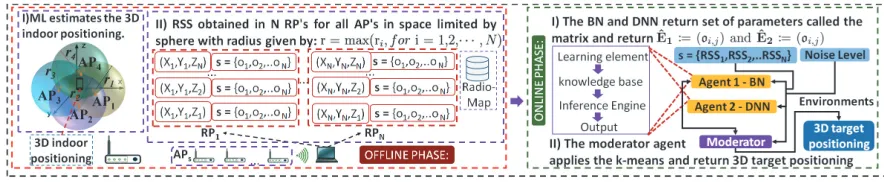
• Moderator module: The implementation of communication in an MAS is crucial to ensure its good performance. The objective of this agent is to provide communication and decision making between BN and DNN agents, avoiding the implementation of a mediation module in each of them. Thus, all communication between the BN and DNN agents occur indirectly through the moderator, which is also responsible for the final positioning estimation. This estimation is obtained by applying the k-means algorithm, which was proposed in [13], in order to partition the matrices of estimates
ˆ
E1 := (oi,j) and Eˆ2 := (oi,j), given respectively by the BN and DNN agents, for 1 i N and
1 j M, into clusters C that represent a set of regions, in which the target will be allocated. After the clustering process, the moderating agent selects the cluster that has the highest number of estimated points and estimates the positioning of the target from the centroid coordinate of this cluster. Figure 1 and Algorithm 1 summarizes the proposed method.
Algorithm 1 IPS-MAS for Wi-Fi 3D indoor positioning.
1: Estimate the target positioning using Equation (1). Implement a sphere with radiusraround the estimated 3D point, wherer= max (ri, fori= 1,2, . . . , N) and get the matrixRPdefined in Equation (2).
2: Implement three functions that represent the moderator, BN, and DNN agents, where each of these agents has a knowledge base and an inference engine, which follows the algorithms defined in Subsection 2.2.
3: whileimaxIterdo
4: The BN and DNN receive a set of parameters called the vector or perception matrix and returnEˆ1 andEˆ2.
5: end while
6: The moderator agent applies the k-means algorithm in order to partition Eˆ1 andEˆ2 and allocates the target to the cluster that has the highest number of estimated points.
7: The system returns the 3D positioning based on the centroid of the estimates.
3. EXPERIMENTAL RESULTS
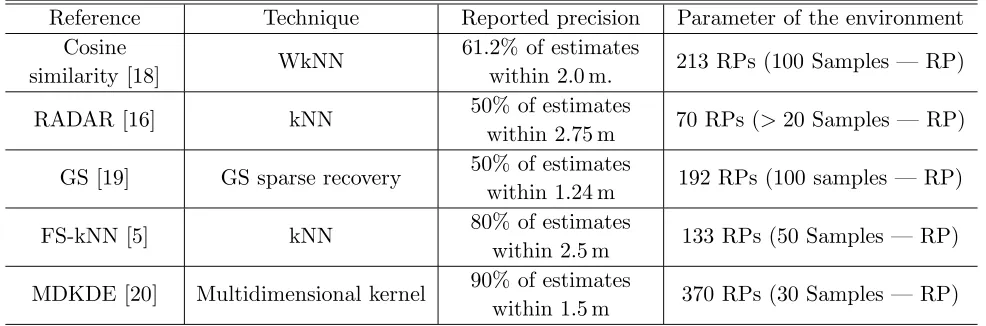
The experiments were conducted on the first, second, and third floors of 707 academic building, which is located at the Technology Center of the Federal University of Cear´a, in Fortaleza, Brazil, with a total area of 3791.05 m2. The RSS was obtained at 180 RPs distributed over the three floors that were used. For each RP, 20 RSS samples were collected in four directions and at three different heights with respect to the selected APs, resulting in 300 RSS values for each RP. To do this, an application was developed using C++. Table 2 shows some values adopted in similar works. In the proposed method, we used a multilayer perceptron (MLP) neural network with four hidden layers. Different numbers of neurons were tested for the hidden layers. The best result observed was 350 neurons. For this neural network, the backpropagation algorithm was used as a learning method. There are different rules for choosing the learning rate η in the literature. [14] suggests 0.001 ≤ η ≤ 0.1, whereas [15] suggests 0 ≤η ≤ 1. In this sense, we choose η = 0.04. For the BN, we applied a TAN with nodes represented by s, noise level, and information received by the moderator. In addition, we used the Dirichlet prior smoothing as discussed in [10]. As algorithms for comparison, the main solutions addressed in the literature were chosen. For the kNN algorithm, we used the Euclidean distance. This together with other measures of similarity , including Mahalanobis, Minkowski, and cosine distances, are discussed in [9]. In [16], it was shown that the best performance for this classifier is achieved for k= 2–4; thus we used values of
k= 2 and 3. The histogram and kernel methods were obtained from Equation (2). For the histogram
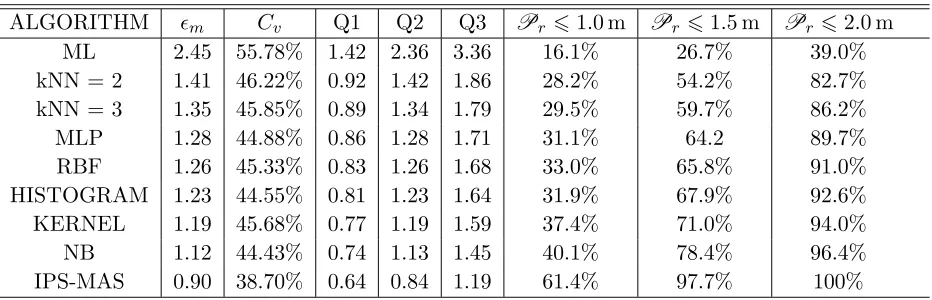
Table 1. Statistics of positioning estimates.
(a) (b) (c)
Figure 2. (a) CDF of the positioning error for the actual performance with 4 APs, (b) CDF of the positioning error for the ML method for several APs simulated by the cost 231 MWM, and (c) relationship between the precision and the noise level.
Table 2. Recent approaches for indoor positioning.
Reference Technique Reported precision Parameter of the environment Cosine
similarity [18] WkNN
61.2% of estimates
within 2.0 m. 213 RPs (100 Samples — RP) RADAR [16] kNN 50% of estimates
within 2.75 m 70 RPs (>20 Samples — RP) GS [19] GS sparse recovery 50% of estimates
within 1.24 m 192 RPs (100 samples — RP) FS-kNN [5] kNN 80% of estimates
within 2.5 m 133 RPs (50 Samples — RP) MDKDE [20] Multidimensional kernel 90% of estimates
within 1.5 m 370 RPs (30 Samples — RP)
method, the distribution of the frequency of the RSS for the environment was constructed in order to obtain P(s|Pi), whereas for the kernel method, P(s|Pi) was obtained from the Gaussian kernel function. Details about this function as well as the implementation of these two methods are discussed in [6]. The MLP neural network (with two hidden layers) and the radial basis function neural network (RBF) were also implemented for comparison. For MLP, the best result was 290 and 170 neurons for the first and second hidden layers, respectively. For RBF, this value was 400 neurons. The machine used in the experiment was a Dell PC with an Intel Core i5 processor having 1.8 GHz, 6 GB RAM, and a Dell wireless 1703 802.11b/g/n adapter. Based on the analysis of the results of the algorithms, the proposed solution has a mean error (m) of less than 0.9 m with a precision (Pr) of 97.7%, and 100% of the estimates were within 1.5 m and 2.0 m, respectively. This result represents a difference in them value of more than 22 cm with respect to the most similar algorithm, and more than 1.55 m with respect to the ML method. A comparison of all algorithms, including the m coefficient of variation(Cv), the first, second, and third quartiles (Q1, Q2, and Q3), andPr are displayed in Table 1 and Figure 2(a).
consider the noise caused by the increase in the number of APs, the precision of all algorithms tends to worsen. In this scenario, the proposed approach exhibited a better performance than the others. This can be explained by the fact that the proposed system has been designed to consider the effect of the noise level on the estimates. The results of these simulations are shown in Figures 2(b) and 2(c). Table 2 is presented for comparison with the results of some approaches existing in the literature.
4. CONCLUSION AND FUTURE WORKS
In this paper, we propose an IPS based on the development of an MAS that was developed based on a combination of the ML and fingerprint methods. The proposed system considered the relationship between the RSS and the noise level, which is influenced by the increase in the number of APs and the number of people moving around the environment. The system had an (m) of less than 0.9 m from the actual position, and with (Pr), 97.7% and 100% of the estimates were within 1.5 m and 2.0 m, respectively. The future research includes:
• Development of an IPS based on multiple discriminant analyses;
• Consideration of the noise level with respect to other variables besides those discussed in this paper.
REFERENCES
1. Hui, L., D. Houshang, P. Banerjee, and L. Jing, “Survey of wireless indoor positioning techniques and systems,” IEEE Transactions on System, Man, and Cybernetics — Part C: Applications and Reviews, Vol. 37, No. 6, 45–61, Nov. 2007.
2. Yassin, A., et al., “Recent advances in indoor localization: A survey on theoretical approaches and applications,”IEEE Communications Surveys &Tutorials, Vol. 19, No. 2, 1327–1346, Second quarter 2017.
3. Krishnamurthy, P., “Technologies for positioning in indoor areas,” Indoor Wayfinding and Navigation,CRC Press, 35–51, CRC Press, Inc. Boca Raton, FL, USA, Mar. 2015.
4. Liu, H., et al., “Push the limit of WiFi based localization for smartphones,”Proc. 18th Annu. Int. Conf. Mobile Comput. Netw. (Mobicom’12), 305–316, Aug. 2012.
5. Li, D., B. Zhang, and C. Li, “A feature-scaling-based k-nearest neighbor algorithm for indoor positioning systems,” IEEE Internet of Things Journal, Vol. 3, No. 4, 590–597, Aug. 2016.
6. Roos, T., P. Myllym¨aki, H. Tirri, P. Misikangas, and J. Siev¨anen, “A probabilistic approach to WLAN user location estimation,”International Journal of Wireless Information Networks, Vol. 09, 45–61, 2002.
7. Dardari, D., P. Closas, and P. M. Djuri´c, “Indoor tracking: Theory, methods, and technologies,”
IEEE Transactions on Vehicular Technology, Vol. 64, No. 4, 1263–1278, Apr. 2015.
8. Schum, D. A., The Evidential Foundations of Probabilistic Reasoning, Northwestern University Press, 1994.
9. Duda, R. O., P. E. Hart, and D. G. Stork, Pattern Classification, 2nd Edition, Wiley, Sep. 2001. 10. Friedman, N., D. Geiger, and M. Goldszmidt, “Bayesian network classifiers,” Machine Learning,
Vol. 29, 131–161, 1997.
11. Bengio, Y., “Learning deep architectures for AI,” Foundations and Trends in Machine Learning, Vol. 2, No. 1, 1–127, 2009.
12. Rumelhart, D. E., G. E. Hinton, and R. J. Williams, “Learning internal representations by error propagation,” Rumelhart, D. E. and McClelland, J. L., editors, Parallel Distributed Processing:
Explorations in the Microstructure of Cognition, Vol. 1, 318–362, Foundations, MIT Press,
Cambridge, MA, USA, 1986.
14. Schulz, E., T. Breitsprecher, Y. Musayev, S. Tremmel, T. Hosenfeldt, S. Wartzack, and H. Meerkamm, “Interactions between amorphous carbon coatings and engine oil additives: Prediction of the friction behavior using optimized artificial neural networks,” Advanced Ceramic
Coatings and Materials for Extreme Environments II, D. Zhu, H. Lin, Y. Zhou, T. Hwang,
M. Halbig, and S. Mathur (eds.), 2012.
15. David, K., A Brief Introduction to Neural Networks, 2007, available at http://www.dkriesel.com. 16. Bahl, P. and V. N. Padmanabhan, “RADAR: An in-building RF-based user location and tracking
system,” Proceedings — IEEE INFOCOM, 775–784, Mar. 2000.
17. “COST 231 multi-wall digital mobile radio towards future generations systems,” Final Report-European Commission, 176–179, 1999.
18. Han, S., C. Zhao, W. Meng, and C. Li, “Cosine similarity based fingerprinting algorithm in WLAN indoor positioning against device diversity,” 2015 IEEE International Conference on Communications (ICC), London, 2710–2714, 2015.
19. Khalajmehrabadi, A., N. Gatsis, and D. Akopian, “Structured group sparsity: A novel indoor WLAN localization, outlier detection, and radio map interpolation scheme,” IEEE Transactions on Vehicular Technology, Vol. 66, No. 7, 6498–6510, Jul. 2017.