Genetic Algorithm Approach for Bandwidth
Optimization in Near Video on Demand System
Kriti Priya Gupta
Symbiosis Centre for Management Studies, NOIDA Faculty of Management Studies, Symbiosis International University
Abstract-In this paper, we employ Genetic Algorithm (GA) technique for minimizing the average bandwidth requirement in Near Video-on-Demand (NVoD) system. Three multicasting schemes are presented which require lesser bandwidth as compared to true Video-on Demand (VoD) systems. Scheme 1 is a double rate batching scheme in which the late arriving customers are served with unicast stream having double transmission rate until they get merged with the multicast stream. Scheme 2 is a client-buffering technique in which the unicast customers are allowed to concurrently buffer some part of the movie from the ongoing multicast stream. In scheme 3, the late arriving customers are served with bundled channels of incrementally increasing transmission rate. All the schemes are compared on the basis of the required bandwidth i.e. average number of I/O streams. The optimal batching time and the minimum streams required are determined by using GA. Numerical results are provided for verifying the analytical results with the GA results.
Keywords: Genetic Algorithm, Near video on demand, Multicasting, Bandwidth, Optimization.
1. INTRODUCTION
In the recent years, video-on-demand (VoD) has become a new source of interactive entertainment via computer communication networks. In a VoD system, customers can choose any movie from a distant video server just by using a remote control, to watch at any time they wish. A true VoD system provides a dedicated transmission stream to each customer. This type of system is quite infeasible to deal with a large number of customers, as it requires a very large bandwidth or a large number of I/O streams of the video server. Minimization of bandwidth is a big problem in VoD systems, which has attracted the attention of many researchers. The study in [14] provides some techniques for bandwidth resource optimization in VoD network architectures.
One way of efficient utilization of the bandwidth is near video-on-demand (NVoD) systems in which, customers requesting the same movie are grouped together in batches and then the movie is broadcasted to them using multicasting via a single transmission stream. NVoD is a cost effective solution for a large scale VoD system as it minimizes the bandwidth requirement by using multicast streams. The study in [22] discusses the advantages of NVoD systems over true VoD systems. The multicast streams are opened after a particular time, which is called as the batching time. When a customer arrives after the
opening of the multicast stream, he is served via a dedicated unicast stream with faster transmission rate and as soon as the unicast stream comes in synchronization with the multicast stream, the customer is merged in the previous multicast stream. The selection of the batching time greatly affects the performance of such a system. The authors in [5] have suggested dynamic batching policies for VoD system. Several broadcasting schemes like Pyramid broadcasting [21], Harmonic broadcasting [10] and Skyscraper broadcasting [8] are proposed for metropolitan VoD systems to reduce the bandwidth requirement. Channel allocation problem in VoD system using batching adaptive piggybacking has been discussed in [11] but this approach is very complex, as it requires a replica of videos with different playout rates to be stored in the server in advance. A double-rate batching policy has been developed in [15], in which the customers arriving after the beginning of the multicast stream, are served by the unicast stream with double transmission rate. When the unicast stream comes in synchronization with the multicast stream, the unicast stream is released and the customer is merged in the multicast stream. But this policy is not scalable for very popular movies with high arrival rates. The study in [16] suggests an adaptive batching scheme, where the batching time changes according to the arrival rate of the customers. The fundamental limitations of multicast streaming algorithms in supporting interactive playback control have been investigated in [23] and a general solution is presented which can be applied to many of the existing multicast streaming algorithms to substantially improve their performance when interactive playback control was to be supported. The authors in [19] have studied optimal segment caching for peer to peer on-demand streaming. They have proposed a centralized heuristic to solve the segment caching optimization problem. They have also proposed a distributed caching algorithm in which each peer adaptively and independently replaced segments to minimize the popularity-supply discrepancy.
client-buffering techniques for scalable video broadcasting over broadband networks with low user delay. In these techniques the clients download the video data from an appropriate channel and then watch the movie by playback operation.
The studies in [24] and [9] integrate the fixed-delay pagoda broadcasting scheme to reduce client waiting time and buffer demand. A scalable binomial broadcasting scheme has been presented in [26] in which live videos are transferred using constant bandwidth, regardless of video length.
Many studies are proposed to broadcast segments over a single channel, such as PAS [25], and the reverse-order scheduling (ROS) scheme [3]. The basic concept behind these schemes is to partition a video into equal-sized segments, which are classified into several groups and transferred over a single channel according to a predefined arrangement.
Till now, the problems of optimizing the resource bandwidth for the video server have been solved by using the conventional linear programming or non-linear programming approaches depending on the nature of the objective function. But sometimes, finding a solution to these problems becomes a difficult task if the objective function is too intricate and analytical solution is difficult to obtain. Hence, non-traditional methods like Genetic Algorithms (GAs) based on evolutionary programming are coming up to deal with such situations. GAs are computerized search and optimization algorithms based on the mechanics of natural genetics and natural selection. So far, GAs have been applied to many optimization problems in different frameworks. Some applications of GAs in search and optimization can be found in [7] and [17]. Many researchers have used GAs for optimal design of reliable computer communication networks [12], [6]. The authors in [20] have used GA for optimal file placement on the video server in VoD systems. They have employed GA to determine the optimal number of copies of multimedia files and their corresponding disk locations on the video server. The investigation in [1] provides a hybrid GA for frequency assignment problem in radio communication systems.
In this paper, we study three schemes for determining the optimal batching time thereby minimizing the average bandwidth i.e. the number of streams for NVoD systems. A simple GA is used for finding the minimum number of streams. The organization of the paper is as follows. Section 2 describes how GAs can be used to solve an unconstrained optimization problem. The methodology and working principles of GAs are described in detail. Firstly, the basic terms involved in the GAs are explained, then the formation of fitness function and the coding technique for the variables are discussed. The genetic operators i.e, reproduction, crossover and mutation are also conferred which are used for creating new population. In section 3, three multicasting schemes for minimizing the bandwidth requirement in NVoD systems are presented. Scheme 1 (S1) is based on the double rate batching policy in which the unicast customers are first served with double transmission rate and then merged with the multicast
stream after getting synchronized with the same. Scheme 2 (S2) is a client buffering technique in which a late arriving customer is served via unicast stream while buffering some part of the movie, simultaneously. Scheme 3 (S3) is also a client-buffering technique in which, the server streams are grouped together into channels of increasing bandwidth. The beginning portion of the movies is transmitted via these channels so that the customers can be merged with an on-going broadcast stream quickly. Mathematical models for the number of streams required in each of the schemes are also presented. In section 4, the GA approach for determining the optimal number of streams for all the schemes is presented. Section 5 compares the analytical as well as GA results for all the schemes by using numerical illustrations. The bandwidth requirements for all the schemes are compared in terms of the number of streams required. S2 and S3 are compared on the basis of the buffer requirement also. Finally, the conclusion is drawn in the last section 6.
2. GENETIC ALGORITHMS:PRELIMINARY CONCEPTS
2.1 Basic Terminology
A genetic algorithm is a non-traditional optimization method, in which a string of numbers is manipulated in a manner similar to how chromosomes are altered in biological evolution. Each string of numbers is called a ‘chromosome’ or an ‘individual’, and each number is referred to as a "gene." A set of chromosomes forms a ‘population’. A chromosome actually represents a variable, which is varied to optimize the ‘fitness function’. The fitness function corresponds to the objective function, which is to be optimized. There are three main genetic operators, ‘reproduction’, ‘crossover’ and ‘mutation’, which are operated on the population to create a new population of points. The operation of GAs begins with an initial population of random chromosomes, which are encoded in some string structures. Each chromosome is then evaluated in terms of the fitness value. Then the genetic operators are operated on the population and a new population of chromosomes is formed. The new population is again evaluated and tested for termination. If the termination condition is not fulfilled, the population is iteratively operated by the genetic operators and evaluated subsequently. This procedure is continued until the termination criterion is met. One complete cycle of these operations and the evaluation procedure is known as a ‘generation’. More detailed description on GAs can be found in [13] and [2].
2.2 Coding of Chromosomes
2.3 Fitness Function
GAs follow the survival-of-the-fittest principle of nature to make a search process. For a particular optimization problem, the fitness function, F(x) is derived from the objective function f(x), and is used in successive genetic operations to evaluate the fitness value. For maximization problems, the fitness function can be considered to be the same as the objective function i.e. F(x)=f(x). For minimization problems, the fitness function can be obtained after converting the maximization problem into minimization problem by using a suitable transformation.
2.4 Genetic Operators
Below, we describe three main genetic operators, which are used for modifying the population in a GA.
(i) Reproduction
This is the first operator, which is applied on a population. It is also known as selection operator since it selects the good strings or chromosomes in a population and forms a mating pool by inserting multiple copies of them. By applying this operator, the above average strings are selected and bad strings are eliminated from the population. The two most commonly used reproduction operators are
Roulette wheel mechanism and Tournament selection
mechanism. (ii) Crossover
This operator creates new strings by exchanging information among the strings of the mating pool. Two strings called parent strings are picked from the mating pool with a particular crossover probability and some portion of the strings are exchanged between them thereby forming new strings known as children strings. Generally, three crossover operators are used, single-point crossover, two-point crossover and uniform crossover.
(iii) Mutation
Like the cross over operator, mutation operator also searches the new strings in the population. It changes 1 to 0 and 0 to 1 in a string with a particular mutation probability. It provides a local search around the current solution. Now, we present the working of a simple genetic algorithm in brief as follows:
Genetic Algorithm
1. Generate initial population randomly. 2. Code the chromosomes into base-2.
3. Evaluate the fitness value of all the chromosomes in the population by using the fitness function. 4. Repeat Steps 4.1 to 4.3 until the termination
condition is met 4.1 Reproduction 4.2 Crossover 4.3 Mutation
5. Decode the final chromosomes. 6. Stop.
3. MULTICASTING SCHEMES FOR NVOD SYSTEMS
In this section, we describe the three multicasting schemes for minimizing the average bandwidth or average number of streams in a NVoD system. All the schemes are explained one by one alongwith the corresponding mathematical models later in this section. The following
notations are used for the mathematical modelling of the schemes:
Ni Number of streams required for ith scheme (i=1,2,3)
Dmax Maximum start-up delay for the customers
B Buffer requirement for the users
λ Mean arrival rate of the customers according to Poisson
distribution
L Length of the movie Tb Batching time (in minutes)
C Bandwidth for a transmission line or stream (bits/minute)
β Average number of customers arriving within batching time Tb
Br Bandwidth requirement (in minutes) for one
multicast group for the whole movie
Now we describe the three schemes along with the corresponding mathematical models as follows:
3.1 Scheme 1: Multicasting without user buffer (S1) This is a multicasting scheme, in which, total movie length is divided into an interval of Tb minutes and a multicast
stream is opened at each interval. For providing good quality of service, the customers arriving after the beginning of the multicast stream are served via unicast streams with double transmission rate. When the unicast stream gets synchronized with the multicast stream, the unicast stream is released and the customers are merged in the multicast stream. The mean number of customers arriving within the batching time Tb can be approximated
as
β
=
max
(
λ
.
T
b
,
1
)
, where
*
denotes the greatest integer less than *. Hence, for one multicast group, the bandwidth demand for the whole movie can be obtained as)
)(
2
(
)
2
)(
(
...
)
2
)(
2
(
)
2
(
C
x
C
x
C
L
x
C
x
B
r
=
+
+
+
β
+
−
)
)(
2
(
)
1
)(
(
L
x
C
Cx
+
+
−
=
β
β
…(1)The first β customers are the unicast customers who require 2C bandwidth in order to double the transmission rate. It should be noted that in the last term, C is multiplied by
L
-
2x
because the multicast stream is started when the first customer joins it. Assuming Poisson process, the distribution f(x) of inter-arrival time is given by f(x) = λe-λ. Hence the average number of streams for S1, can be computed as follows [18]:b T
r
T
C
dx
x
f
L
B
N
b.
)
(
.
.
10 1
−=
[
−]
− − − + +
+
− − +
= − − − − − −
λ λ
λ λ
β
β λ λ 1 λ 1
1 1 1
1 1
1 ) 1
( (b1) (b 1) (Tb 1)
b b T
b T
b b
e T T e
T L e
T T
…(2)
By differentiating the above equation w.r.t. Tb and equating
it to zero, we can obtain the optimal batching time Tb* and
optimal number of streams N1* for S1.
3.2 Scheme 2: Multicasting with user buffer (S2)
Similar to S1, in this scheme also, a movie is broadcasted at a regular interval of Tb minutes. But this scheme provides
the request of a movie in less than Dmax minutes before the
start of a multicast stream, he waits till the start of a multicast stream. On the other hand, if he requests the movie after Dmax minutes, then he is served via a unicast
stream with C bandwidth and simultaneously buffers the movie from the ongoing closest multicast stream. As soon as the customers come in a position to start retrieving the movie from his own buffer, the unicast stream is released and the customer watches the rest of the movie form his buffer. If x is the arrival time of a customer’s request, then the average number of streams for S2 is given by [4]
−
+ =
max
0 2
D T
b b
b
T L dx T
x
N λ
b b
b
T
L
T
D
T
+
−
=
2
)
(
max 2λ
…(3)
By differentiating Eq. (3) w.r.t Tb and equating it to zero,
we get the optimal batching and minimum number of streams as
λ
L
D
T
b*=
max2+
2
…(4)and
−
+
=
max2 max* 2
2
D
L
D
N
λ
λ
…(5)The optimal buffer requirement for S2 is given by
max *
*
T
D
B
=
b−
…(6)3.3 Scheme 3: Stream-bundling multicasting with user buffer (S3)
In this scheme, the server streams are bundled together into multicast channels of increasing bandwidth with an increment of C bits/min for serving the customers more quickly. The total transmission time of a movie is divided into the slots of Tb minutes and each slot is further
subdivided into mini-slots of Dmax minutes. If a customer
arrives after Dmax minutes, he is served via a bundled
channel of C bandwidth. If the customer arrives after 2*Dmax minutes, then he is served via a bundled channel of 2C bandwidth and so on. Hence the number of bundled channels for the movie is (Tb / Dmax)-1. While getting
served by these high-speed channels, the customer concurrently buffers the movie from the ongoing multicast stream, which was started at the beginning of the slot. For this scheme, the average number of streams is given by
b D
T i
b
T
L
T
iD
N
=
b −+
=
1 / 1
max
3 max
b b
T
L
D
T
+
−
=
2
1
2
max …(7)The optimum values of Tb and N3 are obtained as
max *
2
LD
T
b=
…(8)and
2
1
2
max *
3
=
−
D
L
N
…(9)The optimal buffer requirement for S3 is given by
max *
*
T
D
B
=
b−
…(10)4. OPTIMAL NUMBER OF STREAMS USING GA
In this section, we discuss the GA approach for finding the optimal number of streams for the schemes discussed in previous section. Since the objective is to minimize the average number of streams, the fitness function for the GA is taken as
F(x) = 1/(1+f(x)) …(11)
where f(x) = Ni,, i=1,2,3 corresponding to S1, S2 and S3
respectively.
The variable Tb is taken as a chromosome whose best-fit
value is to be found using the GA. The population of 6 chromosomes is used for searching the optimal solution. The chromosomes are converted into binary strings using binary coding. The length of each of the strings is taken as 32 bits. The following linear mapping is used for transforming the variables into binary strings and vice-versa:
i L i U i L i
i
s
c
c
c
c
1
2
32−
−
+
=
…(12)where we denote
c
i: ith chromosome (i=1,2,…,6) Ui
c
: upper bound for the ith chromosomeL i
c
: lower bound for the ith chromosomei
s
: coded string for of the ith chromosome The value of each chromosome lies between the upper and lower bounds, i.e.U i i L
i
c
c
c
≤
≤
for i=1,2,…,6The Roulette wheel mechanism is used for the reproduction operator, where a string is selected with a probability proportional to its fitness. The probability of selecting the ith string is taken as
=
=
61 j
j i i
F
F
p
, i=1,2,..,6 …(13)The single point crossover is used for exchanging the parent strings from the mating pool. The parent strings are chosen with a crossover probability pc and the crossover
points are selected at random. Random mutation is done on the population and each individual (string) in the population is mutated with a mutation probability pm. The
5. NUMERICAL EXPERIMENTS
In this section, we present numerical illustration for verifying the GA results with the analytical results for the three schemes mentioned in section 3. The GA is coded in MATLAB and is run on Pentium II. For scheme 1, the minimum number of streams is determined numerically by using the MATLAB function ‘fmin’. For illustration purpose, we assume Dmax = 2 minutes and L=100 minutes.
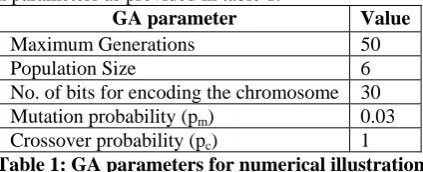
For all the schemes, the optimal batching time and minimum number of streams are obtained using the GA with parameters as provided in table 1.
GA parameter Value
Maximum Generations 50
Population Size 6
No. of bits for encoding the chromosome 30
Mutation probability (pm) 0.03
Crossover probability (pc) 1
Table 1: GA parameters for numerical illustration
Fig. 1 shows the variation of N with respect to Tb for all the
three schemes, by taking λ=18/min. The figure shows that N first decreases and then increases with Tb for the schemes
S1 and S2 whereas in S3, it tends to constant after having decreased in the beginning. Hence, minimum of N exists for all the schemes for some particular values of Tb. Fig.2,
represents the optimal number of streams for all schemes by varying λ. It is noted that for very small values of λ, S2 requires the lesser number of streams while S3 requires the larger number of streams as compared to S1. For intermediate values of λ, S1 gives the worst results in terms of the required number of streams and S2 gives the best results. Also, for very large arrival rates, S3 is the best scheme, as it requires the least number of streams. We also note that the number of streams in S1 and S2 increase with λ and for S3, it remains constant, which is quite obvious. Fig. 3 depicts the variation of N* with Dmax by taking
λ=0.2/min. Clearly, S2 is the best scheme in terms of bandwidth requirement for low Dmax , and S3 is the worst
scheme. For intermediate values of Dmax, S1 requires
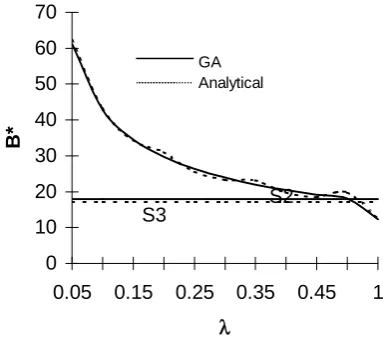
largest number of streams and if the start-up delay is very large, then S3 requires the m inimum number of streams. In fig. 4, the optimal buffer requirement (B*) for all the schemes is shown by varying λ. For higher arrival rates, S2 requires lesser buffer as compared to S3 whereas for lower arrival rates, S3 requires lesser buffer that S2. Further, as the arrival rate increases, the optimal buffer requirement for S2 decreases, while it remains constant for S3.
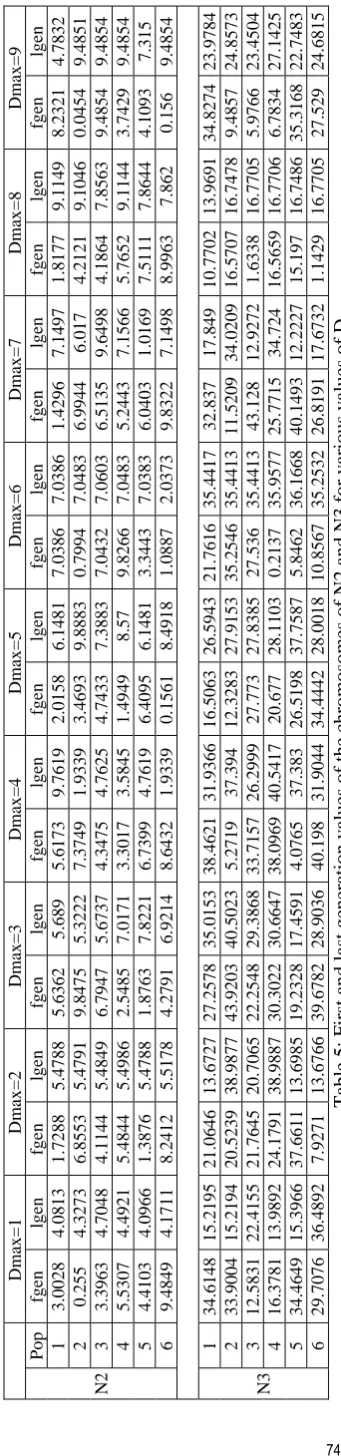
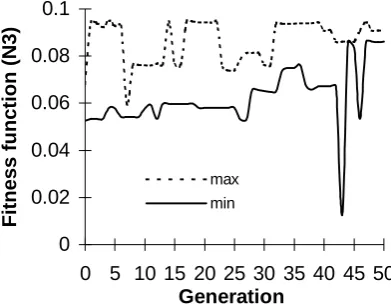
Figures 5(a)-7(a) illustrate the minimum and maximum values and mean values along with the standard deviation of the fitness functions in each generation of the GA for S1, S2 and S3 respectively. In figures 5(b)-7(b) the mean values along with the standard deviation of the fitness functions in each generation of the GA are shown for S1, S2 and S3 respectively.
Table 2 provides the analytical as well as GA values of optimal batching time for different values of Dmax by taking
λ=10. It is observed that for S1 and S3, the batching time increases with Dmax, which implies that low start-up delay
requires lesser batching time and high start-up delay requires larger batching time. Also, the batching time for S2 is independent of the start-up delay. Further, for higher arrival rates (i.e for very popular movies), the batching time is very small. This indicates that multicast streams should be opened very frequently if the arrival rate is very high. Table 3 shows the optimal batching time for all the schemes by taking several values of λ.
In tables 4 and 5, the values of the chromosomes (strings) obtained by the GA are shown for first and last generations. Table 4 gives the values of the chromosomes for N1 and N2 for different values of λ. In table 5, the chromosome values for different values of Dmax are provided for N2 and
N3.
Overall, we conclude that for higher arrival rates, the client buffering schemes (S2 and S3) perform better as far as the bandwidth requirement is concerned. Also, the GA results are quite closer to the analytical results. Also, in S1, where the analytical results are difficult to obtain, the GA results provide easy solution, which is at par with the numerical results.
Dmax Tb*
S1 S2 S3
Numerical GA Analytical GA Analytical GA
1 3.1607 3.1615 4.5826 4.3996 14.1421 13.9889
2 3.1607 3.1615 4.899 4.7822 20 21.2774
3 3.1607 3.1615 5.3852 5.3625 24.4949 23.2774
4 3.1607 3.1615 6 5.4271 28.2843 27.4127
5 3.1607 3.1615 6.7082 6.6976 31.6228 31.3864
6 3.1607 3.1615 7.4833 7.5872 34.641 35.2361
7 3.1607 3.1615 8.3066 8.4491 37.4166 38.2899
8 3.1607 3.1615 9.1652 9.7223 40 39.784
9 3.1607 3.1615 10.0499 10.2781 42.4264 43.2215
Table 2: Optimal batching time (Tb*) for various values of Dmax by taking l=10
λ Tb*
T
able 3:
Opti
m
al
batching ti
m e (Tb * ) f o r var ious
values of l by
taking Dm ax = 2 λ= .1 λ= .2 λ= .3 λ= .5 λ= 1 λ= 5 λ= 10 λ= 20 λ= 30 Pop fg
en lgen f
g
en lgen f
g
en lg
en f
g
en lgen f
g en lgen fg en lgen fg en lgen fg
en lgen f
g en lgen N1 1 28. 288 3 30. 332 9 26. 111 2 16. 970 1 33. 949 7 21. 634 2 42. 158 4 10. 742 15. 580 1 4. 0493 0. 8724 5. 3161 1. 9488 3. 4736 8. 0943 2. 6903 1. 896 3 1. 852 2 42. 832 1 43. 244 40. 840 8 16. 990 7 46. 406 4 24. 255 6 29. 375 23. 118 4 19. 744 16. 412 5. 6458 5. 4809 7. 6939 4. 8591 4. 9366 3. 9403 9. 1914 1. 5395 3 21. 910 8 42. 442 3 13. 851 4 13. 865 7 47. 225 1 24. 768 4 23. 118 4 23. 119 9 37. 383 3 4. 0493 4. 2283 5. 4736 7. 5099 4. 0974 9. 264 3. 9403 9. 986 2 0. 6222 4 17. 540 6 39. 658 3 23. 295 1 13. 070 4 35. 160 4 18. 017 8 6. 8234 23. 118 4 14. 771 4 16. 411 6 0. 8463 6. 5722 5. 8478 3. 448 6. 4961 2. 6903 7. 215 7 9. 352 5 25. 028 5 18. 246 4 20. 737 5 13. 865 8 16. 524 8 12. 256 1 17. 657 24. 680 8 23. 837 5 16. 543 4 4. 5131 6. 5722 0. 5821 3. 7617 9. 5303 2. 6879 6. 45 4 1. 852 6 15. 068 5 40. 512 8 35. 105 2 16. 976 6 24. 756 1 24. 759 2 37. 218 5 26. 250 9 40. 816 7 16. 542 6 5. 6543 1. 5649 4. 7029 8. 476 9. 1531 2. 6903 7. 86 5 1. 852 N2 1 31. 998 1 26. 282 3 38. 757 5 33. 528 50. 945 3 24. 261 1 57. 114 7 18. 232 1 46. 671 3 18. 724 0. 9905 5. 3978 2. 5273 9. 3459 1. 8511 5. 0077 2. 719 9 2. 8731 2 62. 914 3 65. 111 4 2. 8529 29. 721 32. 127 4 21. 987 9 43. 866 8 21. 084 3 14. 862 2 20. 776 4 4. 1944 7. 8612 4. 8364 0. 4263 2. 8683 5. 0923 0. 774 8 2. 8778 3 37. 715 7 69. 758 9 62. 493 6 32. 984 9 57. 261 9 21. 988 2 3. 5843 17. 685 2 52. 185 9 2. 6921 4. 2655 5. 4363 7. 3446 8. 0959 5. 3043 5. 394 7. 6833 2. 8774 4 30. 536 9 61. 555 8 4. 7059 32. 984 9 23. 605 21. 919 7 53. 226 6 56. 999 7 41. 884 1 27. 611 2 1. 7483 5. 3978 4. 3366 9. 9711 7. 0189 5. 0142 9. 979 2. 8781 5 17. 533 45. 141 1 33. 002 3 37. 727 8 55. 101 8 21. 919 8 61. 614 6 66. 423 2 66. 710 8 1. 2245 6. 5202 5. 3978 5. 3077 5. 5961 5. 0137 5. 1509 8. 414 8 9. 995 6 28. 923 1 65. 383 9 30. 310 9 33. 002 3 11. 010 8 21. 919 7 21. 145 5 21. 083 8 19. 788 5 20. 183 6 6. 6015 7. 8612 3. 7133 9. 9721 1. 8097 6. 3424 4. 3 694 2. 8775 Table
4: First a
n d last ge nerati on val u es of th e ch rom o som es o f N1 an d N 2 f o r va rio u
s values of
λ
Dmax=1
Dmax=2
Dmax=3
Dmax=4 Dmax=5 Dmax=6 Dmax=7 Dmax=8
Dmax=9 N2 P op fgen lgen fgen lgen fgen lgen fgen lgen fgen lgen fgen lgen fgen lgen fgen lgen fgen lgen 1 3.0028 4.0813 1.7288 5.4788 5.6362 5.689 5.6173 9.7619 2.0158 6.1481 7.0386 7.0386 1.4296 7.1497 1.8177 9.1149 8.2321 4.7832 2 0.255 4.3273 6.8553 5.4791 9.8475 5.3222 7.3749 1.9339 3.4693 9.8883 0.7994 7.0483 6.9944 6.017 4.2121 9.1046 0.0454 9.4851 3 3.3963 4.7048 4.1144 5.4849 6.7947 5.6737 4.3475 4.7625 4.7433 7.3883 7.0432 7.0603 6.5135 9.6498 4.1864 7.8563 9.4854 9.4854 4 5.5307 4.4921 5.4844 5.4986 2.5485 7.0171 3.3017 3.5845 1.4949 8.57 9.8266 7.0483 5.2443 7.1566 5.7652 9.1144 3.7429 9.4854 5 4.4103 4.0966 1.3876 5.4788 1.8763 7.8221 6.7399 4.7619 6.4095 6.1481 3.3443 7.0383 6.0403 1.0169 7.5111 7.8644 4.1093 7.315 6 9.4849 4.1711 8.2412 5.5178 4.2791 6.9214 8.6432 1.9339 0.1561 8.4918 1.0887 2.0373 9.8322 7.1498 8.9963 7.862 0.156 9.4854 N3 1 34.6148 15.2195 21.0646 13.6727 27.2578 35. 0153 38.4621 31.9366 16.5063 26.5943 21.7616 35.4417 32.837 17.849 10.7702 13.9691 34.8274 23. 9784 2 33.9004 15.2194 20.5239 38.9877 43.9203 40. 5023 5.2719 37.394 12.3283 27.9153 35.2546 35.4413 11.5209 34.0209 16.5707 16.7478 9.4857 24. 8573 3 12.5831 22.4155 21.7645 20.7065 22.2548 29.3868 33.7157 26.2999 27.773 27.8385 27.536 35.4413 43.128 12.9272 1.6338 16.7705 5.9766 23. 4504 4 16.3781 13.9892 24.1791 38.9887 30.3022 30.6647 38.0969 40.5417 20.677 28.1103 0.2137 35. 9577 25.7715 34.724 16.5659 16.7706 6.7834 27. 1425 5 34.4649 15.3966 37.6611 13.6985 19.2328 17.4591 4.0765 37.383 26.5198 37.7587 5.8462 36.1668 40.1493 12.2227 15.197 16.7486 35.3168 22. 7483 6 29.7076 36.4892 7.9271 13.6766 39.6782 28.9036 40.198 31.9044 34.4442 28.0018 10.8567 35.2532 26.8191 17.6732 1.1429 16.7705 27.529 24.6 815 Table
5: First a
n d last ge nerati on val u es of th e ch rom o som es o f N2 an d N 3 f o r va rio u
s values of
D
ma
0 20 40 60 80 100 120 140 160
2 5 8 11 14 17 20 23 26 29
Tb
N
S1 S2
S3
Fig. 1: Number of streams (N) by varying Tb
0 4 8 12 16 20
0.05 0.15 0.25 0.35 0.45 1.00
λ
N*
S1
S3
S2 Numerical GA Analytical
Fig. 2: Optimal number of streams N*by varying λ
2 4 6 8 10 12 14
1 2 3 4 5 6 7 8 9
Dmax
N*
S1
S2 S3 Numerical GA Analytical
Fig. 3: Optimal number of streams N* by varying Dmax
0 10 20 30 40 50 60 70
0.05 0.15 0.25 0.35 0.45 1
λ
B*
S2 S3
GA Analytical
Fig.4: Optimal buffer requirement B*by varying λ
0.000 0.010 0.020 0.030 0.040 0.050
0 5 10 15 20 25 30 35 40 45 50
Generation
Fitness function (N1)
max min
Fig. 5(a): Maximum and Minimum values of fitness function for N1
0.000
0.010
0.020
0.030
0.040
0.050
0 5 10 15 20 25 30 35 40 45 50
Generation
Fitness function (N1)
mean
sd
0 0.02 0.04 0.06 0.08 0.1
0 5 10 15 20 25 30 35 40 45 50
Generation
Fitness function (N3)
max min
Fig. 6(a): Maximum and Minimum values of fitness function for N2
0.00 0.02 0.04 0.06 0.08 0.10
0 5 10 15 20 25 30 35 40 45 50
Generation
Fitness function (N3)
mean sd
Fig. 6(b): Mean and Std. Deviation of fitness function for N2
0 0.01 0.02 0.03 0.04 0.05 0.06 0.07 0.08
0 5 10 15 20 25 30 35 40 45 50
Generation
Fitness function (N2)
max min
Fig. 7(a): Maximum and Minimum values of fitness function for N3
0 0.01 0.02 0.03 0.04 0.05 0.06 0.07 0.08
0 5 10 15 20 25 30 35 40 45 50
Generation
Fitness function (N2)
mean
sd
Fig. 7(b): Mean and Std. Deviation of fitness function for N3
6. CONCLUSION
The problem of minimizing the bandwidth or average number of streams required in a NVoD system is studied. Three multicasting schemes are considered and the optimal batching time is determined using a simple Genetic Algorithm (GA) thereby minimizing the average number of streams. All the schemes are compared on the basis of the bandwidth requirement. Scheme 1 is a double rate batching scheme which requires largest number of streams. Scheme 2 is a client buffering scheme which offers buffering of movie to the users. This scheme performs better than scheme 1, as it requires less number of streams. Scheme 3, which is also a client buffering technique, provides channel bundling or grouping such that the streams are grouped together into channels of incrementally increasing bandwidth. These high bandwidth channels are used to deliver the starting portion of the movie while the users concurrently buffer the later part of the movie from the ongoing multicasting stream. We conclude that the client-buffering techniques substantially reduce the average number of streams, for higher arrival rates or for popular movies. However in case of low arrival rates, scheme 1 is better than scheme 3. The genetic algorithm suggested, provides very accurate results for the optimal batching time for all the schemes. In scheme 1, where analytical results are difficult to obtain, GA facilitates an easy solution technique of minimizing the average number of streams.
REFERENCES
1. Alabau, M., Idoumghar, L. and Schott, R., “New hybrid genetic algorithms for the frequency assignment problem”, IEEE Trans. Broadcasting, 48 (1), pp. 27-34, March, 2002.
2. Aminzadeh, F., “Soft computing”, PTR Prentice Hall, New Jersey, 1994.
3. B. S. Wu, C. C. Hsieh, and Y. W. Chen, “A reverse-order scheduling scheme for broadcasting continuous multimedia data over a single channel,” IEEE Transactions on Broadcasting, 57 (3), pp. 721–728, 2011.
4. Chan. G.S.H. and Yeung, I.S.H., “Client buffering techniques for scalable video broadcasting over broadband networks with low user delay”, IEEE Trans. Broadcasting, 48 (1), pp. 19-26, March, 2002. 5. Dan, A., Sitaram, D. and Shahabuddin, P., “Dynamic batching
6. Dengiz, B., Altiparmak, F. and Smith, A.E., “Local search genetic algorithm for optimal design of reliable networks”, IEEE Trans. Evolutionary Computation, 1(3), pp. 179-188, Sept., 1997.
7. Goldberg, D.E. and Holland, J.H., “Genetic algorithms in search, optimization and machine learning”, Addison Wesley, 1989.
8. Hua, K.A. and Sheu, S., “Skyscraper broadcasting: A new broadcasting scheme for metropolitan video-on-demand systems”, ACM Computer Commun. Rev., 27, pp. 89-100, Oct. 1997.
9. J. F. Paris, “A fixed-delay broadcasting protocol for video-on demand,” Proceedings of the 10th International Conference on Computer Communications and Networks (ICCCN ’01), pp. 418– 423, Scottsdale, Ariz, USA, October 2001.
10. Juhn, L.S. and Tseng, L.M, “Harmonic broadcasting for video-on-demand service”, IEEE Trans. Broadcasting, 43, pp. 268-271, Sept., 1997.
11. Kim, H.J. and Zhu, Y., “Channel allocation problem in VOD system using batching adaptive piggybacking”, IEEE Trans. Consumer Electronics, 44 (3), pp. 969-976, 1998.
12. Kumar, A., Pathak, R.M. and Gupta, Y.P., “Genetic algorithm based reliability optimization for computer network expansion”, IEEE Trans. Reliability, 44 (1), pp. 63-72, 1995.
13. Michalewicz, Z., “Genetic algorithms + data structures = evolutionary programs”, Springer Verlag, 1992.
14. Petit, G.H., Deloddere, D. and Verniest, W., “Bandwidth resource optimization in video-on-demand network architectures”, Proc. Ist IEEE International Workshop on Community Networking, New York, NY, pp. 91-97, July 1994.
15. Poon, W.F. and Lo K.T., “New batching policy for providing true video-on-demand (T-VoD) in multicast system”, Proc. IEEE Int. Conf. Communications (ICC’99), 2, pp. 983-987, June 1999. 16. Poon, W.F., Lo, K.T. and Feng, J., “Adaptive batching scheme for
multicast video-on-demand systems”, IEEE Trans. Broadcasting, 47 (1), pp. 66-69, March 2001.
17. Reeves, C.R., “Genetic algorithms, modern heuristic techniques for combinatorial problems”, Blackwell Scientific Publications, 1993. 18. Shachnai, H. and Yu, P.S., “Exploring wait tolerance in effective
batching for video-on-demand scheduling”, Proc. Eighth Israeli Conf., pp. 67-76, 1997.
19. Tang, H.-S., Chan, S.H.G., Li, H., “Optimizing segment caching for peer-to-peer on-demand streaming”, Proc. IEEE International Conference on Multimedia and Expo, ICME 2009, pp. 810-813, 2009
20. Tang, K.S., Ko K.T., Chan, S. and Wong, E.W.M., “Optimal file placement in VOD system using genetic algorithm”, IEEE Trans. Industrial Electronics, 48(5), pp. 891-897, Oct.2001.
21. Viswanathan, S. and Imielinski, T., “Metropolitan area video-on-demand service using pyramid broadcasting”, Multimedia Syst., 4, pp. 197-208, Aug. 1996.
22. Wong, W.T., Zhang, L. and Pang, K.K., “Video on demand service policies”, Proc. IEEE Singapore Int. Conf. Networks, pp. 560-564, July 1995.
23. Wong, Y. W.,Lee, Jack Y. B, Li, Victor O. K.,Chan, Gary S. H.: Supporting interactive video-on-demand with adaptive multicast streaming, IEEE Transactions on Circuits and Systems for Video Technology, 17(2), pp. 129-142, Feb. 2007.
24. Y. N. Chen and L.M. Tseng, “An efficient periodic broadcasting with small latency and buffer demand for near video on demand,” International Journal of DigitalMultimedia Broadcasting, Article ID 717538, 7 pages, 2012.
25. Y.-W. Chen and C.-Y. Chen, “PAS: a new scheduling scheme for broadcasting a video over a single channel,” IET Communications, 5(7), pp. 951–960, 2011.