Privately Evaluating Decision Trees and Random Forests
(Extended Version)
David J. Wu∗ Tony Feng∗ Michael Naehrig† Kristin Lauter†
Abstract
Decision trees and random forests are common classifiers with widespread use. In this paper, we develop two protocols for privately evaluating decision trees and random forests. We operate in the standard two-party setting where the server holds a model (either a tree or a forest), and the client holds an input (a feature vector). At the conclusion of the protocol, the client learns only the model’s output on its input and a few generic parameters concerning the model; the server learns nothing. The first protocol we develop provides security against semi-honest adversaries. We then give an extension of the semi-honest protocol that is robust against malicious adversaries. We implement both protocols and show that both variants are able to process trees with several hundred decision nodes in just a few seconds and a modest amount of bandwidth. Compared to previous semi-honest protocols for private decision tree evaluation, we demonstrate a tenfold improvement in computation and bandwidth.
1
Introduction
In recent years, machine learning has been successfully applied to many areas, such as spam clas-sification, credit-risk assessment, cancer diagnosis, and more. With the transition towards cloud-based computing, this has enabled many useful services for consumers. For example, there are many companies that provide automatic medical assessments and risk profiles for various diseases by evaluating a user’s responses to an online questionnaire, or by analyzing a user’s DNA profile. In the personal finance area, there exist automatic tools and services that provide valuations for a user’s car or property based on information the user provides. In most cases, these services require access to the user’s information in the clear. Many of these situations involve potentially sensitive information, such as a user’s medical or financial data. A natural question to ask is whether one can take advantage of cloud-based machine learning, and still maintain the privacy of the user’s data. On the flip side, in many situations, we also require privacy for the model. For example, in scenarios where companies leverage learned models for providing product recommendations, the details of the underlying model often constitute an integral part of the company’s “secret sauce,” and thus, efforts are taken to guard the precise details. In other scenarios, the model might have been trained on sensitive information such as the results from a medical study or patient records from a hospital; here, revealing the model can compromise sensitive information as well as violate certain laws and regulations.
∗
Stanford University [email protected], [email protected]. Work done while at Microsoft Research.
†
In this work, we focus on one commonly used class of classifiers: decision trees and random forests [43, 19]. Decision trees are simple classifiers that consist of a collection of decision nodes arranged in a tree structure. As the name suggests, each decision node is associated with a pred-icate or test on the query (for example, a possible predpred-icate could be “age>55”). Decision tree evaluation simply corresponds to tree traversal. These models are often favored by users for their ease of interpretability. In fact, there are numerous web APIs [2, 1] that enable users to both train and query decision trees as part of amachine learning as a serviceplatform. In spite of their simple structure, decision trees are widely used in machine learning, and have been successfully applied to many scenarios such as disease diagnosis [62, 5] and credit-risk assessment [49].
In this work, we develop practical protocols for private evaluation of decision trees and random forests. In our setting, the server has a decision tree (or random forest) model and the client holds an input to the model. Abstractly, our desired security property is that at the end of the protocol execution, the server should not learn anything about the client’s input, and the client should not learn anything about the server’s model other than what can be directly inferred from the output of the model. This is a natural setting in cases where we are working with potentially sensitive and private information on the client’s side and where we desire to protect the server’s model, which might contain proprietary or confidential information. To motivate the need for privacy, we highlight one such application of using decision trees for automatic medical diagnosis.
Application to medical diagnosis. Decision trees are used by physicians for both automatic medical diagnosis and medical decision making [62, 5]. A possible deployment scenario is for a hospital consortium or a government agency to provide automatic medical diagnosis services for other physicians to use. To leverage such a service, a physician (or even a patient) would take a set of measurements (as specified by the model) and submit those to the service for classification. Of course, to avoid compromising the patient’s privacy, we require that at the end of the protocol, the service does not learn anything about the client’s input. On the flip side, there is also a need to protect the server’s model from the physician (or patient) that is querying the service. In recent work, Fredrikson et al. [34] showed thatwhite-boxaccess to a decision tree model can be efficiently exploited to compromise the privacy of the users whose data was used to train the decision tree. In this case, this means that the medical details of the patients whose medical profiles were used to develop the model are potentially compromised by revealing the model in the clear. Not only is this a serious privacy concern, in the case of medical records, this can be a violation of HIPAA regulations. Thus, in this scenario, it is critical to provide privacy for both the input to the classifier, as well as the internal details of the classifier itself. We note that even though black-box access to a model can still be problematic, combining our private model evaluation protocol with “privacy-aware” decision tree training algorithms [34, §6] can significantly mitigate this risk.
1.1 Our Contributions
cloud-based applications where we assume the server is trying to provide a useful service, and thus, not incentivized to give corrupt or nonsensical output to the client. In fact, because the server has absolute control over the model in the private decision tree evaluation setting, privacy of the client’s input is the strongest property we can hope for in the presence of a malicious server. We describe our threat model formally in Section 2.3. Our protocols leverage two standard cryptographic primitives: additive homomorphic encryption and oblivious transfer.
As part of our construction for malicious security, we show how a standard comparison protocol based on additively homomorphic encryption [28] can be used to obtain an efficient conditional oblivious transfer protocol [11, 27] for the less-than predicate.
To assess the practicality of our protocols, we implement both the semi-honest protocol as well as the extended protocol with protection against malicious adversaries using standard libraries. We conduct experiments with decision trees with depth up to 20, as well as decision trees with over 10,000 decision nodes to assess the scalability of our protocols. We also compare the performance of our semi-honest secure protocol against the protocols of [17, 7, 20], and demonstrate over 10x reduction in client computation and bandwidth, or both, while operating at a higher security level (128 bits of security as opposed to 80 bits of security in past works). We conclude our experimental analysis by evaluating our protocols on decision trees trained on several real datasets from the UCI repository [6]. In most cases, our semi-honest decision tree protocol completes on the order of seconds and requires bandwidth ranging from under 100 KB to several MB. This represents reasonable performance for a cloud-based service.
This work provides the first implementation of a private decision tree evaluation protocol with security against malicious adversaries. In our benchmarks, we additionally show that even with the extensions for malicious security, our protocol still outperforms existing protocols that achieve only semi-honest security.
Related work. This problem of privately evaluating decision trees falls under the general um-brella of multiparty computation. One approach is based on homomorphic encryption [35, 59], where the client sends the server an encryption of its input, and the server evaluates the function homomorphically and sends the encrypted response back to the client. The client decrypts to learn the output. While these methods have been successfully applied to several problems in privacy-preserving data mining [39, 16], the methods are limited to simple functionalities. Another general approach is based on Yao’s garbled circuits [63, 53, 51, 10, 9], where one party prepares a garbled circuit representing the joint function they want to compute and the other party evaluates the cir-cuit. These methods typically have large communication costs; we provide some concrete estimates based on state-of-the-art tools in Section 6. We survey additional related work in Section 7.
2
Preliminaries
We begin with some notation. Let [n] be the set of integers {1, . . . , n}, and Zp be the ring of integers modulo p. For twok-bit stringsx, y ∈ {0,1}k, we write x⊕y for their bitwise xor. For a distribution D, we write x← D to denote a sample sfrom D. For a finite setS, we write x ←−r S to denote a uniform drawx fromS. We say that two distributionsD1 andD2 are computationally indistinguishable (denotedD1
c
distributionsD1 and D2 are statistically close. A function f(λ) is negligible in a parameterλif for all positive integers c, f =o(1/λc). For a predicate P we write 1{P(x)} to denote the indicator function for the predicateP—that is, 1{P(x)}= 1 if and only ifP(x) holds, and 0 otherwise.
2.1 Cryptographic Primitives
In this section, we introduce the primitives we require.
Homomorphic encryption. A semantically secure public-key encryption system with message space R (we model R as a ring) is specified by three algorithms KeyGen,Encpk,Decsk (for key generation, encryption, decryption, respectively). The key-generation algorithm outputs a public-private key pair (pk,sk). For a message m, we write Encpk(m;r) to denote an encryption of m with randomness r. The security requirement is the standard notion of semantic security [37]. In an additively homomorphic encryption [59, 28, 29] system, we require an additional public-key operation that takes encryptions of two messages m0, m1 and outputs an encryption of m0+m1. Additionally, we require that the scheme supports scalar multiplication: given an encryption of m∈ R, there is a public-key operation that produces an encryption of km for all k∈Z.
Oblivious Transfer. Oblivious transfer (OT) [60, 56, 57, 4] is a primitive commonly employed in cryptographic protocols. In standard 1-out-of-n OT, there are two parties, denoted the sender and the receiver. The sender holds a databasex1, . . . , xn ∈ {0,1}` and the client holds a selection bit i∈[n]. At the end of the protocol, the client learnsxi and nothing else about the contents of the database; the server learns nothing.
2.2 Decision Trees and Random Forests
Decision trees are frequently encountered in machine learning and can be used for classification and regression. A decision tree T : Zn → Z implements a function on an n-dimensional feature space (the feature space is typicallyRn, so we use a fixed-point encoding of the values). We refer to elements x∈Zn as feature vectors. Each internal node vk in the tree is associated with a Boolean function fk(x) = 1{xik < tk}, where ik ∈ [n] is an index into a feature vector x ∈ Z
n, and t k is a threshold. Each leaf node `is associated with an output value z`. To evaluate the decision tree on an input x ∈ Zn, we start at the root node, and at each internal node vk, we evaluate fk(x). Depending on whether fk(x) evaluates to 0 or 1, we take either the left or right branch of the tree. We repeat this process until we reach a leaf node `. The output T(x) is the value z` of the leaf node.
The depth of a decision tree is the length of the longest path from the root to a leaf. The ith layer of the tree is the set of nodes of distance exactlyifrom the root. A binary tree with depthd is complete if for 0≤i≤d, theith layer contains exactly 2i nodes.
Node indices. We use the following indexing scheme to refer to nodes in a complete binary tree. Let T be a decision tree with depth d. Set v1 to be the root node. We label the remaining nodes inductively: ifvi is an internal node, letv2i be its left child and v2i+1 be its right child. For convenience, we also define a separate index from 0 to 2d−1 for the leaf nodes. Specifically, ifvi is the parent of a leaf node, then we denote its left and right children by z2i−m−1 and z2i−m, where m is the number of internal nodes in T. With this indexing scheme, the leaves of the tree, when read from left-to-right, correspond with the orderingz0, . . . , z2d−1.
Paths in a binary tree. We associate paths in a complete binary tree with bit strings. Specifi-cally, letT be a complete binary tree with depthd. We specify a path by a bit stringb=b1· · ·bd∈
{0,1}d, wherebi denotes whether we visit the left child or the right child when we are at a node at leveli−1. Starting at the root node (level 0), and traversing according to the bitsb, this process uniquely defines a path inT. We refer to this path as the path induced byb inT.
Similarly, we define the notion of a decision string for an input x on a tree T. Let m be the number of internal nodes in a complete binary tree T. The decision string is the concatenation f1(x)· · ·fm(x) of the value of each predicate fi on the inputx. Thus, the decision string encodes information regarding which path the evaluation would have taken at every internal node, and thus, uniquely identifies the evaluation path of x in T. Thus, we also refer to the path induced by a decision string s in T. In specifying the path s, the decision string also specifies the index of the leaf node at the end of the path. We let φ : {0,1}m → {0, . . . , m} be the function that maps a decision string s for a complete binary tree with m decision nodes onto the index of the corresponding leaf node in the path induced bysinT.
Random forests. One way to improve the performance of decision tree classifiers is to combine responses from many decision trees. In a random forest [19], we train many decision trees, where each tree is trained using a random subset of the features. This has the effect of decorrelating the individual trees in the forest. More concretely, we can describe a random forestFby an ensemble of decision treesF ={Ti}i∈[n]. If the random forest operates by computing the mean of the individual decision tree outputs, then F(x) = 1nP
i∈[n]Ti(x).
2.3 Security Model
Our security definitions follow the real-world/ideal-world paradigm of [36, 22, 23, 44]. Specifically, we compare the protocol execution in the real world, where the parties interact according to the protocol specificationπ, to an execution in an ideal world, where the parties have access to a trusted party that evaluates the decision tree. Similar to [22], we view the protocol execution as occurring in the presence of an adversary A and coordinated by an environment E = {Eλ}λ∈N (modeled as a family of polynomial-size circuits parameterized by a security parameter λ). The environment chooses the inputs to the protocol execution and plays the role of distinguisher between the real and ideal experiments.
number` of non-dummy internal nodes in the tree. In our security analysis, we assume that these parameters arepublic and known to the client and server.
Real model of execution. In the real-world, the protocol execution proceeds as follows:
1. Inputs: The environment E chooses a feature vector x ∈ Zn for the client and a decision tree T for the server. Each component inx is represented by at mostt bits, and the tree T
has depth at most d. In the semi-honest setting where the number `of non-dummy internal nodes inT is public, we impose the additional requirement thatT has`non-dummy internal nodes. The environment gives the input of the corrupted party to the adversary.
2. Protocol Evaluation: The parties begin executing the protocol. All honest parties behave according to the protocol specificationπ. The adversaryAhas full control over the behavior of the corrupted party and sees all messages received by the corrupted party. If A is semi-honest, then Adirects the corrupted party to follow the protocol as specified.
3. Output: The honest party computes and gives its output to the environmentE. The adver-sary computes a function of its view and gives it toE.
At the end of the protocol execution, the environmentE outputs a bitb∈ {0,1}. LetREALπ,A,E(λ)
be the random variable corresponding to the value of this bit.
Ideal model of execution. In the ideal-world execution, the parties have access to a trusted third party (TTP) that evaluates the decision tree. We now describe the ideal-world execution:
1. Inputs: Same as in the real model of execution.
2. Submission to Trusted Party: If a party is honest, it gives its input to the trusted party. If a party is corrupt, then it can send any input of its choosing to the trusted party, as directed byA. IfAis semi-honest, it submits the input it received from the environment to theTTP. 3. Response from Trusted Party: On inputxandT from the client and server, respectively,
theTTPcomputes and gives T(x) to the client.
4. Output: An honest party gives the message (if any) it received from the TTP to E. The adversary computes a function of its view of the protocol execution and gives it toE.
At the end of the protocol execution, the environmentE outputs a bitb∈ {0,1}. LetIDEALA,E(λ)
be the random variable corresponding to the value of this bit. Informally, we say that a two-party protocolπ is a secure decision tree evaluation protocol if for all efficient adversariesA in the real world, there exists an adversary S in the ideal world (sometimes referred to as a simulator) such that the outputs of the protocol executions in the real and ideal worlds are computationally indistinguishable. More formally, we have the following:
Definition 2.1 (Security). Let π be a two-party protocol. Then, π securely evaluates the decision tree functionality in the presence of malicious (resp., semi-honest) adversaries if for all efficient adversaries (resp., semi-honest adversaries)A, there exists an efficient adversary (resp., semi-honest adversary) S such that for every polynomial-size circuit familyE ={Eλ}λ∈N,
REALπ,A,E(λ)
c
In this work, we also consider the weaker notion of privacy, which captures the notion that an adversary does not learn anything about the inputs of the other parties beyond what is explicitly leaked by the computation and its inputs/outputs. We use the definitions from [46]. Specifically, define the random variable REAL0π,A,E(λ) exactly as REALπ,A,E(λ), except in the final step of the
protocol execution, the environment E only receives the output from the adversary (and not the output from the honest party). Define IDEAL0A,E(λ) similarly. Then, we can define the notion for
a two-party protocol to privately compute a functionality f:
Definition 2.2 (Privacy). Letπ be a two-party protocol. Then, π privately computes the decision tree functionality in the presence of malicious (resp., semi-honest) adversaries if for all efficient adversaries (resp., semi-honest adversaries)A, there exists an efficient adversary (resp., semi-honest adversary) S such that for every polynomial-size circuit familyE ={Eλ}λ∈
N, REAL0π,A,E(λ)
c
≈IDEAL0S,E(λ).
3
Semi-honest Protocol
In this section, we describe our two-party protocol for privately evaluating decision trees in the semi-honest model. We show how to generalize these protocols to random forests in Section 5. In our scenarios, we assume the client holds a feature vector and the server holds a model (either a decision tree or a random forest). The protocol we describe is secure assuming a semantically secure additively homomorphic encryption scheme and a semi-honest secure OT protocol.
3.1 Setup
We make the following assumptions about our model:
• The client has a well-formed public-private key-pair for an additively homomorphic encryption scheme.
• The client’s private data consists of a feature vector x= (x1, . . . , xn)∈Zn, where xi ≥0 for all i. Lett be the bit-length of each entry in the feature vector.
• The server holds a complete binary decision treeT withm(possibly dummy) internal nodes.
Leakage. As noted in Section 2.3, we assume that the dimension n, the precision t, the depth d of the decision tree and the number ` of non-dummy internal nodes are public in the protocol execution.
3.2 Building Blocks
In this section, we describe the construction of our decision tree evaluation protocol in the semi-honest setting. Before presenting its full details (Figure 1), we provide a high level survey of our methods. As stated in Section 3.1, the decision trees we consider have a very simple structure known to the client: a complete binary tree T with depthd. Letz0, . . . , z2d−1 be the leaf values of
T. Suppose also that we allow the client to learn the index i∈
zi=T(x) by engaging in a 1-out-of-2d OT with the server. In this case, the server’s “database” is the set
z0, . . . , z2d−1 .
The problem with this scheme is that revealing the index of the leaf node to the client reveals information about the structure of the tree. We address this by having the server first permute the nodes of the tree. After this randomization process, we can show that the decision string corresponding to the client’s query is uniform over all bit strings with length 2d−1. Thus, it is acceptable for the client to learn the decision string corresponding to its input on the permuted tree. The basic idea for our semi-honest secure decision tree evaluation protocol is thus as follows:
1. The server randomly permutes the treeT to obtain an equivalent treeT0.
2. The client and server engage in a comparison protocol for each decision node in T0. At the
end of this phase, the client learns the result of each comparison in T0, and therefore, the decision string corresponding to its input inT0.
3. Using the decision string, the client determines the indexithat contains its valuezi =T(x). The client engages in an OT protocol with the server to obtain the valuezi.
Comparison protocol. The primary building block we require for private decision tree evalua-tion is a comparison protocol. We use a variant of the two-round comparison protocol from [28, 32, 17] based on additive homomorphic encryption. In the protocol, the client and server each have a value x and y, respectively. At the end of the protocol, the client and server each possess a share of the comparison bit1{x < y}. Neither party learns anything else about the other party’s input. We give a high-level sketch of the protocol. Suppose the binary representations of x and y are x1x2· · ·xt and y1y2· · ·yt, respectively. Then, x < y if and only if there exists some index i ∈ [t] where xi < yi, and for all j < i, xj = yj. As observed in [28], this latter condition is equivalent to there existing an index i such that zi = xi −yi+ 1 + 3Pj<i(xj ⊕yj) = 0. In the basic comparison protocol, the client encrypts each bit of its input x1, . . . , xt using an additively homomorphic encryption scheme (with plaintext spaceZp). The server homomorphically computes encryptions of r1z1, . . . , rtztwhere r1, . . . , rt←−r Zp, and sends the ciphertexts back to the client in random order. To learn if x < y, the client checks whether any of the ciphertexts decrypt to 0. Note that if zi 6= 0, then the valuerizi is uniformly random in Zp. Thus, depending on the value of the comparison bit, the client’s view either consists oft encryptions of random nonzero values, ort−1 encryptions of random nonzero values and one encryption of 0.
For our decision tree evaluation protocol, we do not reveal the actual comparison bit to the client. Instead, we secret share the comparison bit across the client and server. This is achieved by having the server “flip” the direction of each comparison with probability 1/2. At the beginning of the protocol, the server chooses b ←− {r 0,1}, sets γ = 1−2·b, and computes encryptions of zi = xi −yi +γ + 3Pj<i(xj ⊕yj). Let b0 = 1 if there is some i ∈ [t] where zi = 0. Then, b⊕b0 =1{x < y}.
˜
fv(x) :=fv(x)⊕1. More precisely, on input a decision treeT withminternal nodesv1, . . . , vm, we construct a permuted treeT0 as follows:
1. Initialize T0 ← T and choose s ←− {r 0,1}m. Let v01, . . . , vm0 denote the internal nodes of T0
and letf10, . . . , fm0 be the corresponding boolean functions.
2. Fori∈[m], setfi0(x)←fi(x)⊕si. If si= 1, then swap the left and right subtrees of vi0. Do not reindex the nodes of T0 during this step.
3. Reindex the nodes v10, . . . , vm0 in T0 according to the standard indexing scheme described in Section 2.2. Output the permuted tree T0.
In the above procedure, we obtain a new tree T0 by permuting the nodes of T according to a
bit-string s ∈ {0,1}m. We denote this process by T0 ← πs(T). By construction, for all x ∈ Zn and all s∈ {0,1}m, we have that T(x) = πs(T)(x). Moreover, we define the permutation τs that corresponds to the permutation on the nodes ofT effected byπs. In other words, the node indexed iinT is indexedτ(i) in T0. Then, if σ∈ {0,1}m is the decision string ofT on inputx,τ(σ⊕s) is the decision string ofπs(T) onx.
3.3 Semi-honest Decision Tree Evaluation
The protocol for evaluating a decision tree with security against semi-honest adversaries is given in Figure 1. Just to reiterate, in the first part of the protocol (Steps 1-4), the client and server participate in an interactive comparison protocol that ultimately reveals to the client a decision string for a permuted tree. Given the decision string, the client obtains the response via an OT protocol. We show that this protocol is correct and state the corresponding security theorem. We give the formal security proof in Appendix A.
Theorem 3.1. If the client and server follow the protocol in Figure 1, then at the end of the protocol, the client learns T(x).
Proof. Appealing to the analysis of the comparison protocol from [28, §4.1], we have that for all k∈[`],bk⊕b0k=1(xik ≤tk) =fqk(x). Sincefv(x) = 0 for the dummy nodesv, we conclude thatσ
is the decision string ofx onT. Then, as noted in Section 3.2,τs(σ⊕s) =σ0 is the corresponding decision string of x on πs(T) =T0. By correctness of the OT protocol, the client learns the value ofzφ0(σ0)=T0(x) at the end of Step 5. Since the tree randomization process preserves the function,
it follows that zφ0(σ0) =T0(x) =T(x).
Theorem 3.2. The protocol in Figure 1 is a decision tree evaluation protocol with security against semi-honest adversaries (Definition 2.1).
Asymptotic analysis. We now briefly characterize the asymptotic performance of the protocol in Figure 1. In our analysis, we only count the number of cryptographic operations the client and server perform. Let d be the depth of the tree, n be the dimension of the feature space, ` be the number of non-dummy internal nodes, and t be the precision (the number of bits needed to represent each component of the feature vector).
Let (pk,sk) be a public-private key-pair for an additively homomorphic encryption scheme overZp. The client
holds the secret keysk. Fix a precisiont≤ blog2pc.
• Client input: A feature vectorx∈Znp where eachxiis at mosttbits. Letxi,j denote thejth bit ofxi. • Server input: A complete, binary decision treeT withminternal nodes. Letq1, . . . , q`be the indices of the
non-dummy nodes, and let fqk(x) =1{xik≤tk}, where ik ∈[n] and tk∈Zp. For the dummy nodesv, set
fv(x) = 0. Letz0, . . . , zm∈ {0,1}∗be the values of the leaves ofT. See Section 3.1 for more details.
1. Client: For eachi∈[n] andj∈[t], compute and sendEncpk(xi,j) to the server.
2. Server: The server choosesb ←− {r 0,1}`
. Then, for eachk ∈ [`], set γk = 1−2·bk. For eachk∈ [`] and
j∈[t], chooserk,j←−r Z∗pand homomorphically compute the ciphertext
ctk,j=Encpk "
rk,j xik,w−tk,w+γk+ 3·
X
w<j
(xik,w⊕tk,w)
!#
. (1)
For eachk∈[`], the server sends the client the ciphertexts (ctk,1, . . . ,ctk,t) inrandomorder. Note that the
server is able to homomorphically computectk,j for allk∈[`] and j∈[t] because it has the encryptions of
xik and the plaintext values ofrk,j,γk, andtk. To evaluate the xor, the server uses the fact that for a bit
x∈ {0,1},x⊕0 =xandx⊕1 = 1−x. Since the server knows the value oftkin the clear, this computation
only requires additive homomorphism.
3. Client: The client obtains a set of`tuples of the form (ctek,1, . . . ,ctek,t) from the server. For each k∈[`], it
setsb0k = 1 if there existsj∈[t] such that ˜ctk,j is an encryption of 0. Otherwise, it setsb0k= 0. The client
replies withEncpk(b01), . . . ,Encpk(b0`).
4. Server: The server choosess ←− {r 0,1}m and constructs the permuted tree T0
= πs(T), where πs is the
permutation associated with the bit-string s (see Section 3.2). Initialize σ = 0m. For k ∈ [`], update
σik=bk⊕b
0
k. Letτsbe the permutation on the node indices ofT effected byπs, and computeσ0←τs(σ⊕s).
The server homomorphically computesEncpk(σ0) (each bit is encrypted individually) and sends the result to
the client. This computation only requires additive homomorphism because the server knows the plaintext values ofbkandskand has the encryptions ofb0k for allk∈[`].
5. Client and Server: The client decrypts the server’s message to obtainσ0 and then computes the indexi
of the leaf node containing the response (the client computesi←φ(σ0), withφ(·) as defined in Section 2.2). Next, it engages in a1-out-of-(m+ 1) OT with the server to learn a value ˜z. In the OT protocol, the client supplies the indexiand the server supplies the permuted leaf valuesz00, . . . , z0mofT0. The client outputs ˜z
and the server outputs nothing.
Figure 1: Decision tree evaluation protocol with security against semi-honest adversaries.
The total number of cryptographic operations the client has to perform is thus O(t(n+`) +d). For the server, evaluating the comparisons requires O(`t) public-key operations. After receiving the comparison responses, the server constructs the decision string, which has length 2d−1, so this step requiresO(2d) operations. The1-out-of-2dOT at the end also requiresO(2d) computation on the server’s side, for a total complexity of O `t+ 2d.
4
Handling Malicious Adversaries
one-sided security (see [44,§2.6.2] for a more thorough discussion). To motivate the construction of the extended protocol, we highlight two ways a malicious client might attack the protocol in Figure 1:
• In the first step of the protocol, a malicious client might send encryptions of plaintexts that are not in {0,1}. The server’s response could reveal information about the thresholds in the decision tree.
• When the client engages in OT with the server, it can request an arbitrary index i0 of its choosing and learn the value zi0 of an arbitrary leaf node, independent of its query.
In the following sections, we develop tools that prevent these two particular attacks on the protocol. In turn, the resulting protocol will provide security against malicious clients and privacy against malicious servers.
4.1 Building Blocks
To protect against malicious adversaries, we leverage two additional cryptographic primitives: proofs of knowledge and an adaptation of conditional OT. In this section, we give a brief sur-vey of these methods.
Proofs of knowledge. At the beginning of Section 4, we noted that a malicious client can deviate from the protocol and submit encryptions of non-binary values as its query. To protect against this malicious behavior, we require that the client includes a zero-knowledge proof [38] to certify that it is submitting encryptions of bits. In our experiments, we use the exponential variant of the ElGamal encryption scheme [26, §2.5] for the additively homomorphic encryption scheme. In this case, proving that a ciphertext encrypts a bit can be done using the Chaum-Pedersen protocol [24] in conjunction with the OR proof transformation in [25, 45]. Moreover, we can apply the Fiat-Shamir heuristic [33] to make these proofs non-interactive in the random oracle model.
To show security against a malicious client in our security model (Section 2.3), the ideal-world simulator needs to be able to extract a malicious client’s input in order to submit it to the trusted third party (ideal functionality). This is enabled using a zero-knowledge proof of knowledge. In our exposition, we use the notation introduced in [21] to specify these proofs. We write statements of the form PoK{(r) :c1 =Encpk(0;r)∨c1=Encpk(1;r)}to denote a zero-knowledge proof-of-knowledge of a valuer where eitherc1 =Encpk(0;r) orc2 =Encpk(1;r). All values not enclosed in parenthesis are assumed to be known to the verifier. We refer readers to [38, 8] for a more complete treatment of these topics.
Conditional oblivious transfer. The second problem with the semi-honest protocol is that the client can OT for the value of an arbitrary leaf independent of its query. To address this, we modify the protocol so the client can only learn the value that corresponds to its query. We use a technique similar toconditional oblivious transfer introduced in [27, 11]. Like OT, (strong) conditional OT is a two-party protocol between a sender and a receiver. The receiver holds an inputxand the sender holds two secret keys κ0, κ1 and an input y. At the conclusion of the protocol, the receiver learns
4.2 Secure Decision Tree Evaluation
We now describe how we extend our decision tree evaluation protocol to protect against malicious adversaries.
Modified comparison protocol. Recall from Section 3.2 that the basic comparison protocol exploits the fact that x < y if and only if there exists some index i ∈ [t] where zi = xi−yi+ 1 + 3P
j<i(xj ⊕yj) = 0. In the comparison protocol, the server homomorphically computes an encryption ofci =rizi for a randomri∈Zpand the client decrypts each ciphertext to learn whether zi= 0 for some i. Suppose the server wants to transmit a key κ0 ∈Zp if and only if x < y. It can do this by including an additional set of ciphertexts Encpk(ciρi +κ0) in addition to Encpk(ci) for each i∈ [t], and where ρi is a uniformly random blinding factor from Zp. Certainly, if all of the ci 6= 0, thenρici is uniform and perfectly hidesκ0. On the other hand, if for somei,ci= 0, then the client is able to recover the secret key κ0. Thus, this gives a conditional key transfer protocol for the less-than predicate: the client is able to learn the key κ0 if its input x is less than the server’s input y. Similarly, the server can construct another set of ciphertexts such that κ1 is revealed if
x > y.1 Finally, the same trick described in Section 3.2 can be used to ensure the client learns only a share of the comparison bit (and correspondingly, the key associated with its share).
Decision tree evaluation. Our two-round decision tree evaluation protocol with security against malicious adversaries is given in Figure 2. As in the semi-honest protocol, the client begins by sending a bitwise encryption of its feature vector to the server. In addition to the ciphertexts, the client also sends zero-knowledge proofs that each of its ciphertexts encrypts a single bit. Next, the server randomizes the tree in the same manner as in the semi-honest protocol (Section 3.2). Moreover, the server associates a randomly chosen key with each edge in the permuted tree. The server blinds each leaf value using the keys along the path from the root to the leaf.2 The server sends the blinded response vector to the client. In addition, for each internal node in the decision tree, the server prepares a response that allows the client to learn the key associated with the comparison bit between the corresponding element in its feature vector and the threshold associated with the node. Using these keys, the client unblinds the value (and only this value) at the index corresponding to its query.
Remark 4.1. In the final step of the protocol in Figure 2, the client computes the index of the leaf node based on the complete decision string b0 it obtains by decrypting each ciphertext in the server’s response. At the same time, we note that the path induced byb0in the decision tree can be fully specified by justd=dlog2me bits inb0. This gives a way to reduce the client’s computation in the decision tree evaluation protocol. Specifically, after the client receives the mmessages from the server in Step 3 of the protocol, it only computes the d bits in the decision string needed to specify the path through the decision tree. To do so, the client first computes the decision value at the root node to learn the first node in the path. It then iteratively computes the next node in the
1We can assume without loss of generality that x6=y in our protocol. Instead of comparingxwithy, we compare
2xagainst 2y+ 1. Observe thatx≤yif and only if 2x <2y+ 1. Thus, it suffices to only consider whenx > yand
x < y.
2
There is a small technicality here since the values are elements of{0,1}`, while the keys are elements inG. However,
as long as|G|>2`, we can obtain a (nearly) uniform key in{0,1}`by hashing the group element using a pairwise
Let (pk,sk) be a public-secret key-pair for an additively homomorphic encryption scheme overZp. We assume
the client holds the secret key. Fix a precisiont≤ blog2pc.
• Client input: A feature vectorx∈Znp where eachxiis at mosttbits. Letxi,j denote thejth bit ofxi. • Server input: A complete, binary decision tree T with decision nodes v1, . . . , vm. For all k ∈ [m], the
predicatefk associated with decision nodevkis of the formfk(x) =1{xik≤tk}, whereik∈[n] is an index
andtk∈Zpis a threshold. Letz0, . . . , zm∈ {0,1}`be the values of the leaves ofT.
1. Client: For each i ∈ [n] and j ∈ [t], the client chooses ri,j ←−r Zp, and constructs ciphertexts
cti,j = Encpk(xi,j;ri,j) and proofs πi,j = PoK{(ri,j) :cti,j=Encpk(0;ri,j)∨cti,j=Encpk(1;ri,j)}. It sends {(cti,j, πi,j)}i∈[n],j∈[t] to the server.
2. Server: Let
( ˜cti,j,π˜i,j) i∈[n],j∈[t] be the ciphertexts and proofs the server receives from the client. For
i∈[n] andj∈[t], the server verifies the proof ˜πi,j. If ˜πi,j fails to verify, it aborts the protocol. Otherwise,
the server does the following:
(a) It choosess ←− {r 0,1}m
and computes T0 ←
πs(T), whereπs is the permutation associated with the
bit-strings(see Section 3.2). Letτbe the permutation effected byπson the nodes ofT. Lets01· · ·s 0
m=
τ(s1· · ·sm). Similarly, define the permuted node indicesi01, . . . , i0mand thresholdst01, . . . , t0m inT0.
(b) For eachk∈[m], it chooses keysκk,0, κk,1←−r Zp. Letγi0= 1−2·s
0
i. Then, for eachk∈[m] andj∈[t],
it chooses blinding factorsr(0)k,j, rk,j(1), ρ(0)k,j, ρ(1)k,j←−r Z∗p, and defines
c(0)k,j=r(0)k,j
"
˜
xi0k,j−t
0
k,j−γ
0
k+ 3
X
w<j
˜
xi0k,w⊕t
0
k,w
#
c(1)k,j=r(1)k,j
"
˜
xi0k,j−t
0
k,j+γ
0
k+ 3
X
w<j
˜
xi0k,w⊕t
0
k,w
#
.
Finally, it computes the following vectors of ciphertexts for eachk∈[m]:
A(0)k =Encpk(ck,(0)1), . . . ,Encpk(c(0)k,t)
Bk(0)=Encpk(c(0)k,1ρ(0)k,1+κk,0), . . . ,Encpk(ck,t(0)ρ(0)k,t+κk,0)
A(1)k =Encpk(c (1)
k,1), . . . ,Encpk(c (1)
k,t)
Bk(1)=Encpk(c (1)
k,1ρ (1)
k,1+κk,1), . . . ,Encpk(c (1)
k,tρ
(1)
k,t+κk,1)
.
For eachk∈[m], it randomly permutes the entries in A(0)k and applies the same permutation toB(0)k . Similarly, it randomly permutes the entries in A(1)k and applies the same permutation toBk(1). In the above description, we write ˜xi,j to denote the value that ˜ci,j decrypts to under the client’s secret keysk.
While the server does not know ˜xi,j in the clear, it can still construct encryptions of eachc(0)k,j andc
(1)
k,j
by relying on additive homomorphism of the underlying encryption scheme (the xor can be evaluated using the same procedure as in the semi-honest protocol of Figure 1).
(c) Let d = log2(m+ 1) be the depth of T 0
. For each leaf node z0i in T0, let b1· · ·bd be the binary
representation ofi, and leti1, . . . , idbe the indices of the nodes along the path from the root to the leaf
inT0
. It computes ˆzi0=zi0⊕
L
j∈[d]h(κij,bj)
, whereh:Zp→ {0,1}`is a hash function (drawn from
a pairwise independent family).
(d) It sends the ciphertextsA(0)k , A(1)k , Bk(0), Bk(1)for allk∈[m] and the blinded response vector [ˆz00, . . . ,zˆ 0
m]
to the client.
3. Client: Let ˜A(0)k , ˜A(1)k , ˜B(0)k , ˜Bk(1)(fork∈[m]) be the vectors of ciphertexts and [˜z0, . . . ,z˜m] be the blinded
response vector the client receives. For eachk∈ [m], the client decrypts each entry ˜A(0)k,j forj ∈[t]. If for somej∈[t], ˜A(0)k,j decrypts to 0 undersk, then it setsκk=Decsk( ˜B
(0)
k,j) andb
0
k = 0. Otherwise, it decrypts
each entry ˜A(1)k,j forj ∈[t]. If ˜A(1)k,j decrypts to 0 for some j∈ [t], it sets κk =Decsk( ˜Bk,j(1)) andb0k = 1. If
neither condition holds, the client aborts the protocol. Finally, leti1, . . . , id be the indices of the internal
nodes in the path induced byb0=b01· · ·b 0
min a complete binary tree of depthd, and leti
∗
be the index of the leaf node at the end of the path. The client computes and outputs ˜z= ˜zi∗⊕
L
j∈[d]h(κij)
.
Figure 2 (Continued): Decision tree evaluation protocol with security against malicious clients and privacy against malicious servers.
path by decrypting the set of ciphertexts associated with that node from the private comparison protocol. The client’s computation is thus reduced toO(t·log2m).
Security. We now state the security theorem for the protocol in Figure 2. We give the formal proof in Appendix B.
Theorem 4.1. The protocol in Figure 2 is a decision tree evaluation protocol with security against malicious clients (Definition 2.1) and privacy against malicious servers (Definition 2.2).
Asymptotic analysis. We perform a similar analysis of the asymptotic performance for the one-sided secure protocol as we did for the semi-honest secure protocol. If we apply the improve-ment from Remark 4.1, the client’s computation requires O(t(n+d)) operations and the server’s computation requiresO 2dtoperations.
5
Extensions
In this section, we describe two extensions to our private decision tree evaluation protocol. First, we describe a simple extension to support private evaluation of random forests (Section 2.2). Then, we describe how to provide support for decision trees over feature spaces that contain categorical variables.
Random forest evaluation. As mentioned in Section 2.2, a random forest classifier is an en-semble classifier that aggregates the responses of multiple decision trees in order to obtain a more robust response. Typically, response aggregation is done by taking a majority vote of the individual decision tree outputs, or taking the average of the responses. A simple, but na¨ıve method for gener-alizing our protocol to a random forestF ={Ti}i∈[n]is to run the decision tree evaluation protocol
n times, once for each decision treeTi. At the end of the n protocol executions, the client learns the values T1(x), . . . ,Tn(x), and can then compute the mean, majority, or some other function of the individual decision tree outputs.
that the value of each leaf ofTi(for alli) is an element ofZp. Then, at the beginning of the protocol, the server chooses blinding values r1, . . . , rn ←−r Zp. For each treeTi, the server blinds each of its leaf values v ∈ Zp by computing v ← v+ri. Since ri is uniform over Zp, v is now uniformly random over Zp. The protocol execution proceeds as before, except that the server also sends the client the value r ← P
i∈[n]ri. At the conclusion of the protocol, the client learns the values
{vi+ri}i∈[n] where vi = Ti(x). In order to compute the mean of v1, . . . , vn, the client computes the sum P
i∈[n](vi+ri)−r = P
i∈[n]vi which is sufficient for computing the mean provided the client knows the number of trees in the forest. We note that this protocol generalizes naturally to evaluating any affine function of the individual responses with little additional overhead. The leakage in the case of affine functions is the total number of comparisons, the depth of each decision tree in the model (or a bound on the depth if all the trees are padded to the maximum depth), and the total number of trees. No information about the response value of any single decision tree in the forest is revealed.
Equality testing and categorical variables. In practice, feature vectors might contain cate-gorical variables in addition to numeric variables. When branching on the value of a catecate-gorical variable, the natural operation is testing for set membership. For instance, if xi is a categorical variable that can take on values from a set S = {s1, . . . , sn}, then a branching criterion is more naturally phrased in the form 1{xi ∈S0} for some S0 ⊆ S. We leverage this observation to de-velop a method for testing for set inclusion based on private equality testing when the number of attributes is small. More precisely, to determine whether xi ∈S0, we test whether x =sfor each s∈S0.
We use the two-party equality testing protocol of [58]. Fix a group Gwith generatorP and let (pk,sk) be a key-pair for an additively homomorphic encryption scheme where the client holds the secret key sk. Let Zp be the plaintext space for the encryption scheme. Let x, y ∈Zp denote the client and server’s input to the equality testing protocol, respectively. To test whether x =y, the client sendsEncpk(x) to the server. The server then chooses a randomr←−r Z∗pand homomorphically computes Encpk(r(x−y)) and sends it to the client. The key observation is that r(x−y) is 0 if x=y, and otherwise, is uniform inZp.
We now extend the decision tree evaluation protocol to support categorical variables with up to t classes, where t is the number of bits needed to encode a numeric component in the feature vector. To evaluate a decision function of the form1{xi ∈S0}, whereS0 ={y1, . . . , ym}, the server constructs the ciphertexts Encpk(rj(xi −yj)) for each yj ∈ S0 as above and additional dummy ciphertextsEncpk(rj+1), . . . ,Encpk(rt), for rj+1, . . . , rt←−r Z∗p. The server sends these ciphertexts to the client in random order. Clearly,xi ∈S0 if and only if one of these ciphertexts is an encryption of 0. Moreover, this set of ciphertexts is computationally indistinguishable from the set of ciphertexts the client would receive for a comparison node. Finally, in the decision tree evaluation protocol, we require that the client learns only a share of the value of the decision variable. This is also possible for set membership testing: depending on the value of the server’s share of the decision variable, the server can test membership in S0 or in its complement S0. Since S0∪S0
≤ t, the decision tree evaluation protocols can support these tests with almost no modification. The only difference in the semi-honest setting is that the client encrypts categorical variables directly rather than bitwise. In the one-sided secure setting, the client additionally needs to prove that it sent an encryption of a valid categorical value. To facilitate this, we number the categories from 1 to
providing the encryptionc←Encpk(x;r) of a valuex∈ {1, . . . ,|S|}, the client also includes a proof PoK{(x, r) : (c=Encpk(x;r))∧(1≤x≤ |S|)}. Since |S|is small, this can be done using the same OR proof transformation of Chaum-Pedersen proofs.
6
Experimental Evaluation
We implemented the decision tree evaluation protocol secure against semi-honest adversaries (Fig-ure 1) as well as the protocol with protection against malicious adversaries (Fig(Fig-ure 2). In the latter case, we also implement the optimization from Remark 4.1. Additionally, we implemented both the extension for random forest evaluation and in the semi-honest setting, the extension for supporting categorical variables from Section 5.
Our implementation is written in C++. For the additively homomorphic encryption scheme in our protocols, we use the exponential variant of the ElGamal encryption scheme [26, §2.5] (based on the DDH assumption [13]), and implement it using the MSR-ECC library [14, 15]. In the semi-honest protocol, we instantiated the 1-out-of-n OT with the Naor-Pinkas OT [56], and implemented it using the the OT library of Asharov et al. [4]. In the malicious setting, we use Chaum-Pedersen [24] proofs to prove that the encryptions the client submits are encryptions of bits. We apply the Fiat-Shamir heuristic [33] to make the proofs non-interactive in the random oracle model. We instantiate the random oracle with SHA-256, and leverage the implementation in OpenSSL. We use NTL [61] over GMP [40] for the finite field arithmetic needed for the Chaum-Pedersen proofs. We compile our code using g++ 4.8.2on a machine running Ubuntu 14.04.1. In our experiments, we run the client-side code on a commodity laptop with a multicore 2.30 GHz Intel Core i7-4712HQ CPU and 16 GB of RAM. We run the server on a compute-optimized Amazon EC2 instance with a dual-core 2.60GHz Intel Xeon E5-2666 v3 processor and 3.75 GB of RAM. We do not leverage parallelism in our benchmarks. The network speed in our experiments is around 40-50 Mbps.
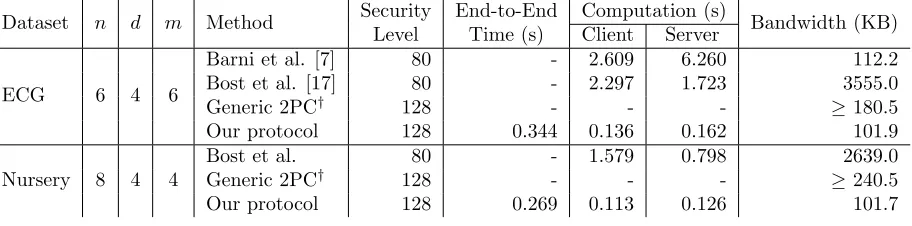
We conduct all experiments at a 128-bit security level. For our implementation of exponential ElGamal, we use the 256-bit elliptic curve numsp256d1. We instantiate the OT scheme at the 128-bit security level using the parameters in [4]. For our first set of benchmarks, we compare our performance against the protocols in [17, 7] on the ECG classification tree from [7] and the Nursery dataset from the UCI Machine Learning Repository [6]. Since the decision tree used in [17] for the Nursery dataset is not precisely specified, we test our protocol against a tree with the same depth and number of comparison nodes as in [17]. In our benchmarks we measure the computation and total communication between the client and the server. We also perform some heuristic analysis to estimate the communication needed if we were to use a generic two-party secure computation protocol based on Yao’s garbled circuits [63, 53] for private decision tree evaluation. We describe this analysis in greater detail at the end of this section.
Dataset n d m Method Security End-to-End Computation (s) Bandwidth (KB) Level Time (s) Client Server
ECG 6 4 6
Barni et al. [7] 80 - 2.609 6.260 112.2 Bost et al. [17] 80 - 2.297 1.723 3555.0
Generic 2PC† 128 - - - ≥180.5
Our protocol 128 0.344 0.136 0.162 101.9
Nursery 8 4 4
Bost et al. 80 - 1.579 0.798 2639.0
Generic 2PC† 128 - - - ≥240.5
Our protocol 128 0.269 0.113 0.126 101.7
†
Estimated bandwidth from directly applying Yao’s protocol [63, 53] for private decision tree evaluation. Note that the estimated numbers are only alower bound, since we only estimate the size of the garbled circuit, and not the OTs. See the discussion at end of Section 6 for more information on these estimates.
Table 1: Performance of protocols for semi-honest secure decision tree evaluation. The decision trees havemdecision nodes and depthd. The feature vectors aren-dimensional. The “End-to-End Time” column gives the total time for the protocol execution, as measured by the client (including network communication). Performance numbers for the Barni et al. and Bost et al. methods are taken from [17], which use a similar evaluation environment.
faster for both the client and the server, and requires slightly less communication. For these small trees, our protocols also require less communication compared to generic two-party computation protocols.
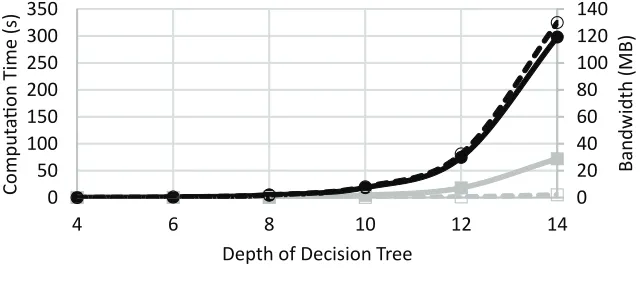
Scalability and sparsity. To understand the scalability of our protocols on large decision trees, we perform a series of experiments on synthetic decision trees with different depths and densities. We first consider complete decision trees, which serve as a “worst-case” bound on the protocol’s performance for trees of a certain depth. In our experiments, we fix the dimension of the feature space ton= 16 and the precision tot= 64. We measure both the computation time and the total communication between the client and server. Our results are shown in Figure 3. We note that even for large trees with over ten thousand decision nodes, our protocol still operates on the order of minutes.
We also compare our protocol against the private decision tree evaluation protocol of Brickell et al. [20]. Their protocol can evaluate a 1100 node tree in around 5 minutes and 25 MB of communi-cation. On a similarly sized tree over an equally large feature space, our protocol completes in 30 seconds and requires about 10 MB of communication, representing a 10x and a 2.5x improvement in computation and bandwidth, respectively.
0 20 40 60 80 100 120 140
0 50 100 150 200 250 300 350
4 6 8 10 12 14
Ba
nd
w
id
th
(M
B)
Co
m
pu
ta
ti
on
T
im
e
(s
)
Depth of Decision Tree
Client Computation Server Computation Client Upload Server Upload
Figure 3: Client and server computation (excluding network communication) and total bandwidth for semi-honest protocol on complete decision trees.
runtimes on the order of minutes. The limiting factor in this case is the exponential growth in the size of the server’s response. Even though the tree is sparse, because the decision string communicated by the server encodes information about every node in the padded tree, the amount of communication from the server to the client is mostly unchanged. The communication upstream from the client to the server, though, is significantly reduced (linear rather than exponential in the depth).
Handling malicious adversaries. Next, we consider the performance of the protocol from Fig-ure 2 that provides protection against malicious adversaries. Since this protocol does not distinguish between dummy and non-dummy nodes, the performance is independent of the number of actual decision nodes in the tree. Thus, we only consider the benchmark for complete trees. Again, we fix the dimension n = 16 and the precision t = 64. The results are shown in Figure 5. Here, the client’s computation grows linearly in the depth of the tree, and thus, is virtually constant in these experiments. In all experiments in Figure 5, the total client-side computation is under half a second. Moreover, the amount of communication from the client to the server depends only on n, t, and is independent of the size of the model. Thus, the client’s computation is very small. This means that the protocol is suitable for scenarios where the client’s computational power is limited. The trade-off is that the server now performs more work. Nonetheless, even for trees of depth 12 (with more than 4000 decision nodes), the protocol completes in a few minutes. It is also worth noting that this protocol is almost non-interactive (i.e., the client does not have to remain online during the server’s computation).
0 20 40 60 80 100 120 140 160
0 20 40 60 80 100 120
10 12 14 16 18 20
Ba
nd
w
id
th
(M
B)
Co
m
pu
ta
ti
on
T
im
e
(s
)
Depth of Decision Tree
Client Computation Server Computation
Client Upload Server Upload
Figure 4: Client and server computation (excluding network communication) and total bandwidth for semi-honest protocol on “sparse” trees.
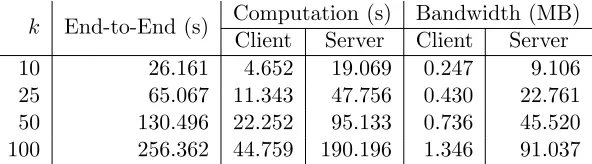
k End-to-End (s) Computation (s) Bandwidth (MB) Client Server Client Server
10 26.161 4.652 19.069 0.247 9.106
25 65.067 11.343 47.756 0.430 22.761
50 130.496 22.252 95.133 0.736 45.520
100 256.362 44.759 190.196 1.346 91.037
Table 2: Semi-honest random forest evaluation benchmarks. Each forest consists of k trees (each tree has depth at most 10 and exactly 100 comparisons). The “End-to-End” measurements include the time for network communication.
than that of [17] in total computation time and requires 3.5x less communication. Thus, even the protocol secure against malicious adversaries is practical, and for the reasons mentioned above (low client overhead and only two rounds of interaction), might, in some cases, be more suitable than the semi-honest secure protocol.
0 20 40 60 80 100 120 140
0 50 100 150 200 250 300 350
4 6 8 10 12
Ba
nd
w
id
th
(M
B)
Co
m
pu
ta
ti
on
T
im
e
(s
)
Depth of Decision Tree
Client Computation Server Computation Client Upload Server Upload
Figure 5: Client and server computation (excluding network communication) and total bandwidth for one-sided secure protocol for decision tree evaluation.
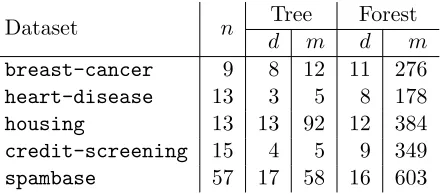
Dataset n Tree Forest
d m d m
breast-cancer 9 8 12 11 276
heart-disease 13 3 5 8 178
housing 13 13 92 12 384
credit-screening 15 4 5 9 349
spambase 57 17 58 16 603
Table 3: Parameters for decision trees and random forests trained on UCI datasets [6]: n is the dimension of the data,m is the number of decision nodes in the model,dis the depth of the tree(s) in the model.
Performance on real datasets. We conclude our analysis by describing experiments on decision trees and random forests trained on real datasets. We benchmark our protocol on five datasets from the UCI repository [6] spanning application domains such as breast cancer diagnosis and credit rating classification. We train our trees using standard Matlab tools (classregtree and
TreeBagger). To obtain more robust models, we introduce a hyperparameter α≥1 that specifies the minimum number of training examples that must be associated with each leaf node in the tree. We choose α by running 10-fold cross validation [43] for several candidate values of α. In most cases,α >1, which has an added benefit of reducing the depth of the resulting model. Additionally, for two of the datasets (housingandspambase), we choose the best value forαsuch that the depth of the resulting trees and forests is within 20. The size and depth of the resulting trees and forests, along with the dimension of the feature space for each of the datasets is given in Table 3.
Of the five datasets we use for the benchmarks, four are binary classification tasks. The excep-tion is thehousingdataset which is a regression problem. Theheart-diseaseandcredit-screening
Dataset Total Bandwidth (KB) Time (s) Upload Download
breast-cancer 0.545 73.7 132.0
heart-disease 0.370 73.3 43.9
housing 4.081 115.7 1795.2
credit-screening 0.551 49.9 45.0
spambase 16.595 463.4 17363.3
Table 4: Performance (with network communication) of semi-honest decision tree evaluation pro-tocol on UCI datasets.
Dataset Total Bandwidth (KB) Time (s) Upload Download
breast-cancer 9.671 106.7 4853.1
heart-disease 4.691 94.9 1758.2
housing 15.152 152.2 8357.4
credit-screening 8.737 92.9 3456.5
spambase 93.276 531.6 89310.7
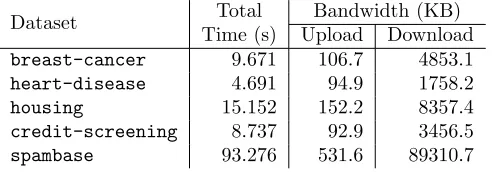
Table 5: Performance (with network communication) of semi-honest random forest evaluation protocol on UCI datasets [6].
at a 128-bit security level, and use 64 bits of precision to represent each component of the feature vector. For the random forest experiments, we train a random forest consisting of 10 decision trees, again choosing α via 10-fold cross-validation. The performance of the semi-honest decision tree evaluation protocol on each of the five datasets is summarized in Table 4 and the performance of the semi-honest random forest evaluation protocol is summarized in Table 5. We remark that while our random forest extension only applies to affine aggregation functions which are suitable for regression problems and not classification problems in general, our classification examples are all examples of binary classification, in which case, taking the mean response is appropriate.
The performance benchmarks demonstrate that our semi-honest secure protocols are suitable for evaluating trees and forests that could arise in practice. Even for relatively deep trees over high-dimensional features spaces such as the spam classification (spambase) dataset, our semi-honest protocol completes in under 20 seconds. In all cases, the client’s computation time in the semi-honest setting is under a second. For all but the largest tree (spambase), the total bandwidth is under 2 MB. For smaller trees, the bandwidth is usually on the order of 100-200 KB. With random forest evaluation, both the client and server have to perform additional computation and there is more data exchanged. Nonetheless, the amount of computation required from the client is on the order of a few seconds, and the server’s computation is also on the order of seconds (except in the case of spambase where the computation took over a minute). Excludingspambase, the total amount of communication is small.
Because we did not implement the extension to categorical variables for the protocol robust against malicious adversaries, we do not have complete benchmarks for all five datasets. We do have concrete results for the housing and breast-cancer datasets. On the breast-cancer
communication (client computation of just 0.263 s) and 8.2 MB of total communication. For the
housing dataset, the decision tree evaluation completes in 357.0 s (client computation of 0.384 s) and 256 MB of communication. These results indicate that for low-depth trees (d < 10), the protocol in Figure 2 remains viable, but the amount of communication does grow rapidly in the depth of the tree.
Comparison to generic methods. Private decision tree evaluation falls under the general umbrella of secure two-party computation. While secure two-party computation protocols based on Yao’s garbled circuits [63, 53] have seen numerous optimizations in the last several years [50, 51, 9, 64], a key limitation of these protocols has been bandwidth. We now describe a simple protocol for private decision tree evaluation based on garbled circuits. In typical two-party computation protocols, the function that is being evaluated is assumed to be public. In our setting, however, we want to hide the structure of the decision tree from the client. Thus, we instead securely evaluate a general decision tree evaluation circuit, which takes as input a description of a decision tree T
(from the server) and a feature vector x (from the client), and outputs T(x). This approach can be viewed as securely evaluating a universal circuit for decision trees of up to depthd.
To compare our protocols to a generic protocol, we provide an estimate on the size of the decision tree evaluation circuit. In the actual protocol execution, the server would send the client a garbled version of this circuit together with the encodings of its input (the description of the decision tree). The client then OTs for the encodings of its input wires (its feature vector), and evaluates the circuit to learn the output. Because the decision tree evaluation circuit must support evaluation of arbitrary trees of depthd, its size is lower bounded by the size of the circuit needed to evaluate on a worst-case input (a complete decision tree of depth d). Using the state-of-the-art free-XOR [51] and half-gate [64] optimizations for garbled circuits, the communicate required to securely evaluate a garbled circuit depends only on the number of AND gates.
The circuit needed to evaluate a tree with depth dmust perform 2d−1 comparisons between two t-bit values. Moreover, each comparison requires indexing into a feature vector of dimension n (to select the value to be compared). Using the optimized comparison circuit from [50, §3.2], comparing twot-bit integers can be performed using a circuit with exactlytAND gates. Using the multiplexer circuits from [50,§C], selecting at-bit value from a vector containingnsucht-bit values can be done using a circuit with (n−1)·t AND gates. Thus, each comparison can be computed with a circuit containingt+ (n−1)·t=n·tgates. Evaluating all of the comparisons in a complete tree of depth drequires a circuit with at least (2d−1)·n·t AND gates. Finally, computing the output requires selecting one of 2dpossible output values. If each output value has`-bits and using the same multiplexer circuit as above, this step requires another (2d−1)·` AND gates. These components give a conservativelower boundof (2d−1)(nt+`) on the number of AND gates in the circuit needed to generically evaluate a complete decision tree of depthd.
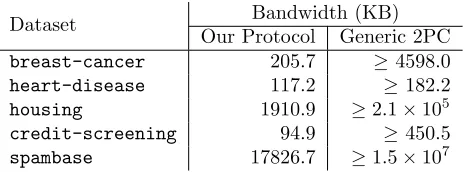
Using the half-gates optimization [64], each garbled AND gate requires sending a table that contains exactly two rows, each λ bits long (where λ is the security parameter). At a 128-bit security level, this means the size of a garbled circuit containingN AND gates is 32N bytes. Note that the size of the garbled circuit provides only a lower bound on the total required communication in Yao’s protocol. We neglect the interaction between the client and the server for the OTs. We compare the communication required in our protocol with our estimates in Table 6 (with the conservative estimate `= 1).
com-Dataset Bandwidth (KB) Our Protocol Generic 2PC
breast-cancer 205.7 ≥4598.0
heart-disease 117.2 ≥182.2
housing 1910.9 ≥2.1×10⁵
credit-screening 94.9 ≥450.5
spambase 17826.7 ≥1.5×10⁷
Table 6: Bandwidth comparison between our proposed semi-honest protocol and estimated band-width using a generic two-party computation protocol on trees trained from UCI datasets.
pared to our estimates for the bandwidth required by a generic Yao-based approach. This is because in order to hide the structure of the tree, the generic approach necessarily incurs the worst-case performance. As a result, the communication grows much more rapidly in the depth of the tree, and quickly becomes infeasible. However, the generic solution does not reveal the number of internal comparison nodes in the tree, while our semi-honest protocol does. It is worth noting that even for complete decision trees, the bandwidth requirements of our protocol is still less than that required by the generic solution.
In recent years, other generic two-party computation frameworks have been introduced that combine Yao’s protocol with methods such as homomorphic encryption or secret sharing tech-niques [12, 30]. Like Yao’s protocol, these generic tools can be leveraged for private decision tree evaluation. However, as our above analysis shows, even for shallow decision trees, a generic circuit for private decision tree evaluation is large and deep (due to the numerous comparison and multi-plexing operations). Thus, direct application of these methods would likely lead to protocols with higher bandwidth or require additional rounds of interaction.
7
Related Work
The earliest work for private decision tree evaluation focused on training decision trees in a privacy-preserving manner [3, 52, 31]. In the case of [52, 31] multiple parties each have their own individual datasets, and the objective is to compute a decision tree on their joint data without revealing their individual datasets.
achieves stronger security.
On the theoretical side, private decision tree evaluation falls into the category of private function evaluation (where we view the decision tree as the underlyingprivatefunction to be evaluated). In the last few years, several generic approaches for private function evaluation have been proposed [47, 55] which are asymptotically very efficient and can be made robust against malicious adversaries. Restricting to private decision tree evaluation, Mohassel et al. describe a protocol for evaluating oblivious decision programs based on OT in [54]. They provide an abstract method for evaluating decision programs in both the semi-honest and malicious setting. However, it is unclear how to integrate comparisons efficiently into their protocol, which would be necessary for evaluating the particular kind of decision trees considered in this work. While the protocols of [47, 55, 54] apply to our setting, we are not aware of any existing implementations of these methods.
8
Conclusion
In this work, we presented two protocols for privately evaluating decision trees and random forests. The first protocol based on additive homomorphic encryption and oblivious transfer is secure against semi-honest adversaries. Then, using a novel conditional OT protocol, we showed how to modify the protocol to obtain security against malicious adversaries. We implemented both protocols and evaluated their performance on decision trees trained on several real-world datasets. Our experiments demonstrate that our protocol is more efficient in terms of both computation and communication compared to existing protocols [7, 17]. A basic back-of-the-envelope calculation shows that our protocols are much more efficient in terms of communication compared to a generic solution based on garbled circuits.
We leave as an open problem that of designing a private decision tree evaluation protocol whose overall complexity issubexponential in the depth of the tree (i.e., a protocol whose performance is not worst-case bounded). Another interesting direction is to explore how to efficiently update the decision tree (or random forest) in a privacy-preserving manner.
Acknowledgments
We thank Melissa Chase, Seny Kamara, and Payman Mohassel for many helpful comments and discussions on this work. The first author is supported in part by an NSF Graduate Research Fellowship under grant number DGE-114747 and an Amazon AWS in Education Grant.
References
[1] BigML. https://bigml.com/.
[2] Microsoft Azure Machine Learning. https://azure.microsoft.com/en-us/services/ machine-learning.
[3] R. Agrawal and R. Srikant. Privacy-preserving data mining. SIGMOD Rec., 29(2), 2000.