Identity-based key encapsulation with semantically
secure Searchable Public-Key encryption
JOSE JAMES& NEETHU FRANCIS
PG Scholar Dept. of CSE,
K.M.P College of Engineering Odakkali, Kerala, India.
Mail Id: - [email protected]
Assistant Professor Dept. of CSE,
K.M.P College of Engineering Odakkali, Kerala,
India. Mail Id: - [email protected]
Abstract
Presently security problems over internet
increases day by day .Existing system gets
search time large with the whole number of
ciphertexts. That makes recovery from broad
database unreasonable. To improve this
problem, this paper propose searchable public
key cipher texts with unseen structure for
keyword explore as fast as feasible lacking
sacrificing semantic security of the encrypted
keywords. In SPCHS, every one keyword
searchable ciphertext are planned by unseen
relative, and with the search trapdoor
subsequent to a keyword, the smallest amount
in sequence of the relations is relate to a look
for algorithm as the supervision to discover all
corresponding ciphertext capably. We build a
SPCHS idea from scrape in which the
ciphertext contain a concealed star like
structure. We demonstrate our system to be
semantically secure in the Random Oracle
(RO) model. The search complexity of the
proposed scheme depended upon the actual no
of cipher text rather than the no of all
ciphertext. Lastly we present a generic SPCHS
construction from unidentified identity based
encryption and clash free full identity
malleable identity based key encapsulation
mechanism with anonymity.
Keywords:Searchable Public-Key, Public-key
searchable encryption, semantic security,
identity-based key encapsulation mechanism,
identity based encryption
.
1.
Introduction
Public-Key encryption with keyword
search(PEKS),are described by Boneh et al. in
[1],the benefit of PEKS is that the anybody
can know the public key of receiver and it can
upload a searchable ciphertexts to the server.
The receiver can hand over the searchable
keyword to the server. Generally, every sender
individually encrypts a file and its extracted
ciphertexts to a server; when the receiver
requests to regain the files containing exact
keyword, he delegates a keyword look for
trapdoor to the server. After that server finds
the encrypted files containing the queried
keyword without knowing the original files or
the keyword itself, and returns the
corresponding encrypted files to the receiver.
Finally, the receiver decrypts these encrypted
files. Objective is to go and protect data, when
data is process and becomes information, so
data is to be protected and should not be
corrupted.Data manipulation is done by the
cloud application level security. i.e.
application need to go and protect data, the
data manipulation by application. [5] The
authors of PEKS also introduced semantic
security against choosen keyword attacks
(SSCKA) in the sense that the server cannot
distinguish the ciphertexts of the keywords of
its pick before observe the equivalent keyword
search trapdoors. It seems a suitable security
concept, particularly if the keywordspace has
no high min-entropy. Existing semantically
secure PEKS scheme take search time least
with the total numberof all ciphertexts. This
makes salvage from large-scale databases
excessive. Therefore, more efficient search
performance is important for basically
deploying PEKS schemes. One of important
work speed up search over encrypted
keywords in public key setting deterministic
encryption introduced by the Bellare et al. [2].
An encryption system is the deterministic if
encryption algorithm is deterministic. Bellare
et al.[2] focus on the enabling search over
encrypted keyword to the efficient as search
for the unencrypted keyword, such a cipher
text containing given keyword can retrieve in
the time complexity logarithmic in total
number of cipher texts. The reasonable
because encrypted keywords from tree like
structure according to the binary values stored.
Deterministic encryption has two inherent
limitations. First, keyword privacy can
guaranteed for keywords are a priori hard to
guess by the adversary. Second,certain
information of the message leaks inevitably
via ciphertext of the keywords since
encryption is deterministic.Hencedeterministic
encryption is applicable in special
scenarios.Nowadays many sectors are work
with cloud technology, as shown in Fig.1
Finance, Telecom, Utilities, Media
andentertainment, Retail and Public sectors
such different industries in different sectors
are work together on multiple natureof cloud
platform. Cloud service provider (CSPs), who
provide infrastructure to their customer.
Customer don’t want to scan their database
even by CSPs for advertisement of or any
other technical reason. [1]
We are concerned to provide that highly
well-organized search routine with no sacrificing
semantic safety in PEKS.We use unseen
star-like arrangement produced by keyword
searchable ciphertexts. A keyword space is
typically of no high min entropy in many
scenarios. Semantic security is important to
agreement of keyword privacy in such
applications. Thus the linear search
complication of existing scheme is the most
important difficulty to their acceptance.
Regrettably, the linear complication seems to
be to be expected because the server has to
search and check each ciphertext, due to the
information that these ciphertexts are
indistinguishable to the server. A earlier look
shows that there is at rest space to develop
explore presentation in PEKS with no sacrifice
semantic safety if one cancategorize the
ciphertexts with gracefully planned but
unknown associations.
Intuitively, if the keyword searchable
ciphertexts have an unknown star-like
arrangement. Then search over ciphertexts
containing particular keywords may be
accelerated. Exclusively, assume all
ciphertexts of the similarkeyword form a chain
by the connected unknown relations, and also
an unknown relation exists from a public top
to the first ciphertext of every chain. With a
keyword look for trapdoor and the top, the
server seeks out the first corresponding
ciphertext via the equivalent relation from the
top. Then a different relation can be disclosed
via the establish ciphertext and guides the for
ager to search for out the next corresponding
ciphertext. By moving on in this way, all
identical ciphertexts can be established.
Clearly, the search time depends on the
definite quantity of theciphertexts contain the
query keyword, relatively than on the total
number of all ciphertexts. To assurance
suitablesafety, the secreted star-like structure
should protect the semantic security of
keywords, which indicate that limited relations
are disclosing only when the equivalent
keyword search trapdoor is recognized. Each
sender should be able to produce the keyword
-searchable ciphertext with the unseen
star-like arrangement by the receiver’s public-key;
the server have a keyword seek out trapdoor
should be able to release partial relations,
which is interrelated to all similarciphertexts.
2.
Related Work
In the earlier year discover on encrypted data
has been widely investigated. Since a
cryptographic viewpoint, the obtainable work
is dividing into two categories. First is
Symmetric searchable encryption and second
is Public-keysearchable encryption. The
search presentation mainly depends on the
total number of the ciphertexts containing the
queried keyword. For safety, the system is
Decisional Bilinear DiffieHellman(DBDH)
assumption [3] in the RO model. The resultant
SPCHS can produce keyword-searchable
ciphertextswith an unseen star-like structure.
Furthermore, if both the essential IBKEM and
IBE have semantic safety and ambiguitythe
resultant SPCHS is semantically safe. As
present are identified IBE schemes [4], [5],
[6], [7] in both the RO model and the usual
model, an SPCHS structure is concentrated to
collision-free full-identity malleable IBKEM
among ambiguity.In 2013, Abdulla et al.
projected quite a few IBKEM scheme to
assemble Verifiable Random Functions2
(VRF)[8]. We prove that one of these IBKEM
scheme is unsigned and collision-free full
identity supple in the RO model. In[9], Frere
et al. utilize the “approximation” of
multilinker maps [10] to create a
standard-model description of Bone hand-Franklin(BF)
IBE scheme [11].We change this IBE method
into a collision-free full-identity flexible
IBKEMmethod with semantic protection and
ambiguity in the typical replica. Anonymous
identity-based broadcast encryption.A
somewhat more complex function is
unidentified identity-based broadcast
encryption with efficient decryption.
Acorresponding application was anticipated
correspondingly by Barth et al. [12] and
Liberty et al. [13] in the establishedpublic-key
location.
Carmela R., Garay J.,[14] describe a method is
“Searchable Symmetric Encryption”.
Symmetric searchableencryption is also
described as a Symmetric key encryption with
keyword search. This primal was introduced
by SongD. X., Wagner D[15].This scheme
required linear search time among the range of
the database. Goh E-J., Bellovin S.,Agrawal
R., Chang Y-C. ,Boldyreva A. they are also
follow this follow a line of investigation and
filter Song etal.’s original work. The SEKS
scheme has been verified to be semantically
secure next to an adaptive opponent. It allows
the search to be process in logarithmic time,
even though the keyword searching require
length linear with the size of the database.
According to above efforts dedicated to either
verifiable security or better search
performance .The work in the above system is
extended SEKS to the multi-sender state.
Wang Q.proposed by “Fuzzykeyword look for
over encrypted information in cloud
computing”. As make unclear Computing
become widespread,extra and extra receptive
information are creature national into the
shade. Even though usual searchable
encryption scheme permit a user to securely
search greater than encrypted data all the way
through keywords and selectively repossess
files of interest, these techniques support only
accurate keyword search. In this paper, meant
the problem of helpful fuzzy keyword search
larger than encrypted shade data whereas
maintaining keyword isolation. Fuzzy
keyword investigate seriously enhance
collection usability by frequent the identical
files whilst users’ searching inputs exactly
counterpart the predefined keywords or the
closest promising similar files based on
keyword correspondence semantics, as soon as
exact match fails.The Waters .B.R.present the
practical applications of SEKS and employs it
to understand secure andsearchable audit
logs.Chase M. proposed to a encrypt prepared
data and a secure method to search that data.
In ontop of PEKS schemes, the search
complication take time linear with the numeral
of all cipher text. during a unconscious
production of keyword search trapdoor is to
preserve the isolation of the keyword adjacent
to a inquiring trapdoor production. Kamara S.
proposed to support the dynamic update of the
encrypted data and dynamicsearchable
symmetric encryption.
Searchable symmetric encryption (SSE) allow
a client to encrypt its data in such a technique
that this statistics can unmoving be searched.
The a large amount instantaneous submission
of SSE is to shade storage, someplace it enable
aclient to securely farm out its data to an
untrusted shade bringer exclusive of sacrifice
the ability to search over it. SSE have been the
focal point of on the go examine and a huge
amount of schemes that accomplish a mixture
of levels of safety measures and efficiency
have be projected. Any useful SSE
arrangement, on the other hand, should satisfy
the subsequent property: sublinear search
time, protection alongside adaptive preferred
keyword attacks, compact guide and the
capacity to add and delete files
resourcefully.Additional improved extra
security in at the cost of the large index. Cash
D. planned by Dynamic searchable encryption
in extremely huge database. This scheme
simultaneously achieve strong security and
high efficiency.Dynamic Searchable
Symmetric Encryption (DSSE) enable a
consumer to achieve keyword query and keep
informed operation on the encrypted organizer
collections. DSSE has more than a few
important applications such as
privacy-preserving data outsourcing for computing
clouds. In this document, we residential a new
DSSE format that achieve the maximum time
alone in the middle of all compared alternative
with little in sequence escape, noninteractive
and professional updates, compressed client
storage space, low attendant storage space for
huge file keywordpair with an trouble-free
intend and accomplishment. Our method
achieve these advantageous properties withan
extremely effortless figures arrangement (i.e.,
a bit matrix supported with two static hash
explore/inform operation on it. We establish
that our method is protected and established
that it is realistic with huge number of
file-keyword pair smooth with an accomplishment
on trouble-free hardware configurations.
The similar work on PEKS, Abdulla et al. [28]
file some gaps write reliability for PEKS and
deals with the conversion among primitives
related to PEKS .some labors have also been
dedicated to make PEKS flexible. The work of
this type include conjunctive search variety
search compartment search , time-scope
search , parallel search , allowed search ,
impartiality test between mixed cipher texts ,
and fuzzy keyword search . Searchable
encryption is worn to prop up search over
encrypted data store on shade servers.
Established searchable encryption no more
than chains accurate keyword searches as a
substitute of supplementary bendable fuzzy
keyword search.To explain this dilemma, a
topical promising arche type, name fuzzy
keyword searchable encryption, has been
projected. In attendance have been some
proposal considered for fuzzy keyword
explore in the symmetric key situation,but not
a bit efficient scheme in the public key setting.
In this paper, we proposition a new primal of
interactive publickey encryption with fuzzy
keyword search (IPEFKS), which chains
proficient fuzzy keyword search greater than
encrypted figures in the public key
background. We construct and spend a
homomorphism encryption base
IPEFKSsystem. In adding together, Arriaga et
al. projected a PEKS scheme to maintain the
isolation of keyword searchtrapdoors.
A chain-like construction is describing to
velocity awake the search on encrypted
keywords. One can message that the sequence
in cannot be completely unseen to the server
and drip the reliability of the keywords. To
recognizea resourceful keyword search,
Bellaire et al. [2] introduce deterministic
public key encryption (PKE) and dignified
asecurity concept “as strong as possible”. A
deterministic searchable encryption system
allow capable keyword searchas condition the
keywords be not encrypted.Bellare et al. [2] as
well obtainable a deterministic PKE system
and a general revolution starting a randomized
PKE toward a deterministic PKE in the
random oracle model. Afterward,
deterministic PKE scheme protected in
theusual model be in parallel projected next to
Bellare et al. and Boldyreva et al.. Particularly
we think about seven thinking of isolation for
deterministic encryption, together with six
forms of semantic protection and an
indistinguishability view, and show them all
corresponding.We then current a deterministic
method for the protected encryption of
consistently and independently spread
trapdoor in one direction permutation. The
earlier uses common convolutionassumption
and the structure are common, while the final
exploit substantial complexity guess and have
enhancedefficiency. Brakerski et al. projected
the deterministic PKE scheme by way of
enhanced security, even thoughthese schemes
are at a halt not semantically secure. So far,
deterministic PEKS schemes can agreement
semanticsecurity simply condition the
keyword freedom has a soaring min-entropy.
If not, an opposition can extort the encrypted
keyword as a result of a straightforward
encrypt-and-test bother. Therefore,
deterministic PEKS schemes are relevant to
application somewhere the keyword space is
of a high min-entropy.
3.
Implementation
A Problem statement:
From above related work we have addressed
following problems in existing system:
Existing semantically secure
public-key searchable encryption schemes
take search time linear with the total
number of the ciphertexts.
Makes retrieval from large scale
databases prohibitive.
The local privacy only contains the
relationship of the new generated
cipher texts.
Deterministic encryption is only
applicable in special scenario.
B] Proposed System as a solution for
existing system:
In our proposed system we provide more
security as well as we search keyword in a
specified file not overalldatabase that make a
minimization of time and search keyword as
fast as possible without sacrificing semantic
security.Build a generic SPCHS construction
with Identity-Based Encryption (IBE) and
collision-free full-identity malleableIBKEM.
C] Our Work:
We initiate by officially defining the idea of
Searchable Public-key Ciphertexts with secret
Structures and its semantic security. In this
new conception, keyword searchable
ciphertexts with their unknown structures can
begenerated in the public key location; with a
keyword look for trapdoor, incomplete
associations can be disclosed toshow the
innovation of all corresponding ciphertexts.
Semantic security is definite for both the
keywords and theunknown structures. It’s
worth noting that this new perception and its
semantic safety are appropriate for keyword
searchableciphertexts with any kind of
unknown structures. In difference, the idea of
conventional PEKS does notinclude any
unseen structure between the PEKS
ciphertexts; likewise, its semantic safety is
only defined for thekeywords.We build a
straightforward SPCHS from scrape in the
generateskeyword-searchable ciphertexts with
a secret star-like structure. The search
presentation mostly depens on the realnumber
of the ciphertexts contain the query keyword.
For safety, the system is established
semantically safe based onthe Decisional
Bilinear Diffie- Hellman (DBDH) hypothesis
in the RO model. We are also paying attention
inprovided that a standard SPCHS building to
produce keyword-searchable ciphertexts with
a secret star-likeconstruction. Our standard
SPCHS is stimulated by several exciting
explanation on Identity-Based Key
EncapsulationMechanism (IBKEM). In
IBKEM, a sender encapsulates a key K to an
intentional receiver ID. Of course, receiver
IDcan encapsulate and achieve K, and the
sender know that receiver ID will achieve K.
conversely, a non-intendedreceiver ID0 may
also try to encapsulate and achieve K0. We
examine that, (1) it is typically the case that K
and K0 areself-determining of every other
from the view of the receivers, and (2) in some
IBKEM the sender may also know K0obtained
by receiver ID0. We refer to the former goods
as conflict freeness and to the latter as
full-identity malleability.An IBKEM scheme is
said to be collision-free full-identity
impressionable if it possesses both properties.
We build ageneric SPCHS construction with
Identity-Based Encryption and collision-free
full-identity malleable IBKEM.
FIGURE 1: BLOCK DIAGRAM
Above diagram contains four models
1] Data Owner.
2] Data Server.
3] End User
4] Verifier.
1] Data Owner: =Data Owner firstly login and
then it upload a file into the data server. Then
that files are successfullystored by the data
server. Ituploads the files with searchable
keyword.
2] Data Server: =Data server is stored server
files. Dataserver also detects the attacker and
attacker’s entry will be storedby the data
server in the database. All transactions record
is also stored by the data server. Dataserver
gives the secretkey to the end user. It also
gives the file to the end user for download.
3] End User: =End user firstly login after that
it will be send the cipher text to the data
server. After that data serverpasses a public
key. Then end user will be giving the file
present in the data serverwith respected
keyword then and then only that file are
download otherwise not. It gives file with their
ratio and delay.
4] Verifier: =Verifier is to check the entry of
the both data owner and end user. If the entry
are present in thedatabase then and then only
data owner and end user are login successfully
otherwise it rejected by the verifier.
4. Experimental Work
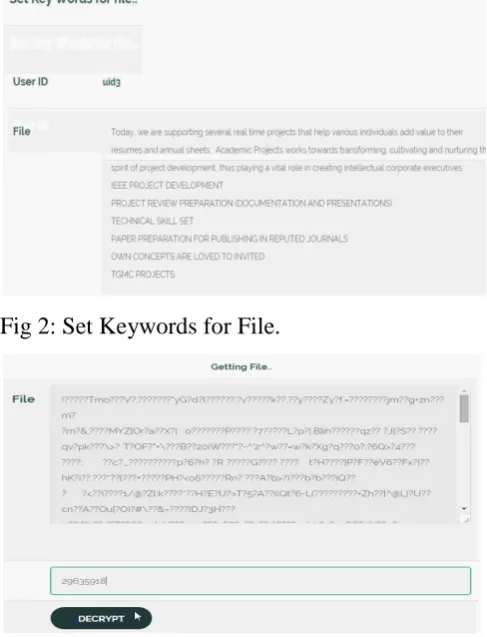
Fig 2: Set Keywords for File.
Fig 3: File in Encrypted Format.
Fig 4: Graph Evolution of System.
5. Conclusion
We investigated fast keyword search in PEKS
with semantic security. Proposed the concept
of SPCHS as analternate of PEKS. The new
concept allows keyword searchable cipher text
generated with the hidden structure. Given
keyword search trapdoor, search algorithm of
SPCHS can disclose part of the hidden
structure for guidance on finding out the
cipher text of the queried keyword. Semantic
security of SPCHS captures privacy of the
keyword and invisibility of the hidden
structures. The scheme generated keywords
searchable cipher texts with the hidden star
likestructure.The identified several interesting
properties that is collision freeness and full
identity malleability in someIBKEM instances
and formalized this properties to build a
generic SPCHS construction. Applications
may be achieveretrieval completeness
verification which is the preeminent our
comprehension and not been achieved in
existing PEKSschemes. Another application
the content search and similarfunctionality
realize by the symmetric searchable keyword
encryption. Such kind of content searchable
encryption isuseful the practice for e.g. Filter
the encrypted spasm. The hidden tree like
structure between the sequentially encrypted
words in the file. Obtain public key searchable
encryption allowing content a search.
6. References
[1] Boneh D., Crescenzo G. D., Ostrovsky R.,
Persiano G.: Public Key Encryption with
Keyword Search. In: Cachin C., Camenisch J.
(eds.) EUROCRYPT2004. LNCS, vol. 3027,
pp. 506-522. Springer, Heidelberg (2004)
[2] Bellare M., Boldyreva A., O’Neill A.:
Deterministic and Efficiently Searchable
Encryption. In: Menezes A. (ed.) CRYPTO
2007. LNCS, vol. 4622, pp.535-552. Springer,
Heidelberg (2007)
[3] Boneh D., Boyen X.: Efficient
Selective-ID Secure Identity-Based Encryption without
Random Oracles. In: Caching C., Camelish J.
(eds.) EUROCRYPT2004. LNCS, vol. 3027,
pp. 223-238. Springer, Heidelberg (2004)
[4] Boyne X., Waters B. R.: Anonymous
Hierarchical Identity-Based Encryption
(Without Random Oracles). In: Work C. (ed.)
CRYPTO 2006. LNCS, vol.4117, pp.
290-307. Springer, Heidelberg (2006)
[5] Gentry C.: Practical Identity-Based
Encryptionwithout Random Oracles. In:
Vaudenay S. (ed.) EUROCRYPT 2006.
LNCS, vol. 4004,pp.445-464.Springer,
Heidelberg (2006)
[6] Ateniese G., Gasti P.: Universally
Anonymous IBE Based on the Quadratic
Residuosity Assumption. In: Fischlin M. (ed.)
CT-RSA 2009. LNCS, vol. 5473,pp. 32-47.
Springer, Heidelberg (2009)
[7] Ducas L.: Anonymity from Asymmetry:
New Constructions for Anonymous HIBE. In:
Pieprzyk J. ed.) CT-RSA 2010. LNCS, vol.
5985, pp. 148-164.Springer, Heidelberg
(2010)
[8] Abdalla M., Catalano D., Fiore D.:
Verifiable Random Functions: Relations to
Identity-Based Key Encapsulation and New
Constructions. Journal ofCryptology, 27(3),
pp. 544-593 (2013)
[9] Freire E.S.V., Hofheinz D., Paterson K.G.,
Striecks C.: Programmable Hash Functions in
the Multilinear Setting. In: Canetti R., Garay
J.A. (eds.) Advancesin Cryptology - CRYPTO
2013. LNCS, vol. 8042,pp. 513-530. Springer,
Heidelberg (2013)
[10] Garg S., Gentry C., Halevi S.: Candidate
Multilinear Maps from Ideal Lattices. In:
Johansson T., Nguyen P. (eds.) Advances in
CryptologyEUROCRYPT2013. LNCS, vol.
7881, pp. 1-17. Springer,Heidelberg (2013)
[11] Boneh D., Franklin M.: Identity-Based
Encryption from the Weil Pairing. In: Kilian J.
(ed.) CRYPTO 2001. LNCS, vol. 2139, pp.
[12] Barth A., Boneh D., Waters B.: Privacy in
Encrypted Content Distribution Using Private
Broadcast Encryption. In: Di Crescenzo G.,
Rubin A.(eds.) FC2006. LNCS, vol. 4107, pp.
52-64. Springer, Heidelberg (2006)
[13] LIBERT B., PATERSON K. G.,
QUAGLIA E. A.: ANONYMOUS
BROADCAST ENCRYPTION: ADAPTIVE
SECURITY AND EFFICIENT
CONSTRUCTIONS IN THESTANDARD
MODEL. IN: FISCHLIN M., BUCHMANN
J., MANULIS M. (EDS.) PKC 2012. LNCS,
VOL. 7293, PP. 206-224. SPRINGER,