Simulation-based Receiver Selective Opening CCA Secure PKE
from Standard Computational Assumptions
⋆Keisuke Hara1,2, Fuyuki Kitagawa1,2, Takahiro Matsuda2, Goichiro Hanaoka2, and Keisuke Tanaka1 1
Tokyo Institute of Technology, Tokyo, Japan
[email protected], {kitagaw1,keisuke}@is.titech.ac.jp 2
National Institute of Advanced Industrial Science and Technology (AIST), Tokyo, Japan {t-matsuda,hanaoka-goichiro}@aist.go.jp
Abstract. In the situation where there are one sender and multiple receivers, a receiver selective opening (RSO) attack for a public key encryption (PKE) scheme considers adversaries that can corrupt some of the receivers and get their secret keys and plaintexts. Security against RSO attacks for a PKE scheme ensures confidential-ity of ciphertexts of uncorrupted receivers. Simulation-based RSO securconfidential-ity against chosen ciphertext attacks (SIM-RSO-CCA) is the strongest security notion in all RSO attack scenarios. Jia, Lu, and Li (INDOCRYPT 2016) proposed the first SIM-RSO-CCA secure PKE scheme. However, their scheme used indistinguishablil-ity obfuscation, which is not known to be constructed from any standard computational assumption. In this paper, we give two contributions for constructing SIM-RSO-CCA secure PKE from standard computational assumptions. Firstly, we propose a generic construction of SIM-RSO-CCA secure PKE using an IND-CPA secure PKE scheme and a non-interactive zero-knowledge proof system satisfying one-time simulation sound-ness. Secondly, we propose an efficient and concrete construction of SIM-RSO-CCA secure PKE based on the decisional Diffie-Hellman (DDH) assumption. Moreover, we give a method for efficiently expanding the plaintext space of the DDH-based construction. By applying this method to the construction, we obtain the first DDH-based SIM-RSO-CCA secure PKE scheme supporting a super-polynomially large plaintext space with compact ciphertexts.
Keywords: public key encryption, receiver selective opening security, chosen ciphertext security.
⋆
Table of Contents
1 Introduction . . . 3
1.1 Background and Motivation . . . 3
1.2 Our Contributions. . . 3
1.3 Technical Overview . . . 4
1.4 Related work. . . 7
1.5 Organization . . . 8
2 Preliminaries . . . 8
2.1 Notations. . . 8
2.2 Public Key Encryption. . . 8
2.3 Non-interactive Zero-knowledge Proof System . . . 9
2.4 “+1”-Decisional Diffie-Hellman (DDH) Assumption. . . 10
2.5 Universal Hash Family and Leftover Hash Lemma . . . 11
2.6 Collision-resistant Hash Function. . . 11
3 CCA Security for Receiver Non-commiting Encryption. . . 11
3.1 Receiver Non-commiting Encryption. . . 11
3.2 RNC-CCA Secure RNCE Implies SIM-RSO-CCA Secure PKE . . . 12
4 Generic Construction of RNC-CCA Secure RNCE. . . 15
4.1 Description . . . 15
4.2 Security Proof. . . 16
5 DDH-based Construction of RNC-CCA Secure RNCE . . . 19
5.1 Description of the Basic Construction . . . 20
5.2 Security Proof for the Basic Construction. . . 21
5.3 Description of the Main Construction . . . 26
5.4 Security Proof for the Main Construction . . . 27
A Generic Construction of RNC-CCA Secure RNCE with a Multi-bit Plaintext Space . . . 35
1 Introduction
1.1 Background and Motivation
In the context of public key encryption (PKE), the generally accepted security notions are IND-CPA and IND-CCA security [10,12]. However, Bellare, Hofheinz, and Yilek [4] pointed out that IND-CPA and IND-CCA security might not be strong enough when considering Selective Opening (SO)attacks in a multi-user scenario. Intuitively, SO attacks consider the corruptions of some fraction of users and the extortions of their secret information. Motivated by the above problem, they firstly introduced SO security for PKE. Even if an adversary can mount SO attacks, SO security can guarantee confidentiality of ciphertexts of uncorrupted users. In practice, considering secret communication among many users, we should take account of information leakage from some users. Therefore, SO security is an important security notion for PKE in practice. To date, two settings have been considered for SO security:Sender Selective Opening (SSO) security[4,5] andReceiver Selective Opening (RSO) security[3,17]. The main focus in this paper is on RSO security. In the situation where one sender and multiple receivers exist, RSO security guarantees confidentiality of uncorrupted ciphertexts even if an adversary can corrupt some fraction of receivers and get their plaintexts and secret keys. SO security is defined in both the chosen plaintext attack (CPA) and the chosen ciphertext attack (CCA) settings. In general, we should take active adversaries into account, and thus the CCA security is more desirable than the CPA security.
Furthermore, there are two types of definitions for SO security: indistinguishability-based SO secu-rity and simulation-based SO secusecu-rity. The definition of indistinguishability-based SO secusecu-rity usually has a restriction on a plaintext distribution that an adversary can choose. More specifically, the definition of indistinguishability-based SO security usually requires the plaintext distribution to satisfy a notion calledefficient resamplability[4]. Intuitively, efficient resamplability requires a plaintext distribution to be such that even if some plaintexts are fixed, the other plaintexts can be efficiently sampled. This re-quirement is somewhat artificial and limits application scenarios since plaintext distributions appearing in practice do not necessarily satisfy this requirement.
On the other hand, simulation-based SO security does not have such a restriction on the plaintext dis-tribution. This security requires that the output of any adversary that is given the public keys, ciphertexts, and plaintexts and secret information of corrupted users, can be simulated by a simulator which only takes the corrupted plaintexts as its input. The secret information corresponds to randomnesses (used in encryptions) of the senders in the SSO setting and secret keys of the receivers in the RSO setting, respec-tively. Compared to indistinguishability-based SO security, simulation-based SO security can guarantee security even if an adversary chooses an arbitrary plaintext distribution. Since there is no restriction on the plaintext distributions, we can say that simulation-based SO security is preferable to indistinguishability-based SO security considering the utilization of PKE. Also, the previous works [3,17] showed that simulation-based SO security is stronger than indistinguishability-based SO security in the CPA setting. It seems that this implication also holds in the CCA setting.
From the above arguments, we aim to achieve simulation-based RSO security against chosen cipher-text attacks which we call CCA security for PKE. So far, the only construction of SIM-RSO-CCA secure PKE is of Jia, Lu, and Li [19], but their construction is based on a very strong cryptographic primitive, indistinguishability obfuscation (iO) [2,11].1 This primitive is not known to be constructed from standard computational assumptions. Hence, in this paper, we tackle the following question: Is it possible to construct a SIM-RSO-CCA secure PKE scheme from standard computational assumptions?
1.2 Our Contributions
Based on the above motivation, we give affirmative answers to the question. More specifically, our tech-nical results consist of the following three parts.
1
SIM-RSO-CCA security derived from RNC-CCA security. As our first technical result, we introduce a new security notion that we callRNC-CCA securityfor receiver non-committing encryption (RNCE) [6, Section 4], which is a variant of PKE with a special non-committing property. Then, we show that RNC-CCA secure RNCE implies SIM-RSO-CCA secure PKE. When considering SIM-RSO-CCA se-curity for PKE, we must take into account information of multiple users, a simulator, and an adver-sary. Thus, if we try to prove SIM-RSO-CCA security directly from standard computational assump-tions, security proofs could become very complex. On the other hand, the merit of considering RNCE with our new security notion is that the definition of RNC-CCA security involves only a single user, a single adversary, and no simulator. Hence, we can potentially avoid a complex security proof when proving RNC-CCA security from standard computational assumptions. We believe that this result gives us a guideline for constructing a new SIM-RSO-CCA secure PKE scheme, and in fact, our proposed SIM-RSO-CCA secure PKE schemes are obtained via this result, as explained below.
A generic construction of RNC-CCA secure RNCE. As our second technical result, we show a generic construction of RNC-CCA secure RNCE using an IND-CPA secure PKE scheme and a non-interactive zero-knowledge (NIZK) proof system satisfying one-time simulation soundness. (In the following, we call this primitive an OTSS-NIZK for simplicity.) This primitive is slightly stronger than an ordinary NIZK proof system. However, the constructions of this primitive based on various standard assumptions are known [13,14,22]. Therefore, our second technical result shows that we can construct RNC-CCA secure RNCE schemes from various standard assumptions through our generic construction.
An efficient and concrete construction of RNC-CCA secure RNCE. Although our generic construction of RNC-CCA secure RNCE can be instantiated based on standard computational assumptions, we require an NIZK proof system as a building block. In general, NIZK proof systems are not very efficient, and thus the above construction does not necessarily lead to an efficient construction. Thus, as our third tech-nical result, we show an efficient and concrete construction of RNC-CCA secure RNCE based on the decisional Diffie-Hellman (DDH) assumption. This scheme is a variant of the Cramer-Shoup encryption scheme [7], and thus we do not need general NIZK proof systems. Moreover, we give a method for effi-ciently expanding the plaintext space of the above construction. By applying this method to the construc-tion, we obtain the first DDH-based RNC-CCA secure RNCE scheme supporting a super-polynomially large plaintext space with compact ciphertexts.
In summary, combining our first and second technical results, we obtain the first generic construc-tion of SIM-RSO-CCA secure PKE from an IND-CPA secure PKE scheme and an OTSS-NIZK. This result enables us to construct SIM-RSO-CCA secure PKE from various standard computational assump-tions. Moreover, combining our first and third technical results, we obtain the first efficient and concrete construction of SIM-RSO-CCA secure PKE from the DDH assumption.
The difference between this paper and the conference version [16]. In the conference version of this paper [16], we gave a SIM-RSO-CCA secure PKE scheme the size of whose plaintext space is poly-nomial in a security parameter based on the DDH assumption. However, when we expand the size of its plaintext space to super-polynomial, the ciphertext overhead (the difference between the ciphertext length and the plaintext length) of the construction increases linearly as the length of a plaintext in-creases. In the following, we call this construction our “basic” construction. In this paper, based on our basic construction, we give the first DDH-based concrete construction with compact ciphertexts which supports a super-polynomially large plaintext space. Here, “compact” means that the ciphertext overhead of our construction is independent of the length of a plaintext increases. In the following, we call this construction our “main” construction. In addition to the contribution, this paper gives the full proofs of Theorems1,2, and3omitted in the conference version [16].
1.3 Technical Overview
se-curity proof. To date, there are three major techniques for constructing IND-CCA secure PKE schemes: the double encryption technique [29], the hash proof system (HPS) technique [8], and the all-but-one (ABO) technique [27,28]. Sahai and Waters [30] pointed out that the “punctured programming” paradigm is compatible with iO when constructing various cryptographic primitives, and they in particular con-structed an IND-CCA secure PKE scheme based on iO. In fact, Jia et al.’s SIM-RSO-CCA secure PKE scheme is obtained from the Sahai-Waters PKE scheme. Since the ABO technique has some similarity to the punctured programming paradigm, in retrospect, Jia et al.’s PKE scheme can be viewed as one constructed via the ABO technique.
In contrast to the Jia et al.’s strategy using the ABO technique, we take two different path of con-structing two different SIM-RSO-CCA secure PKE schemes, that is, the double encryption technique and the HPS technique, respectively. Somewhat surprisingly, our SIM-RSO-CCA secure PKE schemes only require underlying cryptographic primitives that were required to construct IND-CCA secure PKE schemes. In particular, our constructions do not need any other strong cryptographic primitive, such as iO, for achieving SIM-RSO-CCA security.
For making the above two approaches work well, we focus on the work of Hazay, Patra, and Warin-schi [17], who pointed out that RNCE [6, Section 4] is an appropriate cryptographic primitive for achiev-ing RSO security. Concretely, they showed that CPA secure RNCE implies SIM-RSO-CPA secure PKE. Inspired by their idea, we formalize a new security notion for RNCE which we call RNC-CCA secu-rity, and show that RNC-CCA secure RNCE implies SIM-RSO-CCA secure PKE. Then, we propose a generic construction and an efficient and concrete construction of RNC-CCA secure RNCE based on the double encryption technique and the HPS technique, respectively.
The features of RNCE. Here, we explain the features of RNCE. Informally, RNCE is special PKE having the following two algorithms,FakeandOpen.2Fakeis the fake encryption algorithm that takes a public key and trapdoor information (generated at the key generation) as input, and outputs afake ciphertext
which has no information about a plaintext. Open is the opening algorithm that takes a public key, trapdoor information, the fake ciphertext, and a certain plaintext as input, and outputs afake secret key
which decrypts the fake ciphertext to the plaintext.
RNCE requires the following two security properties. The first one is that an adversary cannot distin-guish a real ciphertext generated by the ordinary encryption algorithm and a fake ciphertext generated by
Fake. The second one is that an adversary cannot distinguish a real secret key generated by the ordinary key generation algorithm and a fake secret key generated byOpen. Canetti, Halevi, and Katz [6, Section 4.1] firstly introduced RNCE and a security notion for it considering only non-adaptive chosen cipher-text attacks (CCA1). We extend their security notion to RNC-CCA security considering adaptive chosen ciphertext attacks.
Sufficient condition for SIM-RSO-CCA secure PKE. We briefly review the security definition of RNCE. Informally, if considering only CPA, the security of RNCE is defined using an experiment that proceeds as follows.
1. An adversary is given a public key and chooses an arbitrary plaintext from the plaintext space. 2. The adversary is given either a real ciphertext or a fake ciphertext depending on the challenge bit
chosen uniformly at random.
3. The adversary is given either a real secret key or a fake secret key depending on the above challenge bit.
4. The adversary guesses whether the given ciphertext and secret key are real or fake.
When defining RNC-CCA security for RNCE, it is natural to consider a definition in which an adver-sary is allowed to make a decryption query at any time in the above security experiment. If we define such a security experiment, an adversary can make a decryption query after he gets a secret key. If we adopt
2
this security definition, it is clear that the adversary of RNC-CCA security can simulate the decryption oracle for an adversary of SIM-RSO-CCA security.
However, there is one technical problem if we adopt the above definition. The problem is that we cannot obtain an efficient and concrete construction of RNCE from the HPS technique. More specifically, it seems hard to construct an RNCE scheme based on the Cramer-Shoup encryption scheme [7]. The critical problem is that when proving the CCA security of a Cramer-Shoup encryption scheme, we use the fact that the entropy of the secret key is sufficiently large. In the security experiment of RNCE, an adversary gets the secret key used in the experiment, and thus the entropy of the secret key is completely lost and the security proof fails if we adopt the above definition.
In order to circumvent the above problem, we define the security experiment for RNC-CCA security of an RNCE scheme so that an adversary is not allowed to make decryption queries after he gets the secret key. Adopting this security definition, we do not have to simulate the decryption oracle for the adversary after he gets the secret key, and we can complete the security proof of our RNCE scheme. See Section5for the details.
Here, one might have the following question: Can we show that RNC-CCA security implies SIM-RSO-CCA security when adopting the above modified definition for RNC-CCA security? We show an affirmative answer to this question. In a nutshell, we do not have to simulate the decryption queries which are relative to the secret keys of corrupted users in the definition of SIM-RSO-CCA security, and thus we can still show that RNC-CCA secure RNCE implies SIM-RSO-CCA secure PKE. See Section3for the details.
How to derive RNC-CCA secure RNCE from the double encryption technique. Here, we give an overview of our generic construction of RNC-CCA secure RNCE derived from the classical double encryption technique [26,29]. One can see that our generic construction is an extension of a CPA secure RNCE scheme observed by Canetti et al. [6, Section 4.1]. Their RNCE scheme is inspired by the double en-cryption technique without considering CCA security. The trick for the non-committing property of their construction is that the secret key used in the decryption algorithm is chosen at random from the two underlying secret keys, and thus their scheme is very simple. In order to upgrade the CPA security of this RNCE scheme to CCA security, we focus on the work by Lindell [22] who constructed an IND-CCA secure PKE scheme based on an IND-CPA secure PKE scheme and an OTSS-NIZK using the double encryption technique. Applying a similar method to the above RNCE scheme, we obtain our generic construction of RNC-CCA secure RNCE. See Section4for the details.
We note that the technique for achieving the non-committing property, i.e., generating multiple secret keys and using only one of them for decryption, has been adopted in a number of works, e.g., in the construction of an adaptively and forward secure key-evolving encryption scheme [6, Section 3], and more recently in the construction of a tightly secure key encapsulation mechanism in the multi-user setting with corruption [1]. Furthermore, our construction shares an idea of binding two ciphertexts with an NIZK proof system with [6, Section 3] to resist against active behaviors of an adversary (e.g., decryption queries). However, one difference is that we require one-time simulation-soundness for the underlying NIZK proof system, while they require unbounded simulation-soundness.
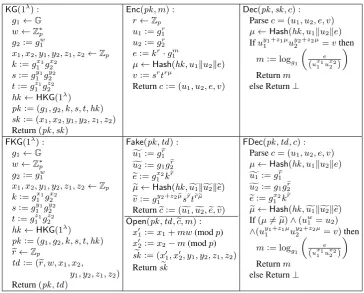
How to derive RNC-CCA secure RNCE from the HPS technique. Here, we explain an overview of our concrete construction of RNC-CCA secure RNCE derived from the HPS technique [7,8]. Our concrete construction is an extension of the CCA1 secure RNCE scheme proposed by Canetti et al. [6, Section 4.2]. Their RNCE scheme is a variant of the Cramer-Shoup-“lite” encryption scheme [7], which is an IND-CCA1 secure PKE scheme based on the DDH assumption. The only difference is that they encode a plaintextmby the group elementgm, wheregis a generator of the underlying group. This encoding is essential for the opening algorithmOpenof their proposed scheme, and the plaintext space of their scheme is of polynomial-size since they have to compute the discrete logarithm ofgmin the decryption procedure.
property using a technique similar to Canetti et al., and handle an adversary’s decryption queries similarly to the CCA security proof of the “full”-Cramer-Shoup encryption scheme. See Sections5.1and5.2for the details. We note that the size of the plaintext space of this construction is restricted to a polynomial in a security parameter.
How to expand a polynomial-sized plaintext space and its drawback. In general, it is natural to ask whether we can expand a plaintext space of an encryption scheme. In fact, we can expand the polynomial-sized plaintext space of our basic construction to a super-polynomially large one by using the scheme in a parallel way. More specifically, in our basic construction, a ciphertext (resp., secret key) consists of four elements(u1, u2, e=kr·g1m, v)ofG(resp., six elements(x1, x2, y1, y2, z1, z2)ofZp), whereGis a multiplicative cyclic group of prime orderp,kis a group element in a public key,g1 is a generator of
G,mis a plaintext that belongs to a polynomial-sized plaintext space (and hence its length is logarith-mic), andr is a randomness used in the encryption procedure. Similarly to the original Cramer-Shoup encryption scheme, a secret key(x1, x2, y1, y2, z1, z2)of our construction is divided into two parts hav-ing different roles. The component(x1, x2)is used for masking a plaintext and the remaining component (y1, y2, z1, z2)is used for checking the validity of a ciphertext. Based on the above basic construction, we can expand the plaintext space as follows. Letdbe a logarithmic function in a security parameter andℓ be a polynomial in a security parameter. If we want to encrypt a plaintextm=m1∥ · · · ∥mℓ∈ {0,1}d·ℓ, we can encrypt this plaintextmby generatingℓindependent components(xi1, xi2)i∈[ℓ]then hiding each blockmi with each component(xi1, xi2). Note that we do not need to increase the number of the com-ponent(y1, y2, z1, z2)for checking the validity of a ciphertext. However, there is a drawback about the ciphertext overhead of the construction obtained in this way. Specifically, in this extended construction, a ciphertext consists ofℓ+ 3elements(u1, u2,(ei)i∈[ℓ], v)ofG, whereei := kri ·g
mi
1 and eachki is a group element in a public key for each i ∈ [ℓ]. If we let the bit length of one group element beq, the ciphertext overhead isq(ℓ+ 3)−dℓ. Thus, as the length of a plaintext increases, the ciphertext overhead of this construction increases linearly.
How to expand a plaintext space more efficiently. It is more desirable to efficiently expand a plaintext space of an encryption scheme. Thus, for reducing the ciphertext overhead, we provide a method for effi-ciently expanding the polynomial-sized plaintext space of our basic construction to a super-polynomially large one. Our technique for achieving compact ciphertexts is inspired by Hofheinz et al. [15]. Compared to our basic construction, when computing a ciphertext (u1, u2,(ei)i∈[ℓ], v), we change how to com-pute(ei)i∈[ℓ]which are components of masked plaintexts. More specifically, before masking a plaintext m = m1∥ · · · ∥mℓ ∈ {0,1}d·ℓ, we firstly use a universal hash functionH : G → {0,1}dto compress each group elementkirused for masking each blockmito ad-bit string for alli∈[ℓ]. Then, we compute ei :=H(kri)⊕mi for alli∈[ℓ]. By taking this approach, the number of group elements in a ciphertext (u1, u2,(ei)i∈[ℓ], v)decreases fromℓ+ 3to3. Similarly to the above, if we let the bit length of one group element beq, the ciphertext overhead is(3q+dℓ)−dℓ = 3q. That is, even if the length of a plaintext increases, the ciphertext overhead of this modified scheme is always constant3q. Remarkably, this over-head is exactly the same as that in the original Cramer-Shoup encryption scheme. See Sections5.3and
5.4for the details.
1.4 Related work
To date, SSO secure PKE schemes have been extensively studied, and several constructions of SIM-SSO-CCA secure PKE have been shown based on various standard computational assumptions [21,23–25]. On the other hand, RSO secure PKE schemes have been much less studied.
scheme, an IND-CCA secure PKE scheme, an NIZK proof system, and a strong one-time signature scheme. Second, they gave a generic construction based on a universal HPS. It is not obvious whether their schemes (can be extended to) satisfy SIM-RSO-CCA security.
Very recently, as a concurrent and independent work, Huang et al. [18] showed three constructions of SIM-RSO-CCA secure PKE. Their first (resp., second) constructions are based on the DDH (resp., decisional composite residuosity (DCR)) assumption the size of whose plaintext space is polynomial (resp., super-polynomial) in a security parameter. Besides, as their third construction, they introduced the new notion of master-key selective opening security for identity-based encryption (IBE) and then showed that SIM-RSO-CCA secure PKE can be constructed from IBE with this security notion. They also showed a construction of IBE with this security notion in the ideal cipher model.
Compared to their work, our results have an overlap on the DDH-based construction. More pre-cisely, their DDH-based construction is essentially the same as our basic construction described in the conference version [16]. However, their work does not treat an analogue of RNC-CCA secure RNCE proposed in this paper. Furthermore, their work does not include our generic construction based on an IND-CPA secure PKE scheme and an OTSS-NIZK, and the DDH-based construction supporting a super-polynomially large plaintext space with compact ciphertexts.
1.5 Organization
The rest of the paper is organized as follows: In Section2, we review the notations, assumptions, and definitions of cryptographic primitives. In Section 3, we introduce RNC-CCA security for RNCE and show its implication to SIM-RSO-CCA security for PKE. In Section 4, we show a generic construc-tion of RNC-CCA secure RNCE with a binary plaintext space, which is constructed from an IND-CPA secure PKE scheme and an OTSS-NIZK. (In Appendix A, we give a multi-bit version of the geniric construction.) In Section5, we show a DDH-based constructions of RNC-CCA secure RNCE.
2 Preliminaries
In this section, we define notations, assumptions, and cryptographic primitives.
2.1 Notations
In this paper, x ← X denotes sampling an elementx from a finite set X uniformly at random. y ←
A(x;r)denotes that a probabilistic algorithmAoutputsyfor an inputxusing a randomnessr, and we simply denotey ← A(x)when we need not write an internal randomness explicitly. For stringsxand y,x∥ydenotes the concatenation of xandy. Also,x := y denotes thatx is defined byy.λdenotes a security parameter. A function f(λ)is a negligible function inλ, iff(λ) tends to0 faster than λ1c for
every constant c > 0.negl(λ) denotes an unspecified negligible function. PPT stands for probabilistic polynomial time. If nis a natural number,[n]denotes the set of integers{1,· · ·, n}. Also, ifaandb are integers such thata ≤ b,[a, b]denotes the set of integers{a,· · · , b}. Ifm = (m1,· · · , mn)is an n-dimensional vector,mJdenotes the subset{mj}j∈J whereJ ⊆[n]. IfOis a function or an algorithm and A is an algorithm, AO denotes that A has oracle access to O. If M is a square matrix, det(M) denotes the determinant ofM.
2.2 Public Key Encryption
A public key encryption (PKE) scheme with a plaintext space Mconsists of a tuple of the following three PPT algorithmsΠ = (KG,Enc,Dec).
KG: The key generation algorithm, given a security parameter1λ, outputs a public keypk and a secret keysk.
Dec: The (deterministic) decryption algorithm, given a public keypk, a secret keysk, and a ciphertext c, outputs a plaintextm∈ {⊥} ∪ M.
As the correctness forΠ, we require thatDec(pk,sk,Enc(pk, m)) =mholds for allλ∈N,m ∈ M, and(pk,sk)←KG(1λ).
Next, we define IND-CPA security and SIM-RSO-CCA security for a PKE scheme.
Definition 1 (IND-CPA security).We say thatΠ = (KG,Enc,Dec)is IND-CPA secure if for any PPT adversaryA= (A1,A2),
AdvindΠ,A-cpa(λ) := 2·Pr[b← {0,1}; (pk, sk)←KG(1λ); (m∗0, m∗1,st1)← A1(pk);c∗←Enc(pk, m∗b); b′ ← A2(c∗,st1) :b=b′]− 1
2
=negl(λ),
where it is required that|m∗0|=|m∗1|.
Definition 2 (SIM-RSO-CCA security).Letnbe the number of users. For a PKE schemeΠ = (KG,
Enc,Dec), an adversaryA= (A1,A2,A3), and a simulatorS = (S1,S2,S3), we define the following
pair of experiments.
Exprson,Π,-ccaA-real(λ) :
(pk,sk) := (pkj,skj)j∈[n]←(KG(1λ))j∈[n] (Dist,st1)← AODec
(·,·)
1 (pk)
m∗ := (m∗j)j∈[n]←Dist
c∗:= (c∗j)j∈[n]←(Enc(pkj, m∗j))j∈[n] (J,st2)← AODec
(·,·)
2 (c∗,st1)
out← AODec(·,·)
3 (skJ,m∗J,st2) Return(m∗,Dist, J,out)
Exprson,Π,-ccaS-sim(λ) : (Dist,st1)← S1(1λ) m∗ := (m∗j)j∈[n]←Dist
(J,st2)← S2(st1)
out← S3(m∗J,st2) Return(m∗,Dist, J,out)
In both of the experiments, we require that the distributionsDistoutput byAandS be efficiently sam-plable. InExprson,Π,-ccaA-real(λ), a decryption query(c, j)is answered byDec(pkj,skj, c).A2 andA3 are
not allowed to make a decryption query(c∗j, j)for anyj∈[n]. Furthermore,A3is not allowed to make
a decryption query(c, j)satisfyingj ∈J. (This is without losing generality, sinceA3 can decrypt any
ciphertext using the given secret keys.)
We say thatΠ is SIM-RSO-CCA secure if for any PPT adversaryAand any positive integer n = n(λ), there exists a PPT simulatorSsuch that for any PPT distinguisherD,
Advrson,Π,-ccaA,S,D(λ) :=|Pr[D(Expn,Π,rso-ccaA-real(λ)) = 1]−Pr[D(Expn,Π,rso-ccaS-sim(λ)) = 1]|=negl(λ).
Remark 1. For simplicity, we consider non-adaptive opening queries by an adversary in our experiments. That is, an adversary can make an opening queryJ ⊆ [n]only at once. However, our constructions of SIM-RSO-CCA secure PKE remain secure even if we consider adaptive opening queries by an adversary.
Remark 2. In this paper, as in the previous works [19,20], we consider only the revelation of secret keys in the definition of SIM-RSO-CCA security. Namely, we assume that an adversary cannot obtain a random coin used for generating a secret key. Hazay, Patra, and Warinschi [17] considered the revelation of both secret keys and random coins used in the key generation algorithm in the definition of RSO-CPA security. If we take into account corruptions of both secret keys and random coins, it seems that we need
key simulatability[9,17] for building blocks.
2.3 Non-interactive Zero-knowledge Proof System
LetRbe an efficiently computable binary relation andL:={x|∃ws.t.(x, w) ∈ R}. A non-interactive proof system forLconsists of a tuple of the following five PPT algorithmsΦ= (CRSGen,Prove,Verify,
CRSGen: The common reference string (CRS) generation algorithm, given a security parameter 1λ, outputs a CRScrs.
Prove: The proving algorithm, given a CRScrs, a statementx ∈ L, and a witnessw for the fact that x∈ L, outputs a proofπ.
Verify: The verification algorithm, given a CRS crs, a statement x, and a proof π, outputs either 1 (meaning “accept”) or0(meaning “reject”).
SimCRS: The simulator’s CRS generation algorithm, given a security parameter1λ, outputs a simulated CRScrsand a trapdoor keytk.
SimPrv: The simulator’s proving algorithm, given a trapdoor keytk and a (possibly false) statementx, outputs a simulated proofπ.
As the correctness forΦ, we require thatVerify(crs, x,Prove(crs, x, w)) = 1holds for allλ ∈ N, all
crs ←CRSGen(1λ), all statementsx∈ L, and all witnesseswfor the fact thatx∈ L.
Next, we define the security notions for a non-interactive proof system:One-time simulation sound-ness(OT-SS) andzero-knowledge(ZK).
Definition 3 (One-time simulation soundness).We say that a non-interactive proof systemΦ= (CRSGen,Prove,Verify,SimCRS,SimPrv) satisfies one-time simulation soundness (OT-SS) if for any PPT adversaryA= (A1,A2),
AdvotΦ,-Ass(λ) := Pr[(crs,tk)←SimCRS(1λ); (x∗,st1)← A1(crs);π∗ ←SimPrv(tk, x∗);
(x, π)← A2(π∗,st1) : (x /∈ L)∧(Verify(crs, x, π) = 1)∧((x, π)̸= (x∗, π∗))] =negl(λ). Definition 4 (Zero-knowledge).For a non-interactive proof systemΦ= (CRSGen,Prove,Verify,
SimCRS,SimPrv)and an adversaryA= (A1,A2), we consider the following pair of experiments.
ExpzkΦ,-Areal(λ) :
crs ←CRSGen(1λ) (x, w,st1)← A1(crs) π ←Prove(crs, x, w) b′← A2(π,st1) Returnb′
ExpzkΦ,-Asim(λ) :
(crs,tk)←SimCRS(1λ) (x, w,st1)← A1(crs) π←SimPrv(tk, x) b′ ← A2(π,st1) Returnb′
In both of the experiments, it is required that x ∈ Landwbe a witness for x ∈ L. We say thatΦis zero-knowledge (ZK) if for any PPT adversaryA,
AdvzkΦ,A(λ) :=|Pr[ExpzkΦ,-Areal(λ) = 1]−Pr[ExpzkΦ,-Asim(λ) = 1]|=negl(λ).
In this paper, we call a non-interactive proof system satisfying both OT-SS and ZK properties an
OTSS-NIZK.
2.4 “+1”-Decisional Diffie-Hellman (DDH) Assumption
In this section, we define the “+1”-DDH assumption. Although it is straightforward to see this assumption is implied by the standard DDH assumption, we provide its formal proof in AppendixBfor completeness. This assumption is used to simplify the security proof of our concrete construction in Section5.
Definition 5 (“+1”-DDH assumption).Letp=Ω(2λ)be a prime number,Gbe a multiplicative cyclic group of orderp, andZp be the set of integers modulop. We say that the “+1”-DDH assumption holds
inGif for any PPT adversaryA,
Adv+1G,A-ddh(λ) :=|Pr[g←G;a←Z∗p;b←Zp :A(g, ga, gb, gab) = 1]
2.5 Universal Hash Family and Leftover Hash Lemma
In this section, we firstly recall the definitions of the statistical distance and a universal hash family.
Definition 6 (Statistical distance).LetX andX′ be distributions over the same setX. The statistical distance betweenX andX′, denoted bySD(X,X′), is defined by
SD(X,X′) := max
f:X→{0,1}|Pr[f(X) = 1]−Pr[f(X
′) = 1]|.
Definition 7 (Universal hash family).LetX andY be sets. LetH := {H: X → Y}be a family of functions. We say thatHis a universal hash family if for anyx1, x2∈X(x1̸=x2),
Pr[H(x1) =H(x2)]≤ 1
|Y|
holds, whereH← H.
Next, we recall the leftover hash lemma.
Lemma 1 (Leftover hash lemma).LetH:={H:X →Y}be a universal hash family. Then, it holds that
SD((H,H(x)),(H, y))≤
√
|Y| 4· |X|,
whereH← H,x←X, andy ←Y.
2.6 Collision-resistant Hash Function
In this section, we recall the definition of a collision-resistant hash function. A hash function consists of a pair of PPT algorithmsΛ = (HKG,Hash).HKGis the hash key generation algorithm that, given a security parameter1λ, outputs a hash keyhk.Hashis the (deterministic) hashing algorithm that, given a hash keyhkand a stringx∈ {0,1}∗, outputs a hash valueh.
Definition 8 (Collision-resistance).We say thatΛ= (HKG,Hash)is a collision-resistant hash function if for any PPT adversaryA,
AdvcrΛ,A(λ) := Pr[hk ←HKG(1λ); (x, x∗)← A(hk) :
(Hash(hk, x) =Hash(hk, x∗))∧(x̸=x∗)] =negl(λ).
3 CCA Security for Receiver Non-commiting Encryption
In this section, we introduce a new security notion that we call RNC-CCA security for receiver non-commiting encryption (RNCE). Next, we show that RNC-CCA secure RNCE implies SIM-RSO-CCA secure PKE.
3.1 Receiver Non-commiting Encryption
Here, we give definitions of RNCE and RNC-CCA security for this primitive. Informally, RNCE is PKE having the property that it can generate a fake ciphertext which can be later opened to any plaintext (by showing an appropriate secret key). Canetti, Halevi, and Katz [6, Section 4.1] gave a definition of RNCE considering security against non-adaptive chosen ciphertext attacks (CCA1). We extend their definition to one considering security against adaptive CCA.
Informally, an RNCE schemeΠ consists of the seven PPT algorithms(KG,Enc,Dec,FKG,Fake,
Definition 9 (Receiver non-commiting encryption). An RNCE schemeΠ with a plaintext space M consists of the following seven PPT algorithms(KG,Enc,Dec,FKG,Fake,Open,FDec).(KG,Enc,Dec)
are the same algorithms as those of a PKE scheme.(FKG,Fake,Open,FDec)are defined as follows.
FKG: The fake key generation algorithm, given a security parameter1λ, outputs a public keypk and a trapdoortd.
Fake: The fake encryption algorithm, given a public keypk and a trapdoortd, outputs a fake ciphertext e
c.
Open: The opening algorithm, given a public keypk, a trapdoortd, a fake ciphertextec, and a plaintext
m, outputs a fake secret keyske.
FDec: The fake decryption algorithm, given a public keypk, a trapdoortd, and a ciphertextc, outputs
m∈ {⊥} ∪ M.
Next, we define RNC-CCA security for RNCE as follows.
Definition 10 (RNC-CCA security). For an RNCE scheme Π = (KG,Enc,Dec,FKG,Fake,Open,
FDec)and an adversaryA= (A1,A2,A3), we consider the following pair of experiments.
ExprncΠ,A-real(λ) : (pk, sk)←KG(1λ) (m∗,st1)← AO1Dec(·)(pk) c∗ ←Enc(pk, m∗)
st2 ← AO2Dec(·)(c∗,st1) sk∗:=sk
Returnb′← A3(sk∗,st2)
ExprncΠ,A-sim(λ) :
(pk, td)←FKG(1λ) (m∗,st1)← AO1Dec(·)(pk) c∗ ←Fake(pk, td)
st2 ← AO2Dec(·)(c∗,st1)
sk∗ ←Open(pk, td, c∗, m∗) Returnb′ ← A3(sk∗,st2)
InExprncΠ,A-real(λ), a decryption querycis answered byDec(pk,sk, c). On the other hand, inExprncΠ,A-sim(λ), a decryption querycis answered byFDec(pk,td, c). In both of the experiments, A2 is not allowed to
make a decryption queryc=c∗ andA3 is not allowed to make any decryption query.
We say thatΠis RNC-CCA secure if for any PPT adversaryA,
AdvrncΠ,A-cca(λ) :=|Pr[ExprncΠ,A-real(λ) = 1]−Pr[ExprncΠ,A-sim(λ) = 1]|=negl(λ).
3.2 RNC-CCA Secure RNCE Implies SIM-RSO-CCA Secure PKE
In this section, we show that an RNC-CCA secure RNCE scheme implies a SIM-RSO-CCA secure PKE scheme. Specifically, we show the following theorem.
Theorem 1. If an RNCE scheme Π = (KG,Enc,Dec,FKG,Fake,Open,FDec) is RNC-CCA secure, thenΠrso:= (KG,Enc,Dec)is a SIM-RSO-CCA secure PKE scheme.
Before providing the formal proof, we describe an intuition of the proof. Letnbe the number of key pairs andAbe an adversary against the SIM-RSO-CCA security ofΠrso. In the proof, we firstly construct a PPT simulatorSinExprson,Π-ccarso,-Ssim(λ). Specifically,Scomputes fake ciphertexts(cej)j∈[n]usingFakeand fake secret keys(skfj)j∈J usingOpen, whereJ is the set of corrupted indices. Here,S can simulate the decryption oracle forAbyFDecusing the trapdoors(tdj)j∈[n]generated byS.
Next, in order to move from the real experimentExprson,Π-ccarso,-Areal(λ)to the simulated experiment
Proof of Theorem1. Letn=n(λ)>0be an arbitrary polynomial that denotes the number of key pairs. LetA= (A1,A2,A3)be any PPT adversary that attacks the SIM-RSO-CCA security ofΠrso. First, we construct the following PPT simulatorS = (S1,S2,S3)forA.
S1(1λ): First,S1computes(pkj, tdj) ←FKG(1λ)for allj ∈[n]. Next, it setspk := (pkj)j∈[n]and runsA1(pk). WhenA1 makes a decryption query(c, j),S1 returnsm ←FDec(pkj, tdj, c)toA1. AfterA1outputs a pair(Dist,st1)of the plaintext distribution and state information and terminates,
S1setsst′1as all the information known toS1, returns(Dist,st1′)toExprson,Π-ccarso,-Ssim(λ), and terminates. S2(st′1): First, S2 computes c∗j ← Fake(pkj, tdj) for all j ∈ [n], sets c∗ := (c∗j)j∈[n], and runs
A2(c∗,st1). When A2 makes a decryption query (c, j) (such that (c, j) ̸= (c∗j, j)), S2 returns m ← FDec(pkj, tdj, c)toA2. AfterA2 outputs a set of indicesJ ⊆[n]and state informationst2 and terminates,S2 setsst′2 as all the information known toS2, returns(J,st2′)toExprson,Π-ccarso,-Ssim(λ),
and terminates.
S3(m∗J,st′2): First,S3 computessk∗j ← Open(pkj, tdj, c∗j, m∗j)for allj ∈ J, setssk∗J := (sk∗j)j∈J, and runsA3(sk∗J,m∗J,st2). WhenA3makes a decryption query(c, j)(such that(c, j)̸= (c∗j, j)and j /∈J),S3returnsm← FDec(pkj,tdj, c)toA3. (Note thatj /∈J holds now due to the rule of the SIM-RSO-CCA experiment.) AfterA3outputsoutand terminates,S3returnsouttoExprson,Π-ccarso,-Ssim(λ)
and terminates.
We letDbe any PPT distinguisher for the adversaryAand the above simulator S. We letpreal be the probability thatD outputs 1 given the output by Exprson,Π-ccarso,A-real(λ) andpsim be the probability that
Doutputs 1 given the output byExprson,Π-ccarso,-Ssim(λ). Note thatAdvn,Πrso-ccarso,A,S,D(λ) = |preal−psim|. In the following, we show that there exists a PPT adversary B = (B1,B2,B3) that attacks the RNC-CCA security ofΠso that|preal−psim|=n·AdvrncΠ,B-cca(λ).
Lemma 2. There exists a PPT adversaryB= (B1,B2,B3)such that|preal−psim|=n·AdvrncΠ,B-cca(λ).
Proof of Lemma2. We construct a PPT adversaryB= (B1,B2,B3)that attacks the RNC-CCA security ofΠso that|preal−psim|=n·AdvΠ,rncB-cca(λ), using the adversaryA= (A1,A2,A3)and the distinguisher
Das follows.
B1(pk): First, B1 chooses i from [n] uniformly at random and sets pki := pk. Next, it computes (pkj, tdj) ← FKG(1λ)for allj ∈[i−1]and(pkj,skj) ← KG(1λ)for allj ∈[i+ 1, n]. Then, it setspk := (pkj)j∈[n]and runsA1(pk). WhenA1 makes a decryption query(c, j),B1 answers as follows.
– Ifj∈[i−1], thenB1computesm←FDec(pkj, tdj, c)and returnsmtoA1
– Ifj =i, thenB1 makes a decryption queryc. When it receivesmfrom its decryption oracle, it returnsmtoA1.
– Ifj∈[i+ 1, n], thenB1computesm←Dec(pkj,skj, c)and returnsmtoA1.
AfterA1outputs a distributionDistand state informationst1,B1samplesm:= (m∗j)j∈[n]← Dist. Finally, B1 sets st′1 as all the information known to B1, returns (m∗i,st′1) to the experiment, and terminates.
B2(c∗,st′1): First, B2 setsci∗ := c∗ and computes the challenge ciphertexts c∗j for allj ∈ [n]\{i}as follows.
– Ifj∈[i−1], thenB2computesc∗j ←Fake(pkj, tdj). – Ifj∈[i+ 1, n], thenB2computesc∗j ←Enc(pkj, m∗j).
Next,B2 setsc∗ := (c∗j)j∈[n] and runsA2(c∗,st1). WhenA2 makes a decryption query(c, j),B2 answers in the same way asB1does. (Note that sinceA2 is not allowed to make a decryption query (c∗j, j) for allj ∈ [n],B2 can perfectly simulate the decryption oracle forA2.) AfterA2 outputs a set of indices J and state informationst2 and terminates, depending on whether i ∈ J holds,B2 proceeds as follows.
• Ifj∈[i−1], thenB2computessk∗j ←Open(pkj, tdj, c∗j, m∗j).
• Ifj∈[i+ 1, n], thenB2 computessk∗j :=skj.
Next,B2setssk∗J := (sk∗j)j∈J and runsA3(sk∗J,m∗J,st2). WhenA3 makes a decryption query (c, j), B2 answers in the same way as B1 does. (Note that since A3 is not allowed to make a decryption query(c, j) (such that ((c, j) = (c∗j, j))∨(j ∈ J)),B2 can perfectly simulate the decryption oracle for A3.) AfterA3 outputs out and terminates,B2 runs D(m∗,Dist, J,out). Then,B2 setsdas the output ofDandst′2as the concatenation of all the information known to
B2and the bitd, returnsst′2to the experiment, and terminates.
– If i ∈ J holds, then B2 just sets st′2 as all the information known to B2, returns st′2 to the experiment, and terminates.
B3(sk∗,st′2): Ifi /∈ J, thenst′2 must contain the bitd, andB3 outputs it to the experiment and termi-nates.
Otherwise, (that is, ifi ∈ J holds,) B3 runs as follows. First,B3 computessk∗j for allj ∈ [n]as follows.
– Ifj∈[i−1], thenB3computessk∗j ←Open(pkj, tdj, c∗j, m∗j). – Ifj=i, thenB3 setssk∗i :=sk∗.
– Ifj∈[i+ 1, n], thenB3setssk∗j :=skj.
Next,B3 setssk∗J := (sk∗j)j∈J and runs A3(sk∗J,m∗J,st2). When A3 makes a decryption query (c, j) (such that(c, j) ̸= (c∗j, j) andj /∈ J),B3 answers in the same way as B1 does. (Note that sincei∈Jholds now due to the rule of the SIM-RSO-CCA experiment,A3 is not allowed to make a decryption query of the form(c, i). Thus,B3 can perfectly simulate the decryption oracle forA3 althoughB3is not allowed to access his own decryption oracle.) AfterA3outputsoutand terminates,
B3 runsD(m∗,Dist, J,out). Finally,B3returns the output ofDto the experiment and terminates. Note thatBdoes not make a forbidden queryc∗to its decryption oracle becauseAdoes not make a decryption query(c∗j, j)for anyj ∈[n]. Note also thatB3 does not make any decryption query. We can estimateAdvrncΠ,B-cca(λ)by
AdvrncΠ,B-cca(λ)
=|Pr[ExprncΠ,B-real(λ) = 1]−Pr[ExprncΠ,B-sim(λ) = 1]|
=∑ t∈[n]
Pr[(ExprncΠ,B-real(λ) = 1)∧(i=t)]−∑ t∈[n]
Pr[(ExprncΠ,B-sim(λ) = 1)∧(i=t)]
=∑ t∈[n]
Pr[i=t]·Pr[ExpΠ,rncB-real(λ) = 1|i=t]− ∑ t∈[n]
Pr[i=t]·Pr[ExpΠ,rncB-sim(λ) = 1|i=t].
In the following, for eacht∈[n], we letqrealt := Pr[ExprncΠ,B-real(λ) = 1|i=t]andqsimt := Pr[ExprncΠ,B-sim(λ) = 1|i=t].
Since i is chosen from [n] uniformly at random, Pr[i = t] = 1n holds for all i ∈ [n]. Thus,
AdvrncΠ,B-cca(λ) = n1 · |∑t∈[n]qtreal −∑t∈[n]qsimt | holds. Next, for all t ∈ [n−1], when B interacts with ExprncΠ,B-real(λ)andi = t+ 1holds, the information given toAandDis exactly the same as that whenBinteracts withExprncΠ,B-sim(λ)andi =tholds. That is, for allt∈ [n−1], we haveqt+1real =qtsim. Thus, we have|∑t∈[n]qtreal−∑t∈[n]qtsim|=|qreal1 −qsimn |.
Finally,Bperfectly simulatesExprson,Π-ccarso,-Areal(λ)forAandDwhenBsamplesi= 1and interacts with
ExprncΠ,B-real(λ). On the other hand,Bperfectly simulates the information forAandDthat is given byS inExprson,Π-ccarso,-Ssim(λ)whenBsamplesi=nand interacts withExprncΠ,B-sim(λ). Therefore,q1real =prealand qsim
n =psimhold, that is, we have|q1real−qnsim|=|preal−psim|.
From the above arguments, it holds thatAdvrncΠ,B-cca(λ) =|Pr[ExprncΠ,B-real(λ) = 1]−Pr[ExprncΠ,B-sim(λ) = 1]|= n1 · |preal−psim|. That is,|preal−psim|=n·AdvrncΠ,B-cca(λ)holds. ⊓⊔(Lemma2)
KG′(1λ) :
α← {0,1}
(pk0,sk0)←KG(1λ)
(pk1,sk1)←KG(1λ)
crs←CRSGen(1λ) pk := (pk0,pk1,crs)
sk := (α,skα) Return(pk,sk)
Enc′(pk, m) : (r0, r1)← R2Π
c0←Enc(pk0, m;r0)
c1←Enc(pk1, m;r1)
x:= (pk0,pk1, c0, c1)
w:= (m, r0, r1)
π←Prove(crs, x, w) Returnc:= (c0, c1, π)
Dec′(pk,sk, c) :
x:= (pk0,pk1, c0, c1)
IfVerify(crs, x, π) = 1then
m←Dec(pkα,skα, cα) Returnm
else Return⊥
FKG′(1λ) :
α← {0,1}
(pk0,sk0)←KG(1λ)
(pk1,sk1)←KG(1λ)
(crs,tk)←SimCRS(1λ) pk := (pk0,pk1,crs)
td:= (α,sk0,sk1,tk)
Return(pk,td)
Fake′(pk,td) :
cα←Enc(pkα,0)
c1⊕α←Enc(pk1⊕α,1)
x:= (pk0,pk1, c0, c1)
π←SimPrv(tk, x) Returnec:= (c0, c1, π)
Open′(pk,td,ec, m) :
e
sk:= (α⊕m,skα⊕m) Returnske
FDec′(pk,td, c) :
x:= (pk0,pk1, c0, c1)
IfVerify(crs, x, π) = 1then
m←Dec(pk0,sk0, c0)
Returnm
else Return⊥
Fig. 1.Generic construction of RNC-CCA secure RNCEΠ′.
adversaryBsuch thatAdvrson,Π-ccarso,A,S,D(λ) =|Pr[D(Expn,Πrso-ccarso,-Areal(λ)) = 1]−Pr[D(Exprson,Π-ccarso,-Ssim(λ)) = 1]|=|preal−psim|=n·AdvrncΠ,B-cca(λ)holds. Therefore, we haveAdvrson,Π-ccarso,A,S,D(λ) =negl(λ)by the
assumption thatΠsatisfies RNC-CCA security. ⊓⊔(Theorem1)
4 Generic Construction of RNC-CCA Secure RNCE
In this section, we show our generic construction of RNC-CCA secure RNCE with the plaintext space
{0,1}. First, in Section4.1, we describe our generic construction. Then, in Section4.2, we give the proof of RNC-CCA security for our generic construction.
4.1 Description
In this section, we formally describe our generic construction of RNC-CCA secure RNCE with the plain-text space{0,1}. LetΠ= (KG,Enc,Dec)be a PKE scheme with the plaintext space{0,1}andRΠbe a randomness space for the encryption algorithmEnc. LetΦ= (CRSGen,Prove,Verify,SimCRS,SimPrv) be a non-interactive proof system forLeq, where
Leq:=
{
(pk0,pk1, c0, c1)∃(m, r0, r1) s.t.(c0 =Enc(pk0, m;r0))∧(c1 =Enc(pk1, m;r1))
}
.
Then, we construct an RNCE schemeΠ′ = (KG′,Enc′,Dec′,FKG′,Fake′,Open′,FDec′)with the plain-text space{0,1}as described in Fig.1. We note that, considering a real ciphertextcand a real secret key
sk, the correctness of the decryption ofΠ′is straightforward due to the correctness ofΠandΦ.
Correctness of decryption using a fake secret key. Although it is not necessary for a security proof, we believe that it is instructive to check the correctness of the decryption procedure using a fake secret key. Hence, we confirm that a fake secret key can decrypt a fake ciphertext and a real ciphertext by the decryption algorithmDec′.
Furthermore, for any plaintextm′∈ {0,1}(not necessarilym), the fake secret key(α⊕m,skα⊕m) can decrypt a real ciphertextc = (c0, c1, π) generated byEnc′(pk, m′)to the plaintext m′ becausec0 andc1encrypt the same plaintextm′.
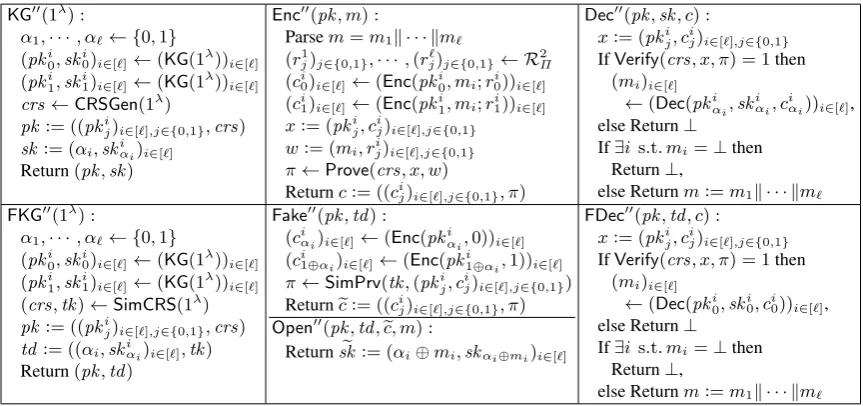
How to expand the plaintext space of our generic construction. In the above, we only give the construc-tion whose plaintext space is{0,1}. However, we can expand the plaintext space by using our single-bit construction in a parallel way except for the generation of a proof of an OTSS-NIZK. More concretely, if we encrypt anℓ-bit plaintextm=m1∥ · · · ∥mℓ, the procedure is as follows. Firstly, we generate a public key pk = ((pkij)i∈[ℓ],j∈{0,1},crs) and a secret keysk = (αi,skiαi)i∈[ℓ], where α1,· · · , αℓ ← {0,1},
(pkij,skij)← KG(1λ)for all(i, j) ∈[ℓ]× {0,1}, andcrs denotes a CRS of an OTSS-NIZK. Next, we compute a ciphertext c = ((cij)i∈[ℓ],j∈{0,1}, π), where cji ← Enc(pkij, mi)for all(i, j) ∈ [ℓ]× {0,1} and π is a proof proving that, for each i ∈ [ℓ], the ciphertexts ci0 and ci1 encrypt the same plaintext mi ∈ {0,1}. Similarly, for the other procedures, we execute the corresponding one-bit version algo-rithms in a parallel way for alli∈[ℓ]except for the procedure of the OTSS-NIZK. See AppendixAfor the details.
4.2 Security Proof
In this section, we show the following theorem.
Theorem 2. IfΠ is an IND-CPA secure PKE scheme andΦis an OTSS-NIZK, thenΠ′ is RNC-CCA secure.
Before describing the formal proof, we highlight the flow of the proof. We changeExprncΠ′,-Areal(λ)to
ExprncΠ′,-Asim(λ)step by step, whereAis an adversary that attacks the RNC-CCA security ofΠ′. Although the main part of our proof is similar to that of the original double encryption paradigm [26,29], we have the following three remarkable changes.
First, toward transforming the challenge ciphertext to a fake ciphertext, we make the challenge ci-phertext component c∗1⊕α encrypt1⊕m∗. Second, in order to eliminate the information of the bit α from the decryption oracle, when answering a decryption queryc = (c0, c1, π)made byA, we use the component(pk0,sk0, c0)corresponding to the position0instead of the component(pkα,skα, cα) corre-sponding to the positionα. Third, we useα⊕m∗instead ofαin order to make the challenge ciphertext c∗ be independent of the challenge plaintextm∗. Due to these changes, the challenge ciphertextc∗ and the real secret keysk are respectively switched to the fake ciphertextecand the fake secret keyske. The formal proof is as follows.
Proof of Theorem2. LetA = (A1,A2,A3)be any PPT adversary that attacks the RNC-CCA security ofΠ′. We introduce the following experiments{Expi}5i=0.
Exp0 : Exp0is exactly the same asExprncΠ′,-Areal(λ). The detailed description is as follows.
1. First,Exp0 samplesα ← {0,1} and computes(pk0,sk0) ← KG(1λ), (pk1,sk1) ← KG(1λ), andcrs ← CRSGen(1λ). Next,Exp0 setspk := (pk0,pk1,crs) andsk := (α,skα) and runs
A1(pk). WhenA1 makes a decryption queryc = (c0, c1, π),Exp0 checks whetherVerify(crs, (pk0,pk1, c0, c1), π) = 1 holds. If this holds, Exp0 computes m ← Dec(pkα,skα, cα), and returnsmtoA1. Otherwise,Exp0 returns⊥toA1.
2. WhenA1outputs(m∗,st1)and terminates,Exp0computes the challenge ciphertextc∗as follows. First,Exp0samples(r∗0, r1∗)← R2Π and computesc∗0 ←Enc(pk0, m∗;r∗0),c∗1 ←Enc(pk1, m∗;r∗1), andπ∗ ←Prove(crs,(pk0,pk1, c∗0, c∗1),(m∗, r0∗, r1∗)). Next,Exp0setsc∗= (c∗0, c∗1, π∗)and runs
A2(c∗,st1). WhenA2makes a decryption queryc,Exp0answers in the same way as above. 3. WhenA2outputs state informationst2and terminates,Exp0runsA3(sk,st2). WhenA3outputs
Exp1 : Exp1 is identical to Exp0 except for the following change. The common reference string crs
is generated by executing(crs,tk) ← SimCRS(1λ) and Exp1 generates a simulated proof π∗ ←
SimPrv(tk,(pk0,pk1, c∗0, c∗1))when computing the challenge ciphertextc∗.
Exp2 : Exp2is identical toExp1except that when computing the challenge ciphertextc∗,Exp2computes c∗1⊕α←Enc(pk1⊕α,1⊕m∗)instead ofc∗1⊕α←Enc(pk1⊕α, m∗).
Exp3 : Exp3is identical toExp2except that when responding to a decryption queryc= (c0, c1, π),Exp3 answersm←Dec(pk0,sk0, c0)instead ofm←Dec(pkα,skα, cα)ifVerify(crs,(pk0,pk1, c0, c1), π) = 1holds. Note that the decryption procedure inExp3is exactly the same asFDec′.
Exp4 : Exp4 is identical toExp3except thatα⊕m∗ is used instead ofα. That is, when computing the challenge ciphertextc∗,Exp4computesc∗0andc∗1byc∗α⊕m∗ ←Enc(pkα⊕m∗, m∗)andc∗α⊕(1⊕m∗)←
Enc(pkα⊕(1⊕m∗),1⊕m∗). Moreover, Exp4 gives the secret key sk = (α ⊕m∗,skα⊕m∗) toA3 instead ofsk = (α,skα).
Exp5 : Exp5is exactly the same asExprncΠ′,-Asim(λ).
We letpi := Pr[Expi(λ) = 1]for alli∈[0,5]. Then, we have
AdvrncΠ′,-Acca(λ) =|Pr[ExprncΠ′,-Areal(λ) = 1]−Pr[ExprncΠ′,-Asim(λ) = 1]|=|p0−p5| ≤ 4
∑
i=0
|pi−pi+1|.
It remains to show how each|pi−pi+1|is upper-bounded. To this end, in the following, we show that there exist an adversaryE = (E1,E2)against the ZK property ofΦsuch that|p0−p1|=AdvzkΦ,E(λ)(Lemma
3), an adversaryF = (F1,F2)against the IND-CPA security ofΠsuch that|p1−p2|=AdvindΠ,F-cpa(λ) (Lemma 4), and an adversaryG = (G1,G2) against the OT-SS ofΦsuch that|p2 −p3| ≤ AdvotΦ,-Gss(λ) (Lemma 5). Then, we show that|p3 −p4| = 0 holds (Lemma 6). The main reason why this is true, is becauseαis chosen uniformly at random, and thusα⊕m∗ is also distributed uniformly at random. Finally, we show that|p4−p5|= 0holds (Lemma7) by showing thatExp4 andExp5are identical. Lemma 3. There exists a PPT adversaryE = (E1,E2)such that|p0−p1|=AdvzkΦ,E(λ).
Proof of Lemma3. We construct a PPT adversaryE = (E1,E2)that attacks the ZK property ofΦso that
|p0−p1|=AdvzkΦ,E(λ), using the adversaryA= (A1,A2,A3)as follows.
E1(crs): First,E1samplesα← {0,1}and computes(pk0,sk0)←KG(1λ)and(pk1,sk1)←KG(1λ). Next, it setspk := (pk0,pk1,crs) andsk := (α,skα), and runs A1(pk). WhenA1 makes a de-cryption query c, E1 returns m ← Dec′(pk,sk, c) to A1. When A1 outputs the challenge plain-text m∗ and state informationst1 and then terminates, E1 samples(r∗0, r∗1) ← R2Π and computes c0∗ ← Enc(pk0, m∗;r0∗) and c∗1 ← Enc(pk1, m∗;r1∗). Finally, E1 sets x∗ := (pk0,pk1, c∗0, c∗1), w∗ := (m∗, r∗0, r∗1), andst1′ as all the information known toE1, returns(x∗, w∗,st′1), and terminates.
E2(π,st′1): First,E2 setsπ∗ :=πandc∗ := (c∗0, c∗1, π∗), and then runsA2(c∗,st1). WhenA2makes a decryption queryc,E2 returns m ← Dec′(pk,sk, c) toA2. WhenA2 outputs state informationst2 and terminates,E2 setssk∗ := sk = (α,skα)and runsA3(sk∗,st2). WhenA3 outputs a bitb′,E2 returnsb′ to its experiment and terminates.
We can see thatE perfectly simulatesExp0 forAif it receives real components fromExpzkΦ,-Ereal(λ). This ensures that the probability that E outputs 1 given real components is exactly the same as the probability that Aoutputs 1 inExp0. That is,Pr[ExpΦ,zkE-real(λ) = 1] = p0 holds. On the other hand, E perfectly simulatesExp1forAif it receives simulated components fromExpzkΦ,-Esim(λ). This ensures that the probability thatE outputs 1 given simulated components is exactly the same as the probability that
Aoutputs 1 in Exp1. That is,Pr[ExpΦ,zk-Esim(λ) = 1] = p1 holds. Therefore, it holds thatAdvzkΦ,E(λ) =
|Pr[ExpzkΦ,-Ereal(λ) = 1]−Pr[ExpΦ,zk-Esim(λ) = 1]|=|p0−p1|. ⊓⊔(Lemma3)