Binary Field Multiplication on ARMv8
Hwajeong Seo1, Zhe Liu2, Yasuyuki Nogami3, Jongseok Choi1, and Howon Kim1⋆
1
Pusan National University, School of Computer Science and Engineering,
San-30, Jangjeon-Dong, Geumjeong-Gu, Busan 609–735, Republic of Korea {hwajeong,jschoi85,howonkim}@pusan.ac.kr
2 University of Luxembourg,
Laboratory of Algorithmics, Cryptology and Security (LACS), 6, rue R. Coudenhove-Kalergi, L–1359 Luxembourg-Kirchberg, Luxembourg
{zhe.liu}@uni.lu 3
Okayama University,
Graduate School of Natural Science and Technology, 3-1-1, Tsushima-naka, Kita, Okayama, 700-8530, Japan
{yasuyuki.nogami}@okayama-u.ac.jp
Abstract. In this paper, we show efficient implementations of binary field multiplication over ARMv8. We exploit an advanced 64-bit poly-nomial multiplication (PMULL) supported by ARMv8 and conduct multi-ple levels of asymptotically faster Karatsuba multiplication. Finally, our method conducts binary field multiplication within 57 clock cycles for B-251. Our proposed method on ARMv8 improves the performance by a factor of 5.5 times than previous techniques on ARMv7.
Keywords: Polynomial Multiplication, Binary Field Multiplication, ARMv8, Elliptic Curve Cryptography, Karatsuba Multiplication
1
Introduction
Since binary field multiplication is an important component of elliptic curve cryptography and authenticated encryption, many researches have studied the high speed implementation of binary field multiplication in software engineering. The typical binary field multiplication over embedded processor may compute the results with bitwise-xor and logical shift operations. The other more clever approach exploits the look-up table by calculating the part of results in advance [6, 7, 10, 8, 9]. Recently, many modern embedded processors adopt the advanced built-in binary field multiplication. ARMv7 supportsVMULL.P8operation which can compute eight 8-bit wise polynomial multiplications with single instruc-tion. In [2], author shows that efficient implementation techniques to construct the 64-bit binary field multiplication with the VMULL.P8operation. After then multiple levels of Karatsuba multiplication is applied to several binary field mul-tiplications includingF2251,F2283 andF2571. The most recent processor, ARMv8,
⋆
supports PMULL operation which can compute 64-bit wise polynomial multipli-cation with single instruction. In [3], author shows that compact implementa-tion of GCM based authenticated encrypimplementa-tion with the PMULL operation. Since the 64-bit multiplication is quite fast enough for 128-bit multiplication, they avoid Karatsuba multiplication. The detailed 128-bit polynomial multiplication is available in Algorithm 1. The implementations achieved 11 times faster results than ARMv7. However, the paper does not show binary field multiplication for long length operands. The long operands are required to compute ECC based cryptography. In this paper, we present efficient implementations of long bits bi-nary field multiplication. We applied multiple levels of Karatsuba multiplication and achieved 5.5 times faster than ARMv7 implementations.
Algorithm 1128-bit Polynomial Multiplication (mul128 p64) Require: 128-bit OperandsA,B.
Ensure: 256-bit ResultC.
1: ld1.16b {v2}, [x2] {Load 128-bit OperandA} 2: ld1.16b {v3}, [x1] {Load 128-bit OperandB}
3: movi.16b v6, #0 {Clear Reg}
4: pmull v0.1q, v2.1d, v3.1d {CL←A[63:0]·B[63:0]} 5: pmull2 v1.1q, v2.2d, v3.2d {CH←A[127:64]·B[127:64]} 6: ext.16b v4, v3, v3, #8 {Shuffle OperandB} 7: pmull v5.1q, v2.1d, v4.1d {CM ←A[63:0]·B[127:64]} 8: pmull2 v4.1q, v2.2d, v4.2d {CM′←A[127:64]·B[63:0]} 9: eor.16b v4, v4, v5 {CM ←CM⊕CM′}
10: ext.16b v5, v6, v4, #8 {Align Result} 11: eor.16b v0, v0, v5 {CL[127:64]←CL[127:64]⊕CM[63:0]} 12: ext.16b v5, v4, v6, #8 {Align Result} 13: eor.16b v1, v1, v5 {CH[63:0]←CH[63:0]⊕CM[127:64]} 14: st1.16b {v0,v1}, [x0] {Return 256-bit ResultC}
The remainder of this paper is organized as follows. In Section 2, we recap the target ARM processor and Karatsuba method. In Section 3, we propose the efficient binary field multiplication. In Section 4, we evaluate the performance of proposed methods in terms of clock cycles. Finally, Section 5 concludes the paper.
2
Related Works
2.1 ARM Processor
the 64-bit is known as AArch64. An ARMv8 processor can support both, al-lowing the execution of 32-bit and 64-bit applications. ARM processors sup-port a single-instruction multiple-data (SIMD) module called the NEON engine. AArch32 features sixteen 32-bit registers (R0-R15) and sixteen 128-bit NEON registers (Q0-Q15). The NEON registers can also be viewed as pairs of 64-bit registers (D0-D32). For example,D0andD1are the lower and higher parts ofQ0, respectively. AArch64 features thirty two 64-bit registers (X0-X31) and thirty two 128-bit NEON registers (V0-V31). The NEON registers can no longer be viewed as pairs of 64-bit registers. From ARMv8, two polynomial dedicated in-structions, PMULL and PMULL2, are available. Both of which carry out a single 64-bit multiplication. In both cases, the inputs are 128-bit registers. Their differ-ence is that in PMULLthe lower 64-bit parts of the inputs are used as operands, while in PMULL2the higher 64-bit parts are used [3].
2.2 Karatsuba Algorithm
The basic idea of Karatsuba multiplication is to split a multiplication of two
s words operands into three multiplications of size s2, which is possible at the expense of some additions [5]. Taking the multiplication of s words operands
A and B as an example, we represent the operands as A=AH·2 s
2 +AL and B=BH·2
s
2+BL. The multiplicationP=A·B can be computed according to
the Equation 1.
AH·BH·2s+ [(AH+AL)(BH+BL)−AH·BH−AL·BL]·2 s
2 +AL·BL
Karatsuba method roughly executes 3s42 mulinstructions to multiply twos -word operands [4]. Recently, the refined Karatsuba’s algorithm from a Crypto 2009 paper by Bernstein [1] makes efficient use of the available registers to keep the low overheads fromloadandstoreinstructions.
3
Proposed Method
3.1 Polynomial Multiplication
Polynomial multiplication can be implemented in ordinary or Karatsuba method. The Karatsuba multiplication is an efficient approach when size of operand is long enough than processor’s word. Since the ARMv8 processor is 64-bit archi-tecture, several parameters are not favorable with Karatsuba multiplication. In this section, we investigate the proper size of minimum Karatsuba technique.
is efficient than Karatsuba approach. As we can see the comparison results in Table 1. Karatsuba method can reduce the number of multiplication by 1. How-ever, more number of other instructions including eor and ext are required. For this reason, ordinary multiplication is better choice for 128-bit polynomial multiplication.
Table 1.Comparison of 128-bit polynomial multiplication methods
Instructions pmull eor movi ext
Ordinary 4 3 1 3
Karatsuba 3 6 1 4
In case of long operands (256, 512 and etc), Karatsuba approach is better choice, because total number of instructions are smaller than ordinary approach. We use the Karatsuba algorithm for both cases and our solution is a combination of the Karatsuba algorithm and a multiplier based on PMULL which we have named the Karatsuba/NEON/PMULL multiplier (KNP).
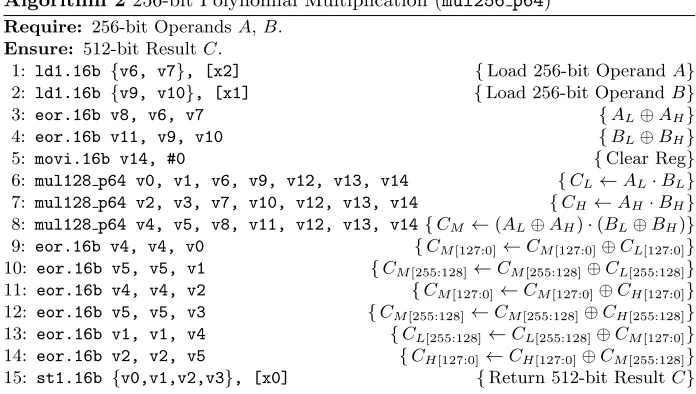
Four terms (256-bit) polynomial multiplication is executed with 1 level of Karatsuba multiplication. The inner 128-bit multiplication is readily established with Algorithm 1. The detailed four terms polynomial multiplication is available in Algorithm 2. In Step 1 and 2, 256-bit operands are loaded from memory. In Step 3 and 4, lower parts of operands are bit-wise exclusive-ored with higher parts. In Step 5, bit register (v14) is cleared. In Step 6, 7 and 8, three 128-bit wise polynomial multiplications (CL ← AL·BL and CH ← AH ·BH and CM ←(AL⊕AH)·(BL⊕BH)) are conducted. The first two input variables of
mul128 p64are results and third and fourth variables represent operands and the last three operands indicate temporal storages. From Step 9 to 14, intermediate results are bit-wise exclusive-ored. At step 15, total 512-bit results are stored into memory.
Eight terms (512-bit) polynomial multiplication consists of 2 levels of Karat-suba multiplication. The first level consists of 256-bit polynomial multiplications and the multiplication is following the Algorithm 2. The detailed 512-bit multi-plication is written in Algorithm 3. In Step 1 and 2, 256-bit operands are loaded from memory. In Step 3 and 6, lower parts of operands are bit-wise exclusive-ored with higher parts. In Step 7, 128-bit register (v14) is cleared. In Step 8, 9 and 10, three 128-bit wise polynomial multiplications (CL ← AL·BL and CH ← AH·BH and CM ←(AL⊕AH)·(BL⊕BH)) are conducted. The first
two input variables ofmul256 p64are results and third and fourth variables rep-resent operands and the last three operands indicate temporal storages. From Step 11 to 22, intermediate results are bit-wise exclusive-ored. At step 23 and 24, total 1024-bit results are stored into memory.
Algorithm 2256-bit Polynomial Multiplication (mul256 p64) Require: 256-bit OperandsA,B.
Ensure: 512-bit ResultC.
1: ld1.16b {v6, v7}, [x2] {Load 256-bit OperandA} 2: ld1.16b {v9, v10}, [x1] {Load 256-bit OperandB} 3: eor.16b v8, v6, v7 {AL⊕AH}
4: eor.16b v11, v9, v10 {BL⊕BH}
5: movi.16b v14, #0 {Clear Reg}
6: mul128 p64 v0, v1, v6, v9, v12, v13, v14 {CL←AL·BL}
7: mul128 p64 v2, v3, v7, v10, v12, v13, v14 {CH←AH·BH}
8: mul128 p64 v4, v5, v8, v11, v12, v13, v14{CM ←(AL⊕AH)·(BL⊕BH)}
9: eor.16b v4, v4, v0 {CM[127:0]←CM[127:0]⊕CL[127:0]} 10: eor.16b v5, v5, v1 {CM[255:128]←CM[255:128]⊕CL[255:128]} 11: eor.16b v4, v4, v2 {CM[127:0]←CM[127:0]⊕CH[127:0]} 12: eor.16b v5, v5, v3 {CM[255:128]←CM[255:128]⊕CH[255:128]} 13: eor.16b v1, v1, v4 {CL[255:128]←CL[255:128]⊕CM[127:0]} 14: eor.16b v2, v2, v5 {CH[127:0]←CH[127:0]⊕CM[255:128]} 15: st1.16b {v0,v1,v2,v3}, [x0] {Return 512-bit ResultC}
the more efficient method than that of Karatsuba. The comparison results are drawn in Table 2. Three terms of Karatsuba multiplication reduces the number of multiplication from 9 to 6. However, additional 8 and 5 times of eor and extinstructions are required. For this reason, ordinary multiplication is better choice for 192-bit polynomial multiplication.
Table 2.Comparison of 192-bit polynomial multiplication methods
Instructions pmull eor movi ext
Ordinary 6 16 1 8
Karatsuba 9 7 1 3
The detailed three terms of polynomial multiplication is available in Algo-rithm 4. In Step 1 and 2, 192-bit operands (A and B) are loaded from mem-ory. By using option 8b, we loaded operands by sequential 64-bit format to the 128-bit registers, which lefts higher 64-bit as an empty. In Step 3 ∼ 6, four multiplications including (CL ← A[63:0] ·B[63:0], TL ← A[63:0]·B[127:64],
CM ← A[63:0]·B[191:128] and T emp ← A[127:64]·B[63:0]) are conducted. After then results (A[127:64]·B[63:0]) are added to TL. From Step 8 to 15, remaining
multiplications are conducted and then added to the intermediate results. After then the results are aligned and accumulated to the intermediate results in Step 17∼22. Finally, total 384-bit results are stored into memory.
Algorithm 3512-bit Polynomial Multiplication Require: 512-bit OperandsA,B.
Ensure: 1024-bit ResultC.
1: ld1.16b {v0, v1, v2, v3}, [x2] {Load 512-bit OperandA} 2: ld1.16b {v6, v7, v8, v9}, [x1] {Load 512-bit OperandB} 3: eor.16b v4, v0, v2 {AL[127:0]⊕AH[127:0]} 4: eor.16b v5, v1, v3 {AL[255:128]⊕AH[255:128]} 5: eor.16b v10, v6, v8 {BL[127:0]⊕BH[127:0]} 6: eor.16b v11, v7, v9 {BL[255:128]⊕BH[255:128]}
7: movi.16b v16, #0 {Clear Reg}
8: mul256 p64 v18, v19, v20, v21, v30, v31, v0, v1, v12, v6, v7, v13,
v14, v15, v16 {CL←AL·BL}
9: mul256 p64 v22, v23, v24, v25, v30, v31, v2, v3, v12, v8, v9, v13,
v14, v15, v16 {CH←AH·BH}
10: mul256 p64 v26, v27, v28, v29, v30, v31, v4, v5, v12, v10, v11, v13, v14, v15, v16 {CM ←(AL⊕AH)·(BL⊕BH)}
Algorithm 4192-bit Polynomial Multiplication (mul192 p64) Require: 192-bit OperandsA,B.
Ensure: 384-bit ResultC.
1: ld1.8b {v0, v1, v2}, [x2] {Load 192-bit OperandA} 2: ld1.8b {v3, v4, v5}, [x1] {Load 192-bit OperandB} 3: pmull v6.1q, v0.1d, v3.1d {CL←A[63:0]·B[63:0]} 4: pmull v9.1q, v0.1d, v4.1d {TL←A[63:0]·B[127:64]} 5: pmull v7.1q, v0.1d, v5.1d {CM ←A[63:0]·B[191:128]} 6: pmull v11.1q, v1.1d, v3.1d {T emp←A[127:64]·B[63:0]} 7: eor.16b v9, v9, v11 {TL←TL⊕T emp}
8: pmull v11.1q, v1.1d, v4.1d {T emp←A[127:64]·B[127:64]} 9: eor.16b v7, v7, v11 {CM ←CM ⊕T emp}
10: pmull v10.1q, v1.1d, v5.1d {TH←A[127:64]·B[191:128]} 11: pmull v11.1q, v2.1d, v3.1d {T emp←A[191:128]·B[63:0]} 12: eor.16b v7, v7, v11 {CM ←CM ⊕T emp}
13: pmull v11.1q, v2.1d, v4.1d {T emp←A[191:128]·B[127:64]} 14: eor.16b v10, v10, v11 {TH←TH⊕T emp}
15: pmull v8.1q, v2.1d, v5.1d {CH←A[191:128]·B[191:128]}
16: movi.16b v11, #0 {Clear Reg}
with ordinary multiplication described in Algorithm 4. The detailed six terms of polynomial multiplication is available in Algorithm 5. In Step 1 ∼4, 384-bit operands are loaded from memory. In Step 5∼10, lower parts of operands are bit-wise exclusive-ored with higher parts. In Step 11, 128-bit register (v14) is cleared. In Step 12, 13 and 14, three 192-bit wise polynomial multiplications (CL ← AL·BL and CH ← AH ·BH and CM ← (AL ⊕AH)·(BL⊕BH))
are conducted. The first six input variables of mul192 p64 are operands and seventh, eighth and nine-th variables represent temporal storages and the last three operands indicate results. From Step 15 to 28, intermediate results are bit-wise exclusive-ored. At step 29 and 30, total 768-bit results are stored into memory.
3.2 Binary Field Multiplication
s word of binary field multiplication produce values of degree at most 2s−2, which must be reduced modulo f(z) = zm+r(z). The usual approach is to
multiply the higher parts by r(z) using shift and xors. For small polynomials
r(z) we can exploit thePMULL instruction to carry out 64-bit multiplication by
r(z).
Curve B-251 The modulo of binary fieldF2251 is defined by (r(z)=z7+z4+ z2+ 1). The detailed reduction method is available in Algorithm 6. In Step 1 ∼3, intermediate results are shifted by 59 to the right. In Step 4 and 5, 60 ∼ 64-th bits are cleared. In Step 6 and 7, intermediate results are shifted by 5 to the left. In Step 8∼10, the results are aligned and then the shifted results are accumulated. In Step 13 and 14, the lower 8-bit of registerv15is set to0x95. In Step 15∼19, the higher intermediate results are multiplied byr(z). In Step 20 ∼ 27, the computed results are aligned and then accumulated to intermediate results. From Step 28 to 41, one more round of reduction process is conducted.
4
Evaluation
In order to test ARMv8 instruction set, we set the development environment as follows. We used Xcode (ver 6.3.2) as a development IDE and tested the program over iPad Mini2 (iOS 8.4). The iPad Mini2 supports Apple A7 with 64-bit architecture operated in 1.3GHz. In Table 3, we show performance results onv various length of polynomial multiplications. For 192-bit, we used ordinary multiplication and the other parameters exploit the Karatsuba multiplication.
Algorithm 5384-bit Polynomial Multiplication Require: 384-bit OperandsA,B.
Ensure: 768-bit ResultC.
1: ld1.8b {v0, v1, v2}, [x2], #24 {Load 192-bit OperandA[191:0]} 2: ld1.8b {v3, v4, v5}, [x2], #24 {Load 192-bit OperandA[383:192]} 3: ld1.8b {v9 , v10, v11}, [x1], #24 {Load 192-bit OperandB[191:0]} 4: ld1.8b {v12, v13, v14}, [x1], #24 {Load 192-bit OperandB[383:192]} 5: eor.16b v6, v0, v3 {AL[63:0]⊕AH[63:0]} 6: eor.16b v7, v1, v4 {AL[127:64]⊕AH[127:64]} 7: eor.16b v8, v2, v5 {AL[191:128]⊕AH[191:128]} 8: eor.16b v15, v9, v12 {BL[63:0]⊕BH[63:0]} 9: eor.16b v16, v10, v13 {BL[127:64]⊕BH[127:64]} 10: eor.16b v17, v11, v14 {BL[191:128]⊕BH[191:128]}
11: movi.16b v18, #0 {Clear Reg}
12: mul192 p64 v0, v1, v2, v9, v10, v11, v19, v20, v21, v25, v26, v27
{CL←AL·BL}
13: mul192 p64 v3, v4, v5, v12, v13, v14, v19, v20, v21, v28, v29, v30
{CH←AH·BH}
14: mul192 p64 normal v6, v7, v8, v15, v16, v17, v19, v20, v21, v0, v1, v2
{CM ←(AL⊕AH)·(BL⊕BH)}
15: eor.16b v0, v0, v25 {CM[127:0]←CM[127:0]⊕CL[127:0]} 16: eor.16b v1, v1, v26 {CM[255:128]←CM[255:128]⊕CL[255:128]} 17: eor.16b v2, v2, v27 {CM[383:256]←CM[383:256]⊕CL[383:256]} 18: eor.16b v0, v0, v28 {CM[127:0]←CM[127:0]⊕CH[127:0]} 19: eor.16b v1, v1, v29 {CM[255:128]←CM[255:128]⊕CH[255:128]} 20: eor.16b v2, v2, v30 {CM[383:256]←CM[383:256]⊕CH[383:256]} 21: ext.16b v4, v18, v0, #8 {Align Result} 22: ext.16b v5, v0, v1, #8 {Align Result} 23: ext.16b v6, v1, v2, #8 {Align Result} 24: ext.16b v7, v2, v18, #8 {Align Result} 25: eor.16b v26, v26, v4 {CL[255:191]←CL[255:191]⊕CM[63:0]} 26: eor.16b v27, v27, v5 {CL[383:256]←CL[383:256]⊕CM[191:64]} 27: eor.16b v28, v28, v6 {CH[127:0]←CH[127:0]⊕CM[319:192]} 28: eor.16b v29, v29, v7 {CH[191:128]←CH[191:128]⊕CM[383:320]} 29: st1.16b {v25,v26,v27}, [x0], #48 {Return 384-bit ResultC[383:0]} 30: st1.16b {v28,v29,v30}, [x0], #48 {Return 384-bit ResultC[767:384]}
Table 3.Performance of polynomial multiplication, (2): two-term
Length 192 256 384 512
Karatsuba - 1-level(2) 1-level(2) 2-level(2)
Algorithm 6251-bit Polynomial Multiplication Require: 502-bit OperandsA.
Ensure: 251-bit ResultC.
1: ushr.2d v4, v1, #59 {Right Shift by #59} 2: ushr.2d v5, v2, #59 {Right Shift by #59} 3: ushr.2d v6, v3, #59 {Right Shift by #59} 4: shl.2d v1, v1, #5 {Clear High Bits} 5: ushr.2d v1, v1, #5 {Clear High Bits} 6: shl.2d v7, v2, #5 {Left Shift by #5} 7: shl.2d v8, v3, #5 {Left Shift by #5} 8: ext.16b v4, v4, v5, #8 {Align Result} 9: ext.16b v5, v5, v6, #8 {Align Result} 10: ext.16b v6, v6, v14, #8 {Align Result} 11: eor.16b v4, v4, v7 {Accumulate Intermediate Result} 12: eor.16b v5, v5, v8 {Accumulate Intermediate Result}
13: movi.16b v15, #149 {Set0x95}
friendly binary field multiplication. The recent work by [3] only explores the short 128-bit binary field multiplication.
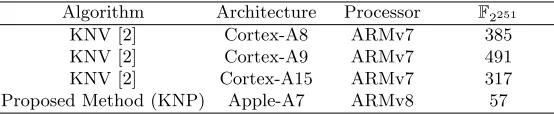
Table 4.Comparison results of binary field multiplication
Algorithm Architecture Processor F2251
KNV [2] Cortex-A8 ARMv7 385
KNV [2] Cortex-A9 ARMv7 491
KNV [2] Cortex-A15 ARMv7 317
Proposed Method (KNP) Apple-A7 ARMv8 57
5
Conclusion
In this paper, we show efficient implementation techniques for binary field mul-tiplication on ARMv8. Our proposed method improves the performance by a factor of 5.5 times than previous techniques on ARMv7. Our future works are efficient binary field elliptic curve cryptography with proposed techniques.
References
1. D. J. Bernstein. Batch binary edwards. InAdvances in Cryptology-CRYPTO 2009, pages 317–336. Springer, 2009.
2. D. Cˆamara, C. P. Gouvˆea, J. L´opez, and R. Dahab. Fast software polynomial multiplication on arm processors using the neon engine. InSecurity Engineering and Intelligence Informatics, pages 137–154. Springer, 2013.
3. C. P. Gouvˆea and J. L´opez. Implementing gcm on armv8. InTopics in Cryptology— CT-RSA 2015, pages 167–180. Springer, 2015.
4. J. Großsch¨adl, R. M. Avanzi, E. Sava¸s, and S. Tillich. Energy-efficient software implementation of long integer modular arithmetic. In Cryptographic Hardware and Embedded Systems–CHES 2005, pages 75–90. Springer, 2005.
5. A. Karatsuba and Y. Ofman. Multiplication of multidigit numbers on automata. InSoviet physics doklady, volume 7, page 595, 1963.
6. J. L´opez and R. Dahab. High-speed software multiplication in f2m. InProgress in CryptologyINDOCRYPT 2000, pages 203–212. Springer, 2000.
7. L. B. Oliveira, D. F. Aranha, C. P. Gouvˆea, M. Scott, D. F. Cˆamara, J. L´opez, and R. Dahab. Tinypbc: Pairings for authenticated identity-based non-interactive key distribution in sensor networks. Computer Communications, 34(3):485–493, 2011. 8. H. Seo, Y. Lee, H. Kim, T. Park, and H. Kim. Binary and prime field multipli-cation for public key cryptography on embedded microprocessors. Security and Communication Networks, 7(4):774–787, 2014.
10. M. Shirase, Y. Miyazaki, T. Takagi, and D.-G. HAN. Efficient implementation of pairing-based cryptography on a sensor node. IEICE transactions on information and systems, 92(5):909–917, 2009.