Cochrane
Database of Systematic Reviews
Workplace interventions for reducing sitting at work (Review)
Shrestha N, Kukkonen-Harjula KT, Verbeek JH, Ijaz S, Hermans V, Pedisic Z
Shrestha N, Kukkonen-Harjula KT, Verbeek JH, Ijaz S, Hermans V, Pedisic Z.
Workplace interventions for reducing sitting at work.
Cochrane Database of Systematic Reviews2018, Issue 6. Art. No.: CD010912. DOI: 10.1002/14651858.CD010912.pub4.
www.cochranelibrary.com
T A B L E O F C O N T E N T S
1 HEADER . . . .
1 ABSTRACT . . . .
3 PLAIN LANGUAGE SUMMARY . . . .
5 SUMMARY OF FINDINGS FOR THE MAIN COMPARISON . . . .
7 BACKGROUND . . . .
9 OBJECTIVES . . . .
9 METHODS . . . .
12 RESULTS . . . .
Figure 1. . . 13 Figure 2. . . 18 Figure 3. . . 21 29 ADDITIONAL SUMMARY OF FINDINGS . . . .
36 DISCUSSION . . . .
Figure 4. . . 38 39 AUTHORS’ CONCLUSIONS . . . .
40 ACKNOWLEDGEMENTS . . . .
41 REFERENCES . . . .
54 CHARACTERISTICS OF STUDIES . . . .
129 DATA AND ANALYSES . . . .
Analysis 1.1. Comparison 1 Sit-stand desk with or without information and counselling versus sit-desk, Outcome 1 Mean difference in time spent sitting at work follow-up short-term. . . 136 Analysis 1.2. Comparison 1 Sit-stand desk with or without information and counselling versus sit-desk, Outcome 2 Mean
difference in time spent sitting at work, follow-up short-term - sensitivity analysis. . . 137 Analysis 1.3. Comparison 1 Sit-stand desk with or without information and counselling versus sit-desk, Outcome 3 Mean
difference in time spent sitting at work. follow-up medium-term (CBA). . . 138 Analysis 1.4. Comparison 1 Sit-stand desk with or without information and counselling versus sit-desk, Outcome 4 Mean
difference in time in sitting bouts lasting 30 minutes or more, follow-up short-term (CBA). . . 139 Analysis 1.5. Comparison 1 Sit-stand desk with or without information and counselling versus sit-desk, Outcome 5 Mean
difference in total time spent sitting (including sitting at and outside work), follow-up short-term. . . 140 Analysis 1.6. Comparison 1 Sit-stand desk with or without information and counselling versus sit-desk, Outcome 6 Mean
difference in time spent standing at work, follow-up short-term. . . 141 Analysis 1.7. Comparison 1 Sit-stand desk with or without information and counselling versus sit-desk, Outcome 7 Mean
difference in time spent standing at work, follow-up short-term (RCT only). . . 142 Analysis 1.8. Comparison 1 Sit-stand desk with or without information and counselling versus sit-desk, Outcome 8 Mean
difference in time spent stepping at work follow-up short-term. . . 143 Analysis 1.9. Comparison 1 Sit-stand desk with or without information and counselling versus sit-desk, Outcome 9 Mean
difference in time spent standng at work, follow-up medium-term (CBA). . . 144 Analysis 1.10. Comparison 1 Sit-stand desk with or without information and counselling versus sit-desk, Outcome 10
Work performance (1-10 scale), follow-up short-term (CBA). . . 145 Analysis 1.11. Comparison 1 Sit-stand desk with or without information and counselling versus sit-desk, Outcome 11
Proportion with≥1 sick days in the last three months (CBA). . . 146 Analysis 1.12. Comparison 1 Sit-stand desk with or without information and counselling versus sit-desk, Outcome 12
Proportion with≥1 sick days in the last month (CBA). . . 146 Analysis 1.13. Comparison 1 Sit-stand desk with or without information and counselling versus sit-desk, Outcome 13
Mean difference in musculoskeletal symptoms, follow-up short-term. . . 147 Analysis 1.14. Comparison 1 Sit-stand desk with or without information and counselling versus sit-desk, Outcome 14
Mean difference in musculoskeletal symptoms, follow-up Medium-term. . . 148 Analysis 2.1. Comparison 2 Standing desk versus sit-stand desk, Outcome 1 Mean difference in time spent sitting at work,
follow-up short-term. . . 148 Analysis 2.2. Comparison 2 Standing desk versus sit-stand desk, Outcome 2 Mean difference in time spent sitting at work,
follow-up medium-term. . . 149
Analysis 3.1. Comparison 3 Active workstation versus sit desk, Outcome 1 Mean difference in time spent sitting at work, follow-up short-term. . . 149 Analysis 3.2. Comparison 3 Active workstation versus sit desk, Outcome 2 Mean difference in time spent in inactive sitting
at work, follow-up medium term. . . 150 Analysis 4.1. Comparison 4 Walking strategies versus no intervention, Outcome 1 Mean difference in time spent sitting at
work, follow-up short term. . . 151 Analysis 4.2. Comparison 4 Walking strategies versus no intervention, Outcome 2 Mean difference in time spent sitting at
work, follow-up medium-term. . . 152 Analysis 4.3. Comparison 4 Walking strategies versus no intervention, Outcome 3 Percentage of lost work productivity
(WLQ Index Score) follow-up medium-term. . . 152 Analysis 5.1. Comparison 5 Short break versus long break, Outcome 1 Mean difference in time spent sitting at work,
follow-up short-term. . . 153 Analysis 6.1. Comparison 6 Information, feedback and/or reminder versus information only or no intervention, Outcome
1 Mean difference in time spent sitting at work, follow-up short term. . . 153 Analysis 6.2. Comparison 6 Information, feedback and/or reminder versus information only or no intervention, Outcome
2 Mean difference in time spent sitting at work, follow-up medium-term. . . 154 Analysis 6.3. Comparison 6 Information, feedback and/or reminder versus information only or no intervention, Outcome
3 Mean difference in total time spent sitting (including sitting at and outside work), follow-up short-term. . . 155 Analysis 6.4. Comparison 6 Information, feedback and/or reminder versus information only or no intervention, Outcome
4 Mean difference in total time spent sitting (including sitting at and outside work), follow-up medium term. . 155 Analysis 6.5. Comparison 6 Information, feedback and/or reminder versus information only or no intervention, Outcome
5 Mean difference in time spent standing at work follow-up short-term. . . 156 Analysis 6.6. Comparison 6 Information, feedback and/or reminder versus information only or no intervention, Outcome
6 Work engagement (0-6 scale), follow-up medium-term. . . 157 Analysis 7.1. Comparison 7 Prompts plus information versus information alone, Outcome 1 Mean difference in time spent
sitting at work, follow-up short term. . . 157 Analysis 7.2. Comparison 7 Prompts plus information versus information alone, Outcome 2 Mean difference in time spent
sitting at work, follow-up medium-term. . . 158 Analysis 7.3. Comparison 7 Prompts plus information versus information alone, Outcome 3 Mean difference in number of
sitting bouts lasting 30 minutes or more, follow-up short-term. . . 158 Analysis 7.4. Comparison 7 Prompts plus information versus information alone, Outcome 4 Mean difference in time in
sitting bouts lasting 30 minutes or more, follow-up short-term. . . 159 Analysis 7.5. Comparison 7 Prompts plus information versus information alone, Outcome 5 Mean difference in total time
spent sitting (including sitting at and outside work), follow-up short-term. . . 160 Analysis 7.6. Comparison 7 Prompts plus information versus information alone, Outcome 6 Mean difference in time spent
standing at work follow-up short-term. . . 160 Analysis 7.7. Comparison 7 Prompts plus information versus information alone, Outcome 7 Mean difference in energy
expenditure, follow-up medium-term. . . 161 Analysis 8.1. Comparison 8 Computer prompts to step versus computer prompts to stand, Outcome 1 Mean difference in
time spent sitting at work, follow-up short-term. . . 161 Analysis 8.2. Comparison 8 Computer prompts to step versus computer prompts to stand, Outcome 2 Mean difference in
number of sitting bouts lasting 30 minutes or more, follow-up short-term. . . 162 Analysis 8.3. Comparison 8 Computer prompts to step versus computer prompts to stand, Outcome 3 Mean difference in
time spent standing at work, follow-up short-term. . . 162 Analysis 8.4. Comparison 8 Computer prompts to step versus computer prompts to stand, Outcome 4 Mean difference in
time spent stepping at work, follow-up short-term. . . 163 Analysis 9.1. Comparison 9 High personalised or contextualised information versus less personalised or contextualised
information, Outcome 1 Mean difference in time in sitting bouts lasting 30 minutes or more, follow-up
short-term. . . 163 Analysis 10.1. Comparison 10 Mindfulness training versus no intervention, Outcome 1 Mean difference in time spent
sitting at work, follow-up medium-term. . . 164 Analysis 10.2. Comparison 10 Mindfulness training versus no intervention, Outcome 2 Work engagement (0-6 scale),
follow-up medium-term. . . 164
Analysis 11.1. Comparison 11 Activity tracker combined with organisational support versus organisational support only, Outcome 1 Mean difference in time spent sitting at work, follow-up short-term. . . 165 Analysis 11.2. Comparison 11 Activity tracker combined with organisational support versus organisational support only,
Outcome 2 Mean difference in time spent sitting at work, follow-up medium-term. . . 165 Analysis 11.3. Comparison 11 Activity tracker combined with organisational support versus organisational support only,
Outcome 3 Mean difference in time in sitting bouts lasting 30 minutes or more, follow-up short-term. . . . 166 Analysis 11.4. Comparison 11 Activity tracker combined with organisational support versus organisational support only,
Outcome 4 Mean difference in time in sitting bouts lasting 30 minutes or more, follow-up medium-term. . . 166 Analysis 11.5. Comparison 11 Activity tracker combined with organisational support versus organisational support only,
Outcome 5 Mean difference in total time spent sitting (including sitting at and outside work), follow-up
short-term. . . 167 Analysis 11.6. Comparison 11 Activity tracker combined with organisational support versus organisational support only,
Outcome 6 Mean difference in total time spent sitting (including sitting at and outside work), follow-up medium-term. . . 167 Analysis 11.7. Comparison 11 Activity tracker combined with organisational support versus organisational support only,
Outcome 7 Mean difference in time spent standing at work follow-up short-term. . . 168 Analysis 11.8. Comparison 11 Activity tracker combined with organisational support versus organisational support only,
Outcome 8 Mean difference in time spent stepping at work, follow-up short-term. . . 168 Analysis 11.9. Comparison 11 Activity tracker combined with organisational support versus organisational support only,
Outcome 9 Mean difference in time spent standing at work follow-up medium-term. . . 169 Analysis 11.10. Comparison 11 Activity tracker combined with organisational support versus organisational support only,
Outcome 10 Mean difference in time spent stepping at work, follow-up medium-term. . . 169 Analysis 12.1. Comparison 12 Multi-component intervention versus no intervention, Outcome 1 Mean difference in time
spent sitting at work, follow-up short-term. . . 170 Analysis 12.2. Comparison 12 Multi-component intervention versus no intervention, Outcome 2 Mean difference in time
spent sitting at work, follow-up medium-term. . . 170 Analysis 12.3. Comparison 12 Multi-component intervention versus no intervention, Outcome 3 Mean difference in
number of sitting bouts lasting 30 minutes or more, follow-up short-term. . . 171 Analysis 12.4. Comparison 12 Multi-component intervention versus no intervention, Outcome 4 Mean difference in time
in sitting bouts lasting 30 minutes or more, follow-up short-term. . . 171 Analysis 12.5. Comparison 12 Multi-component intervention versus no intervention, Outcome 5 Mean difference in time
in sitting bouts lasting 30 minutes or more, follow-up medium-term. . . 172 Analysis 12.6. Comparison 12 Multi-component intervention versus no intervention, Outcome 6 Mean difference in total
time spent sitting (including sitting at and outside work), follow-up short-term. . . 173 Analysis 12.7. Comparison 12 Multi-component intervention versus no intervention, Outcome 7 Mean difference in total
time spent sitting (including sitting at and outside work), follow-up medium-term. . . 173 Analysis 12.8. Comparison 12 Multi-component intervention versus no intervention, Outcome 8 Mean difference in time
spent standing at work follow-up short-term. . . 174 Analysis 12.9. Comparison 12 Multi-component intervention versus no intervention, Outcome 9 Mean difference in time
spent stepping at work follow-up short-term. . . 174 Analysis 12.10. Comparison 12 Multi-component intervention versus no intervention, Outcome 10 Mean difference in
time spent standing at work follow-up medium-term. . . 175 Analysis 12.11. Comparison 12 Multi-component intervention versus no intervention, Outcome 11 Mean difference in
time spent stepping at work follow-up medium-term. . . 175 Analysis 12.12. Comparison 12 Multi-component intervention versus no intervention, Outcome 12 Work engagement
(0-6 scale), follow-up short-term. . . 176 Analysis 12.13. Comparison 12 Multi-component intervention versus no intervention, Outcome 13 Mean difference in
musculoskeletal symptoms all sites (score 0-6) at short-term follow-up. . . 177 177 APPENDICES . . . .
179 WHAT’S NEW . . . .
179 CONTRIBUTIONS OF AUTHORS . . . .
180 DECLARATIONS OF INTEREST . . . .
180 SOURCES OF SUPPORT . . . .
180 DIFFERENCES BETWEEN PROTOCOL AND REVIEW . . . .
181 INDEX TERMS . . . .
[Intervention Review]
Workplace interventions for reducing sitting at work
Nipun Shrestha1, Katriina T Kukkonen-Harjula2, Jos H Verbeek3, Sharea Ijaz4, Veerle Hermans5, Zeljko Pedisic1
1Institute for Health and Sport (IHES), Victoria University, Melbourne, Australia. 2Rehabilitation, South Karelia Social and
Health Care District Eksote, Lappeenranta, Finland.3Cochrane Work Review Group, Finnish Institute of Occupational Health, TYÖTERVEYSLAITOS, Finland.4NIHR CLAHRC West at University Hospitals Bristol NHS Foundation Trust, Population Health Sciences, Bristol Medical School, University of Bristol, Bristol, UK.5Faculty of Psychology & Educational Sciences, Faculty of Medicine & Pharmacy, Vrije Universiteit Brussel, Brussels, Belgium
Contact address: Nipun Shrestha, Institute for Health and Sport (IHES), Victoria University, Melbourne, Victoria, Australia. [email protected],[email protected].
Editorial group:Cochrane Work Group.
Publication status and date:New search for studies and content updated (conclusions changed), published in Issue 6, 2018. Citation: Shrestha N, Kukkonen-Harjula KT, Verbeek JH, Ijaz S, Hermans V, Pedisic Z. Workplace interventions for reducing sitting at work.Cochrane Database of Systematic Reviews2018, Issue 6. Art. No.: CD010912. DOI: 10.1002/14651858.CD010912.pub4.
Copyright © 2018 The Cochrane Collaboration. Published by John Wiley & Sons, Ltd.
A B S T R A C T
Background
A large number of people are employed in sedentary occupations. Physical inactivity and excessive sitting at workplaces have been linked to increased risk of cardiovascular disease, obesity, and all-cause mortality.
Objectives
To evaluate the effectiveness of workplace interventions to reduce sitting at work compared to no intervention or alternative interventions.
Search methods
We searched the Cochrane Central Register of Controlled Trials (CENTRAL), MEDLINE, Embase, CINAHL, OSH UPDATE, PsycINFO, ClinicalTrials.gov, and the World Health Organization (WHO) International Clinical Trials Registry Platform (ICTRP) search portal up to 9 August 2017. We also screened reference lists of articles and contacted authors to find more studies.
Selection criteria
We included randomised controlled trials (RCTs), cross-over RCTs, cluster-randomised controlled trials (cluster-RCTs), and quasi-RCTs of interventions to reduce sitting at work. For changes of workplace arrangements, we also included controlled before-and-after studies. The primary outcome was time spent sitting at work per day, either self-reported or measured using devices such as an accelerometer-inclinometer and duration and number of sitting bouts lasting 30 minutes or more. We considered energy expenditure, total time spent sitting (including sitting at and outside work), time spent standing at work, work productivity and adverse events as secondary outcomes.
Data collection and analysis
Two review authors independently screened titles, abstracts and full-text articles for study eligibility. Two review authors independently extracted data and assessed risk of bias. We contacted authors for additional data where required.
Main results
We found 34 studies - including two cross-over RCTs, 17 RCTs, seven cluster-RCTs, and eight controlled before-and-after studies - with a total of 3,397 participants, all from high-income countries. The studies evaluated physical workplace changes (16 studies), workplace policy changes (four studies), information and counselling (11 studies), and multi-component interventions (four studies). One study included both physical workplace changes and information and counselling components. We did not find any studies that specifically investigated the effects of standing meetings or walking meetings on sitting time.
Physical workplace changes
Interventions using sit-stand desks, either alone or in combination with information and counselling, reduced sitting time at work on average by 100 minutes per workday at short-term follow-up (up to three months) compared to sit-desks (95% confidence interval (CI)−116 to−84, 10 studies, low-quality evidence). The pooled effect of two studies showed sit-stand desks reduced sitting time at medium-term follow-up (3 to 12 months) by an average of 57 minutes per day (95% CI−99 to−15) compared to sit-desks. Total sitting time (including sitting at and outside work) also decreased with sit-stand desks compared to sit-desks (mean difference (MD) −82 minutes/day, 95% CI−124 to−39, two studies) as did the duration of sitting bouts lasting 30 minutes or more (MD−53 minutes/day, 95% CI−79 to−26, two studies, very low-quality evidence).
We found no significant difference between the effects of standing desks and sit-stand desks on reducing sitting at work. Active workstations, such as treadmill desks or cycling desks, had unclear or inconsistent effects on sitting time.
Workplace policy changes
We found no significant effects for implementing walking strategies on workplace sitting time at short-term (MD−15 minutes per day, 95% CI−50 to 19, low-quality evidence, one study) and medium-term (MD−17 minutes/day, 95% CI−61 to 28, one study) follow-up. Short breaks (one to two minutes every half hour) reduced time spent sitting at work on average by 40 minutes per day (95% CI−66 to−15, one study, low-quality evidence) compared to long breaks (two 15-minute breaks per workday) at short-term follow-up.
Information and counselling
Providing information, feedback, counselling, or all of these resulted in no significant change in time spent sitting at work at short-term follow-up (MD−19 minutes per day, 95% CI−57 to 19, two studies, low-quality evidence). However, the reduction was significant at medium-term follow-up (MD−28 minutes per day, 95% CI−51 to−5, two studies, low-quality evidence).
Computer prompts combined with information resulted in no significant change in sitting time at work at short-term follow-up (MD −10 minutes per day, 95% CI−45 to 24, two studies, low-quality evidence), but at medium-term follow-up they produced a significant reduction (MD−55 minutes per day, 95% CI−96 to−14, one study). Furthermore, computer prompting resulted in a significant decrease in the average number (MD−1.1, 95% CI−1.9 to−0.3, one study) and duration (MD -74 minutes per day, 95% CI−124 to−24, one study) of sitting bouts lasting 30 minutes or more.
Computer prompts with instruction to stand reduced sitting at work on average by 14 minutes per day (95% CI 10 to 19, one study) more than computer prompts with instruction to walk at least 100 steps at short-term follow-up.
We found no significant reduction in workplace sitting time at medium-term follow-up following mindfulness training (MD−23 minutes per day, 95% CI−63 to 17, one study, low-quality evidence). Similarly a single study reported no change in sitting time at work following provision of highly personalised or contextualised information and less personalised or contextualised information. One study found no significant effects of activity trackers on sitting time at work.
Multi-component interventions
Combining multiple interventions had significant but heterogeneous effects on sitting time at work (573 participants, three studies, very low-quality evidence) and on time spent in prolonged sitting bouts (two studies, very low-quality evidence) at short-term follow-up.
Authors’ conclusions
At present there is low-quality evidence that the use of sit-stand desks reduce workplace sitting at short-term and medium-term follow-ups. However, there is no evidence on their effects on sitting over longer follow-up periods. Effects of other types of interventions, including workplace policy changes, provision of information and counselling, and multi-component interventions, are mostly incon-sistent. The quality of evidence is low to very low for most interventions, mainly because of limitations in study protocols and small
sample sizes. There is a need for larger cluster-RCTs with longer-term follow-ups to determine the effectiveness of different types of interventions to reduce sitting time at work.
P L A I N L A N G U A G E S U M M A R Y
Workplace interventions (methods) for reducing time spent sitting at work Why is the amount of time spent sitting at work important?
Time spent sitting and being physically inactive at work has increased in recent decades. Long periods of sitting may increase the risk of obesity, heart disease, and premature death. It is unclear whether interventions that aim to reduce sitting at workplaces are effective.
The purpose of this review
We wanted to find out the effects of interventions aimed at reducing sitting time at work. We searched the literature in various databases up to 9 August 2017.
What trials did the review find?
We found 34 studies conducted with a total of 3,397 employees from high-income countries. Sixteen studies evaluated physical changes in the workplace design and environment, four studies evaluated changes in workplace policies, 10 studies evaluated information and counselling interventions, and four studies evaluated multi-category interventions.
Effect of sit-stand desks
The use of sit-stand desks seems to reduce workplace sitting on average by 84 to 116 minutes per day. When combined with the provision of information and counselling, the use of sit-stand desks seems to result in similar reductions in sitting at work. Sit-stand desks also seem to reduce total sitting time (including sitting at work and outside work) and the duration of workplace sitting bouts that last 30 minutes or longer. One study compared standing desks and sit-stand desks but due to the small number of employees included, it does not provide enough evidence to determine which type of desk is more effective at reducing sitting time.
Effect of active workstations
Treadmill desks combined with counselling seem to reduce sitting time at work, while the available evidence is insufficient to conclude whether cycling desks combined with the provision of information reduce sitting at work more than the provision of information alone.
Effect of walking during breaks or length of breaks
The available evidence is insufficient to draw conclusions about the effectiveness of walking during breaks in reducing sitting time. Taking short breaks (one to two minutes every half hour) seems to reduce time spent sitting at work by 15 to 66 minutes per day more than taking long breaks (two 15-minute breaks per workday).
Effect of information and counselling
Providing information, feedback, counselling, or all of these reduces sitting time at medium-term follow-up (3 to 12 months after the intervention) on average by 5 to 51 minutes per day. The available evidence is insufficient to draw conclusions about the effects at short-term follow-up (up to three months after the intervention). The use of computer prompts combined with providing information reduces sitting time in the medium-term on average by 14 to 96 minutes per day. The available evidence is insufficient to draw conclusions about the effects in the short-term.
One study found that prompts to stand reduce sitting time more than prompts to step, on average by 10 to 19 minutes per day.
The available evidence is insufficient to conclude whether providing highly personalised or contextualised information is more or less effective than providing less personalised or contextualised information in reducing siting time at work. The available evidence is also insufficient to draw conclusions about the effect of mindfulness training and the use of activity trackers on sitting at work.
Effect of combining multiple interventions
Combining multiple interventions seems to be effective in reducing sitting time and time spent in prolonged sitting bouts in the short-term and the medium-short-term. However, this evidence comes from only a small number of studies and the effects were very different across the studies.
Conclusions
The quality of evidence is low to very low for most interventions, mainly because of limitations in study protocols and small sample sizes. At present there is low-quality evidence that sit-stand desks may reduce sitting at work in the first year of their use. However, the effects are likely to reduce with time. There is generally insufficient evidence to draw conclusions about such effects for other types of interventions and for the effectiveness of reducing workplace sitting over periods longer than one year. More research is needed to assess the effectiveness of different types of interventions for reducing sitting at workplaces, particularly over longer periods.
S U M M A R Y O F F I N D I N G S F O R T H E M A I N C O M P A R I S O N [Explanation]
Alternative desks and workstations compared to sit- desks for reducing sitting at work
Patient or population:em ployees who sit at work Setting:workplace
Intervention:alternative desks and workstations Comparison:sit-desks
Outcomes Anticipated absolute effects∗(95% CI) of participants
(studies)
Certainty of the evidence (GRADE)
Comments
Risk with sit- desk Risk with changes in desk
Comparison: sit- stand desk with or without information and counselling versus sit- desk
M ean dif f erence in tim e spent sitting at work, short-term f ollow-up (up to 3 m onths)
The m ean dif f erence in tim e spent sitting at work (short-term f ollow-up) was 364 m inutes
M D 100 m inutes lower (116 lower to 84 lower)
323
(10 studies: 4 RCTs, 2 cross-over RCTs, 4 CBAs)
⊕⊕
LOW12
Subgroup analysis showed no dif f erence in ef f ect be-tween sit-stand desks used alone or in com bination with inf orm ation and coun-selling. Restricting the anal-ysis to RCTs only did not show any dif f erence in ef -f ect either
M ean dif f erence in tim e in sitting bouts lasting 30 m in-utes or m ore, short-term f ol-low-up
The m ean dif f erence in tim e in sitting bouts lasting 30 m inutes or m ore (short-term f ollow-up) was 167 m inutes
M D 53 m inutes lower (79 lower to 26 lower)
74 (2 CBAs)
⊕
VERY LOW23
Comparison: treadmill desk combined with counselling versus sit- desk
M ean dif f erence in tim e spent sitting at work, short-term f ollow-up (up to 3
The m ean dif f erence in tim e spent sitting at work (short-term f ollow-up) was 342
M D 29 m inutes lower (55 lower to 2 lower)
M ean dif f erence in tim e in sitting bouts lasting 30 m in-utes or m ore, short-term f ol-low-up - not reported
- - -
-Comparison: cycling desk + information and counselling versus sit- desk + information and counselling
M ean dif f erence in tim e spent in inactive sitting at work, m edium -term f ollow-up (f rom 3 to 12 m onths)
The m ean dif f erence in tim e spent in inactive sitting at work (m edium -term f ollow-up) was 413 m inutes
M D 12 m inutes lower (24 lower to 1 higher)
54 (1 RCT)
⊕⊕
LOW25
*The risk in the intervention group(and its 95% conf idence interval) is based on the assum ed risk in the com parison group and therelative effectof the intervention (and its 95% CI).
CI:Conf idence interval;RR:Risk ratio;OR:Odds ratio;RCT:random ised controlled trialCBA:controlled bef ore-and-af ter study;M D:m ean dif f erence
GRADE Working Group grades of evidence
High certainty:We are very conf ident that the true ef f ect lies close to that of the estim ate of the ef f ect
M oderate certainty:We are m oderately conf ident in the ef f ect estim ate: The true ef f ect is likely to be close to the estim ate of the ef f ect, but there is a possibility that it is substantially dif f erent
Low certainty:Our conf idence in the ef f ect estim ate is lim ited: The true ef f ect m ay be substantially dif f erent f rom the estim ate of the ef f ect
Very low certainty:We have very little conf idence in the ef f ect estim ate: The true ef f ect is likely to be substantially dif f erent f rom the estim ate of ef f ect
1Of the six RCTs, f ive were at high risk of bias. The non-random ised controlled bef ore-and-af ter study/ studies were also at
high risk of bias; downgraded one level
2Im precision with wide conf idence intervals, sm all sam ple size; downgraded one level
3Unconcealed allocation, unblinded outcom e assessm ent and attrition bias; downgraded two levels 4Unblinded outcom e assessm ent; downgraded one level
5Unblinded outcom e assessm ent and attrition bias; downgraded one level
B A C K G R O U N D
Description of the condition
Sedentary behaviour, especially sitting, has attracted great interest from media, government agencies and researchers in recent years. Energy expenditure in various tasks can be expressed in metabolic equivalents (METs). One MET is equivalent to resting energy expenditure, i.e. the energy cost of resting quietly, defined as an oxygen uptake of 3.5 mL kg−1min−1(Ainsworth 2000). Sitting at work and conducting work tasks whilst seated usually involves energy expenditure of 1.5 METs or less. Reduction in time spent sitting usually results in increased levels of physical activity of light to moderate intensity, such as standing or walking (Mansoubi 2014).
The nature of office work has changed since the year 2000 in such a way that workers do not have to move often from their work stations (VicHealth 2012). Advancement in technology (e.g. robotics, computers) has led to a decrease in physical strain at workplaces (Craig 2002). Consequently, workers in some settings have become less physically active at their workplace compared to their leisure time (Franklin 2011;McCrady 2009;Parry 2013; Thorp 2012;van Uffelen 2010). Since the 1960s, in the USA and the UK for example, population levels of occupational phys-ical activity have declined by more than 30% (Ng 2012). A large decline in occupational physical activity has been also found in low- and middle-income countries, such as Brazil and China (Ng 2012). This decline in occupational physical activity can largely be attributed to an increase in time spent sitting at the workplace. It has been found that office-based employees spent 66% of their total working time sitting, with 5% of all sitting events and 25% of total sitting time spent in bouts longer than 55 minutes (Ryan 2011).
Studies have shown that excessive time spent sitting at work may increase the risk of cardiovascular disease, obesity, diabetes, and all-cause mortality, even if one is engaged in recommended levels of physical activity during their leisure time (Chau 2014a;Craft 2012;Dunstan 2011). Estimates show a 5% increase in the risk of obesity and 7% increase in the risk of diabetes associated with every two-hour per day increase in sitting time at work (Hu 2003). It has also been estimated that those who sit for eight to 11 hours per day are at a 15% increased risk of death in the next three years than those who sit for less than four hours per day, whilst the risk increases to 40% for those who sit for more than 11 hours per day (Van der Ploeg 2012). InBey 2003, it is hypothesised that replacing sitting with physical activity of light (from 1.5 METs to 3 METs) to moderate (3 METs to 6 METs;Ainsworth 2011) intensity improves glucose and lipid metabolism. Another study, Duvivier 2013, has also suggested that benefits may be greater when sitting is replaced with activity of light to moderate intensity, such as standing and walking, than when it is replaced with vigor-ous cycling of equal energy expenditure. This may indicate that,
in interventions to reduce sedentary behaviour, changing posture may be equally or even more important than increasing energy expenditure.
Description of the intervention
It is estimated that 60% of the world’s population is part of the workforce and spends on average 60% of their waking hours at work (WHO/WEF 2008). Thus, it is possible to influence health behaviour of a large proportion of the adult population worldwide through workplace interventions.
Workplaces have the advantage of having the potential for creating in-built social support, that is, active collaboration of employees in making sustainable changes to attain a healthy lifestyle, which may reduce the degree of individual effort and motivation needed to make behavioural changes. Therefore, the changes in lifestyle achieved at work are thought to be sustainable in the long term (Plotnikoff 2012).
Workers can be encouraged to be more physically active through changes in the workplace environment and design. A conventional sitting desk can be replaced or supplemented with: a sit-stand desk; a so-called ’hot desk’ that is height-adjustable and allows its user to alternate posture between sitting and standing (Alkhajah 2012; Gilson ND 2012;Straker 2013); a vertical workstation that allows the use of a personal computer while walking on a treadmill at a self-selected velocity (Levine 2007); a stepping/pedalling desk exercise machine placed under the desk that allows the user to step or pedal while being seated (McAlpine 2007); an inflated balloon chair; or a therapy ball (Beers 2008; USPTO 2000). Replacing conventional office chairs with inflated balloon chairs makes the act of sitting more physically demanding by increasing the need to use the abdominal, back, leg and thigh muscles to remain upright and maintain balance.
Time spent in sedentary behaviour can theoretically also be re-duced by changing the layout of workplaces, for example by plac-ing printers further away from desks. Office work can also be made more physically demanding by forming walking or other exer-cise groups like dance or gym groups during work time (Ogilvie 2007;Thogersen-Ntoumani 2013), and by encouraging employ-ees to walk around office buildings during breaks or to take a walk to communicate with fellow employees instead of using the telephone or email. The practices and policies of workplaces can be changed by incorporating periodic breaks within the organisa-tional schedule including short bouts of physical activity (e.g. five to 15-minute activity bouts) or by conducting walking or standing meetings (Commissaris 2007). Meeting rooms can be equipped with sit-stand desks so that employees can choose to stand during meetings, if they wish (Atkinson 2014). These changes in work-place practice and policy have the potential of providing an op-portunity to a large number of people, who mostly sit at work, to reduce their sitting time.
Workers can also be made aware of the importance of changing their sitting behaviour by the provision of information, such as by motivational prompts to sit less at the workstation, via e-health interventions that encourage and remind workers to sit less or in-terrupt prolonged periods of sitting (Cooley 2014;Evans 2012; Pedersen 2013), or by distributing leaflets with messages like “Sit less, move more” that highlight the risks associated with sitting. An e-health intervention consists of information that is delivered electronically like emails, point-of-choice prompts, or any mes-sage periodically displayed on the computer screen. Informational interventions can also be delivered by trained counsellors in an in-teractive manner, where, as part of counselling sessions, they find out about worker’s interests and provide the worker different op-tions on how to reduce sedentary behaviour (Opdenacker 2008). There are some potential drawbacks to these interventions. The performance and productivity of workers at sitting jobs might be decreased when walking at the workplace is encouraged and the employees more frequently leave their desks. Workers using a treadmill desk need to be careful not to trip or fall, and thus divide their attention between work and safety, which might compromise their productivity (Tudor-Locke 2013). In addition, fine motor skills like mouse handling accuracy, math problem solving skills, and perceived work performance seem to decrease with treadmill and cycling desks (Commissaris 2014;John 2009). This decrease in efficiency might be due to learning effects, that is, becoming acquainted with new modes of work.
How the intervention might work
According to ecological models, successful strategies for reducing sedentary behaviour include:
• providing access to infrastructures for reducing sedentary behaviour;
• increasing awareness and understanding of the importance of and methods for reducing sedentary behaviour; or
• using social networks and organisational support to inform and encourage changes in policies and norms related to sedentary behaviour (Sallis 2006).
Based on this definition, we envisage three different ways (in isola-tion or conjuncisola-tion with each other) in which intervenisola-tions could work to decrease sitting at workplaces.
Physical changes in the workplace design and environment
If employees are using a conventional desk or chair in the work-place, provision of new types of work desks or chairs can make them aware of the possibilities such new equipment offers to de-crease sitting, and they may be tempted to try them. This would hypothetically replace sitting with some other activity, while al-lowing the usual tasks to be carried out with the same efficiency. Changing the layout of the workplace by, for example, placing
printers away from desks would force employees to stand up and walk to obtain their printouts.
Policies to change the organisation of work
Organisational policies could support the formation of walking or exercise groups at the workplace or conducting walking meetings. Formation of walking or exercise groups or conducting walking meetings, might help individuals to reduce sitting and might also help them encourage each other to adapt new behaviours. The provision of purposive short breaks (with the aim of reducing sit-ting) might help workers engage in such activities more frequently. The breaks might also encourage employees to take a walk to com-municate with colleagues instead of using the telephone or email. Standing meeting rooms would provide an opportunity for office employees to reduce their sitting time.
Provision of information and counselling
Sedentary workers could be made aware of the importance of re-ducing their time spent in sedentary behaviour. They could be in-formed about health risks and the benefits of reducing time spent sitting and replacing it with time spent in a more physically de-manding behaviour. InWilks 2006, it was found that employees who had received information regarding the health risks of sit-ting were more likely to use a sit-stand desk more frequently than those who had not. Even if people are aware of the adverse effects of excessive sitting, and have access to facilities and programs to decrease sitting, they might still find difficulties in adapting to new behaviour. It requires conscious effort for a person to inter-rupt their normal sitting behaviour and engage in physical activ-ity while at work. To facilitate behaviour change, people could be provided with point-of-choice prompts or counselling, which might enable individuals to evaluate their behavioural choices and motivate them to adopt healthy ones. Points-of-choice prompts can be delivered through various means such as signs, emails, text messages, or telephone calls, to motivate change of behaviour. A prompting software can be installed on an employee’s personal computer, so that a one-minute reminder to take a break appears on their screen every 30 minutes (Evans 2012).
Why it is important to do this review
Interventions to decrease sitting at work are becoming increasingly popular, but it is unclear whether they are effective in the long term or not (Healy 2013). Therefore, there is a need to evaluate whether sitting at work can be reduced by interventions, and to compare the effectiveness of various types of such interventions. Although some studies have shown that sit-stand desks and walk-ing strategies have been useful in reducwalk-ing sittwalk-ing, no significant difference in the duration of individual bouts of sitting was found inStraker 2013. Another study did not find a significant effect of
strategies to increase walking on sitting behaviour (Gilson 2009), while inEvans 2012, it was found that point-of-choice prompting software along with education was superior to education alone. Such inconsistency in the findings from individual studies means it is unclear whether workplace interventions for reducing sitting are effective, and whether different types of interventions differ in their effectiveness.
Possibly because of the variation in results across studies, recom-mendations for reducing sitting at work vary. In recent years, several countries, such as the UK and Australia (Australian Government 2014;Department of Health 2011), have incorpo-rated sedentary behaviour recommendations as part of their phys-ical activity guidelines. These guidelines, however, only propose potential strategies for reducing sitting time without quantifying the recommended total duration of sitting time. In 2015, an in-ternational group of experts recommended that desk-based em-ployees should aim towards accumulating two hours of standing and light activity (light walking) per day during working hours, eventually progressing to a total accumulation of four hours per day. To achieve this, they recommended breaking up sitting time with standing by using sit-stand desks or by taking short active standing breaks (Buckley 2015). While all these guidelines stress the evidence of the adverse effects of sitting on health, there is little evidence that different interventions aiming to reduce sitting can help individuals meet any of these recommendations. Further-more, since this topic is of increasing interest, it is likely that the availability of evidence will increase in the near future. A Cochrane systematic review will ensure timely updating of this information for decision makers.
O B J E C T I V E S
To evaluate the effectiveness of workplace interventions for reduc-ing sittreduc-ing at work compared to no intervention or alternative in-terventions.
M E T H O D S
Criteria for considering studies for this review
Types of studies
We included randomised controlled trials (RCTs), cross-over RCTs, cluster-RCTs, and quasi-RCTs. Quasi-RCTs are trials that allocate participants to the intervention or control group using a method of randomisation that is not actually random. At work-places, interventions operate at group level and may therefore be
difficult to deliver to individuals (Ijaz 2014). Since it is more diffi-cult to randomise units when the intervention is implemented at a higher aggregate level, we also included controlled before-and-after studies (CBAs) that used a concurrent control group for the interventions that aimed to change workplace arrangements.
Types of participants
We included all studies conducted with participants aged 18 years or more, whose occupations involved spending the majority of their working time sitting at a desk, such as administrative work-ers, customer service operators, help-desk professionals, call-cen-tre representatives, and receptionists.
We excluded studies that addressed transportation work. People working in the transportation industry (such as taxi drivers, truck drivers, bus drivers, and airline pilots) and who operate heavy equipment (such as crane operators and bulldozer operators) are also exposed to prolonged sitting, but current technology provides very limited options for implementing interventions to decrease sitting in such occupations. Reducing sitting in people who work in the transportation industry and operate heavy machinery would require specific interventions that could be the scope of another review.
Types of interventions
Intervention
Physical changes in the workplace design and environment • Changes in the layout of the workplace, such as placing printers away from office desks.
• Changes in desks enabling more physical activity, such as the use of sit-stand desks, vertical workstations on treadmills, desk cycle/cycling desks, or stepping devices.
• Changes in chairs enabling more physical activity, such as inflated balloon chairs or therapy balls.
Policies to change the organisation of work
• Walking meetings and walking or other exercise groups during work time.
• Breaks (periodic, frequent, or purposive) to sit less, stand up, and take an exercise break.
• Sitting diaries.
Provision of information and counselling
• Signs or prompts at the workplace (e.g. posters) or at the workstation (computer).
• E-health intervention. • Distribution of leaflets.
• Counselling (face to face, by email, or by telephone).
Multi-component interventions
• Interventions that included elements from all the three above-mentioned categories.
Comparison
We compared the interventions described above with no interven-tion or with other interveninterven-tions.
Types of outcome measures
Primary outcomes
We included studies that evaluated sitting at work measured either as:
• self-reported time spent sitting at work by questionnaires; or • device-based measures of sitting assessed by means of an accelerometer-inclinometer, which assesses intensity of physical activity and body posture (Kanoun 2009;Kim 2015); or
• self-reported or device-based measures of time spent in prolonged sitting bouts (e.g. 30 minutes or more) and number of such bouts.
Secondary outcomes
• Estimated energy expenditure in metabolic equivalent (MET) hours per workday as a proxy measure to detect changes in sitting time.
• Self-reported or device-measured total time spent sitting, including sitting at and outside work.
• Self-reported or device-measured time spent standing and stepping at work.
• Work productivity.
• Adverse events including any reported musculoskeletal symptoms due to prolonged standing as a possible side-effect of using a sit-stand desk.
Search methods for identification of studies
Electronic searches
We searched for all eligible published and unpublished trials in any language. We were prepared to translate non-English language abstracts for potential inclusion. Our search strategy was based on types of study population, types of study design, work-related as-pects, and outcomes related to sitting, and it consisted of keywords generated with the help of a thesaurus, such as ’seated posture’. We searched the following electronic databases from inception to 9 August 2017 for identifying potential studies:
• Cochrane Central Register of Controlled Trials (CENTRAL;Appendix 1);
• MEDLINE (searched through Ovid;Appendix 2); • Cumulative Index to Nursing & Allied Health Literature (CINAHL;Appendix 3);
• Occupational Safety and Health Database (OSH UPDATE;Appendix 4);
• Excerpta Medica dataBASE (Embase;Appendix 5); • PsycINFO (searched through Ovid;Appendix 6); • ClinicalTrials.gov (http://clinicaltrials.gov/;Appendix 7); and
• World Health Organization ( WHO) International Clinical Trials Registry Platform ( ICTRP) search portal (http:// apps.who.int/trialsearch/;Appendix 8).
Searching other resources
We checked reference lists of all included studies and systematic reviews for additional trials. We contacted experts in the field and authors of included studies to identify additional unpublished or ongoing studies.
Data collection and analysis
Selection of studies
Two review authors (NS, KKH) independently screened titles and abstracts of the documents found in our systematic search, to identify potential studies for inclusion. The same authors marked citations as ’retrieve’ (eligible or potentially eligible/unclear) or ’do not retrieve’. We retrieved full-text study reports or publications for all citations considered potentially relevant. Two authors (NS, KKH) independently assessed the retrieved full-texts to identify eligible studies for inclusion. We recorded reasons for exclusion of ineligible studies. We resolved disagreements through discussion or, if required, we consulted a third author (SI). We identified and excluded duplicates and collated multiple reports of the same study so that each study rather than each report was the unit of interest in the review. We recorded the selection process in sufficient detail to create a Preferred Reporting Items for Systematic Reviews and Meta-Analyses (PRISMA) flow diagram (Moher 2009).
Data extraction and management
We used a data collection template to extract study characteristics and outcome data. We extracted the following information.
• Methods: study location, date of publication, type of study design, study setting.
• Participants: number randomised or recruited, mean age or age range, gender, inclusion and exclusion criteria of the trial, occupation, number of withdrawals, similarity of study groups in age, gender, occupation, and sitting time at baseline.
• Interventions: description of intervention methods and randomised groups, duration of active intervention, duration of follow-up, and description of comparisons, interventions and co-interventions.
• Outcomes: description of primary and secondary outcomes and their assessment methods.
• Notes: source of funding for the trial and potential conflicts of interest of trial authors.
Two review authors (NS and either VH or SI) independently ex-tracted outcome data from the included studies. We noted in the Characteristics of included studies table when trial authors did not report outcome data in a usable way. We resolved disagree-ments by consensus or by involving a third author (either SI or VH). One review author (NS) transferred data into Cochrane’s statistical software, Review Manager 5 (Review Manager 2014). We double-checked that we had entered the data correctly. For this purpose we tabulated extracted information about studies in a spreadsheet before entry into Review Manager. A review author (JV) spot-checked a random 20% of extracted data for accuracy against the trial report.
Assessment of risk of bias in included studies
Two review authors (NS and either VH or SI) independently as-sessed risk of bias for each study using the criteria outlined in the Cochrane Handbook for Systematic Reviews of Interventions(Higgins 2011). We resolved disagreements by discussion or by involving another author (ZP). We assessed the included studies’ risk of bias according to the following domains.
• Random sequence generation • Allocation concealment
• Blinding of participants and personnel • Blinding of outcome assessment • Incomplete outcome data • Selective outcome reporting • Validity of outcome measure
• Baseline comparability/imbalance for age, gender and occupation of study groups
We graded each potential source of bias as high, low, or unclear and provided a quote from the study report together with a justification for our judgment in the ’Risk of bias’ tables. We summarised the risk of bias judgements across different studies for each of the domains. Where information on risk of bias related to unpublished data or correspondence with a trialist, we noted it as such in the ’Risk of bias’ tables.
We judged studies as being at low risk for selective outcome re-porting, if the publications of the trial followed what had been planned and had been registered in international databases ( trial registries), such as ClinicalTrials.gov, Australia and New Zealand Clinical Trials Registry (anzctr.org.au/), or Netherlands Trial Reg-istry (trialregister.nl). We judged the studies that were not regis-tered in trial registries as being at low risk for selective outcome
reporting if they had reported all the outcomes mentioned in their methods section.
We judged a study to be at low risk of bias overall when the study included a sufficiently detailed description of its random sequence generation, allocation concealment, blinding of outcome assess-ment, complete outcome data, no selective outcome reporting, and valid outcome measures, that is, all the domains had a low risk of bias. We judged a study to have a high risk of bias when it reported a feature that would be judged as having a high risk of bias in any one of the eight domains. We did not assess blinding of participants or study personnel for risk of bias, as it is very dif-ficult to blind either of them in studies that are trying to modify sedentary behaviour.
Measures of treatment effect
We entered the outcome data for each study into the data tables in Review Manager to calculate the pooled treatment effects. We used risk ratios (RRs) for dichotomous outcomes and mean dif-ferences (MDs) for continuous outcomes. Where only effect esti-mates and their 95% confidence intervals (CIs) or standard errors were reported in studies, we entered these data into Review Man-ager using the generic inverse variance method.
Unit of analysis issues
For cluster-RCTs that did not present results accounting for clus-tering effect, we calculated these assuming a large intra-cluster cor-relation coefficient of 0.10. We based this assumption on a realis-tic estimate by analogy on studies about implementation research (Campbell 2001). We transformed all measurement units for sit-ting at work into minutes per eight-hour workday where needed and possible, and assumed the data referred to a five-day work week, if this was not reported.
Dealing with missing data
We contacted researchers or study sponsors to verify key study characteristics and obtain missing information or full-text reports. When we did not find a full study report even after contacting au-thors listed in the respective abstract, we categorised the references asStudies awaiting classification.
For missing data not obtained from authors, such as standard deviations, we calculated these following the advice in theCochrane Handbooksection 16.1.2 (Higgins 2011). We tested the inclusion of studies with missing data and any imputations in sensitivity analyses.
Assessment of heterogeneity
We assessed clinical homogeneity of the results of included studies based on similarity of populations, interventions, outcomes, and follow-up times. We considered populations to be similar when the participants were 18 years or older and their occupations involved
sitting for a major part of their working time. We considered interventions to be similar when their working mechanisms were similar, for example, replacing sit-desks with sit-stand desks (see Types of interventions). We regarded follow-up times of three months or less as short-term, between three months and one year as medium-term, and more than one year as long-term. We quantified the degree of heterogeneity using the I² statistic, where an I² value of 25% to 50% indicates a low degree of het-erogeneity, 50% to 75% a moderate degree of hethet-erogeneity, and more than 75% a high degree of heterogeneity. If we identified moderate to high heterogeneity, we reported it and explored pos-sible causes by pre-specified subgroup analyses.
Assessment of reporting biases
When ten or more studies were included in a meta-analysis, we tested for the effect of small studies using a funnel plot.
Data synthesis
We analysed the effects of interventions in the categories defined in Types of interventions: physical changes in the workplace design and environment (changes in desks; changes in chairs); policies to change the organisation of work (supporting social environment and policies for breaks); or provision of information and coun-selling. We pooled effect size estimates from individual studies us-ing Review Manager 5 (Review Manager 2014). We considered studies to be heterogeneous, and therefore used a random-effects model to calculate pooled effect sizes.
We calculated the prediction interval for the outcome sitting time at work for sit-stand desks compared to sit-desks. Prediction in-tervals give an estimate of the effect of a new study based on the heterogeneity of effects of studies included in the meta-analysis (Higgins 2009;IntHout 2016).
’Summary of findings’ table
We reported time spent sitting at work and time spent in sitting bouts of 30 minutes or more at short-term follow-up in the ’Sum-mary of findings’ table. Where study authors did not report effects in the short-term follow-up for the outcomes mentioned above, we presented results at medium-term follow-up. We only reported
the most relevant comparisons. We used the Grading of Recom-mendations Assessment, Development and Evaluation (GRADE) considerations (study limitations, consistency of effect, impreci-sion, indirectness, and publication bias) to assess the quality of the body of evidence that contributed data to the meta-analyses for these outcomes (Higgins 2011). We justified all decisions to downgrade or upgrade the quality of evidence using footnotes and we made comments to aid readers’ understanding of the review where necessary.
Subgroup analysis and investigation of heterogeneity
If sufficient data become available in future updates of this review we will conduct the following subgroup analyses for the primary outcome of time spent sitting at work.
• Age: we will compare studies conducted in participants aged 18 to 40 years with studies where all participants were aged 41 years or older, as the probability of maintaining good health and fitness diminishes with older age (AIHW 2008). Older employees might also expect a larger health benefit due to a reduction in sitting (Manini 2015).
• Types of outcome measure: we will carry out a subgroup analysis by type of outcome measure, that is, self-reported (e.g. questionnaire, log book) versus accelerometer/inclinometer versus Ecological Momentary Assessment.
• Types of intervention: we will carry out a subgroup analysis for different interventions that have been pooled under a broader category of intervention.
Similarly, we will assess the robustness of our results by excluding studies we judge to have a high risk of bias from all meta-analyses.
R E S U L T S
Description of studies
See:Figure 1,Characteristics of included studies,Characteristics of excluded studies,Characteristics of studies awaiting classification, andCharacteristics of ongoing studies.
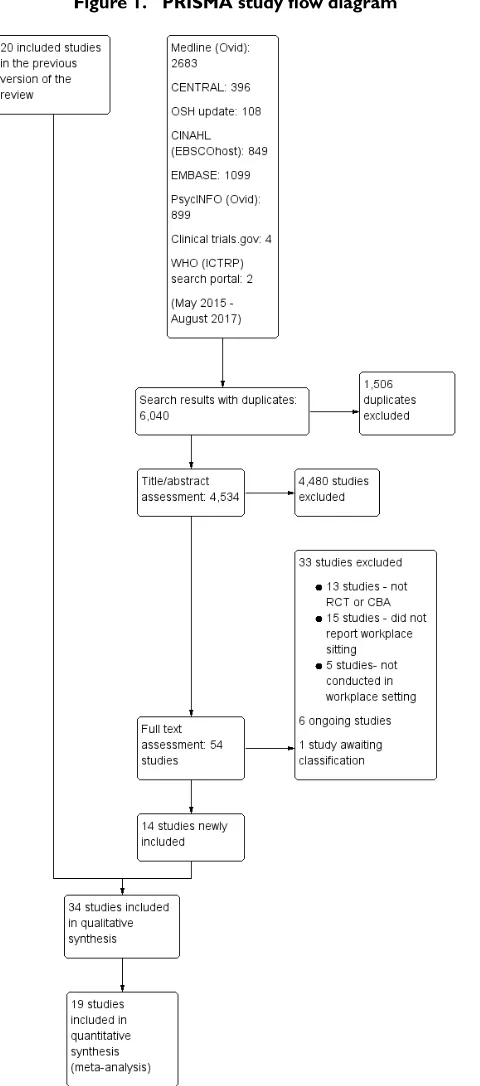
Figure 1. PRISMA study flow diagram
Results of the search
We conducted systematic searches in selected electronic databases and grey literature sources. We identified altogether 12,368 refer-ences in the initial search (December 2013) and the first search update (June 2015), and retrieved a total of 92 references for full-text scrutiny. Of these, we excluded 72 articles and included 20 studies in the previous published version of this review. For this up-date, we searched the electronic databases from June 2015 until 9 August 2017. The updated search identified a total of 6,040 refer-ences, as outlined inFigure 1: 396 from CENTRAL (Appendix 1; 9 August 2017); 2683 from MEDLINE (searched through Ovid, Appendix 2; 9 August 2017); 849 from CINAHL (Appendix 3; 9 August 2017); 108 from OSH UPDATE (Appendix 4; 9 Au-gust 2017); 1099 from Embase (Appendix 5; 9 AuAu-gust 2017); 899 from PsycINFO (Appendix 6; 9 August 2017); 4 from Clinical-Trials.gov (Appendix 7; 9 August 2017); and 2 from the WHO trials search portal (Appendix 8; 9 August 2017). Removal of du-plicates reduced the total number of references to 4,534. Based on their titles and abstracts, we selected 54 of these references for full-text reading. Out of these, we excluded 33 studies. Six studies are ongoing and one study was not available in full text so we classified it as a study awaiting classification. This resulted in 14 studies being included in this review update in addition to the 20 studies already included in the previous version of the review.
Included studies
Study design
Out of the 34 included studies, 17 are RCTs, two are cross-over RCTs, seven are cluster-RCTs, and eight are controlled before-and-after studies with concurrent controls. SeeCharacteristics of included studiesfor further details. Although the authors described their studies as quasi-RCTs, we categorisedAlkhajah 2012, and Neuhaus 2014a, as controlled before-and-after studies because the risk of baseline differences for studies with only two clusters is very high. Only one cluster trial reported unadjusted results (De Cocker 2016). Therefore we adjusted their results for the design effect following the methods stated in Section 16.3 of theCochrane Handbook for Systematic Reviews of Interventionsfor the calculations (Higgins 2011).
We considered randomised and non-randomised studies as similar if there were no considerable differences in their effect estimates (Alkhajah 2012; Chau 2014;Chau 2016; Dutta 2014; Graves 2015; Healy 2013;Li 2017; MacEwen 2017; Neuhaus 2014a; Tobin 2016), but explored any potential differences in a subgroup analysis.
For meta-analyses that included two arms of the same study, we halved the number of participants in the control group (Coffeng
2014;De Cocker 2016;Neuhaus 2014a). ForCoffeng 2014, we used the unadjusted results at twelve months follow-up. In other comparisons we used the adjusted values with the generic inverse variance method. One included study (Neuhaus 2014a) reported only MDs and standard errors and the authors could not provide raw data, so we could not adjust the number of participants. In this case we modelled the means and standard deviations from the intervention and the control group in Review Manager as closely to the real data as possible to achieve the same MD and standard error. Then we halved the number of participants in the control group and entered the resulting standard errors into Review Manager.
Participants
The included studies were conducted with a total of 3,397 em-ployees. The sample sizes of included trials ranged from 16 in the smallest study (Chau 2016), to 523 in the largest one (Verweij 2012), with a median of 44. Studies included workers from the public and private sectors, with nine studies including researchers and other academic staff, two studies including health workers, and 23 including employees in private companies.
Gender
Participants in 20 studies were predominantly women (Carr 2015; Danquah 2017; De Cocker 2016;Donath 2015; Dutta 2014; Evans 2012;Gao 2015;Gilson 2009;Graves 2015;Healy 2016; Kress 2014;Li 2017;MacEwen 2017;Mailey 2016;Pickens 2016; Priebe 2015;Schuna 2014;Swartz 2014;Tobin 2016;Urda 2016). In the remaining 14 studies the proportions of women and men did not differ significantly.
Country
The studies were conducted in Australia, the USA, Canada, and several high-income countries in Europe.
Interventions
1. Physical changes in the workplace design and environment Sixteen studies evaluated the effectiveness of individual workspace modifications on workplace sitting time (Alkhajah 2012; Carr 2015;Chau 2014;Chau 2016;Dutta 2014;Gao 2015;Graves 2015;Healy 2013;Kress 2014;Pickens 2016;Li 2017;MacEwen 2017;Neuhaus 2014a;Schuna 2014;Sandy 2016;Tobin 2016)
Sit-stand desk
Twelve studies assessed the effectiveness of interventions using sit-stand desks. The interventions using a sit-sit-stand desk were assessed independently (Alkhajah 2012;Chau 2014; Dutta 2014;Gao 2015;MacEwen 2017;Neuhaus 2014a), and in combination with information and counselling (Chau 2016; Graves 2015;Healy 2013;Li 2017;Neuhaus 2014a;Tobin 2016).
One study compared the effectiveness of multiple types of inter-ventions, including: 1) sit-stand desk; 2) ergonomic training; 3) sit-stand desk combined with ergonomic training; and 4) standard sit-desk (Sandy 2016).
Standing desk
Two studies compared the effectiveness of a standing desk inter-vention and a sit-stand desk interinter-vention (Kress 2014;Pickens 2016).
Active workstation
Two studies evaluated the effectiveness of interventions using ac-tive workstations (i.e. desks that cause significant increase in en-ergy expenditure compared to conventional sit-desks).One study assessed the effectiveness of a treadmill desk (Schuna 2014), while another assessed the effectiveness of a cycle desk (Carr 2015).
2. Policy to change the organisation of work
Two studies evaluated the effectiveness of walking strategies (Gilson 2009;Puig-Ribera 2015). The first evaluated the effective-ness of route and incidental walking on office employees’ sitting time at work (Gilson 2009). The route-based walking intervention was intended to increase the amount of brisk, sustained walking during work breaks. The incidental walking intervention aimed to increase walking and talking to colleagues, instead of sending emails or making telephone calls, and standing and walking during meetings, instead of sitting at desks. The other study evaluated the effectiveness of incidental movement and short (5 to 10 minutes) and longer (10+ minute) walks on office employees’ sitting time at work (Puig-Ribera 2015).
One study evaluated the effectiveness of planned daily breaks from sitting (Mailey 2016). They compared taking short breaks (one to two minutes every half hour) to taking long breaks (two 15-minute breaks per workday).
3. Provision of information and counselling
Information and feedback
One study evaluated the effectiveness of personalised computer-tailored feedback and generic feedback intervention in reducing sitting time in office employees (De Cocker 2016). Another com-pared the effectiveness of delivering emails containing psychoso-cial materials and other available resources that were based on con-structs of Social Cognitive Theory relating to decreasing seden-tary behaviours at work, to delivering emails concerning general health topics (Gordon 2013). InPriebe 2015, the effectiveness of providing highly personalised or contextualised information was compared with the effectiveness of providing less personalised or contextualised information.
Counselling
InVerweij 2012, the effectiveness of counselling by occupational physicians (highly trained specialists who provide health services to employees and employers (AFOEM 2014)) was compared with usual care in decreasing sitting time in office employees. Another study evaluated the effectiveness of group motivational interview-ing (i.e. a counsellinterview-ing style that stimulates behavioural change by focusing on exploring and resolving ambivalence in a group) by occupational physicians on office employees’ sitting time (Coffeng 2014).
Computer prompts
Four studies evaluated the effectiveness of computer prompts com-bined with information, compared to information alone, for de-creasing sitting time in office employees (Donath 2015;Evans 2012;Pedersen 2013;Urda 2016). Computer prompts offer an opportunity to employees to choose and engage in a short ’burst’ of physical activity such as standing or walking. One study,Swartz 2014, assessed the effect of hourly prompts (computer-based and wrist worn) to stand up or to step on reducing sitting time in office employees.
One study,Brakenridge 2016, assessed the effectiveness of activity tracker combined with organisational support compared to organ-isational support only.
One study,van Berkel 2014, evaluated the effectiveness of mind-fulness training in decreasing sitting time in office employees. The mindfulness intervention consisted of homework exercises and in-formation through emails.
4. Multi-component interventions
Four studies evaluated the effectiveness of combining multiple interventions on sitting at work (Coffeng 2014;Danquah 2017; Ellegast 2012;Healy 2016).
InCoffeng 2014, the effectiveness of combining multiple envi-ronmental interventions with Group Motivational Interviewing