Towards a Smart Contract-based, Decentralized, Public-Key
Infrastructure
∗Christos Patsonakis1, Katerina Samari†1, Mema Roussopoulos1, and Aggelos Kiayias†2
1National and Kapodistrian University of Athens, Greece , {c.patswnakis,ksamari,mema}@di.uoa.gr
2University of Edinburgh and IOHK, UK ,
Abstract
Public-key infrastructures (PKIs) are an integral part of the security foundations of digital communications. Their widespread deployment has allowed the growth of impor-tant applications, such as, internet banking and e-commerce. Centralized PKIs (CPKIs) rely on a hierarchy of trusted Certification Authorities (CAs) for issuing, distributing and managing the status of digital certificates, i.e., unforgeable data structures that attest to the authenticity of an entity’s public key. Unfortunately, CPKIs have many downsides in terms of security and fault tolerance and there have been numerous secu-rity incidents throughout the years. Decentralized PKIs (DPKIs) were proposed to deal with these issues as they rely on multiple, independent nodes. Nevertheless, decentral-ization raises other concerns such as what are the incentives for the participating nodes to ensure the service’s availability.
In our work, we leverage the scalability, as well as, the built-in incentive mechanism of blockchain systems and propose a smart contract-based DPKI. The main barrier in realizing a smart contract-based DPKI is the size of the contract’s state which, being its most expensive resource to access, should be minimized for a construction to be viable. We resolve this problem by proposing and using in our DPKI a public-state cryptographic accumulator with constant size, a cryptographic tool which may be of independent interest in the context of blockchain protocols. We also are the first to formalize the DPKI design problem in the Universal Composability (UC) framework and formally prove the security of our construction under the strong RSA assumption in the Random Oracle model and the existence of an ideal smart contract functionality.
1
Introduction
Public key, or asymmetric, cryptography is a critical building block for securing important communications across the Internet, such as, e-commerce and internet banking. To enable
∗
This is the full version of the paper [42].
†
such applications, public-key infrastructures (PKIs) are essential because they provide a verifiable mapping from an entity’s name to its corresponding public key. In essence, a PKI is a system that allows the creation, revocation, storage, and distribution of digital certificates, i.e., unforgeable data structures that attest to the authenticity of an entity’s public key.
In a centralized PKI (CPKI), a Certification Authority (CA), is responsible for issuing, distributing and managing the status of digital certificates. Two assumptions must be made when deploying a CPKI. These are: 1) everyone knows the CA’s (correct) public key and, 2) statements signed by the CA’s private key are valid, i.e., everyone trusts the CA. In a CPKI, registration is handled in two phases. In the first phase, the user proves her claim on an identity to a Registration Authority (RA). Assuming the RA validates the claim, it forwards the user’s request to the CA. In the second phase, the user receives her digital certificate, which is signed by the CA’s private key, thus, attesting its validity.
CAs periodically publish signed data structures that contain revoked certificates, e.g., a
certificate revocation list (CRL). Distribution of certificate-related information is handled either by the CA (online CA), or, it is delegated to online, publicly accessible directories (offline CA).
While predominant in use, CPKIs have several shortcomings. A CA constitutes a single point of failure, both in terms of security and availability. There have been several incidents where CAs have been hacked that led to the issuance of false certificates for domains of high-profile corporations, such as Google ([3]). Other prominent examples are the Symantec ([4]) and TrustWave ([8]) incidents, as well as the growing concern of governments and private organizations being able to issue false certificates for surveillance, thus, violating the privacy of end-users ([50]). In practice, there exist multiple CAs, which are linked with well-defined, parent-child relationships, based on trust and other policies. The most notable example of this architecture is the SSL/TLS certificate chain. This hierarchical, tree-like, certification model is designed to increase the system’s scalability and fault-tolerance. However, root, or even, subordinate CA compromises are still catastrophic ([26]).
In a decentralized PKI (DPKI), multiple, independent nodes cooperate and deliver the same set of services, without relying on one, or more, trusted third parties (TTPs). DPKIs have been proposed because, as distributed systems, they have the potential to offer a num-ber of desirable properties that CPKIs cannot offer, such as scalability, fault-tolerance, load balancing and availability. Researchers have proposed DPKIs based on various distributed primitives, such as distributed hash tables (DHTs) (e.g., [9]). To account for malicious nodes and provide increased security, they employ secret sharing, threshold and byzantine agreement protocols (e.g., [11, 23]). These techniques, while more complex to design and implement correctly, lead to systems that do not exhibit single points of failure. Unfortu-nately, prior DPKIs do not provide incentives for the participating nodes to ensure that the offered service remains available in the long term, e.g., they fail to address the free-riding problem ([33]).
Blockchain protocols (e.g., Bitcoin [39]), feature a reward mechanism that incentivizes parties to engage in the protocol. The rewards come in the form of a digital currency that compensates its participants, thus, creating a counter-incentive to free-riding, while still retaining a highly scalable, free-entry system.
new generation of blockchains that allow the development of smart contracts, i.e., stateful agents that “live” in the blockchain and can execute arbitrary state transition functions. The main barrier in realizing a smart contract-based DPKI is the size of the smart con-tract’s state which, being its most expensive resource to access, should be minimized for a construction to be considered viable. Previous blockchain-based solutions, such as Name-coin ([6]) and EmerName-coin ([2]), fall short on this part as their state is linear to the number of registered entities. Fromknecht et al. [27] improve on this by harnessing the power of cryptographic accumulators, i.e., space-efficient data structures that allow for (non) mem-bership queries. However, we believe that they do not exploit, sufficiently, their potential for the following reasons: 1) their system’s state is still of logarithmic complexity, due to the use of a Merkle tree-based accumulator and, 2) their construction recomputes accumulator values to handle deletions of elements, i.e., each deletion (revocation) has a linear com-putational complexity. We resolve these inefficiencies by presenting a construction whose state is constant and avoids recomputing accumulator values. Our main building block is a public-state, additive, universal accumulator, based on the strong RSA assumption in the Random Oracle model, which, among others, has the following nice properties: 1) the accumulator and the structures for proving (non) membership (referred to as witnesses) have constant size and, 2) all of its operations can be performed efficiently by having access only to the accumulator’s public key.
In short, the contributions of this paper are as follows:
• We propose the design of a DPKI on top of a smart contract platform. Due to the interoperability of smart contracts, our system provides a generic mechanism for on-blockchain authentication that, up to this point, was handled in an ad-hoc manner. Furthermore, the programmable nature of these platforms allows us to evolve our system with more efficient primitives, when such become available, without the need for a fork in the blockchain, which is the case for specialized PKI blockchains.
• We resolve the main barrier of realizing a viable smart contract-based DPKI by pro-viding a construction that has the “constant-ness” property, i.e., both the smart contract’s state, as well as, the structures for proving (non) membership, have con-stant size. We stress the importance of this property as it guarantees, in addition to efficiency, uniform digital currency costs for any given operation across all users, i.e., fairness in terms of costs.
• Our construction is based on a public-state, additive, universal accumulator, a crypto-graphic tool which may be of independent interest for protocols that employ blockchains for verifying, efficiently, the validity of information.
• We are the first to formalize the DPKI design problem in the Universal Composability (UC) framework ([19]) and we formally prove the security of our construction under the strong RSA assumption in the Random Oracle model and the existence of an ideal smart contract functionality.
other services that reside in this paradigm, e.g., a distributed domain name system (DDNS).
2
Related Work
Several previously proposed systems utilize the same underlying primitive, each in its own unique way, to decentralize the services of a PKI. In the interest of space, we focus on full-fledged DPKIs, i.e., systems that implement registration, revocation, certificate storage and retrieval. Thus, we will not be concerned with certification systems (e.g., [35]), which do not offer revocation, hybrid approaches, e.g., coupling CAs with structured overlays (e.g., [48]), or, even PGP ([52]), whose operation relies on centralized servers. We also review related work regarding cryptographic accumulators, which form the basis of our construction.
Researchers have proposed DPKIs based on the replicated state machine (RSM) paradigm ([51, 43]) to enforce a global, consistent view of the system’s state. This is achieved by hav-ing nodes participate in an authenticated agreement protocol and typically assume: 1) a threshold t of faulty nodes, 2) join() and leave() protocols for nodes wishing to enter, or leave, a replica group, to adjust the system’s threshold parameter and, 3) nodes are able to authenticate any (potential) participant. In RSM-based PKIs, registration requires one to perform an “out-of-band” negotiation with multiple administrative domains, which is cum-bersome for the user. In addition, non-determinism, e.g., time-stamping, is a key difficulty of consistent replication since it can lead to replica state-divergence, thus, compromising fault-tolerance. However, time-stamping is essential in a PKI for tracking certificate life-time. Blockchain-based systems, on the other hand, do not suffer from this issue and they have already been used for the implementation of time-stamping services (e.g., [31]). Fur-thermore, they employ a different form of agreement which is based on computation. This, alternative, agreement algorithm has the nice property of being adaptable as nodes freely join and leave the system. Experience has illustrated, that the blockchain approach has been highly favored by both the research community, as well as the industry, due to its highly scalable, adaptive and non-restrictive nature ([1, 5, 7]).
Structured overlays have also been proposed to distribute the services of a PKI ([11, 23]). These are, by design, scalable, load-balanced and provide for efficient storage and retrieval of data. Unfortunately, these systems do not defend against Sybil attacks. Douceur ([25]) has proved that to defend against the Sybil attack, distributed systems must employ either authentication, or, computational power. However, the aforementioned DHT-based systems do not employ either, thus, they are insecure. Blockchains, on the contrary, are resilient to the Sybil attack since their operation inherently depends on computational power.
In all of the above systems, nodes are expected to participate in resource-intensive protocols. Unfortunately, these systems do not incentivize node participation, nor enforce correct behavior of participating nodes.
([2]). Unfortunately, this approach is inefficient as it forces each user to store an entire copy of the blockchain and traverse its contents every time she needs to validate a mapping. This limits the system’s applicability significantly; for example, storing the entire blockchain on a smartphone is prohibitive. Moreover, validating mappings, which is the most frequent operation, requires an increasing amount of computation as more blocks are appended to the blockchain.
A modern, more involved approach, is to employ cryptographic accumulators, which were first introduced in the work of Benaloh et al. [15] as a decentralized alternative to dig-ital signatures. These are space-efficient data structures that allow for membership queries. Their initial construction was refined in the work of Bari et al. [14] by strengthening the original security notion to that of collision freeness. Camenisch et al. [18] extended pre-vious works and presented the first accumulator scheme that allowed for elements to be dynamically added/deleted, based on the strong-RSA assumption. In this scheme, mem-bership witnesses can be updated by utilizing only the accumulator’s public key, i.e., no trapdoor information is required. Following this work, various constructions have been suggested in the literature with different features and based on different assumptions. Li et al. [36] introduced the notion of universal accumulators, i.e., accumulators that support both membership and non-membership queries and proposed an RSA-based construction for a universal accumulator. Other proposed accumulator schemes are based on Merkle trees (e.g., [41], [16], [44]), bilinear pairings (e.g., [40], [10], [17], [22]) and lattices (e.g., [32], [49]). A detailed classification of existing accumulator schemes can be found in [24], where a unified formal model for cryptographic accumulators is suggested.
Cryptographic accumulators provide a number of benefits. First, their compact (or even constant) size makes them suitable candidates for storage-limited devices (e.g., smart-phones). Second, most (non) membership verifications have constant computational cost, regardless of the number of accumulated values (accumulation is the addition of an element to the accumulator). Third, their security properties are based on standard hardness as-sumptions, thus, making them suitable for critical security infrastructures. An additional benefit of accumulator-based constructions is that they do not employ the blockchain for enforcing consensus on the entire set of (identity,public-key) mappings, as is the case for Namecoin and Emercoin. Instead, the consensus object is the accumulator value(s), which has the following benefits. First, users are not required to perform a complete retrieval and verification of the entire transaction history, i.e., downloading and validating the en-tire blockchain. Instead, an outdated, or, new user, can download and validate only block headers to update her state, which is far more efficient both in terms of communication and computation. Second, it allows the introduction of an unreliable component that users can query to efficiently obtain, among others, a more compact version of the entire history of operations, compared to the full transaction history. Due to the verifiable nature of cryptographic accumulators, this increased efficiency comes at no cost.
maintains two cryptographic accumulators in the blockchain. Certcoin’s first accumulator is based on the strong RSA assumption and accumulates identity names. Thus, users can infer if an identity has been registered in the system. The second accumulator is based on Merkle trees (formally presented in [44]) and accumulates (identity,public-key) mappings. This allows clients to validate the authenticity of any mapping retrieved from the DHT network by downloading and validating the latest block and by performing the appropriate membership queries.
3
Preliminaries
Notation. We use λ to denote the security parameter and negl(·) to denote a function
negligible in some parameter.
Definition 3.1 (Strong-RSA Assumption [14]). For any p.p.t adversary A,
Pr[n←KeyGen(1λ);x←Z∗n; (y, e)← A(n, x) :ye=x mod n] =negl(λ),
where, n=pq, p and q are safe primes.
Definition 3.2 (2-Universal Hash Function Family [21]). Let U = {f|f : X → Y} be
a family of functions. We say that U is a 2-Universal Hash Function Family if, for all
x1, x2 ∈X withx1̸=x2 and for all y1, y2∈Y, Prf∈U[f(x1) =y1∧f(x2) =y2] = (|Y1|)2.
Definition 3.3 (Pseudorandom Generator). Let G:{0,1}k→ {0,1}p(k) be a deterministic
polynomial time algorithm andp(·) a polynomial in some parameterk. We say that Gis a
pseudorandom generator if, for any p.p.t. algorithm D,
Pr[D(r) = 1]−Pr[D(G(s)) = 1]≤negl(k),
where, r is a string chosen uniformly at random from {0,1}p(k) and s, the seed, is chosen uniformly at random from {0,1}k.
4
Public-State Accumulator
In this section, we present the main building block of our naming service. Specifically, in Section 4.1, we provide the definition of a public-state, additive, universal accumulator and, in Section 4.2, we present a construction for such an accumulator under the strong-RSA assumption in the Random Oracle model.
4.1 Definition of a Public-State, Additive, Universal Accumulator
At a high level, we consider an accumulator aspublic-state, if one can perform all of its op-erations by only having access to its public-key, i.e., no trapdoor knowledge is required. Ac-cording to the terminology presented in [13], an accumulator isadditive, if it only allows for addition of elements, and universal, if it allows for both membership and non-membership witnesses. In the following, we present the definition of a public-state, additive, universal accumulator. Our definition employs two trusted parties. The first one, T, runs the key-generation algorithm (KeyGen(1λ)) and publishes the accumulator’s public-key. The second one, the “accumulator manager” Tacc, is responsible for maintaining the accumulator. 1
Definition 4.1 (public-state, additive, universal accumulator). Let D be the domain of
the accumulator’s elements, andX, the current accumulated set. A public-state, additive, universal accumulator consists of the following algorithms:
1Note that the notion of a public-state accumulator is different from that of astrong accumulator, as
• KeyGen: On input a security parameterλ, it generates a key pair (pk, sk) and outputs
pk. This algorithm is run byT.
• InitAcc: On inputpkand the empty accumulated setX=∅, it outputs an accumulator valuec0. This algorithm is run byTacc.
• Add: On input pk, an element x ∈ D to be added and an accumulator value c, it outputs (c′, W), wherec′, is the new value of the accumulator, andW, is a membership witness forx.
• MemWitGen: On input pk, X, candx∈X, it outputs a membership witnessW forx.
• NonMemWitGen : On input pk, X, c, x, where, x ∈ D and x /∈ X, it outputs a non-membership witnessW for x.
• UpdMemWit: On input pk, x, y, W, where, W is a membership witness for x, it out-puts an updated membership witnessW′forx. This algorithm is run after (c′, Wy)← Add(pk, y, c), where,Wy is a membership witness for y.
• UpdNonMemWit : On inputpk, x, y, W, where, x, y ∈ D, x ̸= y and W is a non-membership witness for x, it outputs an updated non-membership witness W′ forx. This algorithm is run after (c′, Wy)←Add(pk, y, c).
• VerifyMem: On input pk, x∈D, W and c, it outputs 1 or 0.
• VerifyNonMem: On input pk, x∈D, W and c, it outputs 1 or 0.
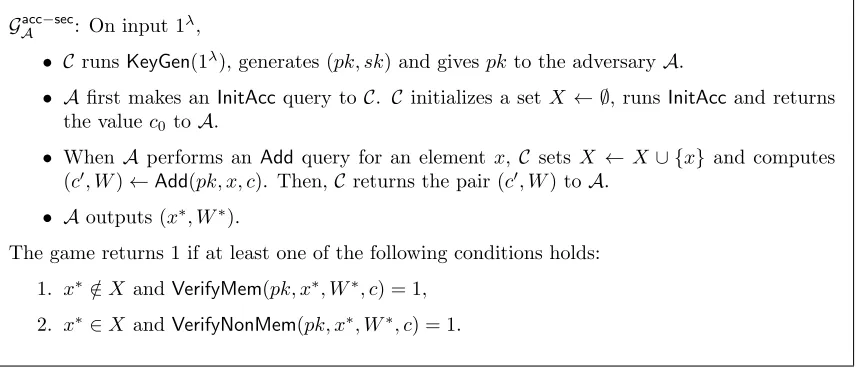
Informally, an accumulator iscorrect if, for any honestly produced membership witness, the membership verification algorithm outputs 1, and if, for any honestly produced non-membership witness, the non-non-membership verification algorithm outputs 1. Furthermore, we consider a universal accumulator as secure if, no p.p.t. adversary can produce a valid non-membership witness for a member of the accumulated set, nor, a valid membership witness for an element which is not a member of the accumulated set. The security property of an accumulator can be met ascollision-freeness, or,soundnessin the literature. A formal definition for security is given below (Definition 4.2), utilizing a game between a Challenger C and an adversary A, as illustrated in Figure 1. For a formal definition of correctness, we refer the interested reader to [37].
Definition 4.2. We say that an accumulator is secure if, for any p.p.t. adversary A
interacting with a challenger C, as illustrated in the security game of Figure 1, it holds that
Pr[GAacc−sec(1λ) = 1] =negl(λ).
4.2 Construction
Gacc−sec
A : On input 1λ,
• C runsKeyGen(1λ), generates (pk, sk) and givespk to the adversaryA.
• Afirst makes an InitAcc query toC. C initializes a set X ← ∅, runsInitAcc and returns the valuec0to A.
• WhenA performs an Add query for an element x, C sets X ← X∪ {x} and computes (c′, W)←Add(pk, x, c). Then,C returns the pair (c′, W) toA.
• Aoutputs (x∗, W∗).
The game returns 1 if at least one of the following conditions holds:
1. x∗ ∈/ X andVerifyMem(pk, x∗, W∗, c) = 1,
2. x∗ ∈X andVerifyNonMem(pk, x∗, W∗, c) = 1.
Figure 1: The security game between the adversary A and a challenger C, where C plays the roles of both T and Tacc.
arbitrary strings to prime numbers. Namely, for any algorithm run on input an element
z ∈ {0,1}∗, the party who runs the algorithm, first, executes the procedure Map, which maps z to a prime number, e.g., zp, and then, proceeds by running the same algorithm as
in the accumulator of Li et al. [36] for the prime number zp. The procedure Mapthat we
utilize is a modified version of a procedure suggested in [30]. Thus, we first present the procedure suggested in [30], then, based on that, we present the modified algorithm Map, which is utilized in the construction of Figure 2. Lastly, we prove that the accumulator of Figure 2 is secure according to Definition 4.2.
Mapping arbitrary strings to primes [30]. Gennaro et al. [30] describe a procedure
that utilizes a universal hash function family U of functions (Definition 3.2), which maps strings of 3kbits to strings ofkbits with the additional property that, for anyy∈ {0,1}kand givenf ∈U, one can efficiently sample uniformly from the set{x∈ {0,1}3k:f(x) =y}. On input z∈ {0,1}∗, it first computes h(z), whereh:{0,1}∗ → {0,1}k is a collision-resistant hash function. It then samples repeatedly from the set{x∈ {0,1}3k :f(x) =h(z)} to find a prime number O(k2) times. This procedure is collision-resistant if h is collision resistant and will output a prime number with high probability due to the following Lemma.
Lemma 4.1([30]). LetU be a Universal Hash Function Family from{0,1}3kto{0,1}k.Then,
for all but a (1/2k)-fraction of functions f ∈ U and for any y ∈ {0,1}k, a fraction of at least 1/ck elements in the set {x∈ {0,1}3k:f(x) =y} are primes, for a small constantc.
Therefore, an algorithm which samples ck2 times from the set {x ∈ {0,1}3k : f(x) =
The domain of the accumulator isD={0,1}∗.
• KeyGen: On input 1λ, it generates a pair of safe primesp, q of equal length, such that,
p= 2p′+ 1, q = 2q′ + 1 and p′, q′ are also primes. It computes n =pq and chooses g
randomly from QRn. It sets ℓ =⌊λ/2⌋ −2 and chooses a deterministic procedure Map
(as described in the previous paragraph), which receives as input an arbitrary string and outputs a prime number less than 2⌊λ/2⌋−2. It sets pk = (n, g,Map), sk = (p, q), and outputspk.
• InitAcc: On inputpk, it outputsc0=g.
• Add : On input pk, x∈ {0,1}∗ and c, it invokes Map on inputx and receives a prime numberxp. Then, it computesc′=cxp modn, setsW =c and outputs (c′, W).
• MemWitGen : On input pk, X and x ∈ {0,1}∗, it computes and outputs W =
g
∏
xi∈X\{x} Map(xi)
.
• NonMemWitGen : On input pk, X, c, x /∈ X, it invokes Map on input x and receives a prime numberxp. Then, it computes u= Π
xi∈X
Map(xi). Sincegcd(xp, u) = 1, it runs the
extended Euclidean algorithm and computes a, b∈ Z, such that, au+bxp = 1. By the Euclidean division, a can be written as a = a′+qxp , where 0 ≤ a′ < xp. Therefore,
a′u+ (b+qu)xp = 1. It setsb′ =b+quand computes d=g−b ′
. Finally, it outputs a non-membership witnessW = (a′, d) = (a modx, g−b−qu).
• UpdMemWit: On inputpk, x, y, W, it invokesMapon inputxand receives a prime number
xp. Then, it computes and outputs W′=Wxp modn.
• UpdNonMemWit : On input pk, x /∈ X, y ∈ X, c and W = (a, d), it invokes Map on inputsx,y and receives the prime numbersxp,yp respectively. Sinceyp ̸=xp, it runs the extended Euclidean algorithm and computesa0, r0∈Z, such that,a0yp+r0xp= 1.Then, it multiplies both sides by a, i.e., aa0yp+ar0xp = a and computes a′ =a0a modxp. Then, it findsr∈Z, such that, a′yp =a+rxp, computesd′ =dcr modn and outputs
W′= (a′, d′).
• VerifyMem: On inputpk, x, W, c, it invokesMapon inputxand receives a prime number
xp. Then, it outputs 1, ifWxp =c modn, otherwise, it outputs 0.
• VerifyNonMem: On inputpk, x, W, c, where, W = (a, d), it invokes Mapon input xand receives a prime numberxp. Then, it outputs 1, ifca=dxpg modn, otherwise, it outputs 0.
Figure 2: Construction of a public-state, additive, universal accumulator.
A modified version of the algorithm in [30]. In our construction (Figure 2), we
employ a deterministic version of the aforementioned Map procedure, which we suggest below. Specifically, we utilize a pseudorandom generator G : {0,1}k → {0,1}p(k), where
p(k) is a polynomial ink, and a labeled hash functionh:{0,1}∗× {0,1}∗→ {0,1}k, which is collision-resistant and which is modeled as a Random Oracle.
We start by picking two labels, i.e., label0,label1 ∈ {0,1}∗. Then, Map, on input
sam-ples elements from the set {x ∈ {0,1}3k : f(x) = h(label0, z)} using as randomness
G(h(label1, z)) and stops when a prime number is found. It is easy to see that since label0,label1 are the same in any run of the algorithm, the algorithm on inputz∈ {0,1}∗
al-ways outputs the same value. Below, in Lemma 4.2, we show thatMapfinds a prime, except with negligible probability, and, in Lemma 4.3, we prove thatMapis collision-resistant.
Lemma 4.2. Let z ∈ {0,1}∗. The algorithm Map, on input z, outputs a prime number,
except with negligible probability, assuming that, G is a pseudorandom generator and, the
hash function h, is a random oracle.
Proof. Assume that Map, on input z ∈ {0,1}∗, fails to find a prime number with
non-negligible probabilityα. We will construct a p.p.t distinguisherD, which breaks the prop-erty of the pseudorandom generatorG, as this is defined in Definition 3.3. Recall that the only difference of the procedure in [30] and the algorithm Map described in the previous paragraph is the samping of elements from the setX={x∈ {0,1}3k:f(x) =h(label0, z)},
i.e., in the former case, elements are sampled uniformly at random while, in the latter case, elements are sampled by using as randomness the output of the PRGG. Based on that, we consider the following p.p.t. distinguisherD:
• On input a string x ∈ {0,1}p(k), sample from the set X = {x ∈ {0,1}3k : f(x) =
h(label0, z)}using as randomness the string x.
• If a prime numberp is output, then, return 1, else, return 0.
First, since h is a random oracle, the seed h(label1, z) is considered random. Then, if
x = r, where r is chosen uniformly at random, by Lemma 4.1, we have that Pr[D(r) = 1] = 1−negl(k). By the assumption that Map fails to find a prime with non-negligible probability α, we have that
Pr[D(r′) = 1]−Pr[G(h(label1, z)) = 1]= 1−negl(k)−(1−α) =α−negl(k), (1)
which is a contradiction, according to Definition 3.3.
Lemma 4.3. The algorithm Map is collision-resistant if the hash function h is
collision-resistant. Namely, no p.p.t. adversary can find z1, z2∈ {0,1}∗ with z1 ̸=z2, such that, the
algorithmMap returns the same primep.
Proof. We assume that Map is not collision resistant, i.e., there is a p.p.t. adversary A, which finds two different z1, z2, such that, Map(z1) =Map(z2) =p. This requires that the
algorithmMapsamples elements from the same set of solutions X={x∈ {0,1}3k:f(x) =
h(label0, z1)}. Thus,Ashould find a collision in the hash functionh, i.e.,Afindsz1, z2 such
thath(label0, z1) =h(label0, z2). However, this holds only with negligible probability.
Security of the accumulator of Figure 2. Before formally proving the security of
the accumulator of Figure 2, we first give a simple example as to why the procedure Map
suggested modification and that an element x ∈ {0,1}∗ was added in our accumulator. This means that Tacc first produces a prime xp and then adds xp in the underlying RSA
accumulator. Then, an adversary can produce a non-membership witnessW forxsimply by producing a different primex′p ̸=xp for the elementxand then running the non-membership
witness generation algorithm for x′p. Therefore, the security property of the accumulator, as defined in the security game of Figure 1, would not hold, since the adversary can output (x, W), such that,x∈X andVerifyNonMem(pk, x, W, c) = 1.
The security of our accumulator is derived by the security of the accumulator of Li et al. [36], which is proven secure under the strong-RSA assumption, and the properties of the algorithm Map, as proven in Lemma 4.2 and Lemma 4.3.
Theorem 4.1. The accumulator of Figure 2 is secure according to Definition 1 under the
strong-RSA assumption and the collision-resistance of Map in the Random Oracle model.
Proof. Assume there is a p.p.t. adversaryA, which breaks the security of the accumulator
of Figure 2. Then, according to Definition 1, A outputs (x∗, W∗), such that: (1) x∗ ∈/ X
and VerifyMem(pk, x∗, W∗, c) = 1, or, (2) x∗ ∈ X and VerifyNonMem(pk, x∗, W∗, c) = 1. Suppose that (1) holds. Then, there are two possible cases: (a) A comes up with x, x∗, such that, Map(x) = Map(x∗) and x ∈ X, thus, breaking the collision-resistance of the
Mapprocedure, or, (b)Acomputes a valid membership witness W∗ for a primex∗p, where,
Map(x∗) =x∗p and x∗ ∈/X. In the latter case, we can construct a p.p.t adversaryB, which breaks the strong-RSA assumption. We refer for further details to the proof of Li et al. [36]. Next, assume that case (2) holds. This implies two possible scenarios: First, A comes up with a valid non-membership witnessW∗ for a prime x∗p, where, Map(x∗) =x∗p andx∈X. This means that we can construct a p.p.t. adversary B, which breaks the strong-RSA assumption (see the proof of Li et al. [36]) and, therefore, we have a contradiction. In the second scenario, the procedure Map, on input x∗, outputs two different primes (with non-negligible probability) if we run it twice, e.g.,x∗p1 and x∗p2. This means that if x∗p1 is added in the accumulator first, then it would be possible forAto compute a valid non-membership witness W∗ forx∗p2. However, this is impossible, since the procedure Mapis deterministic .
Constructing a universal accumulator from an additive, universal
accumula-tor [13]. Assume thatACCUadd is an additive, universal accumulator, which accumulates
elements of the form (x, i,op), where, x is the element to be added, i, is an index, and
op, is either a or d. We construct a universal accumulator ACCU, from ACCUadd, as
fol-lows. When an elementx is added toACCU for the first time,Tacc adds the value (x,1, a)
to ACCUadd. Otherwise, it adds (x, i, a), where, the index i indicates that this is the i-th time that x is added to ACCUadd. When an element x is deleted from ACCU, Tacc adds
(x, i, d) to ACCUadd. In order to prove membership of x in ACCU, one should find an
in-dex i, such that, ((x, i, a) ∈ACCUadd)∧((x, i, d) ∈/ ACCUadd)). Accordingly, to prove that
x /∈ X, one should either prove that (x,1, a) ∈/ ACCUadd, or, find an index i, such that,
(
The naming service functionalityFns:
• On input (sid,Init) by a serverSi,Fns sends (sid,Init, Si) toS. If S returnsallow,Fns setsY ←Y ∪ {Si}(whereY is initialized as Y =∅) and returnssuccessto Si. When all servers have sent a message (sid,Init),Fnssetsflag=start. Also,Scorrupts a number of clients. We denote asCcor the set of corrupted clients.
• On input (sid,Setup, R) byT,Fnschecks ifflag=startand forwards (sid,Setup, R) toS. IfS returnsallow, Fns storesR, initializes a setX ← ∅, sets flag=manageand returns
successtoT.
• On input (sid,Register, id, pk) by a client C, Fns checks if flag=manage and forwards (sid,Register, id, pk) toS.
– IfSreturnsallow,Fns checks if there is (id,·)∈X. If there is no (id,·)∈X, it sets
X ←X∪(id, pk) and returnssuccessto C via public delayed output, otherwise, it returnsfailto Cvia public delayed output.
– IfS returnsfail, thenFns returnsfailtoC via public delayed output.
– IfS returns (sid,Register, id′, pk′, C),Fns checks ifC∈Ccorand if there is (id′,·)∈
X. If there is no (id′,·)∈X, it setsX ←X∪(id′, pk′) and returnssuccesstoCvia public delayed output, otherwise, it returnsfailtoC via public delayed output.
• On input (sid,Revoke, id, pk,aux) by C, Fns checks if flag=manage and forwards (sid,Revoke, id, pk,aux) toS.
– If S returns allow, Fns checks whether R(pk,aux) = 1 and (id, pk)∈ X. If both conditions hold,FnscomputesX←X\(id, pk) and returnssuccesstoCvia public delayed output, otherwise, it returnsfailtoC via public delayed output.
– IfS returnsfail, thenFns returnsfailtoC via public delayed output.
– IfS returns (sid,Revoke, id′, pk′,aux′, C), Fns checks if C ∈Ccor, R(pk′,aux′) = 1 and (id′, pk′)∈X. If so,FnscomputesX ←X\(id′, pk′), and returnssuccesstoC via public delayed output, otherwise, it returnsfailtoC via public delayed output.
• On input (sid,Retrieve, id) byC, ifflag=manage,Fns forwards this message to S. IfS returnsallow, then, if there is a pair (id, pk)∈X, for some pk, Fns returnspk toC via public delayed output, otherwise, it returns⊥. IfS returnsfailtoFns, thenFnsreturns
failtoC via public delayed output.
• On input (sid,VerifyID, id) by a clientC, ifflag=manage,Fns forwards this message to
S. IfS returnsallow, then, if there is a pair (id, pk)∈X, for somepk,Fns returns 1 to
C via public delayed output, otherwise, it returns 0. If S returnsfail to Fns, thenFns returnsfailto Cvia public delayed output.
• On input (sid,VerifyMapping, id, pk) by a client C, if flag=manage, Fns forwards this message to S. If S returnsallow, then, if there is a pair (id, pk)∈X, Fns returns 1 to
C via public delayed output, otherwise, it returns 0. If S returnsfail to Fns, thenFns returnsfailto Cvia public delayed output.
Figure 3: The naming service functionalityFns interacts with a set of nclients, a set of m
5
Defining a Naming Service Functionality
In this section, we describe the security of a naming service in the UC framework ([19]) by defining it as an ideal functionality Fns (Figure 3). Fns interacts with n clients, m
servers, a party T, which is responsible for the setup, and an adversary S, which is called the simulator. It stores (identity,public-key) pairs and supports a number of operations. The servers are responsible for running the naming service and, therefore, before the setup, we require that all servers send a (sid,Init) message. During setup, the party T specifies a relationR, which defines under which condition a public key can be revoked. In practice, this relation might be a verification algorithm for a NIZK proof, or, a signature on a randomly selected message. After the setup phase, a client can register an (identity,public-key) pair, assuming the identity is available, and, can revoke an (identity,public-key) pair, assuming her public key satisfies relation R. Furthermore, she is able to retrieve the public key of a registered identity and check, whether an identity, or, an (identity,public-key) pair, is registered or not. Our model considers only static corruptions, thus, we assume that the simulator specifies the set of corrupted clients,Ccor, before setup. The partyT is considered
trusted, thus, the simulator, S, is not allowed to corrupt T. Also, note that, in practice, this functionality cannot be realized for any corruption model for the mservers. However, the corruption model for the servers depends on the protocol with which we aim to realize the functionalityFns.
6
Naming Service Implementation
At a high-level, the service must allow the storage, retrieval and deletion of (identity,public-key) pairs. The main barrier in realizing a smart contract-based DPKI is the size of its state, which, being its most expensive resource to access, must be minimized. We resolve this issue in a twofold manner. First, we separate storage from the process of verifying the validity of mappings by maintaining two public-state, universal accumulators (as presented in Section 4) as our smart contract’s state. Second, our accumulators are RSA-based and have constant size. The public-state property is required as the contract’s state is publicly accessible. To circumvent the issue that deletions require access to an accumulator’s private key, we employ the methodology that we presented at the end of Section 4.
In Figure 4, we define the functionality FT P, which captures the role of the smart
contract in our protocol. This functionality interacts with a party T, a set of n clients and a set of m servers, some of which may be corrupted by the adversary prior to the initialization phase. FT P is initialized by a trusted partyT by receiving as input a program
P . The state of FT P is updated after a call to the program P and the output is received
by the calling party. Note that the implementation ofFT P requires an honest majority of
servers, along the lines of [28, 29, 12]. The adversary has always full knowledge of all the computations performed and may interfere by either aborting, or, allowing, an execution of
P at will. However, he is restricted from modifying the output. Implementing FT P using
FT P :
• On input (sid,InitTP) by a serverSi,FT P setsSinit←Sinit∪{Si}(initialized asSinit ← ∅) and informs the adversaryAthatSiis initialized by sending (sid,InitTP, Si). Then,FT P returnssuccesstoSi. If all the serversS1, . . . , Smhave sent a message (sid,InitTP),FT P setsflag=ready.
• On input (sid,Install, P) by T, if flag=ready, send (sid,Install, P) to A. If A returns
allow, set flag=start, store P, set state ← ε, where ε is the empty string, and return
successtoT.
• On input (sid, x) by a clientC, ifflag=ready, send (sid, x) toA. IfAreturnsallow, run
P on input (x, state) and output (y, state′). Set state←state′ and return (y, state′) to
C via public delayed output. If xis an invalid input for program P, return⊥to C via public delayed output.
Figure 4: The functionalityFT P captures the role of the smart contract. It interacts with
a trusted party T, a set ofn clients, a set of mservers and the adversary A.
1. On input (Setup, params), whereparamsis of the form (pk1, pk2, R), runInitAccon input pk1 and on inputpk2 and compute c0,1, c0,2 respectively. This procedure initializes two
public-state, additive, universal accumulatorsc1andc2by settingc1←c0,1, c2←c0,2. It
setsstate←(params, c1, c2) and returnsstate.
2. On input (Register, id, pk, i, W1, W2),
(a) Ifi= 1, check if VerifyNonMem(pk2,(id,1, a), W1, c2) = 1.
(b) Ifi≥2, check ifVerifyNonMem(pk2,(id, i, a), W1, c2) = 1 andVerifyMem(pk2,(id, i−
1, d), W2, c2) = 1.
If all the above checks succeed, run (c′1, W1′)←Add(pk1,(id, pk, i, a), c1) and (c′2, W2′)←
Add(pk2,(id, i, a), c2). Update state by setting c1 ← c′1 and c2 ← c′2, and return
((c′1, W1′),(c′2, W2′)). Otherwise, returnfail.
3. On input (Revoke, id, pk, i, W1, W2, W3,aux),
(a) Check ifR(pk,aux) = 1.
(b) Check if VerifyMem(pk2,(id, i, a), W1, c2) = 1, VerifyNonMem(pk2,
(id, i, d), W2, c2) = 1 andVerifyMem(pk1,(id, pk, i, a), W3, c1) = 1.
If none of the above verifications fail, run (c′2, W2′)←Add(pk2,(id, i, d), c2) and (c′1, W1′)←
Add(pk1,(id, pk, i, d), c1). Update state by setting c1 ← c′1 and c2 ← c′2 and return
((c′1, W1′),(c′2, W2′)). Otherwise, returnfail.
4. On inputRetrieveState, returnstate←(params, c1, c2).
FU DB :
• On input (sid,InitUDB) by a server Si, FU DB sets S′init ← Sinit′ ∪ {Si} (initialized as S′init ← ∅) and sends (sid,InitUDB, Si) to A. Then, FU DB returns success to Si. If all servers S1, . . . , Sm have sent a message (sid,InitUDB), FU DB sets flag=ready,
DBstate← ∅andp←0.
• On input (sid,Post, x) by a clientC, ifflag=ready, forward (sid,Post, x, C) toA. IfA sendsallow, setp←p+ 1,DBstate[p]←xand returnsuccesstoC.
• On input (sid,RetrieveDB) by a clientC, if flag=ready, forward (sid,RetrieveDB, C) to
A. IfAreturnsallow, returnDBstateto C.
• On input (sid,ChangeDBstate, DBstate′) byA, set DBstate←DBstate′.
Figure 6: The functionality FU DB models an unreliable database and interacts with a set
of nclients, a set of m servers and the adversaryA.
underlying blockchain, specifically related to peristence of transactions, cf. [28, 29, 12], imply the security of FT P’s realization.
Furthermore, we assume that all operations are completed in a synchronous, atomic fashion. In practice, some time is required for an operation (transaction) to be validated, i.e., to be recorded in the blockchain. Nevertheless, blockchains enforce a total ordering of transactions and execute them serially, which has the same net result. In our protocol, FT P is input the program P of Fig. 5, thus, FT P essentially maintains the aforementioned
accumulators as its state, i.e., it acts as the accumulator manager Tacc. To simplify the
description and security analysis of our design, we assume a trusted setup phase that es-tablishes the relation R and generates the accumulators’ keys. This assumption does not introduce a single point of failure in our design as it can be replaced, in a practical imple-mentation, with distributed protocols for generating parameters (e.g., [46]).
In Figure 6, we introduce the functionality FU DB, which handles the storage of
infor-mation that are relevant to our protocol, e.g., (identity,public-key) pairs. FU DB interacts
withnclients, a set ofℓservers and the adversary. This functionality models an “unreliable database”, i.e., the adversary may tamper with its contents. Its involvement in our protocol is twofold. First, a client queries this functionality to retrieve all the necessary information that will allow her to, subsequently, interact with FT P. Second, following the completion
of an interaction withFT P, the client stores inFU DB, among others, information that were
output by the smart contract and reflect the new state of the system. We elaborate more on the information that clients query/store from/toFU DB later on in this section where we
provide a high-level description of each operation. A practical realization ofFU DB is out of
the scope of this paper. However, an authenticated DHT network comprised of nodes that have registered in our PKI would be a suitable candidate, both in terms of security (i.e., it is Sybil resilient), as well as efficiency, due to its logarithmic message complexity.
In our scheme, we accumulate (id, pk, i,op) tuples in c1, where, op = a or op = d
clients to infer if an identity is registered in the system. In the following, and due to space limitations, we present a high-level description of the Register, Revoke, Retrieve, VerifyID, and VerifyMapping operations.
Informally, a client that is interested in registering an (identity,public-key) mapping must prove to the smart contract that the identity is, currently, available. To achieve this, she generates two witnesses. First, a membership witness of the tuple (id, i, d) forc2,
which proves that the i-th instance of this identity has been marked as deleted. Second, a non-membership witness of the tuple (id, i + 1, a) for c2, which proves that the (i+
1)-th instance of this identity, i.e., the one she is interested in registering, has not been marked as added. If both of the aforementioned conditions hold, she can convince the smart contract to accumulate her mapping inc1. These witnesses are constructed by, first,
queryingFU DB for the history of operations and, second, locating records regarding id, in
an attempt to find the proper value for index i. Following a successful registration, the client posts a (Register, id, pk, i, W1, W2, W3) record to FU DB. The witnesses W1, W2, W3
facilitate queries from future clients regarding, e.g., the validity of the (i+ 1)-th instance of her (identity,public-key) mapping.
To revoke an (identity,public-key) mapping, a client generates the following proofs. First, a proof of ownership of the corresponding secret key, which is captured by the relation R. Second, a membership witness of the tuple (id, i, a) forc2, which proves that this identity has
been marked as added for index i. Third, a non-membership witness of the tuple (id, i, d) forc2, which proves that this identity has not been marked as deleted for indexi. Fourth, a
membership witness of the tuple (id, pk, i, a) forc1, which proves that the identity is indeed
mapped to the same public-key that satisfies the relation R. Assuming that witnesses are generated honestly, the client convinces the contract to revoke her mapping and, then, she proceeds on posting (Revoke, id, pk, i) to FU DB.
To retrieve an identity’s public-key, the client queries FU DB to check whether the last
record related to this identity is a registration record. If so, the client updates the witnesses
W1, W2, W3 stored in the retrieved registration record and, subsequently, invokes the smart
contract to validate the (identity,public-key) mapping. VerifyID and VerifyMapping follow the same procedure asRetrieveto verify if an identity, or, an (identity,public-key) mapping, is registered.
In Figure 7, we present the formal description of protocolπ, which realizes the function-ality Fns. Recall that the entities that participate in the protocol are: 1) a trusted party
T, which is used for setup purposes, 2) a functionalityFT P, 3) nclientsC1, . . . , Cnand, 4)
a functionalityFU DB. We denote withX1 and X2 the sets of accumulated elements of c1
and c2, respectively. These sets are constructed by the client as follows. For any record of
the form (Register, id, pk, i,·), a client adds (id, pk, i, a) toX1 and (id, i, a) to X2. For any
record of the form (Revoke, id, pk, i), a client adds (id, pk, i, d) to X1 and (id, i, d) to X2.
For ease of presentation, we have described our protocol using two accumulators. We can achieve the same net result using only one accumulator since bothc1 andc2 accumulate
arbitrary strings. Thus, we are able to accumulate both types of tuples, i.e., (id, i,op) and (id, pk, i,op), in one accumulator, while still being able to generate the (non) membership witnesses required in our protocol. To achieve this, we modify the Register and Revoke
1. On input (sid,Init), a server Sisends (sid,InitTP) and (sid,InitUDB) toFT P andFU DB. IfSi receivessuccessby bothFT P andFU DB, thenSi returnssuccess.
2. On input (sid,Setup, R), the partyTsends (sid,Install, P) toFT P, wherePis the program of Figure 5. If FT P returns as success, then T runs KeyGen(1λ) twice, sets params= (pk1, pk2, R) and sends (sid,(Setup, params)) toFT P, which executes the programP on input (Setup, params) (if A returns allow to FT P). Therefore, if FT P returnsstate ← (params, c1, c2) toT,T returnssuccess.
3. On input (sid,Register, id, pk), C sends (sid,RetrieveDB) to FU DB. Upon receiving
DBstate, Cchecks for records regarding id.
(a) it finds the last record regardingidand checks if it is of the form (Revoke, id, pk, i). If it is not, C returns fail. Otherwise, she computes a non-membership wit-ness W1 for (id, i+ 1, a) and a membership witness W2 for (id, i, d) by running
NonMemWitGen(pk2,(id, i+ 1, a), X2, c2) and MemWitGen(pk2,(id, i, d), X2, c2)
re-spectively.
(b) If no record is found, C computes a non-membership witness W1 for (id,1, a) by
runningNonMemWitGen(pk2,(id,1, a), X2, c2), setsW2=⊥andi= 0.
Then, C sends (sid,Register, id, pk, i+ 1, W1, W2) to FT P, which runs P on this in-put. If FT P returns ((c′1, W1′),(c′2, W2′), state), where W1′ is a membership witness for
(id, pk, i+ 1, a) in c′1 and W2′ is a membership witness for (id, i+ 1, a) in c′2, C com-putes a non-membership witnessW3′ for (id, i+ 1, d) by runningNonMemWitGen((id, i+ 1, d), X2, c′2) and sends
(
sid,Post,(Register, id, pk, i+ 1, W1′, W2′, W3′))toFU DB. IfFU DB returnssuccess, Coutputssuccess. Otherwise,Coutputsfail.
4. On input (sid,Revoke, id, pk,aux), C sends (sid,RetrieveDB) to FU DB. Upon receiving
DBstate, C searches for records that precede her registration record. Assuming ℓ such records, and depending if an encountered record is of the formRegister, or,Revoke,C, on each iteration, updates her witnesses as follows:
(a) C encounters a (Register, id′, pk′, j, Wid′
1 , Wid
′
2 , Wid
′
3 ). She updates W1′ by running W1′ ← UpdMemWit(pk1,(id, pk, i, a),(id′, pk′, j, a), W1′). W2′, W3′ are updated
ac-cordingly.
(b) C encounters a (Revoke, id′, pk′, j). She updates W1′ by running W1′ ←
UpdMemWit(pk1,(id, pk, i, a),(id′, pk′, j, d), W1′). W2′, W3′ are updated accordingly.
Then, C sends (sid,Revoke, id, pk, i, W1′, W2′, W3′,aux) to FT P. If FT P returns ((c′1, W1′),(c′2, W2′), state), C sends (sid,Post,(Revoke, id, pk, i)) to FU DB. If FU DB re-turnssuccess,C outputssuccess. Otherwise,C outputsfail.
5. On input (sid,Retrieve, id), C sends (sid,RetrieveDB) to FU DB. If there is no record related toid,C outputsfail, otherwise,C:
(a) Checks if the last record related to id is of the form Register. If so, she retrieves
W1′, W2′, W3′ from the record and runs Steps 4a and 4b to compute the updated witnessesW1′, W2′, W3′. Otherwise,C outputsfail.
(b) Sends (sid,RetrieveState) to FT P. If FT P returns state then C runs
VerifyMem(pk1,(id, pk, i, a), W1′, c1),VerifyMem(pk2,(id, i, a), W2′, c2) and
VerifyNonMem(pk2,(id, i, d), W3′, c2). If all algorithms output 1, C outputs pk
as the retrieved public key, otherwise,C outputs⊥.
6. On input (sid,VerifyID, id), C runs Step 5. If Step 5 outputs some pk, C outputs 1, otherwise,Coutputs 0.
Second, we invoke UpdMemWit after the second call to Add, to update the membership witness that was returned by the first call to Add. This approach, cuts down in half the contract’s state, but, increases the computation of both Register and Revoke by one exponentiation and one invocation of theMapprocedure.
Lastly, we show that our construction is secure by proving Theorem 6.1. The proof of Theorem 6.1 is provided in Appendix A.
Theorem 6.1. The protocol πof Figure 7 securely realizes the functionalityFnsof Figure 3
in the (FT P,FU DB)-hybrid world under the strong-RSA assumption in the Random Oracle
model.
References
[1] Ascap, prs and sacem join forces for blockchain copyright system. https:// www.musicbusinessworldwide.com/ascap-prs-sacem-join-forces-blockchain-copyright-system/. Accessed: 2017-07-06.
[2] Emercoin - distributed blockchain services for business and personal use. http://www. emercoin.com. Accessed: 2010-09-30.
[3] Final report on diginotar hack shows total compromise of ca servers. https: //threatpost.com/final-report-diginotar-hack-shows-total-compromise-ca-servers-103112/77170/. Accessed: 2017-04-07.
[4] Google takes symantec to the woodshed for mis-issuing 30,000 https certs.
https://arstechnica.com/information-technology/2017/03/google-takes-symantec-to-the-woodshed-for-mis-issuing-30000-https-certs/. Accessed: 2017-04-07.
[5] Ibm pushes blockchain into the supply chain. https://www.wsj.com/articles/ibm-pushes-blockchain-into-the-supply-chain-1468528824. Accessed: 2017-07-06.
[6] Namecoin. https://namecoin.org/. Accessed: 2017-04-07.
[7] Swiss industry consortium to use ethereums blockchain. https://www.ccn.com/ swiss-industry-consortium-use-ethereums-blockchain/. Accessed: 2017-07-06.
[8] Trustwave admits it issued a certificate to allow company to run man-in-the-middle at-tacks. https://www.techdirt.com/articles/20120208/03043317695/trustwave-
admits-it-issued-certificate-to-allow-company-to-run-man-in-the-middle-attacks.shtml. Accessed: 2017-04-07.
[9] Karl Aberer. P-Grid: A Self-Organizing Access Structure for P2P Information Sys-tems. Springer Berlin Heidelberg, 2001.
2009. Proceedings, volume 5473 ofLecture Notes in Computer Science, pages 295–308. Springer, 2009.
[11] Agapios Avramidis, Panayiotis Kotzanikolaou, Christos Douligeris, and Mike Burmester. Chord-pki: A distributed trust infrastructure based on p2p networks. Computer Networks, 56, 2012.
[12] Christian Badertscher, Ueli Maurer, Daniel Tschudi, and Vassilis Zikas. Bitcoin as a transaction ledger: A composable treatment. In Katz and Shacham [34], pages 324–356.
[13] Foteini Baldimtsi, Jan Camenisch, Maria Dubovitskaya, Anna Lysyanskaya, Leonid Reyzin, Kai Samelin, and Sophia Yakoubov. Accumulators with applications to anonymity-preserving revocation. In 2017 IEEE European Symposium on Security and Privacy, EuroS&P 2017, Paris, France, April 26-28, 2017, pages 301–315. IEEE, 2017.
[14] Niko Bari and Birgit Pfitzmann. Collision-free accumulators and fail-stop signature schemes without trees. In Walter Fumy, editor, Advances in Cryptology - EURO-CRYPT ’97, International Conference on the Theory and Application of Cryptographic
Techniques, Konstanz, Germany, May 11-15, 1997, Proceeding, volume 1233 ofLecture
Notes in Computer Science, pages 480–494. Springer, 1997.
[15] Josh Cohen Benaloh and Michael de Mare. One-way accumulators: A decentralized alternative to digital sinatures (extended abstract). In Tor Helleseth, editor,Advances in Cryptology - EUROCRYPT ’93, Workshop on the Theory and Application of of Cryptographic Techniques, Lofthus, Norway, May 23-27, 1993, Proceedings, volume 765 ofLecture Notes in Computer Science, pages 274–285. Springer, 1993.
[16] Philippe Camacho, Alejandro Hevia, Marcos A. Kiwi, and Roberto Opazo. Strong accumulators from collision-resistant hashing. In Tzong-Chen Wu, Chin-Laung Lei, Vincent Rijmen, and Der-Tsai Lee, editors, Information Security, 11th International Conference, ISC 2008, Taipei, Taiwan, September 15-18, 2008. Proceedings, volume 5222 ofLecture Notes in Computer Science, pages 471–486. Springer, 2008.
[17] Jan Camenisch, Markulf Kohlweiss, and Claudio Soriente. An accumulator based on bilinear maps and efficient revocation for anonymous credentials. In Stanislaw Jarecki and Gene Tsudik, editors, Public Key Cryptography - PKC 2009, 12th International Conference on Practice and Theory in Public Key Cryptography, Irvine, CA, USA,
March 18-20, 2009. Proceedings, volume 5443 of Lecture Notes in Computer Science,
pages 481–500. Springer, 2009.
[18] Jan Camenisch and Anna Lysyanskaya. Dynamic accumulators and application to efficient revocation of anonymous credentials. In Moti Yung, editor,Advances in Cryp-tology - CRYPTO 2002, 22nd Annual International CrypCryp-tology Conference, Santa
Bar-bara, California, USA, August 18-22, 2002, Proceedings, volume 2442 ofLecture Notes
in Computer Science, pages 61–76. Springer, 2002.
[20] Ran Canetti. Universally composable signature, certification, and authentication. In 17th IEEE Computer Security Foundations Workshop, (CSFW-17 2004), 28-30 June 2004, Pacific Grove, CA, USA, page 219. IEEE Computer Society, 2004.
[21] Larry Carter and Mark N. Wegman. Universal classes of hash functions. J. Comput. Syst. Sci., 18(2):143–154, 1979.
[22] Ivan Damg˚ard and Nikos Triandopoulos. Supporting non-membership proofs with bilinear-map accumulators. IACR Cryptology ePrint Archive, 2008:538, 2008.
[23] Anwitaman Datta, Manfred Hauswirth, and Karl Aberer. Beyond ”web of trust”: Enabling P2P e-commerce. InCEC 2003, pages 303–312.
[24] David Derler, Christian Hanser, and Daniel Slamanig. Revisiting cryptographic ac-cumulators, additional properties and relations to other primitives. In Kaisa Nyberg, editor, Topics in Cryptology - CT-RSA 2015, The Cryptographer’s Track at the RSA Conference 2015, San Francisco, CA, USA, April 20-24, 2015. Proceedings, volume 9048 ofLecture Notes in Computer Science, pages 127–144. Springer, 2015.
[25] John R. Douceur. The sybil attack. IPTPS ’01.
[26] Carl Ellison and Bruce Schneier. Ten risks of pki: What you’re not being told about public key infrastructure. 2000.
[27] Conner Fromknecht, Dragos Velicanu, and Sophia Yakoubov. A decentralized public key infrastructure with identity retention. IACR Cryptology ePrint Archive, 2014:803, 2014.
[28] Juan A. Garay, Aggelos Kiayias, and Nikos Leonardos. The bitcoin backbone protocol: Analysis and applications. In Elisabeth Oswald and Marc Fischlin, editors,
EURO-CRYPT, volume 9057 ofLecture Notes in Computer Science, pages 281–310. Springer,
2015.
[29] Juan A. Garay, Aggelos Kiayias, and Nikos Leonardos. The bitcoin backbone protocol with chains of variable difficulty. In Katz and Shacham [34], pages 291–323.
[30] Rosario Gennaro, Shai Halevi, and Tal Rabin. Secure hash-and-sign signatures without the random oracle. In Jacques Stern, editor,Advances in Cryptology - EUROCRYPT ’99, International Conference on the Theory and Application of Cryptographic
Tech-niques, Prague, Czech Republic, May 2-6, 1999, Proceeding, volume 1592 of Lecture
Notes in Computer Science, pages 123–139. Springer, 1999.
[31] Bela Gipp, Norman Meuschke, and Andr´e Gernandt. Decentralized trusted timestamp-ing ustimestamp-ing the crypto currency bitcoin. CoRR, abs/1502.04015, 2015.
[33] Murat Karakaya, Ibrahim Korpeoglu, and ¨Ozg¨ur Ulusoy. Free riding in peer-to-peer networks. IEEE Internet Computing, 13(2).
[34] Jonathan Katz and Hovav Shacham, editors. Advances in Cryptology - CRYPTO 2017 - 37th Annual International Cryptology Conference, Santa Barbara, CA, USA, August
20-24, 2017, Proceedings, Part I, volume 10401 ofLecture Notes in Computer Science.
Springer, 2017.
[35] F. Lesueur, L. Me, and V. V. T. Tong. An efficient distributed pki for structured p2p networks. InIEEE P2PC, 2009.
[36] Jiangtao Li, Ninghui Li, and Rui Xue. Universal accumulators with efficient nonmem-bership proofs. In Jonathan Katz and Moti Yung, editors, Applied Cryptography and Network Security, 5th International Conference, ACNS 2007, Zhuhai, China, June 5-8,
2007, Proceedings, volume 4521 ofLecture Notes in Computer Science, pages 253–269.
Springer, 2007.
[37] Atefeh Mashatan and Serge Vaudenay. A fully dynamic universal accumulator. Pro-ceedings of the Romanian Academy, 14:269–285, 2013.
[38] Petar Maymounkov and David Mazi`eres. Kademlia: A peer-to-peer information system based on the xor metric. IPTPS ’01.
[39] Satoshi Nakamoto. Bitcoin: A peer-to-peer electronic cash system. http://bitcoin. org/bitcoin.pdf. Accessed: 2017-04-07.
[40] Lan Nguyen. Accumulators from bilinear pairings and applications. In Alfred Menezes, editor, Topics in Cryptology - CT-RSA 2005, The Cryptographers’ Track at the RSA Conference 2005, San Francisco, CA, USA, February 14-18, 2005, Proceedings, volume 3376 ofLecture Notes in Computer Science, pages 275–292. Springer, 2005.
[41] Kaisa Nyberg. Fast accumulated hashing. In Dieter Gollmann, editor, Fast Software Encryption, Third International Workshop, Cambridge, UK, February 21-23, 1996,
Proceedings, volume 1039 ofLecture Notes in Computer Science, pages 83–87. Springer,
1996.
[42] Christos Patsonakis, Katerina Samari, Mema Roussopoulos, and Aggelos Kiayias. To-wards a smart contract-based, decentralized, public-key infrastructure. InCANS, 2017.
[43] Michael K. Reiter, Matthew K. Franklin, John B. Lacy, and Rebecca N. Wright. The
ω key management service. CCS ’96.
[44] Leonid Reyzin and Sophia Yakoubov. Efficient asynchronous accumulators for dis-tributed PKI. In Vassilis Zikas and Roberto De Prisco, editors,Security and Cryptog-raphy for Networks - 10th International Conference, SCN 2016, Amalfi, Italy, August
31 - September 2, 2016, Proceedings, volume 9841 of Lecture Notes in Computer
Sci-ence, pages 292–309. Springer, 2016.