
The OPTLS Protocol and TLS 1.3
(extended abstract)
Hugo Krawczyk∗ Hoeteck Wee†
October 9, 2015
Abstract
We present the OPTLS key-exchange protocol, its design, rationale and cryptographic analysis. OPTLS design has been motivated by the ongoing work in the TLS working group of the IETF for specifying TLS 1.3, the next-generation TLS protocol. The latter effort is intended to revamp the security of TLS that has been shown inadequate in many instances as well as to add new security and functional features. The main additions that influence the cryptographic design of TLS 1.3 (hence also of OPTLS) are a new “0-RTT requirement" (0-RTT stands for “zero round trip time") to allow clients that have a previously retrieved or cached public key of the server to send protected data already in the first flow of the protocol; making forward secrecy (PFS) a mandatory requirement; and moving to elliptic curves as the main cryptographic basis for the protocol (for performance and security reasons). Accommodating these requirements calls for moving away from the traditional RSA-centric design of TLS in favor of a protocol based on Diffie-Hellman techniques. OPTLS offers a simple design framework that supports all the above requirements with a uniform and modular logic that helps in the specification, analysis, performance optimization, and future maintenance of the protocol. The current (draft) specification of TLS 1.3 builds upon the OPTLS framework as a basis for the cryptographic core of the handshake protocol, adapting the different modes of OPTLS and its HKDF-based key derivation to the TLS 1.3 context.
∗IBM Research
Contents
1 Introduction 3
2 OPTLS Overview 5
3 Cryptographic preliminaries 10
3.1 Security model for key exchange . . . 10
4 Cryptographic Core of OPTLS 12 4.1 Detailed overview . . . 14
4.2 1-RTT semi-static . . . 15
4.3 Early application data (0-RTT) . . . 18
4.4 1-RTT non-static . . . 19
4.5 PSK and PSK-DHE modes . . . 20
4.6 Encrypting handshake traffic . . . 22
5 OPTLS in TLS 1.3 22 5.1 Relation to TLS 1.3 draft-09 [51] . . . 23
1 Introduction
TLS (Transport Layer Security) [23,24], often referred to as SSL, is the most important cryptographic protocol in current practice, responsible for providing security to web communications and many other applications. In spite of this fundamental role in the Internet security infrastructure, the protocol has been repeatedly shown to suffer of security weaknesses (see below list of references) that have been addressed with occasional updates and ad-hoc “patches". These recurrent modifications to the protocol add non-trivial complexity and are hard to implement and deploy due to the huge use basis of TLS and the myriad of different settings where it is applied. This state of affairs calls for a major revamping of the protocol design and the need to found it on on a clean and sound cryptographic design. This is a main goal of the work currently underway in the TLS Working Group of the IETF which is charged with defining the “next generation TLS", named TLS version 1.3.
In addition to the need to clean up the protocol, a major force behind the work on TLS 1.3 is the need to address new performance and security requirements from the TLS key-exchange protocol, namely, the
handshake protocol1. These include: (i) a new “0-RTT option" that would reduce latency in cases where the client has a previously retrieved or cached public key of the server by allowing the client to trans-mit protected information already in the first flow of the protocol; (ii) adding forward secrecy (PFS) as a mandatory feature of the protocol; and (iii) moving to elliptic curves as the main cryptographic tool for the implementation of the protocol. These requirements call for moving away from the traditional RSA-centric design of the TLS Handshake in favor of a protocol that is based on Diffie-Hellman techniques. In particular, the 0-RTT requirements requires the inclusion of a one-message key-exchange protocol which, in turn, requires a KEM-like mechanism for authentication (digital signatures cannot provide au-thentication in a one-message protocol). Naturally, this mechanism needs to be based on Diffie-Hellman if implemented via elliptic curves.
At the same time, these new elements in the protocol need to mesh with further mechanisms to support other, more traditional protocol settings essential to TLS, including a one round-trip (1-RTT) protocol supporting the common case where a client does not have a pre-cached public key of the server, a protocol mode where client and server have a pre-shared key (PSK), an inexpensive means of resuming a session based on a previously exchanged session key, and more. Therefore, there is a need to design a cryptographic protocol simple enough to be practical and easy to specify (and manage), but at the same time flexible enough to accommodate all the above requirements and modes of operation of TLS.
In this paper we present OPTLS, a key-exchange (KE) protocol developed to inform the design of the handshake protocol in TLS 1.3 and which serves as a basis for the current (draft) specification of the TLS 1.3 handshake [51]. OPTLS is designed to respond to the above TLS 1.3 needs, namely, a sound crypto-graphic framework on which the different functionalities and requirements of the TLS handshake proto-col can be based upon. Due to the complexity of the TLS environments, one cannot over-emphasize the importance of laying the cryptographic foundation of TLS on a simple protocol that provides sufficient flexibility to adapt to the many different use scenarios of TLS while offering a modular and uniform logic across its different modes. Such modularity and uniform logic is essential for aiding the specification of TLS 1.3 and its analysis, and as a basis for the many other protocols and applications that are based on TLS. We note that while the immediate motivation of our work on OPTLS is to support the specification of TLS 1.3, its flexibility and modularity are likely to help its application to other key exchange settings. Most of the presentation here is independent of TLS details.
Our presentation starts with Section 2where we provide a high-level and informal description of OPTLS. It is intended to highlight the design approach, the common logic of its different variations and modes, and the flexibility of the design that allows for different optimizations depending on the use case. In Section3we present the security model on which the OPTLS analysis is based and in Section4 we formally describe OPTLS and present an analysis of its modes and underlying key derivation scheme, where the latter serves as a unifying element across the different protocol modes. Finally, Section5 describes the adopted uses of OPTLS in the specification of TLS 1.3.
We consider the simplicity of the OPTLS protocol and its analysis as strengths of this work. It is important that the basic cryptographic core of an “uber standard” like TLS be simple and amenable to analysis by both cryptographers and existing tools for automated verification. Using standard, well understood techniques is yet another advantage of OPTLS.
Related work. In view of its importance, TLS has long been the subject of intense research analysis and attacks, including, in chronological order, [53,16,50,37,34,52,22,35,5,47,31,6,48,26,49,11,2,32, 46,27,18,46,3,12,4,13,10]. Particular attention has been given in recent works to the analysis of TLS 1.2, starting with variants of the protocol in [34,48], to the cryptographic core in [32,41,29,43] and then a more complete specification [14]. The recent QUIC protocol from Google by Langley and Chang [42], designed to add support to the 0-RTT setting, has also been the subject of formal analysis by Fischlin and Günther [28] and by Lychev et al. [44]. In recent concurrent works, Kohlweiss et al. [36] and Dowling et al. [25] analyzed earlier candidates of TLS 1.3 drafts which predate the full-fledged adoption of OPTLS; in particular, both works covered a variant of our 1-RTT non-static protocol, but do not cover the 0-RTT, PSK and 1-RTT semi-static modes.
OPTLS borrows from QUIC a similar mechanism for supporting the 0-RTT case and for providing forward secrecy to the protocol, but extends this mechanism to cover other use cases in TLS, for example, several 1-RTT settings with and without server’s signatures, a non-public-key mode based on a shared symmetric key between client and server, and more. The 1-RTT non-static protocol is also similar to (a one-way authenticated variant of ) the SIGMA-I protocol from [20,38]. The OPTLS approach is to build the protocols for these different authentication and keying settings in a modular way and under a common logic, using key derivation as a unifying element for all modes.
For the analysis of OPTLS, we use the Canetti-Krawczyk security model [19] that we adapt to the server-only authentication setting. For the analysis of the 0-RTT mode, we use the specialization of this model to one-message key-exchange protocols from [30].
2 OPTLS Overview
chello
z }| {
nC,negotC,
ceks z}|{
gx
shello z }| {
nS,negotS,
seks z}|{
gy ,
ssks+ z }| {
certS,
sfin
z }| {
MACsfk(nC,negotC,gx,nS,negotS,gy,idS)
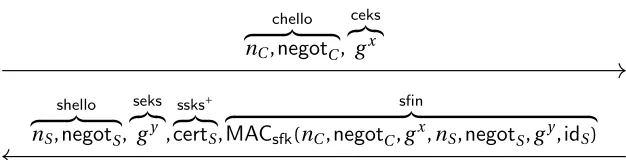
Figure 1: OPTLS Basis (c.f. 1-RTT semi-static).sfkis derived fromgxsandatkfromgx yandgxs. See Fig2 for the full OPTLS protocol.
We provide a high-level overview of OPTLS intended to convey the general logic and rationale of the protocol and its main features. Details are given in Section4where a formal treatment of the protocol and its analysis are presented; in particular, Figure2describes the different modes of OPTLS. Section5 explains the uses of OPTLS in TLS 1.3.
OPTLS basics. OPTLS is based on the simple protocol depicted in Figure 1 run between a clientC, on the left side, and a serverS; it corresponds to the 1-RTT semi-static mode described in Section4. This version provides server-only authentication (the most common use case in TLS) and assumes the possession by the serverSof a CA-signed DH certificatecertSbinding the server’s identity to a DH keygs(wheresis the server static secret key). We note that while authentication via DH certificates will not be the typical use case in TLS, this mode is useful to illustrate the logic of OPTLS (in the more common setting, this logic is preserved but the server itself will sign a static or ephemeral key using a signature certificate). The values
nC,nSrepresent unique session nonces andnegotC,negotSrepresent protocol parameters negotiated by the parties to agree on a protocol version, cryptographic algorithms, etc. Authentication is provided by aMAC2computed with keysfkderived from the valuegxs; valuesxandyare ephemeral secrets chosen by the client and server, respectively. The information shown under theMACrepresents the information that must be authenticated but in the actual protocol other elements may be included (in TLS, the input to the MAC is a hash of the handshake transcript).
The output of the protocol is a session key derived jointly fromgxsandgx ywith the former ensuring securing for as long as the server’s private keys is secure and the latter providing security in case of leakage ofs, namely,perfect forward secrecy (PFS). Details of key derivation are discussed below. We note that the session key in the TLS setting is theapplication traffic key (atk)used to protect data transmitted over the record protocol, via the use of authenticated encryption (AEAD) [49,45,9,37].
In spite of its simplicity and schematic representation, the underlying logic of the protocol in Fig-ure 1 is demonstrated and preserved throughout all variations and modes of OPTLS. That is, atwo-layer
authentication logicwhere the server’s DH keygsis authenticated by a signature (in the example of Fig-ure 1 this is done via a CA-signed certificate) and this keygs is then used to authenticate the transcript of the protocol through aMAC(which makes this MAC, i.e., the mandatory server’s Finished message in TLS 1.3, an essential piece in handshake authentication). As we see below, due to functional require-ments of TLS 1.3 (e.g., 0-RTT) and the limited deployment of DH certificates, OPTLS supports other ways
of implementing the top-layer authentication, namely, different ways of managing the authentication of the server’s keygs. The flexibility and uniform logic of the protocol is not only demonstrated through the many protocol variants but also in the ability to accommodate different optimization trade-offs (more below).
From DH certificates to signature certificates. Since in today’s practice servers typically possess certi-fied signature keys, we adapt the above protocol to more available settings by using the server’s signature key to sign the static DH keygs. Thus, instead of a DH certificate, we now consider the transmittedcertS to be a certificate binding the server’s identity to a signing key, and add a signature of the server on the static DH keygs. This signature can take one of two forms: (i) the signature coversgs and a validity pe-riod through which a client can accept server authentication based ongs; or (ii) the signature coversgs
and the client’s noncenC. The latter can be thought of a validity period that lasts for the current session only, i.e., ensures the freshness of the signature. A clear advantage of option (i) is that it saves the cost of a per-session signature, only requiring the server to periodically (offline) signgsvalues (after which a client can cachegs); it also provides much flexibility to the management of static keys by a server includ-ing the use of short-livedgs values. On the other hand, offline signing empowers the server’s signature with certification capabilities (for certifying gs) something the current TLS 1.3 specification does not support3although an extension for such a mode is in the plans. Option (ii) resolves the concerns with offline signing at the cost of requiring anonlinesignature, one per session, that can be costly, especially while using RSA signing keys (the prevalent case today). As we see next, this cost can be amortized via caching of keysgs.
Cached keys and 0-RTT. An operational mode required by TLS 1.3 and supported by OPTLS is the use of server’s static keys cached by a client or retrieved out of band. This is needed to support a “0-RTT mode" in which the client can send data already in the first message of the protocol, following the value
gx (seeearly datain Figure2), and protect it using authenticated encryption under a key derived from
gxs. Such a 0-RTT mode is mandatory for TLS 1.3 and is intended to decrease the latency introduced by the rounds of communication imposed by prior versions of TLS. A typical application example [42] is that of a user sending a TLS-protected query to a search engine; with current TLS, the browser and server need to exchange handshake-specific messages before they can establish the secure channel on which to transmit the query. Using the 0-RTT mode, the client can send its protected query already in its first message. In addition, cached server’s keys (received by the client in a previous session with the server) also allow for handshake sessions without signatures at all, something that may be particularly beneficial when using RSA signatures (a 2048-bit RSA signature is an order of magnitude more costly than a variable-base 256-bit ECDH exponentiation).
Replay protection.An important consideration for the use of a 0-RTT mode is the fact that data (early data) transmitted in the first message under the protection ofgxsis open to replay by an attacker. OPTLS does not include a specific anti-replay mechanism as this can be implemented in different forms by different implementations, independently of the KE mechanism. A typical anti-replay approach is for the server to keep state about the 0-RTT messages (e.g., client nonces) it has seen and reject duplicates. QUIC [42], for example, includes such an elaborate mechanism. We caution that managing an anti-replay mech-anism at the “Internet scale" is very non-trivial as recently observed in the TLS mailing list4and much care needs to be exercised when assessing a particular mechanism.
3A potential weakness arises from server implementations that protect the signing key, e.g., via hardware protection, but may be vulnerable to occasional unauthorized use of the signing capability that would allow an attacker to obtain a signature on a valuegsof her choice and use it to impersonate the server for a long period of time.
Optimizations. One of the salient properties of OPTLS is its flexibility and the way it can support differ-ent performance needs. For example, consider the use of server signatures in the protocol as discussed above. OPTLS provides variants where server signatures are not used at all (the case of DH certificates), or only used offline, or used online but amortized over repeated uses of cachedgskeys. These are all very attractive options for saving in the number of signing operations which is particularly important when considering RSA signatures. On the other hand, for ECDSA signatures where signing is very efficient, one may not want to focus on saving signing operations and prefer saving on DH exponentiations. Here is how this can be achieved with OPTLS. Consider for simplicity a server that does not support cached keys or DH certificates. The client sendsgxand the server responds with a signedgs, the ephemeralgy, and aMACcomputed using a key derived fromgxs. This costs the server a signature and two DH variable-base exponentiations (the latter for computinggxs andgx y). However, since the client does not cache the server’s key, the server can usegsas a one-time value (used only for this particular session) and elim-inategy, where the one-timegs provides PFS. Authentication is still obtained via theMACcomputation as in the basic logic of OPTLS. The cost is one signature and one DH exponentiation, hence accomplish-ing the savaccomplish-ing of one DH exponentiation as intended. This is how the 1-RTT non-static mode is defined (except that in the description of this mode in Figures2and3we follow the TLS 1.3 notation and usegy
in the role ofgs).
Key derivation. The two central ingredients in the key derivation of OPTLS are the DH valuesgxs, from which theMACkeysfkfor server authentication is derived, andgx ythat serves as input to the derivation of the session keyatkfor providing PFS. More precisely, OPTLS strengthens the session key by deriving it from bothgx y andgxs, hence ensuring the security of the session key even upon compromise of one of the secretsyors(assuming the compromise ofshappens after the handshake is complete). In the 0-RTT case where the client sends protected data in the first protocol message, the authenticated-encryption key is derived fromgxsonly. OPTLS implements these key derivations using the HMAC-based construc-tion HKDF [40,39] that serves as a unifying tool for the multiple derivations in the protocol. This results in a uniformderivation tree, based on the HKDF extract and expand components, common to all of the protocol modes (see Figure2and note the notationsskandeskforgxsandgx y, respectively).
Recall that HKDF takes as inputs: an initial keying material value (IKM) from which keys are derived, a constant or random salt value, a context valueinfo, and the total length of keys to be output. In OPTLS, theinfovalue is the concatenation of a unique label (indicating the purpose of the derived key) with information from the protocol’s transcript that includes nonces, identities, security parameters, crypto-graphic algorithms, etc. For deriving the server’sMACkeysfkand the client’s authenticated-encryption key for protection of 0-RTT data, IKM is set tossk=gxs and the salt value to 0. For the derivation of the session keyatk, IKM is set tomESwhich is derived fromesk=gx y and the salt is set tomSSthat is derived fromssk=gxs; this achieves the mixing ofgx yandgxsin the derivation of the session keyatkfor ensuring, as explained above, the security of this key even if one ofyorsleak.
Interestingly, for analyzing these key derivations we resort to the full modeling power of HKDF: The derivation fromgxsuses a salt value of 0 which is equivalent to modeling HMAC as a random oracle (this is necessary to ensure CCA security of the keygxs[1])5.
For the derivation of the session keyatkwe consider two cases. First, ifsis uncompromised thenmSS
is pseudorandom (by virtue of the secrecy ofgxsand the modeling ofHKDF(0,·) as a random oracle) and
we only need to assume HMAC to be a PRF; note that in this caseatkis secure even ifyis disclosed, all we need isgy to be unique. Second, ifsleaks (after the session key is computed, hence ensuring that
gxs was not adversarially chosen) thenmSSleaks too but it is still the output from a random oracle on a non-adversarial input, hence it serves as a public random salt in the derivation ofatk; in this case it suffices to assume that HMAC is a (strong) randomness extractor seeded by the saltmSS.
Pre-shared key. While the main operational mode of TLS (and OPTLS) assumes that the server possesses a long-term public key (typically a signature verification key), there is an important use case in which the client and server enter the protocol with a previously shared secret key. This mode, called Pre-Share Key needs to be supported in TLS 1.3 too (where it is also used as a session resumption mechanism). OPTLS naturally accommodates this mode by simply replacing the keygxs (for theMACcomputation and key derivation) with the pre-shared secret. The other input to key derivation,gx y, is preserved hence providing PFS (the resultant mode is called PSK-DHE). One can also obtain pre-shared key mode (PSK) without PFS by eliminatinggx and gy which results in a very efficient mode with only symmetric key operations.
Handshake encryption. TLS 1.3 requires its handshake messages to be protected to the extent possible with authenticated encryption (AEAD). This is intended to hide the contents of some messages such as the server identity/certificate from an observer. For this, OPTLS derives an additional handshake traffic key (htk) fromgx yand starts encrypting all handshake traffic following thegy value sent in the server’s message (the first client’s message is not protected, except for client’searly datain the 0-RTT case). In OPTLS and TLS 1.3, the keyhtkfor encrypting handshake traffic is computational independent of that for application traffic, even though both keys are derived fromgx y. Using separate keys for handshake and application traffic allows the use of standard KE models [7,19] that require that session keys remain indistinguishable from random at the end of the KE run. In addition, it enables modular and composable design where one can analyze the KE protocol independently of any specific application [19,17]. In contrast, TLS 1.2 uses the application key to encrypt handshake messages, adding complexity to the analysis and violating the generic security and modular composability of the key exchange protocol. We note that OPTLS guarantees the security of the KE protocol even without encryption of the handshake traffic. In fact, we first analyze the KE protocol without handshake encryption, and then extend our analysis to the setting with handshake encryption.
Protocol analysis. In Section4we present a formal specification and analysis of the OPTLS protocol. The analysis is carried in the Canetti-Krawczyk model of KE protocols [19,21] that allows for the con-sideration of leakage not only from session keys but also from the session’s temporary values such as ephemeral exponents and intermediate keys. More specifically, we use the CK model with server-only authentication, as well as its specialization to one-message KE protocols [30] as needed for analyzing the 0-RTT mode of the protocol. Much of the analysis is standard and, thanks to the uniform logic of OPTLS, it applies with relatively small adaptations to the different variants of the protocol. As discussed in the introduction, the analysis of OPTLS in such a model is essential for gaining confidence in its security and for guiding the very design of the protocol as well as its use in TLS 1.3. Additionally, we purposely mini-mize the elements in the protocols to understand what is essential for security and what is not: not only for the sake of analysis but also to know what’s “the cryptographic core” that must be preserved when adapting it to new uses.
model used here, such as resistance to “key synchronization attacks”; the interaction between different modes and components of TLS, including the co-existence with previous versions of TLS; specification and implementation issues as well as varying use cases and application-specific semantics; and more. Fortunately, much work has been done in these directions with TLS 1.2 (see introduction) and we expect TLS 1.3 (partly thanks to its OPTLS basis) to be significantly more amenable to analysis. We anticipate that the analysis presented here will serve as a basis for the above more comprehensive studies, in par-ticular as a way to frame in a formal way the cryptographic logic of the protocol, as well as to guide future extensions to the protocol (e.g., the use of DH certificates, offline signatures, and further optimizations not currently supported in the TLS 1.3 spec).
OPTLS in TLS 1.3. The main motivation for the design of OPTLS is to serve as a basis for the handshake protocol of TLS 1.3 and, in particular, to respond to the new requirements of the TLS working group as discussed earlier, namely, the provision of a 0-RTT mode, making forward secrecy an integral part of the protocol, and accommodating elliptic curves as the preferred cryptographic machinery. OPTLS delivers these requirements while offering a combination of conceptual simplicity, design flexibility, and a uniform logic that unifies the different protocol variants. These are all attractive properties for the analysis, specification and future adaptations of a complex protocol like TLS.
Due to these properties and flexibility, OPTLS is being adopted and adapted as a basis for the design of the TLS 1.3 Handshake protocol [51]. At the same time, a specification of a complex protocol like TLS needs to manage the tension between the need to support multiple use scenarios and the need to reduce the number of options and execution paths allowed by the protocol. The latter is needed for reducing the overall complexity of the protocol, simplifying its specification, and avoiding implementation errors. In the case of TLS 1.3, its designers can choose the subset of OPTLS variants that best fit the function-ing and security requirements of the protocol. These choices mainly refer to the properties ofgs, such as specifying the method for authenticating this key and whether it is static, semi-static or non-static key (roughly correspond to a long-termgs as in the case of DH certificate, a short term cacheable key, or a one-time key as discussed in the optimization section above and in more detail in Section4.4). Impor-tantly, the execution paths of the protocol are similar for all these cases as exemplified by the uniform key derivation strategy for the different protocol modes (see Figure7).
3 Cryptographic preliminaries
Cryptographic groups. We consider cyclic groups of orderpgenerated by a generatorg. We assume that we can efficiently verify membership in the group, and that both parties will always verify membership in the group throughout the protocol. The Gap Diffie-Hellman (gap-DH) assumption [1] asserts that computingguv given (g,gv,gu) is hard on average, even given access to a verification oracle (g,gv,·,·) for DDH tuples. In other words, CDH is hard given a DDH oracle.
HKDF assumptions. HKDF [40,39] uses a two-step mechanism by which one first extracts random-ness from a possibly non-uniform secret input to create a uniformly random string that is then used with a regular PRF to generate keying material. Here, we denote the two steps asHKDF.Extractand
HKDF.Expand. The rationale of the extraction part is to concentrate the “secret entropy” of the input on a single strong cryptographic key (from which more keys can be derived).
• When the first input is 0, we treatHKDF.Extract(0,·) as a random oracle, and as a deterministic extractor when applied to flat high-entropy sources. In particular, if the input is uniformly ran-dom, then the output is uniformly random. When the first input is a random stringK, we treat
HKDF.Extract(K,·) as a pseudo-random function with keyKifKis secret, and as a (strong) extrac-tor with seedK ifK is public.
• We treatHKDF.Expand(K,·) as a (variable-length output) pseudo-random function with key K.
HKDF.Expandreceives as an additional input a string denoting context information related to the derived keys (calledinfoin Section2). We use unique labels for domain separation when using
HKDF.Expandto derive multiple keys.
3.1 Security model for key exchange
This section presents an abridged description of the Canetti-Krawczyk security model for key-exchange protocols [19,21,8] on which all the analysis work in this paper is based. The reader familiar with this model can skip this section. On the other hand, please consult [19] for complete details.
Akey-exchange (KE) protocolis run in a network of interconnected parties where each party can be activated to run an instance of the protocol called asession. Within a session a party can be activated to initiate the session or to respond to an incoming message. As a result of these activations, and according to the specification of the protocol, the party creates and maintains asession state, generates outgoing messages, and eventuallycompletesthe session by outputting asession keyatkand erasing the session state. A session may also beabortedwithout generating a session key. A KE session is associated with its
owner(the party at which the session exists), apeer(the party with which the session key is intended to be established), and asession identier.
of its choice, including public keys equal or related to keys of other parties in the system. In this paper, a public key will always be a static Diffie-Hellman value and the private key its secret exponent. We use
ssks=gs to denote the server’s DH key share, and we usessks+to denote the server’s authenticated DH key share. That is,ssks+includes both the server’s identitysid, along with a signature chain starting with the CA authenticating bothssksandsid.
Attacker model. The attacker is modeled to capture realistic attack capabilities in open networks, in-cluding the control of communication links and the access to some of the secret information used or generated in the protocol. The basic principle is that since security breaches happen in practice (e.g., via break-ins, mishandling of information, insider attacks, cryptanalysis), a well-designed protocol needs toconfine the damage of such breaches to a minimum. In particular, the leakage of session-specific ephemeral secret information should have no adverse effect on the security of any othernon-matching
sessions.
The attacker, denotedA, is an active “man-in-the-middle" adversary with full control of the commu-nication links between parties.A can intercept and modify messages sent over these links, it can delay or prevent their delivery, inject its own messages, interleave messages from different sessions, etc. (For-mally, it isA to whom parties hand their outgoing messages for delivery.)A also schedules all session activations and session-message delivery. In addition, in order to model potential disclosure of secret information, the attacker is allowed access to secret information via the following attacks:
• AStateReveal() query is directed at a single session while still incomplete (i.e., before outputting the session key) and its result is that the attacker learns the session state for that particular session (which may include, for example, the secret exponent of an ephemeral DH value but not the long-term private key used across all sessions at the party).
• AReveal() query can be performed against an individual session after completion and the result is that the attacker learns the corresponding session keyatk(this models leakage on the session key either via usage of the key by applications, cryptanalysis, break-ins, known-key attacks, etc.).
• ACorrupt() means that the attacker learns the long-term secret of that party; in addition, from the moment a party is corrupted all its actions may be controlled by the attacker.
Basic security. To define security, we need a notion ofmatching. For the protocols in this paper, we use a prefix of the transcript as the session identifier. That is, we say that two sessions arematchingif the transcripts at both sessions begin with the samesessionid=(chello,ceks,shello,seks,ssks+). Recall that
ssks+includes the server’s identitysid.
Sessions against which any one of the above attacks
StateReveal(),Reveal(),Corrupt() is performed (including sessions compromised via party corruption) are calledexposed. In addition, a session is also called exposed if the matching session has been exposed (since matching sessions output the same session key, the compromise of one inevitably implies the compromise of the other).
The security of session keys generated in unexposed sessions is captured via the inability of the at-tackerA to distinguish the session key of atest session, chosen byA among all complete sessions in the protocol, from a random value. This is captured via aTest() query. This query may only be asked once during the security game. SetsK0:=atk(or random ifatk=⊥) as the real session key, and sets
K1←R{0, 1}λ. Then, it picksb←R{0, 1} and returnsKb. In the case of server-only authentication, the
The attacker can continue with the regular actions against the protocol also after theTest() query; at the end of its runA outputs a bitb′, which is meant as a guess for the value ofb.
A key-exchange protocolπis calledsecure[19] if for polynomial-time attackersA running againstπ it holds:
1. If two uncorrupted parties complete matching sessions in a run of protocolπunder attackerA then they output the same key (except for a negligible probability).
2. The probability that the test session is not exposed andA output a correct guessb=b′is at most 1/2 plus a negligible fraction.
Forward secrecy. An stronger notion of security is that ofperfect forward secrecy (PFS), namely, es-tablished session keys remain secure even if the parties are corrupted and their long-term secrets are exposed. More formally, a key-exchange protocol is said to achieve PFS security if it achieves basic secu-rity even if we relax the definition of unexposed sessions to allow aCorrupt() query upon completion of the session.
Resilience to disclosure of ephemeral exponents. Another stronger notion of security is that of re-silience to disclosure of ephemeral exponents, namely, establish session keys remain secure even if some ephemeral exponents are leaked. More formally, a key-exchange protocol is said to achieve resilience to disclosure of ephemeral exponents if it achieves basic security even if we relax the definition of unex-posed sessions to allow aStateReveal() only on the server side. (For the protocols in this paper, it is impossible to protect the session key upon aStateReveal() on the client side.)
Simplifications and conventions. Following [41], we assume selective security in the choice of the test session, which implies fully adaptive security at a security loss which is linear in the total number of sessions. In our proofs we will assume the existence ofa single honest client and a single honest server. This simplification is without loss of generality since we may simply simulate all other clients and servers.
4 Cryptographic Core of OPTLS
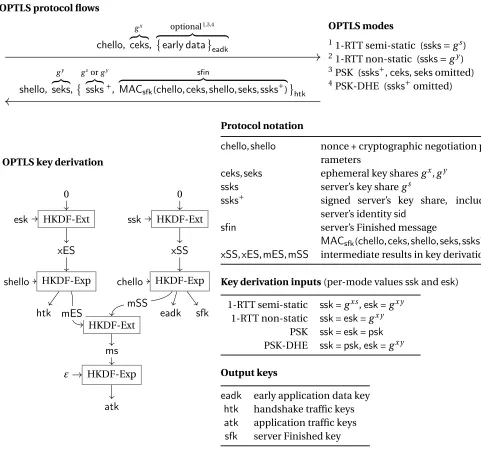
The OPTLS protocols have two flows as shown in Fig2. Before going into detail, we reiterate that the OPTLS protocols are designed to achieve basic KE security (c.f. Section3.1) and do not incorporate many elements in TLS 1.3 that are necessary for operating in the real world; we elaborate on these latter issues in Section5.
OPTLS modes. There are four primary modes for OPTLS:
• 1-RTT semi-static, where the server has a semi-staticgs which can also be used to support early application data in a 0-RTT mode;
• 1-RTT non-static, where there is no staticgsand the ephemeralgy plays the role ofgs;
• PSK for use with a pre-shared secret key (an existing secret shared between the server and the client);
OPTLS protocol flows chello, gx z}|{ ceks, optional1,3,4
z }| {
{
early data}eadk
shello, gy z}|{
seks,{ gsorgy
z}|{
ssks+,
sfin
z }| {
MACsfk(chello,ceks,shello,seks,ssks+) }
htk
OPTLS modes
11-RTT semi-static (ssks=gs)
21-RTT non-static (ssks=gy)
3PSK (ssks+,ceks,seksomitted)
4PSK-DHE (ssks+omitted)
OPTLS key derivation
HKDF-Ext ssk 0 HKDF-Ext esk 0 ms HKDF-Ext HKDF-Exp chello HKDF-Exp shello HKDF-Exp ε xSS xES atk
htk mES eadk sfk
mSS
Protocol notation
chello,shello nonce + cryptographic negotiation pa-rameters
ceks,seks ephemeral key sharesgx,gy
ssks server’s key sharegs
ssks+ signed server’s key share, includes
server’s identitysid
sfin server’s Finished message
MACsfk(chello,ceks,shello,seks,ssks+) xSS,xES,mES,mSS intermediate results in key derivation
Key derivation inputs(per-mode valuessskandesk)
1-RTT semi-static ssk=gxs,esk=gx y
1-RTT non-static ssk=esk=gx y
PSK ssk=esk=psk
PSK-DHE ssk=psk,esk=gx y
Output keys
eadk early application data key
htk handshake traffic keys
atk application traffic keys
sfk server Finished key
Figure 2: OPTLS Summary. Modes, Terminology and Key Derivation (unique labels used as inputs to HKDF-Exp are not shown;εdenotes the empty string).
mode ceks seks ssks sfk eadk atk htk cost
1-RTT semi-static gx gy gs gxs gxs gxs,gx y gx y 2DH
1-RTT non-static gx gy gy gx y – gx y gx y 1DH + 1sig
PSK – – – psk psk psk psk –
PSK-DHE gx gy – psk psk psk,gx y gx y 1DH
These four modes have also been adapted and adopted in the TLS draft as described in [51, Section 7.1] (see Section5for more details).
Key derivation. We derive the keys for all the different modes in a unified manner as shown in Fig2. We designed the key derivation schedule following the following principles from HKDF:
• We always useHKDF.ExtractbeforeHKDF.Expandand we use multiple invocations ofHKDF.Expand
with different labels to derive multiple keys;
• Each intermediate key is only used at most once as an input to eitherHKDF.ExtractorHKDF.Expand.
In the protocols, we minimized the input toHKDF.Expandto understand what is essential for security and what is not. We refer to Section5for discussion on using session hash (i.e. a hash of all handshake messages up to the point of derivation) for key derivation to thwart key synchronization attacks.
Server configuration. The 1-RTT protocols refer to the server configurationssks+, namely an authenti-catedssks=gs attached to a server identityidS. There are several different ways to implement such an authenticated configuration. First, it could be transmitted out-of-band, e.g. via DNSSEC, DANE, a web-site or a previous TLS execution. Second, it could be transmitted during the protocol execution, e.g. via DH certificates, or offline signatures, or online signatures that coversgstogether with the client’s nonce. The specification of the server configuration in the current TLS draft [51, Section 6.3.7] also includes an expiration date, which we left out here as it is not captured by our security model.
Notation. We denote algorithmsMAC,HKDFusing all-caps and stringschello, . . . using all-lower-case. We use{M}K to denote an authenticated-encryption (AEAD) of a messageMunder keyK.
4.1 Detailed overview
We present a detailed overview of the modes that rely on DH key exchange: 1-RTT semi-static, 1-RTT non-static and PSK-DHE. Here, we deviate slightly from the overview in Section2, treating each of the three modes in parallel. For simplicity, we first carry out the analysis ignoring handshake encryption and then address handshake encryption in Section4.6.
The starting point is the textbook protocol for key exchange with signatures: the client sends (chello,gx), and the server responds with (shello,gy) and a signature over the entire transcript, and the shared session key isgx y. As noted in the introduction, if the server has an authenticatedgsinstead of a signature key, then it could instead authenticate the entire transcript with a MAC using a key derived fromgxs. Note that both of these protocols achieve PFS, sincegx yremains pseudorandom even if the server’s long-term signing key or DH exponentsis compromised upon completion of the key exchange protocol.
The message flow for TLS handshakes [51, Figure 1] mandates that the server provides a Finished message across all modes of operation, whose role is to “providing authentication of the server side of the handshake and computed keys” [51, Section 6.3.9]. In TLS, the Finished message corresponds to a MAC computation, since not all modes admit a server’s signing key.
In OPTLS, we also adopt the server’s Finished message in TLS, and we require that the server authen-ticate the entire transcript via the server’s Finished message, which corresponds to computing a MAC –instead of a signature– over the entire transcript. We continue to derive the session key fromgx y (possi-bly along with additional keying material to enable security even ifyis compromised), but the question remains: how do we derive the MAC keysfk?
• In 1-RTT semi-static, the server has an authenticated semi-static keygs andsfkis derived from
• In 1-RTT non-static, there is no semi-static keygs. Instead, the server would signgy (this can be pre-processed offline), and then derivesfkfromgx y. An alternative interpretation of this mode is as follows: once the server signsgy, it plays a role similar to the semi-static keygs and this mode may be thought of replacing (gs,gxs) in 1-RTT semi-static with (gy,gx y).
• In PSK-DHE mode,sfkis derived from the pre-shared keypsk; the session key is derived from a combination ofpskandgx y, which allows us to achieve PFS in the case wherepskgets compro-mised.
Proof overview. The proofs all follow the following high-level structure in the PFS setting.
• We rely on the security of server authentication andsfkto argue thatgy at the client test session must have come from an honest server. The exact security reduction depends on howsfkis de-rived: for instance, in 1-RTT non-static, this follows quite readily from the security of the server’s signature, and in PSK-DHE mode, this follows quite readily from PRF security with seedpsk. The formal security reduction requires a bit more care as we need to properly account for replay at-tacks.
• We then apply the DH assumption to key sharesgx,gyat the client test session to replacegx ywith random, upon which we are essentially done.
Key derivation. To achieve uniform key derivation, we associate each mode with a pair of keysesk,ssk
(denoting ephemeral secret and static secret keys). For 1-RTT semi-static, these correspond naturally to (gx y,gxs). The remaining keys are then derived from (esk,ssk) in a unified manner as shown in Fig2.
• We note thatsfkis derived fromsskand not fromesk. In 1-RTT semi-static, onlyssk=gxs can authenticate the handshake as it is the only element to involve the server’s semi-static keygs. One of the main elements to be authenticated by the server isgy, thus derivingsfkfromesk=gx y(or from mixingeskandssk) would create a circularity issue in the logic of the derivation.
• We encrypt handshake traffic under a key derived fromesk=gx y and not from botheskandssk. This allows the server to start encrypting handshake traffic as soon asgy is transmitted; in partic-ular, it allows the encryption of the server’s semi-static keygs.
• We derive the application key from a mix ofsskandeskvia HKDF; deriving fromeskprovides for-ward secrecy whereas deriving fromsskprovides resilience to disclosure of ephemeral exponents (the latter in 1-RTT semi-static and PSK-DHE modes). One can contemplate straightforward com-binations ofsskandesksuch as a simple XORing of these values. We choose to use HKDF instead as a more robust option against future changes and misuse. In particular, an XOR could be prob-lematic in the 1-RTT non-static and PSK modes where we setssk=esk. See the “Key derivation" text in Section2for more detailed rationale of the particular way in whichsskandeskare mixed through HKDF.
4.2 1-RTT semi-static
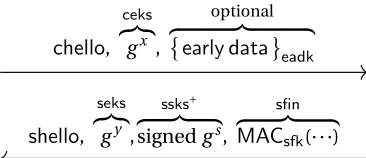
The 1-RTT semi-static mode is summarized in Fig4.
chello,
ceks z}|{
gx ,
optional
z }| {
{
early data}eadk
shello,
seks z}|{
gy ,
ssks+ z }| { signedgs,
sfin
z }| {
MACsfk(···)
Figure 4: 1-RTT semi-static mode. Here, (sfk,eadk) are derived fromgxsandatkfrom (gxs,gx y). See Fig2 for details on computation of these keys andsfin.
agree on the samessks+ and it is included in the computation of sfin. We first analyze the protocol assuming there is no early data, and we analyze the security of early data in Section4.3.
Theorem 1 (1-RTT semi-static) The OPTLS protocol in the 1-RTT semi-static mode achieves security with perfect forward security (PFS) and resilience to disclosure of ephemeral exponents. This holds in the ran-dom oracle model assuming security of HKDF, hardness of Gap-DH and hardness of DDH.
Here, PFS security refers to the server’s secret sand long-term signing key inssks+, and resilience to disclosure of ephemeral exponents refers to the server’s ephemeral exponenty. The Gap-DH assumption and the random oracle are used to ensure non-malleability across multiple sessions that use the same fixedgs, as was the case in the DHIES CCA-secure encryption scheme in [1].
Correctness. Suppose two honest peers have the same matching conversation (chello,ceks,shello,seks,ssks+). Observe that this uniquely determinesesk,sskand thus the session keyatk.
Security. Letsessionid∗=(chello∗,ceks∗,shello∗,seks∗,ssks∗) denote the view of the client at the test ses-sion. Throughout, we write (ceks∗,seks∗,ssks∗)=(gx,gy,gs). Throughout the proofs, we treatHKDF.Extract(0,·) as a random oracle, which we simulate via lazy sampling. We consider two cases. The first addresses the setting wheregxs is secure (e.g.sis secure butymay be leaked via aStateRevealquery, and the second addresses the setting wheregx y is secure (e.g. yis secure butsmay be leaked after the handshake via a
Corruptquery, i.e. the PFS setting).
Case 1:sis never compromised. Here, we rely on security ofssk=gxsfor the privacy ofatk. We proceed via a sequence of games as follows:
• Game 0: Real game.
• Game 1: Abort ifssks∗ does not matchgs for the honest server whose identity is embedded in
ssks+. This follows from the security of the signature scheme used to signssks∗(or the security of whatever mechanism used to authenticatessks+).
• Game 2: Abort if the adversary queriesHKDF.Extract(0,·) atgxs. In addition, pick a uniformly ran-dom stringxSS∗and implicitly programHKDF.Extract(0,gxs) to bexSS∗. By the Gap-DH assump-tion6 which tells us thatgxs is hard to compute giveng,gx,gs and a verification oracle (g,gs,·,·) for DDH tuples, this affects the advantage by a negligible quantity. In the security reduction,
– We picky ←R Zp ourselves, setting (ceks∗,seks∗,ssks∗)=(gx,gy,gs) (here, we use the fact that (ceks∗,seks∗)=(gx,gs) are sampled uniformly by an honest client and honest server respectively);
– We simulate the honest server by simulating
HKDF.Extract(0,·) ourselves via lazy sampling to computexSS, using the DDH verification oracle to ensure that the queries are simulated consistently.
Note that any leakage ofxSS∗to the adversary must come from interacting with the honest server in a session withceks=gx(and there could be many such sessions at the same server).
• Game 3: Replace (sfk∗,mSS∗,eadk∗) by uniformly random strings. This follows readily from PRF security ofHKDF.Expand(xSS∗,·). (Again, multiple sessions at the same server could share the samegx,xSS∗,sfk∗.)
• Game 4: Abort if there is no matching conversation, i.e., no server session begins with the view
sessionid∗. In Game 2, the only access the adversary has tosfk∗comes from interacting with the honest server, which computesMACsfk∗(·). By the security of the MAC, the client will only reach
accept state if the adversary forwardssfin=MACsfk∗(sessionid∗) as computed by an honest server,
in which case we have a matching conversation. In the security reduction,
– We pickx,s←RZpourselves, setting (ceks∗,ssks∗)=(gx,gs);
– We programsfk∗to be the MAC key;
– We simulate all messages from the honest server ourselves using s, except that we use the
MACsfk∗(·) oracle to computesfinwheneverceks=gxand thusxSS=xSS∗;
– When the honest client receivessfin∗from the adversary, the reduction outputs (sessionid∗,sfin∗).
Whenever client accepts without a matching conversation, the reduction outputs a valid forgery forMACsfk∗(·). Finally, note that the matching conversation is unique since all other server sessions
useshello̸=shello∗.
• Game 5: Replacems∗by a uniformly random string. This follows from PRF-security ofHKDF.Extract(mSS∗,·) and the uniqueness ofmES∗across different sessions via a birthday analysis.
• Game 6: Replaceatk∗ by a uniformly random string. This follows readily from PRF-security of
HKDF.Expandwith seedms∗.
Observe that in the final game, the view of the adversary is completely independent of the challenge bit. Furthermore, observe that throughout the proof, we always picky←RZpourselves at the honest server, which means that security holds even when y is compromised at the honest server via aStateReveal
query.
Case 2: sis compromised after handshake. Next, we consider the case wheresis compromised after the client receivesgy and reaches accept state. Here, we rely on security ofesk=gx y for the privacy of
atk. Also, we only rely on the security ofsin Game 2 before the completion of the handshake. We start out as before:
• Game 1: Same as Case 1.
• Game 2: As in Case 1, except the abort condition only applies to queries made before the client reaches accept state (and thus beforesis compromised).
• Game 3: Same as Case 1.
• Game 4: Same as Case 1.
• Game 5: Replaceesk∗ =gx y with gz wherez ←RZp. This follows from the DDH assumption, which tells us thatgx yis pseudorandom giveng,gx,gy. In the security reduction,
– We picks←RZp ourselves, setting (ceks∗,seks∗,ssks∗)=(gx,gy,gs) (here, we use the fact that (ceks∗,seks∗)=(gx,gy) are sampled uniformly by the honest client and honest server respectively);
– We simulate the honest client ourselves;
– We simulate all messages from the honest server ourselves using s, except that we use the challengegx yorgzfor computingesk∗.
• Game 6: Replace (htk∗,mES∗) with uniformly random strings. This follows from PRF security of
HKDF.Expandwith seedxES∗which is derived fromgz.
• Game 7: Replace
ms∗=HKDF.Extract(mSS∗,mES∗)
with a uniformly random string. This follows from modelingHKDF.Extractas a strong extractor, wheremES∗is the entropy source andmSS∗is the public seed.
• Game 8: Same as Game 6 in Case 1.
Observe that in the final game, the view of the adversary is completely independent of the challenge bit.
4.3 Early application data (0-RTT)
We refer to the protocol in Figure4and analyze the protocol where early data is transmitted. If the client has a cachedssks+, then it can start transmitting early application data in the first flow, encrypted under
eadk. This is also known as 0-RTT exchange, which is a requirement for TLS 1.3, c.f. [51, Section 6.2.2]. We reiterate that the early data is not part of the input toMACsfkin computingsfin. Here,eadkis open to
replay attacks (butatkis not). We prove privacy ofeadkin the one-pass model from [30]. Note that it is impossible to achieve PFS security in the one-pass setting.
One-pass security model. We modify the security model in Section3.1as follows:
• the adversary’s queriesReveal(),Test() refer toeadkinstead ofatk;
• We define matching conversations based on (chello,ssks+) (this applies only toeadkand not to
atk).
Theorem 2 (early data in 1-RTT semi-static) The OPTLS protocol in the 1-RTT semi-static mode achieves one-pass security for early application data. This holds in the random oracle model assuming security of HKDF and hardness of Gap-DH.
The theorem refers to the first message of the protocol in Fig4and to the session keyeadk.
Correctness. Correctness assumes an anti-replay mechanism where all sessions at an honest sender have distinct incomingchello, so thatchellouniquely identifiesceks=gx. This means that when there is a matching conversation, both parties sharechello,ceks,ssksand thus compute the sameeadk.
Security. We want to prove privacy ofeadk∗in the case where the server’s static keyssksis never com-promised. We start out similar to the proof of Case 1 in Theorem3.
• Game 0: Real game.
• Game 1: Same as Case 1 in Theorem3.
• Game 2: Same as Case 1 in Theorem3.
• Game 3: Replaceeadk∗with a uniformly random string. This follows from PRF security ofHKDF.Expand(xSS∗,·), since
– Reveal queries foreadkin other sessions do not affecteadk∗sincechello̸=chello∗;
– Leakage from other types of keysatk,sfkdo not affecteadk∗ due to domain separation en-forced by the different labels. In particular, this implies security ofeadk∗ even ifatk∗ gets compromised.
4.4 1-RTT non-static
The 1-RTT semi-static mode is summarized in Fig5.
chello,
ceks z}|{
gx
shello,
seks z}|{
gy ,
ssks+ z }| { signedgy,
sfin
z }| {
MACsfk(···)
Figure 5: 1-RTT non-static mode. Here,sfk,atkare derived fromgx y. See Fig2for details on computation of these keys andsfin. In the actual protocol, there is no need to transmitgy twice.
Theorem 3 (1-RTT non-static) The OPTLS protocol in the 1-RTT non-static mode achieves security with perfect forward security (PFS). This holds in the standard model assuming security of HKDF and hardness of DDH.
use” semi-staticgs in the semi-static mode. Indeed, the proof is similar to that of Case 1 of Theorem1 wheresis never compromised. Note however that we avoid the use of the random oracle model and the Gap-DH assumption in Theorem1for 1-RTT static. The intuition is as follows: in 1-RTT semi-static mode, we needed the Gap-DH assumption to simulate the DDH oracle for a fixedgswhich is used across multiple sessions. Here, a freshgy is picked for each session and there is no fixedgs. In 1-RTT semi-static, we also needed the random oracle to extract a random keyxSSfromgxs; here, we may sim-ply use the DDH assumption to extract a randomxSSfromgx y, again becausegy is fresh per session.
The security proof in this section relies on completely standard techniques and follows closely Case 1 of Theorem1except for Games 2 and 3, so we leave out details of the security reduction.
Security. Let (chello∗,ceks∗,shello∗,seks∗,ssks∗) denote the view of the client at the test session. Through-out, we write (ceks∗,seks∗)=(gx,gy).
• Game 0: Real game.
• Game 1: Abort ifseks∗=gy does not match asekscoming from an honest server session. This follows from security of the server’s signature.
• Game 2: Replaceesk∗=ssk∗=gx ywithgzwherez←RZp. This follows from the DDH assumption.
• Game 3: Replace (htk∗,mES∗,mSS∗,sfk∗) with uniformly random strings. This follows from PRF security ofHKDF.Expandwith seedxES∗=xSS∗which is derived fromgz.
• Game 4: Abort if there is no matching conversation, i.e., no server session begins with the view
sessionid∗. This follows from the security ofMACsfk∗(·) as in Game 4 in Case 1 of Theorem1.
• Game 5: Replacems∗by a uniformly random string. This follows from PRF-security ofHKDF.Extract(mSS∗,·) and the uniqueness ofmES∗across different sessions via a birthday analysis. This is the same as
Game 5 in Case 1 of Theorem1.
• Game 6: Replaceatk∗with a uniformly random string. This follows readily from PRF-security of
HKDF.Expandwith seedms∗. This is the same as Game 6 in Case 1 of Theorem1.
4.5 PSK and PSK-DHE modes
TLS provides a pre-shared key (PSK) mode which allows a client and server who share an existing secret (e.g., a key established out of band) to establish a connection authenticated by that key [51, Section 6.2.3]. PSKs can also be established in a previous session and then reused (“session resumption”). The basic PSK mode does not achieve forward secrecy, but can be augmented with a DH exchange to provide forward secrecy in combination with shared keys.
Following the TLS specification, we assume thatchellocontains a unique identifier for pre-shared key
psk, in addition to the client nonce. We say that two sessions are matching if the transcripts at both ses-sions begin with (chello,ceks,shello,seks) and we require that distinct identifiers amongst honest parties correspond to independent pre-shared keys.
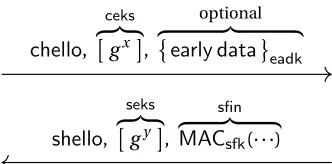
The PSK and PSK-DHE modes are summarized in Fig6.
chello,
ceks z }| { [
gx],
optional
z }| {
{
early data}eadk
shello,
seks z }| { [
gy],
sfin
z }| {
MACsfk(···)
Figure 6: PSK and PSK-DHE modes.gx,gyare only used in PSK-DHE modes. Here, (sfk,eadk) are derived frompsk.atkis derived frompskin PSK mode, and from (psk,gx y) in PSK-DHE mode.
Theorem 4 (PSK and PSK-DHE modes) The OPTLS protocol in the PSK mode achieves basic security in the standard model assuming security of HKDF. The OPTLS protocol in the PSK-DHE mode achieves secu-rity with perfect forward secusecu-rity (PFS) and resilience to disclosure of ephemeral exponents in the standard model assuming security of HKDF and hardness of DDH.
Here, PFS security refers to the server’spsk, and resilience to disclosure of ephemeral exponents refers to the server’s ephemeral exponenty.
Note that the PSK and PSK-DHE modes are similar to the 1-RTT modes in thatpskessentially replaces
gxs: in PSK mode, we haveesk=ssk=pskinstead ofesk=ssk=gx yin 1-RTT non-static, whereas in PSK-DHE mode, we have (esk,ssk)=(gx y,psk) instead of (esk,ssk)=(gx y,gxs). We highlight some of the main differences between the analysis of the PSK and PSK-DHE modes from the 1-RTT ones. Here, we need to simulate multiple sessions at the honest client with the same secretpskand we need to explicitly handle key reveal queries at clients. In the 1-RTT modes, different sessions at the client do not share any secret state and we can simulate each client session in the reduction. Nonetheless, we do effectively get independence across the different honest clients due to PRF-security with seed derived frompskapplied to distinctchello’s across the sessions.
Correctness. Suppose two honest peers have the same matching conversation (chello,ceks,shello,seks). This determinespskand thus the session keyatk.
Security for PSK mode. The proof is similar to that for Theorem3for 1-RTT non-static. There, we have
esk=ssk=gx y, and here, we haveesk=ssk=psk. That is, we simply bypass Games 1 and 2 and go directly from Game 0 to Game 3. In Game 3, we can immediately rely on PRF-security ofHKDF.Expand
with seedxES∗=xSS∗which is derived frompsk.
Security for PSK-DHE mode. The proof is similar to that for Theorem1for 1-RTT semi-static. Again, we consider two cases. In Case 1,pskis never compromised. This is the same as Case 1 from before except we can bypass Game 1 and immediately rely PRF-security ofHKDF.Expandwith seedxSS∗which is derived frompsk. In Case 2,pskis compromised after the handshake and security ofatkcomes from
esk=gx y. This is the same as Case 2 from before.
4.6 Encrypting handshake traffic
We need to show that encrypting the handshake traffic as shown in Fig2does not compromise security of the key exchange protocols. That is, all handshake messages afterseksare encrypted under a keyhtk de-rived fromesk. Note that we still define matching conversations as before (chello,ceks,shello,seks,ssks+), that is, with the unencryptedssks+.
Clearly, the only changes we need to make to the security proofs from before are in the games that refer tosfin,ssks+andhtk. Forsfin,ssks+(which is where the main challenge lies), we need to be able to decrypt incoming messages to an honest client in order to verify the signature onssks+and the MAC in
sfin. For the 1-RTT semi-static, 1-RTT non-static and PSK-DHE modes, we we use the fact that the honest client knowsxand can computehtkand recover the unencryptedssks+,sfin. That is,
• In Game 1 in Case 1 and 2 of Theorem1and in Game 1 of Theorem3, we usexto computehtkand to recover the unencryptedssks+, upon which we can rely on the security of the server’s signature (that is, the honest server which is the peer of the honest client at the test session).
• In Game 4 in Case 1 and 2 of Theorem1and in Game 4 in Case 1 of Theorem3, we usexto compute
htkand to recover the unencryptedsfin, upon which we can rely on security of the MAC.
For the PSK mode, we use the fact that the honest client can computehtkusing the PRF oracle whose seedxESis derived frompsk, thanks to domain separation enforced bychello. Interestingly, the above argument does not rely on AEAD security of the encryption scheme used for handshake encryption.
It is also straight-forward to verify that in the prior proofs, for the honest server, we can always com-putehtkand then encryptssks+,sfin. For instance, in Theorem1Case 2 Game 5, we will derivehtk∗from
esk∗(eithergx y orgz) and then usehtk∗to encryptssks+,sfin. The rest of the proofs then go through unchanged.
In fact, the prior proofs also established security of (atk,htk) (in that we can treat (atk,htk) as the session key), as long asy is not compromised. Concretely, we replacedhtk∗with a uniformly random string in the proofs of Theorem1Case 2 Game 6 and Theorem3Game 3 (which carry over to the proofs of Theorem4). AEAD security then ensures privacy ofssks+ once it is encrypted underhtk. From a cryptographic stand-point, there is no security advantage to encryptingsfin; the reason for doing so is to simplify implementation. We omit further details about protecting privacy of the handshake messages as this is not captured by our security model.
5 OPTLS in TLS 1.3
We show how the basic OPTLS design is adapted into the current TLS 1.3 specification, along with a uniform treatment of all of the major modes, including the PSK mode. Here, we follow the maximalist approach of TLS, namely hashing everything to the point of derivation (a.k.a. “session hash” [15]) as part of the context forHKDF.Expand.
The different modes as summarized in Fig7build upon those in OPTLS, and the only modifications pertain to the input toHKDF.Expandfor key derivation (thehashinputs which also include unique labels not shown in the figure). The analysis is exactly the same as before, since the only changes are that we add additional context information as input toHKDF.Expand(and since the role of these additions are to enforce domain separation, adding more things to the context does not affect the security proofs).
OPTLS in TLS 1.3 draft-09
HKDF-Ext
ssk
0
HKDF-Ext
esk
0
ms
HKDF-Ext
HKDF-Exp hash0
HKDF-Exp hash1
HKDF-Exp hash2
xSS xES
rms
atk
htk mES eadk sfk
ems
mSS
eadk early application data key
htk handshake traffic keys
atk application traffic keys
ems exporter master secret
rms resumption master secret
sfk server Finished key
1-RTT s.s. ssk=gxs,esk=gx y
1-RTT n.s. ssk=esk=gx y
PSK ssk=esk=psk
resumption ssk=esk=rms
PSK-DHE ssk=psk,esk=gx y
hash0 chello+ceks
hash1 ... +shello+seks
hash2 ... +ssks+
Figure 7: Diagram for key derivation (unique labels used as inputs toHKDF.Expandare not shown), as adopted in [51, Sec 7.1]. The session hash refers to all handshake messages sent or received to the point of derivation, with the exception of the Finished messages. Here, online signatures ofsskscover hash1. We derive the keys for the different modes by setting (esk,ssk) appropriately as a function of
gx y,gxs,psk, in the orderssk,xSS,mSS,eadk,sfk;esk,xES,mES,htk;ms,atk,ems,rms. The changes from Fig2are highlighted in red.
instances agree on the same key withA (in the CK model, there is no guarantee about the distribution of a key exchanged with a corrupted party). This form of attack was the source of the triple handshake attack [13]. The session hashes added in the TLS 1.3 key derivation should preclude this attack.
5.1 Relation to TLS 1.3 draft-09 [51]
As mentioned earlier, the four major modes of OPTLS and our uniform key derivation have been adopted in TLS 1.3 draft-09, with a number of additions as described below. The default 1-RTT mode in the draft is the 1-RTT non-static. 1-RTT with known configuration in the draft instantiates 1-RTT semi-static with a cachedssks+.
RSA certificate for RSA encryption in TLS 1.2 and offline signing in TLS 1.3.
We stress that eliminating online signatures may enhance the privacy features of the protocol by providing “plausible deniability” of the peer’s identity. Note that our analysis of OPTLS shows that future uses of TLS could indeed safely forgo the use of online signatures when clients cache a server’s semi-static keygs or when authentication is performed using DH certificates or offline signatures with dedicated signature keys. This is in contrast to recent analysis of TLS 1.3 candidates in [36,36] which crucially rely on the use of online signatures for security.
Key derivation. Key derivation in draft-09 uses additionalhashinputs as mentioned above. Note that since eachHKDF.Expandoperation is paired with anHKDF.Extractoperation, all of the keys can also be computed using black-box invocations of HKDF at the cost of additional invocations ofHKDF.Extract
(instead of separate invocations ofHKDF.ExtractandHKDF.Expandas depicted in our KDF representa-tion). This provides compatibility with a black-box HKDF API, e.g. in PKCS #11 for cryptographic tokens, such as hardware security modules (HSM) and smart cards. Basic KE security of the protocol is not changed by the additionalhashinputs.
Binding keys to identities. The final keys (atk,rms,ems) are bound to server’s identities, even if the server’s identity is not transmitted on the wire as is the case in the 1-RTT semi-static mode. This is a prudent addition addressed in [51, Section 7.2.1] which defines the handshake hash to always include the server’s configuration.
5.2 Further work
Our treatment here does not include some of the elements/modes that are part of TLS 1.3 and which we list here. We anticipate that our analysis work can be extended to cover these elements.
Resumption. Resumption is an important mode in TLS that allows to cache session information (in-cluding keying material) and enable a fast resumption of a session without having to go through the full cost of a new session establishment. TLS 1.3 simplifies (and adds security to) resumption by reducing it [51, Section 6.2.3] to the PSK mode.
Client authentication. Our treatment focuses on server authentication only, the most common case in TLS practice. Yet, client authentication is necessary and supported in other cases. OPTLS can be aug-mented with such capability but we don’t do it here, particularly since the full requirements and opera-tional details of this mode are not yet worked out by the TLS working group. This includes issues such as providing support of client authentication only after server authentication or doing so already in the first message from client to server, something that raises replay considerations. We leave the augmentation of OPTLS with client authentication as a future work item.

![Figure 7: Diagram for key derivation (unique labels used as inputs to HKDF.Expand are not shown),as adopted in [51, Sec 7.1]](https://thumb-us.123doks.com/thumbv2/123dok_us/7923464.1315641/23.612.79.484.74.316/figure-diagram-derivation-unique-labels-inputs-expand-adopted.webp)
