Implementation of Optimization of Latency in
Wireless Mesh Network
Kusuma M1, Umapathi G R2 1, 2
Dept of Information Science and Engineering, Acharya Institute of Technology, Bangalore, India
ABSTRACT-- Research interest towards wireless mesh network has improved drastically. WMN is emerging as promising technology for many useful applications. Many efforts have been conducted to maximize network throughput in multi-channel multi-radio wireless mesh network. Most current approaches are based on either purely static or purely dynamic. Channel allocation plays major role to maximize the network throughput. In hybrid channel allocation, every mesh node is equipped with static and dynamic interfaces.
In turn, Interference and Congestion Aware Routing Protocol (ICAR) in hybrid network with both static and dynamic links, which are capable of balancing the channel usage in network, is proposed. ICAR balances the channel usage of network. Simulation results show the reduced packet delay without degrading the network throughput. Hybrid architecture performs better to changing traffic than pure static architecture, which achieves lower delay than existing approaches for hybrid networks.
Keywords--Wireless mesh network, channel allocation, Multiradio Multi channel, network throughput.
I. INTRODUCTION
Wireless mesh network (WMN) is a promising technology. Ubiquitous and high speed broadband access in urban and rural areas is provided by this technology. Network topology of Wireless Mesh Network may be either a partial or a full mesh topology. A Wireless Mesh Network comprises a number of devices that have the ability to communicate via radio. These devices can be mesh node, mesh router or mesh gateways. Each mesh node has a transmission range. Within the range of each node, wireless links will be formed. End users such as laptops, cell phones or any wireless devices are called Mesh clients. Mesh routers forwards traffic in between Mesh clients or between Mesh clients and the gateway. Gateway in Wireless Mesh Network connects network with the Internet [1].
Due to low cost, easy network maintenance, and reliable service coverage features WMN have received better attention these years. In Wireless Mesh Network, nodes acts as both hosts and routers, and packets forwarded in a multi-hop fashion to or from the gateway connected to the Internet. The most crucial problem in Wireless Mesh Network is the capacity degradation due to wireless interference. To overcome this problem, an effective approach was introduced.
The approach is to employ multiple non-overlapping channels in the network. Advanced technologies along with the effective approaches made it possible to equip a Wireless Mesh router with multiple radios, which can be
configured to different channels. Parallel transmissions in the network improved the network capacity thus resulting in the reduction of the network interference [2]. Compared to single-radio single-channel mesh networks, mesh networks achieves significantly higher performance, by exploiting spatial diversity through multiple radio interfaces located in Mesh nodes, each operating in different channels and directional antenna [3].
Another major challenge in Multiradio Multichannel Wireless Mesh Network is the allocation of channels to interfaces of Mesh routers so that the network capacity can be maximized. There are currently two approaches of channel allocation. Static approach and Dynamic approach are the two approaches. In static channel allocation, each interface of every mesh router is assigned a channel permanently. In dynamic channel allocation, an interface is allowed to switch from one channel to another channel frequently. Both strategies have their advantages and disadvantages.
Static approaches do not require interfaces to switch channels. Hence they have lower overhead. They depend on the stable and predictable traffic patterns in the network. Dynamic approaches are more appropriate when the network traffic changes frequently and is unpredictable. The overall traffic profile is usually complex in the real environment. It not only contains some predictable traffic, for example, a large amount of traffic from end-users to the Internet through gateways, but it also contains a considerable amount of unpredictable traffic between end-users due to the emerging new applications within the community.
Hybrid architecture is proposed to overcome the inflexibility of static channel allocation and the high overhead of the dynamic channel allocation. This hybrid architecture combines the advantages of both static and dynamic approaches. One interface from each mesh router uses the dynamic channel allocation, while the other interfaces use the static channel allocation approaches in Hybrid architecture. The links working on static channels provides high throughput paths from end-users to the gateway while the links working on dynamic channels enhance the network connectivity and the network’s adaptivity to the changing traffic. Therefore, the hybrid architecture can achieve better adaptivity compared to the static architecture without much increase of overhead compared to the purely dynamic architecture [4].
A. Architecture of the Wireless Mesh Network
access points and mobile nodes. The network architecture is shown in below fig 1. Mobile nodes are the mesh clients. Mobiles, laptops and any other wireless devices are the
examples for mesh clients. Access Points have a wireless
infrastructure and they work with the other networks to provide a multi-hop internet access service for mesh clients. Also the mesh clients can connect to network over both mesh routers and other clients. In the mesh network, wireless backbone topology is fixed. In this network architecture, it is not necessary for all access points to have direct connection to the network gateways. They may need to forward their traffic through other intermediate access points in order to reach a gateway. The wireless infrastructures are self-organizing, self-optimizing, and fault tolerant.
1) Network Gateway: The network gateway in the
Wireless Mesh Network is one of the network elements. It allows access to the wired infrastructure. This infrastructure may be the Internet or other local networks. More than one gateway can be deployed in a wireless mesh network.
Fig.1 Architecture of Wireless Mesh Network
2) Access Points (APs): The APs are low cost, flexible,
and easy to deploy. They can be embedded with enhanced capabilities like directional antennas, multiple antennas, multiple interface cards, etc. Using wireless or wired means users are connected to APs. The APs are assumed to be static, with a low failure probability, and no power constraints. The network backbone is formed over a wide area by Access Points. The mesh of APs serves as a relay between the mobile terminals and the network gateways.
3) Mobile Nodes: Mobile nodes includes a wide range
of devices that include PDAs, laptops, cell phones, wireless devices with varying degrees of mobility. In terms of energy autonomy, computation and transmission capabilities mobile nodes can be significantly differentiated. According to the position and transmission capabilities of mobile nodes, they can communicate with the wired infrastructure directly through the network gateway. They can also communicate through the Access Points. It is not necessary for all APs to have direct connection to the network gateways in a Wireless Mesh Network [5].
B. Routing Protocols
Ad hoc routing protocols are categorized as proactive, reactive and hybrid. Proactive routing protocols works like wired networks classical routing. Routers makes sure that at least one path reaches to any destination. Reactive protocols allocate the path if and only if there is a packet that is to be sent to the destination. A path to the destination from a sending node is not requested, if a sending node does not have a packet to send to any destination. Routing protocols of WMN use similar routing protocols of ad hoc networks. WMNs four main classifications are: ad-hoc based, controlled flooding, traffic aware and opportunistic protocols [6].
1) Ad-hoc Based WMN Routing Protocols: To work on the link quality variations WMN ad-hoc based protocols adapt ad-hoc routing protocols. Link metrics are updated in advance from the routers and are advertised to other routers. The Link Quality Source Routing (LQSR) protocol is ad-hoc based protocol that combines both the link-state proactive routing and link state reactive routing protocols from ad hoc networks. LQSR computes shortest paths making use of overall network as a link-state.
SrcRR is another ad-hoc based protocol. The routing information of traversed links is updated by this ad-hoc based protocol in a reactive manner. To compute routes it not necessarily needs over all view of network. By using source routing and ETX both SrcRR and LQSR performs routing discovery procedure. To operate over multichannel and multiradio by using WCETT metric, the Multi Radio LQSR (MR-LQSR) is adapted from LQSR. Due to usage of source routing, even though WCETT does not assure paths with minimum costs, MR-LQSR is loop-free[7].
2) Controlled Flooding WMN Routing Protocols:
Another example of controlled flooding is Optimized Link State Routing (OLSR). To use ETX as a WMN metric OLSR has been adapted. Every node chooses its own MPRs. MPRs are the combination of nodes. They are responsible for transmitting the received routing information. The routing information is received from the fraction nodes. An MPR set with the minimum number of one-hop neighbors is constructed such that they are required to reach all two-hop neighbors [9].
3) Traffic-Aware WMN Routing Protocols: Traffic-aware or tree-based routing protocols are also consider as WMNs’ general traffic matrix. Ad-hoc on demand distance vector-spanning tree (AODV-ST) adapts AODV from ad-hoc networks. On AODV-ST, the gateway requests current path info from every node in the network to update routing table. This protocol uses the hop metric and other metrics for load balancing.
4) Opportunistic WMN Routing Protocols:
Opportunistic WMN routing protocols promotes the routing based on cooperative variety schemes. If there are any link failures, link layer retransmissions are implemented successfully. This continues until reaches the next hop or maximum number of link layer retransmission is acquired.
Routing is combined with MAC layer functionality using Extremely Opportunistic Routing (ExOR) protocol. Broadcast packets are not included in the route computing that are sent as stacks by the router. Protocol costs are reduced due to this stack structure. Reliability is enhanced through broadcasting data packets. Just an intermediate router is needed to hear a transmission. A list of radios that are capable of forwarding data from itself to the destination is built from a source radio. The IDs of radio are placed in a list. This list is sorted by distance to the destination, from near to far[10].
At the head of the list there is the destination radio. A list of the packets is started from the source radio to measure the packets progress. "Batch map" is an array of radio IDs. Each packet has a radio ID. Radio that transmits the packet is denoted by the radio ID. This is the nearest to the destination radio. A list of radios along with the packets placed in the front in each data packet. The first batch of data packets is broadcasted from the source radio. A timer is set. Data packets are ignored if the radio receives a packet that is not in the list. These packets are thrown as soon as they are received by the radios. Data packets received are saved by the radios that are in the radios packet list. Batch map is also updated. The packets are transmitted such that no radio closer to the destination has retransmitted, when a radio times out [11][12].
Resilient Opportunistic Mesh Routing Protocol (ROMER), ROMER is balanced in between the long-term route stability and the short-term opportunistic performance [13]. Forwarding mesh per each packet basis offering a set of candidate routes, a runtime is built by ROMER. The actual forwarding path by each packet opportunistically adapts to the dynamic channel condition and exploits the highest rate wireless channels at the time. Over the candidate forwarding mesh in a controlled and randomized
manner, ROMER delivers redundant data copies, to improve resilience against lossy links. To ensure high throughput and robustness ROMER uses opportunistic, forwarding mesh adjusted on a packet basis [14].
The mesh depends on the long-term stable and minimum-cost. But it exploits the highest-quality by elaborating or compressing at the runtime. The physical-layer multirate options enable the best-rate links. The high-rate links in the list of routes offered by the mesh are selected by the actual forwarding routes. To ensure resiliency against link failure and transient node outages and to deliver redundant data copies in a controlled manner, the actual forwarding routes are randomized [15].
II. IMPLEMENTATION
Hybrid architecture combines the advantages of both static and dynamic approaches. One interface from each router uses the static channel allocation strategy, while the other interfaces use the dynamic channel allocation strategy in the newly proposed architecture. From end-users to the gateway, the links working on static channels provides high throughput paths. The links working on dynamic channels enhances the network’s adaptivity to the changing traffic and the network connectivity.
Therefore, the hybrid architecture can achieve a better adaptivity compared to the purely static. Much increase of overhead compared to the purely dynamic architecture. The advantages of both the static and dynamic approaches are combined in the hybrid architecture. One interface from each router uses the dynamic channel allocation strategy and the other uses the static channel allocation strategy.
A. INTERFERENCE AND CONGESTION AWARE ROUTING PROTOCOL
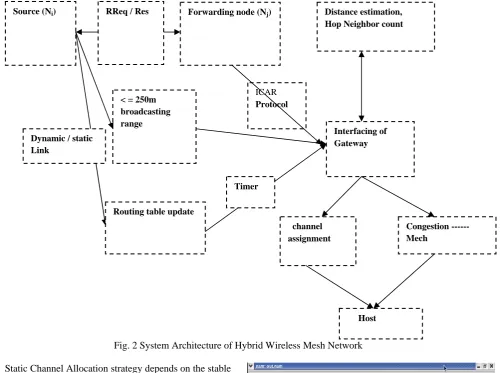
Interference and Congestion Aware Routing protocol (ICAR) helps in channel assignment and routing paths selection are critical issues for the functionality in transmission, Minimum cumulative Interference and channel Switching Delay (MISD) method (The inter-flow interference is reduced by selecting appropriate transmission range and adversaries make decision of the optimal channel assignment and selection scheme for each hop transmission ) balancing the channel usage over the network and thus improve the network throughput.
Fig. 2 System Architecture of Hybrid Wireless Mesh Network
Static Channel Allocation strategy depends on the stable and predictable traffic methods in the network. Dynamic Channel Allocation strategy requires frequent channel switching in the network. Both Static Channel Allocation strategy and Dynamic Channel Allocation strategy causes high packet delay and degrading network throughput usage. The protocol may used in the allocation of channels named as, Adaptive dynamic channel allocation protocol, which means that considers optimization for both throughput and delay in the channel assignment. Path may construct using Interference and Congestion Aware Routing protocol (ICAR) in the hybrid network with both static and dynamic links, which balances the channel usage in the network. And also ADCA reduce the packet delay without degrading the network throughput. After message transmission based on static, dynamic and hybrid links. Finally it reaches the destination.
III. RESULTS
We develop a simulation using NS2 (version 2.31). In this NS2 simulator, the MAC protocol is used on IEEE 802.11. Mesh nodes are distributed over 800*800 flat field.
Fig. 3 Initialization of network
The above screen is displayed when we run the simulation. It clearly shows the initialization of the Wireless Mesh Network with the Static link with the thick lines between the nodes and between the gateway and nodes.
Source (Ni) RReq / Res Forwarding node (Nj)
ICAR
Protocol < = 250m
broadcasting range
Routing table update Dynamic / static
Link
Interfacing of Gateway
Timer
Distance estimation, Hop Neighbor count
Congestion ---Mech
channel assignment
Fig. 4 Transmission range of each node in the network
The transmission range of each node is shown in the above screen shot. Each node may contain one or more neighboring node in its transmission range. Node can transmit the packet to its neighboring node in its transmission range through dynamic links.
Fig. 5 Packets Transmitting Using Static Link
The packets from the source node to its destination node are transmitted through intermediate nodes in the network. The path to transfer packet from source to destination it can take either static or dynamic link. Here in the nodes are making uses of static link to transmit the packet from node to node to reach the destination.
Fig. 6 Packets Transmitting Using Dynamic Link
The packets from the source node to its destination node are transmitted through intermediate nodes in the network. The path it takes to transfer packet from source to destination can be either static or dynamic link. Here the nodes are making use of dynamic links to transmit the packet from source node to intermediate node to reach the destination where the neighboring nodes lie in their transmission range.
Fig. 7 Graph of Overall Throughput in the WMN
The above graph depicts the overall throughput in wireless Mesh Network that consists of both the static and dynamic links in the network.
Fig. 8 Graph of Average Packet Delay in the WMN
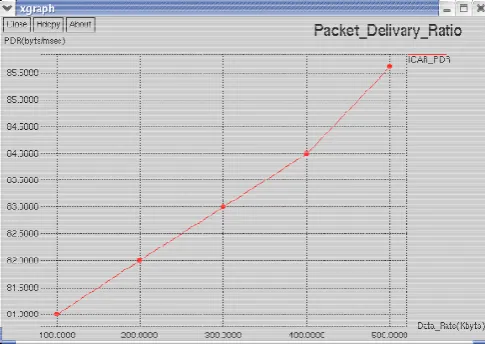
Fig. 9 Graph of Packet Delivery Ratio in the WMN
The above graph depicts the Packet Delivery Ratio in Wireless Mesh Network. The Channels are assigned with the multi channels i.e. Static and Dynamic Links. Since both the Links are been used the ration of the Packet delivered is more in the network compared to the existing system.
Fig. 10 Display the overall throughput, average delay and the packet delivery ratio
The overall throughput in wireless Mesh Network that consists of both the static and dynamic links in the network and the Average Packet Delay and the Packet Delivery Ratio in wireless Mesh Network. The Channels are assigned with the multi channels i.e. Static and Dynamic Links. The packets from source to destination are transferred using static links and dynamic links. Since the advantages of both are been used the Packet delay in the network is been reduced and the ratio$ of the Packet delivered is more in the network compared to the existing system.
IV. CONCLUSION
In this paper, we have proposed a Hybrid Wireless Mesh Network architecture, where each mesh node has both static and dynamic interfaces. We also proposed an
Interference and Congestion Aware Routing algorithm in the hybrid network, which balances the channel usage in the network and therefore increases the network throughput. In this architecture, one interface from each router uses the dynamic channel allocation strategy, while the other interfaces use the static channel allocation strategy. The links working on static channels provide high throughput paths from end-users to the gateway while the links working on dynamic channels enhance the network connectivity and the network’s adaptively to the changing traffic. Therefore, this hybrid architecture can achieve better adaptivity compared to the purely static architecture without much increase of overhead compared to the purely dynamic architecture.
REFERENCES
[1] Book By Yan Zhang, Jijun Luo, Honglin Hu Auerbach Publications Taylor & Francis Group "Wireless Mesh Networking, Architectures, Protocols and Standards"
[2] Tehuang Liu and Wanjiun Liao,"Interplay of Network Topology and Channel Assignment in Multi-Radio Multi-Rate Multi-Channel Wireless Mesh Networks", Department of Electrical Engineering, National Taiwan University, Taipei 2009.
[3] Manos Delakis and Vasilios A. Siris, "Channel Assignment in a Metropolitan Wireless Multi-Radio Mesh Network", Institute of Computer Science, Foundation for Research and Technology - Hellas Crete, Greece 2010.
[4] Sonia Waharte & Raouf Boutaba & Youssef Iraqi & Brent Ishibashi, " Routing protocols in wireless mesh networks: challenges and design considerations", Springer Science Business Media, LLC 2006 [5] A. Raniwala and T.-C.Chiueh, "Architecture and Algorithms for an
IEEE 802.11-Based Multi-Channel Wireless Mesh Network" , IEEE Infocom, Mar. 2005, pp. 2223–34.
[6] Edmundo Chissungo, Hanh Le, Edwin Blake, "Routing Protocols and Metrics used on Wireless Mesh Networks", Computer Science Department, University of Cape Town Cape Town
[7] J. So and N. Vaidya, "Multi-Channel Mac for Ad Hoc Networks: Handling Multi-Channel Hidden Terminals Using a Single Transceiver", Proc. Acm Mobihoc, 2004.
[8] A. Dhananjay, H. Zhang, J. Li, and L. Subramanian, "Practical, Distributed Channel Assignment and Routing in Dual-Radio Mesh Networks", Proc. SIGCOMM, 2009.
[9] A. Raniwala, K. Gopalan, and T. Chiueh, "Centralized Channel Assignment and Routing Algorithms for Multi-Channel Wireless Mesh Networks", ACM Mobile Computing and Comm. Rev., vol. 8, pp. 50-65, 2004.
[10] M. Kodialam and T. Nandagopal, "Characterizing the Capacity Region in Multi-Radio Multi-Channel Wireless Mesh Networks", Proc. ACM MobiCom, 2005.
[11] Safak Durukan Odabasi, A. Halim Zaim, " A Survey On Wireless Mesh Networks, Routing Metrics And Protocols", International Journal Of Electronics, Mechanical And Mechatronics Engineering Vol.2 Num.1 pp.(92-104)
[12] Jian Tang, Guoliang Xue and Weiyi Zhang,"Interference-Aware Topology Control and QoS Routing in Multi-Channel Wireless Mesh Networks", Department of Computer Science and Engineering Arizona State University Tempe, AZ 85287-8809, USA.
[13] M. Alicherry, R. Bhatia, and L. Li, “Joint Channel Assignment and Routing for Throughput Optimization in Multi-Radio Wireless Mesh Networks,” Proc. ACM MobiCom, 2005..
[14] K. Jain, J. Padhye, V. Padmanabhan, and L. Qiu, "Impact of Interference on Multi-Hop Wireless Network Performance", Proc. ACM MobiCom, 2003.
[15] P. Kyasanur and N. Vaidya, "Routing and Link-Layer Protocols for Multichannel Multi-Interface Ad Hoc Wireless Networks", ACM Sigmobile Mobile Computing and Comm. Rev., vol. 10, pp. 31-43, 2006.