Available Online atwww.ijcsmc.com
International Journal of Computer Science and Mobile Computing
A Monthly Journal of Computer Science and Information Technology
ISSN 2320–088X
IMPACT FACTOR: 6.017IJCSMC, Vol. 6, Issue. 7, July 2017, pg.173 – 177
Innovation for Digital India
Rajesh Kumar
CRM Jat College, Hisar, Haryana, India [email protected]
Abstract— Digital India – the dream project of the government and a blessing for the citizens, could help in connecting the dots of various projects, past and present, to bring India to a global platform. It will help in moving with the universal trends of digital innovation and create positive impact in the lives of people - rural and urban, young and old. Digital India initiative could help in achieving the objectives of Education for all, Information for all, Healthcare for all, Broadband for all if the government focuses on strong leadership structure, enables private participation, creates detailed implementation plan with common ‗citizen centric‘ framework and robust security/privacy measures, and ensures integrated efforts from all departments. As they say ―The sky is not the limit‖ for the benefits.
Keywords— Digital, Economy, E-Governance, Innovation, Internet.
INTRODUCTION
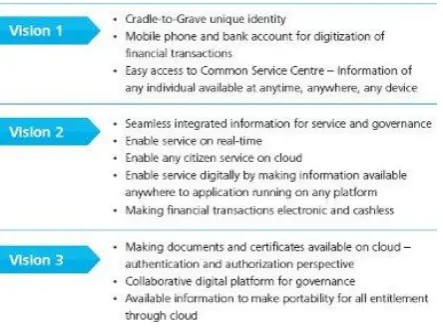
A good governing body requires a good communication platform to communicate with the stakeholders efficiently. Communicating with the citizens has been a big challenge for the government of India with widespread geography, massive population, and enormous linguistic & cultural diversity1. The way of communication has changed a lot from postal and telegraph era to print and broadcasting media to the era of Digital Communication. The efficient way to communicate with the citizens of the world‟s largest democracy with a population of 1.2 billion is only possible by connecting with everyone on a digital platform. Though India is considered as the IT powerhouse of the world, there is a huge digital divide. The Digital India initiative is a dream project of the Government to transform India into a digitally empowered society and knowledge economy. It is centered on three vision areas:
A. Digital Infrastructure as a Utility to Every Citizen:
The government is planning to provide high-speed Internet connectivity to 250,000 Gram Panchayats, which will be a core utility for digital inclusion. The citizens will be provided with a digital identity which will be unique, lifelong, online, and valid. There will be easy access to common Service Centers and a shareable private space for every citizen on a public cloud.
B. Governance and Services on Demand:
C. Digital Empowerment of Citizens:
This vision is to empower citizens through digital literacy and universal access to digital resources. e.g. all documents/certificates to be available on cloud and in Indian languages. Government also wants to provide collaborative digital platforms for participatory governance. e.g. MyGov website for crowd sourcing ideas.
INTERNET OF EVERYTHING
The Digital India initiative is undoubtedly one of the largest and most exciting initiatives that we have embarked upon in the last decade. The current government‟s vision to drive country-wide transformation through digital empowerment of citizens means that this is India‟s greatest opportunity to leapfrog developmental challenges and finally be considered on par with other developed nations.
A Digital India not only means empowerment for citizens but also offers significant scope for economic progress and growth and the opportunity to position India as a global technology hub and knowledge economy that other developing countries can learn from and emulate. In order to achieve this however, there needs to be a concerted effort to drive and follow through with effective change as well as a shift in mind-set from the traditional approach. What is really needed is the development of a larger innovation ecosystem in the country- one that fosters creativity, collaboration, partnerships and shared technical know-how to create disruptive business models, products and services that will fuel India‟s Digital transformation3
.
A Public Private Partnership “PPP” approach allows for the sharing of best practices, combining the expertise of the private sector with the public sector‟s resources and benefits of scale, and we are witnessing the evolution of several new economic models to create the optimum environment for success. I believe that these innovative new business models will facilitate greater co-operation between the government, private enterprise and citizens, allowing us to overcome traditional barriers around regulation, privacy, safety and security, and standardization of technology to transform our cities and communities. A great example of this model is our partnership with the Electronics City Industries Association (ELCIA) to develop Asia‟s first end-to-end „Internet of Things (IoT) Innovation Hub‟ in Bangalore4. This involved setting up a „Living Lab‟ for ESDM start-ups and other local
manufacturers to co-create, develop and test products for the IoT environment. The goal is to make the region a hub for electronics exports and to develop a replicable digital ecosystem for the rest of the country.
With big data, analytics, mobility and the network of possibility, we will help businesses to create a new world order. But the delta between perception and reality in a world holds the potential to be connected at a much higher level. And so there lies tremendous business potential for all those who want to rule the future, and I see IT solutions and services bridging that gap much more efficiently this year5.”
Top = 19mm (0.75")
Bottom = 43mm (1.69")
Left = Right = 14.32mm (0.56")
Your paper must be in single column format.
COMMERCE TO E-COMMERCE
Constituting about 10% of its GDP, India‟s retail sector is emerging as one of the most dynamic and profitable sectors. The e-Commerce market is slowly replacing the traditional brick and mortar sellers in India. The increase in mobile and smart device penetration, the access to internet and entry of numerous online retailers with exciting discount and payment options are the key drivers for e-retail growth in India. With the emergence of non-banking players in the payments industry, the e-commerce market is also growing at a rapid pace. Indian e-commerce majorly depends upon Cash-on-Delivery option of payment as 50% of all online transactions are done in this mode. 32 As per CRISIL report, the online market place holds a mere 18% while online ticketing has 65% market share in the `400 billion e-Commerce market in India12 . The mentality of “can‟t touch, won‟t buy” is changing. Customers can now purchase travel tickets, book movie shows or buy any product via a mobile platform without standing in queues. The entry of many online retailers in the market has taken the competition to a different level. The e-retailers have joined the traditional mall operators and brick-and-mortar retailers to skim the market by providing heavy discounts and attractive offers like exclusive merchandise, cashback schemes and promotional offers during the festive seasons. The recent partnership between Snapdeal & Croma or Amazon & Future Group is no more a partnership between two retailers. It has extended to a vendor and technology partners offering technology and logistics services. This will help in the growth of new brands and private labels.
boundaries no longer are a limitation when almost everyone and everything is a digital handshake away. This interconnection is the basis of the global engine of change that is transforming people from employees to entrepreneurs unshackling the traditional notions of workplace and success6.”
TAXATION IN DIGITAL ECONOMY
Digital economy is fast becoming „the economy‟ with vast amount of goods and services being transacted online or being in the nature of digitized goods and services. Hence, it has become imperative to understand the specific business models in play and the consequent tax challenges7. Domestic and international tax regimes based on traditional models have made provisions to avoid double taxation of cross border income i.e. the income is taxed either in the country where the receiver of income is a resident („resident country‟) or the country from which the income arises („source country‟), with relevant credits for tax deducted being built-in if the income is taxed in both countries. However, what was not envisaged while formulating these tax regimes was a situation of double non-taxation/taxation at a very low rate which is more easily achievable for companies in a digital economy and gives rise to various tax challenges.
Traditionally, physical presence of employees/dependent agents in the source country was required for conclusion of contracts, marketing, etc., but in the digital economy the same is now possible through the internet.
Similarly, while earlier maintaining a warehouse in a source country may have been considered an auxiliary activity not creating a PE, but the same may lead to non-taxation in a digital economy where maintaining a warehouse in the market country is a critical activity for an e-tailer which conducts all other activities through automated processes. Also, it is possible to fragment critical functions of a business and locate the same in different countries due to increased communication links and sophisticated, automated equipment from a transfer pricing perspective. This may result in non-creation of a PE or low attribution of profits to the PE.
SECURITY –INFORMATION CATEGORIZATION
Security plays a major role in designing the digital architecture. Going digital would require: 1.Organizational planning and structuring people, process, infrastructure and data/information
2. Security principles, policies and guidelines in line with regulatory and security compliance perspectives 3. Architecture decisions and standards, design patterns
4. Assessment of backend application and existing assets for re-use and their feasibility to digitize
Figure 1: Vision areas enabled by Security
ANALYTICS -UNIQUE DIGITAL IDENTITY AND DATA LINKAGE WITH SECURITY
UIDAI or PAN number should be used to connect with citizens‟ details. A centralized data centre should hold all the details of citizens about their credit worth, background check, address of residence, permanent address, utility consumption details, criminal records (domestic and international) among others. This data should be hosted in a highly secured data centres and hosted in private cloud8.
Figure 2: Vision areas enabled by Analytics
Conclusions
Digital economy presents unique challenges which require the tax laws as well as the tax administration to be more up to date with the technological advances in the space and to ensure that the digital economy is liable to pay appropriate taxes. It is necessary in this context to have overall taxation principles for the digital economy which would form the cornerstones of any tax reform. The tax principles which were presented in the 1998 Ottawa Ministerial Conference on Electronic Commerce and which have thereafter been accepted in OECD‟s 2014 deliverable on „BEPS10
Action 1: Address the tax challenges of the digital economy‟ are: Neutrality, Efficiency, Certainty and Simplicity, Effectiveness and Fairness.
The OECD‟s BEPS Action 1 discusses the following possible solutions for addressing taxation challenges posed by a digital economy:
1) Replacing the PE concept with significant presence concept which sale of goods/services through close customer relationship or based on content gathered from persons in the country, etc.
2) Progressive tax on the bandwidth usage of websites („Bit tax‟) which is creditable against corporate income tax to maintain neutrality with traditional business.
3) Modification/elimination of PE exceptions to ensure that taxation is not escaped by artificial splitting of functions of a business.
4) Withholding tax by financial institutions while making payments for digital goods/services.
The Indian Government has proposed to introduce Goods and Service Tax („GST‟) by April 2016. It is a destination based consumption tax. Under GST, there is shift of focus from manufacture/provision of service/ sale to supply. Hence, GST should eliminate the anomaly of double taxation on software licenses, right to use goods etc. However, it is not conclusive if there would be separate rate for services. If there are different rates for goods and services, the problem of double taxation could continue even under GST11.
R
EFERENCES
1. Government advances NOFN rollout deadline. See:
http://timesofindia.indiatimes.com/tech/tech-news/Government-advances-NOFN-roll-out-deadline/articleshow/45318168. cms
2. Intel Digital Skills program. See:
http://www.livemint.com/Politics/tVi3qteBfYKkXOPdwl1O4J/Intel-India-to-aid-govt-with-digital-literacy-programme.html
3. E-Kranti scheme gets Rs 500 crore boost. See:
http://www.india.com/budget-2014/union-budget-2014-live-e-kranti-scheme-gets-rs-500-crore-boost-93234/ 4. Farmer‟s Portal. See: http://farmer.gov.in/
5. Kisaan Call Center. See: http://dackkms.gov.in/Account/Login.aspx
6. GIS based Planning. See: http://india.gov.in/gis-based-planning-atlas-lucknow-district
boost-gdp-up-to-1-trillion-by-2025-mckinsey/articleshow/45536177.cms
8. India is now world‟s third largest internet. See:
http://www.thehindu.com/sci-tech/technology/internet/india-is-now-worlds-third-largest-internet-user-after-us-china/article5053115.ece
9. TRAI Performance Indicator Report – June 2014
10. Press Release. TRAI, December 2014. See:
http://www.trai.gov.in/WriteReadData/PressRealease/Document/PR-TSD-80-05122014.pdf
11. Digital India Employment Opportunity, August 2014. See:
http://post.jagran.com/pm-modis-digital-india-project-to-give-employment-to-17-crore-youth-1409050390
12. India Post eyes $9 bn e-commerce business; live tracking, SMS info soon, November 2014. See
http://www.financialexpress.com/article/economy/