Lattice Attacks on the DGHV Homomorphic
Encryption Scheme
Abderrahmane Nitaj1? and Tajjeeddine Rachidi2 1
Laboratoire de Math´ematiques Nicolas Oresme Universit´e de Caen Basse Normandie, France
2
School of Science and Engineering Al Akhawayn University in Ifrane, Morocco
Abstract. In 2010, van Dijk, Gentry, Halevi, and Vaikuntanathan de-scribed the first fully homomorphic encryption over the integers, called DGHV. The scheme is based on a set ofmpublic integersci=pqi+ri, i= 1,· · ·, m, where the integers p,qi and ri are secret. In this paper,
we describe two lattice-based attacks on DGHV. The first attack is ap-plicable whenr1= 0 and the public integerscisatisfy a linear equation a2c2+. . .+amcm=a1q1for suitably small integersai,i= 2, . . . , m. The
second attack works when the positive integersqi satisfy a linear
equa-tiona1q1+. . .+amqm= 0 for suitably small integersai,i= 1, . . . , m.
We further apply our methods for the DGHV recommended parame-ters as specified in the original work of van Dijk, Gentry, Halevi, and Vaikuntanathan.
Keywords: Homomorphic Encryption, Cryptanalysis, Lattice reduction.
1
Introduction
In the last ten years, cloud computing has gained major importance and widespread. Yet, a very important concern of cloud computing remains the security and pri-vacy of data. A useful solution to this concern is the use of fully homomorphic encryption (FHE) to encrypt data stored remotely. Indeed, a fully homomor-phic encryption scheme supports the computation of arbitrary functions on en-crypted data, possibly distributed across the cloud, without the need to resort to decryption. Unfortunately, not all encryption schemes are fully homomorphic. For example, RSA [20] is only multiplicatively homomorphic: given two cipher-textsc1≡me1 (mod N) andc2≡me2 (modN), one can compute the encrypted form ofm1m2, that is (m1m2)e (modN), without having to recover the plain-textsm1 andm2, simply by applyingc1c2≡m1eme2≡(m1m2)e (modN). Sim-ilarly, ElGamal [7] is multiplicatively homomorphic. By contrast, Paillier [19]
?
is additively homomorphic: given two ciphertexts c1 = gm1r1N (modN2) and
c2 = gm2r2N (modN2), one can perform c1c2 = gm1+m2(r1r2)N (mod N2), which givesm1+m2 without having to resort to the decryption of the cipher-texts c1 andc2. Another example of an additively homomorphic scheme is the Goldwasser-Micali scheme [10].
In 2009, Gentry [8], presented the first construction of a FHE scheme. Gen-try’s scheme supports both addition and multiplication on ciphertexts and con-sists of three main steps. The first step constructs a somewhat homomorphic scheme, which is limited to evaluating low-degree polynomials over encrypted data. The second step slightly modifies the somewhat homomorphic scheme to make it bootstrappable, i.e., capable of evaluating its own decryption circuit (op-erations). The third step transforms the bootstrappablesomewhathomomorphic encryption scheme into a fully homomorphic encryption through a recursive self-embedding. The security of Gentry’s scheme has been determined to be based on the worst-case hardness of solving specific problems in an ideal lattice, namely the shortest independent vector problem (SIVP) over ideal lattices in the worst-case (see [9]).
A key disadvantage of Gentry’s scheme, however, is its computational inef-ficiency. Therefore, much effort has been made by the research community to find alternative efficient FHE schemes. In 2010, van Dijk, Gentry, Halevi and Vaikuntanathan [6] presented DGHV, a computationally efficient FHE scheme over the integers. This scheme is based on a set of public integers,ci =pqi+ri,
i = 1, . . . , m, where the parameters p, qi and ri are secrets with the following size constraints:
• pis a prime number.
• ηis the bit-length of the secret keyp.
• ρis the bit-length of the secret noisesri.
• γis the bit-length of the public integersci.
In [6,16,5], the security of DGHV has been studied against several attacks, which served the purpose of improving its security by defining optimal bounds for its parameter bit size (η, ρ,andγ). As reported in [16], these attacks can be categorized according to their underling techniques:
• Brute force search[6,3]: Whenc1=pq1, this technique consists in remov-ing the noise, sayr2fromc2 by trying all possibilities forr2∈(−2ρ,2ρ) and computing gcd(c1, c2−r2) which gives pwith overwhelming probability.
• Continued fractions [6,16]: This consists on recovering qi/qj from ci/cj using continued fractions, which yields immediate calculation ofp=bci/qie.
Yet, a more direct way to break the DGHV scheme whenr1= 0 consists in findingpandq1by factoringc1=pq1. To date, the most efficient known methods to factorc1are the Number Field Sieve (NFS) [2] and the Elliptic Curve Method (ECM) [14]. As shown in [16] (p. 82, Table 7.1), the DGHV factorization problem ofc1is considered as untractable ifp >2261andc1>22911.
1.1 Our Contribution
In this paper, we propose two new attacks on the DGHV scheme. The starting point of both attacks are the existance of two linear equations involving the public integersci fori= 2, . . . , mand the secret parameterq1 on the one hand, and the secret parametersqi, i= 1, . . . , mon the other.
In the first attack, we suppose that c1 = pq1 and that ci = pqi+ri with
ri 6= 0 for i= 2, . . . , m. To avoid factoring attacks on c1, we also suppose that
q1 is prime. If q1 is not coprime with one of the integers ci for 2 ≤ i ≤ m, then gcd(c1, ci) = q1 which will reveal p = cq11. Hence, q1 is coprime ci for
i= 2, . . . , m. Therefore for any integersa2, . . . , am−1, the integeram≡ −(a2c2+
. . .+am−1cm−1)(cm)−1 (modq1)) exists and satisfies the linear integer relation
a2c2+. . .+amcm=a1q1for an integera1. We will leverage this relationship and show that one can find the DGHV parameters p, qi and ri in polynomial time if the coefficients ai, i= 1,· · · , mare suitably small. The attack uses Copper-smith’s method for solving multivariate linear modular equations, as presented by Herrmann and May in [12].
In the second attack, we suppose that ci = pqi+ri for i = 1, . . . , m. Let
G= gcd(q1, . . . , qm). Then qm−G1 is coprime with one qGi,i6=m−1. Assume that qm−1
G is coprime with qm
G. Leta1, . . . , am−2 be arbitrary integers. Define
am−1≡ −
a1
q1
G+. . .+am−2 qm−2
G
qm−1
G −1
(mod qm
G).
Then there exists an integeramsuch that
a1
q1
G +. . .+am−2 qm−2
G +am−1 qm−1
G +am
qm
G = 0,
or equivalentlya1q1+. . .+amqm= 0. This shows that the integersq1, . . . , qm are linked by infinitely many linear integer relations. We exploit this relation, and show that if the coefficientsai, i= 1, . . . , mare sufficiently small, then one can efficiently find all the DGHV parameters. Unlike the first attack, this attack is based solely on lattice reduction techniques, namely the LLL algorithm [15].
For both attacks, we carry out experiments to verify the validity and the effectiveness of our methods. We also define the new bounds for DGVH secret parameters that resist our attacks, effectively improving on previously proposed optimal bounds [6],[16].
1.2 Organization
attacks on the DGHV scheme. In Section 4, we present our first lattice-based attack on DGHV, that is when r1 = 0 and the numbers ci satisfy a linear equationa2c2+. . .+amcm=a1q1for suitably small integersai,i= 2, . . . , m. In section 5, we present our second lattice-based attack, which is applicable when the integersqi satisfy a linear equationa1q1+. . .+amqm= 0 for suitably small integersai. We then conclude the paper in Section 6.
2
Preliminaries
In this section, we review the DGHV scheme parameters and the Approximate-GCD assumption upon which its security is based. We also recall Coppersmith’s method for solving linear diophantine equations, and review the lattice reduction technique used in our new attacks on the DGHV scheme.
2.1 The DGHV Scheme over the Integers
In 2010, van Dijk, Gentry, Halevi and Vaikuntanathan [6] proposed a fully ho-momorphic encryption scheme based on m public integers ci =pqi+ri where the secret parametersp,qi,ri are such that:
• Fori= 1, . . . , m,ci is a public integer of bit-lengthγ.
• pis a private prime number of bit-length η.
• Fori= 1, . . . , m,qi is a private integer of bit-lengthγ−η.
• Fori= 1, . . . , m,ri is a private random integer with|ri|<2ρ.
In [6], it is shown that the scheme is semantically secure under the Approximate-GCD assumption which states the following:
Definition 1 (Approximate-GCD assumption).
Let γ, η, ρ be positive integers. For any η-bit prime number p, given m many positive integers ci =pqi+ri withm many(γ−η)-bit integers qi andmmany
integers ri satisfying|ri|<2ρ, it is hard to findp.
The hardness of the Approximate-GCD assumption has been studied by Howgrave-Graham [13], and used in the study of the security of the DHGV scheme in [6] and [16], leading to the establishment of typical integer sizes that guarantee high security levels of DHGV. Therein, the valuesρ≈√η,γ=η3+η are considered secure (see [6]).
2.2 Lattice reduction
Here we present some basics on lattice reduction techniques. Let b1. . . , bd be
d linearly independent vectors of Rn with d ≤ n. The lattice L spanned by
the determinant of L is det(L) = √BtB, and the Euclidean norm of a vector
v∈ Lis defined using the scalar productkvk=√v·v.
Of interest to many applications and algorithms is the shortest non-zero vector in a lattice. Finding the shortest non-zero vector is a computationally hard problem known as the Shortest Vector Problem (SVP) that guarantees the security of many cryptographic schemes. However, Minkowski’s theorem, which dates back to 1889, guarantees the existence of short vectors, i.e., non-zero vectors whose length is not too large as in the following theorem.
Theorem 1 (Minkowski). Let L be a lattice. Then there exists a non-zero vectorv∈ L such that
kvk ≤p
dim(L) det(L)dim(1L).
Given a lattice L and its original basis b1. . . , bd, lattice reduction consists in finding another basis, where a short non-zero vector is easily determined. This can be achieved through different algorithms, whose running time is usually at least exponential in the dimension of the latticed. However, the LLL algorithm of Lenstra, Lenstra, and Lovsz [15] can find, in polynomial time, short non-zero vectors in a lattice with reasonable dimension.
Theorem 2 (LLL). LetLbe a lattice spanned by a basis(u1, . . . , ud), then the
LLL algorithm produces a new basis(b1, . . . , bd)ofL satisfying
kb1k ≤2 d−1
4 det(L) 1 d,
in polynomial time.
Thus, finding a reduced basis using LLL leads to finding reasonably short vectors in polynomial time.
2.3 Coppersmith’s method for solving linear diophantine equations
The LLL algorithm has many applications in cryptography, including solving dio-phantine equations. Using the LLL algorithm, Coppersmith [4] derived a method for finding small roots of univariate modular equations and bivariate equations. This strategy is know as Coppersmith’s technique and has been heuristically generalized for finding small roots of multivariate linear equations. The follow-ing result by Herrmann and May [12] gives a sufficient condition under which small roots of a modular linear equation can be found in polynomial time.
Theorem 3 (Herrmann-May). Let N be a composite integer of unknown factorization with a divisor p ≥ Nβ. Let f(x
1, . . . , xn) ∈ Z[x1, . . . , xn] be a
linear polynomial in n variables. One can find in polynomial time all solu-tions x(0)1 , . . . , x(0)n
of the equation f(x1, . . . , xn) ≡ 0 (modp) with
x
(0) 1
<
Nλ1, . . . , x
(0) n
< N
λn if
n
X
i=1
λi<1−(1−β) n+1
n −(n+ 1)
1−pn
3
Former attacks on the DGHV Scheme
We recall here the main existing attacks on the DGHV scheme. For more details, we refer to [6] and [16]. Assume that we have an instance of DGHV withc1=pq1 andci=pqi+ri,i= 2, . . . , mwhere the parametersp,qiandriare secret. The task is to recoverp. We recall thatpis aη-bit prime and 0< ri<2ρ.
3.1 Brute force on the remainder
A simple way to recoverpis to remove the noise, say fromc2, by findingr2, and then computep= gcd(c1, c2−r2). This can be achieved by trying all integersr2 with 0<|r2|<2ρ. The complexity of this attack is obviouslyO(2ρ). However, applying the method of Chen and Nguyen [3], one can find pwith complexity
O 2ρ/2
. As a consequence, removing the noise to recover p does not work in practice whenρis sufficiently large.
3.2 Continued fractions
Usingc1=pq1andc2=pq2+r2, and given thatq1and q2 are prime numbers, one gets
c2
c1
−q2
q1
= |r2|
c1
.
To recover q2
q1 as a convergent of the continued fraction expansion of c2
c1, we need
|r2| c1 <
1 2q2
1
, that is 2q1|r2| < p. This is not possible if q1 is much larger thanp as for the recommended values for the DGHV parameters whereq1isη3-bit size whilepisη-bit size.
3.3 Simultaneous Diophantine approximation
In [15], it is shown that the LLL algorithm can find a solution for the simultane-ous diophantine approximations. That is, givenn rational numbersα1,· · · , αn and ε with 0 < ε < 1, one can efficiently find integers p1, . . . , pn, and q such that, for i= 1, . . . , n,
|qαi−pi| ≤ε, and 1≤q≤2 n(n+1)
4 ε−n.
This can be applied to the DHGV scheme. Usingc1=pq1 andci=pqi+ri, we get fori= 2, . . . , m
q1
ci
c1
−qi
=|ri|
p <2
ρ−η.
This givesm−1 simultaneous diophantine approximations which can be solved by applying the LLL algorithm [15] to reduce a basis of a lattice of dimension
m. The LLL algorithm will succeed under the condition:
q1≤2 (m−1)m
4 ·2−(ρ−η)(m−1)= 2 (m−1)m
Sinceq1≈2γ−η, then γ−η≤
m(m−1)
4 + (η−ρ)(m−1), which can be achieved if
m >−2η+ 2ρ+1 2 +
1 2
p
16η2−32ηρ+ 16ρ2+ 16γ−8η−8ρ+ 1. For secure DHGV parameters, such as γ =η3+η, ρ ≈√η with a sufficiently largeη, this gives a large lower bound form, and in this case lattice reduction will not recover the shortest vector. For example, forη= 200 we getm >5297, which makes the lattice reduction totally inefficient according to the optimal complexity boundO m4logBM(mlog(B))
whereBis an upper bound of the Euclidean norms of the basis vectors and M(k) denotes the time required to multiplyk-bit integers (see [18]).
3.4 Orthogonal lattice attack
Another attack on DGHV is the orthogonal lattice attack [6,16]. Letc1 =pq1 andci=pqi+ri, fori= 2, . . . , m. Then there existm−1 integersai,i= 2, . . . , m such thata2c2+. . .+amcm≡0 (modc1). This can be rewritten as
p(a2q2+. . .+amqm) +a2r2+. . .+amrm≡0 (modpq1).
Hence a2r2+. . .+amrm≡0 (modp),and when the integers ai, i= 2, . . . , m, satisfy|ai| ≤ 2
η−1−ρ m−1 , then
|a2r2+. . .+amrm| ≤ |a2||r2|+. . .+|am||rm|
≤(m−1)·max
i |ai| ·maxi |ri|
≤(m−1)· 2
η−1−ρ
m−1 ·2 ρ
≤2η−1.
Since p >2η−1, then |a2r2+. . .+amrm| < p, that is a2r2+. . .+amrm = 0. Finding many suchai’s, leads to recoveringpusing gcd(c1, a2c2+. . .+amcm) =p.
4
Our First Lattice-based Attack on DGHV
In this section, we present our first attack on the DGHV scheme. We exploit the existence of a linear relation between the c2, . . . , cm and the factor q1 of c1 in the form
a2c2+. . .+amcm=a1q1,
4.1 The attack
Theorem 4. Letc1=pq1 andci=pqi+ri,i= 2, . . . , m, bempositive integers
with2η−1< p <2η,2γ−1< c
i<2γ and|ri|< pfori= 2, . . . , m. Leta1, . . . , am
bemintegers satisfying|ai|<2αifori= 2, . . . , manda2c2+. . .+amcm=a1q1.
Defineβ =γ−γη−1. If
m
X
i=2
αi<
1−(1−β)m−m1 −m
1− m−p1
1−β(1−β)(γ−1),
then, one can find p,q1, . . . , qm,r2, . . . , rm in polynomial time.
Proof. Suppose thatc1=pq1 andci =pqi+ri fori= 2, . . . , m. Leta1, . . . , am bem integers satisfyinga2c2+. . .+amcm=a1q1. Then
a2c2+. . .+amcm≡0 (modq1), (1)
where q1 is an unknown divisor ofc1. Suppose that 2η−1< p <2η and 2γ−1<
c1<2γ. Then, sinceq1=cp1, we get
2γ−η−1< q1<2γ−η+1. Defineβ =γ−γη−1. Then
q1>2γ−η−1= 2γβ> c β 1.
Using Herrman-May’s Theorem 3, we can solve the equation (1) if the unknown parameters ai satisfy|ai|< cλ1i fori= 2, . . . , mwhere
m
X
i=2
λi<1−(1−β) m m−1 −m
1− m−p1 1−β(1−β). (2)
Fori= 2, . . . , m, defineαi= (γ−1)λi. Then
cλi 1 >2
(γ−1)λi = 2αi.
Now, suppose that |ai| < 2αi for i = 2, . . . , m. Then |ai| < cλ1i and plugging
αi= (γ−1)λi in equation (2), one can find the parameters ai,i= 2, . . . , m if m
X
i=2
αi<
1−(1−β)m−m1 −m
1− m−p1 1−β(1−β)(γ−1).
Using the recovered values of the parameters aifori= 2, . . . , m, we compute
q1= gcd(c1, a2c2+. . .+amcm), p=
c1
q1
.
Algorithm 1: The first attack
Input: A set of public valuesc1=pq1,ci=pqi+ri,i= 2, . . . , m.
Output: The set of private parametersp,qi,i= 1, . . . , mif the conditions of
Theo-rem 4 are fulfilled.
1: Setf(x2, . . . , xm) =c2x2+. . .+cmxm.
2: Apply Coppersmith’s technique and Herrman-May’s Theorem 3 to solve the poly-nomial equationf(x2, . . . , xm)≡0 (modq1).
3: Foreach solution (x2, . . . , xm)do
4: Computeg= gcd(c1, x2c2+. . .+xmcm).
5: If g >1then
6: Setq1=gandp=c1 q1.
7: For i= 2, . . . , mdo
8: Computeri≡ci (modp).
9: Computeqi= ci−pri.
10: End for
11: Outputp,qi,i= 1, . . . , m,ri,i= 2, . . . , m.
12: Halt
13: End if
14: End for
4.2 Comparison with the orthogonal lattice attack
Let us now compare our method with the orthogonal lattice attack of [6]. Suppose thatc1=pq1andci=pqi+rifori= 2, . . . , m. Leta2, . . . , ambem−1 integers satisfying a2c2+. . .+amcm ≡ 0 (modc1) and |ai| < 2α as required in the orthogonal attack. Then, sincec1=pq1, we geta2c2+. . .+amcm≡0 (modq1) which means that the equation can be exploited in our attack. Using Theorem 4, our attack can recover all the parametersp,q1,qi,rifori= 2, . . . , mif
α < 1 m−1
1−(1−β)m−m1 −m
1− m−p1
1−β(1−β)(γ−1), (3)
where β = γ−ηγ−1. Recall that the orthogonal attack of [6], as explained in Section 3.4, will findpif
|ai| ≤ 2η−1−ρ
m−1 = 2
η−1−ρ−log2(m−1),
fori= 2, . . . , m. So, define the bound for the orthogonal lattice attack of [6]
α0=η−1−ρ−log2(m−1), and the bound for our attack
αnew = 1
m−1
1−(1−β)m−m1 −m
1− m−p1
1−β(1−β)(γ−1).
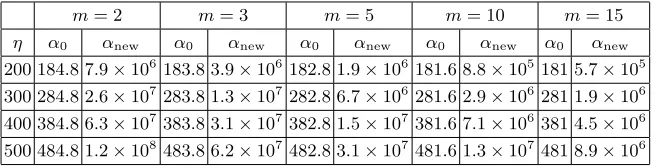
currently known attacks including factorization, diophantine and lattice-based attacks. In Table 1, we show the maximal values ofα0for which the orthogonal attack of [6] works, and the maximal values ofαnewfor which our attack works. Clearly, our methodsignificantlyincreases the bounds of the size of the unknown integersai,i= 2, . . . , amfor which DGHV is vulnerable.
m= 2 m= 3 m= 5 m= 10 m= 15
η α0 αnew α0 αnew α0 αnew α0 αnew α0 αnew
200 184.8 7.9×10⁶ 183.8 3.9×106182.8 1.9×10⁶ 181.6 8.8×105181 5.7×10⁵
300 284.8 2.6×10⁷ 283.8 1.3×107282.8 6.7×10⁶ 281.6 2.9×106281 1.9×10⁶ 400 384.8 6.3×10⁷ 383.8 3.1×107382.8 1.5×10⁷ 381.6 7.1×106381 4.5×10⁶ 500 484.8 1.2×10⁸ 483.8 6.2×107482.8 3.1×10⁷ 481.6 1.3×107481 8.9×10⁶
Table 1.Comparison ofα0andαnewfor certain values ofηandm.
4.3 Deriving new parameter sizes
To avoid the new attack, it is sufficient to make the inequality (3) impossible or hard to occur. Sinceγis large, this could be possible if
1−(1−β)m−m1 −m
1− m−p1
1−β(1−β)≈0,
where β = γ−γη−1. Therefore, form >1, our attack will fail ifβ ≈0, or equiv-alently γ ≈ η. However, our attack is likely to be successful when β ≈ 1 and the numbermof public integersci,i= 1, . . . , m is not very large. In this situa-tion, the inequality (3) reduces toα < mγ−−11.Note thatβ ≈1 implies that γ is much larger thanηwhich is the case for the currently recommended parameters. Therefore, for the recommended parametersγ=η3+η with largeη, our attack will be successful as long asα < mγ−−11.
4.4 Experimental Results
We implemented our attack and experimented it with 100 instances of DGHV. All the 100 attacks were successful. For efficiency reasons, we considered only instances of DGHV where the sizes of the parameters are small, typicallyη≤60 and γ ≤ 200. The recommended DHGV parametersη ≥200 and γ =η3+η i.e.,γ≥8000200 are not suitable for experimentation using an off-the-shelf com-puter.
Consider the following situation withm= 4 public integers:
c1=pq1= 115681713396549343702207914242260837695350516124613657,
c2=pq2+r2= 108225557677193859451749518166560930564055519997881978,
c3=pq3+r3= 87008627993581418190653163120734875926757081732242410,
c4=pq4+r4= 63900735072220368383452304843047856476842423469473333, where, fori= 2,3,4,ci <2γwithγ= 177. According to Theorem 4, we can solve the linear equationa2c2+a3c3+a4c4=a1q1if the unknown parametersa2,a3 anda3 are suitably small. Combining the method of Herrmann and May [12] for solving the equationa2c2+a3c3+a4c4≡0 (modq1), and the LLL algorithm [15], we get at least two polynomials sharing the solutionsa2,a3,a4. Then applying Gr¨obner Basis computation for solving systems of polynomial equations, we get the solution
a2= 130722418993, a3= 16613347, a4= 27131339. Using these values, we get
q1= gcd(c1, a2c2+a3c3+a4c4)
= 2939299645410290951093220439666796843647265081, p=c1
q1
= 39356897.
Using the value of p, we get
r2≡c2≡13835383 (modp),
r3≡c3≡37261850 (modp),
r4≡c4≡1283090 (mod p). Finally, we get
q2=
c2−r2
p = 2749849859281179089188599349348118845956161635, q3=
c3−r3
p = 2210759349081341910431941906414392270985110481, q4=
c4−r4
p = 1623622285878390473300075075609945989310143619.
The whole process, including Gr¨obner Basis computation, took less than one minute. Note that sincea2c2+a3c3+a4c46≡0 (modp), the orthogonal attack of [6] and [16] is not applicable to this DGHV instance.
5
Our Second Lattice Attack on DGHV
5.1 The attack
Theorem 5. Let ci =pqi+ri, i= 1, . . . , m, be m positive integers with c1 <
. . . < cm and|ri|<2ρ fori= 1, . . . , m. Leta1, . . . , am bem integers satisfying
|ai|<2α fori= 1, . . . , m anda1q1+. . .+amqm= 0. If
α < 1
mlog2(cm) + log2 √m
m+ 1
−ρ,
then, one can find p,q1, . . . , qm,r1, . . . , rm in polynomial time.
Proof. Letci=pqi+rifori= 1, . . . , mwithri6= 0. Then, there existmintegers
ai,i= 1, . . . msuch that a1q1+. . .+amqm= 0. Combining the values ofci for
i= 1, . . . , m, we get:
a1c1+. . .+amcm=a1r1+. . .+amrm. (4) Consider them×mlatticeL ⊂Zmdefined by the rows of the matrix
M =
1 0 0. . .0 c1 0 1 0. . .0 c2 0 0 1. . .0 c3 ..
. ... ... . .. ... ... 0 0 0. . .1cm−1 0 0 0. . .0 cm
.
The dimension of L is dim(L) = m and the determinant is det(L) = cm. Let
v∈ Lbe a target vector generated from the vectoru= (a1, . . . , am)∈Zm, that
is,
v=uM = (a1, . . . , am−1, c1a1+. . .+cmam). (5) Minkowski’s Theorem 1 forLasserts that there exists short non-zero vectors of size at mostσ(L) where
σ(L) =pdim(L) det(L)dim(1L) =√mc 1 m
m. (6)
For our target vectorv to be among the shortest non-zero vectors of the lattice
L, the inequality σ(L)>kvkmust hold. Assume further that fori= 1, . . . , m, we have |ai| ≤2α and|ri| ≤2ρ. Using (5) witha1q1+. . .+amqm= 0, we get
kvk= m−1
X
i=1
a2i + (c1a1+. . .+cmam)2
!1/2
=
m−1
X
i=1
a2i + m
X
i=1
airi
!2
1/2
<22α(m−1) + 2α+ρm2
1/2
<22(α+ρ)(m+ 1)2 1/2
Therefore, the inequalityσ(L)>kvk is fullfiled if√mc
1 m
m >(m+ 1)2α+ρ, from which we deduce the following condition onα.
α < 1
mlog2(cm) + log2 √m
m+ 1
−ρ. (7)
If the condition (7) holds, then applying lattice reduction toLyields the vector
v= (a1, . . . , am−1, c1a1+. . .+cmam) withc1a1+. . .+cmam=a1r1+. . .+amrm, as in (4). Combining the obtained values from the reduction, that isa1, . . . , am−1 and c1a1+. . .+cmam, and the known public valuesci,i = 1,· · ·, m, one can calculateam as follows:
am=
(c1a1+. . .+cmam)−(c1a1+. . .+cm−1am−1)
cm
.
The next step in the attack is to solve the equation
a1r1+. . .+amrm=c1a1+. . .+cmam, (8) with the unknown parameters r1, . . . , rm with|ri|<2ρ fori= 1, . . . , m. To do so, we consider the (m+ 1)×(m+ 1) latticeL0⊂
Zm+1 defined by the rows of
the matrix
M0=
1 0 0. . .0 Ca1 0 1 0. . .0 Ca2 0 0 1. . .0 Ca3
..
. ... ... . .. ... ... 0 0 0. . .1 Cam
0 0 0. . .0C(c1a1+. . .+cmam)
,
where C is a given parameter to be optimized later. The determinant ofL0 is
det(L0) =C|c
1a1+. . .+cmam|and its dimension is dim(L0) =m+ 1.
Letv0 ∈ L0 be a vector. Then there exists a vectoru0 = (y1, . . . , ym+1)∈Zm+1
such that
v0=u0M0= (y1, . . . , ym, C(a1y1+. . .+amym) +C(c1a1+. . .+cmam)ym+1). We set our target vector to bev0= (r1, . . . , rm,0), therefore
y1=r1, . . . , ym=rm,
(a1y1+. . .+amym) + (c1a1+. . .+cmam)ym+1= 0.
In addition, we need ym+1 = −1 so that a1r1+. . .+amrm = c1a1+. . .+
cmam which provides a solution to equation (8). Now recall that Minkowski’s Theorem 1 asserts that there exist short non-zero vectors in the latticeL0of size
at mostσ(L0) where
σ(L0) =pdim(L0) det(L0)dim(1L0) =
√
Sincec1a1+. . .+cmam=a1r1+. . .+amrmwith|ai|<2α and|ri|<2ρ, then,
σ(L0)<√m+ 1·Cm1+1· 2α+ρm 1
m+1. (9)
The norm of our target vectorv0= (r1, . . . , rm,0) with|ri|<2ρfori= 1, . . . , m, satisfies
kv0k= m
X
i=1
ri2 !1/2
<2ρ√m.
Therefore, for our target vectorv0to be among the short vectors, the inequality
σ(L0)>kv0kmust be satisfied. For this, it is sufficient thatρsatisfies
√
m+ 1·Cm1+1· 2α+ρm 1
m+1 >2ρ√m which leads to the following condition onC
C > mm−21 ·(m+ 1)− m+1
2 ·2mρ−α. (10) So, under condition 10, applying lattice reduction toL0recovers a short non zero
vector v0 = (r
1, . . . , rm,0) which yields the ri’s. Next, usingr1 and r2, we get
p= gcd(c1−r1, c2−r2) and fori= 1, . . . , m, we getqi =ci−pri. This terminates
the proof. ut
We can summarize the whole method in Algorithm 2.
5.2 Application with the DGHV recommended parameters
Let us consider the recommended optimal parameters for a secure DGHV, as stated in [6], that is γ =η3+η, ρ≈√η andη ≥200. Then, the condition of Theorem 5 becomes
α < η
3+η
m + log2 √m
m+ 1
−√η.
On the other hand, the condition on the constantC in (10) becomes
C > mm−21 ·(m+ 1)− m+1
2 ·2m
√
η−α
.
In Table 2, we present the upper bounds forαin terms ofη andmunder which our second method will solve the equationa1q1+. . .+amqm= 0 and then find all the DGHV parameters. For all cases, we useC= 1, wich fullfils condition (10).
η m= 2 m= 3 m= 5 m= 10 m= 15 200 4×10⁶ 2.6×10⁶ 1.6×10⁶ 8×10⁵ 5.3×10⁵
Algorithm 2: The second attack
Input: A set of ciphertextsci=pqi+ri,i= 1, . . . , m.
Output: The set of private parametersp,qi,i= 1, . . . , mif the conditions of
Theo-rem 5 are fulfilled.
1: Define the latticeLwith the basis matrix
M=
1 0 0. . .0 c1
0 1 0. . .0 c2
0 0 1. . .0 c3
. .
. ... ... . .. ... ... 0 0 0. . .1cm−1
0 0 0. . .0 cm .
2: Apply the LLL algorithm to reduce the basis matrix. 3: Foreach row (a1, . . . , am−1, R) of the reduced matrixdo
4: Computeam=
R−(c1a1+...+cm−1am−1)
cm .
5: Computeα= maxi(log2(|ai|)).
6: Computeρ= 1
mlog2(cm) + log2 √
m m+1
−α. 7: LetC be the integral part ofmm−21·(m+ 1)−
m+1
2 ·2mρ−α+ 1.
8: Define the latticeL0
with the basis matrix
M0=
1 0 0. . .0 Ca1
0 1 0. . .0 Ca2
0 0 1. . .0 Ca3
. .
. ... ... . .. ... ... 0 0 0. . .1 Cam
0 0 0. . .0C(c1a1+. . .+cmam)
9: Apply the LLL algorithm to reduce the basis matrix. 10: Foreach row (r1, . . . , rm+1) of the reduced matrixdo
11: If rm+1= 0then
12: Computep= gcd(c1−r1, c2−r2). 13: If p >1then
14: Fori= 1, . . . , mdo
15: Computeqi=ci−pri.
16: End for
17: End if
18: End if
19: Outputp,qi,i= 1, . . . , m,ri,i= 1, . . . , m.
20: Halt
21: End for
5.3 Experimental Results
For our second attack, we also experimented with 100 DHGV instances with various practical sizes of the parameters η, ρ, γ and m. When the conditions of Theorem 5 are satisfied, we always succeeded in finding the solutions of our equations and recovered the secret parameters. We illustrate the steps of our attack through the following detailed example.
Consider the following DHGV instance:
c1=pq1+r1= 56405845507494530020941008480572940286181689237258854,
c2=pq2+r2= 39904821464460948494700284192336525523357407545067668,
c3=pq3+r3= 56294991345433284900612805613249060787237279328022519, with the bounds ci < 2γ, i = 1,2,3, with γ = 176. According to Theorem 5, one can solve the equationa1q1+a2q2+a3q3= 0 if the unknown coefficientsai,
i= 1,2,3 satisfy |ai|<2α with
α+ρ <1
3log2(c3) + log2
√
3 4
!
≈57.459,
whereρis the bit size of the noiseri,i= 1,2,3. LetLbe the lattice spanned by the rows of the matrix
1 0c1 0 1c2 0 0c3
.
Applying the LLL algorithm [15] for reduction, yields a reduced basis, where the first vector is (3991298341123,3713241313153,18196712614595893). From this, we deduce
a1= 3991298341123,
a2= 3713241313153,
a3=
18196712614595893−(a1c1+a2c2)
c3
=−6631296680887.
In this example, we have |ai|<2αfor i= 1,2,3 withα= 43. Next, the aim is to solve the equation
a1r1+a2r2+a3r3=a1c1+a2c2+a3c3= 18196712614595893,
with the unknown coefficientsr1,r2, andr3. LetCbe a constant, and consider the lattice L0 spanned by the rows of the matrix
1 0 0 Ca1
0 1 0 Ca2
0 0 1 Ca3
0 0 0C(a1c1+a2c2+a3c3)
Then, using C= 1 and applying the LLL algorithm, we get the following short vector (−23593,−18617,−21881,0).This leads to the values of
r1= 23593, r2= 18617, r3= 21881.
Hence, in this example, we have |ri|<2ρ for i= 1,2,3 with ρ= 15. We then deduce
p= gcd(c1−r1, c2−r2) = 706549229,
q1=
c1−r1
p = 79832859753208406686890615063671579331921809, q2=
c2−r2
p = 56478472874338029310481752988136833029305319, q3=
c3−r3
p = 79675964582268739409540570899482307392394422.
In this example, we have p < 2η with η = 30. We notice that the dimensions of the underlying lattices are small and that the computation took less than 30 seconds using an off-the-shelf computer. Also, we notice that the condition of Theorem 5 is satisfied since
α+ρ≈ 1
mlog2(cm) + log2 √m
m+ 1
≈58.
More importantly, this example shows that while our second attack was suc-cessful, the existing attacks of [6], as described in Section 3, fail to recover the parameter p: the continued fraction attack fails because we need |r2c1| < 2q12
1 , which is not the case in this example, the simultaneous diophantine approxima-tion attack fails too, because the condiapproxima-tion onm should be
m >−2η+ 2ρ+1 2 +
1 2
p
16η2−32ηρ+ 16ρ2+ 16γ−8η−8ρ+ 1>9, whilem= 3 in this example. Finally, the orthogonal attack can not work since none of the ri= 0.
6
Conclusion
In this paper, we presented two new lattice-based attacks on the DHGV encryp-tion scheme using Coppersmith’s technique and the LLL algorithm for the first attack, and only the LLL algorithm for the second attack. The first attack is applicable when c1 = pq1 and the m−1 public integers ci, i = 2, . . . , m sat-isfy a linear equation a2c2+. . .+amcm =a1q1 for suitably small integers ai,
i= 2, . . . , m. The second attack works even withc1=pq1+r1when the integers
qi satisfy a linear equationa1q1+. . .+amqm= 0 for suitably small integersai,
References
1. Boneh, D.: Twenty years of attacks on the RSA cryptosystem, Notices Amer. Math. Soc. 46 (2), pp. 203–213, (1999)
2. Buhler, J.P., Lenstra, H.W., Pomerance, C.: The development of the number field sieve, Volume 1554 of Lecture Notes in Computer Science, Springer-Verlag, 1994, pp. 50–94 (1994)
3. Chen, Y., Nguyen, P.Q.: Faster algorithms for approximate common divi-sors: Breaking fully-homomorphic-encryption challenges over the integers. In Pointcheval and Johansson (Eds.), EUROCRYPT 2012 Proceedings, volume 7237 of Lecture Notes in Computer Science. Springer, 2012, pp. 502–519 (2012) 4. Coppersmith, D.: Small solutions to polynomial equations, and low exponent RSA
vulnerabilities. Journal of Cryptology, 10(4), pp. 233–260 (1997)
5. Coron, J.S., Mandal, A., Naccache, D., Tibouchi, T.: Fully homomorphic encryp-tion over the integers with shorter public keys. CRYPTO 2011, In Rogaway (Eds.), Proceedings, volume 6841 of Lecture Notes in Computer Science. Springer, 2011, pp. 487–504 (2011)
6. van Dijk, M., Gentry, C., Halevi, S., Vaikuntanathan, V.: Fully homomorphic en-cryption over the integers. In H. Gilbert (Ed.), EUROCRYPT 2010, LNCS, vol. 6110, Springer, 2010, pp. 24–43 (2010)
7. El Gamal, T.: A public key cryptosystem and signature scheme based on discrete logarithms. IEEE Transactions on Information Theory IT-31, pp. 496–473 (1976) 8. Gentry, C.: A fully homomorphic encryption scheme. Ph.D. thesis, Stan-ford University (2009) Available at http: http://crypto.stanford.edu/craig/ craig-thesis.pdf.
9. Gentry, C.: Toward basing fully homomorphic encryption on worst-case hardness, Crypto 2010, LNCS 6223, pp. 116–137 (2010)
10. Goldwasser, S., Micali, S.: Probabilistic Encryption. Journal of Computer and Sys-tem Sciences, Vol 28, Issue 2, pp. 270–299 (1984)
11. Hardy, G.H., Wright, E.M.: An Introduction to the Theory of Numbers. Oxford University Press, London (1975)
12. Herrmann, M., May, A.: Solving linear equations modulo divisors: On factoring given any bits. In Advances in Cryptology-ASIACRYPT 2008. Springer, 2008, pp. 406–424 (2008)
13. Howgrave-Graham, N.: Approximate integer common divisors. In CaLC’01, volume 2146 of Lecture Notes in Computer Science, pp. 51–66. Springer, (2001)
14. Lenstra, H.W.: Factoring integers with elliptic curves, Annals of Mathematics, vol. 126, pp. 649–673 (1987)
15. Lenstra, A.K., Lenstra, H.W., Lov´asz, L.: Factoring polynomials with rational coefficients, Mathematische Annalen, Vol. 261, pp. 513–534, (1982)
16. Lepoint, T.: Design and Implementation of Lattice-Based Cryptography, Ph.D. thesis (2014)
https://www.cryptoexperts.com/tlepoint/thesis/lepoint-phd-thesis.pdf. 17. May, A.: New RSA Vulnerabilities Using Lattice Reduction Methods. Ph.D. thesis,
University of Paderborn (2003)
http://wwwcs.upb.de/cs/ag-bloemer/personen/alex/publikationen/
18. Nguyen, P.Q. and Stehl´e, D.: An LLL algorithm with quadratic complexity. SIAM J. of Computing, 39(3):874–903 (2009).