Device-Enhanced Password Protocols with Optimal Online-Offline
Protection
Stanislaw Jarecki∗ Hugo Krawczyk† Maliheh Shirvanian‡ Nitesh Saxena§ March 29, 2017
Abstract
We introduce a setting that we callDevice-Enhanced PAKE (DE-PAKE), where PAKE (password-authenticated key exchange) protocols are strengthened against online and offline attacks through the use of an auxiliary device that aids the user in the authentication process. We build such schemes and show that their security, properly formalized, achieves maximal-attainable resistance to online and offline attacks in both PKI and PKI-free settings. In particular, an online attacker must guess the user’s password andalso corrupt the user’s auxiliary device to authenticate, while an attacker who corrupts the server cannotlearn the users’ passwords via an offline dictionary attack. Notably, our solutions do not require secure channels, andnothing(in an information-theoretic sense) is learned about the password by the device (or a malicious software running on the device) or over the device-client channel, even without any external protection of this channel. An attacker taking over the device still requires a fullonlineattack to impersonate the user. Importantly, our DE-PAKE scheme can be deployed at the user end without the need to modify the server and without the server having to be aware that the user is using a DE-PAKE scheme. In particular, the schemes can work with standard servers running the usual password-over-TLS authentication.
1
Introduction
Today, passwords constitute the prevalent authentication mechanism for bootstrapping security in online, personal and business applications, with a plethora of sensitive information depending on the security of password-based authentication. However, passwords are vulnerable to both online and offline dictionary attacks that build on password dictionaries from which a significant portion of passwords are chosen. Can-didate passwords for authenticating a user to a server can be tested by an attacker through online interactions with the server. Furthermore, an attacker breaking into a server can mount an offline attack that uses infor-mation stored on the server (typically, a salted hash of the password) to test the different passwords in the dictionary. Such offline dictionary attacks are a serious concern, especially in light of frequent attacks against major commercial vendors such as PayPal [1], LinkedIn [4], Blizzard [2], Gmail [3], RSA [5, 6], and many more. The offline attacks are particularly devastating because a single server break-in may lead to
∗
U. California Irvine. Email: [email protected]. †
IBM Research. Email: [email protected]. ‡
U. Alabama at Birmingham. Email: [email protected] §
U. Alabama at Birmingham. Email: [email protected]
compromising a huge number of user accounts [7]. Furthermore, since many users re-use their passwords across multiple services, compromising one service may compromise user accounts at other services.
In this paper we present solutions which enhance password protocols against both online and offline attacks through the use of an auxiliary device (e.g., a smartphone, smartwatch, USB token, etc.) owned by the user. We prove our solutions to be secure against an active man-in-the-middle attacker acting on user-server and user-device links, and capable of compromising devices and servers by learning their full internal state (e.g., server’s password file and device’s secrets).
1.1 Our Contributions
We introduce the setting of Device-Enhanced PAKE (DE-PAKE), where PAKE (password-authenticated key exchange) protocols are strengthened against online and offline attacks through the use of an auxiliary device which aids the user in the authentication process. We build such schemes and show that their security, properly formalized, achievesmaximal-attainableresistance to online and offline attacks in both PKI and PKI-free1 settings. Most importantly, our DE-PAKE schemes can be deployed at the user end without the need to modify the server and without the server having to be aware that the user is using a DE-PAKE scheme. In particular, in the PKI setting the scheme can work with unmodified servers running the usual password-over-TLS authentication. We note that while we focus the presentation on a setting where the auxiliary device is a physical personal device, e.g. a phone, our protocols apply also to the setting where the device entity is implemented by an auxiliary on-line service.
Secure and Efficient DE-PAKE Protocols:We introduce efficient DE-PAKE protocols with the following properties:
•Resistance to online and offline attacks: Our DE-PAKE schemes providemaximal-attainablesecurity in terms of resistance to both online and offline attacks. That is, the only attack allowed by the scheme is the unavoidableonline guessing attack where the attacker tests if a given valuepis the userU’s password by interacting withbothdeviceDand serverSin the role ofUwith passwordpand observing whetherSaccepts. In other words, each guess attempt requires the attacker to interact on bothU-DandU-Slinks. No amount of attacking on one link helps without a corresponding attack on the other. Moreover, fully compromising Dstill requires a full online guessing attack on theU-Slink, and fully compromisingSrequires a full online guessing attack on theU-Dlink. And even if bothSandDare compromised, a full offline dictionary attack is required. More formally, to have an impersonation probability of q/|Dict|, whereDict is a passwords dictionary from whichUchooses its password, the attacker needs to either runqonline interactions withD andq online interactions withS, orq online interactions withU impersonating bothDandS. Moreover, even when compromisingDand finding all its secrets, the attacker still needs to run q online interactions with eitherSorU, and if the server is compromised,qonline interactions withDorU. Finally, if bothD andSare compromised the adversary must stage a full offline dictionary attack to learn any passwords. We formalize these properties through a security model, DE-PAKE, that extends the traditional PAKE security setting, and then we use this model to prove the security of our schemes.
•PKI-agnostic:We show that the above strong security can be achieved even when the user-server channel is not protected by a server public key. On the other hand, when such protection is available one obtains the additional benefit that impersonating the server to the user is infeasible even if the user’s password is
1
disclosed. Luckily, our schemes can work, without modification and without having to be aware of it, with PKI-based and PKI-free authentication protocols, providing in each case the best attainable offline-online protection.
•Modularity and server-transparency: Our design is modular allowing for the use of independent device and server components, in particular enabling the use of our scheme with existing password protocols and without the need to modify the server side. Indeed, one of the core results in the paper is acomposition theorem showing that the composition of our user-device protocol (we call it PTR) with anyuser-server PAKE scheme2 results in a secure DE-PAKE protocol. A case of particular practical significance is when the user-server PAKE is implemented via the standard password-over-TLS protocol (this particular setting requires the communication from device to user to be authenticated - see Section 4.53). Moreover, a single device and the same device-user protocol can serve passwords for different services, including services using different user-server PAKE protocols, with the user having to remember a single (master) password for all these services (see Section 5). As a particular application of these results, in [34] we show how to build, using the DE-PAKE framework, a smartphone-based password manager application with outstanding and unique security properties.
1.2 Related Work
Prior Work on Device-Enhanced Authentication. Our approach is closely related to the work of Acar, Belenkiy, and Kupcu [8], and Boyen [13]. A close variant of the key ingredient of our solution, a “Password-to-Random” (PTR) protocol, was proposed as a “Hidden Credential Retrieval” (HCR) scheme by [13]. Our DE-PAKE protocol has similar goals as the “Single Password Authentication” (SPA) scheme of [8], namely, strengthening password authentication by making offline dictionary attack against the server infeasible. Moreover, one of their schemes does so in roughly the same way as we do, following an approach first suggested by Ford-Kaliski [16], i.e. having the user “strengthen” her password into a strong secret via the HCR/PTR protocol with an auxiliary device (or service), and then use this strong secret to authenticate to the primary server. Despite these similarities, our work improves on [8, 13] in the following aspects: (1) Whereas [13] shows that HCR can be realized almost identically to our PTR, i.e. using the same variant of the Ford-Kaliski protocol [16], the SPA scheme of [8] did not show a general compiler from HCR, but assumed a stronger tool of unique blind signature which is costlier to realize (moreover, in their scheme the user-device blind signature protocol goes over TLS, while in ours the PTR protocol goes over insecure links); (2) The SPA scheme of [8] is weaker than our DE-PAKE, in that it achieves only entity authentication rather than authenticated key exchange as in our case and it assumes PKI while our DE-PAKE works in both PKI-free and PKI settings;4 (3) Very importantly, our modular approach that treats PTR and PAKE as
independent components and has no involvement of the server in the PTR execution, allows us to obtain DE-PAKE security without any modification to existing servers (e.g., those running password-over-TLS authentication). In contrast, the SPA scheme of [8] requires the server to perform additional public key operations.
Relation to T-PAKE and 2-PAKE.The DE-PAKE model that we introduce is closely related to 2-PAKE, the two-server case of Threshold PAKE (T-PAKE) [32]. Our model can be seen as a main-server/auxiliary-server version of 2-PAKE, where the client establishes an independent session key only with the single
2
More precisely, any PAKE scheme that finding the user’s password requires an offline dictionary attack even upon server compromise - see Section 3.2.
3In the previous version of this paper we overlooked this requirement that is specific to the password-over-TLS case. 4
designated server. In DE-PAKE, the role of the second server is played by the device, and its role is solely to provide security against offline dictionary attacks in case the server is corrupted. The major advantage of the DE-PAKE model is that it enables modular realizations where the user-server authentication can use anypassword protocol, including standard password-over-TLS. In this case, one cannot just use 2-PAKE solutions as those would require a dedicated protocol on the server side too. See Section 3.3 for more details on modeling DE-PAKE as a case of T-PAKE.
Interestingly, the main-server/auxiliary-server 2-PAKE protocols implied by our work are more efficient than previously known 2-PAKE’s (modified so that only one server establishes a session key). Indeed, assuming PKI and assuming that the user-server protocol proceeds over a pre-established TLS session, our DE-PAKE instantiation (see Section 5) requires 2 exponentiations for user and 1 for device, while to the best of our knowledge, the DE-PAKE implied by the most efficient existing 2-PAKE in that setting [14, 36], would take 2 exp’s for server and 2 for device, assuming pre-estalished TLS sessions. The total costs includingTLS session establishment would be even better in our case because in the 2-PAKEs of [14, 36] the client needs TLS sessions with both servers, while in our DE-PAKE the client needs a TLS session only with the main server. In thePKI-Free model, our DE-PAKE instantiation (see Section 5) requires 6 exponentiations for user, 1 for device, and 3 for the server, which to the best of our knowledge beats prior non-PKI 2-PAKE schemes5. Another point of comparison is the required cryptographic assumptions. While our protocol requires the One-More Diffie-Hellman (OMDH) interactive assumption in the Random Oracle Model (ROM), the 2-PAKE’s of [14, 36] are secure under Decisional Diffie-Hellman (DDH) in ROM. We also note that there are 2-PAKE schemes secure in the standard model [9, 21, 28–30], but they are much less efficient than our ROM-based constructions.
Relation to Work on Two-Factor Authentication.One important and increasingly common line of defense against password attacks is the use oftwo-factor password authentication (TFA) schemes. TFA mechanisms are used for authenticating a userUto a serverSwhere the user has a password and a personal deviceDthat contains some secret auxiliary information. This secret information is used to provide security even in the case that the user’s password leaks (e.g., by an attack on the client machine). Our DE-PAKE scheme offers several defenses against attacks on the client machine as we describe in Section 5 but does not add protection against the leakage of a user’s password. For such protection, it is possible to combine a DE-PAKE scheme with a traditional two-factor mechanism that takes advantage of the presence of an auxiliary device (e.g. a one-time PIN delivered to or generated by the hand-held device).
In this context, it is worth recalling the work of Shirvanian et al. [35] that addresses the issues of two-factor authentication and defense against offline attacks in one combined solution. The main idea underlying their protocols is for the server to store a randomized hash of the password, h = H(p, s), and for the device to store the corresponding random secrets. For authentication, the user sends bothsandpto the server which makes the scheme crucially dependent on the PKI infrastructure over which the password is transmitted. The scheme also requires a special-purpose protocol on the server side and shared information between server and device. While we do not provide two-factor authentication, we improve on the latter two counts by accommodating PKI-free protocols as well as not requiring any changes on the server side.
5
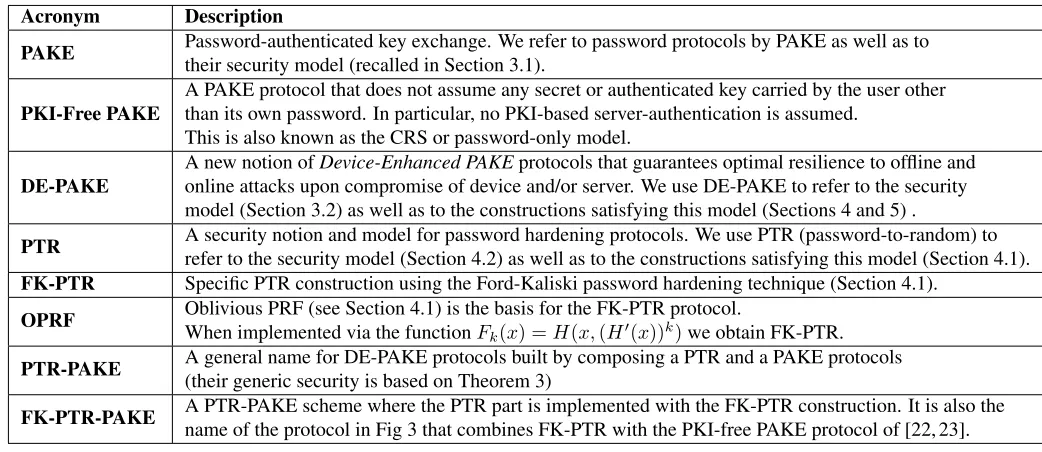
Table 1: Glossary
Acronym Description
PAKE Password-authenticated key exchange. We refer to password protocols by PAKE as well as to their security model (recalled in Section 3.1).
PKI-Free PAKE
A PAKE protocol that does not assume any secret or authenticated key carried by the user other than its own password. In particular, no PKI-based server-authentication is assumed.
This is also known as the CRS or password-only model.
DE-PAKE
A new notion ofDevice-Enhanced PAKEprotocols that guarantees optimal resilience to offline and online attacks upon compromise of device and/or server. We use DE-PAKE to refer to the security model (Section 3.2) as well as to the constructions satisfying this model (Sections 4 and 5) .
PTR A security notion and model for password hardening protocols. We use PTR (password-to-random) to refer to the security model (Section 4.2) as well as to the constructions satisfying this model (Section 4.1). FK-PTR Specific PTR construction using the Ford-Kaliski password hardening technique (Section 4.1).
OPRF Oblivious PRF (see Section 4.1) is the basis for the FK-PTR protocol.
When implemented via the functionFk(x) =H(x,(H0(x))k)we obtain FK-PTR.
PTR-PAKE A general name for DE-PAKE protocols built by composing a PTR and a PAKE protocols (their generic security is based on Theorem 3)
FK-PTR-PAKE A PTR-PAKE scheme where the PTR part is implemented with the FK-PTR construction. It is also the name of the protocol in Fig 3 that combines FK-PTR with the PKI-free PAKE protocol of [22, 23].
1.3 Organization and Glossary
We overview our design and proof methodology in Section 2, with full details given in Section 4. Section 3 presents our formal DE-PAKE security model on which we base our analysis. Section 5 presents protocol instantiations and extensions: A fully specified DE-PAKE scheme secure in the PKI-free (i.e. CRS) model; a description of our approach for armoring existing servers against online and offline attacks while keeping the servers unmodified; and extensions which address issues related to client security (which are not covered in our DE-PAKE model). For easy reference, in Table 1 we provide a summary of the main terms and acronyms used throughout the paper.
2
Overview: DE-PAKE Design and Analysis
Our design follows the “password hardening” approach of Ford and Kaliski [16], but dispenses of authen-ticated channels (other than during a registration phase), multiple servers and/or other safeguards that were required for the secure use of these techniques in prior work [16, 20].
or secret channel between the client and Dsince this would either require knowing a device public key or storing pwd-related information at D (the latter would open pwdto an offline dictionary attack upon compromisingD). We show that in spite of the client-device link being unauthenticated, hence controlled by the attacker, the “blinded DH” approach of Ford-Kaliski, (see Section 4.1), can be used to implement the PTR protocol.
PTR
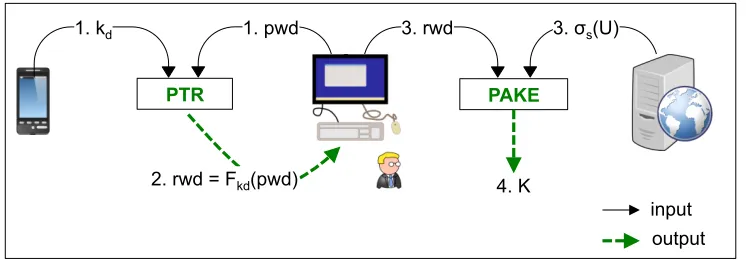
1. kd 1. pwd
PAKE
3. rwd
input output 3. σs(U)
4. K 2. rwd = Fkd(pwd)
Figure 1: PTR-PAKE Authentication Phase
Hence, we obtain a DE-PAKE scheme, which we callPTR-PAKE, as the composition of a PTR protocol and a secure PAKE. We depict this generic construction of a DE-PAKE protocol in Figure 1. The outputK
in step 4 denotes the session key established between the user and the server, i.e. the output of the DE-PAKE protocol, which is equal to the output of the PAKE subprotocol. The server’s input σS(U) to the PAKE
subprotocol denotes the user-specific information stored atScreated in the PAKE initialization usingrwdin the role of the password (e.g. in a common PKI-based PAKEσS(U)would be a salted hash ofrwd).
In order to prove the security of such scheme, we first extend the established security models for the PAKE functionality to the DE-PAKE setting (Section 3). For the DE-PAKE modeling we consider a fully capable man-in-the-middle attacker active on all the links between all parties and one who is allowed to compromise servers and devices at will. No external source of authentication is assumed other than the user’s password (except for secure registration of a user with the server and device). Second, we define the security requirements from a PTR protocol and show a PTR instantiation, FK-PTR, that satisfies this definition in the random oracle model. Finally, we prove ageneric security composition theoremshowing that the composition of a secure PTR scheme (run betweenUandDon the basis of the user’s passwordpwd) with a secure PAKE protocol (run betweenUandSon the basis of the hardened passwordrwd=Fk(pwd)) results in a secure DE-PAKE scheme, provided that the PAKE protocol satisfies “security against server compromise” or the more precise notion of KCI resistance introduced and discussed in Section 3.2 (we note that typical protocols that store a salted version of the password satisfy this property).
Since our FK-PTR scheme does not require PKI, using a PKI-free PAKE in the above composition results in a DE-PAKE protocol that does not rely on public keys or other secure channels.
PAKE protocol. In particular, this allows us to use without any change a server that implements the standard PKI-based password-over-TLS protocol, but in this case the outgoing communication from the device needs to be authenticated (see Section 4.5).
A PTR scheme is a close variant of OPRF, and the potential of OPRF to strengthen password authen-tication was recently used in the Pythia system [15], but their proposal differs from ours in at least three ways: (1) Their OPRF scheme is significantly more costly than our PTR: it requires 6 exponentiations and a bilinear map compared to 3 exponentiations in our PTR scheme (and we can use elliptic curves without bilinear maps where exponentiations are cheaper); (2) Their solution relies on PKI, while ours does not; (3) Their solution does not offer a server-transparent instantiation.
3
Security Model
We introduce theDevice-Enhanced PAKE (DE-PAKE)security model under which we prove the security of our schemes. The model extends the standard PAKE (Password Authenticated Key Exchange) formalisms to include user-specific devices and formulates a security definition that guarantees maximal online and offline security of password protocols. We start by recalling the PAKE security model (adapted to the client-server setting) and then we present the extension of the PAKE model to the DE-PAKE setting.
3.1 PAKE Security Model
We recall the security model for PAKE (Password-based Authenticated Key Exchange) protocols, based on the model of Bellare, Pointcheval and Rogaway [11] that extends authenticated key exchange models to account for the inherent vulnerability of password protocols to online guessing attacks. We adapt the PAKE model to the client-server setting borrowing some of the formalism from [22]. In Section 3.2 we will extend this standard PAKE model to security against server compromise.
Protocol participants. There are two types PAKE protocol participants, users and servers. Each userUis associated with a unique serverSwhile servers may be associated with multiple users.
Protocol execution.A PAKE protocol has two phases: initialization and key exchange. In the initialization phase each user U chooses a random password pwdfrom a given dictionary Dict and interacts with its associated serverSproducing a user’s stateσS(U)thatSstores whileUonly remembers its passwordpwd. Initialization is assumed to be executed securely, e.g., over secure channels. In the key exchange phase, users interact with servers over insecure (adversary-controlled) channels to establish session keys. Both users and servers may execute the protocol multiple times in a concurrent fashion. Each execution of the PAKE protocol byUorSdefines a (user or server) protocolinstance, also referred to as a protocolsession, denoted respectivelyΠUi orΠSi, where integer pointer iserves to differentiates between multiple protocol instances executed by the same party. Each protocol session is associated with the following variables: a session identifiersid, which we equate with the message transcript observed by this instance (where both UandSorder their interaction transcripts starting withU’s message), apeer identitypid, and asession key sk. For a user instance the peer is always the user’s server while for a server instance the peer is the user authenticated in the session. The output of an execution consists of the above three variables which can be set to ⊥if the party aborts the session (e.g., when authentication fails, a misformed message is received, etc.). When a session outputssk6=⊥we say that the sessionaccepts.
model defines the following queries or activations through which the adversary interacts with, and learns information from, the protocol’s participants.
send(P, i, P0, M): Delivers messageMto instanceΠPi purportedly coming fromP0. In response to asend query the instance takes the actions specified by the protocol and outputs a message given toA. When a session accepts, a message indicating acceptance is given toA. Asendmessage with a new valuei(possibly with nullM) creates a new instance at P with pidP0. For simplicity, we assume that the pair {P, P0}in any sendmessage contains a user and the server associated to that user (a non-compliant message causes the receiving instance to abort). Thesendquery can also create a new instance of partyP: IfΠUi does not exist then querysend(U, i,S,init)creates a new instanceΠUi which executes withpid = SonU’s chosen password pwd. Similarly, if ΠSi does not exist then send(S, i,U, M) creates a new instanceΠSi which executes withpid= UonS’s inputσS(U), withU’s first message set toM. (This formalism assumes that protocol exchanges are initiated by users, which is the operational setting in PAKE.)
reveal(P, i): If instanceΠPi has accepted, outputs the respective session keysk; otherwise outputs⊥. corrupt(P): Outputs all data held by partyP andAgains full control ofP. We say thatP iscorrupted.
compromise(S,U): Outputs stateσS(U)atS. We say thatSisU-compromised.
test(P, i): If instanceΠPi has accepted, this query causesΠPi to flip a random bitb. Ifb= 1the instance’s session keyskis output and ifb = 0a string drawn uniformly from the space of session keys is output. A testquery may be asked at any time during the execution of the protocol, but may only be asked once. We will refer to the partyP against which a test query was issued and to its peer as thetarget parties.
The following notion taken from [22] is used in the security definition below to ensure that legitimate messages exchanged between honest parties do not help the attacker in online password guessing attempts (only adversarially-generated messages count towards such online attacks). It has similar motivation as theexecute query in [11], but the latter fails to capture the ability of the attacker to delay and interleave messages from different sessions.
Roguesendqueries/activations:We say that asend(P, i, P0, M)query isrogueif it was not generated and/or delivered according to the specification of the protocol, i.e. messageMhas been changed or injected by the attacker, or the delivery order differs from what is stipulated by the protocol (delaying message delivery or interleaving messages from different sessions is not considered a rogue operation as long as internal session ordering is preserved). We also consider as rogue anysend(P, i, P0, M)query whereP is uncorrupted and
P0is corrupted. We refer to messages delivered through roguesendqueries asrogue activationsbyA. Matching sessions. A session in instanceΠPi and a session in instanceΠPj0 are said to bematchingif both have the same session identifier sid(i.e., their transcripts match), the first has pid = P0, the second has pid=P, and both have accepted.
Fresh sessions. A session at instanceΠPi with peerP0 s.t.{P, P0} = {U,S}is calledfreshif none of the queriescorrupt(U),corrupt(S),compromise(S,U),reveal(P, i)orreveal(P0, i0)were issued, whereΠPi00 is an instance whose session matchesΠPi (if suchΠPi00 exists).
Correctness.Matching sessions between uncorrupted peers output the same session key.
Attacker’s advantage.LetPAKEbe a PAKE protocol andAbe an attacker with the above capabilities running againstPAKE. Assume thatAissues a singletestquery against a fresh session at a user or server and ends its run with an output bitb0. We say thatAwinsifb0 = bwherebis the bit chosen internally by thetest session. Theadvantage ofAagainstPAKEis defined asAdvAPAKE = 2·P r[Awins againstPAKE]−1.
roguesendqueries having the target userUas recipient andqSis the number of roguesendqueries having the targetSas recipient.
Dictionary size2d.Our treatment works for any dictionary size, but for notational convenience we denote it as2d.
3.2 Security against server compromise and KCI-resistance
In the asymmetric client-server setting of password authentication that concerns us in this paper, plain pass-words should not be stored at the server, so as to prevent the leakage of the password in case of server compromise. Instead, the server should store some other verification information corresponding to this pass-word, such as the salted password hash. The security requirement in this case, often referred to assecurity against server compromise[18], is that access to the server’s state for a particular user (i.e,U-compromise in our terminology) does not allow the attacker to authenticate that user to the server except after running an offline dictionary attack that recovers the password given the server’s state.6 In the key-exchange literature an attack in which the compromise of a partyP allows the attacker to falsely authenticate another partyP0
toP is called aKey-Compromise Impersonation (KCI) attack[12]. Therefore, the above notion of security against server compromise can be seen as aweak form of KCI resistance,where impersonation ofUtoSis possible but only after running an offline dictionary attack.
We extend the above PAKE formalism to capture resistance to weak KCI attacks (wKCI-resistance) through the following game (which is well-suited to ROM-based implementations that hash the password). The security experiment is as before except for the following changes. UserU (associated with serverS) chooses its password at random from a dictionaryDict, whereDictis a random subset of{0,1}τ of size
2d (for integersd<τ). The attackerA is given a random subset ofDict of sizeq as well as the server’s stateσS(U), and it must choose the test session at an instance ofSwith peerU (in the regular case this is not allowed sinceSisU-compromised). We call a PAKE scheme-wKCI-resistantif for anyq ≤ 2d, the attacker’s advantage in this game is at mostq/2d+.
A strong notion of KCI resistance is achieved in the DE-PAKE model as we will see next.
3.3 DE-PAKE Security Model
We extend the PAKE model to the DE-PAKE setting. Besides servers and users in the PAKE model, each user is associated with a deviceDwith which it communicates over a two-way link. (We stress that the role ofDcan be played by any data-connected entity, including a hand-held device or an auxiliary web service.) The initialization phase of PAKE is extended to include the user-device communication that establishes the state stored at D. As before, users only remember their passwords. As in the PAKE case, initialization (including the user-device interaction) is assumed to run over secure channels. After initialization, the links between users and devices are subject to the same man-in-the-middle adversarial activity as in the links between users and servers. Device instancesΠDi are created similarly to user and server instances, and are activated byAviasend queries that include users and devices as senders and receivers. However, device instances do not produce output other than the outgoing messages. In particular,revealqueries do not apply to them, butcorruptqueries can be issued against devices, in which case the internal state of the device is revealed toAwho then controls the device. The session-related notions, including the test query, do not apply to devices.
6Recovering the password via an offline dictionary attack is unavoidable in the PAKE model. Also unavoidable is impersonating
The attacker’s goal is the same as before, i.e. to win the test experiment at a user or server instance, as in the PAKE setting. Also the correctness property is unchanged. However, to the attacker resources we add the number ofroguesendqueries (see Section 3.1) where the target user is the recipient and the device the sender (denotedqU0 ) and the number ofroguesendqueries where the target user is the sender and the device the recipient (denotedqD). We refer to this more powerful adversary as a DE-PAKE attacker.
Strong KCI resistance. The DE-PAKE model is intended to provide a much stronger notion of security in case of server compromise than achievable in the PAKE case. While in the latter, impersonatingUtoS in case ofU-compromise is possible (and unavoidable) through an offline dictionary attack, in DE-PAKE protocols this is prohibited. In order to formalize this requirement we follow the treatment of KCI resistance from [31] and we strengthen the capabilities of a DE-PAKE attacker through a more liberal notion of fresh sessions at a serverS. All sessions considered fresh in the PAKE model are also considered fresh in the DE-PAKE model; in addition, in the DE-PAKE model, a sessionΠSi at serverSwith peerUis considered fresheven if corrupt(S) orcompromise(S,U) were issued as long as all other requirements for freshness are satisfied andthe attackerAdoes not have access to the temporary state information created by session ΠSi. This relaxation of the notion of freshness captures the case where the attackerAmight have corrupted Sand gained access toS’s secrets (including long-term ones), yetAis not actively controllingSduring the generation of sessionΠSi. In this case we would still want to preventAfrom authenticating asUtoSon that session. Definition 2 (item 2) below ensures that this is the case for DE-PAKE secure protocols even when unboundedoffline attacks againstSare allowed.
The following security definition captures the maximal-attainable online and offline security from a DE-PAKE protocol as informally discussed in the introduction. LetDPKbe a DE-PAKE protocol andAbe an attacker with the above capabilities running againstDPK. As in the PAKE model, we assume thatAissues a singletestquery against someUorSsession, thatAoutput bitb0, and we say thatAwins ifb0 =bwhereb
is the bit chosen by thetestsession. We defineAdvADPK= 2·P r[Awins againstDPK]−1.
Definition 2. A DE-PAKE protocol is called(qS, qU, qU0 , qD, T, )-secure if it is correct, and for any pass-word dictionary Dict of size 2d and any attacker that runs in timeT, the following properties hold (for
qS, qU, qU0 , qD as defined above):
1. IfSandDare uncorrupted, the following bound holds:
AdvADPK≤ min{qU+qS, q
0
U +qD}
2d +. (1)
2. IfDis corrupted thenAdvDPKA ≤(qU+qS)/2d+. 3. IfSis corrupted thenAdvADPK≤(qU0 +qD)/2d+.
4. When bothDandSare corrupted, expression (1) holds butqD andqSare replaced by the number of offline operations performed based onD’s andS’s state, respectively.
Note that the bounds in items 3 and 4 hold also whenSisU-compromised (since being corrupted implies U-compromise for all usersUassociated withS).
(resp. 3) could be covered by (1) if one replacedqD (resp.qS) in this expression with the number of offline operations performed based onD’s (resp.S’s) state.
Note on modeling DE-PAKE via a T-PAKE. In a (t, n)-Threshold-PAKE (T-PAKE) (cf. [22]), a user holding a single password can securely establish authenticated keys with a subset of nservers as long as no more than t of them are corrupted (and the user interacts with at leastt+ 1 well-behaving servers). One can implement DE-PAKE on the basis of a T-PAKE for(t, n)=(1,2), otherwise known as 2-PAKE, by lettingDandSact as the two servers in the 2-PAKE scheme. This would imply the first three conditions of Definition 2, but the last condition should be added as an additional requirement. Moreover, one can use 2-PAKE as the basis for the definition of DE-PAKE where the user only authenticates to one of the servers. However, the dedicated DE-PAKE definition we present, and its instantiations, provide several advantages: (1) It makes the security goals for the DE-PAKE notion clearer; (2) It allows for a more precise specifica-tion of the (strict) upper bounds on attacker’s advantage depending on the attack setting; and (3) It allows for more efficient implementations, in particular enabling a server-transparent DE-PAKE implementation, which cannot be done using 2-PAKE. (A 2-PAKE cannot be server-transparent because ifSruns the code as in PAKE thenS’s presence cannot helpUto authenticate toD.)
Note on client security.The DE-PAKE model is designed to capture (maximal) security against online and offline attacks where the attacker fully controls all communication channels and can compromise servers and devices. However, as it is customary in the PAKE setting, the model does not consider the security of the machine (the “client”) into which the user enters the password. Yet, our solutions, while vulnerable to some forms of attack by an attacker controlling the client machine, also provide defenses to common attacks such as keyloggers or phishing attacks (see Section 5).
4
A modular DE-PAKE Scheme
In this section we present and analyze our generic DE-PAKE scheme, i.e. the PTR-PAKE shown in Figure 1, which results from the composition of two independent cryptographic primitives, a PTR protocol and a PAKE protocol with resistance to wKCI attacks (see section 3.1). For a high-level description of the functionality of a PTR (password-to-random) scheme and its use for obtaining a DE-PAKE scheme see Section 2. We start by describing a specific efficient PTR implementation we call FK-PTR, with is based on the “password hardening” protocol of Ford-Kaliski [16] (Section 4.1). We then use this protocol example to formalize the PTR notion and its security requirements (Section 4.2), and we prove that the FK-PTR protocol satisfies the PTR security notion (Section 4.3). Finally, we prove that thegenericcomposition of any secure PTR scheme and any PAKE scheme with resistance to wKCI attacks results in a secure DE-PAKE scheme (Section 4.4). Thus, our scheme can be instantiated with the FK-PTR scheme as the PTR part and any secure wKCI-resistant PAKE protocol (e.g., [18, 22]). Moreover, if the PAKE scheme is in the password-only model7then the DE-PAKE scheme is also secure in this model.
4.1 The FK-PTR Scheme
The instantiation of a PTR scheme we call FK-PTR is based on Ford-Kaliski’s “password hardening” [16] or its more general interpretation as an Oblivious PRF (OPRF) [17, 26, 27]. Roughly, an OPRF is a pseudoran-dom function that is computed by two parties, one that holds the key to the function and learns nothing from
7
Setup
• GroupG.The scheme works over a cyclic groupGof prime orderq,|q|=`, with generatorg.
• Hash functionsH, H0 map arbitrary-length strings into elements of{0,1}τ andG, respectively, whereτ is a security parameter.
• OPRF.For a keyk←Zq, we define functionFkasFk(x) =H(x,(H0(x))k).
• Parties.UserU, DeviceD, ServerS.
• DictionaryDictof size2d(a power of2is used for notational convenience only).
• Any PAKE protocolΠ.
Initialization Phase(assumed to be executed over secure links)
• FK-PTR Initialization:Uchooses passwordpwd←Dict;Dchooses and stores OPRF keyk←Zq;Uinteracts withDto computerwd=Fk(pwd).
• PAKE Initialization: UserUand serverSare initialized with valuerwdused as a password according to the specification of PAKE protocolΠ.
Login Phase
• User-Device Interaction (FK-PTR)
1. Uchoosesρ←Zq; sendsα= (H0(pwd))ρtoD.
2. Dchecks that the receivedα∈Gand if so it responds withβ=αk.
3. U setsrwd=H(pwd, β1/ρ).
• User-Server Interaction (PAKE)
Follows the specification of the PAKE protocolΠwhereUusesrwdas its password.
Figure 2: The FK-PTR-PAKE Scheme
the computation, and one that holds an input and learns the output of the function on that input and nothing else.8 In Figure 2 we present a particular instantiation of the PTR-PAKE protocol, which we call FK-PTR-PAKE, that results from a composition of FK-PTR, which is a specific instantiation of a PTR scheme, with a PAKE scheme. Figure 2 fully specifies the FK-PTR protocol, which is an interaction betweenUandD by which Uretrieves a random valuerwd with the help of its passwordpwd. At initialization,Uchooses and remembers passwordpwdwhileDchooses and storesk← Zq. To retrieverwd,Ufirst blindspwdby raising the hashed valueH0(pwd)to a random exponentρ, and send it toD. This perfectly hidespwdfrom Dand from any eavesdropper on theU−Dlink.Dchecks that the received value is in the groupGand if so it raises it to the secret exponentk. Now,Ucan de-blind this value by raising it to the power1/ρto obtain
H0(pwd)k. Finally,Uhashes this value withpwdto obtain the randomized passwordrwd.
Note thatDcontains no information related topwdhence an attacker interacting withDor even breaking into it learns nothing aboutpwd. Also,Udoes not run any test on the value reconstructed in the FK-PTR
8
protocol. Hence, an attacker that interacts withUin the role ofDdoes not learn anything aboutpwdfrom watching the behavior ofU. These “obliviousness” and minimality properties of FK-PTR are essential to achieve PTR security and make the security analysis challenging. We will use this scheme to motivate the security requirements from a PTR scheme as needed for composing it with a PAKE protocol and obtain a secure DE-PAKE protocol. We establish these requirements in the next subsection and then prove the security of FK-PTR.
4.2 PTR Security Model
Here we present the security model for (generic) PTR schemes. We first define the adversarial game under-lying this model and then use the FK-PTR scheme and explicit potential attacks against it to motivate the security definition.
PTR adversarial game.The game is parameterized by a function familyF and a password dictionaryDict of size 2dfor somed(the power of two is chosen for notational convenience only). UserUis initialized with password pwd ← Dict and deviceD with a keyk defining function Fk. Later, the parties interact so that in an undisturbed interaction betweenUandD, whereUruns with inputpwd,Uoutputs the secret rwd = Fk(pwd). Attacker Ahas oracle access to UandD, calling these parties with any message of its choice and receiving the corresponding response as defined by the scheme depending on the internal secrets and state of the responding party. The security requirements are defined below in Definition 3 but we first motivate them as follows.
Attack avenues and PTR security requirements. We define security of a PTR scheme in a way that guarantees that the generic composition of PTR and PAKE protocols results in a secure DE-PAKE scheme. The definition consists of several requirements that we motivate next via concrete attacks showing these requirements to benecessary(and by virtue of Thm. 3 also sufficient). Reducing the PTR requirements to the minimum necessary is pivotal for obtaining ourvery efficient FK-PTR implementation that would not be possible otherwise.
Attack avenue 1: Leakage onrwd=Fk(pwd). Given thatAcan obtain values inRDictby interacting with Don input any password in Dict we need to assure that nothing in the scheme leaks information on the specific value ofrwd = Fk(pwd)or otherwise the attacker can use this information to gain advantage on guessing which of theRDictvalues is more plausible to be the correctrwd(e.g., it shouldn’t be possible for Ato test a possible valuepas a candidate forpwdor to test a valueras a candidate forrwd). More generally, to apply PAKE we need to ensure that the view of the attacker at the end of the PTR run is independent, computationally or statistically, fromrwd.
To capture this property we define the following experiment referred to as thedistinguishing test. Define RDictas{Fk(p) :p∈Dict}wherekisD’s secret key. Letrwd=Fk(pwd)and chooser ←RDict\ {rwd}. Ais given bothrwd, r(in random order) and it needs to guess which one equalsFk(pwd).
Attack avenue 2: Learning values in RDict. Since A can learn values inRDict by interacting withD, A can later interact withSin the PAKE protocol using these values. Thus, the best we can do is to require the PTR protocol not to leak toAmore than one value inRDictfor each interaction withD. We formalize this by defining a game where the attacker, at the end of its run, outputs a set of candidate values inRDict, and requiring that this set does not contain more thanqD correct values whereqD is the number of rogue activations ofDbyA.
pwd0 ∈ Dictis known toA. In this case,Acan observe the PAKE run ofU withSand see ifpwd0 is the correct password. This allowsAto test passwords inDictwithout having to act as an active MitM in the PAKE protocol betweenUandS. While this attack is not possible against FK-PTR (as we will prove later), one can show PTR schemes where this attack is feasible. There are two ways of dealing with this issue. We either show that any such “dictated password” requires a specific rogue activation of D(as in Attack 2 above) hence treating it as any other password inRDict that Amay learn by interacting withD or we require that a secure PTR scheme does not allow for such attack. The latter is better as it preventsAfrom testing passwords without a rogue activation ofUbut the former can be acceptable in a protocol that allows the attack. Given that our FK-PTR protocol does not allow the attacker to useU as an oracle for testing passwords inRDict\ {rwd}, we choose the stronger notion by adding an explicit requirement against such possibility.
To prevent this we require thatU’s PTR output equalsFk(pwd0)forpwd0 ∈Dict\ {pwd}with at most negligible probability.
Attack avenue 4: RunningUon passwords outsideRDict. The PTR-PAKE composition presents an attack avenue not present in regular PAKE protocols: Acan makeUrun the PAKE protocol on a password from a dictionary RDict∗ different than RDict (note that this is different from attack scenario 3). To see this, consider an attack in whichAimpersonatesDtoUrunning the protocol with a keyk0 chosen byA. As a consequence,Uwill run the PAKE protocol with the valueFk0(pwd), i.e., with a value uniformly distributed overRDict∗={Fk0(p) :p∈Dict}whereRDict∗is known toA. This allowsAto attack the PAKE protocol as follows. It impersonatesStoUas if the server’s state was initialized with passwordFk0(p)forp∈Dict. Ifp =pwd,Asucceeds in the impersonation and learnspwd.9 This attack is not contemplated in standard
PAKE models where the user is assumed to run with a password from the specified dictionary and without adversarial choice of the password. To illustrate the dangers of such attack, imagine that the familyF has a keyk∗ such thatFk∗(·)is a constant function (with an output known toA). This is a real possibility against FK-PTR if we defineFk(p)to beH((H0(p)k)in which casek∗ = 0has exactly this effect. Similarly, if there is a keyk∗for whichFk∗ is at-to-1 function,Acould discardtpasswords with eachS-impersonation attempt againstU. Again, this is possible against FK-PTR with the modifiedFkwhereAcan chooseβ0, the response returned toU, to be in a group of small-order. (Such an implementation of FK-PTR would require to testβ0∈G\ {1}.)
To prevent this attack avenue we require thatanyattack strategy byAfor generating a dictionaryRDict∗ induces a 1-1 function. We formalize this as follows. Let c denote a set of coins for parties U,D,Ain a PTR run. For any such c define fc(p) as the output from U if its password was p. We require that except for negligible probability over the choice ofc,fcis 1-1. (Note that each suchcdefines a dictionary RDict∗ ={fc(p) :p∈Dict}of size|Dict|.)
We are now ready to define PTR security.
Definition 3. We say that a PTR scheme is (qD, qU, T, )-secureif for any PTR attackerAthat runs time T and performsqD andqU rogue activations ofDandU, respectively,is an upper bound on the values 1, 2, 3, 4defined as follows (thesei are functions ofqD, qU, T and they correspond to the above attack avenues):
9This attack recoverspwdwith2d
impersonation attempts (ofS) againstUand it only requires one valueFk0(pwd)used byU
as its PAKE password. This does not imply a break of the DE-PAKE scheme, since for each impersonation attempt againstU,A
needs to perform a rogue activation ofUin PTR. IfqU0 is the number of rogue activation ofUin PTR andqUis the number of rogue
calls toUin PAKE, then the probability of successful impersonation is at mostmin{qU, q0U}/2d. This implies thatit is insecure
1. the probability thatApasses the distinguishing test of attack avenue 1 is at most1/2 +1;
2. the probability thatAoutputs more thanqDvalues inRDictfollowing attack avenue 2 is at most2;
3. the probability thatUoutputsFk(pwd0)forpwd0 ∈Dict\ {pwd}is at most3;
4. the probability thatfc, as defined in attack avenue 4, is not 1-1 is less than4.
where in all four cases the probability goes over random PTR keykand randompwdinDict.
4.3 Security of the FK-PTR Scheme
Theorem 1 below summarizes the security of the FK-PTR scheme in terms of Definition 3. It uses the One-More Gap Diffie-Hellman assumption defined next.
The One-More Gap DH (OMG-DH) Assumption [10, 27]: LetGbe a group of prime orderq andk a random value inZq. LetDHk be an oracle10 that on inputg ∈ Goutputs gk, and letDDHk be an oracle that on input a pair(a, b)answers whetherb=ak. We say thatGsatisfies theomg-OMG-DH assumption for functionomg if any attackerAthat runs in timeT has probability at mostomg(T, qdh, qddh)to win the following game:Ais given access to theDHkandDDHkoracles, which it queriesqdhandqddhtimes, resp., and is given a setRof random elements inG. It wins if it outputsqdh+ 1different pairs(g, gk), g∈R.
Theorem 1. LetGbe a group where the omg(·)-One-More Gap DH holds. Let the hash functionsH, H0 be modeled as random oracles andqH be the number of invocations toH. Then, the FK-PTR scheme run over groupGwith a dictionaryDict⊂ {0,1}τ is(q
D, qU, T, )-securewhere= max{1, 2, 3, 4}with
1= 0,2≤T /2τ +omg(T, qD, qH),3 ≤1/2τ,4≤ |Dict|2/2τ.
Proof. To show that1 = 0, note that the only informationA sees related to the particular valuepwdis
α= (H0(pwd))ρbut sinceρis chosen byUuniformly inZq,αis uniformly distributed inGindependently of pwd. Thus, the view ofA is independent of U’s password pwd and the probability of A to win the distinguishing test is1/2. The bound on2 follows from Lemma 2 below proven based on the OMG-DH
assumption. The bound on3follows from the fact thatpwdis included underH, hence the probability that
for somepwd0 ∈Dict\ {pwd}, we haveH(pwd0,(H0(pwd0))k) =H(pwd,(H0(pwd))k)is2−τ whereτ is the length of the output fromH. Similarly, the bound on4follows from the collision resistance properties
of the (random)H.
Note: The bound|Dict|2/2τon
4can be reduced significantly if one relaxes requirement 4 of PTR security
to allow for some deviation from injectiveness, e.g., allowingRDictto be of sizeα· |Dict|for someα, say
α= 1/2.
Lemma 2. LetGbe a group where theomg-One-More Gap DH assumption holds and model hash functions H, H0 as random oracles. Let A be a PTR-attacker against the FK-PTR scheme that runs time T and activatesDqD times with values chosen byA(i.e., rogue activations). Then, the probability thatAoutputs more thanqD values inRDict(as in attack avenue 2) is at most2 =T /2τ+omg(T0, qD, qH)whereqH is the number of invocations ofHbyAandT0≈T.
Proof. Given a PTR attackerAagainst the FK-PTR scheme over aomg-OMG-DH groupG, we build an attackerA0 against OMG-DH in groupG. A0 gets access to aDHkandDDHk oracles and an input in the form of an ordered setR =g1, ..., gN of random elements inG. A0 runsAon a simulated run of FK-PTR. A0 usesDHkto answer queries toD(i.e.,A0 simulates an instance ofDunder keyk) and uses the setRto
10DH
kis not defined over elements outsideGhence one needs to check the input to the oracle - it can be done by an explicit
answerH0queries. Namely, ifR =g1, ..., gN then the firstH0 query is answered withg1, the second with
g2, etc. Queries(x, y)toHare answered with random values in{0,1}τ. A0 keeps a table of defined
inputs-outputs for these oracles and answers to repeated queries with the corresponding values in these tables. A0 choosespwd, setsH0(pwd) =g1(i.e., this is done prior to answering anyH0 query fromA), and queriesg1
toDHkobtaininggk1 which we denote byy∗.
A0 simulates the actions ofU faithfully, namely, it outputs messages of the formα = g1ρ for random
ρ ← Zq and upon receiving a response β fromA it computes r0 = H(pwd, β1/ρ). When A delivers a messageα0 toD, A0 responds to it as follows. Ifα0 was output byU, in which caseA0 knowsρ such that
α0 = g1ρ,A0 responds withy1ρ; otherwiseA0 queriesα0 fromDHk. In addition, for inputs (x, y) toH, A0 checks thatH0(x)was queried and if so it checks, using theDDHkoracle, whether thegj ∈Rreturned as the result ofH0(x)satisfiesy =gkj. If all checks pass,A0 stores the pair(gj, y)in a listL.
Note that the above simulation ofAis perfect hence the output fromAis the same as in a real execution of FK-PTR. As claimed in the proof of Theorem 1, the view ofAis independent of pwdandg1 (Aonly
sees values of the formg1ρfor one-time randomρ’s) hence it is independent of rwd(which is computed as
H(pwd,(H0(pwd))k)).
Denote byR0 the set of values inRDictoutput byA. LetE1 denote the event thatR0 contains a value
r0 =H(p,(H0(p))k)forp ∈Dictand thatAdid not queryH on(p,(H0(p))k)orH0 onp; the probability ofE1 is at mostT /2τ. AssumingE1 does not happen we have that ifr0 = H(p,(H0(p))k) ∈ R0 thenA
queriedH0onpandHon(p,(H0(p))k). SinceA0chooses its responses toH0queries from elements in the setR, we have thatr0 = H(p, gjk)forgj ∈ Rso the queryH(p,(H0(p))k) resulted in the pair(gj, gjk) being included byA0 into the listL. Thus,|R0| ≤ |L|.
Note thatA0has obtained pairs(gj, gjk)for all pairs inLas well as for(g1, g1k). LetL0 =L∪ {(g1, g1k)}.
By the DH-OMG assumption we have that the probability that L0 contains more thanqdh elements is at mostomg(T0, qdh, qddh)whereT0 is the running time ofA0. So, except for this probability, we can assume
|L0| ≤qdh. We show|L| ≤qDand therefore|R0| ≤qDas claimed by the lemma.
A0queriesDHkin two cases: Upon rogue activations ofDbyAand for obtainingg1k. Thus, if(g1, g1k)∈/
Lwe haveqdh = qD+ 1, and together with the assumptionqdh ≥ |L0| = |L|+ 1 we obtain that|L| ≤ qdh−1 = qD. If(g1, gk1) ∈ L(meaning thatg1 was also queried by Athrough a rogue activation) then
qdh=qDand together withqdh≥ |L0|=|L|we obtain that|L| ≤qdh=qD.
In all, we have that except for probability2=omg(T0, qD, qH) +T /2τ,|R0| ≤ |L| ≤qD. The running time ofA0 is essentially that ofAif we countUactivations as part ofArunning time and equate the cost of a call toDHkto that of aDactivation and the cost of aH0call to that of aDDHkinvocation.
4.4 PTR-PAKE Composition Theorem
We are now ready to prove the composition theorem showing that composing a secure PTR with a PAKE that offers the wKCI-resistance property, results in a secure DE-PAKE scheme (with security definitions as presented in Section 3). As noted earlier, if the PTR and PAKE schemes dispense of PKI so does our DE-PAKE protocol: An example of such composed scheme free of PKI (except for initialization) is presented in Section 5.
Theorem 3. LetP be a (qD, q0U, TP, P)-secure PTR scheme and Π be a (qS, qU, TΠ, Π)-secure PAKE
protocol that is alsoKC-wKCI-resistant, then the DE-PAKE schemeC that uses the composition of both protocols is a(qS, qU, qU0 , qD, TC, C)-secure DE-PAKE protocol whereC =Π+ (3qU0 + 1)P +KC+
qU+qS
2τ−1 .
4.5 Adaptation to Standard Password-over-TLS
The most widely deployed password protocol in practice is the web-based “password-over-TLS” scheme, namely, one where server and browser establish a TLS channel authenticated by the server over which the user’s password is encrypted and transmitted to the server. At reception the server decrypts the password and passes it to the application that requested the authentication. Typically, such application will not keep passwords in plaintext form but will rather store a (possibly salted) hash image of the password so that upon server compromise an attacker still has to mount a dictionary attack. However, in this setting an attacker that compromises or controls a server can potentially learn thecleartext passwordupon user authentication, namely, when the password is decrypted and sent to the application.
This capability of the attacker can be exploited in our setting as follows. Assume the attackerAcorrupts serverSand impersonates the device to the user choosing its own OPRF keyk0. When the userU authenti-cates toS, it obtains from the (impersonated) device the valuerwd0 =fk0(pwd)whichUthen transmits toS over TLS. If we assume thatAlearns the cleartextrwd0 by corruptingS, thenAcan now mount a dictionary attack onpwdon the basis of the valuesk0andrwd0that it knows. Therefore, to recover DE-PAKE security in this case one has to assume that the communication from the deviceDto the user’s client machine is au-thenticated. This requires a one-time setup procedure where a device’s key is installed in the user’s machine (one can also leverage the PKI setting in this case) .
Revisiting the security analysis in this case, one notes that the ability to learn the plaintextrwd0, violates PTR security, particularly viaattack avenue 4. Indeed, the attackerAcan now induce the computation of a passwordrwd0 outsideRDictwhich it learns viaScompromise. Requiring the communication from the device to the client machine to be authenticated solves the issue as it prevents the attacker from choosing its own OPRF keyk0 for computing non-RDictpasswords. Thus, with device authentication the proof of Theorem 3 remains valid. It is worth noting that in this setting the attacker Acan learnrwd = fk(pwd) computed under the real device’s keyk. Yet, this is of no value toAas it does not allow to mount an attack onpwdor on otherrwdvalues except ifAalso compromises the device. In the latter case,Acan mount an offline dictionary attack but as stated before such an attack upon compromise of both device and server is unavoidable.
5
Instantiations and Extensions
In this section, we discuss several instantiations and extensions of our PTR-PAKE scheme showing the practicality and flexibility of our approach. We first present a full and detailed instantiation of PTR-PAKE that is secure in the PKI-free setting . Then, we show how to provide transparent DE-PAKE support to currently deployed web services, namely, armoring an existing service against online and offline attacks without changing the server. Finally, we comment on extensions that provide defenses against client-side and phishing attacks.
PKI-Free DE-PAKE.Figure 3 describes a full instantiation of a PKI-free PTR-PAKE protocol using the FK-PTR scheme from Figure 2 and a PKI-free PAKE protocol with resistance against wKCI attacks adapted from the threshold PAKE (TPAKE) protocol of [22, 23]. More precisely, the PAKE protocol we use is an adaptation of the variant of the TPAKE protocol from [22, 23] with resistance against wKCI attacks, proven secure in the PKI-free (or CRS) model, to the single-server case (i.e., a (1,1)-TPAKE).
Parties: UserU, DeviceD, ServerS. Public Parameters and Components
• GroupGof prime orderqwith generatorg.
• Hash functionsH, H0with ranges{0,1}2τ, GandZ
q, respectively, forτa security parameter.
• Pseudorandom function (PRF)fwith range{0,1}2τ.
• OPRF functionFk(x) =H(x,(H0(x))k)for keyk∈Zq.
• Key exchange formulaKE: on input long-term and ephemeral private-public keys outputs shared keyK∈ {0,1}τ.
Initialization Phase(assumed to be executed over secure links)
• FK-PTR Initialization: Run FK-PTR initialization of Fig. 2 to choosepwd, device’s OPRF key kd, and compute
rwd=Fkd(pwd).
• PAKE Initialization:
1. Schoosesps∈RZqand sends toUthe public keyPs=gps(Pscan be used with all ofS’s users). 2. Uchoosesz∈R{0,1}τ, ks∈RZq;
sets valuesc=z⊕Fks(rwd), r=fz(0), C=H(r,rwd, c), pu=fz(1) modq;
computesPu=gpu andmu=fz(2, Pu, Ps); and sends toSthe valuesc, C, ks, Pu, mu.
3. Sstoresc, C, ks, Pu, muin itsU-associated storage (ifPsis user-specific, it also storesPsandps).
Login Phase
• User-Device Interaction (FK-PTR)
Follows the FK-PTR protocol as per Fig. 2 to obtainrwdon inputpwdfromUand inputkdfromD.
• User-Server Interaction (PAKE)
1. U chooses ρ, xu ← Zq; initiates a key exchange session with S by sending its identity U, the value
α= (H0(rwd))ρandXu=gxu. 2. Sproceeds as follows:
(a) Checks thatα∈G;
(b) Retrieves(c, C, ks, Pu, mu)from itsU-associated storage; (c) Picksxs∈RZqand computesβ =αks, Xs=gxs. (d) Sends toU:β, c, C, Pu, mu, Ps, Xs.
(e) ComputesK=KE(ps, xs, Pu, Xu)and outputs session keySK=fK(0).
3. Uproceeds as follows:
(a) Setsz=c⊕H(rwd, β1/ρ), r=f
z(0), pu=fz(1) modq.
(b) Aborts unless the following conditions hold:β∈G, C=H(r,rwd, c), mu=fz(2, Pu, Ps). (c) ComputesK=KE(pu, xu, Ps, Xs)and outputs session keySK=fK(0).
• Explicit Authentication
If explicit authentication of the parties is required thenSadds the valuefK(1)to its message andU adds a third message with valuefK(2). Each party verifies the value received from the other party.
secrecy, etc. However, we note that in order to achieve security against server compromise (needed to provide the maximal security of a PTR-PAKE scheme) one must use a public key mechanism. Otherwise, the server would be storing a secret authentication key for the user which would allow an attacker to impersonate the user to the server in case of server compromise. Thus, while we allow for different key exchange mechanisms through a generalKEformula, we do require these to be based on public keys for both parties (we also accommodate ephemeral keys if forward secrecy is desired). For illustration, and as a concrete and efficient instantiation that preserves a minimal number of messages and provides forward secrecy, we define the key computation formulas corresponding to the HMQV protocol [31], where eu = H(Xu,S), es = H(Xs,U):
ForS: K =KE(ps, xs, Pu, Xu) =H((XuPueu)xs+esps)
ForU: K=KE(pu, xu, PS, XS) =H((XsPses)xu+eupu)
Server-Transparent DE-PAKE.An important implication of the modularity of our PTR-PAKE scheme is that the user can use any secure PTR protocol to derive a hardened passwordrwdfrom her nominal password pwd, and then registerrwdas her actual password with an existing server, where the latter implementsany wKCI-resistant password authentication protocol acting as PAKE. In particular, such authentication protocol can be the standard PKI-based password-over-TLS protocol widely used as the basis for web authentication. In such case the login phase of the PTR-PAKE protocol consists of the user typing her passwordpwd, the client terminal and the device executing the PTR protocol to compute the hardened passwordrwd, and the client terminal sendingrwdto the server over a TLS session. In this setting, no modification to an existing service is required. We note, however, that as stated in Section 4.5, providing DE-PAKE security in this TLS setting requires authentication of the communication from device to the user’s machine. Once this authentication is ensured (via a setup procedure where a device’s key is installed in the user’s machine) the resultant composition of PTR and password-over-TLS is DE-PAKE secure.
There are several advantages of this setting: (1) the user can simply remember the short nominalpwd but register with a strong high-entropy password that significantly increases resistance to online and offline guessing attacks (in particular, offline-only attacks on a compromised server are not possible); (2) nominal passwordpwdcan be the same or reused among multiple services, but the OPRF key associated with each service stored on the device can be different (hence alsorwdwould be different), and therefore the compro-mise of the passwordrwdat one server will not reveal the actual passwordpwdand will not compromise the user’s accounts with other services; (3) rather than asking the user to frequently change the password and memorize the updated password, only the key on the device can be changed, which improves the usability.
In a companion work [34], we have developed a smartphone-based password manager application built on top of the DE-PAKE framework and investigated its usability. The results of our study demonstrate the promising feasibility of our approach to a real-world practical problem.
Resisting Client-Side & Phishing Attacks.Malicious code and keyloggers remain a threat to browsers in spite of browser security enhancements. Because we use a keyed password hardening scheme, an attacker who learnspwdby a key-logger or shoulder surfing cannotauthenticate to the service without interacting with the device. However, an attacker who compromises a client terminal can obtainrwd. By using service-specific keys at the device we guarantee that an attacker who obtainsrwdcan only compromise the particular service associated with it; even ifpwdis used for multiple services, therwdvalues derived for each service are random and independent .
a key thatDshares withS. Note that in a traditional TFA mechanism, compromising the client allows the attacker to hijack the current login session of the user, but does not allow the attacker to login in future sessions (due to the use of “one-time” PIN codes). Integrating our DE-PAKE protocol with traditional TFA could provide the same level of security in the event of client compromise, while providing all the other security properties of our DE-PAKE scheme.
Resistance to phishing attacks can be achieved ifrwdis computed on a concatenatation ofpwdand the URL being accessed, i.e., ifrwd=FKd(pwd|url). This is similar to the PwdHash approach [33] except that in PwdHash, the attacker that obtains the randomized password through phishing can mount a dictionary attack to find the user’s password while in our case this is not feasible.
Integrating our DE-PAKE techniques with existing two-factor authentication mechanisms (e.g., PIN based) to simultaneously enhance security against offline-online attacks and client compromise is left as a future work item.
6
Conclusions and Future Work
In this paper, we considered the problem of armoring password protocols against online guessing attacks as well as offline dictionary attacks in the event of server or device compromise. We proposed a novel, effi-cient and modular device-enhanced password protocol (DE-PAKE) and formally analyzed its security. In contrast to previous work on this subject, our protocol does not require the presence of a public key infras-tructure or the availability of authenticated public keys (except, possibly, for initial password registration) thus relaxing the concerns regarding PKI failures or compromises. At the same time, when an authentic and uncompromised public key of the server is available, our protocol further guarantees resilience to server im-personation even when the user’s password is disclosed. Remarkably, we can achieve these benefits without necessitating service-side changes.
Finally, we note that, thanks to our modular architecture, one can further increase the resistance to server compromise by using a threshold-PAKE protocol (e.g., [22]), in which case an attacker needs to compromise a threshold of serversin addition tothe device before being able to mount an offline dictionary attack.
Acknowledgments
This research is partially supported by ONR Contract N00014-14-C-0113, NSF CICI Award #1547435 and #1547350, and NSF CNS Award #1209280.
References
[1] Anonymous hackers claim to leak 28,000 PayPal passwords on global protest day. Available at:http://goo.
gl/oPv2h.
[2] Blizzard servers hacked; emails, hashed passwords stolen. Available at:http://goo.gl/OTNWJC.
[3] Hackers compromised nearly 5M Gmail passwords. Available at: http://goo.gl/IRu07u.
[4] LinkedIn Confirms Account Passwords Hacked. Available at:http://goo.gl/UBWuY0.
[5] RSA breach leaks data for hacking securid tokens. Available at: http://goo.gl/tcEoS.
[6] RSA SecurID software token cloning: a new how-to. Available at:http://goo.gl/qkSFY.
[8] T. Acar, M. Belenkiy, and A. Kupcu. Single password authentication. Computer Networks, 57(13):2597 – 2614, 2013.
[9] A. Bagherzandi, S. Jarecki, N. Saxena, and Y. Lu. Password-protected secret sharing. InProceedings of the 18th ACM Conference on Computer and Communications Security, CCS 2011, Chicago, Illinois, USA, October 17-21, 2011, pages 433–444, 2011.
[10] M. Bellare, C. Namprempre, D. Pointcheval, and M. Semanko. The one-more-RSA-inversion problems and the security of Chaum’s blind signature scheme. 16(3):185–215, June 2003.
[11] M. Bellare, D. Pointcheval, and P. Rogaway. Authenticated key exchange secure against dictionary attacks. In Advances in Cryptology – Eurocrypt, 2000.
[12] S. Blake-Wilson, D. Johnson, and A. Menezes. Key agreement protocols and their security analysis. In Pro-ceedings of the 6th IMA International Conference on Cryptography and Coding, pages 30–45, London, UK, UK, 1997. Springer-Verlag.
[13] X. Boyen. Hidden credential retrieval from a reusable password. InProceedings of the 4th International Sympo-sium on Information, Computer, and Communications Security, ASIACCS ’09, pages 228–238, New York, NY, USA, 2009. ACM.
[14] J. Brainard, A. Juels, B. Kaliski, and M. Szydlo. A new two-server approach for authentication with short secrets. InProceedings of the 12th Conference on USENIX Security Symposium - Volume 12, SSYM’03, pages 14–14, Berkeley, CA, USA, 2003. USENIX Association.
[15] A. Everspaugh, R. Chaterjee, S. Scott, A. Juels, and T. Ristenpart. The pythia prf service. In24th USENIX Security Symposium (USENIX Security 15), 2015.
[16] W. Ford and B. S. Kaliski Jr. Server-assisted generation of a strong secret from a password. In Enabling Technologies: Infrastructure for Collaborative Enterprises, 2000.
[17] M. J. Freedman, Y. Ishai, B. Pinkas, and O. Reingold. Keyword search and oblivious pseudorandom functions. InTheory of Cryptography. 2005.
[18] C. Gentry, P. MacKenzie, and Z. Ramzan. A method for making password-based key exchange resilient to server compromise. InAdvances in Cryptology-CRYPTO. 2006.
[19] S. Halevi and H. Krawczyk. Public-key cryptography and password protocols. 2(3):230–268, Aug. 1999.
[20] D. P. Jablon. Password authentication using multiple servers. InThe Cryptographer’s Track at RSA Conference (CT-RSA). 2001.
[21] S. Jarecki, A. Kiayias, and H. Krawczyk. Round-optimal password-protected secret sharing and T-PAKE in the password-only model. InAdvances in Cryptology - ASIACRYPT 2014 - 20th International Conference on the Theory and Application of Cryptology and Information Security, Kaoshiung, Taiwan, R.O.C., December 7-11, 2014, Proceedings, Part II, pages 233–253, 2014.
[22] S. Jarecki, A. Kiayias, and H. Krawczyk. Round-optimal password-protected secret sharing and T-PAKE in the password-only model. InAdvances in Cryptology–ASIACRYPT. 2014.
[23] S. Jarecki, A. Kiayias, H. Krawczyk, and J. Xu. Highly Efficient and Composable Password-Protected Secret Sharing. In1st IEEE European Symposium on Security and Privacy (EuroS&P). 2015.
[24] S. Jarecki, A. Kiayias, H. Krawczyk, and J. Xu. Highly-efficient and composable password-protected secret sharing (or: How to protect your bitcoin wallet online). InIEEE European Symposium on Security and Privacy, EuroS&P 2016, Saarbr¨ucken, Germany, March 21-24, 2016, pages 276–291, 2016.
[25] S. Jarecki, H. Krawczyk, M. Shirvanian, and N. Saxena. Device-enhanced password protocols with optimal online-offline protection. IACR Cryptology ePrint Archive: Report 2015/1099 available athttp://eprint.