The Simplest Protocol for Oblivious Transfer
Tung Chou and Claudio Orlandi
Technische Universieit Eindhoven and Aarhus University
Abstract Oblivious Transfer (OT) is one of the fundamental building blocks of cryptographic proto-cols. In this paper we describe the simplest and most efficient protocol for 1-out-of-nOT to date, which is obtained by tweaking the Diffie-Hellman key-exchange protocol. The protocol allows to performm 1-out-of-nOTs using only 2 + 3mfull exponentiations (2mfor the receiver, 2 +mfor the sender) and, sending onlym+ 1 group elements and 2mnciphertexts. We also report on an implementation of the protocol using elliptic curves, and on a number of mechanisms we employ to ensure that our software is secure against active attacks too. Experimental results show that our protocol (thanks to both al-gorithmic and implementation optimizations) is at least one order of magnitude faster than previous work.
Update: The proceeding version of this paper contains incorrect claims. See Section 1.1 for details.
1
Introduction
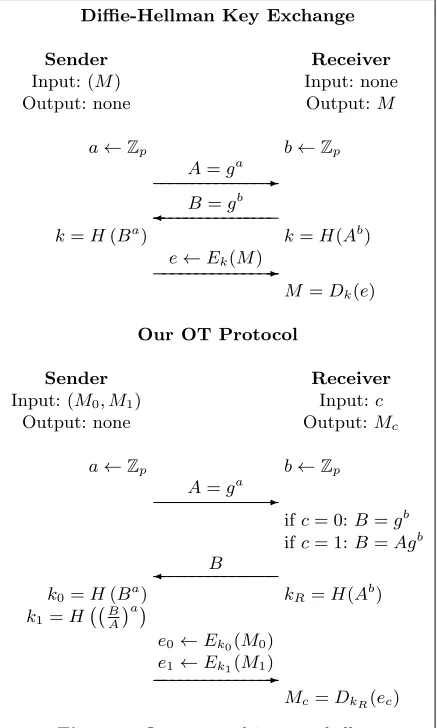
Diffie-Hellman Key ExchangeSender Receiver
Input: (M) Input: none
Output: none Output:M
a←Zp b←Zp
A=ga
B=gb
k=H(Ba) k=H(Ab)
e←Ek(M)
-M =Dk(e)
Our OT Protocol
Sender Receiver
Input: (M0, M1) Input:c
Output: none Output:Mc
a←Zp b←Zp
A=ga
-ifc= 0:B=gb
ifc= 1:B=Agb
B
k0=H(Ba) kR=H(Ab)
k1=H BA
a
e0←Ek0(M0)
e1←Ek1(M1)
-Mc=DkR(ec)
Figure 1.Our protocol in a nutshell Oblivious Transfer (OT) is a cryptographic primitive
de-fined as follows: in its simplest flavour, 1-out-of-2 OT, a sender has two input messages M0 and M1 and a
re-ceiver has a choice bit c. At the end of the protocol the receiver is supposed to learn the messageMcand nothing
else, while the sender is supposed to learn nothing. Per-haps surprisingly, this extremely simple primitive is suf-ficient to implement any cryptographic task [Kil88]. OT can also be used to implement most advanced crypto-graphic tasks, such as secure two- and multi-party com-putation (e.g., the millionaire’s problem) in an efficient way [NNOB12, BLN+15].
Given the importance of OT, and the fact that most OT applications require a very large number of OTs, it is crucial to construct OT protocols which are at the same time efficient and secure against realistic adversaries.
A Novel OT Protocol.In this paper we present a novel and extremelysimple,efficient and secure OT protocol. The protocol is a simple tweak of the celebrated Diffie-Hellman (DH) key exchange protocol. Given a group G and a generator g, the DH protocol allows two players Alice and Bob to agree on a key as follows: Alice samples a randoma, computesA=ga and sendsAto Bob.
Sym-metrically Bob samples a random b, computes B = gb
and sends B to Alice. Now both parties can compute gab = Ab = Ba from which they can derive a key k.
The key observation is now that Alice can also derive a different key from the value (B/A)a =gab−a2, and that
We can now turn this into an OT protocol by letting Alice play the role of the sender and Bob the role of the receiver (with choice bitc) as shown in Figure 1. The first message (from Alice to Bob) is left unchanged (and can be reused over multiple instances of the protocol) but now Bob computes B as a function of his choice bit c: if c = 0 Bob computes B = gb and if c = 1 Bob computes B = Agb. At this point Alice
derives two keysk0, k1 from (B)a and (B/A)a respectively. It is easy to check that Bob can derive the key
kccorresponding to his choice bit fromAb, but cannot compute the other one. This can be seen as arandom
OT i.e., an OT where the sender has no input but instead receives two random messages from the protocol, which can be used later to encrypt his inputs, thus achieving the OT functionality.
A Secure and Efficient Implementation. We report on an efficient and secure implementation of the 1-out-of-2 random OT protocol: Our choice for the group is a twisted Edwards curve that has been used by Bernstein, Duif, Lange, Schwabe and Yang for building the Ed25519 signature scheme [BDL+11]. The security of the curve comes from the fact that it is birationally equivalent to Bernstein’s Montgomery curve Curve25519 [Ber06] where ECDLP is believed to be hard: Bernstein and Lange’s SafeCurves website [BL14] reports cost of 2125.8 for solving ECDLP on Curve25519 using the rho method. The speed comes from the
complete formulas for twisted Edwards curves proposed by Hisil, Wong, Carter, and Dawson in [HWCD08]. We first modify the code in [BDL+11] and build a fast implementation for a single OT. Later we build
a vectorized implementation that runs OTs in batches. A comparison with the state of the art shows that our vectorized implementation is at least an order of magnitude faster than previous work (we compare in particular with the implementation reported by Asharov, Lindell, Schneider and Zohner in [ALSZ13]) on recent Intel microarchitectures. Furthermore, we take great care to make sure that our implementation is secure against both passive attacks (our software isimmune to timing attacks, since the implementation is
constant-time) and active attacks (by designing an appropriate encoding of group elements, which can be efficiently verified and computed on). Our code can be downloaded fromhttp://orlandi.dk/simpleOT.
Organization. The rest of the paper is organized as follows: in Section 1 we discuss related work; in Section 2 we formally describe and analyse our protocol; Section 3 describes the chosen representation of group elements; Section 4 describes the low level building blocks of the group operations; and Section 5 reports the timings of our implementation.
Related Work. OT owes its name to Rabin [Rab81] (a similar concept was introduced earlier by Wies-ner [Wie83] under the name of “conjugate coding”). There are different flavours of OT, and in this paper we focus on the most common and useful flavour, namely n1
-OT, which was first introduced in [EGL85]. Many efficient protocols for OT have been proposed over the years. Some of the protocols which are most similar to ours are those of Bellare-Micali [BM89] and Naor-Pinkas [NP01]. More recent OT protocols such as [HL10, DNO08, PVW08] focus on achieving a strong level of security in concurrent settings1 without re-lying on the random oracle model. Unfortunately this makes these protocols more cumbersome for practical applications: even the most efficient of these protocols i.e., the protocol of Peikert, Vaikuntanathan, and Waters [PVW08] requires 11 exponentiations for a single 21
-OT and a common random string (which must be generated by some trusted source of randomness at the beginning of the protocol).
OT Extension. While OT provably requires “public-key” type of assumptions [IR89] (such as factoring, discrete log, etc.), OT can be “extended” [Bea96] in the sense that it is enough to generate few “seed” OTs based on public-key cryptography which can then be extended to any number of OTs using symmetric-key primitives only (PRG, hash functions, etc.). This can be seen as the OT equivalent of hybrid encryption
(where one encrypts a large amount of data using symmetric-key cryptography, and then encapsulates the symmetric-key using a public-key cryptosystem). OT extension can be performed very efficiently both against passive [IKNP03,ALSZ13] and active [Nie07,NNOB12,Lar14,ALSZ15,KOS15] adversaries. Still, to bootstrap OT extension we need a secure and efficient OT protocol for the seed OTs (as much as we need secure and efficient public-key encryption schemes to bootstrap hybrid encryption): The OT extension of [ALSZ15] reports that it takes time (7·105+ 1.3m)µsto perform mOTs, where the fixed term comes from running
190 base OTs. Using our protocol as the base OT in [ALSZ15] would reduce the initial cost to approximately
1
190·114 ≈ 2·104µs [Sch15], which leads to a significant overall improvement (e.g., a factor 10 for up to 4·104 OTs and a factor 2 for up to 5·105 OTs).
1.1 Incorrect Security Claim in Proceeding Version
The proceeding version of this work [CO15] claims that our protocol achieves UC security. The claim is incorrect, and has therefore been removed from this version.
Li and Micciancio [LM18] showed that the protocol cannot be simulated in the equational framework, due to subtle timing attacks. Gen¸c, Iovino and Rial [GIR17] pointed out a problem with the proof of security, noticing that the protocol cannot be proven secure under the CDH assumption.2This particular problem was
later fixed by Hauck and Loss using the GapDH assumption [HL17], who also proposed a different protocol based on the CDH assumption only.
It was later pointed out by several authors (Byali, Patra, Ravi and Sarkar [BPRS17], Doerner, Kondi, Lee and shelat [DKLs18]), that the extraction strategy in the case of a corrupt receiver in the original proof of security is incompatible with composable security. In a nutshell, the issue is that a corrupt sender can “attack” the protocol by delaying decryption. Thus, the simulator cannot extract the input of the receiver before the protocol is over (and cannot use said inputs to simulate later protocol messages e.g., when combining our OT with garbled circuits). It appears that this problem can be circumvented if the next protocol message is from the receiver to the sender, and this message is a “proof of timely decryption” in the sense that the sender will check this “proof” and only accept if indeed the the receiver has performed the necessary decryption queries. This technique has been employed by Barreto, David, Dowsley, Morozov and Nascimento in [BDD+17], where OT protocols in the random oracle from different assumptions are presented
(their protocol contains an ad-hoc “proof of timely decryption”) and in [DKLs18] (where our OT is combined with an OT extension protocol, which informally works as “proof of timely decryption”). See [CJS14] for a more thorough discussion of the issues arising in using random oracles in UC-proof of security, and for an OT protocol that can be proven secure in the “global” random oracle model.
2
The Protocol
Notation. If S is a set s ← S is a random element sampled from S. We work over an additive group (G, B, p,+) of prime order p(with log(p)> κ) generated by B (the base point), and we use the additive notation for the group since we later implement our protocol using elliptic curves. Given the representation of some group elementP we assume it is possible to efficiently verify ifP∈G. We use [n] as a shortcut for {0,1, . . . , n−1}.
Building Blocks.We use a hash-functionH : (G×G)×G→ {0,1}κas a key-derivation function to extract aκbit key from a group element, and the first two inputs are used to seed the function.3 We modelH as a random oracle when arguing about the security of our protocol.
Input/Outputs.We want to implementm n1
-OT’s for`-bit messages withκ-bit security between a sender S and a receiver R. The receiver R has a vector of indices (c1, . . . , cm) ∈ [n]m, and the sender S has m
vectors of message{(Mi
0, . . . , Mni−1)}i∈[m] for alli, j:M
j
i ∈ {0,1}`. At the end of the protocol the receiver
Routputs a vector of`-bit strings (z1, . . . , zn), such that for alli∈[m],zi=Mi ci.
2.1 Random OT
We split the presentation in two parts: first, we describe and analyze a protocol for random OT where the sender outputsnrandom keys and the receiver only learns one of them; then, we describe how to combine
2
See alsohttps://eprint.iacr.org/forum/read.php?18,962.
this protocol with an appropriate encryption scheme to complete the OT. We are now ready to describe our novelrandom OT protocol:
Setup: (only once, independent ofm):
1. S samplesy←Zp and computesS=yB andT =yS;
2. S sendsS toR, who aborts ifS 6∈G; Choose: (in parallel for alli∈[m])
1. R(with inputci∈[n]) samplesxi←
Zp and computes
Ri=ciS+xiB
2. RsendsRi toS, who aborts ifRi6∈
G; Key Derivation: (in parallel for alli∈[m])
1. For allj ∈[n],S computes
kij=H(S,Ri)(yRi−jT)
2. Rcomputes
kRi =H(S,Ri)(xiS)
Basic Properties.The key ki
j is computed by hashing xiyB+ (ci−j)T and therefore at the end of the
protocolki
R=kici if both parties are honest. It is also easy to see that:
Lemma 1. No (computationally unbounded)S∗ on inputRi can guess ci with probability greater than 1/n.
Proof. SinceB generatesG, fixed anyP =x0B the probability thatRi=P whenci =j is the probability
thatxi= (x
0−ciy), therefore∀S, P ∈G, j∈[n], Pr[Ri=P|ci=j] = 1/p, which is independent ofj.
Lemma 2. No (computationally bounded)R∗ can output any two keyski j0 andk
i
j1 with j06=j1∈[n]if the computational Diffie-Hellman problem is hard inG.
Proof. In the random oracle model R∗ can only (except with negligible probability) compute ki j0, k
i j1 by
querying the oracle on points of the form Ui
0 = (yRi−j0T) and U1i = (yRi−j1T). Assume for the sake
of contradiction that there exist a PPT R∗ who outputs (R, j
0, j1, U0, U1) ← R∗(B, S) such that (j1−
j0)−1(U0−U1) = T = logB(S)2B with probability at least . We show an algorithm A which on input
(B, X=xB, Y =yB) outputsZ=xyBwith probability greater than3. Run (RX, UX
0 , U1X)← R∗(B, X),
(RY, UY
0 , U1Y)← R∗(B, Y), then run (R+, U + 0, U
+
1 )← R∗(B, X+Y) and finally output
Z= (p+ 1)
2 (U
+ 0 +U
+ 1)−(U
X
0 +U
X
1 )−(U
Y
0 +U
Y
1)
Now Z = xyB with probability at least 3, since when all three executions of R∗ are successful, then
UX
0 +U1X = (x2)B,U0Y +U1Y = (y2)B and U + 0, U
+
1 = (x+y)2B and thereforeZ =
p+1
2 2xyB=xyB. ut
Note that the above proof loses a cubic factor. A better proof for this lemma, which only loses a quadratic factor, can be found in [BCP04].
From Random OT to standard OT.We start by adding a transfer phase to the protocol, where the sender sends the encryption of his messages to the receiver:
Transfer: (in parallel for alli∈[m]) 1. For allj ∈[n],S computesei
j←E(kij, Mji)
2. S sends (ei
0, . . . , ein−1) toR;
Retrieve: (in parallel for alli∈[m])
The protocol uses a symmetric encryption scheme (E, D). We callK,M,C the key space, message space and ciphertext space respectively andκthe security parameter. We allow the decryption algorithm to output a special symbol⊥to indicate an invalid ciphertext. We want to use an encryption scheme that satisfies the following properties:
Definition 1. We say a symmetric encryption scheme (E, D)is non-committing if there exist PPT algo-rithmsS1,S2 such that∀M ∈ M(e0, k0)and(e, k)are computationally indistinguishable wheree0 ← S1(1κ),
k0 ← S2(e0, M),k← K ande←E(k, M)(S1,S2 are allowed to share a state).
The definition says that it is possible for a simulator to come up with a ciphertext e which can later be “explained” as an encryption of any message, in such a way that the joint distribution of the ciphertext and the key in this simulated experiment is indistinguishable from the normal use of the encryption scheme, where a key is first sampled and then an encryption ofM is generated.
Definition 2. Let S be a set of random keys from K and VS,e ⊆ S the subset of valid keys for a given
ciphertextei.e., the keys inS such thatD(k, e)6=⊥.
We say (E, D) satisfies robustness if for all ciphertextse← A(1κ, S)adversarially generated by a PPT
A,|VS,e| ≤1 except with negligible probability.
The definition says that it should be hard for an adversary to generate a ciphertext which can be decrypted to more than one valid ciphertext using any polynomial number of randomly generated keys (even for adversaries who see those keys before generating the ciphertext).
Traditionally ciphertext integrity is defined for an adversary who has access to an encryption oracle, but the above definition suffices for our goal.
A concrete example. We give a concrete example of a very simple scheme which satisfies Definition 1 and 2: let M={0,1}` andK =C ={0,1}`+κ. The encryption algorithmE(k, m) parses k as (α, β) and
e= (m⊕α, β). The decryption algorithmD(k, e) parsesk= (α, β) ande= (e1, e2) and outputs⊥ife26=β
or outputsm=e1⊕αotherwise. It can be shown that:
Lemma 3. The scheme(E, D) defined above satisfies Definition 1 and 2.
Proof. We show that the scheme satisfies Definition 1 and 2 in a strong, information theoretic sense. For Definition 1:S1outputs a randome← {0,1}`+κ;S2(e, M) parsese= (e1, e2) and outputsk= (e1⊕M, e2).
The simulated distribution is trivially identical to the real one. For Definition 2: given any ciphertexte= (e1, e2),D((α, β), e)6=⊥implies thatβ =e2. Thus even an unbounded adversary can break robustness of
the scheme only if there are two keys ki, kj ∈ S such that βi = βj which only happens with probability
negligible inκ.
Non-Malleability in Practice.When instantiating our protocol we must replace the random oracle with a hash function. To approximate the model, one can “localize” the random oracle by prepending the parties id’s and the session id to the hash function. We argue here that our choice of using the transcript of the protocol (S, Ri) as salt for the hash function helps in making sure that the oracle is local to the protocol,
and helps against malleability attacks in cases where the parties’ and sessionid’s are unavailable. Consider the following man-in-the middle attack, where an adversaryA plays two copies of the n1
-OT, one as the sender with Rand one as the receiver with S. Here is how the attack works: 1) A receivesS from S and forwards it toR; 2) Then the adversary receivesRfromRand sendsR0=S+RtoS; 3) FinallyAreceives the{ei}i∈[n] fromS and setse0i=e(i−1 modn)toR. It is easy to see that if the same hash function is used to
instantiate the random oracle in the two protocols (and ifc6= 0), then the honest receiver outputsz=Mc+1,
which is clearly a breach of security (i.e., this attack could not be run if the protocols are replaced with OT functionalities).
The previous attack can be seen as a malleability attack on the choice bit. An adversary can also try a malleability attack on the sender messages by forwarding (S0, R0) = (S, R) but then manipulating theei’s
authenticated encryption for (E, D) (which also satisfies robustness as in Definition 2). Now an adversary who changes both ciphertext is equivalent to an ideal adversary using input (⊥,⊥), while an adversary who only changes one ciphertext, sayec, is equivalent to an adversary which uses input bit 1−con the left and
inputs (m1−c,⊥) on the right. This attack could also be run in an idealized world where parties have access
to an OT functionality. Unfortunately for n1
-OT (withn >2) this is not the case, since the protocol allows to “copy” any subset of messages, which would not be possible in an idealized setting.
3
The Random OT Protocol in Practice
This section describes how the random OT protocol can be realized in practice. In particular, this section focuses on describing how group elements are represented as bitstrings, i.e., the encodings. In the abstract description of the random OT protocol, the sender and the receiver transmit and compute on “group ele-ments”, but clearly any implementation of the protocol transmits and computes on bitstrings. We describe how the encodings are designed to achieve efficiency (both for communication and computation) and security (particularly against a malicious party who might try to send malformed encodings).
The Group.The groupGwe choose for the protocol is a subset of ¯G; ¯Gis defined by the set of points on the twisted Edwards curve
{(x, y)∈F2255−19×F2255−19:−x2+y2= 1 +dx2y2}
and the twisted Edwards addition law
(x1, y1) + (x2, y2) =
x
1y2+x2y1
1 +dx1x2y1y2
, y1y2+x1x2 1−dx1x2y1y2
introduced by Bernstein, Birkner, Joye, Lange, and Peters in [BBJ+08]. The constant dand the generator
B can be found in [BDL+11]. The two groups ¯
GandGare isomorphic respectively toZp×Z8andZp with
p= 2252+ 27742317777372353535851937790883648493.
Encoding of Group Element. An encoding E for a group G0 is a way of representing group elements
as fixed-length bitstrings. We writeE(P) for a bitstring which representsP ∈ G0. Note that there can be
multiple bitstrings that represent P; if there is only one bitstring for each group element, E is said to be
deterministic (E is said to be non-deterministic otherwise4). Also note that some bitstrings (of the fixed length) might not represent any group element; we writeE(G1) for the set of bitstrings which represent some
element inG1⊆G0.E is said to beverifiable if there exists an efficient algorithm that, given a bitstring as
input, outputs whether it is inE(G0) or not.
The Encoding EX for Group Operations. The non-deterministic encoding EX for ¯G, which is based on the extended coordinates in [HWCD08], represents each point using the tuple (X : Y : Z : T) with XY =ZT, representingx=X/Z andy=Y /Z. We useEX whenever we need to perform group operations
since givenEX(P),EX(Q) whereP, Q∈G¯, it is efficient to computeEX(P+P),EX(P+Q), andEX(P−Q).
In particular, given an integer scalarr∈Zp it is efficient to computeEX(rB), and givenr andEX(P) it is
efficient to computeEX(rP).
The Encoding E0 and Related Encodings.The deterministic encodingE0 for ¯Grepresents each group element as a 256-bit bitstring: the natural 255-bit encoding ofy followed by a sign bit which depends only onx. The way to recover the full valuexis described in [BDL+11, Section 5], and group membership can be verified efficiently by checking whetherx2(y2−1) =dy2+ 1 holds; thereforeE0 is verifiable. See [BDL+11]
for more details ofE0.
For the following discussions, we define deterministic encodings E1andE2 forGas
E1(P) =E0(8P),E2(P) =E0(64P), P ∈G.
4
We also define non-deterministic encodingsE(0) andE(1) for
Gas
E(0)(P) =E
0(P+t),E(1)(P) =E0(8P+t0), P ∈G,
wheret, t0 can be any 8-torsion point. Note that each element inGhas exactly 8 representations underE(0)
andE(1).
Point Compression/Decompression. It is efficient to convert from EX(P) to E0(P) and back; since
E0 represents points as much shorter bitstrings, these operations are called point compression and point decompression, respectively. Roughly speaking, point compression outputsy=Y /Z along with the sign bit ofx=X/Z, and point decompression first recovers xand then outputsX =x, Y =y, Z= 1, T =xy. We always check for group membership during point decompression.
We useE0 for data transmission: the parties send bitstrings inE0( ¯G) and expect to receive bitstrings in E0( ¯G). This means a computed point encoded byEX has to be compressed before it is sent, and a received
bitstring has to be decompressed for subsequent group operations. Sending compressed points helps to reduce the communication complexity: the parties only need to transfer 32 + 32mbytes in total.
Secure Data Transmission. At the beginning of the protocolS computes and sendsE0(S). In the ideal
case,Rshould receive a bitstring in E0(G) which he interprets asE0(S). However, an attacker (a corrupted
S∗ or a man-in-the-middle) can sendR1) a bitstring that is not inE
0( ¯G) or 2) a bitstring inE0( ¯G\G). In the first case, Rdetects that the received bitstring is not valid during point decompression and ignores it. In the second case,Rcan check group membership by computing thepth multiple of the point, but a more efficient way is to use a new encodingE0 such that each bitstrings inE0( ¯G) represents a point inGunderE0. ThereforeRconsiders the received bitstring as E(0)(S) =E
0(S+t), wheretcan be any 8-torsion point.
The encoding E(0) (along with point decompression) makes sure thatRreceives bitstrings representing
elements inG. However, an attacker can deriveci by exploiting the extra information given by a nonzerot: a naiveRwould compute and sendE0(ci(S+t) +xiB) =E0(cit+Ri); now by testing whether the result is
E0(G) the attacker learns whetherci = 0.
To get rid of the 8-torsion point, Rcan multiply received point by 8·(8−1modp), but a more efficient
way is to just multiply by 8 and then operate onEX(8S) andEX(8xiB) to obtain and sendE1(Ri) =E0(8Ri),
i.e, the encoding switches toE1forRi. After thisS works similarly asR: to ensure that the received bitstring
represents an element inG,S interprets the bitstring asE(1)(Ri) =E
0(8Ri+t); to get rid of the 8-torsion
point S also multiplies the received point by 8, and then S operates onEX(64Ri) andEX(64T) to obtain
EX(64(yRi−jT)).
Key Derivation.The protocol computesHS,Ri(P) whereP can bexiS, yRi,oryRi−jT forj∈[n]. This is implemented by hashingE1(S)k E2(Ri)k E2(P) with Keccak [BDPVA09] with 256-bit output. The choice of
encodings is natural:S computesEX(S), andRcomputesEX(8S); since multiplication by 8 is much cheaper
than multiplication by (8−1modp), we useE
1(S) =E0(8S) for hashing. For similar reasons we useE2forRi
andP.
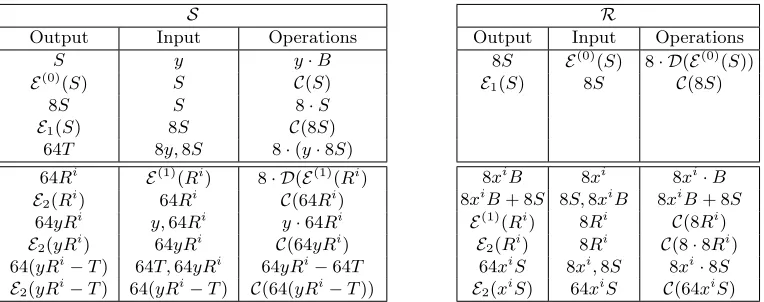
Actual Operations.For completeness, we present in Table 1 a full overview of operations performed during the protocol for the case of 1 out of 2 OT (i.e.,n= 2).
4
Field Arithmetic
This section describes our implementation strategy for arithmetic operations in F2255−19, which serve as
low-level building blocks for operations on the curve. Field operations are decomposed into double-precision floating-point operations using our strategy. A straightforward way for implementation is then using double-precision floating-point instructions. However, a better way to utilize the 64×64→128-bit serial multiplier is to decompose field operations into integer instructions as [BDL+11] does. The real reason we decide to
S
Output Input Operations
S y y·B
E(0)(S) S C(S)
8S S 8·S
E1(S) 8S C(8S) 64T 8y,8S 8·(y·8S) 64Ri E(1)(Ri) 8· D(E(1)(Ri)
E2(Ri) 64Ri C(64Ri) 64yRi y,64Ri y·64Ri E2(yRi) 64yRi C(64yRi)
64(yRi−T) 64T,64yRi 64yRi−64T E2(yRi−T) 64(yRi−T) C(64(yRi−T))
R
Output Input Operations 8S E(0)
(S) 8· D(E(0) (S)) E1(S) 8S C(8S)
8xiB 8xi 8xi·B 8xiB+ 8S 8S,8xiB 8xiB+ 8S
E(1)
(Ri) 8Ri C(8Ri)
E2(Ri) 8Ri C(8·8Ri) 64xiS 8xi,8S 8xi·8S E2(xiS) 64xiS C(64xiS)
Table 1. How the parties compute encodings of group elements: each row shows that the “Output” is computed given “Input” using the operations “Operations”. The input might come from the output of a previous row, a received string (e.g.,E(1)(Ri)), or a random scalar that the party generates (e.g., 8xi). The upper half of the table are the
operations that does not depend oni, which means the operations are performed only once for the whole protocol. EX is suppressed: group elements written without encoding are actually encoded by EX.C and D stand for point
compression and point decompression respectively. Computation of therth multiple of P is denoted as “r·P”. In particular, 8·P can be carried out with only 3 point doublings.
which is called vectorization, makes our vectorized implementation achieve much higher throughtput than our non-vectorized implementation based on [BDL+11].
Representation of Field Elements.Each field elementx∈F2255−19is represented as 12limbs(x0, x1, . . . , x11)
such thatx=P
xiandxi/2d21.25ie ∈Z. Eachxi is stored as a double-precision floating-point number. Field
operations are then carried out by limb operations such as floating-point additions and multiplications.
When a field element gets initialized (e.g., when obtained from a table lookup), each xi uses no more
than 21 bits of the 53-bit mantissa. However, after a series of limb operations, the number of bits xi takes
can grow. It is thus necessary to reduce the number of bits (in the mantissa) with carries before any precision is lost; see below for more discussions.
Field Arithmetic.Additions and subtractions of field elements are implemented in a straightforward way: simply adding/subtracting the corresponding limbs. This does increase the number of bits in the mantissa, but in our application it suffices to reduce bits only at the end of the multiplication function.
A field multiplication is divided into two steps. The first step is a schoolbook multiplication on the 2·12 input limbs, with reduction modulo 2255−19 to bring the result back to 12 limbs. The schoolbook multipli-cation takes 132 floating-point additions, 144 floating-point multiplimultipli-cations, and a few more multiplimultipli-cations by constants to handle the reduction.
Let (c0, c1, . . . , c11) be the result after schoolbook multiplication. The second step is to perform carries to
reduce number of bits inci. Carry fromci toci+1(indices work modulo 12), which we denote as ci→ci+1,
is performed with 4 floating-point operations:c←ci+αi;c←c−αi;ci←ci−c;ci+1←ci+1+c.The idea
is to use αi = 3·2ki where ki is big enough so that the less significant part of ci are discarded in ci+αi,
forcing c to contain only the more significant part ofci. Fori= 11, one extra multiplication is required to
scalecby 19·2−255before it is added toc0.
A straightforward way to reduce number of bits in all limbs is to use the carry chainc0→c1→c2→ · · · →
c11 → c0 → c1. The problem with the straightforward carry chain is that there is not enough instruction
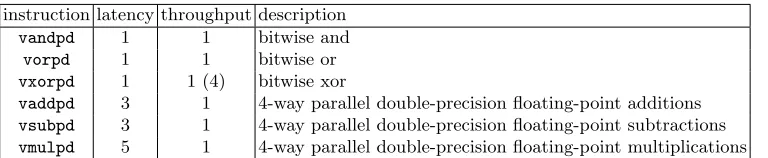
instruction latency throughput description vandpd 1 1 bitwise and vorpd 1 1 bitwise or vxorpd 1 1 (4) bitwise xor
vaddpd 3 1 4-way parallel double-precision floating-point additions vsubpd 3 1 4-way parallel double-precision floating-point subtractions vmulpd 5 1 4-way parallel double-precision floating-point multiplications
Table 2.256-bit vector instructions used in our implementation. Note thatvxorpdhas throughput of 4 when it has only one source operand.
the following 3 carry chains:
c0→c1→c2→c3→c4→c5,
c4→c5→c6→c7→c8→c9,
c8→c9→c10→c11→c0→c1.
In total the multiplication function takes 192 floating-point additions/subtractions and 156 floating-point multiplications.
When the input operands are the same, many limb products will repeat in the schoolbook multiplication; a field squaring is therefore cheaper than a field multiplication. In total the squaring function takes 126 floating-point additions/subtractions and 101 floating-point multiplications.
Field inversion is implemented as a fix sequence of field squarings and multiplications.
Vectorization.We decompose field operations into 64-bit floating-point and logical operations. The Intel Sandy Bridge and Ivy Bridge microarchitectures, as well as many recent microarchitectures, offer instructions that operate on 256-bit registers. Some of these instructions treat the registers as vectors of 4 double-precision floating-point numbers and perform 4 floating-point operations in parallel; there are also 256-bit logical instructions that can be viewed as 4 64-bit logical instructions. We thus use these instructions to run 4 scalar multiplications in parallel. Table 2 shows the instructions we use, along with their latencies and throughputs on the Sandy Bridge and Ivy Bridge given in Fog’s well-known survey [Fog14].
5
Implementation Results
This section compares the speed of our implementation of 21
-OT (i.e., n = 2) with other similar imple-mentations. We stress that our software is a constant-time one: timing attacks are avoided using the same high-level strategy as [BDL+11].
To show that our speeds for curve operations are competitive, we modify the software to support the function of Diffie-Hellman key exchange and compare the results with existing Curve25519 implementations (our implementation performs scalar multiplications on the twisted Edwards curve, so it is not the same as Curve25519). The experiments are carried out on two machines on the eBACS site for publicly verifiable benchmarks [BL15]:h6sandy (Sandy Bridge) and h9ivy (Ivy Bridge). Since our protocol can serve as the base OTs for an OT extension protocol, we also compare our speed with a base OT implementation presented in [ALSZ13], which is included in the Scapi multi-party computation library; the experiments are made on an Intel Core i7-3537U processor (Ivy Bridge) where each party runs on one core. Note that all experiments are performed with Turbo Boost disabled.
h6sandy h9ivy [MF15] Average cycles to compute a public key 61828 57612 [BDL+11] Average cycles to compute a shared secret 194036 182708 this work Average cycles to generate a public key 61458 60853 Average cycles to compute a shared secret 182169 180343 Table 3.DH speeds of our work and existing Curve25519 implementations.
m 4 8 16 32 64 128 256 512 1024
this work Running time ofS 548 381 321 279 265 257 246 237 228 Running time ofR 472 366 279 229 205 200 193 184 177 [ALSZ13] Running time of S 17976 10235 6132 4358 3348 2877 2650 2528 2473 Running time ofR 16968 9261 5188 3415 3382 2909 2656 2541 2462
Table 4.Timings for per OT in kilocycles. Multiplying the number of kilocycles by 0.5 one can obtain the running time (inµs) on our test architecture.
in parallel, the numbers in the table are the time for generating 4 public keys or 4 shared secrets divided by 4. In other words, our implementation is optimized forthrougput instead oflatency.
Comparing with Scapi. Table 4 shows the timings of our implementation for the random OT protocol, along with the timings of a base-OT implementation presented in [ALSZ13]. The paper presents several base-OT implementations; the one we compare with is Miracl-based with “long-term security” using random oracle (cf. [ALSZ13, Section 6.1]). The implementation uses the NIST K-283 curve and SHA-1 for hashing, and it is not a constant-time implementation. It turns out that our work is an order of magnitude faster for m∈ {4,8, . . . ,1024}.
Memory consumption.Our code for public-key generation uses a 284-KB table. For shared-secret com-putation the table size is 12 KB. For OTs,S uses a 12-KB table, whileRisallowed to use a table of size up to 1344 KB which depends on the parameters given. The current code provides 4 copies of the precomputed points, one for each of the 4 scalar multiplcations, so it is possible to reduce the table sizes by a factor of 4 by broadcasting the precomputed points. Another reason that we have large tables is because of the representation for field elements: each limbs takes 8 bytes, so each field element already takes 12·8 = 96 bytes. The window sizes we use are the same as [BDL+11]. See [BDL+11] for issues related to table sizes.
Acknowledgments.We are very grateful to: Daniel J. Bernstein and Tanja Lange for invaluable comments and suggestions regarding elliptic curve cryptography and for editorial feedback on earlier versions of this paper; Yehuda Lindell for useful comments on our proof of security; Peter Schwabe for various helps on im-plementation, including providing low-level code for field arithmetic; the anonymous LATINCRYPT reviewer and in particular Gregory Neven.
References
ALSZ13. Gilad Asharov, Yehuda Lindell, Thomas Schneider, and Michael Zohner. More efficient oblivious transfer and extensions for faster secure computation. InProceedings of the 2013 ACM SIGSAC conference on Computer communications security, pages 535–548. ACM, 2013.
ALSZ15. Gilad Asharov, Yehuda Lindell, Thomas Schneider, and Michael Zohner. More efficient oblivious transfer extensions with security for malicious adversaries. Cryptology ePrint Archive, Report 2015/061, 2015. http://eprint.iacr.org/.
BBJ+08. Daniel J Bernstein, Peter Birkner, Marc Joye, Tanja Lange, and Christiane Peters. Twisted edwards curves. InProgress in Cryptology–AFRICACRYPT 2008, pages 389–405. Springer, 2008.
BCP04. Emmanuel Bresson, Olivier Chevassut, and David Pointcheval. New security results on encrypted key exchange. InPublic Key Cryptography - PKC 2004, 7th International Workshop on Theory and Practice in Public Key Cryptography, Singapore, March 1-4, 2004, pages 145–158, 2004.
BDD+17. Paulo S. L. M. Barreto, Bernardo David, Rafael Dowsley, Kirill Morozov, and Anderson C. A. Nascimento. A framework for efficient adaptively secure composable oblivious transfer in the rom. Cryptology ePrint Archive, Report 2017/993, 2017. https://eprint.iacr.org/2017/993, Version 21 December 2017. BDL+11. Daniel J. Bernstein, Niels Duif, Tanja Lange, Peter Schwabe, and Bo-Yin Yang. High-speed high-security
signatures. In Cryptographic Hardware and Embedded Systems – CHES 2011, volume 6917 of Lecture Notes in Computer Science, pages 124–142. Springer-Verlag Berlin Heidelberg, 2011.
BDPVA09. Guido Bertoni, Joan Daemen, Micha¨el Peeters, and Gilles Van Assche. Keccak sponge function family main document. Submission to NIST (Round 2), 3:30, 2009.
Bea96. Donald Beaver. Correlated pseudorandomness and the complexity of private computations. InProceedings of the Twenty-Eighth Annual ACM Symposium on the Theory of Computing, Philadelphia, Pennsylvania, USA, May 22-24, 1996, pages 479–488, 1996.
Ber06. Daniel J Bernstein. Curve25519: new Diffie-Hellman speed records. InPublic Key Cryptography-PKC 2006, pages 207–228. Springer, 2006.
BL14. Daniel J. Bernstein and Tanja Lange. Safecurves: choosing safe curves for elliptic-curve cryptography, accessed 1 December 2014. http://safecurves.cr.yp.to.
BL15. Daniel J Bernstein and Tanja Lange. eBACS: Ecrypt benchmarking of cryptographic systems, accessed 16 March 2015. http://bench.cr.yp.to.
BLN+15. Sai Sheshank Burra, Enrique Larraia, Jesper Buus Nielsen, Peter Sebastian Nordholt, Claudio Orlandi, Emmanuela Orsini, Peter Scholl, and Nigel P. Smart. High performance multi-party computation for binary circuits based on oblivious transfer. Cryptology ePrint Archive, Report 2015/472, 2015. http: //eprint.iacr.org/.
BM89. Mihir Bellare and Silvio Micali. Non-interactive oblivious transfer and spplications. In Advances in Cryptology - CRYPTO ’89, 9th Annual International Cryptology Conference, Santa Barbara, California, USA, August 20-24, 1989, Proceedings, pages 547–557, 1989.
BPRS17. Megha Byali, Arpita Patra, Divya Ravi, and Pratik Sarkar. Fast and universally-composable oblivious transfer and commitment scheme with adaptive security. Cryptology ePrint Archive, Report 2017/1165, 2017. https://eprint.iacr.org/2017/1165, Version 21 Mar 2018.
Can01. Ran Canetti. Universally composable security: A new paradigm for cryptographic protocols. In 42nd Annual Symposium on Foundations of Computer Science, FOCS 2001, 14-17 October 2001, Las Vegas, Nevada, USA, pages 136–145, 2001.
CF01. Ran Canetti and Marc Fischlin. Universally composable commitments.IACR Cryptology ePrint Archive, 2001:55, 2001.
CJS14. Ran Canetti, Abhishek Jain, and Alessandra Scafuro. Practical UC security with a global random oracle. InProceedings of the 2014 ACM SIGSAC Conference on Computer and Communications Security, Scottsdale, AZ, USA, November 3-7, 2014, pages 597–608, 2014.
CO15. Tung Chou and Claudio Orlandi. The simplest protocol for oblivious transfer. InProgress in Cryptology - LATINCRYPT 2015 - 4th International Conference on Cryptology and Information Security in Latin America, Guadalajara, Mexico, August 23-26, 2015, Proceedings, pages 40–58, 2015.
DKLs18. Jack Doerner, Yashvanth Kondi, Eysa Lee, and shelat abhi. Secure two-party threshold ecdsa from ecdsa assumptions. IEEE Security and Privacy Symposium, Cryptology ePrint Archive, Report 2018/499, 2018. https://eprint.iacr.org/2018/499, Version 23 May 2018.
EGL85. Shimon Even, Oded Goldreich, and Abraham Lempel. A randomized protocol for signing contracts. Commun. ACM, 28(6):637–647, 1985.
Fog14. Agner Fog. Instruction tables. 2014. http://www.agner.org/optimize/instruction_tables.pdf. GIR17. Ziya Alper Gen¸c, Vincenzo Iovino, and Alfredo Rial. ”the simplest protocol for oblivious transfer”
revisited. Cryptology ePrint Archive, Report 2017/370, 2017. https://eprint.iacr.org/2017/370, Version 24 May 2017.
HL10. Carmit Hazay and Yehuda Lindell.Efficient Secure Two-Party Protocols - Techniques and Constructions. Information Security and Cryptography. Springer, 2010.
HL17. Eduard Hauck and Julian Loss. Efficient and universally composable protocols for oblivious transfer from the cdh assumption. Cryptology ePrint Archive, Report 2017/1011, 2017. https://eprint.iacr.org/ 2017/1011, Version 24 October 2017.
HWCD08. Huseyin Hisil, Kenneth Koon-Ho Wong, Gary Carter, and Ed Dawson. Twisted Edwards curves revisited. InAdvances in Cryptology-ASIACRYPT 2008, pages 326–343. Springer, 2008.
IKNP03. Yuval Ishai, Joe Kilian, Kobbi Nissim, and Erez Petrank. Extending oblivious transfers efficiently. In Ad-vances in Cryptology - CRYPTO 2003, 23rd Annual International Cryptology Conference, Santa Barbara, California, USA, August 17-21, 2003, Proceedings, pages 145–161, 2003.
IR89. Russell Impagliazzo and Steven Rudich. Limits on the provable consequences of one-way permutations. InProceedings of the 21st Annual ACM Symposium on Theory of Computing, May 14-17, 1989, Seattle, Washigton, USA, pages 44–61, 1989.
Kil88. Joe Kilian. Founding cryptography on oblivious transfer. In Proceedings of the 20th Annual ACM Symposium on Theory of Computing, May 2-4, 1988, Chicago, Illinois, USA, pages 20–31, 1988. KOS15. Marcel Keller, Emmanuela Orsini, and Peter Scholl. Actively secure ot extension with optimal overhead.
CRYPTO, 2015.
Lar14. Enrique Larraia. Extending oblivious transfer efficiently, or - how to get active security with constant cryptographic overhead. IACR Cryptology ePrint Archive, 2014:692, 2014.
LM18. Baiyu Li and Daniele Micciancio. Equational security proofs of oblivious transfer protocols. InPublic-Key Cryptography - PKC 2018 - 21st IACR International Conference on Practice and Theory of Public-Key Cryptography, Rio de Janeiro, Brazil, March 25-29, 2018, Proceedings, Part I, pages 527–553, 2018. MF15. Andrew Moon “Floodyberry”. Implementations of a fast elliptic-curve digital signature algorithm,
ac-cessed 16 March 2015. https://github.com/floodyberry/ed25519-donna.
Nie07. Jesper Buus Nielsen. Extending oblivious transfers efficiently - how to get robustness almost for free. Cryptology ePrint Archive, Report 2007/215, 2007. http://eprint.iacr.org/.
NNOB12. Jesper Buus Nielsen, Peter Sebastian Nordholt, Claudio Orlandi, and Sai Sheshank Burra. A new ap-proach to practical active-secure two-party computation. InAdvances in Cryptology CRYPTO 2012 -32nd Annual Cryptology Conference, Santa Barbara, CA, USA, August 19-23, 2012. Proceedings, pages 681–700, 2012.
NP01. Moni Naor and Benny Pinkas. Efficient oblivious transfer protocols. InProceedings of the Twelfth Annual Symposium on Discrete Algorithms, January 7-9, 2001, Washington, DC, USA., pages 448–457, 2001. PVW08. Chris Peikert, Vinod Vaikuntanathan, and Brent Waters. A framework for efficient and composable
oblivious transfer. InAdvances in Cryptology - CRYPTO 2008, 28th Annual International Cryptology Conference, Santa Barbara, CA, USA, August 17-21, 2008. Proceedings, pages 554–571, 2008.
Rab81. Michael O. Rabin. How to exchange secrets with oblivious transfer. Technical Report TR-81, Aiken Computation Lab, Harvard University, 1981.
Sch15. Thomas Schneider. Personal communication, 2015.