Copyright © 2014 CTTS.IN, All right reserved 260
Control and Optimization of the Energy Produced by a Chain
of Wind Energy Conversion Controlled by a Double-fed
Asynchronous Generator
Abdelhadi EL MOUDDEN
Empowered Professor, The National School of Electricity and Mechanics (ENSEM), [email protected]
Aicha WAHABI
Assistant Professor, the superior school of technology (EST), [email protected]
Fatima Ezzahra BOUNIFLI
Doctoral Student, The National School of Electricity and Mechanics (ENSEM), [email protected]
Abdelhalim SANDALI
Empowered Professor, The National School of Electricity and Mechanics (ENSEM), [email protected]
Computing laboratory, systems and renewable energies (LISER) analysis team and control of electrical energy systems (ACSEE), the National School of Electricity and Mechanics (ENSEM), University Hassan II Aïn Chock, Casablanca, Morocco.
Nomenclature
: The area swept by the blades of the turbine [m²] : The density of the air ( = 1.225kg / m3 in atmospheric pressure)
: Wind speed [m/s] : Power coefficient
: The ratio of blade tip turbine speed and wind speed : The blade pitch angle
, : Torque and speed of the machine : Torque and speed of the turbine : Electromagnetic torque
, : Voltage and stator current along the axis d , : Stator and rotor flow along the axis d , : Voltage and stator current along the axis q
, : Stator and rotor flow along the axis q , : Rotor voltage and current along the axis d
, : Stator and rotor pulsation
, : Rotor voltage and current along the axis d : Rotation speed of the machine
, : A stator and rotor phase resistance , : Stator and rotor cyclic Inductance , : Inductance own stator and rotor
: Mutual inductance between two stator phases : Mutual inductance between two rotor phases : Magnetizing inductance.
: Number of pair’s pole : Friction coefficient
, : Stator active and reactive power
Abstract — The aim of this paper is to study the conversion of wind energy in its entirety in order to optimize power output and improve the quality of energy supplied; therefore, we can extract the maximum power point : MPTT. For this, we are interested in modeling and simulation of a wind turbine, of a multiplier, and of a double feed induction generator (DFIG) wound rotor controlled with an indirect control of power. The adopted technique algorithm is developed using Matlab/Simulink/Sim-Power-Systems. Simulation results are presented and analyzed at the end of article.
Keyword — Turbine, DFIG, MLI, Converters, Maximum power, MPTT, Modeling, Matlab / Simulink.
1. I
NTRODUCTIONCopyright © 2014 CTTS.IN, All right reserved 261
range of wind speeds, and gets the maximum possible power for each wind speed: MPPT. Its stator circuit is connected directly to the network. A second circuit is placed in the rotor, connected also to the network but via the power converters. Thus, DFIG offers several advantages: a very good energy efficiency, robustness and ease of operation and control, in addition to this, it allows an operation over a speed range of ± 30 % around the synchronous speed, ensuring a reduced dimensioning of the static converters.
The performance of production wind chain does not only depend on the asynchronous machine, but also to the manner in which the two parts of “back- to-back” converters are controlled. The power converter placed on the rotor is called "Rotor Side Converter" (RSC) and the second power converter is called "Grid Side Converter" (GSC).
The machine side power converter allows controlling the active power and reactive power produced by the system. Concerning the network side converter, it controls the DC bus voltage and power factor.
In this paper, we present a technique of indirect power control system, first, we’ll start by the modeling and the simulation the blocks of the wind turbine, of the multiplier and induction generator, then a technique of maximum power point tracking (MPPT) will be presented. We analyze the dynamic performance of the system by simulations in Matlab/Simulink/Sim-Power-Systems.
2. W
INDS
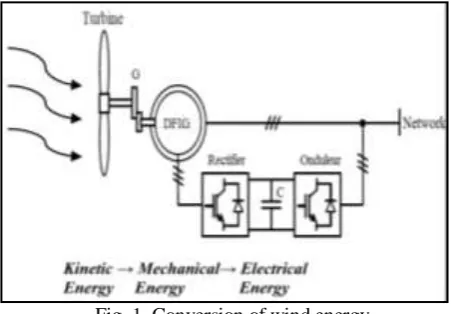
YSTEMThe wind system studded is composed by a turbine, a multiplier, DFIG, alternative-continuous converter, DC bus and a continuous-alternative converter placed between the rotor and the network [1].
Fig. 1. Conversion of wind energy
3. M
ODELING ANDS
IMULATION OFT
URBINEBy applying the Bernoulli theorem, we can determine the incident power (the theoretical power), due to the wind
(1) = The area swept by the blades of the turbine;
= The air density (ρ=1.225 kg/m3in an atmospheric pressure);
= wind speed [m/s].
In a turbine, the available power on the rotor turbine which we can extracted is less than the forward power :
(2)
= The power coefficient, it expresses the efficiency of the turbine and it depends on the ratio , this ratio represents the ratio of the speed in extremity of the turbine blade and the wind speed, and the orientation angle .
(3) The maximum power coefficient was determined by Albert Betz (1920) as follows :
(4) This coefficient depends on the constitution of the turbine. For a wind turbine of average power we have :
(5) We observe in the figures 2.a and 2.b, that out the Betz limit is verified: .
Fig. 2.a. Power coefficient
Copyright © 2014 CTTS.IN, All right reserved 262
is the torque on the slow axis of the turbine :
(6)
The total inertia is composed by the inertia of the turbine reported on the fast axis and the inertia of the generator :
(7)
The fundamental equation of dynamic is written :
(8)
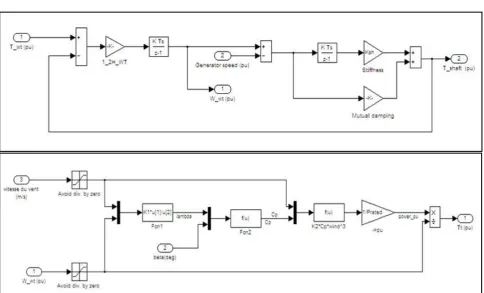
3.1. Block Diagram of a Turbine
To remove the maximum power of the incident energy, we must constantly adjust the speed of the wind turbine.
Fig. 3.a. Diagram of the multiplier and the turbine with control of the speed
Fig. 3.b. Blocks implemented for simulation of turbine Optimal
Lambda
Ω𝑀𝑟𝑒𝑓
Ω𝑡𝑟𝑒𝑓
Ω𝑡
𝜆
C𝑝
C𝑡 C𝑚 C𝑒𝑚 Ω𝑚é𝑐
Ω𝑚é𝑐
P
+ -
+
_ _
1 𝐺
+
_ _
1 𝑗𝑠 + 𝑓
PI
1 𝐺
𝜆 =𝑅. Ωt 𝑣
1 𝐺
𝜆𝑜𝑝𝑒𝑣
𝑅𝑣
Wind 𝐶
𝑡 =
𝑃𝑒𝑥𝑡
𝛺𝑡 =
1
2 𝜌. 𝑆. 𝐶𝑝 𝜆, 𝛽 . 𝑣 3.
Copyright © 2014 CTTS.IN, All right reserved 263
3.2. The results of Simulation
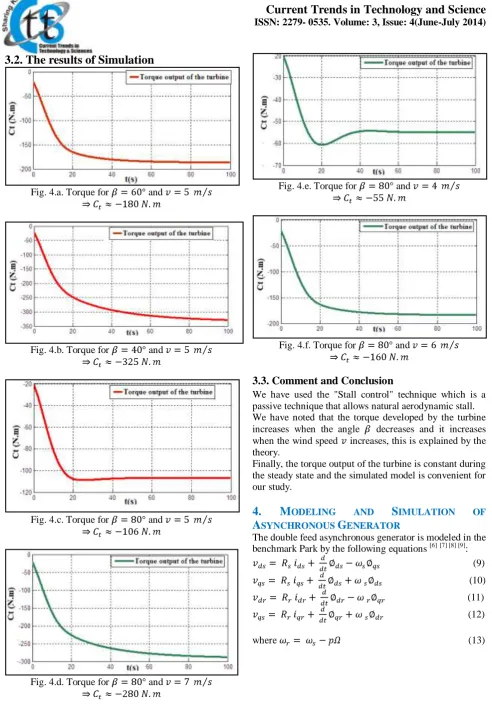
Fig. 4.a. Torque for and
Fig. 4.b. Torque for and
Fig. 4.c. Torque for and
Fig. 4.d. Torque for and
Fig. 4.e. Torque for and
Fig. 4.f. Torque for and
3.3. Comment and Conclusion
We have used the "Stall control" technique which is a passive technique that allows natural aerodynamic stall. We have noted that the torque developed by the turbine increases when the angle decreases and it increases when the wind speed increases, this is explained by the theory.
Finally, the torque output of the turbine is constant during the steady state and the simulated model is convenient for our study.
4.
M
ODELING ANDS
IMULATION OFA
SYNCHRONOUSG
ENERATORThe double feed asynchronous generator is modeled in the benchmark Park by the following equations [6][7] [8] [9]:
(9)
(10)
(11)
(12)
Copyright © 2014 CTTS.IN, All right reserved 264
(14), (15), (16), (17)
and (18)
4.1. Independent control of active and reactive power
To adequately control the electricity production of the wind, we will realize independent control of active and reactive powers Ps and Qs stator [2] [3] [4] [5] [6]. The reference (dq) is oriented so that :
and (19)
Assuming that the stator flux is constant (constant electric network) and ignoring the stator resistance, we obtain for and :
(20)
(21)
The currents and are such that :
(22)
(23)
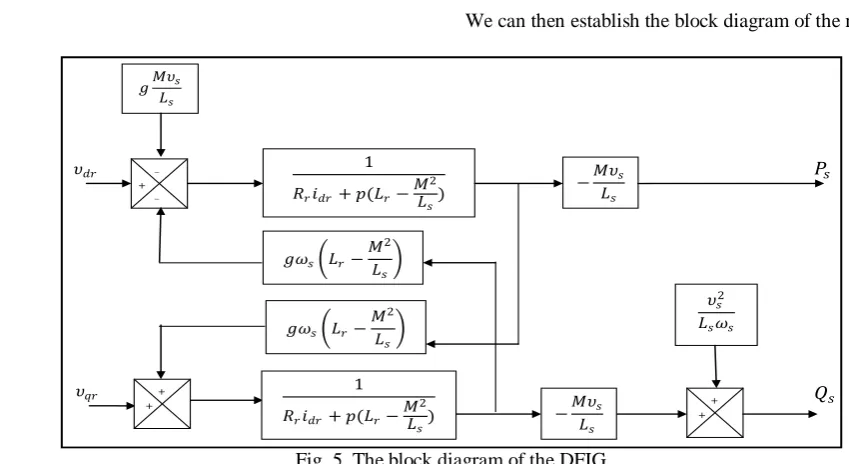
We can then establish the block diagram of the machine :
Fig. 5. The block diagram of the DFIG
Indirect control can be performed on two different axes (Axis q - Active Power / Main Lines - Reactive power) taking into consideration the coupling and compensation
[1] [2]
.
The studied system is then represented by the principle following diagram :
Fig. 6. The bloc diagram of the independent control of active and reactive power
𝑔𝑀𝜐𝐿𝑠
𝑠
1
𝑅𝑟𝑖𝑑𝑟+ 𝑝(𝐿𝑟−𝑀 2 𝐿𝑠)
𝜐𝑠2 𝐿𝑠𝜔𝑠 −𝑀𝜐𝑠
𝐿𝑠
𝑔𝜔𝑠 𝐿𝑟− 𝑀2
𝐿𝑠
𝑃𝑠
𝜐𝑑𝑟
𝜐𝑞𝑟 𝑄𝑠
_ +
_ _
+ + 1
𝑅𝑟𝑖𝑑𝑟+ 𝑝(𝐿𝑟−𝑀 2
𝐿𝑠) −
𝑀𝜐𝑠 𝐿𝑠 𝑔𝜔𝑠 𝐿𝑟−𝑀
2
𝐿𝑠
Copyright © 2014 CTTS.IN, All right reserved 265
4.2. Results of simulation of the generator with its indirect power control
The machine model and indirect control were implemented in the MATLAB environment to test the control. We therefore subjected the system to varying values of active and reactive power in order to observe the behavior of its regulation.
The double feed induction generator studied is characterized by the parameters given in Table (1) [1].
Table (1) Parameters of the asynchronous generator
Rotor resistance 0.19
Rotor inductance 0.0213 H
Mutual inductance 0.034H
Number of pairs of poles 2
Stator resistance 0.455
Stator inductance 0.07 H Nominal active power 150kW
The gain correction are calculated by the method of compensation poles and identification to a first order system (system response time of about 10 ms) and were refined after simulation.
To improve the indirect control, we will incorporate two control loops, one at the level of rotor currents and the other at the level of powers to eliminate the static error while keeping the system dynamics.
Fig. 7. Active power with power Reference equal to reference equal to : 150kW
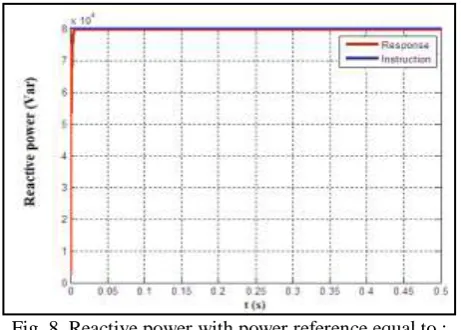
Fig. 8. Reactive power with power reference equal to : 80kVAR
Figures 7 and 8, show that our system has a satisfactory dynamic, which reacts rapidly with almost zero static error, either for active or reactive power.
It is observed that the powers of reference are followed. This wouldn’t cause a problem for the exploitation of the machine model.
To demonstrate the interest of the proposed control, simulation results were compared those with other techniques (direct and indirect control command without power control).
We have noticed that having an indirect control with two control loops improves the robustness of the system, something that remains an important issue especially for systems with large variations in parameters (meteorological factors). If we had changed the instructions, the response of the system would have been controlled with indirect control.
Copyright © 2014 CTTS.IN, All right reserved 266
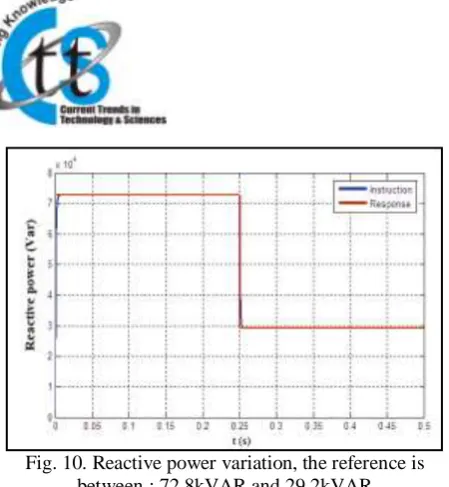
Fig. 10. Reactive power variation, the reference is between : 72.8kVAR and 29.2kVAR
Figures 9 and 10 show the evolution of the power at a reference power variation. Note that this change does not affect the system which still manages to ensure control powers. Also, through the response characteristics, good performance is observed even in the presence of instructions variations.
5. C
ONCLUSION ANDO
UTLOOKIn this study, we have addressed the modeling and control of the turbine, of the multiplier and the double-fed asynchronous generator operating machine with an indirect power control.
The simulation results have allowed us to evaluate the quality of the control strategy adopted.
We have noticed that the indirect control provides a powerful and robust system with very good simulation results.
We retain indirect control for the rest of our work, which would study the overall operation of a wind generator while ensuring constant power supplied to the network via two converters and DC bus.
6. R
EFERENCES[1] A. Boyette. Control-command of a doubly-fed asynchronous generator with wind power storage Doctoral thesis, University Poincaré of Nancy, France, December 2006.
[2] A. El Moudden , A.Wahabi , A.Sandali , F. A. Bounifli Modeling and simulation of a double-fed asynchronous generator for control of wind energy, International Congress of Thermal, Agadir, Maroc, April 2014.
[3] F. Kendouli , K. Nabti , K. Abed and H. Benalla, Modelling, simulation and control of a variable speed wind turbine based on doubly-fed induction generator, Journal of Renewable Energy Vol. 14, No.1, March 2011.
[4] S. Khojet elkhil , Vector Control of Doubly Fed Asynchronous Machine ( DFIG), Doctoral thesis, National Polytechnic Institute of Toulouse, France, December 2006.
[5] G. Salloum, Contribution to the robust control of the asynchronous machine dual power. Doctoral thesis, National Polytechnic Institute of Toulouse, France, March 2007.
[6] A. Gaillard, Contribution to the study of the quality of electric power and continuity of service in 2010, based on a DFIG wind system. Doctoral thesis.
University Henri Poincare of Nancy, France, April 2010.
[7] K. Belmokhtar, ML Doumbia, K. Agbossou, Modeling and control of a wind energy system based on an asynchronous machine, Fourth International Conference on Electrical Engineering CIGE'10, University of Bechar, Algeria, November 2010.
[8] A. Sid Ahmed El Mahdi, Speed control sliding mode a machine Asynchronous Dual Power Memory Of Magister, University Djillali Liabes Sidi-Bel-Abbes, Algeria, 2010.
[9] N. Abu - Tabak, Dynamic stability of the electric systems of multiple machines : Modeling, control, monitoring and simulation, Doctoral memory, School Central Lyon, November 2008.
7.
A
UTHORS'
P
ROFILESPr. Dr. EL MOUDDEN Abdelhadi : Doctor of Science from The National Polytechnic Institute of Toulouse (INPT) in 1993 - FRANCE.
He is now a professor in the National School of Electricity and Mechanics (ENSEM), University Hassan II Aïn Chock, Casablanca, Morocco.
Since 2006, he has been a member of Laboratory Computing, Systems and Renewable Energies (LISER), Research Group : Analysis and Control Systems of Electrical energy (ACSEE).
Copyright © 2014 CTTS.IN, All right reserved 267
I am
Mrs. Wahabi Aicha, an assistant professor at the superior school of technology (EST) in Casablanca, Morocco since 1991. From 2012 to the present, I’m a member of Laboratory of Computing, Systems and Renewable Energy (LISER), Research Group : Team Analysis and Control Systems of Electrical Energy (ACSEE). I wish to inform you that I'm preparing my habilitation in energy renewable more precisely wind energy turbine, in the National School of Electricity and Mechanics (ENSEM). I completed the diploma of superior depth studies in 2000 in the National School of Electricity and Mechanic (ENSEM) Casablanca, Morocco, I am also an electromechanical engineer of the National School of Mineral Industry (ENIM) in Rabat, Morocco (in 1990). I have already presented three papers in Morocco on wind energy during the years 2013 and 2014.BOUNIFLI Fatima-Ezzahra : I am a doctoral student preparing a doctoral thesis in the National School of Electricity and Mechanics (ENSEM), University Hassan II Aïn Chock, Casablanca, Research Group: Analysis and Control Systems of Electrical energy (ACSEE) - Laboratory of Computing, Systems and Renewable Energy (LISER).
On June 2013, I got an engineering diploma specialized in electrical energy in ENSEM. My doctoral thesis is about direct and fuzzy-logic control systems of the double-feed induction generator wind turbine. I've submitted my first technical paper to (AMT) scientific conference (22/04/2014).
Pr. Dr. SANDALI Abdelhalim : Doctor of Science, laureate from the University of Clermont-Ferrand 2 on 1991- FRANCE.
Now he is a professor in the National School of Electricity and Mechanics (ENSEM), University Hassan II Aïn Chock, Casablanca, Morocco. Since 2006 he has been a team leader of research group : Analysis and Control Systems of Electrical energy (ACSEE) - Laboratory of Computing, Systems and Renewable Energy (LISER).