Article
EXPLORATIVE MULTIDIMENSIONAL ANALYSIS
FOR ENERGY EFFICIENCY: DATAVIZ VERSUS
CLUSTERING ALGORITHMS
Dario Cottafava1ID, Giulia Sonetti2, Paolo Gambino3and Andrea Tartaglino4
1 Department of Culture, Politics and Society, University of Turin; [email protected]
2 Interuniversity Department of Regional & Urban Studies and Planning, Politechnic of Turin;
3 Department of Physics, University of Turin; [email protected]
4 Energy Management, University of Turin; [email protected]
Abstract:In this paper, we propose a simple tool to help the energy management of a large buildings 1
stock defining clusters of buildings with the same function, setting alert thresholds for each cluster, 2
and easily recognizing outliers. The objective is to enable a building management system to be used 3
for detection of abnormal energy use. First, we framed the issue of energy performance indicators, 4
and how they feed into data visualization (Data Viz) tools for a large building stock, especially 5
for university campuses. Both for Data Viz and clustering algorithm processes, we discussed two 6
possible approaches to choose the right number of clusters and the identification of alert thresholds 7
and outliers, after a brief presentation of the University of Turin’s building stock case study. Different 8
Data Viz tools have been studied to apply a specific clustering algorithm, the k-means one. An 9
explorative analysis based on the general Multidimensional detective approach by Inselberg has 10
been performed. Two multidimensional analysis tools, the Scatter Plot Matrix and the Parallel 11
coordinates method have been used. Secondly, the k-means clustering algorithm has been applied 12
on the same dataset in order to test the hypothesis made during the explorative analysis. Data Viz 13
techniques developed in this study revealed to be very useful to explore quickly and simply a large 14
buildings’ stock, identifying the worst efficient buildings and clustering them according to their 15
distinct functions. 16
Keywords:Energy Efficiency Indices, Data Visualization, Clustering Algorithms, University Campus, 17
Energy Management 18
1. Introduction 19
Energy efficiency programs as well as policies for the reduction of greenhouse gas (GHG) 20
emissions have been worldwide adopted by national and international governments and public 21
administrations [1]. Reduction of energy consumption and the shift toward a more sustainable use 22
of resources are increasingly becoming a challenge for any sector and activity related to the built 23
environment [2]. 24
The buildings sector is indeed a high energy-consumer, accounting for over one-third of the global 25
final energy consumption [3]. Energy demand is expected to rise by 50% by 2050 if no action is urgently 26
taken [4]. This means that major efforts are required to go beyond existing technical and economic 27
barriers for improving the efficiency of our energy use in buildings. The power to characterise the 28
energy consumption of a complex building stock, for instance, can reduce cost barriers for energy 29
efficient solutions. The improvement of reliable indicators to measure building energy performance at 30
a neighbourhood/city scale is therefore an important contributions for achieving urban sustainability 31
targets [5,6]. 32
Abu Bakar et al. [7] proposed to measure buildings’ energy performance basing on heating, 33
ventilating and conditioning (HVAC) system consumption. Moghimi et al. [8] studied commercial 34
buildings, analysing indicators related to the occupied air conditioning area. González et al. [9] 35
suggested to adopt a reference building in order to compare the energy consumption within a buildings 36
stock. 37
Although Energy Efficiency Indices (EEIs) are widely studied, there is still a lack of researches 38
in literature related to energy decision-making tools relying on these indices [10]. For this reason, 39
current research challenges are envisaged in developing links between EEIs and more general energy 40
assessment frameworks, to enable sounding comparisons among buildings with different architectural 41
features, functions and/or occupations schedules [11]. 42
To this respect, university campuses may represent a valuable test bed, being often a joint resemble 43
of building with very different characteristic yet belonging to a same purpose. For their physical 44
scale in the city, university’s campuses have a significant role to play respect to local energetic and 45
socioeconomic impacts, going far beyond the university scale itself [12]. Universities are increasingly 46
conceived as hubs for innovation, serving as test bed for new energy reduction strategies [13–15]. 47
However, a mayor focus among all the initiatives is generally devoted to energy performance 48
improvement, and its monitoring [16], justified by the increased investments in energy efficient 49
technologies [17]. Living labs monitoring infrastructure provide an appropriate way for answering 50
energy data queries while displaying all the necessary information for performances self-assessment 51
and external reporting purposes [18]. There is, however, a gap between these energy performances 52
oriented experiences and the international ranking systems for green labelling of campuses which are 53
not based on performance indicators but relying on ranges of total energy consumption [19]. 54
Towards the same direction, a work of the National Bureau of Stastistics of China [20] highlights 55
that universities or megaversities with different building functions have energy consumption per 56
square meter that cannot be compared and classified with the same criteria. Those challenges are also 57
linked to the diversity of material utilization, CO2 emissions, energy source and regulatory compliance, 58
which is different from country to country, and from city to city [21]. 59
1.1. Motivation and problem identification 60
Both at city scale or campus scale, as already noted by Haas [22], the most difficult task when 61
dealing with EEIs is to provide the corresponding data by end use to obtain suitable numbers for 62
cross-country evaluations. Many of the parameters needed for time series and cross-country analyses 63
are dependent on the obtainability of disaggregated data from wide-ranging surveys and cross-section 64
analyses, and there are number of critical methodological problems that still pave the way for the 65
creation of such operational indicators of energy efficiency [23]. Regarding the specific University 66
campus realm, Sonetti et al. [24] already argued the lack of a precise analysis based on building types or 67
functions, in one of the most spread and recognized green ranking for universities, theUI GreenMetric 68
- World Universities Rankings. The need of three clusterizations based on urban morphology, climate 69
zones or university functions has been highlighted for a sounding comparisons among campuses. 70
However, the advantages of performing large scale energy monitoring through easy visualization 71
tools are many, for example, the association of a fixed (or predictable at least) amount of energy 72
resources in areas of a city or in different buildings of the same district [25], energy outliers [26],demand 73
side management operations and local balancing [27], entrants for critical retrofit intervention [28], 74
large benchmarking analysis engaging allowing inter-comparison [29,30], peak power demand [31], 75
1.2. Current paper aim and structure 77
The paper’s aims are two-folds: propose a simple, efficient and precise analysis tool able to 78
compare buildings within a large stock, inputting only energy efficiency indices; and explore how to 79
use this tool to cluster buildings within a stock according to their specific function. The proposed tool 80
tries to fill the gap between very detailed energy audits analysis and the lack of precise user-friendly 81
and immediate tools for energy efficiency comparisons among buildings. The proposed approach 82
needs basic energy data input for each building - i.e. monthly energy bills – and, starting from those, 83
it adopts interactive data visualization tools to analyse the dataset. Themultidimensional detective 84
approach, as described by Inselberg [32], has been adopted to define the clusters’ alert thresholds. 85
The paper is structured as follows. First, we framed the issue of energy performance indicators, 86
and how they feed into data visualization tools for a large building stock, especially for university 87
campuses (Introduction). In theLarge scale buildings energy monitoring methodssection, current 88
Data Visualization techniques and clustering algorithms are explained. In theMethodologysection, 89
the adopted approach for developing a simple energy monitoring tool exploiting the University of 90
Turin’s building stock, defining clusters of buildings with the same function, setting alert thresholds for 91
each cluster, and easily recognizing outliers is described. Both for data visualization and the clustering 92
algorithm processes, we discussed two possible approaches to choose the right number of clusters 93
and the identification of alert thresholds and outliers, after a brief presentation of the University of 94
Turin’s building stock case study. Finally,ResultsandDiscussionreport a comparison between the 95
two approaches with considerations on the obtained clusters and their accuracy. 96
2. Large scale buildings energy monitoring methods 97
2.1. Data Visualization 98
In the Big Data decade, data visualization becomes fundamental to extract useful and valuable 99
information from the enormous amount of data available today. Each specific dataset, in fact, 100
potentially has a huge amount of hidden information and could reveal important tips for managers 101
and policy makers, as well as for data miners and data scientists. According to Card et al. [33], 102
Information Visualization, the most general definition of Data Visualization (DataViz), is defined as 103
visual representations, computer-supported, able to amplify human cognition. Keim et al. [34], in fact, 104
define DataViz as the process to "translate" complex dataset into visual tips and immediate qualitative 105
information and they identify three main aims: presentation, confirmative and explorative. For both 106
three aims, one of the fundamental aspects of DataViz is based on the interactive process allowed by 107
modern DataViz coding libraries, as D3.js [35], Julia [36], GoogleCharts and others tools, which permit 108
users to manipulate datasets in order to better understand hidden information in datasets. Within this 109
framework, interactive Data Visualizations are crucial for explorative analysis where data miners have 110
no quantitative insights to model a particular datasets. This is particularly important for data driven 111
researches as for energy efficiency studies, or more in general for analysis aimed at policy makers 112
and managers, where the main aim of an analysis should be to identify alert thresholds, outliers or 113
anomalies [37]. 114
Generally speaking, each multidimensional datasetXis composed bynarrays - i.e. the number 115
of observations/the size of the dataset,xi = (xi1,xi2, ...,xim),i=1, ...,nwithmattributes/dimensions 116
and it may be represented by a matrixnxm. With this representationsxij is the datum of the real 117
observationiwith attributej. Data Visualization techniques may be grouped into four main approaches: 118
1) Axis reconfiguration [38], 2) dimensional embedding [39], 3) dimensional sub-setting [40] and 4) 119
dimensional reduction [41]. In particular, two approaches out of four - i.e. axis reconfiguration and 120
dimensional sub-setting - will be discussed within this paper, exploiting respectively theScatter Plot 121
Matrix(dimensional sub-setting) and theParallel Coordinates(axis reconfiguration), two of the most 122
The Scatter Plot Matrix 124
It highlights, as described by Keller [42], relationships among variables as in a correlation matrix, 125
where single scatter plots between two attributes of the datasets are plotted within the same graph. 126
The Scatter Plot Matrix can be understood as a generalization of a single Scatter Plot. With respect to 127
the energy field, for instance, Corgnati et al. [43] proposed the use of a single Scatter Plot based on 128
two attributes - i.e. the annual building consumption and the annual electrical building consumption 129
per square meter - in order to identify the top interventions priorities within a large building stock, 130
while Cottafava et al. [44] proposed two other attributes in order to identify buildings with the most 131
inefficient lighting and heating schedules: electrical building consumption per square meter and 132
the day/night energy efficiency index (a ratio between energy consumption during the weekday 133
working hours and during the night/weekend). Thus, the Scatter Plot Matrix could be exploited as a 134
preliminary analysis method useful to identify the top/bottom priorities with respect to three, or more, 135
attributes of a datasets. 136
The Parallel Coordinates 137
This method, introduced by Inselberg [38], allows to visualize a muldimensional dataset 138
thanks tomequidistant copies of the y-axis, perpendicular to the x-axis. Thanks to this method, 139
the observation xi = (xi1,xi2, ...,xim) is represented as a polygonal line which intersects each 140
vertical axis. It is noteworthy to highlight that, in this visualization, each vertical axis represents 141
a different attribute/dimension of a multidimensional dataset, and each polyline represents a different 142
observation. In order to exploit the Parallel Coordinates method is crucial to cite one fundamental 143
property, namedBumping the Boundaries, which ensures that a polygonal line lying in-between two 144
other polygonal lines, it represents an interior point of the corresponding hypersurface inmdimensions 145
[32]. 146
2.2. Data Clustering algorithms 147
Data Clustering is a process of detection of different groups within a specific dataset in order 148
to identify patterns or subsets, i.e. clusters, as well as outliers. Clustering process aims to identify 149
clusters where"Instances, in the same clusters, must be similar as much as possible", meanwhile"Instances, 150
in different clusters, must be different as much as possible"[45]. Clustering, in particular, is an unsupervised 151
process where instances (objects) have no initial label (i.e. assigned cluster) given by data scientists 152
and researchers but the cluster configuration depends on the chosen algorithm and on the adopted 153
similarity measuresanddistance metrics. 154
Distance metrics 155
Metrics depend on, as reviewed by Xu et al. [46], the adopted definition of distance. The most common used definition, for quantitative measures, is theMinkowski distanceof order p:
Dij= d
∑
l=1
|xil−xjl| 1
p
!p
whered=n. of dimensions,xij =value of the attribute j of the object/point iandDijis the distance between 156
the pointiand the pointj. For precisepthe Minkowski distance is defined as theEuclidean distance 157
(Minkowski order 2), theManhattan distance(order 1) or theCebysev distance(order∞). Other common 158
distance metrics are based on theMahalanobis distance,Dij = xi−xjTS−1 xi−xj
and theJaccard 159
distance Jδ(A,B) =1−|A∩B|/|A∪B|=|A∪B|−|A∩B|/|A∪B|whereSis the Covariance Matrix of the cluster 160
Evaluation 162
Evaluation consists in the process of testing of the validity of the chosen algorithm. Evaluation indicators may be subdivided into two categories:internal evaluationandexternal evualuation. The first one refers to data within the same cluster, while the second one refers to similarity evaluation among data lying in different clusters [47]. Some of the most widely adopted internal evaluation methods are: i) theWithin-Cluster Sum of Square[48]
QT= 1 k
k
∑
j=1 σj= 1
k k
∑
j=1
|Zj|
∑
i=1
d(xij,cj)
|Zj|
(1)
ii) theDavies-Bouldin Index[49]
DB= 1
k k
∑
i=1 max
i6=j
σi+σj
d ci,cj !
(2)
iii) theSilhouette Index[50]
S= 1
k k
∑
j=1 Sj=
1 k
k
∑
j=1 1
|Zj|
|Zj|
∑
i=1
bij−aij
maxhaji,bjii (3)
where
aji = 1 |Zj|
|Zj|
∑
l=1,l6=i
d(xi,xl) and bji =p=1,...,mink;k6=j
1
|Zp|
|Zp|
∑
l=1
dxij,xlp
where n = total number of points, xji = point i lying in cluster j, k = n. of clusters, cx = 163
the centroid of the cluster x,σx = the mean distance between any data in cluster x and the centroid of the 164
cluster,|Zx|=n. of point in cluster Zx,d xi,xj
=the distance between points xiandxj(both centroids 165
or observations). Finally, there arevarious external evaluation indices, as reported by Dongkuan et al. 166
[47] (i.e. Rand index [51], Jaccard Index [52], Fowlkes-Mallows Index [53], ...) useful to evaluate the 167
efficiency of clustering algorithms in terms of finding true (false) positives and negatives with respect 168
to a reference cluster configuration. 169
Clustering Algorithms 170
In literature, generally, clustering algorithms are mainly split into two main categories -Hierarchical 171
andPartitionclustering methods - but various sub-classifications have been proposed in order to 172
categorize the dozens of clustering algorithms. Dongkuan et al. [47] subdivide algorithms in traditional 173
ones and modern algorithms. Traditional algorithms have been aggregated into 9 categories - partition, 174
hierarchy, Fuzzy Theory, distribution, density, graph theory, grid, fractal and model - based, while for 175
modern algorithms they count more than 40 proposed algorithms divided into 10 categories. Nagpal 176
et al. [54], instead, propose a classification where algorithms are - partition, hierarchy, density, grid, 177
model and category - based. Partition clustering algorithms arrange thendata intokdifferent clusters 178
[55]. The numberkof cluster is an input parameter of the algorithm. The partitioning is obtained by 179
minimizing an objective function, and it depends on the distance from the centroid to any point within 180
a single cluster or on some similarity functions. Basically, the initialization of a partition algorithm 181
consists in: a) assigning randomly k seed points, the initial centroids and b) every point in the dataset 182
must be labelled to the nearest cluster centroid. Then, in each step, c) a new centroid for each cluster 183
must be computed by averaging over all points lying in the same cluster and d) the nearest centroid 184
for every point in the dataset must be checked again. Steps c) and d) continue untill a local optimum is 185
found. The two most famous partition clustering algorithms are the k-means [56] and the k-medoids 186
(K-means for discrete data) [57] directly developed from the core concept of partition algorithms. 187
randomly from the existing points, in order to avoid empty clusters. Other partition algorithms, 189
instead, as CLARA [58], CLARANS [59] and PAM [60] choose seed points randomly in a grid based 190
way. Generally, the advantage of these algorithms is a high efficiency and low time complexity while 191
disadvantage consists in the necessity of defining the number of clusterskas an algorithm input, 192
taking into account that the choice ofkaffects results and the identification of outliers. Hierarchical 193
algorithms find clusters in an iterative way starting from the whole dataset in a unique cluster,divisive 194
mode(top-down approach), or from a single point,agglomerative mode(bottom-up approach). The basic 195
idea of hierarchical algorithms is to find nested clusters starting from 1 group tongroups or vice versa 196
in an iterative way merging (or splitting) the nearest clusters (or the furthest ones). Typical algorithms 197
are CURE [61], BIRCH [62], CHAMELEON [63] and many others. For instance, BIRCH - Balanced 198
Iterative Reducing and Clustering using Hierarchies - is based on saving only theCluster Features 199
triplen,LS,SSwheren=total number of points within a cluster,LSis the sum of attributes of all points 200
within a cluster andSSis the sum of square. CURE - Clustering Using REpresentatives - thought 201
for large database, is insensitive to outliers, while CHAMELEON merges two cluster only if they are 202
close "enough". Many algorithms, such as the k-means, need the number of clusterkas an input, 203
while many others determine the right number in a dynamic way. The problem of the identification 204
of the number of clusters can be solved thanks to various methods. For instance, Ketchen et al. [64] 205
analysed the elbow method based on the within-cluster sum of square, method introduced by Robert 206
L. Thorndike [65] in 1953. The elbow method consists in plotting the within-cluster sum of square, i.e. 207
the average distance of any point within a cluster with respect to its centroid, in a scatter plot with 208
the number of clusterk, looking for the "elbow", the point where the WSS stops to rapidly decrease. 209
The elbow point shows the best number of clusterk. Pollard et al. [66] use the Mean Split Silhouette 210
(MSS), a measure of cluster heterogeneity, and they minimize it to choose the bestk. Tibshirani et al. 211
[67], instead, proposed the gap statistic, a methodology based on the comparison of the change in 212
within-cluster sum of square dispersion with respect to a proper reference null distribution. Other 213
methods, widely adopted in literature, are based on MonteCarlo simulations cross validation [68,69]. 214
Consensus Clustering [70] and Resampling [71] try to findklooking for the most "stable" configuration 215
through different MonteCarlo simulations but with the same number of clusters. On the contrary, 216
Junhui Wang [72] proposed to select the number of clusters minimizing algorithm’s instability, a simple 217
measure of the robustness of any algorithm against the initial random seeds. 218
3. Methodology 219
In order to design a simple, user-friendly approach for energy efficiency analysis for large 220
buildings stock, we compared different Data Visualization tools applying a specific clustering 221
algorithm, the k-means one. An explorative analysis based on the generalMultidimensional detective 222
approach[38], has been performed as first step. We exploited two multidimensional analysis tools, the 223
Scatter Plot Matrix and the Parallel coordinates method. Secondly, the k-means clustering algorithm 224
has been applied on the same dataset in order to test the hypothesis made during the explorative 225
analysis. The first step, the multidimensional detective approach as the one proposed by Inselberg 226
[38], identified the most meaningful clusters. As described in Cottafava et al. [44], the process consists 227
of few steps, and it is able to identify outliers and "junk attributes" as well as to define boundaries and 228
alert thresholds, a minimum and a maximum value, such asxmin,j≤xij≤xmax,j,∀xieZkwhereZkis 229
the k-th subset ofXfor every cluster. The three steps - i)define building types, ii)test the assumptions 230
and iii)identify thresholds and outliers- consists in choosing the building types (e.g. libraries, hospitals, 231
research centres, and so forth) and labelling each data relying on the knowledge background of the 232
data source organization. When each datum has been labelled, alert thresholds can be identified and 233
outliers can be recognized. The three steps have been accomplished via the Scatter Plot Matrix and the 234
Parallel Coordinates methods. After defining clusters and thresholds, the k-means algorithm tests the 235
validity of the clusters hypothesis. Finally, we propose a tool to monitor historical trends based on an 236
(a)Humanities Departments (b)Administrative Offices
Figure 1.Scatter plot matrix for the Unito’s buildings stock with respect to four attributes: type of building (1-9), the night/day energy efficiency index, the energy consumption per user and the energy consumption per square meter.
3.1. Dataset and indices description 238
As briefly mentioned in the introduction, the selected case study for testing the simple tool for 239
large scale building stocks energy analysis has been the University of Turin (Unito) in Italy. The 240
advantage of choosing the Unito campus relies in the availability of a wide historical data set and 241
the precise match of energy-related information and the locus of its consumption, thanks to a wide 242
net of smart meters, periodical human-based control on data trends and an open access website 243
prompting all data. The University of Turin is a little city within a city: Unito’s buildings stock is very 244
heterogeneous with respect to functions of the buildings, their construction year (ranging from the 245
XVI century to 2014) and architectural features. It sums more than 800000m2, with about 120 buildings 246
sprout all over the city and in Piedmont region, for a total of 2.08 TOE of methane gas and 23.5 GWh of 247
electrical energy consumption per year. The buildings stock comprises museums, administrative offices, 248
libraries, hospitals, as well as research centres, a botanical garden and departments of humanities and 249
sciences [73]. The Unito energy data related to a whole year on monthly basis have been adopted 250
as the training dataset for this study. Analysed data refers to 46 buildings, with 59 electricity meters 251
and 77 methane gas meters. Four attributes for each point have been chosen: the absolute annual 252
energy consumption (kWh), the annual energy consumption per meter square (kWh/m2), the annual 253
energy consumption per user (kWh/user)and the"night/day energy efficiency index" EEIyear,kWh,night/day = 254
1/12∑12i=1Ei,kWh,night/Ei,kWh,daywhereEi,kWh,day =kWh during working hoursandEi,kWh,night =kWh during 255
night/holiday for month i. 256
3.2. k-means algorithm 257
The k-means algorithm has been used for the same dataset in order to compare results obtained 258
by the algorithms with the results obtained by the multidimensional detective approach. Each real 259
observationxij, for each dimensionjhas been normalized so thatxij=(xij−minxj)/(maxxj−minxj)e(0, 1)
260
, in order to allow to compute a meaningful Euclidean distance metric among points. The initial 261
centroids for each cluster have been picked at random among the existing points of the dataset in 262
order to avoid empty clusters. Three internal evaluation indices have been used to validate results 263
index and the Silhouette index. The final result, for eachk(fromk=2 up tok=15), has been chosen 265
as the best configuration - the one with the minimum WSS index - over 1000 independent MonteCarlo 266
simulations. The right number of clusterk, as described by the Elbow method, has been obtained by 267
identifying theelbowin the scatter graphWSS VS k. Finally, once defined the rightk, the best cluster 268
configuration has been selected chosing the highest external evaluation indices, theRand Indexand 269
theFowlkes-Mallows Index, over 1000 MonteCarlo simulations, with respect to the algorithm result 270
and the target cluster configuration. The target cluster configuration is the one chosen during the 271
multidimensional detective process.
(a)Humanities Departments (b)Agrarian Departments
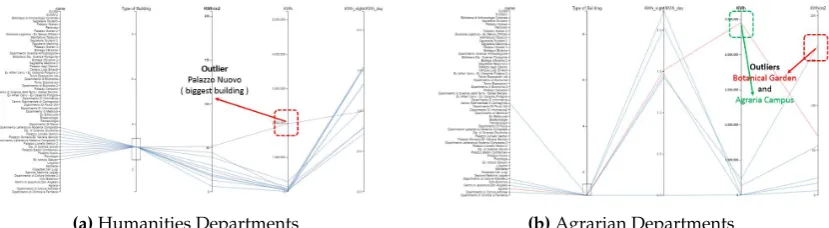
Figure 2.Parallel coordinates method for the Unito’s buildings stock with respect to four attributes: type of building (1-9), the night/day energy efficiency index, absolute annual energy consumption and the energy consumption per square meter.
272
4. Results 273
4.1. Cluster Identification 274
Cluster hypothesis 275
A general hypothesis has been made due to the heterogeneity of the Unito’s building stock. The 276
whole stock has been categorized into nine clusters with respect to the functions of the buildings: 277
Scientific Departments (with laboratories), Scientific Departments (without laboratories), Medical, 278
Agrarian and Humanities Departments, libraries and administrative offices, and, finally, sport 279
infrastructures and large complexes. 280
Data Visualization Techniques. 281
The proposed clusters have been tested with two types of visualization: the Scatter Plot Matrix, a 282
dimensional sub-setting method (Fig.1), and the Parallel Coordinates method, an axis reconfiguration 283
technique (Fig.2). First, our approach consists to separate the chosen cluster from all the other ones in 284
order to define, in a qualitative way, cluster thresholds and to look for anomalies and outliers. Second, 285
hypothesis have to be tested in order to identify alert thresholds and outliers. The first step can be 286
achieved thanks to the brush functions of the two proposed visualizations. As shown in Fig.1aand 287
Fig. 1bfor the Scatter Plot Matrix and in Fig. 2aand Fig. 2bfor the Parallel Coordinates method, 288
the identification of the pre-defined clusters is straightforward and outliers emerge in a very clear 289
way. The Scatter Plot Matrixis the generalization of the Scatter Plot, as described in Cottafava et al. 290
[73] and as publicly available athttps://goo.gl/o4nn4f. Fig.1shows the whole buildings’ stock of 291
the University of Turin and reports 16 different single Scatter Plots. Respectively x-axis, and y-axis, 292
starting from the bottom-left graph, report the following attributes:Type of building,the day/night energy 293
efficiency index,the annual energy consumption per userandthe annual energy consumption per meter square. 294
y-axis. Each cluster is identified with a different colour and it can be highlighted simply selecting the 296
type of the building in the bottom-left graph. The nine labelled colours are: red (Agrarian depts.), 297
green (Medical depts.), blue (Humanities depts.), black (Scientific depts. - with lab.), grey (Scientific 298
depts. - without lab.), sky-blue (Large complexes), yellow (Libraries) and pink (Sport infrastructure). 299
In particular, Fig. 1areports, as an example, the Humanities Departments and Fig. 1bshows the 300
Administrative Offices of the University of Turin. This visualization configuration allows to check if 301
buildings with the same label lye on the same 1-D cluster, simply observing points distribution on 302
the left and bottom plots. The tool here described is publicly available athttps://goo.gl/ZJem9h. 303
The Parallel Coordinatesmethod also allows to display various attributes for hundreds points with 304
a different visualization configuration. This approach permits data miner to analyse dependent, or 305
independent, attributes and to detect anomalies or precise trends and correlation among different 306
attributes as in a pattern recognition problem. Fig.2shows the whole Unito’s buildings stock with 307
respect to four different attributes: thetype of the building, theannual energy consumption per square meter, 308
theabsolute annual energy consumptionand theday/night energy efficiency index. In this case, the nine 309
clusters are labelled with number from 1 to 9 and represented by the first vertical axis. Respectively, 310
from 1 to 9, the clusters correspond to the following: agrarian depts., medical depts., humanities 311
depts., scientific depts. - with lab, scientific depts. - without lab, large complexes, libraries and Sport 312
infrastructure. As for the Scatter Plot Matrix, in this case the brush function allows data miner, or the 313
policy maker/energy manager, to highlight precise subset of the whole dataset. This feature permits to 314
exploit the propertyBumping the boundariesin order to bound the clusters. Fig.2aand2b, respectively, 315
show humanities depts. and agrarian depts. At a first sight, it is possible to notice quite precise 316
fluxes/patterns of polygonal lines with a high density. The tool we used is publicly available on: 317
https://goo.gl/4aHYuj. 318
Clustering Algorithm. 319
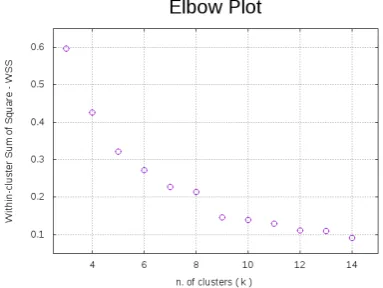
Figure 3.Elbow method. The plot shows within-cluster sum of square VS k (n. of clusters). The right k number is between 9 and 10.
The k-means algorithm has been used in order to identify and recognize clusters depending on 320
three main attributes,annual absolute energy consumption,annual energy consumption per square meter 321
and theday/night energy efficiency index, avoiding the energy consumption per user due to lack of data 322
for administrative offices and other buildings. In this paragraph, first, we report some considerations 323
on the right number of clusters found thanks to the elbow method. We select the best configuration 324
for eachk- i.e. the lowest WSS - running one thousand MonteCarlo simulations. The elbow method 325
suggests, as previously defined in data visualization analysis, that the right number ofkis between 9 326
and 10, where the WSS slightly stop to decrease. Fig.3shows the elbow plot with the WSS index on the 327
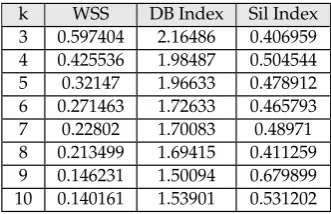
y-axis andk, the number of clusters on the x-axis. In Table1we report data obtained related to WSS, to 328
kwhile WSS and DB index decrease askincrease. Since Silhouette index lies in−1≤Sil≤1, where a 330
Sil index of−1 means a bad cluster correlation and 1 a good one, the obtained clusters represent a 331
quite good configuration. 332
Table 1.best configuration evaluation index.
k WSS DB Index Sil Index 3 0.597404 2.16486 0.406959 4 0.425536 1.98487 0.504544 5 0.32147 1.96633 0.478912 6 0.271463 1.72633 0.465793 7 0.22802 1.70083 0.48971 8 0.213499 1.69415 0.411259 9 0.146231 1.50094 0.679899 10 0.140161 1.53901 0.531202
Comparison between DataViz and k-means clusters. 333
Once chosen the best number of clusters (k=9), two external evaluation indices - theRand Index 334
and theFowlkes-Mallows Index- have been computed comparing clusters obtained by the k-means and 335
the previously defined clusters within the Data Visualization paragraph. In order to obtain the best 336
configuration, further ten thousand MonteCarlo simulations have been run with the chosenk=9 337
maximizing the Rand Index and choosing the respective cluster configuration. Table2reports the best 338
cluster configuration result with respect to the Rand Index.
Table 2.best external evaluation index.
Rand Index Fowlkes Index 0.76898 0.644766
339
4.2. Setting Thresholds 340
Table 3.thresholds for consumption per square meter and for day/night energy efficiency index.
Building kWh/year∗m2 EEI
night/day
Scientific depts without lab 30−50 0.8−1.1 Scientific depts with lab 70−110 1.1−1.9 Humanities depts <50 0.6−1.1
Agrarian depts 20−70 1.5−2.5
Medical depts 50−70 1.2−1.5
Administrative offices <50 0.4−1
Starting from the Parallel Coordinates graph we defined alert thresholds for the main six clusters 341
- i.e. scientific depts. (without lab.), scientific depts. (with lab), humanities, agrarian and medical 342
depts. and administrative offices. Results and alert thresholds are reported in Tab.3with respect two 343
main attributesEEIyear,kWh,night/dayandkWh/year∗m2. We don’t report absolute energy consumption per 344
year because it is not interesting as a general index for energy efficiency. Tab. 3shows that clusters 345
corresponding to scientific depts.. (with lab.), agrarian and medical depts. have an high day/night 346
energy efficiency index, as expected. Scientific depts. (with lab.) shows a higher energy consumption 347
per meter square with respect to agrarian and medical depts. and in general with respect to all other 348
clusters. Administrative offices, scientific depts. (without lab.) and humanities depts.., instead, have 349
a common behaviour with lowkWh/year∗m2 andEEIyear,kWh,night/day. Scientific depts. (without lab), 350
4.3. Monitoring Trends 352
The final step of the presented process is based on an application of the parallel coordinates 353
method. In this case, we plot different annual energy consumptions on a different axis (each axis 354
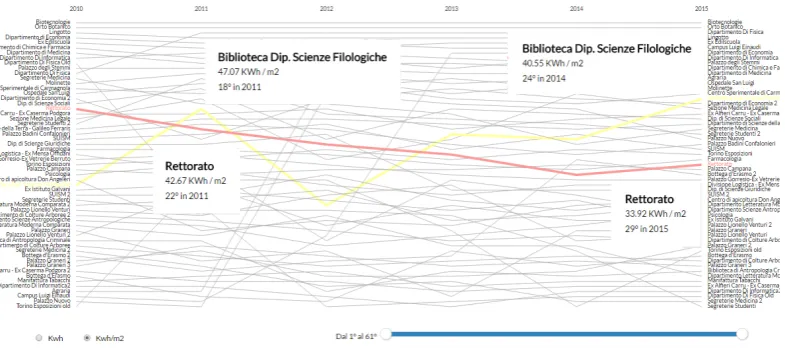
represents a different year) where only one attribute may be plotted. This tool, shown in Fig. 4 355
allows to visualize the historical trend of a chosen energy efficiency index. A useful feature, is the 356
possibility to highlight simultaneously various buildings, in order to observe their historical trends. By 357
simply hoovering the mouse on each polyline, the building energy consumption for the chosen year is 358
shown. By clicking on it, the polyline is highlighted as seen in Fig.4, where "Biblioteca Dip. Scienze 359
Filologiche" (yellow) and the "Rettorato" (red) stand out. The tool here described is publicly available 360
athttps://goo.gl/YuPTRB. 361
Figure 4. Interactive Data Visualization tool to monitor historical trends based on the Parallel Coordinates method.
5. Discussion 362
The first aim of this paper was to determine a process to set general hypothesis on building 363
clusters with respect to energy efficiency indices. A clusters hypothesis has been previously stated 364
relying on the background knowledge of the energy management staff at the University of Turin. We 365
envisage this step as a limit of this study, since it requires a preliminary effort by a human task force 366
that can be not always reliable, available, competent or even present. However, the time required in 367
this phase is widely compensated by the easiness of the subsequent steps and the replicability of the 368
monitoring phase in each institution able to offer at least the energy bill data source. 369
The clusters hypothesis has been made based on main buildings function and then it has been 370
verified via to two methodologies for the identification of buildings clusters: a data visualization 371
approach and a clustering algorithm. 372
The data visualization approach allowed to recognize the validity of the clusterization hypothesis. 373
In fact, after labelling each building with a precise function, it is possible to match each building within 374
a precise cluster, straightforward (via the brush function). In this way, it is possible to immediately 375
identify outliers and set rough alert thresholds as described in sec.4.2and in Tab.3. 376
This method made us identify some outliers in the Unito case study. For instance, thePhysics Dept. 377
and theBiotechnology Dept. are two outliers within the cluster "Scientific Depts. - with laboratory". 378
High consumption per square meter and high day/night energy efficiency index are due both to large 379
IT centres and electric chillers running 24/24h. Within the "Agrarian depts." cluster, thebotanical garden 380
is another outlier, with its very high consumption per square meter. TheAgrarian Campushas been 381
identified as an outlier, too, with respect to its annual energy consumption. Looking into that, one 382
experiments and greenhouses maintenance, its energy behaviour must be different and must be treated 384
differently. Within the "Medical depts." cluster, theDental School(named “Lingotto” within graphs 385
from the building it is hosted by) and thelegal medicine section(named Sezione Legale Medicina) are 386
outliers compared to an average energy consumption or a day/night energy efficiency index. Again, a 387
more detailed data source analysis reveals that the Dental School lies in a much bigger complex, the 388
Lingottosite, provoking an increase in HVAC use, summed to a high number of dental and technical 389
machinery. As for the legal medicine section, the reason of the high night consumption lies on the 390
morgue and the mortuary rooms, asking for a constant air conditioning system, very costly especially 391
during spring and summer seasons. Within the "Humanities Depts." cluster, there are two outliers, 392
theSocial Science Dept.and thePsychology Dept., with respect to the day/night index: the reasons of 393
this anomalous consumption is still under studying at the Unito’s facility management office after 394
a signalling coming from this work. Palazzo Nuovohas one of the highest number of students and 395
classrooms within the same building, thus explaining its higher energy request. Within the "Scientific 396
Depts - without laboratory", two outliers emerge. TheManagement Dept(named “Dipartimento di 397
Economia”) andTorino Esposizioni. The first one has a high consumption per square meter and an 398
high annual consumption because the energy meter counts also the consumption of the Regional IT 399
center, while “Torino Esposizioni” has a very high day/night index because of the secondary function 400
of the building (art exhibitions, fairs and other types of events). Finally, the "Administrative offices" 401
cluster has three outliers:Palazzo degli Stemmi,Manifattura TabacchiandStudents’ secretariat. These three 402
buildings have an high day/night index due to different reasons. The first one is the main building for 403
the technical directions of the University and it hosts a lot of IT server of the University. Other reasons 404
are under investigation. The other two buildings, instead, are two multifunctional buildings hosting 405
public events for the City of Turin. 406
6. Conclusion 407
To conclude, this data visualization approach offers a simple way to identify outliers, but the 408
reasons of the inefficiency have to be explained with a deeper analysis, scouting via Google Maps or 409
the facility management office further features that did not emerge during the preliminary labelling 410
phase. As a methodological caveat, this approach reveals outliers within clusters defined ex-ante: 411
therefore, every multifunctional cluster is shown as an outlier of its own cluster, and that can be a 412
limit if a cluster is the result of a preliminary wrong human inference. However, Data Viz techniques 413
revealed to be very useful to explore quickly and simply a large buildings’ stock, identifying the worst 414
efficient buildings and separate their distinct functions. 415
Secondly, a clustering algorithm has been used in order to test the initial hypothesis. The test was 416
made exploiting two external indices - i.e. theRand Indexand theFowlkes-Mallows Index- comparing 417
the clusters configuration hypothesis (hp0) and the obtained clusters thanks to the k-means algorithm. 418
The obtained clusters configuration withk=9 may be compared with the clusters hypothesis (Rand 419
Index = 0.76898). K-means, due to its algorithm basic principles, as many other clustering algorithm 420
is strongly affected by local optimum and outliers. In fact, with a deeper analysis on clusters details, 421
k-means algorithm is able to well-identify outliers - e.g. Management Dept., Biotechnology Dept. or 422
Agrarian Campus - but it recognizes some clusters without physical explanation due to local optimum. 423
For instance, theDepartment of Arboree Cultures(hp0: Agrarian Depts. cluster) and theManifattura 424
Tabacchi(hp0: administrative offices cluster) or theDon Angeleri Beekeeping Center(Agrarian Depts. 425
cluster) and thePsychology Dept.(hp0: Humanities Depts. cluster) always lye within the same cluster 426
without any other point because of they have a very common energy consumption behaviour. The three 427
clusters - i.e. hp0: administrative offices, humanities depts. and scientific depts. (without laboratories) 428
- are mixed together in only two clusters. Scientific Depts. (with laboratories) cluster is well-recognized 429
loosing one of the outliers described in data visualization approach, the Biotechnology Dept., and 430
gaining two outliers from other clusters, theBotanical Gardenand theDental School. Many outliers, 431
Torino Esposizioni,legal medicine section,Social Science DeptandStudents’ secretariat. This behaviour 433
reveals that a possible new cluster hypothesis should include amultifunctional buildingcluster. Finally, 434
the two main campusesCampus Luigi Einaudiand theAgrarian Campusare always grouped together, 435
representing a reasonable choice. TheManagement Dept., outlier within the Scientific depts. (without 436
lab) cluster, and theBiotechnology Dept.are clustered alone. In conclusion, k-means clustering algorithm 437
recognizes very accurately the main clusters – identified as campuses, service industry buildings and 438
Scientific depts. - confirming our initial hypothesis but it is not able, as expected, to recognize slight 439
differences between Humanities depts., Scientific Buildings (without lab) and Administrative Offices. 440
Results revealed also that clustering algorithms - k-means in our case - cannot be exploited to 441
design useful clusters depending on building functions, except for some macro clusters like tertiary 442
service buildings or campuses and scientific buildings. Moreover, they pointed out how the most 443
interesting part of information in energy efficiency analysis is lost. In fact, data analysts or energy 444
managers are usually interested in inefficient buildings, thus in outliers with respect to their cluster, 445
even when clustering algorithms tend to aggregate outliers in the wrong cluster. This makes a 446
humanised process always necessary and not replaceable. At city level, such data driven tool requires 447
a large penetration of metering systems and possibilities to explore private data of the entire building 448
stock; these conditions are still not easily accessible but combined techniques need to be taken into 449
account for future researches to achieve the desired level of granularity in the data source. Of course, 450
identifying and removing causes of abnormal energy use ensures a more efficient environment and 451
not just in terms of the building energy costs, talking about university campus cases. With our tool, 452
the algorithms applied appears computationally efficient and robust, therefore, they can be easily 453
integrated into existing university campus building energy management and warning systems. Of 454
course, further work is needed to build on this clustering technique to provide additional dataset 455
for training the algorithm, as well as language processing tools for automated analysis of metered 456
building / energy bills data. 457
Acknowledgments:The investigation has been done under the research fellowship funded by the Fondazione 458
Goria in Italy within the program "Talenti per la Società Civile". 459
Author Contributions: Dario Cottafava was the principal investigator. Giulia Sonetti contributes in findings 460
proper energy efficiency indices. Paolo Gambino supervised the work as scientific supervisor of the Energy 461
Working Group of the Unito Green Office and Andrea Tartaglino, as Energy Manager of the University of Turin, 462
helped to verify obtained results and to identify proper explanations for the outliers. 463
Conflicts of Interest:The authors declare no conflict of interest. 464
References 465
1. Powell, J.B. Green Building Services. Journal of International Commerce and Economics2015. 466
2. Wilkinson, P.; Smith, K.; Beevers, S.; Tonne, C.; Oreszczyn, T. Energy, energy efficiency, and the built 467
environment. Lancet2007,370, 1175–1187. 468
3. Newman, P. The environmental impact of cities. Environment and Urbanization2006, 18, 275–295. 469
doi:10.1177/0956247806069599. 470
4. Staff, I.E.A. Transition to Sustainable Buildings: Strategies and Opportunities To 2050; Organization for 471
Economic Cooperation and Development: Paris, 2013. doi:http://dx.doi.org/10.1787/9789264202955-en. 472
5. Lombardi, P.; Trossero, E. Beyond energy efficiency in evaluating sustainable development in planning 473
and the built environment. International Journal of Sustainable Building Technology and Urban Development
474
2013,4, 274–282. doi:10.1080/2093761X.2013.817360. 475
6. Brandon, P.S.; Lombardi, P.; Shen, G.Q.Future challenges in evaluating and managing sustainable development
476
in the built environment; John Wiley & Sons, 2017. 477
7. Bakar, N.; Hassan, M.Y.; Abdullah, H.; Rahman, H.; D., P.M.; Hussin, F. Sustainable energy management 478
practices and its effect on EEI: a study on university buildings. Global engineering, science and technology 479
conference; , 2013. 480
8. Moghimi, S.F.A.; Mat, S.; Lim, C.; Salleh, E.; Sopian, K. Building energy index and end-use energy analysis 481
9. González, A.B.R.; Díaz, J.J.V.; Caamano, A.J.; Wilby, M.R. Towards a universal energy efficiency index for 483
buildings. Energy and Buildings2011,43, 980 – 987. doi:https://doi.org/10.1016/j.enbuild.2010.12.023. 484
10. Yun, G.; Steemers, K. Behavioural, physical and socio economic factors in household cooling energy 485
consumption.Applied Energy2011,88, 2191–2200. 486
11. Li-Ming, W.; Bai-Sheng, C. Modeling of energy efficiency indicator for semi-conductor industry. 487
Proceedings of the IEEE international conference on industrial engineering and engineering management. 488
IEEE, 2007. 489
12. Ferrer-Balas, D.; Lozano, R.; Huisingh, D.; Buckland, H.; Ysern, P.; Zilahy, G. Going beyond the 490
rhetoric: system-wide changes in universities for sustainable societies. Journal of Cleaner Production
491
2010,18, 607 – 610. Going beyond the rhetoric: system-wide changes in universities for sustainable 492
societies, doi:https://doi.org/10.1016/j.jclepro.2009.12.009. 493
13. Agdas, D.; Srinivasan, R.; Frost, K.; Masters, F. Energy Use Assessment of Educational Buildings: Toward 494
a Campus-wide Sustainable Energy Policy. Sustainable Cities and Society2015,17. 495
14. Chung, M.; Rhee, E. Potential opportunities for energy conservation in existing buildings on university 496
campus: A field survey in Korea.Energy and Buildings2014,78, 176–182. 497
15. Escobedo, A.; Briceño, S.; Juárez, H.; Castillo, D.; Imaz, M.; Sheinbaum, C. Energy consumption and GHG 498
emission scenarios of a university campus in Mexico.Energy for Sustainable Development2014,18, 49 – 57. 499
doi:https://doi.org/10.1016/j.esd.2013.10.005. 500
16. Evans, J.; Jones, R.; Karvonen, A.; Millard, L.; Wendler, J. Living labs and co-production: university 501
campuses as platforms for sustainability science. Current Opinion in Environmental Sustainability2015,16, 1 502
– 6. Sustainability science, doi:https://doi.org/10.1016/j.cosust.2015.06.005. 503
17. Robinson, O.; Kemp, S.; Williams, I. Carbon management at universities: A reality check.Journal of Cleaner
504
Production2014,106. 505
18. del Mar Alonso-Almeida, M.; Marimon, F.; Casani, F.; Rodriguez-Pomeda, J. Diffusion of sustainability 506
reporting in universities: current situation and future perspectives. Journal of Cleaner Production2015, 507
106, 144 – 154. Bridges for a more sustainable future: Joining Environmental Management for Sustainable 508
Universities (EMSU) and the European Roundtable for Sustainable Consumption and Production (ERSCP) 509
conferences, doi:https://doi.org/10.1016/j.jclepro.2014.02.008. 510
19. Lauder, A.; Sari, R.F.; Suwartha, N.; Tjahjono, G. Critical review of a global campus 511
sustainability ranking: GreenMetric. Journal of Cleaner Production 2015, 108, 852 – 863. 512
doi:https://doi.org/10.1016/j.jclepro.2015.02.080. 513
20. of Statistics of China (NBSC), N.B. China Statistical Yearbook. Technical report, China Statistics Press, 514
China, 2012. 515
21. Shriberg, M. Institutional assessment tools for sustainability in higher education: Strengths, weaknesses, 516
and implications for practice and theory. International Journal of Sustainability in Higher Education2002, 517
3, 254–270. doi:10.1108/14676370210434714. 518
22. Haas, R. Energy efficiency indicators in the residential sector: What do we know and what has to be 519
ensured? Energy Policy1997,25, 789 – 802. Cross-country comparisons of indicators of energy use, energy 520
efficiency and CO2 emissions, doi:https://doi.org/10.1016/S0301-4215(97)00069-4. 521
23. Jollands, N.; Patterson, M. Four theoretical issues and a funeral: improving the policy-guiding value of 522
eco-efficiency indicators. International Journal of Environment and Sustainable Development2004,3, 235–261. 523
doi:10.1504/IJESD.2004.005074. 524
24. Sonetti, G.; Lombardi, P.; Chelleri, L. True Green and Sustainable University Campuses? Toward a Clusters 525
Approach.Sustainability2016,8. doi:10.3390/su8010083. 526
25. Yik, F.; Burnett, J.; Prescott, I. Predicting air-conditioning energy consumption of a group of buildings 527
using different heat rejection methods.Energy & Buildings2001,33, 151–166. 528
26. Howard, B.; Parshall, L.; Thompson, J.; Hammer, S.; Dickinson, J.; Modi, V. Spatial distribution 529
of urban building energy consumption by end use. Energy and Buildings 2012, 45, 141 – 151. 530
doi:https://doi.org/10.1016/j.enbuild.2011.10.061. 531
27. Yang, C.; Létourneau, S.; Guo, H. Developing Data-driven Models to Predict BEMS Energy Consumption 532
for Demand Response Systems. Modern Advances in Applied Intelligence; Ali, M.; Pan, J.S.; Chen, S.M.; 533
28. Hong, T.; Yang, L.; Hill, D.; Feng, W. Data and analytics to inform energy retrofit of high performance 535
buildings. Applied Energy2014,126, 90 – 106. doi:https://doi.org/10.1016/j.apenergy.2014.03.052. 536
29. Yalcintas, M. An energy benchmarking model based on artificial neural network method with a 537
case example for tropical climates. International Journal of Energy Research 2006, 30, 1158–1174. 538
doi:10.1002/er.1212. 539
30. M., Y.; Aytun, O. An energy benchmarking model based on artificial neural network method utilizing 540
US Commercial Buildings Energy Consumption Survey (CBECS) database. International Journal of Energy
541
Research2007,31, 412–421. 542
31. Fan, C.; Xiao, F.; Wang, S. Development of prediction models for next-day building energy 543
consumption and peak power demand using data mining techniques. Applied Energy2014, 127, 1 – 544
10. doi:https://doi.org/10.1016/j.apenergy.2014.04.016. 545
32. Inselberg, A. Multidimensional Detective. Information Visualization. IEEEE, 1997. 546
33. Card, S.K.; Mackinlay, J.; Shneiderman, B. Readings in Information Visualization: Using Vision to Think. 547
Morgan Kaufman1999. 548
34. NIST-SEMATECH. E-Handbook of Statistical Methods, 1997. 549
35. Bostock, M.; Ogievetsky, V.; Heer, J. D3: Data-Driven Documents. IEEE Trans Vis Comput Graph2011, 550
12, 2301–9. 551
36. Bezanson, J.; Edelman, A.; Karpinski, S.; Shah, V.B. Julia: A fresh approach to numerical computing. 552
arXiv:1411.16072014. 553
37. Keim, D. Visual techniques for exploring databases. Technical report, NIST, 2003. 554
38. Inselberg, A. The plane with parallel coordinates. Visual Computer1985, pp. 1:69–97. 555
39. Feiner, S.; Beshers, C. Worlds within worlds: metaphors for exploring n-dimensional virtual worlds. 3rd 556
annual ACM SIGGRAPH symposium on User interface software and technology, 1990, pp. 76–83. 557
40. Cleveland, W.Visualizing Data; Hobart Press, 1993. 558
41. Borg, I.; Groenen, P.J.F. Modern Multidimensional scaling: theory and Applications. Visual Computer2005. 559
42. Keller, P.R.; Keller, M.M. Visual Cues-Practical Data Visualization. IBM Systems Journal1993,33. 560
43. Ariaudo, F.; Balsamelli, L.; Corgnati, S.P. Il Catasto Energetico dei Consumi come strumento di analisi e 561
programmazione degli interventi per il miglioramento dell’efficienza energetica di ampi patrimoni edilizi. 562
48th International Conference AICARR, 2011, pp. 547–559. 563
44. Cottafava, D.; Gambino, P.; Baricco, M.; Tartaglino, A. Multidimensional analysis tools for energy efficiency 564
in large building stocks. 12th Conference on Sustainable Development of Energy, Water and Environment 565
Systems, 2017. 566
45. Jain, A.; Dubes, R.Algorithms for clustering data; Prentice-Hall: Upper Saddle River, 1988. 567
46. Xu, R.; Wunsch, D. Survey of clustering algorithms. IEEE Transactions on Neural Networks2005,16, 645–678. 568
doi:10.1109/TNN.2005.845141. 569
47. Xu, D.; Tian, Y. A Comprehensive Survey of Clustering Algorithms. Annals of Data Science2015,2, 165–193. 570
doi:10.1007/s40745-015-0040-1. 571
48. Kassambara, A.Practical Guide To Cluster Analysis in R; STHDA, 2017. 572
49. Maulik, U.; Bandyopadhyay, S. Performance evaluation of some clustering algorithms and 573
validity indices. IEEE Transactions on Pattern Analysis and Machine Intelligence 2002, 24, 1650–1654. 574
doi:10.1109/TPAMI.2002.1114856. 575
50. Starczewski, A.; Krzy ˙zak, A. Performance Evaluation of the Silhouette Index. Artificial Intelligence and 576
Soft Computing; Rutkowski, L.; Korytkowski, M.; Scherer, R.; Tadeusiewicz, R.; Zadeh, L.A.; Zurada, J.M., 577
Eds.; Springer International Publishing: Cham, 2015; pp. 49–58. 578
51. Rand, W.M. Objective Criteria for the Evaluation of Clustering Methods. Journal of the American Statistical
579
Association1971,66, 846–850,[https://www.tandfonline.com/doi/pdf/10.1080/01621459.1971.10482356]. 580
doi:10.1080/01621459.1971.10482356. 581
52. Kosub, S. A note on the triangle inequality for the Jaccard distance.CoRR2016,abs/1612.02696,[1612.02696]. 582
53. Fowlkes, E.B.; Mallows, C.L. A Method for Comparing Two Hierarchical 583
Clusterings. Journal of the American Statistical Association 1983, 78, 553–569, 584
[https://www.tandfonline.com/doi/pdf/10.1080/01621459.1983.10478008]. 585
54. Nagpal, A.; Jatain, A.; Gaur, D. Review based on data clustering algorithms. 2013 IEEE Conference on 587
Information Communication Technologies, 2013, pp. 298–303. doi:10.1109/CICT.2013.6558109. 588
55. Ahmad, A.; Dey, L. A K-mean Clustering Algorithm for Mixed Numeric and Categorical Data. Data Knowl.
589
Eng.2007,63, 503–527. doi:10.1016/j.datak.2007.03.016. 590
56. Macqueen, J. Some methods for classification and analysis of multivariate observations. In 5-th Berkeley 591
Symposium on Mathematical Statistics and Probability, 1967, pp. 281–297. 592
57. Park, H.; Jun, C. A simple and fast algorithm for K-medoids clustering. Expert Systems with Applications
593
2009,36, 3336–3341. doi:doi:10.1016/j.eswa.2008.01.039. 594
58. Kaufman, L.; Rousseeuw, P.Partitioning around medoids (program pam); Wiley, Hoboken, 1990; pp. 126–160. 595
59. Ng, R.T.; Jiawei, H. CLARANS: A method for clustering objects for spatial data mining. IEEE Transactions
596
on Knowledge and Data Engineering2002,14, 1003–1016. doi:10.1109/TKDE.2002.1033770. 597
60. Kaufman, L.; Rousseeuw, P.Partitioning around medoids (program pam); Wiley, Hoboken, 1990; pp. 68–120. 598
61. Guha, S.; Rastogi, R.; Shim, K. CURE: An Efficient Clustering Algorithm for Large Data sets. Published in 599
the Proceedings of the ACM SIGMOD Conference, 1998. 600
62. Zhang, T.; Ramakrishnan, R.; Livny, M. BIRCH: an efficient data clustering method for very large databases. 601
In Proc. of the ACM SIGMOD Intl. Conference on Management of Data (SIGMOD, 1996, pp. 103–114. 602
63. Karypis, G.; Han, E.H.; Kumar, V. Chameleon: hierarchical clustering using dynamic modeling. Computer
603
1999,32, 68–75. doi:10.1109/2.781637. 604
64. Ketchen, J.D.; Shook, C.L. The application of cluster analysis in strategic management reasearch: an 605
analysis and critique. Strategic Management Journal1996,17, 441–458. doi:https://doi.org/10.1002/. 606
65. Thorndike, R.L. Who belongs in the family? Psychometrika1953,18, 267–276. doi:10.1007/BF02289263. 607
66. Pollard, K.S.; Van Der Laan, M.J. A method to identify significant clusters in gene expression data. SCI 608
(World Multiconference on Systemics, Cybernetics and Informatics), 2002, Vol. 2, pp. 318–325. 609
67. Tibshirani, R.; Walther, G.; Hastie, T. Estimating the number of clusters in a data set via the gap statistic. 610
Journal of the Royal Statistical Society: Series B (Statistical Methodology)2001,63, 411–423. 611
68. Sheikholeslami, G.; Chatterjee, S.; Zhang, A. Wavecluster: A multi-resolution clustering approach for very 612
large spatial databases. VLDB, 1998, Vol. 98, pp. 428–439. 613
69. Smyth, P. Clustering Using Monte Carlo Cross-Validation. Kdd, 1996, Vol. 1, pp. 26–133. 614
70. Monti, S.; Tamayo, P.; Mesirov, J.; Golub, T. Consensus clustering: a resampling-based method for class 615
discovery and visualization of gene expression microarray data.Machine learning2003,52, 91–118. 616
71. Roth, V.; Lange, T.; Braun, M.; Buhmann, J. A resampling approach to cluster validation. Compstat. 617
Springer, 2002, pp. 123–128. 618
72. Wang, J. Consistent selection of the number of clusters via crossvalidation. Biometrika2010,97, 893–904. 619
doi:10.1093/biomet/asq061. 620
73. Cottafava, D.; Gambino, P.; Baricco, M.; Tartaglino, A. Energy efficiency in a large university: the UniTo 621
experience. Sustainable Built Environment. Towards Post Carbon Cities, 2016, pp. 92–101. 622