Acta mater. Vol. 44, No. 8, Pp. 3293-3298, 1996 Copyright ‘$3 1996 Acta Metallurgica Inc. Published by Elsevier Science Ltd Printed in Great Britain. All rights reserved
1359-6454396 $15.00 + 0.00 Pergamon
1359-6454(95)00424-6
A CALCULATION
OF THE STRUCTURE
AND ENERGY OF
THE Nb/A1203 INTERFACE
D. M. DUFFY, J. H. HARDING? and A. M. STONEHAM?
B552, AEA Technology, Harwell, Didcot, Oxfordshire, OX11 ORA, England (Receiwd 26 May 199.5; in recised ,form 12 October 1995)
Abstract-We have modelled the (I 1 1)N~/(0001),Nb/A1202 interface using an atomistic, static lattice simulation technique. The interaction between the metal and the oxide combines the short range interaction between the metal atoms and the oxide ions, the Coulomb interaction between the oxide ions and the induced image charge of the metal, and the energy required to immerse the ionic cores in the metal jellium. The short range interaction between the AP+ ion and the Nb atom was found to be repulsive, but the O’-/Nb interaction was found to be attractive at separations greater than 0.23 nm. As a result the lowest energy interface was found to terminate on an oxygen plane of the Al103 crystal, with the Nb atoms placed over the vacant sites in the Al lattice. The interfacial energy of this interface was calculated to be -3.6 J/m2. As in previous work the results agree well with LDF calculations. The calculated structure is also in good agreement with the interpretation of the HREM images of Nb films grown on the (0001) face of A1103 using Molecular Beam Epitaxy. Copyright 9 1996 Acta Metallurgica Inc.
1. INTRODUCTION
The technological importance of metal/ceramic interfaces has meant that such interfaces have attracted a great deal of attention from both the theoretical and experimental scientific community. Several studies have attempted to understand the bonding of such interfaces using theoretical tech- niques and others have studied the structure using High Resolution Electron Microscopy (HREM).
The interfaces which receive most attention, theoretically and experimentally, are those which have no significant chemical interaction between the two materials and a good matching of the lattice parameters. Such interfaces have a low density of dislocations and a high degree of periodicity, which makes them suitable for study with both theoretical and experimental techniques. The Nb/A120? (sap- phire) interface is a good example of such an interface and there have been many structural studies [l&3] and electronic structure calculations [4, 51 on this system. However, despite the interest in this material, many questions remain unanswered, both about the structure and the type of bonding which is prevalent at the interface.
In this paper we describe the results of a calculation of the structure of the interface which takes a somewhat different approach. Our approach is complementary to full-scale electronic structure methods, but it requires far less computer effort. We use an established modelling technique to relax the structure and calculate the energy of the lowest
tPresent address: Physics Dept., University College London, Gower Street, London WClE 6BT, England.
energy configuration. The dominant interactions at the interface are included explicitly. These include the Coulomb interactions between the ions, the short range interactions between the oxide ions and the metal atoms, and the Coulomb interaction between the ions and the induced charge in the metal. This approach has been used previously to model simple metal/oxide interfaces (Ag/MgO [6] and Ag/NiO [7]) and the resulting energies and structures gave good agreement with more complex electronic structure calculations. The model provides a relatively simple, intuitive approach to the study of complex interfaces. The calculated structures are compared with the interpretations of the experimental results and give close agreement with the predicted structures.
2. THE MODEL
2.1. The structure
Alumina has the corundum structure in its most stable form. This consists of hexagonal close packed oxygen ions with aluminium ions in two thirds of the interstitial sites. The structure of the unit cell is represented in Fig. 1. Such a structure has a large number of possible orientations and each orientation has a number of inequivalent surfaces. The structure and energy of some of the stable surfaces of sapphire were calculated by Tasker and these are illustrated in Ref. [S]. Niobium is a body centred cubic metal with a lattice parameter of 0.329 nm. The interface we consider in this work has the orientation relationship (11 l),,//(OOOl), (where S represents sapphire). The lattice constants of the hexagonal unit cell of sapphire are 0.476 and 1.272 nm for a and c, respectively. Thus
3294 DUFFY rt al.: Nb/A1203 INTERFACE
the (111) surface of niobium and the (0001) surface ~ o- -0. o- -
of alumina have a lattice parameter mismatch of 1.9%. We use an expanded lattice parameter of 0.335 nm for Nb, which gives a perfect match with
the alumina lattice parameter and maintains maxi- _ o2-_ 02-- o’--
mum periodic&y. Assuming that the lattice parameter mismatch is eliminated in a real interface by misfit dislocations, we are effectively modelling the region
of the interface between the dislocations. _ 02-_ o’-- 02-_
The lowest energy surface of sapphire in the (0001)
orientation terminates on a single Ali+ layer, l Y
therefore the interface involving this surface was
considered first. A second possible surface terminates * - o2-_ 02.-o~--
on an oxygen layer but such a terminated crystal has a dipole moment. It is necessary to cancel this dipole moment in order to find a stable surface or interface (0001)
and this is done by halving the charge of the surface - 02-- (y- o”- oxygen ions. The crystal is terminated in the bulk
with a layer of oxygen with an equivalent charge, giving a crystal with zero net charge and dipole
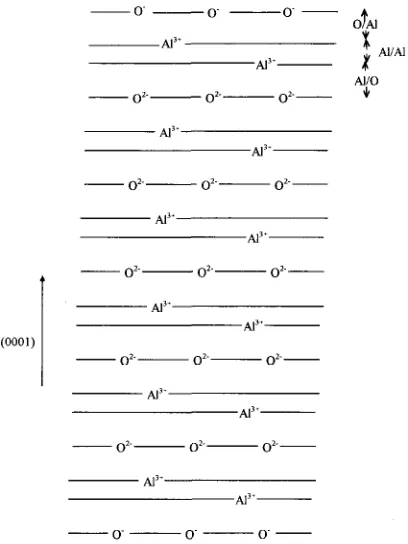
moment. The structure is illustrated schematically in _ oz._ o2--o’-- Fig. 2.
2.2. The progrum ,,q”_
The interface was modelled using the MIDAS - 0. - o- o- -
computer program which is used to calculate the
structure and energy of planar interfaces in ionic Fig. 2. Schematic representation of the structure of the crystals [9]. This is a static lattice simulation where oxygen moment terminated is eliminated (0001) surface by halving the charge of the ions on of alumina. The dipole
the crystal is described by an assembly of atoms with the outer planes.
the perfect crystal structure. The atoms are then relaxed to equilibrium using an efficient numerical
method. The total energy and the energy derivatives separated into the two main components, the long of a block of crystal adjacent to the interface are range Coulomb interaction between the ionic charges required for the minimisation. The energy can be and the short range interaction which provides the
repulsion necessary for stability at close separations. The Coulomb interactions are calculated using a
(0001) Z-dimensional lattice summation technique which is
equivalent to the 3-dimensional Ewald summation. The short range interaction is derived either from calculations of the overlap of the electronic wavefunctions or by fitting the parameters to
0 02-
Fig. 1. The structure of a unit cell of a-alumina
measured properties of the material.
The program has recently been modified for the calculation of interfaces between ionic crystals and metals. The interaction between the ionic charges and the induced charge in the metal is included by introducing image charges into the calculation. The image interaction is screened at short distances by the restriction of the induced charge to fluctuations with wavelengths longer than the Fermi wavelength of the metal [lo]. This screening removes the divergence of the image interaction at the image plane. The energy required to immerse the ions in the metal jellium is also included in a simplified form. These interactions are all included in the program which can be run on a modest PC.
2.3. The interatomic potentials
It was noted in the previous section that we
DUFFY et al.: Nb/ALO, INTERFACE 3295
-2
Distance (A)
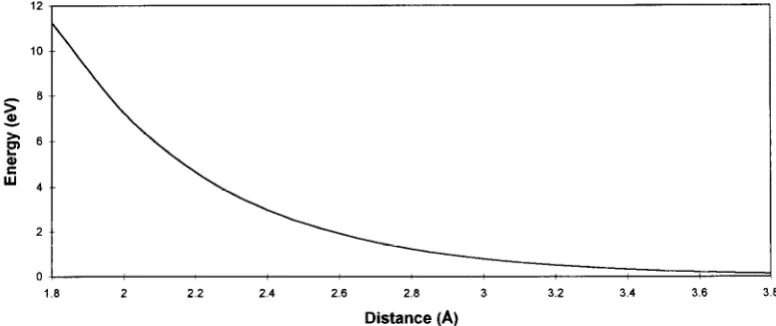
Fig. 3. Calculated interaction energy between the Nb atoms and the AP+ ions.
6
between the atoms and ions of the interface. The short range potentials for A120, have been calculated by several authors. We have chosen to use the empirical potentials derived by Catlow et al. [1 l] as these interactions were used by Tasker to model the alumina surfaces [S]. The parameters of a Buckingham potential were obtained by fitting to the bulk elastic and dielectric properties. The parameters for the harmonic core-shell interaction were obtained by fitting to the dielectric properties.
The interaction between Nb and ALO,, on the other hand, must be calculated directly as there are no experimental parameters available for fitting. We use the Dirac-Fock method developed by Wood and Pyper [ 12, 131. This method is more accurate than the more usual electron gas approach as it excludes interactions between wavefunctions which are forbid- den by symmetry. The wavefunctions of the atoms in the appropriate ionic environment are first calcu- lated, and these are used to calculate the Pauli
repulsion. The open shell nature of the metal atoms is taken into account by averaging the electrons over the equivalent orbitals. The oxide ions have closed shells. Estimates of the correlation interaction are obtained using the electron densities obtained from the calculated wavefunctions and standard electron gas functionals for the correlation potential. The dispersion interaction is calculated within the Slater-Kirkwood approximation, using the known polarizabilities of the oxide ions and assuming the polarizability of the metal to be the cube of the Wigner Seitz radius. The Pauli repulsion, correlation and dispersion terms are added to give the total interaction. The interaction is fitted to a Buckingham potential of the form
V(r) = A exp( - r/p) - B/F.
Here, Y represents the metal-ion separation. The parameters for the Nb/02- interaction were
A = 26370 eV, p = 0.255 8, and B = 683.4 eV8, [6]
12
4
2.6 2.8 3 3.2 3.4 3.6 3.6
Distance (A)
3296 DUFFY et al.: Nb/AhO, INTERFACE
and for the Nb/AP+ interaction A = 600.50 eV, p = 0.4526 8, and B = 0.0 eVA [6]. These are plotted in Figs 3 and 4. We note that the NbjO interaction is attractive at separations greater than 2.3 A, with a minimum of - 1.4 eV. This attractive interaction contributes to the binding of the interface. The Nb/Nb interaction is not required for this calculation as the metal is relaxed only as a rigid block.
To complete the calculation we require the interaction energy between the ions and the metal jellium. The energy of immersion for a range of neutral atoms in a jellium is given as a function of the electron density by Puska [14]. Both the Al’+ and the O*- ions have a similar electronic structure to Ne; therefore we use the parameters for Ne, which gives an immersion energy (AE) of
AE = 602.36 n + 3.16 x 10%~~
-2.766 x 10%~~ + 2.037 x 10’n“.
Here, n is the electron density in a.u. The electron density near the surface of a metal is given in a simple analytic form by Smith [ 151. The parameters for niobium give
n = 20.8 x 10m3 exp( - 1.27~)
where z is the distance from the metal surface in a.u.. Combining the two expressions, changing the distance units to 8, and neglecting small terms we have
AE = 12.53 exp( -z/O.416 A)
+ 13.67 exp( - z/O.208 A) eV
for both the AP+ and the 02- ions. This is a repulsive interaction which represents the energy required to move the ions of the oxide into the electron gas of the metal. It has the effect of counteracting the attractive interaction between the ionic charges of the oxide and the induced polarisation charge in the metal.
3. RESULTS AND DISCUSSION
The first calculations modelled a metal/oxide interface in which the alumina crystal terminated on a single plane of aluminium ions. The corresponding alumina free surface has been shown to have a relatively low surface energy and it has no net dipole moment. We found, however, that the interface was unstable with respect to the two free surfaces. The repulsive energy between the Al ions and the Nb atoms dominated the attractive image interactions and the interface did not bind. We predict, therefore, that this is not a stable configuration for the sapphire/niobium interface.
The second type of interface modelled an alumina crystal which terminated on a plane of oxygen ions. Such an interface takes advantage of the attractive interaction between the oxygen ions and the niobium atoms of the metal. However, as noted earlier, there is a net dipole moment across a crystal terminated by
0
O- ion 0 Raised A13+ ionI._, ‘_: Lowered A13’ ion
Fig. 5. [OOOl] projection of the surface of alumina showing the position of the surface oxygen ions and the first two layers of Al’+ ions. The three distinct positions for the Nb atoms are represented by the letters A (metal-over vacant site), B (metal-over raised Al) and
C (metal-over lowered Al).
a fully charged oxygen plane. The presence of the metal, and the resulting induced image charge, does not cancel the dipole moment, as the induced dipole has the same sign as the crystal dipole. To cancel this dipole moment it is necessary to reduce the ionic charge of the oxygen ions on the interfacial plane to
- 1 and terminate the crystal by a plane of equivalent charge in the bulk crystal. The resulting crystal has zero net charge and no net dipole moment. Such an interface could form from an Al terminated surface of alumina by each of the 02- ions of the first oxygen layer losing one electron to the AP+ ions of the surface layer, forming neutral Al atoms, which could then dissolve in the niobium metal.
DUFFY et al.: Nb/Al>Oj INTERFACE 3297
Table 1. The energy of the Nb/AIIOI interface after relaxation to equilibrium
Interfacial Interfacial Confinuration _ Dilation (A) energy (eV) energy (Jim’)
A 0.10 -4.44 -3.61
B 0.41 -2.17 ~ 1.76
C 0.26 -3.36 -2.73
The interfacial energy is defined as the difference between the energy of a (0001) surface of Al203 terminated with a plane of O- ions, and the energy of the interface. The three configurations A, B and C represent the metal sited over the vacant site, the raised Al ion and the lowered Al ion of the Al lattice, respectively.
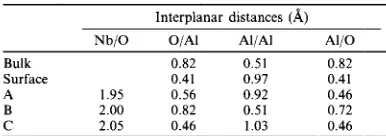
The ions in the sapphire crystal experienced significant displacements from the unrelaxed pos- itions in the minimum energy configurations. This is demonstrated in Table 2, where we have summarized the interplanar distances of the relaxed structures, together with the corresponding interplanar distances for the bulk crystal and the oxygen terminated surface. Clearly the free surface also experiences significant relaxations, with the distance between the aluminium planes increasing and the distance between the oxygen and aluminium planes decreas- ing, with respect to the bulk crystal. The relaxation arises from the electric fields experienced by charged planes in this orientation. In the case of the interfaces, the short range interaction between the metal and the ions also influences the final configuration. For example, the Al/Al interplanar distance in the B configuration is reduced with respect to the other cases because the repulsive force between the Nb and the Al pushes the raised Al down into the crystal. In the case of the B configuration this distance is increased, because it is the lowered Al plane which is pushed into the crystal. The A and C configurations resemble free surface whereas the B configuration is more like the bulk crystal. These calculations demonstrate the need to relax a reasonable number of planes in order to obtain an accurate estimate of the interfacial energies. Here we included six oxygen planes in the explicitly relaxed region of the crystal and the inner interplanar distances closely resembled that of the bulk crystal.
4. COMPARISON WITH EXPERIMENT
Specimens of the A1203 interface can be prepared by various methods and each method may produce a
Table 2. Summary of the interplanar distances of the relaxed interfaces compared with the bulk crystal and the oxygen
terminated surface Interplanar distances (A)
NbjO O/Al Al/Al Al/O
Bulk 0.82 0.51 0.82
Surface 0.41 0.97 0.41
A 1.95 0.56 0.92 0.46
B 2.00 0.82 0.51 0.72
C 2.05 0.46 1.03 0.46
The O/Al, Al/Al and Al/O refer to the interplanar distances between the four outer planes of the (0001) surface. These are illustrated in Fig. 2.
difference type of interface. Specimens prepared by internal oxidation of a Nb/Al alloy, for example, were found to form a topotaxial relationship, with close packed planes of AhO, and Nb parallel to each other [l]. This gives the (lOOO),//(Ol l)Nb orientation relationship which has a unit cell five times larger than the surface unit cell of alumina. Analysis of the structure suggests that the sapphire crystal terminates on an oxygen plane. Specimens with the same orientational relationship were prepared by diffusion bonding and examined by HREM [2]. In this case the analysis suggests that the crystal terminates on a triple layer of Al ions. Such a configuration would have a significant dipole moment and, according to our calculations, a significant repulsive interaction between the terminating Al ions and the metal atoms. We would, therefore, question whether such a structure could be stable.
Interfaces grown by Molecular Beam Epitaxy (MBE), on the other hand, are free to grow in the lowest energy orientation. An examination of such interfaces by HREM found that the preferred orientation relationship was (11 l)Nb//(OOO1), [3], which maintains the symmetry of the surface and has a relatively small unit cell. This corresponds to the interface modelled in our calculations. A simulation of the interface found that closest agreement with the experimental images was obtained by an oxygen terminated sapphire surface, with the first layer of Nb atoms sited where the next Al layer would be in the bulk crystal: that is over the vacant site. This is in good agreement with our results as it corresponds to the calculated lowest energy structure. We find a small dilation of 0.01 nm at the interface but this is within the experimental error (0.02 nm) quoted for the translation vector measurements. This analysis seems to confirm our result that the minimum energy configuration is the one which maximises the distance between the Nb atoms and the Al ions.
Calculations have been performed by Finnis and Kruse [5] on a single layer of Nb atoms replacing the top layer of Al in the (0001) sapphire surface. Their results agree qualitatively with ours in that they find the lowest energy configuration has the metal atoms sited over the vacant site of the Al lattice. We cannot compare the results quantitatively as they do not quote any interfacial energies. Their results suggest that the bonding is primarily ionic, with the Nb atom losing three electrons to become Nb3+. These results should be treated with caution; calculations with more layers of Nb are in progress and this will give a better idea of the bonding at the interface.
5. CONCLUSIONS
3298 DUFFY et al.: Nb/AlzOx INTERFACE
is a combination of the Coulomb energy of the ions, the short range interaction between the oxide ions and between the ions and the metal atoms and the image interaction between the ionic charges and the induced charge in the metal. The interface with the orientational relationship (11 l)//(OOOl) was modelled as this interface has a small unit cell and a small mismatch between the lattice parameters of the two crystals. We found that, in order to form a stable interface, the sapphire crystal must terminate on an oxygen plane. The minimum energy configuration is the one in which the metal atoms are located over the vacant site in the Al lattice, as this maximises the distance between the Nb and Al ions, thus minimising the repulsive energy. Interfaces grown by MBE, and examined by HREM were found to have a structure which closely resembles the calculated minimum energy configuration.
The static simulation technique provides a relatively simple method for examining complex metal/oxide interfaces and obtaining information about the low energy structures and energies. The predicted structure of the Nb/A120j interface appears to be confirmed by analysis of the electron microscopy results.
2.
4.
5.
6.
I.
8.
9. 10.
11. 12. 13. 14.
15. J. R. Smith, Phys. Rea. 181, 522 (1969). REFERENCES
W. Mader, Z. Metallk. 80, 139 (1989).
D. Knauss and W. Mader, Ultramicroscopy 37, 247 (1991).
J. Mayer, G. Gutekunst, G. Miibus, J. Dura, C. P. Flynn and M. Riihle, Acta metall. mater. 40, S217 (1992).
M. Kohyama, S. Kose, M. Kinoshita and R. Yamamoto, J. Gem. Solids 53, 345 (1992).
M. W. Finnis and C. Kruse, Muter. High Temp. 12, 189 (1994).
D. M. Duffy, J. H. Harding and A. M. Stoneham,
J. appl. Phys. 76, 2791 (1994).
D. M. Duffy, J. H. Harding and A. M. Stoneham,
Acta metall.-mater. 43, 1559 11995).
P. W. Tasker, Ado. Ceramics 10, 176 (1983)
P. W. Tasker, Phil. Mag. A39, 119 (1979).
D. M. Duffy, J. H. Harding and A. M. Stoneham,
Phil. Map. A67, 865 (1993).
C. R. A.-Catlow, R. James, W. C. Macrodt and R. F. Stewart, Phys. Reu. B25, 1006 (1982).
C. P. Wood and N. C. Pyper, Molec. Phys. 43, 1376 (1981).
C. P. Wood and N. C. Pyper, Phil. Trans R. Sot. A320, 71 (1986).
![Fig. 5. [OOOl] projection first two layers A (metal-over showing of the surface of alumina the position of the surface oxygen ions and the of Al’+ ions](https://thumb-us.123doks.com/thumbv2/123dok_us/8065189.1344531/4.540.290.466.65.243/projection-layers-showing-surface-alumina-position-surface-oxygen.webp)