TO STUDY DATA CENTRIC ROUTING PROTOCOLS
FOR EFFICIENT ENERGY IN WIRELESS SENSOR
NETWORKS
Sachin Kumar
1,
Ranju Kanwar
21
M.Tech student,
2Assistant professor,
Punjab College of engineering and technology, Lalru (India)
ABSTRACT
Wireless sensor networks is composed of thousands of nodes that are deployed in large geographical area and
these sensor nodes are small, wireless and battery powered in this paper we propose an energy efficient and
reliable routing protocol in which we increase the efficiency of network and make our network more efficient
and take performance of various parameters such as average delay, average energy consumption and
throughput. discuss what values of these parameters are existing now what we propose to do and these all
terms are represented by graphical representation and our work is to reduce energy consumption in network
from simulation results comparison is made between existing scheme and proposed scheme on basis of
parameters such as average time delay, average energy consumption and throughput and analyzed that our
results in this scheme is better energy efficient.
Keywords: Energy Efficient, Reliable Routing, Ns-2
I INTRODUCTION
I.1 Wireless Sensor Network
Wireless Sensor Networks (WSN) have gained world-wide attention in recent years due to the advances made
in wireless communication, information technologies and electronics field. WSN in its simplest form can be
defined as a network of devices denoted as nodes that can sense the environment and communicate the
information gathered from the monitored field through wireless links; the data is forwarded, possibly via
multiple hops relaying, to a sink that can use it locally, or is connected to other networks (e.g., the Internet)
through a gateway . The concept of wireless sensor networks is based on a simple equation: Sensing + CPU +
Radio = thousands of potential applications. This sensing technology deploys tiny, autonomous and compact
devices called sensor nodes or motes in a remote area to detect phenomena, collect and process data and
transmit sensed information to users . WSNs provide a new class of computer systems and expand the ability of
individuals to remotely interact with the physical world. In a broad sense, WSNs will transform the way we
manage our homes, factories, and environment [3].
Application specific:
Dynamic nature:
Scale and density
Resource constraints
Deployment
1.3 Requirements of WSN
Fault toleranceLife-time
Scalability
Real-time
Security
Production cost
1.4 Architecture of Wireless Sensor Network
A sensor network is composed of a large number of sensor nodes, which are densely deployed in a terrain under
monitoring. These sensors have the ability to communicate either among each other or directly to an external
base-station. A greater number of sensors allows for sensing over larger geographical regions with greater
accuracy. Each sensor node comprises sensing, processing, transmission and power units.
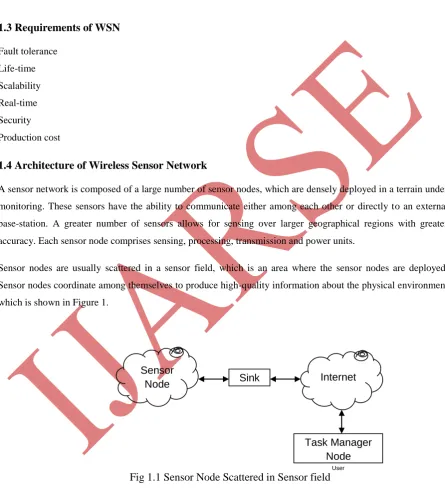
Sensor nodes are usually scattered in a sensor field, which is an area where the sensor nodes are deployed.
Sensor nodes coordinate among themselves to produce high-quality information about the physical environment
which is shown in Figure 1.
Fig 1.1 Sensor Node Scattered in Sensor field
1.5 Data Centric routing protocol
In many applications of sensor networks, it is not feasible to assign global identifiers to each node due to the
sheer number of nodes deployed. Such lack of global identification along with random deployment of sensor
nodes makes it hard to select a specific set of sensor nodes to be queried. Therefore, data is usually transmitted Sink
Task Manager Node
User
Internet Sensor
from every sensor node within the deployment region with significant redundancy. Since this is very inefficient
in terms of energy consumption, routing protocols that will be able to select a set of sensor nodes and utilize
data aggregation during the relaying of data have been considered. This consideration has led to data-centric
routing, which is different from traditional address-based routing where routes are created between addressable
nodes managed in the network layer of the communication stack.
In data-centric routing, the sink sends queries to certain regions and waits for data from the sensors located in
the selected regions. Since data is being requested through queries, attribute-based naming is necessary to
specify the properties of data. SPIN is the first data-centric protocol, which considers data negotiation between
nodes in order to eliminate redundant data and save energy. Later, Directed Diffusion has been developed and
has become a breakthrough in data-centric routing. Then, many other protocols have been proposed either based
on Directed Diffusion or following a similar concept. Here we will describe these protocols in details and
highlight the key ideas. [17]
II PROPOSED WORK
In the Existing work the comparison of ERRP,REEP and Direct diffusion has been done. It shows ERRP is a
energy efficient data centric protocol. As the main concern to Wireless sensor network is energy efficiency and
max throughput with increase transmission ration with in a large network. For achieving this goal we have to
make some changes in existing algorithm i.e. I add a concept of Update Threshold energy which is updated after
each Transmission to improve Life Time of the network with large no of nodes.
2.1 Modification in existing system
If (Source node‟s energy < Threshold Energy)
{
i.
Send request for data transmission to alternate source node.
}
Else
{
i.
Update Threshold.
ii. Forward the data through the reverse path followed by the request.
}
2.2 Calculation of Threshold
1.
Calculate the energy of each node say
E
i2.
For each node i
3.
repeat
4.
Sum=Sum +
E
i6.
average=Sum/no of nodes
7.
Return average.
2.3 Parameters Used
For the evaluating the performance we are using four parameters:-
1. Average Energy Consumption
2. Average Delay
3. Packet Transmission Ration
4. Throughput.
III RESULTS AND DISCUSSION
The proposed technique is implemented in NS-2.35 Simulator in Linux environment. The hnd.tcl file is
executed and it generates a .nam file which can be viewed in Network Animator tool of ns2 simulator.
Nam is a Tcl/TK based animation tool for viewing network simulation traces and real world packet traces. It
supports topology layout, packet level animation, and various data inspection tools. Nam began at LBL. It has
evolved substantially over the past few years. The nam development effort was an ongoing collaboration with
the VINT project. Currently, it is being developed as an open source project hosted at Source forge.
Parameters Used
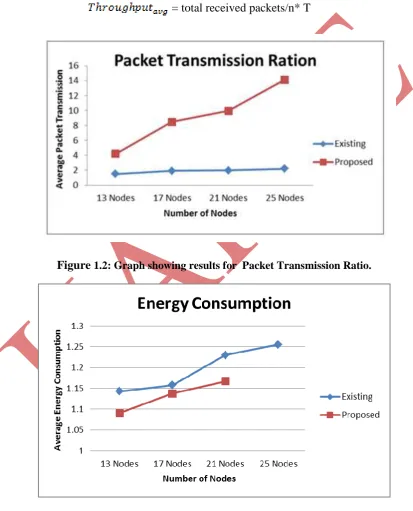
1. Average packet transmission: It can be defined as average number of packet transmissions per node for a
particular task. Average packet transmission is calculated by using the equation below:
Where 𝑃𝑟𝑒𝑐𝑖 and 𝑃𝑡𝑟𝑎𝑛𝑠𝑖 are the number of packets received and transmitted by node i respectively. „n‟ is the number of nodes and T is number of task.
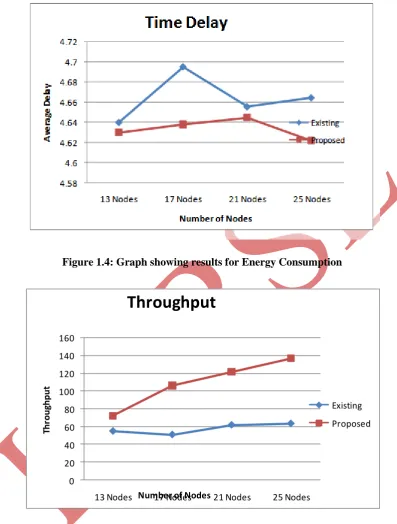
2. Average Delay: It can be defined as the time required for receiving the first data after the query generation
at the sink node for a particular task. . Average delay is calculated by using the equation below:
Where is the time of receiving first data packet for particular task i, is time of sending query by
sink for particular task i and T is the total number of task.
3. Average Energy Consumption: It can be defined as the average amount of energy consumed by each node
Where and are initial energy and residual energy of node i respectively. „n‟ is the number of nodes and T is number of task.
4. Through put: It can be defined as the ration of received packets to end to end delay (transmission delay from source node to sink node) and can be calculated as average throughput using equation given below:
= total received packets/n* T
Figure
1.2: Graph showing results for Packet Transmission Ratio.
Figure 1.4: Graph showing results for Energy Consumption
Figure 1.5: Graph showing results for Throughput
IV CONCLUSION AND FUTURE WORK
In this thesis, our proposed protocol is used to reduce the energy consumption by using excessive flooding of
packets in whole network. We have used three set of nodes i.e. 17, 34 and 41 numbers of nodes. From the
simulation results comparison is made between the existing scheme and the proposed scheme on the basis of
three parameters namely average packet transmission, average time delay, average energy consumption and 0
20 40 60 80 100 120 140 160
13 Nodes 17 Nodes 21 Nodes 25 Nodes
Thr
oug
hpu
t
Number of Nodes
Throughput
Existing
average throughput. It is analyzed that the results of our proposed scheme are increased in performance than the
existing scheme. Thus we can conclude that our proposed scheme is better energy efficient and robust
In future security can be applied on this scheme to enhance its performance and can also be applied on various
other scenarios like Geographical location error. This can be done with help of GPS- geographical information
with routing technique. These approaches are all Address centric in that we are focused on that end-to-end
Routing between pair of addressable nodes. This will make the wireless sensor network like MANET more
Energy efficient and robust.
V REFERENCES
[1] Salvatore La Malfa “Wireless Sensor Networks” 19/01/2010.
[2] G. Kalpana, Dr. T. Bhuvaneswari “A Survey on Energy Efficient Routing Protocols for Wireless Sensor Networks”, 2nd National Conference on Information and Communication Technology (NCICT) 2011.
[3] Mihaela Cardei, Jie Wu “Energy-efficient coverage problems in wireless ad-hoc sensor networks”
Department of Computer Science and Engineering, Florida Atlantic University, Boca Raton, FL 33431,
USA Received 17 December 2004; accepted 17 December 2004.
[4] J. Carle, D. Simplot, Energy efficient area monitoring by sensor networks, IEEE Computer 37 (2) (2004)
40–46.
[5] N. Bulusu, D. Estrin, L. Girod and J. Heidemann, “Scalable Coordination for wireless sensor networks:
Self-Configuring Localization Systems,” In Proceedings of the Sixth International Symposium on
Communication Theory and Applications (ISCTA 2001), Ambleside, Lake District, UK, July 2001.
[6] Archana Bharathidasan, Vijay Anand Sai Ponduru “Sensor Networks: An Overview” 2003.
[7] Mehdi Kalantari and Mark Shayman, “Energy Efficient Routing in Wireless Sensor Networks”, 2004
[8] M. Vieira, et.al., “Survey on Wireless sensor Network Devices”, In proceedings of Emerging Technologies
and Factory Automation, 2003 IEEE Conference, Volume: 1, 16-19, September 2003, pp: 537-544.
[9] P. Zhang, M. Sadler, A, Lyon and M. Martonosi, “Hardware Design Experiences in Zebra Net”, In proceedings of SenSys‟04,November 3-5, 2004, Baltimore, USA.
[10] A. Sinha and A. Chandrakasan, “Dynamic Voltage Scheduling using adaptive filtering of workload traces”,