Publicly Verifiable Software Watermarking
Aloni Cohen∗ Justin Holmgren† Vinod Vaikuntanathan‡
December 7, 2015
Abstract
Software Watermarking is the process of transforming a program into a functionally equiv-alent “marked” program in such a way that it is computationally hard to remove the mark without destroying functionality. Barak, Goldreich, Impagliazzo, Rudich, Sahai, Vadhan and Yang (CRYPTO 2001) defined software watermarking and showed that the existence of indis-tinguishability obfuscation implies that software watermarking is impossible. Given the recent candidate constructions of indistinguishability obfuscation, this result paints a bleak picture for the possibility of meaningful watermarking.
We show that slightly relaxing the functionality requirement gives us strong positive results for watermarking. Namely, instead of requiring the marked program to agree with the original unmarked program onall inputs, we require only that they agree on a large fraction of inputs. With this relaxation in mind, our contributions are as follows.
1. We define publicly verifiable watermarking where marking a program requires a secret key, but anyone can verify that a program is marked. The handful of existing watermarking schemes are secretly verifiable, and moreover, satisfy only a weak definition where the ad-versary is restricted in the type of unmarked programs it is allowed to produce (Naccache, Shamir and Stern, PKC 1999; Nishimaki, EUROCRYPT 2013). Moreover, our definition requires security against chosen program attacks, where an adversary has access to an oracle that marks programs of her choice.
2. We construct a publicly verifiable watermarking scheme for any family of puncturable pseudo-random functions (PPRF), assuming indistinguishability obfuscation and injective one-way functions.
Complementing our positive result, we show that there are pseudo-random functions which cannot be watermarked, even in a very weak setting. As a corollary, we demonstrate the first family of PRFs that are not point-puncturable.1
∗
E-mail: [email protected]. MIT.
†
E-mail: [email protected]. MIT.
‡
E-mail: [email protected]. MIT. Research supported in part by DARPA Grant number FA8750-11-2-0225, an Alfred P. Sloan Research Fellowship, Microsoft Faculty Fellowship, and a Steven and Renee Finn Career Development Chair from MIT.
Contents
1 Introduction 3
1.1 Our Results . . . 3
1.2 Our Techniques . . . 4
1.3 Related Work . . . 5
2 Preliminaries and Definitions 6 2.1 Watermarking Schemes . . . 6
2.1.1 Weakened Definitions . . . 8
2.2 Remarks on the Definition . . . 9
3 Amplifying Unremovability and Unforgeability 9 4 A Distinguishing to Removing Reduction 11 5 Main Construction 12 6 The Limits of Watermarking 14 A Puncturable Encryption 18 A.1 Required Properties . . . 19
B Puncturable Encryption Construction 20 B.1 Construction . . . 20
B.2 Ciphertext Pseudorandomness. . . 22
C Proof of Theorem 5.3 26 D Proof of Theorem 5.4 29 E Proof of Theorem 4.2 31 F Unwatermarkable PRFs 31 F.1 Preliminaries . . . 32
F.2 Construction . . . 33
F.3 Learnability . . . 34
F.4 Pseudorandomness . . . 35
1
Introduction
Software watermarking is the process of embedding a “mark” in a program so that the marked program preserves functionality, and furthermore, it is impossible to remove the mark without destroying functionality. Despite its numerous applications in digital rights management and copy protection, rigorous definitions of software watermarking and mathematically sound constructions have been few and far between.
Software watermarking was first formally defined in the seminal work of Barak, Goldreich, Impagliazzo, Rudich, Sahai, Vadhan and Yang [BGI+12]. They showed that the existence of indistinguishability obfuscation (IO) implies that software watermarkingcannotexist (for any non-trivial class of programs). Given the recent candidate constructions of IO [GGH+13,BR14,PST14,
GLSW14], this result paints a rather dismal picture for the possibility of meaningful watermarking. Fortunately, though, this impossibility result crucially relies on the fact that the marked version of a program computes the same functionas the original program. Indeed, they suggested that an
approximate functionality-preserving relaxation of the definition wherein the programs agree on a large fraction (but not all) inputs might lend itself to positive results.
In this work, we pursue the notion of approximate functionality, and show constructions of watermarking for a general class of functions, namely any family of puncturable pseudo-random functions [BW13,BGI14,KPTZ13], under a strong definition of security. Our construction is pub-licly verifiable, meaning that while marking a program requires a secret (marking) key, verification is public. Moreover, our construction is secure againstchosen program attacks, where the adversary gets access to an oracle that marks any program of its choice. Curiously enough, our construction relies on the existence of indistinguishability obfuscators.
A natural question that arises out of our positive result is whether all families of PRFs (more generally, any class of unlearnable circuits) can be watermarked. Complementing our positive result, we show that there are pseudo-random functions which cannot be watermarked. Our result relies on a generalization of the notion of robust unobfuscatable functions of Bitansky and Paneth [BP12].
We describe our results in more detail.
1.1 Our Results
Our first contribution is to define the notion of public-key watermarking, building on the beautiful work of Hopper, Molnar and Wagner [HMW07] who introduced a secret-key definition.2 Roughly speaking, in a watermarking scheme, there is a marking algorithm Mark that takes as input a program P and uses the (secret) marking key M K to produce a marked program #P3 while the verification algorithm Verifyuses the (public) verification key V K to recognize legally marked programs. A watermarking scheme should satisfy three properties:
• Approximately Functionality Preserving: The program #P should agree with P in at least 1−ρ(n) fraction of inputs, where ρ is the approximate functionality parameter.
• Unremovability: We say that a watermark remover R succeeds given #P if she produces as program ˆP that is approximately (functionally) equivalent to #P and yet, Verify fails
2
While the work of [HMW07] targeted the watermarking of perceptual objects such as text, audio and video, the definition remains essentially unchanged for watermarking programs or circuits.
3
to recognize ˆP as a marked program. Unremovability says that this should be hard for polynomial-time removers R.
• Unforgeability: The other side of the coin is unforgeability which requires that a forger F cannot succeed in producing a new marked program, given only #P and the verification key
V K.
Moreover, we require security againstchosen program attacks, namely that unremovability and unforgeability hold even given access to a Mark oracle that produces marks programs for the ad-versary. (In this case, the forger needs to produce a marked program that is sufficiently different from all his queries to theMark oracle).
Armed with this definition, our main result is the construction of a publicly verifiable watermark-ing scheme for any family of puncturable pseudo-random functions. Puncturable pseudo-random functions (PPRFs) [BW13,BGI14,KPTZ13] are pseudorandom functions wherein the owner of the key K can produce a punctured key Kx that allows computation of the PRF on all inputs y6=x.
Moreover, given the punctured key, PRFK(x) is pseudorandom. PPRFs have seen a large number
of uses recently in applications of indistinguishability obfuscation. We show:
Theorem 1.1 (Informal). Assuming indistinguishability obfuscation and injective one-way func-tions, there is a watermarking scheme for any family of puncturable pseudo-random functions.
1.2 Our Techniques
We describe our publicly verifiable watermarking construction through a sequence of ideas. As a starting point, we construct a simple secret-key watermarking scheme for puncturable PRFs. Intuitively, the (secret) marking key specifies a random pair (x∗, y∗), and the watermarking of a PRF key K is simply the indistinguishability obfuscation of a program PK,x∗,y∗ that does the following:
On input x, outputy∗ if x=x∗, and PRFK(x) otherwise.
(Secret-key) verification of a circuitC is simply checking whetherC(x∗)=? y∗. Intuitively, it should be hard to remove the mark since the obfuscation #P = O(PK,x∗,y∗) “should hide” the location
x∗ where the functionality is altered. In other words, removing the mark necessitates altering the program at essentially all points. We formalize this intuition via a two-step proof.
First, we show a general distinguishing-to-removing reduction. Consider a watermark remover that takes the program #P and outputs an unmarked, yet approximately equivalent, program
Q. We claim that the remover can be used to distinguish between the special input x∗ and a uniformly random input x. This is because (a) we know that #P(x∗) 6= Q(x∗) (simply because the watermark remover succeeded), and yet: (b) for a uniformly random input x, #P(x) = Q(x) w.h.p. (becauseQ and #P agree on a large fraction of inputs). This idea can be formalized as a general distinguishing-to-removing reduction, as long as the watermark verifier uses the program #P as a black-box (which is true for all our constructions).
Secondly, we show that #P hides x∗, crucially relying on both the pseudorandomness of the family as well as its puncturability. First, one can indistinguishably replace #P by a program that uses the punctured PRF keyKx∗ to compute the PRF on all inputs x6=x∗; this is because of the IO security guarantee. Second, we can replace y∗ by PRFK(x∗) indistinguishably; this is because
points, using the IO security guarantee again. At this point, the program contains no information about x∗ whatsoever.
Unforgeability can be shown using similar ideas.
However, this construction falls to the following attack, against an adversary that obtains the marked version of even a single program of its choice. Consider an adversary that obtains a marked version #Qof an unmarked programQthat she chooses. She can build a distinguisher forx∗ using these two programs. Indeed, if Q(x)6= #Q(x), then x is likely x∗. In other words, she can build a program DistQ,#Q that, on input x, predicts whether x = x∗. With this newfound ability, the
adversary can easily remove marks from programs. Indeed, given a marked program #P, it builds a wrapper aroundP that first checks if an inputxisx∗. If yes, it outputs⊥, otherwise, it computes the program correctly.
Looking back at this attack (which we call the “majority attack”), we realize that the main source of difficulty is that we reuse the trigger point x∗ across all programs. Our main idea to circumvent this attack is to make the trigger point program-dependent. In particular, the marking algorithm probes the program on a set of pre-determined inputs to obtain x∗ (That is, x∗ is a function of thevaluesof the program on these inputs). Then, it goes ahead and changes the output of the program onx∗. This allows us to construct a watermarking scheme secure againstlunch-time chosen program attacks. That is, the adversary can query the Mark oracle before it obtains the challenge program, but not after.
Finally, we augment the construction to be publicly verifiable. Our security proof sketched above relied crucially on the fact that the trigger points cannot be distinguished from uniformly random points, and yet verification seems to require knowledge of these points. We resolve this apparently conundrum by first embedding an exponentially large number (yet an exponentially small fraction) of trigger points, and observing that while verification requires a program that generates a random trigger point, security only requires that a uniformly random trigger point is pseudo-random. These requirements can indeed co-exist, and in fact, we use a variant of thehidden sparse trigger machinery of Sahai and Waters [SW14] to achieve both effect simultaneously. We refer the reader to Section5 for the technical details.
Limits of Watermarking. A natural question that arises out of our work is whether all classes of circuits can be watermarked (of course, with approximate preservation of functionality).4 We show that there are PRF families that cannot be watermarked. Our result relies on the notion of robust unobfuscatable functions of Bitansky and Paneth [BP12]. (See Section6 for more details.)
1.3 Related Work
There has been a large body of work on watermarking in the applied research community. Notable contributions of this line of research include the discovery ofprotocol attackssuch as the copy attack by Kutter, Voloshynovskiy and Herrigel [KVH00] and the ambiguity attack by Adelsback, Katzen-beisser and Veith [AKV03]. However, these works do not formally define the security guarantees required of watermarking, and have resulted in a cat-and-mouse game of designing watermarking schemes that are broken fairly immediately.
4
There are a handful of works that propose rigorous notions of security for watermarking, with associated proofs of security based on complexity-theoretic assumptions. Hopper, Molnar and Wag-ner [HMW07] formalized strong notions of watermarking security with approximate functionality; our definitions are inspired by their work. Barak et al. [BGI+12] proposed simulation-based defini-tions of watermarking security; their main contribution is a negative result, described earlier in the introduction, which shows that indistinguishability obfuscation rules out any meaningful form of watermarking that preserves functionality exactly. The starting point of our construction is their speculative idea that relaxing this to approximate functionality might result in positive results.
In another line of work, Naccache, Shamir and Stern [NSS99] showed how to watermark a specific hash function. Nishimaki [Nis14] recently showed a similar result along these lines, watermarking a specific construction of lossy trapdoor functions (LTDF) based on bilinear groups. These works achieve a rather weak notion of watermarking. First and most important, they define a successful adversary as one that outputs a program from the class C. In particular, the watermark remover for the LTDF must output an LTDF key. In contrast, we permit the watermark remover to output any (polynomial-size) circuit. Secondly, that is they are only secure as long as a bounded number of marked programs is released to the adversary. Finally, they are bothprivately verifiable.
2
Preliminaries and Definitions
Notation. We will letλdenote a security parameter throughout this paper. We will let{Cλ}λ∈N
be the family of all circuits with domain{0,1}n(λ)and range{0,1}for some polynomialn. We will
let {Cλ}λ∈Nbe a particular family of circuits; that isCλ ⊆Cλ for all λ∈N.
Let ρ:N→[0,1] be a function. For circuitsC, C0∈Cλ, we say thatC ∼ρC0 if
Pr
x←{0,1}n[C(x)6=C 0
(x)]≤ρ(n)
We call such circuits “ρ-close”. We refer to probabilistic polynomial time algorithms simply as “p.p.t. algorithms”.
2.1 Watermarking Schemes
Our definitions will generalize and refine those of Hopper, Molnar and Wagner [HMW07]. A (public-key) watermarking scheme W for a family of circuits C ={Cλ}λ∈N is a tuple of p.p.t. algorithms
(Setup,Mark,Extract), where:
• (mk,vk)←Setup(1λ) is a p.p.t. key generation algorithm takes as input a security parameter
λ∈N and outputs amarking keymk and averification key vk.
• C# ← Mark(mk, C) is a p.p.t. marking algorithm that takes as input the marking key mk
and a circuitC ∈Cλ and outputs a circuitC#.
• b←Verify(vk, C#) is a p.p.t. algorithm which takes as input the (public) verification keyvk
and a (possibly marked) circuitC#∈C, and outputs eitheraccept(1) or reject(0).
Note that whileMarkand Verifytake any circuit inCas input, we only require the correctness and
Correctness Properties. Having defined the syntax of a watermarking scheme, we now define the desired correctness properties. First, it is functionality preserving, namely marking a circuitC
does not change its functionality too much. We formalize this by requiring that the marked and unmarked circuits agree onρ(n) fraction of the domain (wheren is the length of the input to the circuit). Secondly, we require that the verification algorithm always accepts a marked circuit.
Definition 2.1(ρ-Functionality Preserving). We say that a watermarking scheme (Setup,Mark,Verify) isρ-functionality preserving if for all C∈ C:
Mark(mk, C)∼ρC
Definition 2.2(Completeness). A watermarking scheme (Setup,Mark,Verify) is said to becomplete
if
Pr
Verify(vk,Mark(mk, C)) = 1
mk,vk←Setup(1λ)
C← C
≥1−negl(λ)
Security Properties. We turn to the desired security properties of the watermarking scheme. We define a scheme’s “uremovability” and “unforgeability” with respect to the following security game.
The watermarking security game is defined with two helper setsCandM: Cis the set of marked challenge programs given to a p.p.t. adversaryA;Mis the set of circuits given to the adversary as a response to aMark(mk,·) query. We only require that the adversary cannot “unmark” a challenge program, and that the adversary cannot “forge” a mark on a program for which he has never seen a mark.
Game 2.1 (Watermarking Security). First, the challenger generates (mk,vk) ← Setup(1λ) and helper setsCandMinitialized to∅. The adversary is presented withvkand access to the following
two oracles.
• A marking oracleOM which takes a circuit C and returns Mark(mk, C). OM also addsC to
the set M.
• A challenge oracle OC which takes no input, but samples a circuit C∗ uniformly from C and returns #C∗ =Mark(mk, C∗). #C∗ is then added to C.
Finally, Aoutputs a circuit ˆC.
Our ideal notion of unremovability is that no adversary can – with better than negligible prob-ability – output a program that is δ-close to the challenge program, but on which Verify returns zero with any noticeable probability. Along the way, we will need to consider a relaxed notion: (p, δ)-unremovable. For this, we require that no adversary can – with better than negligible prob-ability – output a program that is δ-close to the challenge program, but on which Verifyreturns 0 with probability significantly greater thanp. If p= 0, then this coincides with the previous notion of unremovability, which we simply call δ-unremovability.
Formally, the scheme is (p, δ)-unremovable if for all p.p.t. algorithms A and all polynomials poly(λ):
Pr
Pr[Verify(vk,Cˆ) = 0]> p+ poly(1 λ)
∧ ∃C0∈C:C0 ∼δCˆ
mk,vk←Setup(1λ),
ˆ
C← AOM,OC(1λ,vk)
≤negl(λ)
Likewise, we say a scheme is (q, γ)-unforgeable if no adversary can – with better than negligible probability – output a program that is γ-far from all marked programs previously received from the challenger, but on whichVerify returns 1 withprobability significantly greater than q. Ifq = 0, then this coincides with a stronger notion we callγ-unforgeability.5
Definition 2.4 ((q, γ)-Unforgeable). In the security game, we say that the adversary (q, γ)-forges
if Pr[Verify(vk,Cˆ) = 1]> q+poly(1 λ) and for allC0∈M∪C, ˆC 6∼γ C0. A’s (q, γ)-forging advantage is
the probability thatA(q, γ)-forges. The scheme is (q, γ)-unforgeable if all p.p.t. Ahave negligible (q, γ)-forging advantage. The scheme is γ-unforgeable if it is (q, δ)-unforgeable for allq >negl(λ).
Formally, the scheme is (q, γ)-unforgeable if for all p.p.t algorithmsAfor all polynomials poly(λ):
Pr
Pr[Verify(vk,Cˆ) = 1]> q+poly(1λ) ∧ ∀C0 ∈M∪C:C0 6∼γ Cˆ
mk,vk←Setup(1λ),
ˆ
C← AOM,OC(1λ,vk)
≤negl(λ)
2.1.1 Weakened Definitions
In our main construction, we achieve a weaker version ofδ-unremovability, which we callδ-lunchtime unremovability.6 In this weaker definition, the adversary only has access to the marking oracle before receiving the challenger, and receives only one challenger program.
Definition 2.5((p, δ)-Lunchtime Unremovability). δ-lunchtime unremovabilityis defined as above, except that we modify the security game: the adversary can query OC at most once, after which the adversary can no longer query OM.
In our main construction, we achieve a weaker notion ofγ-unforgeability. In particular, we only show that a “strong” type of γ-forgery is impossible, in effect establishing only a relaxed form of unforgeability.
In order to say that A γ-strong-forges, we require an additional property on A’s output ˆC. Instead of requiring that for all marked programsC0 ∈M∪Creceived by the adversary, there is a
γ fraction of the domain on which C0 differs from ˆC, we switch the order of the quantifiers. That is, there is a γ fraction of the domain on which for all C0 ∈M∪C,C0 differs from ˆC.
Definition 2.6 ((q, γ)-Relaxed Unforgeability). We say that the adversary (q, γ)-strong forges if Pr[Verify(vk,Cˆ) = 1]> q+ poly(1 λ) and for all C0∈M∪C,
Pr[∃C0 ∈M∪Cs.t. C0(x) = ˆC(x)|x← {0,1}n]≤γ
The scheme is (q, γ)-relaxed unforgeable if all p.p.t. A have negligible (q, γ)-strong forging advan-tage.
5
This implies a sort of “meaningfulness” property a la [BGI+12]: that for a random circuitC← C,Verify(vk, C) = 0 with high probability.
6This name is in analogy to “lunchtime” chosen ciphertext attacks on encryption schemes, in which access to a
2.2 Remarks on the Definition
Relation to definition in “From Weak to Strong Watermarking” As discussed in the introduction, [HMW07] provide a similar definition for watermarking to that provided above. One major difference is the notion of public verification – to the best of our knowledge, we are the first to put forth this notion and provide a construction in any cryptographic setting.
Another important difference is in the definitions ofρ-functionality preserving,δ-unremovability, andγ-unforgeability. The earlier definition does not consider these parameters separately: all three are conflated and represented byδ. As observed in that work, the (im)possibility of watermarking in a particular setting depend intimately on these parameters. In this work, we separate them. In doing so, we are able to achieve constant δ for negligible ρ: that is an adversary cannot remove a mark that only alters the behavior of the original negligible fraction of the domain, even by changing the functionality of the program on 1/4 of the domain! Additionally, we show that if a watermarking scheme is both (0, δ)-unremovable and (0, γ)-unforgeable, then γ ≥ δ+ poly(1n) for some polynomial poly. (seeAppendix G). We also provide an Amplification Lemma (seesection 3) which depends crucially on δ and γ being distinct.
Extractable Watermarking We consider a setting in which a program is either “marked” or it is “unmarked.” A natural extension is to allow a program to be “marked with a string.” That is, Mark would take a string M as an additional argument and output a marked program
CM. A corresponding detection algorithmExtractwould then extract the embedded mark. Indeed,
similar definitions are considered in [BGI+12] and [HMW07]. The two notions coincide the space of possible marks to embed is just a singleton. The extractable setting presents a number of additional challenges, and is a very interesting direction for future work.
Perfectly Functionality Preserving. As observed in Barak et al. [BGI+12], if indistinguisha-bility obfuscation exists for C, then no watermarking scheme can exist that perfectly preserves
functionality. To see this, choose C ← Cλ and mark it to get C#. Obfuscate both circuits
(ap-propriately padded) – yielding ˜C and ˜C#. By unforgeability, Verify(vk,C˜) =⊥; by unremovability
Verify(vk,C˜#) =m. In this way,Verifygives a distinguisher for the two obfuscated circuits. Because
Mark perfectly preserves functionality, this violates the security of the obfuscation.
Even more basically, if we restrict our attention to black-box verification (as discussed in sec-tion 4), then a watermarking scheme must clearly change the functionality in some way.
3
Amplifying Unremovability and Unforgeability
Ideally, we would like to construct a watermarking scheme that that is δ-unremovable and γ -unforgeable; that is, for all PPT algorithmsA, the probability thatAcan remove or forge is negli-gible. In this section, we show that it suffices to prove something weaker. Informally, we show that given a watermarking scheme (Setup,Mark,Verify) that is (p, δ)-unremovable and (q, γ)-unforgeable for some parameters (1−p)≥q+poly(1λ), we construct a watermarking (Setup,Mark,Verify0) that isδ-unremovable and γ-unforgeable.
thanτ trials, we return 1; ifVerify= 1 on fewer thanτ trials, we return 0. More formally, we prove the following lemma.
Lemma 3.1 (Amplification Lemma). Let (Setup,Mark,Verify) be a (p, δ)-unremovable and (q, γ) -unforgeable watermarking scheme, where the run-time ofVerifyistVerify. Suppose that(1−p) =q+α
for some non-negligible α. Then there is a watermarking scheme (Setup,Mark,Verifyp,q) that is
(0, δ)-unremovable and (0, γ)-unforgeable, and the run-time of Verifyp,q is O(αλ2)·tVerify.
Remark 1. The proof that follows is essentially an application of a Hoeffding bound. The argument also holds for the weaker definitions of unremovability and unforgeability that we consider in this work. Specifically, in the setting of , we use the Amplification Lemma to construct a δ-lunchtime unremovable, γ-relaxed unforgeable watermarking scheme from a (2δ, δ)-lunchtime unremovable, (1−γ, γ)-relaxed unforgeable scheme.
Proof. Letτ = q+(12−p). We defineVerifyp,q(vk, C) the following algorithm that repeatedly evaluates Verify(vk, C) a total ofT = 8αλ2 times, with independent randomness on each trial.
Verifyp,q(vk, C)
(
1 if T1 PT
i=1Verify(vk, C)> τ
0 if T1 PTi=1Verify(vk, C)≤τ
As Setup and Mark are unchanged, the new scheme preserves functionality to the same extent as the original.
To show completeness, we observe that for allC ∈ CandC#←Mark(mk, C),Verifyp,q(vk, C#) =
0 if at least a (1−τ) fraction of the independent executions of Verify(vk, C#) return 0. By the
completeness of the original scheme, Pr[Verify(vk, C#) = 0] ≤ negl(λ) in each independent run.
Observing that 1−τ is significantly larger than α4, and applying a standard Hoeffding bound yields Pr[Verifyp,q(vk, C#) = 0]≤e−λ.
Next, we must show that (Setup,Mark,Verifyp,q) is (0, δ)-unremovable. That is, for all p.p.t. A playing the watermarking security game and outputting ˆC, if ˆC is δ-close to a challenge program
C0 ∈C, then Pr[Verifyp,q(vk,Cˆ) = 0] is negligible. Equivalently, we must show that Pr[PTi=1Verify(vk,Cˆ)≤
τ ·T] is negligible. By the (p, δ)-unremovability of the watermarking scheme, we know that Pr[Verify(vk,Cˆ) = 1] > 1−p−negl(λ), lower-bounding the one-shot probability of verification. Combined with the definition of τ, this implies that Pr[Verify(vk,Cˆ) = 1]−τ is significantly larger than α4. Applying a standard Hoeffding bound yields Pr[Verifyp,q(vk,Cˆ) = 0]≤e−λ.
4
A Distinguishing to Removing Reduction
The way in which we prove unremovability is by showing that no adversary can distinguish points queried by Verify from random. This technique is clearly restricted to schemes in which there is a notion of “points queried by Verify”. We will therefore restrict our attention in this work to watermarking schemes with black-box verification.
Definition 4.1(Watermarking scheme with black-boxVerify). We say a watermarking scheme has a black-box verificationifVerify(vk, P) can be efficiently evaluated with oracle access to P.
The distinguishing-to-removing reduction we now illustrate applies to any game in which the adversary’s goal is to unmark a random marked program, but for concreteness we only show a reduction to Theorem 2.1.
We now give sufficient conditions for a watermarking scheme to be (p, δ)-unremovable. In particular, the condition is that no p.p.t. algorithmAhas non-negligible advantage in the following game.
Game 4.1 (Distinguishing). First, the challenger samples (mk,vk) from Setup(1λ). The adversary is then givenvkand access to the following two oracles.
• A marking oracleOM which takes a circuitC and returns Mark(mk, C).
• A challenge oracle OC which when queried, samples a circuit C∗ uniformly from C and
computes C#∗ =Mark(mk, C∗). The adversary must query OC exactly once.
At the end of the game, the challenger executesVerify(vk, C#∗). From the points at whichVerify queried C#∗, the challenger picks x0 uniformly at random. The challenger also chooses x1 as a
random point in the domain of C#∗. The challenger picks a random bit b and sends xb to the
adversary.
The adversary then outputs a bit b0 and wins if b0=b.
Lemma 4.2 (Distinguishing to Removing Reduction). If all p.p.t. algorithms A have negligible advantage in Theorem 4.1, and if Verify queries at most L points, then (Setup,Mark,Verify) is
(L·δ, δ)-unremovable for all δ.
We prove the lemma by assuming the existence of an (L·δ, δ)-remover, and constructing a distinguisher for the above game. Consider a removing adversary restricted to changing at mostδ
fraction of the marked challenge program. If he can remove the mark with too high of a probability (significantly greater than L·δ), then we must show that he can distinguish points queried by Verifyfrom random points with non-negligible advantage. This follows because Verifyis black-box; intuitively, the unmarked program ˆC will disagree with the challenge C#∗ at x0 with significantly
greater probability than on a uniformly random pointx1.
5
Main Construction
Theorem 5.1. There is a watermarking scheme which is both δ-lunchtime unremovable and γ -relaxed unforgeable, for any choice of δ, γ satisfying γ >2δ+poly(1 λ) for some polynomial poly.
Proof. InTheorem 5.3, we show thatTheorem 5.2is (2δ, δ)-lunchtime unremovable for everyδ. In
Theorem 5.4, we show thatTheorem 5.2 is (1−γ, γ)-relaxed unforgeable for everyγ.
Given any δ0, γ0 satisfying γ0 > 2δ0 + poly(1λ), we note that our scheme is (2δ0, δ0)-lunchtime unremovable and (1−γ0, γ0)-relaxed unforgeable. Theorem 3.1then implies thatTheorem 5.2can be amplified into a scheme which is simultaneously (0, δ0)-lunchtime unremovable and (0, γ0)-relaxed unforgeable.
Remark 3. Insubsection G.1, we describe how to extend this construction to pseudorandom function families with arbitrary output bit-length, with a small loss in parameters.
Our construction marks any PRF family {Pλ : {0,1}n → {0,1}m}λ∈N that is puncturable at a
single point, if n = n(λ) and m = m(λ) are Ω(λ) for some > 0. Our construction uses the following building blocks.
• Pseudorandom function families{Fλ:{0,1}n→ {0,1}m}
λ∈Nand{Gλ :{0,1}` → {0,1}m}λ∈N which are selectively puncturable on any interval. We refer the reader to [BW13] for definitions and constructions of selectively secure puncturable PRF families.
• A puncturable encryption system PE with plaintexts in {0,1}` and ciphertexts in {0,1}n,
where ` = `(λ) is Ω(λ). We explicitly denote the randomness used in PE.Enc as r. We construct such aPE inAppendix A.
• A collision resistant hash function{hλ:{0,1}m → {0,1}`/2}λ∈N.
• A pseudorandom generator P RG1 : {0,1}`/4 → {0,1}`/2, as well as another pseudorandom
generator P RG2 :{0,1}`/2 → {0,1}n.
Construction 5.2 (Unamplified). • Setup(1λ): Setup samples (DK, EK) ← PE.Gen(1λ) and puncturable PRFs F ← Fλ and G ← Gλ. Setup then outputs (mk,vk), where mk = (DK, F, G) andvkis the iO-obfuscation of the program in Figure 3.
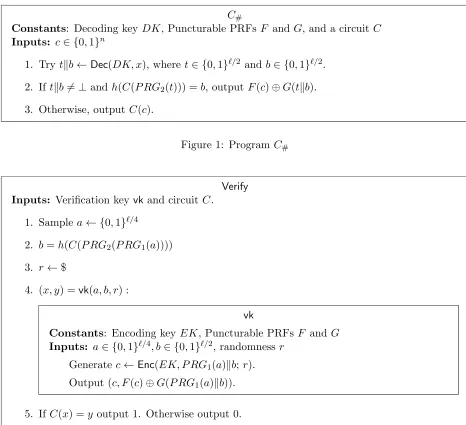
• Mark(mk, C): Mark outputs the iO obfuscation of the circuitC#, which is described in
Fig-ure 1, but padded to be as big as the largest of the circuits in any of the hybrids.
• Verify(vk, C): Verifysamples uniformly random bit stringsa∈ {0,1}`/4and randomly samples
r. Verify then computes b = h(C(P RG2(P RG1(a)))). Verify evaluates vk (an obfuscated
program) on (akb, r) to obtain a pair (x, y), and returns 1 if C(x) =y; otherwise, it returns 0.
AsVerifyis an algorithm which runs an obfuscated program vkas a subroutine, we provide the “unrolled” verification algorithm inFigure 3.
We now state the main theorems of this section, and defer the proofs to appendices Cand D.
Theorem 5.3. Theorem 5.2is (2δ, δ)-unremovable for everyδ.
C#
Constants: Decoding keyDK, Puncturable PRFs F and G, and a circuitC
Inputs: c∈ {0,1}n
1. Trytkb←Dec(DK, x), where t∈ {0,1}`/2 and b∈ {0,1}`/2.
2. Iftkb6=⊥and h(C(P RG2(t))) =b, output F(c)⊕G(tkb).
3. Otherwise, outputC(c).
Figure 1: ProgramC#
Verify Inputs: Verification key vkand circuit C.
1. Samplea← {0,1}`/4
2. b=h(C(P RG2(P RG1(a))))
3. r ←$
4. (x, y) =vk(a, b, r) :
vk
Constants: Encoding key EK, Puncturable PRFs F and G
Inputs: a∈ {0,1}`/4, b∈ {0,1}`/2, randomnessr
Generatec←Enc(EK, P RG1(a)kb;r).
Output (c, F(c)⊕G(P RG1(a)kb)).
5. IfC(x) =y output 1. Otherwise output 0.
Figure 2: Unrolled Verify(vk, C). Line 4 expands the execution of the program vk, which is itself an obfuscated program.
Constants: Encoding keyEK, Puncturable PRFsF andG
Inputs: a∈ {0,1}`/4, b∈ {0,1}`/2, randomnessr
1. Generatex←Enc(EK, P RG1(a)kb;r).
2. Output (x, F(x)⊕G(P RG1(a)kb)).
6
The Limits of Watermarking
A natural question is whether there are families of functions that for which there does not exist any watermarking scheme (waterproof). Barak et al observed that general-purpose indistinguisha-bility obfuscation rules out a notion of watermarking thatexactly preserves functionality, but not watermarking schemes that change functionality on even a negligible fraction of the domain (as in
section 5).
In this section, we discuss a number of conditions sufficient to prove that a family of circuits cannot even be watermarked – even with a much weaker form of unremovability. Informally, if a family is (non-black-box) learnable given access to a ρ-approximation of a circuit in the family, then the family is waterproof. Because it suffices to learn the family with an approximate imple-mentation, we focus on non-black-box learnability. For such a family, from a challenge marked program the learning algorithm is able to recover the original (unmarked) program. This violates unremovability of a watermarking scheme.7
We construct waterproof PRFs using techniques closely related to the unobfuscatable function families of [BGI+12] and [BP12].8 In doing so, we present a construction of a family of PRFs that is not point-puncturable. To the best of our knowledge, this is the first such “unpuncturable” family of PRFs.
Consider an indexed family of functions F ={fK} where each function is indexed by the key
K. In our setting, the learning algorithm will be given any circuit g that is a ρ(n)-approximate implementation of fK, a uniformly sampled function from the family. The (randomized) learner
will then output some “hypothesis” functionh. Ifhis sufficiently close tofK, then we can conclude
that the family F cannot be watermarked.
As a warm up, we begin with a very strong notion of learnability, in which the learning algorithm – here called anextractor – can not only output a hypothesishwhich agrees withfK on all inputs,
but output the circuit fK itself.
Definition 6.1 (ρ-Robustly Extractable Families). LetF ={Fn}n∈N be a circuit ensemble where each familyFn={fK}K∈{0,1}n. We say that F is ρ-robustly extractable if there exists an efficient extractorE such that for all large enoughn∈Nand randomK← {0,1}n,E extractsK from any
circuitC such that C∼ρ(n)fK:
Pr[K ←E(C,1n)] is non-negligible.
Theorem 6.1. IfF isρ-robustly extractable, then there does not exist a watermarking scheme that is ρ(n)-functionality preserving,δ-unremovable, and γ-unforgeable for any δ≥0 and γ ≤1. 9
Proof. Given a ρ functionality-preserving watermarking scheme for the family F, for all circuits
fK ∈ F, the marked program #fK = Mark(mk, fK) is ρ-close to the original. If F is ρ-robustly
extractable, then given a challenge marked program,10 the extractorE outputsf
K with noticeable
7
We avoid the language of learning theory because the learnability conditions we consider are not among the common settings of that field.
8
Specifically, we extend Theorem 4.3 from [BGI+12] to a more general notion of approximate obfuscators. 9More precisely, (0, δ)-unremovability and (1− 1
poly(n), γ)-unforgeability, for anyδ ≥ 0,γ ≤ 1, and polynomial poly(n).
probability. Unless Verify(vk, fK) = 1 with high probability, the extractor E violates even
0-unremovability. Otherwise we may trivially violate 1-unforgeability by simply outputting a random
fK ← F (without ever receiving a marked program).
Note that the watermarking adversary presented in the proof breaks even a very weak notion of watermarking. Namely, the adversary requires only a challenge, and no calls to a Mark oracle nor to aVerify key or verification oracle whatsoever. In this very weak setting, the construction in
Theorem 5.2 is secure for any family of point-puncturable PRFs.
Towards proving the main theorems of this section, we weaken Definition 6.1 in two ways. Combined together in Definition 6.2, these weaker notions of learnability will capture richer func-tiontionalities and allow us to construct a PRF family that cannot be watermarked (Theorem 6.3). The following discussion motivates the stronger definition and outlines the proof of the correspond-ingTheorem 6.2
Learnable versus extractable. What if the family is only “learnable,” but not “extractable:” instead of outputting fK itself, the learning algorithm L(C) can only output a circuit h that was
functionally equivalent tofK? One might think that this is indeed sufficient to proveTheorem 6.1,
but the proof encounters a difficulty.
As before, we run the learner on the challenge program to get h=L(#fK); ifVerify(vk, h) = 0
with noticeable probability, then unremovability is violated. On the other hand, ifVerify(vk, h) = 1 with high probability, how is unforgeability violated? In the extractable setting, it was possible to sample a program which verifieswithout ever seeing a marked version, simply by pickingfK ← F.
In the weaker learnable setting, we only know how to sample from this verifying distribution by evaulating L(#fK) on a marked program. But a forger must output a marked program that is
substantially different (at least γ-far) than all other marked programs seen.
To get around this issue, we consider families that are learnable with implementation indepen-dence; that is, for any g and g0 which are both ρ approximations of fK ∈ F, the distributions
L(g) andL(g0) are computationally indistinguishable.11To complete the above proof, a forger will simply evaluate h ←L(fK) for random (unmarked) fK (rather than on the marked #fK). Input
independence ofL guarantees that Verify(vk, h) = 1 with high probability.
Approximate versus exact learning. InDefinition 6.1(and the discussion above), we required that an algorithm learning a familyF is able to exactly recover the functionality fK, when given
g that ρ-approximates fK. What can we prove if h =L(g) is only required to δ-approximate the
original functionfK?
Though we cannot violate 0-unremovability, we might hope to violate δ-unremovability. For
ρ-functionality preserving watermarking scheme, when given a marked program #fK, the
learn-ing algorithm returns h =L(#fK) which is a δ-approximation (with noticeable probability). By
similar reasoning to Theorem 6.1, it must be that either Verify(vk, h) = 1 with high probabil-ity or δ-unremovability is violated. If L is implementation independent as above, we contradict unforgeability.
11Weaker notions likely suffice because unforgeability only requires noticeable probability of forging whereas this
Definition 6.2 (ρ-Robustly, δ-Approximately Implementation Independent Learnable Families). Let F = {Fn}n∈N be a circuit ensemble where each family Fn = {fK}K∈{0,1}n. We say that F is ρ-robustly, δ-approximately learnable if there exists an efficient learnerL such that for all large enoughn∈N, randomK ← {0,1}n, and any circuit C such thatC ∼
ρ(n)fK:
Pr[h∼δ fK :h←L(C,1n)] is non-negligible.
We say thatL is implementation independent if for allC1,C2 that are both ρ(n)-close to fK, the
distributions L(C1,1n) and L(C2,1n) are computationally indistinguishable.
Theorem 6.2. If F is ρ-robustly, δ-approximately learnable with implementation independence, then there does not exist a watermarking scheme (Setup,Mark,Verify) that is ρ(n)-functionality preserving, δ-unremovable, and γ-unforgeable for any γ ≤1. 12
The existence of indistinguishability obfuscation implies a 0-robust, exact, implementation in-dependent learning algorithm for polynomial-sized circuits.13 Therefore the theorem rules out exact watermarking schemes, assuming the existence of iO – capturing the impossibility of exact watermarking originally presented in [BGI+12].
Already, this rules out watermarking a large array of families. For instance, any family that is improperly PAC learnable cannot be watermarked for any negligible function ρ. The main result of this section is that there exists a PRF family that is learnable as in Definition 6.2; the construction and proof are presented inAppendix F.
Theorem 6.3. Assuming one-way funcitons, there exists a pseudorandom function familyFδ that isρ-robustly,δ-approximately learnable with implementation independence, for anyδ= poly(1 n), and any negligible ρ(n).
Corollary 6.4. Assuming one-way functions, for any negligible functionρ(n), inverse-polynomial function d(n), and γ ≤ 1, there is a family of pseudorandom functions that is not (ρ,d(1n), γ) -watermarkable.
As discussed, the watermarking adversary in Theorem 6.2 breaks even a very weak notion of watermarking. The adversary requires only a challenge, and no calls to a Mark oracle nor to a Verify key or verify oracle whatsoever. In this very weak setting, the construction in Theorem 5.2
is secure for any family of point-puncturable PRFs. Thus we construct an “unpuncturable” family.
Corollary 6.5. Assuming one-way functions, there exists a family of pseudorandom functions that is not puncturable at points.14
12
More precisely, (0, δ)-unremovability and (1− 1
poly(n), γ)-unforgeability, for anyδ ≥ 0,γ ≤ 1, and polynomial poly(n).
13
Observed by Nir Bitansky. 14
References
[AKV03] Andr´e Adelsbach, Stefan Katzenbeisser, and Helmut Veith. Watermarking schemes provably secure against copy and ambiguity attacks. In Moti Yung, editor,Proceedings of the 2003 ACM workshop on Digital rights management 2003, Washington, DC, USA, October 27, 2003, pages 111–119. ACM, 2003.
[BGI+12] Boaz Barak, Oded Goldreich, Russell Impagliazzo, Steven Rudich, Amit Sahai, Salil P. Vadhan, and Ke Yang. On the (im)possibility of obfuscating programs.J. ACM, 59(2):6, 2012.
[BGI14] Elette Boyle, Shafi Goldwasser, and Ioana Ivan. Functional signatures and pseudoran-dom functions. InPublic-Key Cryptography - PKC 2014 - 17th International Conference on Practice and Theory in Public-Key Cryptography, Buenos Aires, Argentina, March 26-28, 2014. Proceedings, pages 501–519, 2014.
[BP12] Nir Bitansky and Omer Paneth. From the impossibility of obfuscation to a new non-black-box simulation technique. In 53rd Annual IEEE Symposium on Foundations of Computer Science, FOCS 2012, New Brunswick, NJ, USA, October 20-23, 2012, pages 223–232. IEEE Computer Society, 2012.
[BR14] Zvika Brakerski and Guy N. Rothblum. Virtual black-box obfuscation for all circuits via generic graded encoding. In Yehuda Lindell, editor, Theory of Cryptography - 11th Theory of Cryptography Conference, TCC 2014, San Diego, CA, USA, February 24-26, 2014. Proceedings, volume 8349 ofLecture Notes in Computer Science, pages 1–25. Springer, 2014.
[BW13] Dan Boneh and Brent Waters. Constrained pseudorandom functions and their applica-tions. In Advances in Cryptology - ASIACRYPT 2013 - 19th International Conference on the Theory and Application of Cryptology and Information Security, Bengaluru, In-dia, December 1-5, 2013, Proceedings, Part II, pages 280–300, 2013.
[CHN+15] Aloni Cohen, Justin Holmgren, Ryo Nishimaki, Vinod Vaikuntanathan, and Daniel Wichs. Watermarking cryptographic capabilities. Cryptology ePrint Archive, Report 2015/1096, 2015. http://eprint.iacr.org/.
[GGH+13] Sanjam Garg, Craig Gentry, Shai Halevi, Mariana Raykova, Amit Sahai, and Brent Waters. Candidate indistinguishability obfuscation and functional encryption for all circuits. In54th Annual IEEE Symposium on Foundations of Computer Science, FOCS 2013, 26-29 October, 2013, Berkeley, CA, USA, pages 40–49. IEEE Computer Society, 2013.
[GLSW14] Craig Gentry, Allison B. Lewko, Amit Sahai, and Brent Waters. Indistinguishability obfuscation from the multilinear subgroup elimination assumption. IACR Cryptology ePrint Archive, 2014:309, 2014.
Proceed-[KPTZ13] Aggelos Kiayias, Stavros Papadopoulos, Nikos Triandopoulos, and Thomas Zacharias. Delegatable pseudorandom functions and applications. In Ahmad-Reza Sadeghi, Vir-gil D. Gligor, and Moti Yung, editors, 2013 ACM SIGSAC Conference on Computer and Communications Security, CCS’13, Berlin, Germany, November 4-8, 2013, pages 669–684. ACM, 2013.
[KVH00] M. Kutter, S. Voloshynovskiy, and A. Herrigel. The watermark copy attack. In Pro-ceedings of the SPIE, Security and Watermarking of Multimedia Contents II, volume 3971, pages 371–379, 2000.
[Nis14] Ryo Nishimaki. How to watermark cryptographic functions. IACR Cryptology ePrint Archive, 2014:472, 2014.
[NSS99] David Naccache, Adi Shamir, and Julien P. Stern. How to copyright a function? In Hideki Imai and Yuliang Zheng, editors,Public Key Cryptography, Second International Workshop on Practice and Theory in Public Key Cryptography, PKC ’99, Kamakura, Japan, March 1-3, 1999, Proceedings, volume 1560 of Lecture Notes in Computer Sci-ence, pages 188–196. Springer, 1999.
[NW15] Ryo Nishimaki and Daniel Wichs. Watermarking cryptographic programs against arbitrary removal strategies. Cryptology ePrint Archive, Report 2015/344, 2015.
http://eprint.iacr.org/.
[PST14] Rafael Pass, Karn Seth, and Sidharth Telang. Indistinguishability obfuscation from semantically-secure multilinear encodings. In Juan A. Garay and Rosario Gennaro, editors,Advances in Cryptology - CRYPTO 2014 - 34th Annual Cryptology Conference, Santa Barbara, CA, USA, August 17-21, 2014, Proceedings, Part I, volume 8616 of
Lecture Notes in Computer Science, pages 500–517. Springer, 2014.
[SW14] Amit Sahai and Brent Waters. How to use indistinguishability obfuscation: deniable encryption, and more. In David B. Shmoys, editor,Symposium on Theory of Computing, STOC 2014, New York, NY, USA, May 31 - June 03, 2014, pages 475–484. ACM, 2014.
A
Puncturable Encryption
One of our main abstractions is a puncturable encryption system. This is a public-key encryption system in which the decryption key can be punctured on a set of ciphertexts. We will rely on a strong ciphertext pseudorandomness property which holds even given access to a punctured decryption key. We will additionally require that valid ciphertexts are sparse, and that a decryption key punctured at some set of ciphertexts C is functionally equivalent to the nonpunctured decryption key, except possibly on C.
In this section we define the puncturable encryption abstraction that we use in section 5. We instantiate this definition inTheorem A.1.
Syntactically, a puncturable encryption scheme PE for a message spaceM={0,1}` is a triple
exposition to the case whenλ=`. The puncturable encryption scheme has an additional parameter
Q∈Nwhich determines the number of points that can be punctured.15
• Gen(1λ) →EK, DK: Gentakes the security parameter in unary, and outputs an encryption keyEK and a decryption keyDK.
• Puncture(DK, C)→ DK{C}: Puncturetakes a decryption key DK, and a set of ciphertexts
C⊂ {0,1}n, of size at most Q.16 Punctureoutputs a “punctured” decryption key DK{C}.
• Enc(EK, m)→c: Enc takes an encryption keyEK and a message m∈ {0,1}`, and outputs
a ciphertextc in{0,1}n.
• Dec(DK, c) → m or ⊥: Dec takes a possibly punctured decryption key DK and a string
c∈ {0,1}n. It outputs a message mor⊥.
A.1 Required Properties
Correctness We require that for all messages m,
Pr
Dec(DK, c) =m
(EK, DK)←Gen(1λ), c←Enc(EK, m)
= 1
Punctured Correctness We also require17the same to hold for keys which are punctured. For all possible keys (EK, DK) ←Gen(1λ), all sets C⊂ {0,1}n of size at most Q, all punctured keys
DK0 ←Puncture(DK, C), and all potential ciphertextsc∈ {0,1}n\C:
Dec(DK, c) =Dec(DK0, c)
Ciphertext Pseudorandomness We require that in the following game, all PPT adversariesA have negligible advantage.
Game A.1 (Ciphertext Pseudorandomness). .
1. Asends a messages m1, . . . , mQ/2∈ M to the challenger.
2. The challenger does the following:
• Samples (EK, DK)←Gen(1λ)
• Computes encryptionsci ←Enc(EK, mi) for eachi∈[Q/2]. Let~c= (c1, . . . , cQ/2).
• Samples r1, . . . , rQ/2 ← {0,1}n. Let~r = (r1, . . . , rQ/2).
• Generates the punctured keyDK0←Puncture(DK,{c1, r1,· · · , cQ/2, rQ/2})
• Samples b← {0,1} and sends the following toA:
(~c, ~r, EK, DK0) ifb= 0 (~r, ~c, EK, DK0) ifb= 1
3. The adversary outputs b0 and wins ifb=b0.
15
ThisQ will correspond to the number of queries made by theVerifyalgorithm in the final watermarking con-struction, hence the choice of letter.
Sparseness We also require that most strings are not valid ciphertexts:
PrhDec(DK, c)6=⊥
(EK, DK)←Gen(1
λ), c← {0,1}ni≤negl(λ)
One of our contributions is the following theorem.
Theorem A.2. A puncturable encryption system can be constructed using indistinguishability ob-fuscation and injective one-way functions
A full construction and proof is provided in appendices Band B.2.
B
Puncturable Encryption Construction
We provide a construction of the puncturable encryption defined inAppendix A.
B.1 Construction
We construct a puncturable encryption scheme in which the lengthnof ciphertexts is 12 times the length`of plaintexts. Our construction utilizes the following ingredients:
• A length-doublingP RG:{0,1}`→ {0,1}2`
• A puncturable, injective family of PRFs {Fλ : {0,1}3` → {0,1}9`}. We require Fλ to be
selectively puncturable on anyQprefixes.18[TODO: Remark that this can be done from any OWF.]
• A puncturable family of PRFs {Gλ : {0,1}9` → {0,1}`}. We require Gλ to be selectively
puncturable on any Qof points.[TODO: Remark that this can be done from any OWF.]
• A injective bit commitmentCommit using randomness in {0,1}9`, which can in fact be
con-structed by an injective one-way function. We only use this in our security proof.
Construction B.1 (Puncturable Encryption Scheme). . [TODO: Padding]
– Gen(1λ) samples a function F ← F and G← G, and generatesEK as the iO-obfuscation of the circuit in Figure 4. Gen returns (EK, DK), where DK is the (un-obfuscated) program inFigure 5.
– Puncture(V K, c0, c1) outputsDK0, whereDK0 is theiO-obfuscation of the program described
inFigure 6.
– Enc(EK, m) takesm∈ {0,1}` and outputs EK(m)∈ {0,1}12`.
– Dec(DK, c) takes c∈ {0,1}12` and returnsDK(c).
Remark 4. We note that in all of our obfuscated programs (including the hybrids), whenever α0
and α1 or β0 and β1 or γ0 and γ1 are treated symmetrically, then we can and do store them in
lexicographical order. A random ordering would also suffice for security.
18
As in [SW14], any puncturable PRF family from{0,1}k → {
0,1}2k+ω(logλ)
Pre-obfuscated EK
Constants: Puncturable injective PRF F : {0,1}3` → {0,1}9`, Puncturable PRF G :
{0,1}9`→ {0,1}`
Inputs: m∈ {0,1}`, r∈ {0,1}`
1. Computeα=P RG(r).
2. Computeβ =F(αkm).
3. Computeγ =G(β)⊕m.
4. Output (α, β, γ).
Figure 4: Program describing how to encode
Decoding keyDK
Constants: Puncturable injective PRF F : {0,1}3` → {0,1}9`, Puncturable PRF G :
{0,1}9`→ {0,1}`
Inputs: c= (αkβkγ), where α∈ {0,1}2`,β ∈ {0,1}9`, and γ ∈ {0,1}`.
1. Computem=G(β)⊕γ.
2. Ifβ=F(αkm), outputm.
3. Else output⊥.
Figure 5: Program describing how to decode
Pre-obfuscated DK0 punctured at c0 and c1
Constants: C ⊂ {0,1}n, a puncturable injective PRF F : {0,1}3` → {0,1}9`, and a
punc-turable PRFG:{0,1}9` → {0,1}`
Inputs: c= (αkβkγ), where α∈ {0,1}2`,β ∈ {0,1}9`, and γ ∈ {0,1}`.
1. Ifc∈C, output⊥.
2. Computem=G(β)⊕γ.
3. Ifβ=F(αkm), outputm.
4. Else output⊥.
Figure 6: Program describing how to decode
equivalent to DK except on inputs in C.
Sparseness Sparseness follows from, for example, the length-doubling PRG; most values ofαare not in the image ofP RG.
B.2 Ciphertext Pseudorandomness
We give a sequence of hybridsH0throughH14. The goal of the hybrids to reach a game in which the
challenge encryptionsc1, . . . , cQ/2and the random ciphertextsr1, . . . , rQ/2are treated symmetrically
inEKandDK0, and in which both are sampled uniformly at random by the challenger. We proceed by iteratively replacing pieces ofc0 by uniformly random values, puncturingF andGas necessary.
[TODO: Instead of simply presenting the hybrids in order, do a “top-down” view of the hybrid argument. Present the first/last hybrids, then the main 2-3 intermediate hybrids, then the rest of the intermediate hybrids.]
H0 Hybrid H0 is defined as the real security game:
1. Asends a messages m1, . . . , mQ/2∈ M to the challenger.
2. The challenger does the following:
(a) Samples an injective PRF F :{0,1}3`→ {0,1}9` which is selectively puncturable on Q
prefixes, and PRFG:{0,1}9` → {0,1}` selectively puncturable onQ points.
(b) For eachi∈[Q/2]: Samples ti ← {0,1}`,
αi =P RG(ti)∈ {0,1}2`,
βi =F(αikmi),
γi =G(βi)⊕mi.
Letci asαikβikγi, and~c= (c1, . . . , cQ/2).
(c) Samples r1, . . . , rQ/2 ← {0,1}12`.
Parseri=α0ikβ0ikγi0 and let~r = (r1, . . . , rQ/2).
(d) Generates EK as the iO-obfuscation of Figure 4 and DK0 as the iO-obfuscation of
Figure 6.
(e) Samples b← {0,1} and sends the following toA:
(~c, ~r, EK, DK0) ifb= 0 (~r, ~c, EK, DK0) ifb= 1
3. The adversary outputs b0 and wins ifb=b0.
H1: In hybrid H1, we alter the generation of the challenge ciphertexts (see Line 2(b) of H0).
Sample eachαi← {0,1}2` uniformly at random.
H2: In hybrid H2, we alter the generation of EK (see Line 2(d) of H0). We punctureF in EK
on all strings of the formαik? or αi0k? for each i∈[Q/2]. This is functionally equivalent because
F is never evaluated on strings of these forms because αi and α0i are with high probability not in
H3: In hybrid H3, we modify the generation of DK0. For eachi∈[Q/2], hard-code the constants
ˆ
βi =F(α0ikmi) and ˆγi =G( ˆβi)⊕mi. For each i∈[Q/2], add the following line in the beginning of
DK0: “Ifc∈α0ikβˆikˆγi, outputmi.” This change is functionally equivalent, asαikβˆikˆγi is already a
valid encryption ofci. Notice, that these ˆβi do not correspond to either the βi orβi0 (and similarly
for ˆγi). [TODO: explain what they are. Forward pointer to H4.]
For reference, we describeDK0 from HybridH3 inFigure 7.
Constants: C ⊂ {0,1}n, a puncturable injective PRF F : {0,1}3` → {0,1}9`, and a
punc-turable PRFG:{0,1}9` → {0,1}`, and for every i∈[Q/2]: the valuesα
i,α0i, ˆβi, ˆγi,mi.
Inputs: c= (αkβkγ), where α∈ {0,1}2`,β ∈ {0,1}9`, and γ ∈ {0,1}`.
1. [TODO: Emphasize the changed lines]If α=α01 and β = ˆβ1 andγ = ˆγ1, output m1.
If α=α02 and β = ˆβ2 andγ = ˆγ2, output m2.
. . .
If α=α0Q/2 and β = ˆβQ/2 and γ = ˆγQ/2, output mQ/2.
2. Ifc∈C, output⊥.
3. Computem=G(β)⊕γ.
4. Ifβ=F(αkm), outputm.
5. Else output⊥.
Figure 7: DK0 as in HybridH3, pre-obfuscation
H4: In hybrid H4, we again modify the generation of DK0 (see Figure 8). We add the following
check: “If (α, m) ∈ SQ/i=12{(αi, mi),(α0i, mi)}, output ⊥.” This is functionally equivalent by two
cases:
1. When (α, m) = (αi, mi) for some i ∈ [Q/2], then either c = ci, in which case DK0 already
would output⊥, orc6=ci, in which caseDK0 rejectscas an invalid ciphertext (because every
pair (α, m) together define a unique valid ciphertext).
2. When (α, m) = (α0i, mi), we only reach this line if c6=α0ikβˆikˆγi (by the check introduced in
HybridH3). In this case, DK0 already rejectscas an invalid ciphertext.
Constants: C ⊂ {0,1}n, a puncturable injective PRF F : {0,1}3` → {0,1}9`, and a
punc-turable PRFG:{0,1}9` → {0,1}`, and for every i∈[Q/2]: the valuesα
i,α0i, ˆβi, ˆγi,mi.
Inputs: c= (αkβkγ), where α∈ {0,1}2`,β ∈ {0,1}9`, and γ ∈ {0,1}`.
1. Ifα=α01 and β = ˆβ1 and γ= ˆγ1, output m1.
If α=α02 and β = ˆβ2 andγ = ˆγ2, output m2.
. . .
If α=α0Q/2 and β = ˆβQ/2 and γ = ˆγQ/2, output mQ/2.
2. Ifc∈C, output⊥.
3. Computem=G(β)⊕γ.
4. [TODO: emphasize the changed lines.] If (α, m)∈SQ/i=12{(αi, mi),(α0i, mi)}, output ⊥.
5. Ifβ=F(αkm), outputm.
6. Else output⊥.
Figure 8: DK0 as in HybridH4, pre-obfuscation
H5: In hybrid H5, we modify the generation of the key DK0 in the security game. Instead of
using the unpunctured key forF, we punctureF at the pointsαikmi andα0ikmi for eachi∈[Q/2].
This is functionally equivalent because – by the checks added in the previous hybrid –F will never be evaluated on such inputs.
H6: In hybrid H6, we alter the generation of the challenge ciphertexts (see Line 2(b) ofH0). We
sample β∗ uniformly at random from{0,1}9`. This is indistinguishable by the pseudorandomness
of F at punctured points.
H7: In hybridH7, we change Line 1 ofFigure 8. For eachi∈[Q/2], hardcodezi:=Commit(0; ˆβi,
and we replace the check “β = ˆβi” with the check “Commit(0;β) = z∗”. This is functionally
equivalent by the injectivity of Commit.
H8: In hybrid H8,zi is instead hard-coded as “Commit(1; ˆβi). Indistinguishability is by the
com-putational hiding of Commit.
H9: In hybridH9,we replace the expression “Commit(0; β) =zi” withFalse. This is functionally
equivalent with high probability because of the perfect binding of Commit (which follows from injectivity). In fact, we remove the entire line 1, which also preserves functionality.
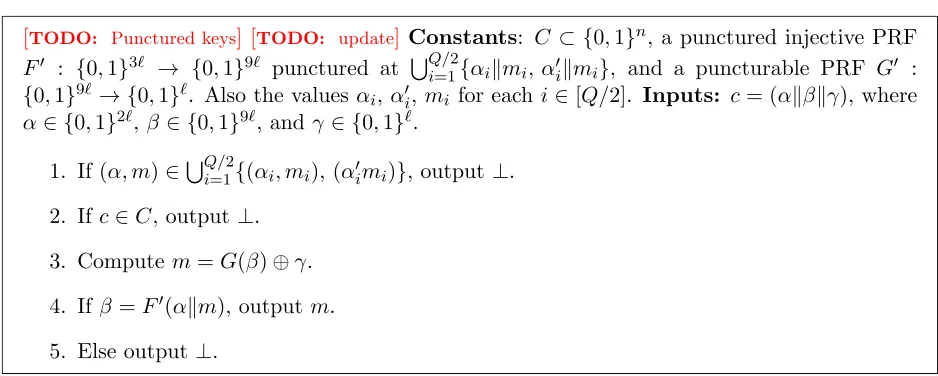
[TODO: Punctured keys] [TODO: update]Constants: C ⊂ {0,1}n, a punctured injective PRF
F0 : {0,1}3` → {0,1}9` punctured at SQ/2
i=1{αikmi, α
0
ikmi}, and a puncturable PRF G0 :
{0,1}9` → {0,1}`. Also the values α
i,α0i,mi for each i∈[Q/2]. Inputs: c= (αkβkγ), where
α∈ {0,1}2`,β ∈ {0,1}9`, and γ ∈ {0,1}`.
1. If (α, m)∈SQ/i=12{(αi, mi),(α0imi)}, output⊥.
2. Ifc∈C, output⊥.
3. Computem=G(β)⊕γ.
4. Ifβ=F0(αkm), outputm.
5. Else output⊥.
Figure 9: DK0 as in HybridH4, pre-obfuscation
H10: In hybridH10, we modify how the challenge ciphertexts are generated (see Line 2(b) ofH0).
For every i ∈ [Q/2], sample βi ← {0,1}9` uniformly at random. This is indistinguishable by the
pseudorandomness ofF at the (selectively) punctured points.
H11: In hybridH11, we alter the generation of EK (see Line 2(d) ofH0). We punctureG inEK
on βi and βi0 for everyi∈[Q/2]. This is functionally equivalent by the sparsity of F; since βi and
βi0 are now chosen at random for everyi, with high probability they are not in the image ofF.
H12: In hybridH12, we alter the generation of DK0, changing Line 2 ofFigure 10. Instead of “If
c∈C: output⊥”, we replace it with “If β ∈SQ/i=12{βi, βi0}: output ⊥”. To see that this change is
functionally equivalent, we observe that with high probability, neither of these lines has any effect. Since with high probability, none of the βi and βi0 are in the image of F, if β ∈
SQ/2
i=1{βi, β
0
i}
– which is the case when c∈C – thenDK0(c) =⊥ with high probability, even without the extra check.
The obvious question, then, is why not remove the check? Because checking ifβ∈SQ/i=12{βi, βi0}
will allow us to punctureG on this set in the following hybrid.
H13: In hybridH13, we alter the generation ofDK0. We punctureGat
SQ/2
i=1{βi, βi0}inDK
0. This change is functionally equivalent because of the ostensibly useless checks in the previous hybrid.
H14: In hybridH14, we generate the challenge ciphertexts in a different way. For eachi∈[Q/2],
we sample γi uniformly at random from{0,1}`. This change is indistinguishable by the selective
indistinguishability of Gat the punctured set.
For reference, we describe DK0 from Hybrid H14 inFigure 10. In this hybrid, ci =αikβikγi and
ri = α0ikβ
0
ikγ
0
i are now treated symmetrically in both EK and DK
0. Furthermore, they are both sampled uniformly and independently at random from{0,1}12`. So no adversary has any advantage
Constants: C ⊂ {0,1}n, a punctured injective PRF F0 : {0,1}3` → {0,1}9` punctured at SQ/2
i=1{αikmi, α
0
ikmi}, and a punctured PRFG0 :{0,1}9` → {0,1}`punctured atSQ/i=12{βi, βi0}.
Also the valuesαi,α0i,mi for each i∈[Q/2].
Inputs: c= (αkβkγ), where α∈ {0,1}2`,β ∈ {0,1}9`, and γ ∈ {0,1}`.
1. If (α, m)∈SQ/i=12{(αi, mi),(α0i, mi)}, output ⊥.
2. Ifc∈C, output⊥.
3. Computem=G0(β)⊕γ.
4. Ifβ=F0(αkm), outputm.
5. Else output⊥.
Figure 10: DK0 as in HybridH14, pre-obfuscation
C
Proof of
Theorem 5.3
To prove Theorem 5.3, we first give a distinguishing game and show that no p.p.t. algorithm A can win this game with non-negligible probability. BecauseVerify is black-box as in Definition 4.1
and queries exactly 2 points of an argument program, a variant ofTheorem 4.2implies the desired result.19
Game C.1 (Lunchtime Distinguishing). First, the challenger generates (mk,vk) by Setup(1λ). The
adversary is presented withvkand access to the following two oracles.
• A marking oracleOM which takes a circuitC and returns Mark(mk, C).
• A challenge oracle OC which takes no input, but samples a circuit C∗ uniformly from C and returnsC#∗ =Mark(mk, C∗). The adversary must queryOC exactly once, after which he may
no longer query either oracle.
At the end of the game, the challenger executes Verify(vk, C#∗). From the points at which Verify queried C#∗, the challenger picks x0 uniformly at random. The challenger also chooses x1 as a
random point in the domain of C#∗. The challenger picks a random bit b and sends xb to the
adversary.
The adversary then outputs a bitb0and wins ifb0 =b. The adversary’s advantage isPr[b0=b]−12 .
Lemma C.2. Every p.p.t. algorithmAhas negligible advantage in Theorem C.1for Theorem 5.2.
We will show that security in the last hybrid reduces to the security of the puncturable en-cryption PE. We will construct an algorithm B distinguishing (EK, DK{x0, x1}, x0, x1) from
(EK, DK{x0, x1}, x1, x0) with non-negligible advantage. To do so, we will have to answer the
queries of the watermarking adversary inTheorem C.1using thePE challenge. The main challenge therefore is to use only the punctured decryption key and to treat x0 and x1 symmetrically.
Proof. We must show that in the game, no p.p.t. algorithm can distinguishx0from a random point
x1 with non-negligible advantage. Recall that x0 is chosen from the points at whichVerifyqueries
C#∗. In Theorem 5.2, there are two such points, one of which is P RG2(P RG1(a∗)) for randomly
chosena∗ ← {0,1}`/4, and thus pseudorandom. In the rest of the proof, we focus on the other case:
x0 is computed asEnc(EK, P RG1(a∗)kh∗), whereh∗ =h(C#∗(P RG2(P RG1(a∗)))). We must show
that this distribution ofx0 is indistinguishable from a uniform x1.
As A’s runtime is bounded by some polynomial q, we define a sequence of hybrid games H0
through Hq+4. Hybrid H0 is simply Theorem C.1, except that the challenger picks C∗, generates
C#∗, and samplesx0 and x1 appropriately before presenting the adversary withvk. This is possible
because these are all chosen independently of the adversary’s actions.
In hybrid Hi, the adversary’s firstiqueriesC1, . . . , CitoOmare answered in a modified way (as in
Figure 11). These queries are answered using only apunctured decryption keyDK0 =DK{x0, x1}
and punctured PRF key F0 =F{x0, x1}. In hybridHq, we answer all queries toOM in this way.20
Constants: Punctured decoding key DK0 = DK{x0, x1}, Punctured PRF F{x0, x1}, PRF
G, and a circuit Cj
Inputs: x∈ {0,1}n
1. Ifx∈ {x0, x1}, outputCj(x).
2. Trytkb←Dec(DK0, x).
3. Iftkb6=⊥and h(Cj(P RG2(t))) =b, outputF{x0, x1}(x)⊕G(tkb).
4. Otherwise, outputCj(x).
Figure 11: Modified marked program Cj# forj≤iin hybrid Hi.
Claim C.2.1. InHi, h(Ci+1(P RG2(P RG1(a∗)))) =h∗ with negligible probability.
Proof. First we note that because h :{0,1}m → {0,1}`/2 is a compressing collision-resistant hash
function,his also a one-way function. Suppose that in hybridHi,h(Ci+1(P RG2(P RG1(a∗)))) =h∗
with non-negligible probability. Then we provide an algorithm Inv that inverts h, or violates the pseudorandomness ofC∗. Throughout this proof, let P RGdenote P RG2◦P RG1.
Inv takes as input y = h(r) for uniformly sampled r ← {0,1}m. Inv samples random a∗ ← {0,1}`/2, EK, DK ← Gen(1λ), x
1 ← {0,1}n, F ← Fλ, and G ← Gλ. Inv samples an encryption
of a∗ky, namely x0 ← Enc(a∗ky). Lastly, Inv punctures both the decryption key and PRF key at
{x0, x1}, obtainingDK0 and F0.
Using the above, InvrunsAand answers queries toOM as in hybridHi. The view ofAin this
simulation is indistinguishable from the view in the real hybrid Hi; the only difference is that in
the real hybrid, y=h(r) forr =C∗(P RG(a∗)) for random C∗ ← C (instead of uniformly random
r). By the pseudorandomness of the familyC, the views are indistinguishable.
20